Southeast As£an Stud£es, Vol. 25, No.2, September 1987
Input/Output Methods for Thai
--Development of a Database and a Computer Concordance for the Three Seals Law of
Thailand--Mamoru SHIBAYAMA*
Abstract
An intelligent Thai computer terminal and a Thai text editor with the function of automatic and consecutive conversion from Roman spelling to Thai letters have been developed which are operable on a micro computer. These employ the Transliteration Method (TM) or the Simplified Transliteration Method (STM), which are based on a newly devised transliteration table from Roman spelling. We are now developing a database and a computer concordance of the Three Seals Law (Kotmaz· Tra Sam
Duang),and making a machine-readable Thai dictionary using this terminal and editor. The Transliteration and Simplified Transliteration Methods were both estimated to require a greater number of key strokes in the making of the machine-readable Thai dictionary than the method used for the ordinary IBM electronic Thai typewriter, here called the Direct Mapping Method (DMM). However, an evaluation of learning effects from the number of key strokes and the measurement of learning curves in the input of the Thai dictionary indicated that although the Transliteration Method required a 42.9% greater number of key strokes than the Direct Mapping Method, a9.8% higher input rate in terms of characters per minute.
For the output of Thai letters, the design and implementation of a printing system for a Japanese laser beam printer run from a main-frame computer and a CRT display for a micro computer are described.
I Introduction
In the Center for Southeast Asian Studies, Kyoto University, we are now developing a database for the Three Seals Law (Kotmai Tra Sam Duang, compiled in 1805, about 1700 pages, about 32,500 lines in the five-volume version published in 1962) on the main-frame computer in the Data Processing Center, Kyoto University with a view to making a computer concordance, which will provide an important resource
*
~rl1 ;y, The Center for Southeast AsianStudies, Kyoto University
for studying the history, law, sociology,and linguistics of Thailand [Ishii 1969]. For processing this Thai text, the input/output methods for Thai text and Thai letters are of major importance and present sophisti-cated problems.
Two input methods are considered. One is the Direct Mapping Method (DMM) by which each Thai letter corresponds uniquely to one of the keys on the keyboard [Sugita 1980]. This scheme requires an intelligent terminal to identify which Thai letter is input; in other words, the ordinary teletype terminal cannot be used for the input/output
of Thai letters because it is impossible to display/print Thai letters on the terminal. The other method is a transliteration approach using a table by which Thai letters are generated from Roman letters according to their pronunciation, like the Roman-Kanji conversion in Japanese, and is a method, here called Hartmann's Transliteration Method (HTM), proposed by J. F. Hartmann and G. M. Henry [Hartmann and Henry 1983J. This ap-proach requires a greater number of key strokes for input than the Direct Mapping Method, but it is readily operable by non-native speakers of Thai. Also, it does not require an intelligent terminal if the transliteration approach is used for display-ing Thai letters and if the main-frame computer performs the function of trans-literation.
In 1984, we implemented a Thai text editor in which we adopted the DMM as one of the input methods [Shibayarna et al. 1984]. In 1985, we modified the table proposed by J. F. Hartmann et al. to produce a new transliteration table, here called the Transliteration Method (TM), which was incorporated into the text editor [Shibayama et al. 1985J. We have also developed a method Roman-Thai conversion called the Simplified Transliteration method (STM) [Shibayama and Hoshino 1987].
For output, we have developed a display system of Thai letters on the micro computer and a printing system of Thai letters on a laser beam printer run from the main-frame computer at the Data Processing Center, Kyoto University.
This paper describes the characteristics
of the DMM and the TM implemented on the Thai text editor~ compares the DMM, TM, and HTM by estimating the munber of key strokes required to input text of the Three Seals Law, and shows the results of typing speed and learning curves measured for the work of inputting the main entries of a Thai-Thai dictionary by the DMM and TM methods. The basic idea of the STM, which should be more readily operable for non-native speakers of Thai, IS also
presented.
For output, the characteristics and structure of display/printing controls in the system are described.
Lastly, an appendix presents an outline for developing a database and a computer concordance of the Three Seals Law and making a machine-readable Thai dictionary.
IT Characteristics of Thai
The Thai writing system differs from that of western languages in several points: (a) Thai letters are phonetic. Thai has
5 tones. Each Thai syllable is com~
posed either of consonant+vowel or consonant
+
vowel+consonant.(b) The consonants, vowels, and tonal marks must be positioned appropri-ately.
(c) Words in a sentence are not separated from each other.
(d) Vowels may be placed before, after, above, or below a consonant.
(e) Punctuation is scarcely used.
Fig. 1 shows an example of Thai script printed by our Thai printing system using the laser beam printer. Given the
charac-530807 530808 530809 530810 530811 530812 530813
M.SHIBAYAMA: Input/Output Methods for Thai
I
l11
~li1~11G}j~oli
It'HU111
U'Yl/li1~Bltlf)11 I~~/llf
nn
lw~tI
ttn
l~l'fll1B~(li11~1
•tfl~BUI
.B1U/)bt~/~f
b'HUInJul\l/Glhtl/"Ultl/~1tl
I ° ~ ~ Y <) I Y I I C I l Y c:!.\lolU1/UUI f)/fl1'a~1tl/tl1Y/~HJbt~1/ WfI11~11/bVit'atlfl
c::o CIl SI I SI~ ~ ~ III SI
nnl
b~U'YlU/blHbfl/~UU/ fl'aUI\l~/tlU/fl~~ ~ I b1l~llJ/Ul1 /'W1~SI
ft'
SIc:!. e:v <! e:v ~ ° ° ~Bltlf111/ Hltl~lJl11litl/~~/11J(~BI~ .COUltll.\llUl/) UUI 'Hl/b'U~
lH'llU/bJI
~1tl/l
\ll(;lf)/bU~Ul/iJ~~/liUu/li\l11fUl/n/\l~/
(i
BHll.fUuoll.tlln
l'
IBf)1fl~1t1JU/l1B~
(bfl1lBU/.B1U/)nit
rl
\)/ll/\)~I
Fi~.1 Example of Thai Letters: A Part of Text of the Three Seals Law
teristics of Thai noted above and shown in Fig. 1, several points must be considered in processing Thai text using the computer:
(a) How to input Thai letters.
(b) How to control the display and printing positions for each consonant, vowel, and tonal mark.
(c) How to divide a text into sentences and a sentence into words, namely, seg-mentation.
Several studies into the complex question of input/output of Thai have been made. For input, typical methods include the keyboard of the ordinary IBM electronic Thai typewriter and the keyboard connected to the computer used in Thailand, which employs the DMM. For inputting Thai text of the Three Seals Law, Sugita adopted the DMM in using a graphic terminal connected to an IBM host computer [Sugita 1980]. Hartmann and Henry, who have been using the computer to study Thai language in the field of library information, have proposed the trans-literation approach mentioned in Section 1
[Hartmann and Henry 1983].
For output the typing head of the IBM electronic Thai typewriter and the use of
ROM (Read Only Memory) for display and printing Thai letters on the computer are generally used. Sakamoto has developed integrated computer programs by which several Southeast Asian and African can be printed out with a laser beam printer [Sakamoto 1979]. Also, a printing pro-gram which can output Thai letters has been developed in the Center for Infor-mation Processing of Tsukuba University.
III Thai Text Editor
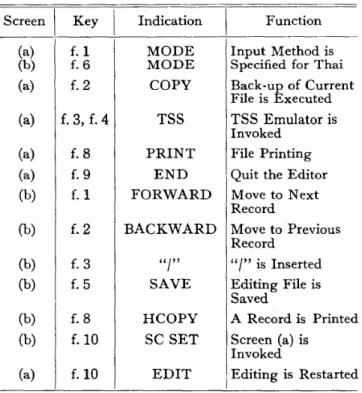
Fig. 2 shows file control and editing screens of the Thai text editor implemented on a micro computer. This editor employs the functions shown in Table 1. The column "Screen" in Table 1 shows whether the screen is in (a) the file control or (b) the editing mode in Fig. 2. The screen in Fig. 2(b) is in the TM mode described in section IV.2 and IV.4.2, and corresponds to a record, namely, a line in the text which has a maximum of 160 characters in Thai, and which is divided into 4 lines in order to display Thai characters. Below each dis-play line is the area of movement of cursor. The cursor can be moved to any directions
INITIAL SET SCREEN
I
THAI TEXT EDITOR' [V2.2]86/03/22
1) Source Text Drive#(l/2) : ? 2 2) Source Text File Name 3) Work File Initial Set
[FUNCTION]
SOURCE WARM
4) Line Number Start Col.: 1 5) Line Number Length : 6 6) Text Length/ Line 122
7) Start
Line Number
:1
'---~ ----JMODE COPY TSS TSS PRINT END EDIT
FILEC2:S0URCE ] MODE[Roman]
(a) File Control Screen
THAI TEXT EDITOR
CURSORC ·4 LINE. 27 COL.J DPC 1] ASCII C10SJ GETCI1: 85/01/09 TMAXC OJ 4J PUTC.: J d 3 d d
k
3 SHIBAYAMAMAMO~I
/-d~1J/ Q/ - ' j A FORWARD BACKWAR :-~ ')J Q/tJ~11~
cflllDUOtJ 10
Q.oo'-J
~ -d~ A- A1 A2 / SAVE MODE (b) Editing ScreenFi~.2 Screens of the Thai Text Editor
M. SHIBAYAMA: Input/Output Methods for Thai
Table 1 Functions of the Thai Text Editor
using the arrow keys, and Thai characters are displayed using graphic instructions on the micro computer.
We found that a character pattern composed of 16(W)*32(H) mesh stored in RAM (Random Access Memory) can be displayed without appreciable delay by using thePUT@ statement in the graphic instructions. We synthesized a new pattern on the GVRAlVl (Graphic Video RAM) by using the OR operation for all bits of the patterns shown in Fig. 3. This figure also shows that patterns other than tones should be shi fted by 5 dots downward in the Y direction from the standard position in order to save the main memory area for storing all patterns.
Screen (a) (b) (a) (a) (a) (a) (b) (b) (b) (b) (b) (b) (a) Key f.l f.6 f.2 f. 3, f.4 f.8 f.9 f.l f.2 f.3 f.5 f.8 f.10 f.10 Indication MODE MODE COpy TSS PRINT END FORWARD BACKWARD "I" SAVE HCOPY SC SET EDIT Function Input Method is Specified for Thai Back-up of Current File is Executed TSS Emulator is Invoked
File Printing Quit the Editor Move to Next Record Move to Previous Record "I"is Inserted Editing File is Saved A Record is Printed Screen (a) is Invoked Editing is Restarted 16 dots
Thai pronunciation, namely, the Trans-literation Method (TM), has the benefit of improving the operability of typing for non-native speakers of Thai and for people IV Input Methods
1. D£rect Mapp£ng Method (DMM) In the Thai text editor implemented on the micro computer, we adopted the keyboard assignment, here called the Direct Mapping Method (DMM), as shown in Fig. 4. Since this keyboard assignment is almost equivalent to that of the IBM electronic Thai typewriter, and the editor employs the dead key control, whereby a character pattern overlaps the preceding patterns without the carriage moving, so that the consonants, vowels, and tones can be displayed in their appropriate positions on the CRT, the editor can be used like the
IBM electronic Thai typewriter.
2. Translz"terat£on Method (TM)
The input method of Thai letters by means of the Roman letters representing the
y y r-..
,-v'q
'I'"+
>8CjM
>16 } 8Consonant Vowel Tone
RegIstered patterns "..." r:::+ }5 dots "'v
+
1'\ \.V~
'1AJ
Displayed patternso :
The origin of pattern Fi~.3 The Display on the CRTx
dots dots dots
SHIFT
""'--
---ll
XFER )(a): Little finger (b): Third finger (c): Middle finger (d): Forefinger
Fig.4 Keyboard Assignment of DMM
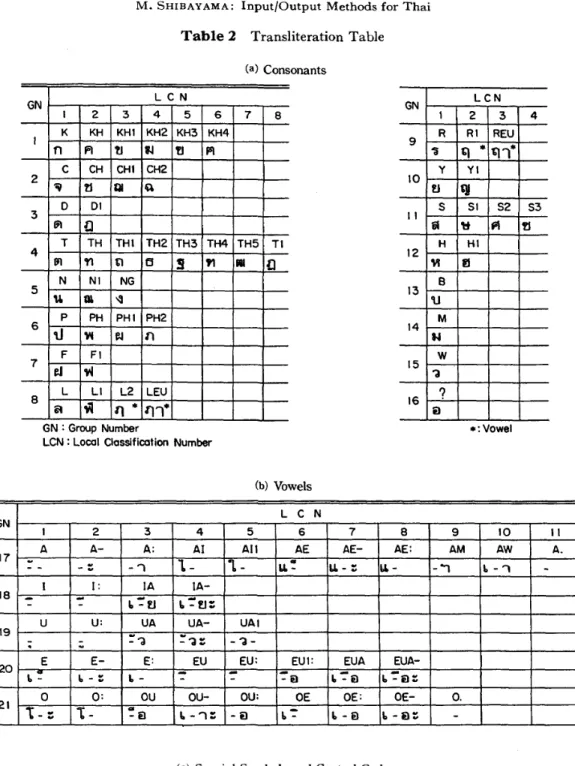
accustomed to the normal keyboard as-signment of Roman letters. At the same time, the transliteration table should be simple for typists and must be designed to decrease the number of key strokes and the sphere of movement of the fingers. To this end, we have proposed the revised transliteration table from Roman to Thai letters shown in Table 2 and implemented a function capable of automatic and consecutive conversion according to this table.
The characteristics of the transliteration table are as follows:
(a) The Roman spellings of the Thai consonants and vowels are classified into 21 groups according to their pronunciations, each group comprising character strings headed by same Roman character. The numerals, tones, special symbols, and control codes are classified into 28 groups. A group number,
GN,
is assigned to each of these 49 groups, and each character string in a group is discriminated bya local classification number, LeN.
(b) The transliteration approach by Hartmann and Henry distinguishes different Thai letters with the same pronunciation by use of apostrophes, for example, TH, rH', TH", TH"', TH"", and TH"'''.
In our system, the distinction is repre-sented by adding a number to the Roman spelling. The Thai letters are arranged, moreover, in order of decreasing frequency of occurrence in the text of the Three Seals Law. In this way, the number of key strokes required by the operator is de-creased. For example, TH) THi, TH2, TH3, TH4) and TH5 are used for 'YI, 0, ti,
3'
611, and WJ, instead of TH, TH', TH", TU"', TH"", and TU""'. An advantage of this scheme is that the ordinary teletype terminal can be used for input/output of Thai letters if the function of interconversion of Roman and Thai letters is implemented on the host com-puter.M.SHIBAY AMA: Input/Output Methods for Thai
Table 2 Transliteration Table (a)Consonants GN L C N I 2 3 4 5 6 7 8 K KH KHI KH2 KH3 KH4 I n PI tJ JJ tJ PI C CH CHI CH2 2 ti ~ AI ~ 0 01 3 @l !I T TH THI TH2 TH3 TH4 TH5 TI 4 fJI 't1 tI fj !
"
l1li !I N NI NG 5 \I, m '.:l P PH PHI PH2 6 'I.J yt eJ fl F Fl 7 ~ ~ L LI L2 LEU 8 VI 11 • ~tn·
GN : Group NumberLCN: Local Classification Number
(b) Vowels GN LCN 1 2 3 4 R Rl REU 9 'I • '11· '1 Y YI 10 tJ 'lI 5 51 52 53 II i1 ti f1 tl H HI 12 VI fI B 13 'U M 14 N W 15 ~ 16 ? i) .:Vowel L C N GN :; 5 7 8 9 10 I 2 4 6 II
A A- A: AI All AE AE- AE: AM AW A.
17
-1.-1-
..
- -
-
-
-'1 LL- LL - :: LL- -"'1 1.-'1 -I I: IA tA-18-
-l.:'tJ I.:'tJ:: - -U U: UA UA- UAI 19 :.''';1 :.'~:: ~ :.-~-E E- E: EU EU: EUI: EUA
EUA-20
I.':' I. - :: I. -
-
-
-
-
:'i) I.:'i) I.:'i)::0 0: au OU- au: OE OE: aE- O.
21
't - :
t-
~i) 1.-'1:: -i) 1.7 I. -i) I.-il:-(e) Special Symbols and Control Codes
~ 22 23 24 25 26 27 28 29 30 31 0 I 2 3 4 5 6 7 ~ 9 I 0
•
til•
« « b..
f6 « ~ 32 33 34 35 36 37 38,
< :> + Q Z V I..
-
.
~-
-
-
-
"l.,
-~ 39 40 41 42 43 44 45 46 47 48 /•
( ) ,-
: sp <!! 1 / '" ( ) ,-
: sp ~ GN :49, LCN:I Carriage Return3. Comparison of DMM, TM, and HTM While the TM requires at most 49 keys to be used on the keyboard, the DMM, in which each Thai letter corresponds uniquely to one key, requires the use of 92 keys. Thus the TM allows the number of keys to be reduced by 46.7%. However, the number of key strokes required to input all Thai letters by the TM is 176, which is 91.3% higher than the number required by the DMM.
Compared with the DMM, the number of key strokes required to input a text with the same frequency of occurrence of Thai letters as the text of the Three Seals Law, it was estimated that the HTM, which is the transliteration method proposed by
J.
F. Hartmann and G. M. Henry, requires 32.0% more strokes and the TM 21.90/0 more strokes [Shibayama and Hoshino 1986a].4. Measurement and Evaluation of Learning Effect
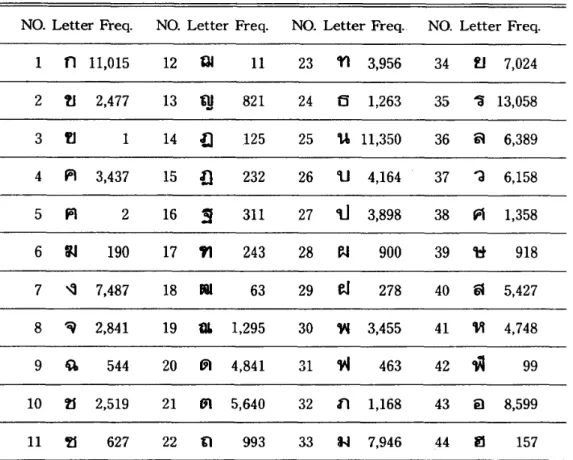
Input of the main entries of the Thai-Thai dictionary published by the Thai Royal Institute [Photchana nukrom Thai 1982J, a total of 31,202 words, was completed in about 6 weeks by 3 persons (about 9 man-weeks). The frequency of occurrence of each Thai letter in the dictionary, the learning effect measured for the elapsed time of the input work, and its evaluation are as follows.
4.1 Frequency
of
Occurrence of That." LettersThe main entries in the dictionary contained a total of 217,926 letters, which
included all 72 character patterns. The percentages of consonants, vowels, tones, and others were 63.5%, 29.90/0' 5.4%, and 1.2% respectively.
Table 3 shows the frequency of occurrence of Thai letters in the main entries of the dictionary. For inputting this text, the ratio of the' number of key strokes, T.D., required by the TM and DMM can be represented as follows:
TD. ..= "Ef;r;"Efi
where f; is the frequency of occurrence of the i-th Thai letter indicated in the NO. column in Table 3, 1"; is the number of
characters in its Roman spelling, and the suffix i ranges from 1 to 70. The "Ef;ri represents the total number of key strokes for the text. It was found that the number of key strokes required by the TM was 42.9% higher than by the DMM.
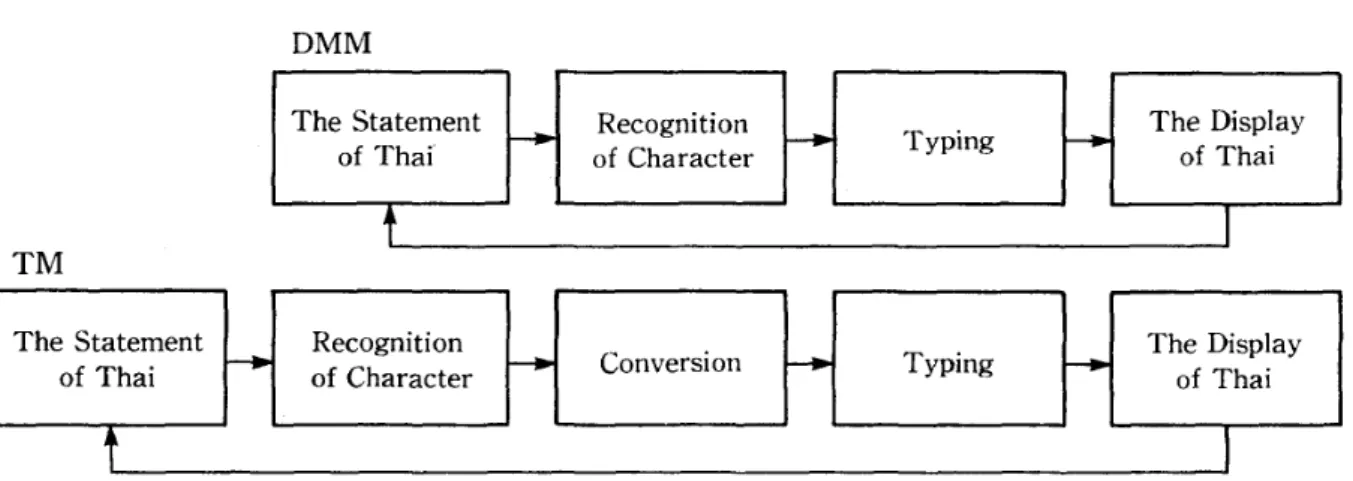
4.2 Environment of Measurement The model of behavior in the input work by the typist in the making of the database for the Thai dictionary is shown in Fig. 5. We have measured the learning effect for two persons in the actual input work by the DMM and TM in conjunction with the text editor implemented by both methods. On the editing screen for this input work, of which an example is shown in Fig. 2(b) , the slash (/) indicates the division between the words, and the hyphen (-) means that the previous character string with no hyphen is duplicated in this position.
The Thai character string in the second row from the bottom in Fig. 2(b) is a prompt for the next input in Roman spelling,
M. SHIBAYAMA: Input/Output Methods forThai
Table 3 Frequency of Occurrence of Thai Letters in the Thai Dictionary
(a) Frequency of Occurrence of Consonants
NO. Letter Freq. NO. Letter Freq. NO. Letter Freq. NO. Letter Freq.
1
n
11,015 12 Q 11 23en
3,956 34 tJ 7,024 2 tI 2,477 13q
821 24 G 1,263 35 ":i 13,058 3 fJ 1 14il
125 25'"
11,350 36 ~ 6,389 4 Fl 3,437 15 {) 232 26 'U 4,164 37 d 6,158 5 FI 2 16!
311 27'lJ
3,898 38 ~ 1,358 6 ~ 190 17 fI 243 28 ~ 900 39 ti 918 7 ~ 7,487 18 WI 63 29eJ
278 40 ~ 5,427 8 ~ 2,841 19m
1,295 30 'Y4 3,455 41 'IIi 4,748 9 ~ 544 20 61 4,841 31 ~ 463 42 cVJ 99 10 'l1 2,519 21 91 5,640 32 11 1,168 43 el 8,599 11 'lJ 627 22 tl 993 33 3.J 7,946 44 ~ 157(b) Frequency of Occurrence of Vowels and Tones
NO. Letter Freq. NO. Letter Freq. NO. Letter Freq. .., 45
...
...
5,315 54 b 7,854 63 6,211 46 7,893 55 U 2,415 64 5,308 47 '1 14,874 56't
2,118 65 205 48 6,596 57q
301 66 221-
..
49 4,421 5811
4 67 2,302-
627 59.,
1,625 68 '1 292 50 51 1,798 601
652 69,
2 52-
..
4,092 611
1,495 701
20 a 53-
...
1,988 62 806DMM
The Statement
f--+ Recognition f-. The Display
of Thai of Character Typing r--+ of Thai
1
I
TM
The Statement
J--- Recognition The Display of Thai of Character f--+ Conversion f--+ Typing f--- of Thai
t
I
Fig.5 Model of Behavior for Typing of Thai
4.3 Measunment and Its Evaluation It was assumed that the operators used their fingers and hands in accordance with the assignment shown in Fig. 4. The frequency of the use of fingers, hands, and each row of the keyboard by the typist is illustrated in Fig. 6. It is noticeable that the little fingers, which are considered least effective, are used frequently in both methods, and that the right hand works more than left hand by 24.80/0 and 17.00/0 respectively in the DMM and the TM. Of the rows of the keyboard, the home row
C is used most frequently, which is con-sidered to be effective, and the average
(d) (c) (b) (a) 58.5
[h1J
25.011.7 18.9 2.9 TM 14.1 13.2.DlJ]
(a) (b) (c) (d) 41.5ClliJ
(d) (c) (b) (a) 62.4 gB8_
8 ._ 4 _ _----J1L::.27:..::.9~___,1
E
/18.3 45.4 Unit:% Utilization of the Fingers, Hands, and Rows of Keyboard Fig. 65~
11--11 _ 7 ._ 1 _,1;12:.::.:;9.5 1 - ,_ _---r_ _- - J134.9 L....-_----Ih8.5 DMM 8.2,.an
o=ELJ
(a) (b) (c) (d) 37.6Enumeration of Main Entries in the Dictionary
Table 4
Input Operator (A) Operator (B) Method Number INumber NumberINumber
of Words of Char. of Words, of Char. DMM I 12,455 [ 78,340 [ 4. 478 1 29,181 TM I 8,490
I
54, 527 1 4.661I
29,200 Total I 20, 945 1132, 867 I 9, 139 1 58,381Table 4 shows the amount of text input by two operators, the total number of words and characters input being 30,084, and 191,248 respectively. These two ope-rators had no prior knowledge of Thai letters or Thai language, but were able to input about 200 letters per minute of Roman script.
displaying the group of Thai letters above and their corresponding Roman spellings below. Fig. 2(b) shows the prompt when "U" was typed as the next input. The Thai character string in the center of the third row from the bottom represents the result of transliteration of the input of the Roman spelling inside the box in the second row from the bottom.
M.SHIBAYAMA: Input/Output Methods for Thai
distance of movement of fingers is follows:
S(t)=M(l-e-Gt)
8-.-- --,-8
~ ~
the transliteration table to identify the Roman spel-ling, namely, the LeNin Table 2. It is difficult, however, to memorize the transliteration table in a short time, especially for non-native speakers of Thai, and the need to consult it reduces the speed of typing.
o o
c:i
As shown in section IV.2 and from the experiment just described, to input any Thai letter by the TM, the typist has to memorize or consult
5. SZ'mplified TransNteration Method (STM)
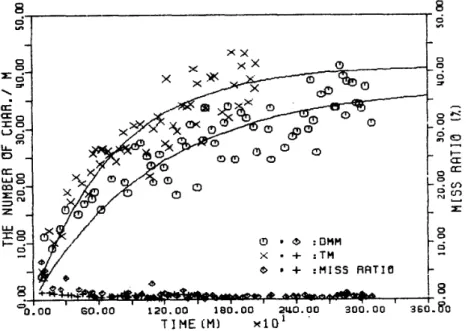
where M is the superior limit of the typing speed, and G is the coefficient of training efficiency. Fitting of the learning curves to the measured values by use of this relation gives M=37.25, G=0.0527 for the DMM, and M=40.9, G=0.0797 for the TM. Despite the time required to consult the transliteration table in the TM, and the 42.9% greater number of key strokes than the DMM, the typing speed is 9.80/0 higher by the TM than the DMM. Consequently, we found that the TM is more readily operable by non-native speakers of Thai accustomed to inputting Roman script.
It is also expected that the typing speed would increase if the elapsed time could be extended. o ~_~..---r-~ ::7 \!) • ~ :OHM X • + :TH ~ • + :HISS ARTHI x GO.CO 120.00 180.00 2~O.OC 300.00 T1ME (M) ~101 .
Fi~. 7 Typing Speed and the Learning Curve for Operator(A)
~g
...
o o c X:c:i ::7' ... a: a:o :J:o Wc:i u..'" o d DMM=0.185*1+0.349*0+0.295*1+0.171*2 =0.882 dTM =0.63where dDMM and dTM are the average distance of movement in the DMM and the TM estimated from the utilization in Fig. 6. In comparison, the figures for the standard English keyboard dE for Roman script input, RICOH d2 (two-strokes method) for Japanese input, and JIS dj (lIS keyboard) for Japanese input are 0.66, 0.60, and 0.91 respectively.
Fig. 7 shows the result of the measure-ment of typing speed by both methods and the learning curves for operator (A). The
X axis in Fig. 7 indicates the elapsed time in the actual input work, and the Yaxis indicates the number of characters input per minute. To represent the learning curves, the speed of typing S(t) is fitted to a function of the elapsed time t as follows:
To eliminate the overhead time for memorizing and consulting the trans-literation table in the TM, we have devised a simplified transliteration table composed of only GN's groups, without the distinction of LCN, namely, the Simplified Trans-literation Method (STM, See Fig. 8). For example, the Roman spelling "K" cor-responds to
"n",
"f!", "6JJ", "fJ",
"6lJ",
and
"R".
After pressing "K", the typist then selects the appropriate Thai letter from the group by pressing the "XFER" key (See Fig. 4) on the keyboard, which causes the Thai letters to appear one by one cyclically, and by pressing any key except the "XFER" key for the next input when the appropriate Thai letter appears.To estimate the number of key strokes of the STM using the frequency of occurrence of Thai letters as shown in Table 3, the ratio of the number of key strokes,
S.D.,
required by the STM and the DMM can be repre-sented as follows:Simplified Transliteration Method
'\l
letter indicated in Table 3, namely, the value of LCN, in the j-th group belong-ing its i-th Thai letter and the suffix j corresponds to the value of GN shown in Table 2. For example, the number of key strokes required for
"f!"
is 2 ("K" and "XFER" keys) which corresponds the value of LCN in GN=1. And "'Ef;nj represents the total number of key strokes for the text.It is estimated that the number of key strokes required by the STM for inputting a text with same frequency of occurrence of Thai letters as the main entries of the dictionary is 61.60/0 (43.00/0 for the conso-nants and 93.9% for the vowels and tonal marks) higher than by the DMM. Com-pared with the TM, the STM requires 18.7% more strokes. However, the STM is more readily operable by non-native speakers of Thai than the TM, and the number of key strokes can be reduced if the sequence of appearance of Thai letters, especially the vowels, in a group is changed according to the text, like the learning function for the Roman-Kanji conversion in Japanese. This scheme can also be imple-mented on an intelligent terminal capable of displaying Thai letters, such as a micro computer. fl
n
---~ )-S D -. . - "'Efm j"'Eli Fig.S Next Letter.--{
wheref; is the frequency of occurrence of the i-th Thai letter indicated in the NO. column in Table 3 and the suffix
i
ranges from 1 to 70. The nJ is the number ofkey strokes for extracting the i-th Thai
V Thai Printing
1. Characteristics of Thai Letters
Thai letters have the following charac-teristics:
M.SHIBAYAMA: Input/Output Methods for Thai
well as shape, for example, 1,
W'
1,
ry,
andl-(b) Several letters are overlapped in print-ing, for example,
d
is composed ofJ
and <v.(c) Several letters are located above and between adjacent letters, like
lrn.
(d) The printing positiors of the sameletter are sometimes different, like
:!f
L-61J and 61J •
Sakamoto has proposed that such prob-lems can be solved for the printing of almost all Asian and African letters by dividing letter patterns into sub patterns, comprising the basic character with special information on the basic line and the added character with information on its basic point [Sakamoto 1979]. We have adopted this idea in the design of a Thai printing system and developed more con-trollable programs that allow any line spacing with an integral number of dots by adding functions for overlap control of the character patterns, line position control for each line, and vertical position control of a character depending on the position of the previous character. The schemes of these controls are as follows:
(1) Discrimination of Basic Character and A dded Character
Thai letters in combinations ofconsonant +vowel or consonant+vowel+consonant are composed of 6 regions centered on the first consonant of a word, as shown in Fig. 9. The characters located at (1), (2), and (3) in Fig. 9 are categorized as bast·c characters, and those at (4), (5), and (6) as added characters. Itis assumed that the
Tone
(4)
Vowel
(5)
Vowel
Consonant
Vowel
(I) (2) (3)
Consonant
or
Vowel
(6)Fig. 9 Positions of Consonants, Vowels, and Tones
sequence of appearance of characters must bebasic characterbeforeadded character.
(2) Control of Basic Character
Basic characters have the attribute basic l/ne,which shows the width of the character, and which determines the horizontal printing position of the letter relative to the preceding letter. By employing this scheme, the width of letters can be con-trolled closely, and printing with pro-portional spacing is possible.
(3) Control of Added Character
An added character has a basic point rather than a basic Nne, which together with information on its setting post'tion serves to locate the character relative to the basic Nne of the preceding basic charader. The printing position for a Thai letter with an added character is thus determined by the attribute setting posi#on. This control is the same as the dead key control of a typewriter.
lapping the preceding vowel.
# FAIRS USER(KYOT02) ASIS 2. Example
Fig. 10 shows an example of the output for retrieving a Thai bibliography on the intelligent terminal connected to the host computer. FAIRS 2 and FAIRS in Figure are commands - for invoking the information retrieval system on the host computer. We have developed a program such that the printing program runs mainly by operating the dead key and vertical position controls for each character, as
FAIRS ENDED (4) Parental and Ch-ild Patterns and
the Line Position Control
Satisfactory printing quality of conso-nants can generally be achieved if a charac-ter is represented by 40*40 dots. However, consonants like
!J
andJ
require 80*40 dots. We have therefore split the string of Thai letters into three levels, and divided the consonants and vowels represented by 80*40 dots into two patterns, here called parental and child patterns. The printingposition for each pattern in a
FAIRS2 Thai letter is decided by the
at-tribute line position, which shows +FCA002A ENTER USERID-KYOT02 the level of the parental and child FAIRS> END
patterns.
TI~Jf1t-ir~fi~~]~f4i
jlIT1Ji1~_L __ ..'l1. ~ _.
FAIR5-I (V10/L20) RS> OUT RS> SELECT THAI FAIRS> RS LINE WANNAO YUDEN 1979 262 T86005200006 ~ w ~ ~1~~~RLUe4"U I ;ULU11 1 ~n~ ~~~m TU~"
D p
Fig.l0 Example of Retrieval of Thai Bibliography Using the Intelligent Terminal
T3 A2 BANGO #1 4 FOUND (5) Overlap Control
Every character pattern IS
synthesized by an OR operation for all dots. This scheme is necessary for such characters as
,j,
iJ,
and'1l~
(6) Vertical Control of Added Characters
To improve printing quality, four tonal marks in the vertical position need to be repositioned if the previous letter has a vowel like .,., ""', or .... In this case, the settz"ng posz"tion of tonal mark is shifted vertically upward by an appropriate number of dots, and the tonal mark is printed
over-M.SHIBAYAMA: Input/Output Methods for Thai
described previously.
VI
Conclusion
The Thai text editor and the intelligent Thai terminal designed have the functions for inputting the Thai text by the Direct Mapping, Transliteration, and Simplified Transliteration Methods. Using these, we are now developing a database and a com-puter concordance of the Three Seals Law. The structure and characteristics of the input methods have been compared by measuring the speed of typing and learning curves in the actual input work for making a machine-readable Thai dictionary. The Transliteration Method has the advantage of requiring fewer keys on the keyboard than the Direct Mapping Method, and if transliteration from Roman spelling to Thai letters is implemented on a host computer connected to the terminal, an ordinary teletype terminal can be used to input Thai letters. Although the number of key strokes required for text input will normally be higher by the Transliteration Method, this method was found to be more readily operable by those accustomed to inputting Roman spelling.
This scheme is applicable to design of terminals and editors for other Southeast Asian languages, like Laotian and Burmese. We have also developed output methods for Thai letters of high quality, and have described the structure and characteristics of methods for controlling the printing and display positions of Thai characters on a laser beam printer and a micro computer. We are now working to develop a
data-base and a computer concordance of the Three Seals Law at the Center for Southeast Asian Studies and the Data Processing Center, Kyoto University using this editor and terminal.
Acknowledgtnent
Thanks are due to Prof. Yoneo Ishii of the Center for Southeast Asian Studies and Prof. Satoshi Hoshino of the Data Processing Center, Kyoto University who led us to this study, and to Dr. Shigeharu Sugita of the National Museum of Ethnology, who made many valuable comments and provided the original text of the Three Seals Law in machine readable form. Thanks are also due to Prof. Yasuyuki Sakamoto of Tokyo Foreign Languages University, Prof. Tetsuya Katsumura of the Research Institute for Humanistic Studies, Kyoto University, Mr. Yukio Hayashi of Ryukoku University, Mrs. Aroonrut Wichienkeeo of Chiang Mai Educational University, Dr. Supamard Panichsakpatana of Kasetsart University, Dr. Jitti Pinthong of Chiang Mai University, and Dr. Sukanya Nitungkorn of Thammasat University, who made many valuable comments on the trans-literation table in the editor and terminal design.
This study has carried out as part of a project to develop database for the Three Seals Law of Thailand in the Data Processing Center, Kyoto University, and has been supported by grants for scientific research from the Japanese Ministry of Education.
Appendix
- - Outline of Development of a Database and
a Computer Concordance for the Three Seals Law of
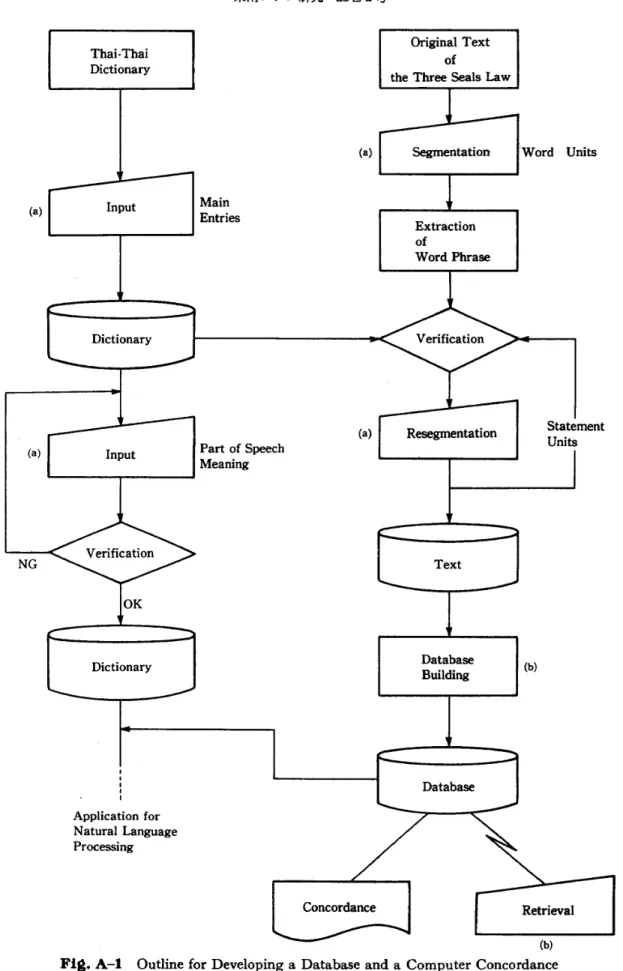
Thailand--The process for implementing on-line information retrieval and a computer concordance of the Three Seals Law is shown in Fig. A-I. The process in Fig. A-I advances into two flows: on the left, a database of Thai dictionary on the computer has been made in order to verify all the words in the text of the Three Seals Law. This can be used for the studies of natural language processing, in other words, morpheme analysis, syntactic analysis, and semantic analysis as basic research into natural
Thai-Thai Dictionary
Original Text of
the Three Seals Law
(a) Input Main
Entries (a) Extraction of Word Phrase 'Word Units (a) Dictionary Part of Speech Meaning
(a) Resegmentation Statement Units NG Text OK Dictionary Database Building (b) Retrieval Concordance Application for Natural Language Processing (b) Fig. A-I Outline for Developing a Database and a Computer Concordance
M. SHIBAYAMA: Input/Output Methods for Thai Floppy Disk Disk Unit Other Countries
o
Japanese Laser Beam Printer TSS Thai Emulator! Thai Text Editor MicroComputer Host Computer
System Configuration for Retrieving the Database of the Three Seals Law
Seals Law and the dictionary in the off-line status. The edited files are transferred into the host computer using the file transfer function on the micro computer. Also, (b) shows that the ordinary terminal and the intelligent terminal connected to the host computer are used. The overall con-figuration of the system for building and retrieving the database is shown in Fig. A-2. The database of the Three Seals Law and the dictionary of Thai are stored on the disk unit and managed by the IRSin the host computer.
For building or retrieval, the database is
accessed by invoking the IRS from the terminal, and the results can be output to a Japanese laser beam printer or to the terminal.
The terminal shown in Fig. A-2 is made up 2 components: a micro computer and a TSS1) 1) TSS: Time-sharing system, namely, the mode of communication with the host computer on an interactive basis. Tele-communication Line 300/1200 bps NTT Communication Network Printer Fig. A-2 FACOM M-780
language understanding, for a ques-tion-answering system, and for machine translation involving Thai. The right-hand flow shows the process of building a database from the original text of the Three Seals Law, which had made such seg-mentation that a statement is divided into the words, provided by the National Museum of Ethnology into a database on the host computer capable of retrieving it through the on-line terminal, and it also shows that a computer concordance is constructed simultaneously.
In making the database of the Thai dictionary, the main entries (about 32,000 words) of the dic-tionary published by the Thai Royal
Institute [Photchana nukrom Thai NEC PC-98XA/ 1982] were input using the Thai text PC-9801 editor. To complete the
machine-readable dictionary, the main entries need to be supplemented with de· tails of part of speech, meanings, and other rules necessary for the machine processing of Thai. Final-ly, when the database of the Thai dictionary is complete, it can be used for syntactic analysis of Thai statements.
In the building of the database and the computer concordance of the Three Seals Law, resegmen-tation has first to be accomplished, which includes the reading of text to confirm the existing segmen-tation and the input work using the Thai text editor. Then each different word is extracted from the text file and the verified against the dictionary on the host computer. Ifany mistakes are found in either the dictionary or the text, feedback into the appropriate positions must be attempted. After the corrective work, the text is segmented into the sentences to make the database retrieval more efficient.
By building the database using the information retrieval system, IRS, as an application software on the computer, on-line information retrieval of the Three Seals Law is possible, and computer concordance also can be accomplished by using a function in theIRS.
As shown in Fig. A-1, (a) shows that the Thai text editor is used for editing the text of the Three
terminal emulator, which is operated on the micro computer, and is connected with the host computer through a telecommunication line with the speed of 300/1200 bps.2) The micro computer can, of course, be used for editing the Thai text in the off-line status.
References
Hartmann, J.F.; and Henry, G. M. 1983a. Thai Script Computer-converted from a Precise, Pronounceable Transliteration for Biblio-graphic Management. Bulle#n oj Commz'ttee on Researck Materials on Soutkeast Asz'a (CORMOSEA) 11(2).
- - - - . 1983b. The Processing of Thai Lan-guage Text Using a Personal Computer. Bulletz'n of Commz"ttee on Researck Materz"als on Soutkeast Asz'a (CORMOSEA) 11(2). Ishii, Y. 1969. Sanin Hoten ni Tsuite
[Intro-ductory Remarks on the Law of Three Seals]. Tonan Ajz"a Kenkyu[Southeast Asian Studies] 6(4): 155-178.
Murayama, N. 1982. 2 Sutorooku-ho [2 Strokes Method]. Jyoko Syori [Information Pro-cessing] 23(6).
Photchana nukrom Thai. 1982 (Thai 2525). Ckabap Ratckabandz't-satkan. Krungthep: Samnakphim Aksonchaoenthat.
Sakamoto, Y. 1979. Ajia Afurica Gengo no Konpyuuta Syori [Computer Processing for Asian and African Languages]. Jyoko K anri [Information Management] 22(7).
Shibayama, M.; Sugita, S.; and Ishii, Y. 1984.
2) bps: Bits per second, namely, the unit of communication rate.
Pasokon ni yoru Taigo Tekisuto no Syon [Processing of Thai Text Using a Personal Computer]. Daz" 28Kaz' Jyoko Syorz" Gakkaz" Zenkoku Taz'kaz" Ronbun-syuu [Proceedings on Japan Information Processing Society 28th National Conference].
- - - - . 1985. Romaji Hyoki ni yoru Taimoji no Nyuryoku Hoshiki [Input Methods for Thai Using Roman Spelling]. Daz" 30 kaz" Jyoko Syorz" Gakkaz' Zenkoku Taz'kaz"
Ronbun-syuu [Proceedings of JIPS30].
Shibayama, M. ; and Hoshino, S. 1986a. Imple-mentation of an Intelligent Thai Computer Terminal. Journal of Injorma#on Processz'ng 8(4): 300-306.
- - - . 1986b. Taiji Jisyo no Nyuryoku-ho to Nyuryoku-tokusei [Methods and Character-istics of Thai Dictionary Inputs]. Daz'33 kat'
Jyoko Syorz" Gakkaz" Zenkoku Taz'kaz" Ronbun-syuu[Proceedings of JIPS33].
- - - - . 1987. A comparative Study of the Characteristics of Input Methods for Thai. In Proceedz'ngs of tke Regz"onal Symposz"um on Computer Scz'ence and Its Applz'catz'on. Thailand: NRCT. pp. 19,1-19,18.
Sugita, S. 1980. Text processing of Thai language: The Three Seals Law. In Kagaku Kenkyuu-hz' Skz'ken Kenkyuu Sez"ka Hokoku-syo: Jz"nbun Kagaku Kenkyuu Shz'en no tameno Konpyuuta Apurz'keesyon no Kaz'katsu [Development of Computer Application for Assisting the Studies of Cultural Science], edited by Tadao U mesao, pp. 122-129. National Museum of Ethnology.