Journal of the Operations Research Society of Japan
Vol. 43, No. 2, June 2000
SECOND MOMENTS OF THE WAITING TIME IN SYMMETRIC POLLING SYSTEMS
Seiya Kudoh Hideaki Takagi On Hashida University of Tsukuba
(Received February 26, 1999; Revised September 30, 1999)
Abstract Multiple queue, cyclic service systems (called polling systems) have often been used as perfor- mance evaluation models in communication and production systems with cyclic resource allocation. How- ever, most research has focused only on the mean waiting times due to prohibitively growing complexity in computing higher-order moments of the waiting time. This paper presents the explicit expressions for the second moments of the waiting time in symmetric exhaustive and gated service systems of two, three, and four queues with Poisson arrival processes. Numerical comparison reveals that they are ordered in the number of queues (increasingly/decreasingly for exhaustive/gated service systems, respectively) and bounded fairly tightly by those for single queue systems and by those for systems with infinitely many queues. Conjecture of their heavy traffic limits is also made.
1. Introduction
In polling systems, N queues are served by a single server in cyclic order. Such systems have diverse applications in communication networks and production systems in which a single resource is shared by multiple users with cyclic allocation. A particularly noteworthy application is the performance evaluation of token ring and FDDI protocols for high speed LANs. Two service disciplines among others with respect to the set of customers served a t each visit of the server to a queue are exhaustive and gated service ones; they differ in respect to whether those customers that arrive a t a queue in service are served during the current visit or reserved for the next visit. As usual in queueing systems, of main interest from customer's viewpoint is his/her waiting time. A special case in which N = 1 is referred to as a system with server vacations. Another extreme case in which N = oo (the load at each queue is infinitesimally small) is called a continuous polling system. Early studies of analysis and applications of polling systems are surveyed in [g, 14, 15, 161.
Consider a polling system with exhaustive or gated service discipline in which each queue has a Poisson arrival process and general service time distribution (like in an M/G/l queue) and the switchover times of the server also has general distribution. Then it can be shown that the moments of any order of the customer waiting time in each queue can be evaluated, in principle, through the solution to a set of linear equations. However, explicit analytical formulas are unavailable for the waiting time moments, even for the mean waiting time except for a few special cases (for example, systems with N = 2 queues and symmetric systems). Thus major efforts have focused on the mean waiting times, such as the reduction in the number of the linear equations [6, 101 as well as efficient algorithms for their computation [8], and linear dependence relationships among them called pseudoconservation
tirne in exhaustive and gated service polling systems. The second moments generally give measures of variability and can be used in Chebyshev inequality for estimating the probabil- ity distribution. In our evaluation of the second moments, we confine ourselves to symmetric systems such that all the queues are statistically identical. The explicit formulas are avail- able for the mean waiting times in symaxetric polling systems of N queues ( l
5 N
5 cm)
[?l.
To the authors's best k~uwledge~ the second moments (or variaxlces) of the waiting timehave been obtained for the following special cases only (besides for seryer v a c a t i o ~ systems N = l): an symmetric exhaustive service system of
N
= 2 queues and zero switchover times [13]? the same system but with aonzero switchover times [l2], symmetric systerns with deterministic service and switchover times of N = 2 and 3 queues [l], and symmetric con- tinuous polling systems ( N = m) L3, 51. Numerical computation procedures for the variance are given in [S], [8] and [Ill. We present the explicit expressions for the second moments of the waiting time in symmetric exhaustive and gated service systems with N = 2 , 3 , and4 queues. They have been obtained by solving the traditio~al set of linear equations using the software package Mathematics [l91 for symbolic formula manipulation. We show by nu- merical examples that the second moments are ordered in N (i~cremi~gly/decrewingly for exha~istive/gated service systems7 respectively) and fairly tightly bounded by those for the continuous polling systems ( N = m) and those for single queue systems ( N = 1). We also conjecture the heavy traffic limit forms of the second moments for general .N. The heavy traffic case of an exhaustive service system of N = 2 queues and zero switchover times i~ studied in [4].
The rest of the paper is organized as followse IB Section 2 we describe aur models more speci5cally and introduce notation wed in the paper- In Sections 3 and
4
we consider symmetric exhausti~e and gated service system3 re~pmtively~ and give the second moments of the waiting time for systems of N = Z7 3 and 4 queues- In Section 5, they are plotted and compared numericall~r. We also discuss limiting forms of the second moments in heavy traffic conditions.2- Models and Natation
Let us describe our systems and introduce notation for system parameters. The number of queues in the system is denoted by N. Queues are indexed by i 7 i = l? 2 > . * = N 3 in the order of server movement. We assume a Poisson arrival process of customers a t rate Ag for queue i. The LaplaceStieltjes transform (LST) of the distribution function @F) the meaB7 and the nth moment of service time of a customer a t queue i are denoted by
B:
( S ) , hi, b p ) ? respectively. The total load offered to the system is then given byIn each queae? customers me served on first-come first-sert~ed (FCFS) basis* The buffer of each queue has infinite capacity. We assume
p
<
1 which makes the whole system stable. The LST of the RF, the mean7 and the nth moment of time meded by the server to switch from queue i to queue ti+
1 (switchover time) are denoted by R: ( S ) , ri, respectively. We308 5. Kudoh, H. Takagj & 0. Hashida
The switchover times are assumed to be independent of the arrival and service processes. The LST of the D F and the nth moment of the waiting time Wi of a customer a t queue 2 are denoted by Wz(s) and E [ W g , respectively. A system in which the arrival and service processes in all queues and all the switchover times are independent of queue index i is called symmetric. For symmetric systems, we let p, = p = Ab, and omit subscript 2 from other parameters; thus we get p = N p and F = N r .
3. Exhaustive Service Systems
We first consider exhaustive service systems. In such systems, the server continues to serve each queue until no customers remain there. Customers arriving a t the queue in service are also served during the current visit of the server.
Let Li(t) denote the number of customers present in queue i a t time t. We define the joint generating function (GF) for [Lilt),
& ( t ) ,
. .
.,
LN(t)] at time t = r d m ) , i.e., at theinstant when the server visits queue i in the mth polling cycle as m Ñ oo by
By counting the number of customers in each queue a t t = ri{m) and t = ri+l(m), we get the relation
where Q^(s) is the LST of the D F for the length of a busy period a t queue 2, and satisfies the equation
The LST of the D F for the waiting time W, in an exhaustive service FCFS system is given by
where the marginal G F for Li(t) at time t = ri(m) as m
-+
oo is defined byand z is the z
formulas. In order to
th argument in F i ( l , . . . , l , z , 1 , .
.
. l ) . See [l41 for the derivation of these find up to the second moments of the waiting time, letWaiting Time in Polling Systems
where it is known that
From (6) with ( g ) , the second moment of Wi is expressed as
Thus we need fi (i, i ) and fi (i, i, i ) t o obtain E [W:]. To do so, a set of N 3 equations for
{ f i ( j , k ) ; i, j, k = 1 , 2 , .
. .
,
N } is derived from the partial derivative of (4) at z\ = 2:2 = =ZN = 1 as follows.
f. ( 2 , i ) A , A ^
+--"'-
[ f i ( Ã ˆ j ) &+
fi(i, q j ]+
k )+
j # i , k # i ( l l a )1 - Pi ( 1 - pd2
Similarly, a set of N 4 equations for { f i ( j , k , 1 ) ; i, j, k , I = 1 , 2 ,
. . .
,
N } is given by fi+l ( j , k , 1 ) = ~ j ~ t ~ i r . C "+
\,\isfi(l)+
\,\,fi{k)+
W i f i ( j )+
3 A j A t A i b J i ( i ) ] ri ( 2 )1 - Pi
\,fi(k, 1)
+
Afefi(j, 1)+
\if&, k )+
2b,{\,\,,f,(i, 1 )+
\,Alfi(i, k )+
\t\tf.(i,l}
1 - pi{
b y i ( i , i ) + bi2) fi ( 2 ) 3Aibi2l2 bi3)+3A-A \r-
( l - p i Y ( l - p i } }+\,&A1( ( 1 - p i Y
+
( 1 - p i YI
3AjAiAlbi f i ( i , i ) ] bi2)+
\,\,sfi(i, 1 )+
\i\ifi(i, k )+
Ak\i fi(i, j)+
1 - A ( 1 -
A ~ A ~ A ( ~ ; / ~ ( ~ , i, 2 ) b.
+
+
[\jAkfi(i, i,1)+
Aj A, fi(i, i, k )+
fi(i, i , })I( 1 - ( 1 -
bi
+
f . ( j , k , l )j
^
i , k # i , l#
i (12a)+
[\,fi(i, k , 1 )+
&f&,
j , 1 )+
hf.[i, j , k ) ] -For a symmetric system, all subscripts are dropped from A,, bi, bin), ri, r à ‘ p in (lla-c) and (12a-d). Although no explicit solution to (11) is available in general, fi(i, i) for
system is given by
where A2 = r^ - r2.
We have not been able t o derive an explicit expression for
fA&
i, i) even for system with a general value of N. However, we can get fi (i, i, i) for specifica symmetric
a symmetric values of N.
Here we have solved these equations using Mathematica for symmetric systems of N = 2,3, and 4 queues. The resulting second moments are as follows:
Waiting Time in Polling Systems 31 l
4. Gated Service Systems
We next consider gated service systems. Here, the server serves only those customers that are found at the instant when the queue is visited. Those customers that arrive during the service period are set aside to be served in the next round of visit. For a gated service system, the joint G F Fi(zl, z2,
. . .
,
zN) defined in (3) satisfies the equationfrom which we can get fi(i), fi(i,i) and f i ( i , i , i ) in the same way as in Section 3. It is known that
A set of N 3 equations for { fi(j, k); i, j, k = l, 2,
. . .
,
N } is given byS. Kudoh, H. Takagi & 0. Hashida
For a symmetric system we get
The LST of the D F for the waiting time
W i
in a gated service F'CFS system is given byfrom which we get
We have obtained the second moments of the waiting time in symmetric gated service systems of N = 2 , 3 , and 4 queues as follows:
Waiting Time in Polling Systems
5. Numerical Results, Comparison, and Heavy Traffic Limits
Let us compare the waiting times in various symmetric systems with the same total load
p
= Np. To avoid the effects from the variability in switchover times, we assume that all the switchover times are deterministic, thusd2)
= r2,d3)
= r3, and d2 = 0- In such a case, we have the second moment of the waiting time in a continuous polling system, that is a limiting form obtained by making N+
m withp
= NAb and F = N r held a t fixed values~51:
Note that a continuous polling system has no distinction of exhaustive and gated service because the load a t each queue is infinitesimally small. The second moment of the waiting time in single queue systems ( N = l) without the assumption of deterministic switchover times are given by [l71
l
[d3)
~ b ( ~ )]
+ ~ b ( ~ ) [ r r ) ~ b ( ~ )]
exhaustive service : E[w2] = - -
+
- -+
--3 r ~ - p ~ ( l - p ) l - P ( 2 4 4 l
[d3)
Ab(3)]
+ ~ b ( ~ ) [ r r ) + ~ b ( ~ )]
gated service : E[w2] = - -+
-3 r l - p 2(1-p) 1 - P
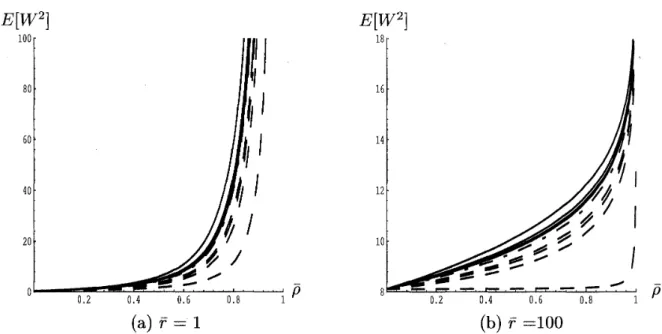
In Figures l and 2, we plot E[W2] against
p
with fixed b (= l) and T (= l or = 100) for different number N of queues. The service times are either deterministic or exponentially distributed. To compare, let us use E [W2IeTN, E[W2]g,N, and E[W2Im to denote the second moment of the waiting time in an exhaustive service system of N queues, in a gated service system of N queues, and in a continuous polling system, respectively. We observe in the figures monotone ordering for the second moment of the waiting time:31 4 S. Kudoh, H. Takagi & 0. Hashida
(a) F = l (b) F = l 0 0
Figure l: Second moments of the waiting time in exhaustive and gated service systems (service times are deterministic).
(a) F = l (b) F = l 0 0
Figure 2: Second moments of the waiting time in exhaustive and gated service systems (service times are exponentially distributed).
Legend for the figures
- exhaustive service systems
m
N = l, 2) 3, and 4 from below gated service systems
.
N = l, 2, 3) and 4 from top
Waiting Time in Polling Systems 31 5
We also see that the second moments are fairly tightly bounded by those for the contin- uous polling systems (N = m) and those for single queue systems ( N = l) if the switchover times are small and the total load
p
is not so large. This suggests possible use of the formula (23), (24a) and (24b) for approximating E[W2] in a system of N queues where 25
N<
m . While it seems difficult t o obtain the second moments of the waiting time for general values of N a t present, we may conjecture the limiting forms in the heavy traffic conditionp
+
1. In (14a-c) and (22a-c), we see that the most significant contributions in this limit come from terms of order 0 (l/ (l -p)2).
From the coefficients of these terms, we induce the heavy traffic limitsexhaustive service : E
[w2]
zgated service :
E[w2]
z+
We note that these agree as N
--+
m with the heavy traffic system which can be obtained from (23) ascontinuous polling system :
E [ w ~ ]
=
2[b(2)12 3(1 - pl2b2
+
limit in a continuous polling
For the systems with zero switchover times, the above heavy traffic limits reduce to 2 [ N A ~ ( ~ ) ] ~
exhaustive service :
E[w2]
FZ3(1 - Npl2
gated service : E
[w2]
z 2(N2+
N+
l ) [ ~ A b ( ~ ) ] ~ 3 ( N+
ll2(l - N P ) ~which agree with the special cases of the recent result for the n t h moments of the waiting time [l81
exhaustive service : E [Wn] z n! [NA b(2)]n ( n
+
l)(l - Np)nn!(Nn
+
Nn-l+
- -
+
N~+
N+
l ) [ ~ ~ b ( ~ ) ] ~ gated service : E[Wn] z( n
+
l ) ( N+
l)n(l - NpIn (28b) where n = l, 2 ? ..
..References
[l] Y. J. Aminetzah: An Exact Approach to the Pollzng System (Ph.D. dissertation. Depart- ment of Electrical Engineering, McGill University? Montreal, Quebec? Canada, 1975). [2] 0. J . Boxma: Workloads and waiting times in single-server systems with multiple
31 6 S. Kudoh, H. Takagi & 0. Hashida
[4] E. G. Coffman, J r . , A. A. Puhalskii, and M. I. Reiman: Polling systems with zero switchover times: a heavy-traffic averaging principle. The Annals of Applied Probability,
5 (1995) 681-719.
[5] M. J . Ferguson: Computation of the variance of the waiting time for token rings. IEEE Journal on Selected Areas in Communications, SAC-4 (1986) 775-782.
[6] M. J . Ferguson and Y. J . Aminetzah: Exact results for nonsymmetric token ring sys- tems. IEEE Transactions on Communications, COM-33 (1985) 223-231. Correction in: G. L. Choudhury and H. Takagi: Comments on "Exact results for nonsymmetric token ring systems."
IEEE
Transactions on Communications, 38 (1990) 1125-1127. [7] 0. Hashida: Analysis of multiqueue. Review of the Electrical Communication Labora-tones, 20 (1972) 189-199.
[8] A. G. Konheim, H. Levy, and M. M. Srinivasan: Descendant set: An efficient approach for the analysis of polling systems. IEEE Transactions on Communications, 42 (1994) 1245-1253.
[g] H. Levy and M. Sidi: Polling systems: applications, modeling, and optimization. IEEE Transactions on Communications, 38 (1990) 1750-1760.
[l01 D. Sarkar and W. I. Zangwill: Expected waiting time for nonsymmetric cyclic queueing systems - Exact results and applications. Management Science, 35 (1989) 1463-1474. [l11 D. Sarkar and W . I. Zangwill: Waiting time variance for nonsymmetric cyclic queueing
systems. (Preprint
,
AT&T Bell Laboratories, 1991).[l21 M. M. Srinivasan, H. Levy, and A. G. Konheim: The individual station technique for the analysis of cyclic polling systems. Naval Research Logistics, 43 (1986) 79-101. [l31 L. TakAcs: Two queues attended by a single server. Operations Research, 16 (1968)
639-650.
[l41 H. Takagi: Analysis of Polling Systems (The MIT Press, Cambridge, Massachusetts, 1986).
[l51 H. Takagi: Queuing analysis of polling models. ACM Computing Surveys, 20 (1988) 5-28.
[l61 H. Takagi: Application of polling models t o computer networks. Computer Networks and ISDN Systems, 22 (1991) 193-211.
[l71 H. Takagi: Queueing Analysis, A Foundation of Performance Evaluation, Volume 1: Vacation and Priority Systems, P a r t 1 (Elsevier, Amsterdam, 1991).
[l81 R. D. van der Mei: Polling systems in heavy traffic: higher moments of the delay. In V. Ramaswami and P. E. Wirth (eds.): Teletraffic Analysis for the Communication Age (Elsevier, Amsterdam, 1997), 275-284.
[l91 S. Wolfram: Mathematica: A System for Doing Mathematics by Computer, Second edition (Addison-Wesley, Reading, Massachusetts, 1991).
Hideaki Takagi
Institute of Policy and Planning Sciences University of Tsukuba