DISSERTATION
Measuring Dynamical Masses of
Galaxy Clusters
with Stacked Phase Space
by
Akinari Hamabata
A thesis submitted to
the graduate school of science,
the University of Tokyo
in partial fulfillment of
the requirements for the degree
of
Master of Science in Physics
Abstract
The mass of galaxy clusters that has been estimated by using motions of astronomical objects around the clusters is called the dynamical mass. The dynamical mass approach provides a complementary method to estimate cluster masses which are dominated by dark matter and hence difficult to measure. In addition, the comparison of the dynamical mass with the mass estimated by gravitational lensing provides an important means of testing General Relativity.
However, previous studies of dynamical masses did not fully take account of the com-plexity of dynamics around clusters. To estimate the dynamical mass accurately, we have to understand more about the dynamical state of clusters. Using a large box N -body sim-ulation, we analyze motions of dark matter halos surrounding galaxy clusters. We find that the stacked pairwise velocity distribution can be well described by a two component model, which consists of the infall component and the splashback component. We find that very little fraction of halos is well relaxed even at z = 0. We also find that the radial velocity distribution of the infall component deviates from the Gaussian distribution and is described well by the Johnson SU distribution. In addition, we study the dependence of the phase space distribution on cluster masses as well as masses of satellite-halos and sub-halos.
Our model is then used to derive the probability distribution function of the line-of-sight velocity vlos, which can directly be compared with observations. In doing so, we project our model of the three-dimensional phase space distribution along the line-of-sight by taking proper account of the effect of the Hubble flow. We find that we can estimate cluster masses even at the outer region of the projected phase space rproj > 2 Mpc/h, which is complementary to the traditional approach to use velocity dispersions measured at rproj≲ 1 Mpc/h. Our model allows us to understand how the vlos distribtions at large radii can constrain cluster masses, which is complicated due to the competing effects of the infall velocities and the Hubble flow. We conclude that by using SDSS spectroscopic galaxies we can constrain mean cluster masses with an accuracy of 4% by using the outer phase space distributions at rproj > 2 Mpc/h. We discuss potential systematic errors associated with this method.
Contents
Chapter 1. Introduction 1
Chapter 2. Basic Dynamics of Dark Matter Halos 5
2.1 Dynamics of Collisionless Particle . . . 5
2.2 Escape Velocity Profile of a Galaxy Cluster . . . 8
Chapter 3. Basic Method of Dynamical Mass Measurement 11 3.1 Measurement of vlos . . . 12
3.2 Stacking Galaxy Clusters . . . 13
3.3 Reconstruction of Masses of Galaxy Clusters from vlos Histograms . . . 14
Chapter 4. Modeling the Phase Space Distribution of Dark Matter Halos 19 4.1 Phase Space Distribution of Halos from N -body Simulation . . . . 21
4.2 Overview of Our Model . . . 21
4.3 Radial Velocity Distribution . . . 23
4.4 Tangential Velocity Distribution . . . 28
4.5 Radial Dependence of Parameters in The Model . . . 32
4.6 Reconstruct vlos Histogram . . . 42
4.7 Dependence of the Phase Space Distribution on Satellite-Halo Masses . . . 52
Chapter 5. Measurement of Dynamical Masses from vlosDistribution Func-tions 67 5.1 Dependence of the PDF of vlos on Cluster Masses . . . 67
5.2 Origin of Dynamical Mass Dependence of the PDF of vlos . . . 71
5.3 Accuracy of Mass Estimation . . . 75
5.4 Systematic Errors . . . 76
5.4.1 Dependence of the PDF of vlos on Satellite-Halo and Sub-Halo Masses 76 5.4.2 Inaccuracy of Our Model . . . 79
5.4.3 Measurement Errors of Galaxy Redshifts . . . 82
5.4.4 Miscentering . . . 82
Chapter 6. Summary and Future Prospects 85
Acknowledgments 87
Appendix A. Review of a Cluster Finding Method 89
A.1 Calculating Probability of Red Sequence Galaxy . . . 89 A.2 Calculating the Number of Member Galaxies . . . 90 A.3 Refining Cluster Candidates . . . 91
Chapter 1
Introduction
In the Λ Cold Dark Matter (ΛCDM) universe, the energy budget of the Universe is composed of three components. The first component is baryon, which represent ordinary matter such as stars, galaxies, and intracluster medium. The second component is dark matter, which interacts mostly via gravitational field. While the true nature of dark matter is unknown, it is usually assumed to interact with baryon only very weakly, which makes it very challenging to infer the distribution of dark matter from astronomical obser-vations. The third component is dark energy. Dark energy is a hypothetical component with negative pressure, which is introduced as a source of the accelerated expansion of the Universe. In the standard ΛCDM model, initial density perturbations grow by the gravitational instability, and form the cosmic structure hierarchical.
We can extract information on the initial density perturbation, the structure forma-tion history, and cosmological parameters from distribuforma-tions of cosmic structures such as galaxy clusters. Galaxy clusters are the biggest self-gravitating system in the Universe, whose typical size is 1 Mpc, the typical weight is 1014M
⊙, and the main component is
dark matter. For instance, we can extract the matter density (Ωm) and the amplitude of the density perturbation (σ8) from the abundance of galaxy clusters (e.g., Rozo et al. 2010). Fig. 1.1 shows an example of cosmological constraints obtained from the abun-dance of galaxy clusters. The dominant source of the uncertainty in this analysis is the uncertainty of estimating cluster masses, which is necessary to compare observations with theory involving dark matter. To constrain cosmological parameters accurately, we need to estimate masses of galaxy clusters precisely, which is difficult because masses of clusters are dominated by dark matter.
There are several methods to estimate masses of galaxy clusters, including gravitational lensing (Schneider et al. 1992; Umetsu et al. 2011; Oguri et al. 2012; Newman et al. 2013), the X-ray observation (Sarazin 1988; Vikhlinin et al. 2006), and the Sunyaev-Zel’dovich effect (Sunyaev & Zeldovich 1972; Arnaud et al. 2010; Planck Collaboration et al. 2014). In addition, another method to estimate masses of galaxy clusters by using the relative motion of galaxies surrounding galaxy clusters has also been proposed (Smith 1936; Busha et al. 2005; Rozo et al. 2015; Farahi et al. 2016). In this thesis, we call the mass estimated by motions of galaxies around clusters as the dynamical mass. It is of great importance to compare cluster masses derived by these different methods in order to understand
Figure 1.1: The cosmological constraints obtained from the abundance of galaxy clusters. The maxBCG clusters (Koester et al. 2007), and the mass calibration by stacked weak lensing (Johnston et al. 2007) are used in this analysis. The plot shows 68% confidence regions. The solid line shows the result of the fiducial analysis, the dotted line shoes the analysis with a more conservative error on the mass calibration, and the dashed line shows the analysis with the perfect purity and completeness. Other cosmological parameters are fixed at WMAP5 values (Dunkley et al. 2009). Taken from Rozo et al. (2010).
systematic errors inherent to the individual methods. Different methods have different systematic errors, which can be inferred and hopefully corrected for by cross-checking the results of the individual methods.
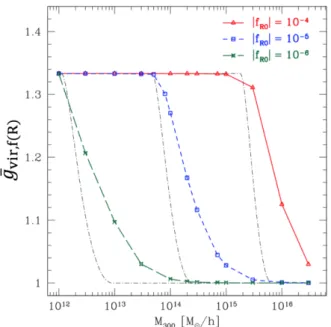
Furthermore, we can also test General Relativity by comparing masses of galaxy clusters estimated by gravitational lensing effect (hereafter referred to as the lens mass) with dy-namical masses (Schmidt 2010; Lam et al. 2013). Because the dydy-namical mass (Mdyn) and lens mass (Mlens) have different information about metric, we can test General Relativity by comparing these two masses. Fig. 1.2 is an example of the comparison between Mdyn and Mlens taken from Schmidt (2010). In that paper, they assume one class of modified gravity theories, f (R) gravity (Nojiri & Odintsov 2011), which add a new term f (R) to Lagrangian of the gravitational field (LG) as
LG = R + f (R) , (1.1)
where R is curvature, and f (R) is
f (R) = −2Λ − fR0
R0 2
R2 . (1.2)
Note that Λ is cosmological constant, R0 is the present day background curvature, and
fR0 is a parameter of the model. Then they define gvir,f(R) as the ratio of the dynimcal and lens masses
gvir,f(R) = ( Mdyn Mlens )5/3 . (1.3)
3
Figure 1.2: Comparison between galaxy cluster masses estimated by gravitational lens-ing (Mlens) and by using relative motions of dark matter halos around clusters (Mdyn) for one class of modified gravity theories, f (R) gravity. The vertical axis is gvir,f(R) = (Mdyn/Mlens)5/3. The horizontal axis is Mlens. Symbols show the mass ratios taken from
N -body simulations, and the corresponding dot-dashed lines show the results of an
an-alytic calculation with approximations. Different symbols corresponds to different |fR0|, which is a parameter of f (R) gravity. Taken from Schmidt (2010).
The value of this parameter is always unity for General Relativity, but can deviate from the unity for modified gravity theories. In Fig. 1.2, we show the comparison between Mlens and Mdyn in the case of the f (R) gravity. From Fig. 1.2, we can see that the ratio of
Mlens and Mdyn deviates from unity for low-mass halos up to ∼ 30%, which can be tested with observations. This example highlights the importance of accurate measurements of
Mdyn to test General Relativity.
While there are some previous studies to estimate Mdyn (Smith 1936; Busha et al. 2005; Rozo et al. 2015; Farahi et al. 2016), there is room for improvement in several ways. For example, to estimate Mdyn accurately, we have to understand the dynamical state of dark matter halos around galaxy clusters. However, there are no existing theoretical methods of the Mdyn measurement which fully take account of the complexity of the dynamical state of dark matter halos. Moreover, in most of previous studies, motions of galaxies (or dark matter halos) within ∼ 1 Mpc from centers of galaxy clusters are used to derive Mdyn. In this thesis, we study the phase space distribution of galaxies around galaxy clusters up to very large distances, several tens of Mpc from cluster centers, by using an N -body simulation, and propose a new method to measure Mdyn using a staked phase space diagram. For this purpose, we construct a new model of the phase space distribution of dark matter halos around clusters. We discuss how Mdyn can be estimated by the stacked phase space distribution at large distances beyond ∼ 2 Mpc, which is
highly complementary to traditional methods to estimate Mdyn from motions of galaxies within∼ 1 Mpc from cluster centers.
This thesis is organized as follows. In Chapter 2, we review the basic dynamics of dark matter halos. In Chapter 3, we review previous methods to measure Mdyn. We show our new model of the phase space distribution of dark matter halos in Chapter 4. In Chapter 5, we discuss how to measure Mdyn by using our model. Finally, we conclude in Chapter 6.
Chapter 2
Basic Dynamics of Dark Matter
Halos
To estimate Mdyn of galaxy clusters, we need to know the phase space distribution or the dynamical state of dark matter halos. In this Chapter, we review basic thory of dynamics of dark matter halos.
2.1
Dynamics of Collisionless Particle
Dark matter particles are usually assumed to be collisionless. The dynamics of such collisionless particles are governed by the collisionless Boltzmann equation (see e.g., Mo et al. 2010) df dt = ∂f ∂t + ∑ i vi ∂f ∂xi − ∑ i ∂ϕ ∂xi ∂f ∂vi = 0, (2.1)
where f = f (x, v, t) is the phase space distribution function of the particles, and ϕ =
ϕ(x, t) is the gravitational potential. Note that we assume only single mass (m) particles.
We can derive the continuity equation by integrating eq. (2.1) over the velocity space
∂ρ ∂t + ∑ i vi ∂ ∂xi (ρvi) = 0, (2.2)
where ρ is the density described as
ρ(x, t) = m
∫
d3v f (x, v, t), (2.3)
and vi is the i-th component of the mean velocity given as
vi(x, t) = ∫ d3v v if (x, v, t) ∫ d3v f (x, v, t) . (2.4) 5
We can also derive equation of motion for collisionless particles by multiplying eq. (2.1) by vj and integrating eq. (2.1) over the velocity space
∂ρvj ∂t + ∑ i ∂ ∂xi (ρvivj) + ρ ∂ϕ ∂xj = 0, (2.5) where vivj(x, t) = ∫ d3v v ivjf (x, v, t) ∫ d3v f (x, v, t) . (2.6) Now we define σij as σij = √ vivj − vi vj . (2.7)
Using σij, eq. (2.7) is rewritten as
∂vj ∂t + ∑ vi ∂vj ∂xi =−1 ρ ∑ ∂ ∂xi (ρσij2)− ∂ϕ ∂xj . (2.8)
Eq. (2.8) is called the Jeans equation.
We can also derive equation of energy by multiplying eq. (2.5) by xk and integrating
over real space ∫ d3x xk ∂(ρvj) ∂t =− ∑ i ∫ d3x xk ∂ ∂xi (ρvivj)− ∫ d3x ρxk ∂ϕ ∂xj . (2.9)
The second term of right hand side is rewritten as
−∑ i ∫ d3x xk ∂ ∂xi (ρvivj) = ∫ d3x (ρvjvk)− ∑ i ∫ dSi xkρvivj, (2.10)
where, dSi corresponds to the surface element oriented toward the direction of xi. The
first term of right hand side means the kinetic energy tensor
Kjk =
1 2
∫
d3x (ρvjvk). (2.11)
The second term of right hand side of eq. (2.10) means the surface pressure Σjk =−
∑
i
∫
dSi xkρvivj. (2.12)
Using the Chandrasekhar potential energy tensor defined as
Wjk =− ∫ d3x ρxj ∂ϕ ∂xk , (2.13) we rewrite eq. (2.9) as ∫ d3x xk ∂(ρvj) ∂t = 2Kjk + Wjk+ Σjk . (2.14)
2.1 Dynamics of Collisionless Particle 7
The left hand side of eq. (2.14) can be rewritten as ∫ d3x xk ∂(ρvj) ∂t = 1 2 d dt ∫ d3x ρ(xkvj+ xjvk) =−1 2 d dt ∫ d3x ∂(ρvi) ∂xi xjxk = 1 2 d dt ∫ d3x ∂ρ ∂txjxk = 1 2 d2Ijk dt2 , (2.15)
where Ijk is the inertial moment tensor defined as
Ijk =
∫
d3x ρxjxk . (2.16)
By using eqs. (2.10), (2.11), (2.12), (2.13), (2.15), and (2.16), eq. (2.9) can be rewritten as 1 2 d2I jk dt2 = 2Kjk+ Wjk+ Σjk . (2.17)
Eq. (2.17) is called the tensor virial theorem. We can derive the scalar virial theorem by taking trace of eq. (2.17)
1 2 d2I dt2 = 2K + W + Σ, (2.18) where I = ∫ d3x ρ|x|2, (2.19) K = 1 2 ∫ d3x (ρ|v|2), (2.20) W =− ∫ d3x ρx· ∇ϕ, (2.21) Σ = Tr(Σjk) =− ∫ dSi xkρvivk. (2.22)
For a static system, d2I/dt2 = 0, eq. (2.18) becomes
2K + W + Σ = 0 . (2.23)
When we neglect the surface term Σ, the total energy E (≡ K + W ) can be described as
E =−K = 1
This model is used as a basic of dynamics of dark matter particles and halos.
If the system is spherically symmetric, eq. (2.8) can be rewritten in a spherical coordinate as ∂vr ∂t + vr ∂vr ∂r =− 1 ρ ∂ ∂r(ρσ 2 rr)− 2βσrr2 r − ∂ϕ ∂r, (2.25) where β = 1− σ 2 θθ+ σϕϕ2 2σ2 rr (2.26) is called the velocity anisotropy parameter. If the velocity dispersion is isotropic, β reduces to zero, and if the radial (tangential) component is dominant, β = 1 (β → −∞).
When we assume that the system is static, we can rewrite eq. (2.25) by using eq. (2.26) as GM (< r) r = 1 2σ 2 rr(r)× (3 + 2β) , (2.27)
where M (< r) is the mass within r. Once we set r to r200, which is the radius within which the average density is 200 times the critical density of the Universe, M200 ∝ r2003 , and regard β as constant, we can describe σrr(r200) as
σrr(r200)∝ M 1/3
200 (2.28)
This equation shows the most basic relationship between masses of galaxy clusters and dynamics within dark matter halos.
2.2
Escape Velocity Profile of a Galaxy Cluster
The caustic model is a model that focuses on dark matter halos of infall sequence to galaxy clusters, based on s spherical collapse model (Diaferio & Geller 1997). In Stark et al. (2016), the caustic model is extended to apply it for an expanding Universe. In this Section, we review an improved caustic method based on Stark et al. (2016).
The caustic method is based on collisionless infall. The escape velocity (vesc) is described as
v2esc(r) =−2Φ(r), (2.29)
where Φ is the potential. Following Nandra et al. (2012), they construct effective Φ for an acceleration experienced particle with zero angular momentum by two components as
⃗
∇Φ = ⃗∇Ψ + qH2
rˆr . (2.30)
The first term of right hand side of eq. (2.30) corresponds to the Newtonian gravitational potential of a galaxy cluster, and the second term corresponds to the effect of expanding Universe, where, H is Hubble parameter, and q is given by q≡ −(¨aa)/˙a2. Integrating eq.
(2.30), ∫ req r dΦ = ∫ req r dΨ + qH2 ∫ req r r′dr′ . (2.31)
2.2 Escape Velocity Profile of a Galaxy Cluster 9
Note that the integration is performed out to a finite radius, req, which is termed the ”equivalence radius” in Behroozi et al. (2013a). The finite range of the integration is due to the fact that the escape velocity at infinity is poorly defined. Following Behroozi et al. (2013a), they define the req to be the point at which the acceleration due to the gravitational potential and the acceleration of the expanding Universe are equivalent ( ⃗∇Φ = 0). Hence, req is defined as req = ( GM −qH2 )1/3 , (2.32)
where M is the mass of the galaxy cluster. They assume that at large r, Ψ is given by Ψ = −GM/r via the Poisson equation. Then, by integrating eq. (2.31), we have
Φ(r) = Ψ(r)− Ψ(req) + 1 2qH
2(r2− r2
eq) + Φ(req) . (2.33) At req, vesc must be zero, Φ(req) = 0. Hence, vesc is described as
vesc(r) = √
−2{Ψ(r) − Ψ(req)} − qH2(r2− r2eq) . (2.34) This is the one of the most basic models to describe infalling dark matter halos to a galaxy cluster. This model, however, cannot predict the phase space distribution of dark matter halos which we study in Section 4.3.
Chapter 3
Basic Method of Dynamical Mass
Measurement
There have been several studies about dynamical mass measurements of galaxy clusters based on stacking analysis (Munari et al. 2013; Farahi et al. 2016). An advantage of the stacking approach is that we can derive an accurate average mass of a sample of galaxy clusters, which is crucial in the era of wide-field surveys in which a large sample of galaxy clusters can be constructed. In this Chapter, we review previous studies of dynamical mass measurements using the stacking approach.
We can obtain information on the gravitational potential of a cluster, which depends on the mass of the cluster, from motions of galaxies. Therefore, we can measure masses of galaxy clusters by analyzing motions of galaxies in and around galaxy clusters. On the other hand, in N -body simulations, galaxy clusters correspond to dark matter halos. In this thesis, a cluster-scale dark matter halo whose dynamical mass is our main interest is referred to as a host-halo, whereas a galaxy-scale dark matter halo and subhalo in and around the cluster-scale dark matter halo are referred to as a satellite-halo and a sub-halo, respectively. We give more strict definition of the host-halo, satellite-halo, and sub-halo in Chapter 4.
The outline of the measurement of dynamical masses of stacked galaxy clusters are as follows. First, we calculate pairwise line-of-sight velocities (vlos) between host-halos (clusters) and satellite-halos and sub-halos (galaxies). Because galaxy clusters are located far away from us, we cannot measure motions perpendicular to the celestial sphere. Hence, all we can observe are line-of-sight velocities. Second, we stack galaxy clusters to construct the vlos histogram. Because each galaxy cluster has only 50-100 observable satellite-halos and sub-halos at most, it is impossible to construct an accurate enough vlos histogram from a single cluster. Hence, we have to stack a lot of clusters for accurate dynamical mass measurements. Third, we reconstruct masses of galaxy clusters from vlos histograms. Since the relationships between masses of galaxy clusters and vloshistograms have not yet been fully understood, we usually estimate dynamical masses of galaxy clusters from vlos histograms by an empirical way using N -body simulation results. We review each step in this Chapter.
Figure 3.1: Rough illustration of vlos measurement
3.1
Measurement of v
losIn this Section, we review how to measure the line-of-sight velocity (vlos) following to Farahi et al. (2016). They measure pairwise vlosbetween host-halos and satellite-halos and sub-halos by using galaxy redshifts. It is known that almost all galaxy clusters have large luminous galaxies at their centers. These galaxies are called Brightest Cluster Galaxies (BCG), whose positions are regarded as the centers of the galaxy clusters and whose velocities as bulk motion of galaxy clusters. The other galaxies in galaxy clusters are called satellite galaxies, whose positions and velocities are regarded as those of satellite-halos and sub-satellite-halos. We note that these are approximations and can generate systematic errors.
Fig. 3.1 shows a schematic picture of the configuration of the vlos measurement. For each pair of a cluster and a satellite galaxy, they calculate vlos by
vlos = c ( zsat− zcen 1 + zcen ) , (3.1)
where zcen is the redshift of the BCG, and zsat is the redshift of the satellite galaxy. This vlos contains contributions from the Hubble flow and pairwise line-of-sight peculiar velocity. Specifically, vlos is given by
vlos= H · dlos− (vlos:cen− vlos:sat), (3.2) where H is the Hubble parameter, dlos is the line-of-sight distance between the BCG and the satellite galaxy, and, vlos:cen and vlos:satare the line-of-sight component of the peculiar velocity of the BCG and satellite galaxy, respectively.
3.2 Stacking Galaxy Clusters 13
The measurement error of vlos is
∆vlos = √( ∆zsat 1 zsat− zcen )2 + { ∆zcen ( 1 1 + zcen + 1 zsat− zcen )}2 × vlos . (3.3) Since the typical value of vlos is 500 km/s, we have to measure redshifts as accurate as 500 km/s/c ∼ 10−3. In observations, the typical error of photometric redshifts is 10−2, whereas that of spectroscopic redshifts is 10−4. For this reason, we need to use spectroscopic galaxies to measure vlos.
3.2
Stacking Galaxy Clusters
For stacked vlos measurements, it is important to construct a large sample of galaxy clusters in order to reduce the error in the vlos histogram. In this Section, we review the main concept of red-sequence cluster finding methods (e.g., Rykoff et al. 2014; Oguri 2014).
It is known that a lot of galaxies in galaxy clusters follow a tight color-magnitude rela-tionships. These galaxies are called red sequence galaxies. Fig. 3.2 is a color-magnitude diagram of the galaxy cluster Abell 22. The Figure indicates that many cluster mem-ber galaxies are populated along a line in the color-magnitude diagram. The tight red-sequence indicates that many cluster member galaxies were formed at a similar epoch. This color-magnitude relation shows that a high density region of red and luminous galaxies must be associated with a galaxy cluster. Hence we can find galaxy clusters by finding such concentrations of red galaxies, and can also derive photometric redshifts of clusters from colors of the red-sequence.
In order to infer rough masses of galaxy clusters identified by the red-sequence meth-ods, it is common to adopt richness, which is essentially the number of cluster member galaxies. For instance, Rykoff et al. (2014) define richness by the number of red cluster member galaxies with the projected radius of
Rλ = 1.0 h−1 ( λ 100 )0.2 Mpc, (3.4)
where λ is richness of a galaxy cluster. In Rykoff et al. (2014), λ and Rλ are computed
iteratively, until they converge. We can expect that clusters with large richness are more massive on average, which is indeed confirmed by e.g., stacked weak lensing observations (e.g., Murata et al. 2017).
We review more details about CAMIRA (Oguri 2014), one of red-sequence cluster finding methods, in Appendix A.
Figure 3.2: Color-magnitude diagram of the galaxy cluster Abell 22. The vertical axis is a galaxy color i.e., the difference between B-band and R-band magnitudes. The horizontal axis is the R-band magnitude. Points are galaxies. Points with circles shows color-magnitude relations of red cluster member galaxies. The solid line shows a fit to the red-sequence relation. Taken from Stott et al. (2009)
3.3
Reconstruction of Masses of Galaxy Clusters from
v
losHistograms
Now, we can construct the vloshistogram by stacking a lot of galaxy clusters. We discuss how we obtain masses of galaxy clusters from the vlos histogram. Here, we introduce previous studies based on Munari et al. (2013) and Rozo et al. (2015).
In those papers, all galaxies within rproj < Rλ are used to construct the vlos histogram, where rproj is the projected radius, and Rλ is defined in eq. (3.4).
The vlos histogram is fitted to the following function form
f (vlos) = √A0 2πσ2 G exp ( −vlos2 2σ2 G ) + A1 . (3.5)
The first term corresponds to signals from cluster member galaxies, and the second term of eq. (3.5) corresponds to contributions from foreground and background galaxies of galaxy clusters, i.e., field galaxies. Because the distribution of cluster member galaxies is highly elongated along the line-of-sight in the redshift space, it is difficult to separate cluster member galaxies from other galaxies on an individual basis, which is why we have
3.3 Reconstruction of Masses of Galaxy Clusters from vlos Histograms 15
Figure 3.3: Distribution of vlos. The black points are from mock observations of an N -body simulation, and the solid line is the best fit of eq. (3.5). Taken from Rozo et al. (2015)
.
to subtract the contributions from the foreground and background galaxies statistically. The fitting range may affect results. At first fitting, they set the fitting range to
|vlos| ≤ 3000 × (λ/20) 0.45
km/s . (3.6)
After deriving σG, they change the fitting range to
|vlos| ≤ 5σG (3.7)
and re-fit the histogram. This process is repeated until it converges. Fig. 3.3 is an example of the vlos distribution and the fitting result. We can see that their model is generally good, but not perfect. For example, the model cannot reproduce the sharp peak around vlos = 0.
Free parameters in eq. (3.5) are A0, A1, and σG, where A0 and A1 are parameters to determine the ratio of the number of field galaxies to that of cluster member galaxies. Moreover, σG is the ”velocity dispersion” of galaxy clusters. In Munari et al. (2013), by using N -body simulation, they show that the cluster mass is inferred from the one-dimensional velocity dispersion (σ1D) as
σ1D= A2 ( h(z) M200 1015M ⊙ )α , (3.8)
where, A2 and α are fitting parameters, M200 is the mass within a sphere of radius r200, and r200 is the radius that the density of a spherical region within r200 being equal to 200 times the critical density of the Universe ρcrit. The parameter h(z) is the dimensionless Hubble parameter defined as
h(z)≡ H(z)
100 (km/s/Mpc). (3.9)
In the N -body simulation, σ1D is defined as
σ1D= v u u t 1 3Nsat Nsat ∑ i |vcluster− vi,sat|2, (3.10)
where vcluster is the velocity of the center of galaxy cluster, vi,sat is the velocity of the
i-th satellite-halo, and Nsat is the number of satellite halos. While we can infer the mean cluster mass from the stacked vlosdiagram once we regard σ1Dand σGas the same, there are several notable differences between these two parameters. First, σ1D is calculated directly from the pairwise velocity rather than by fitting eq. (3.5) to the histogram. Second, σ1D assumes an isotropic pairwise velocity distribution, whereas σG does not rely on such an assumption. Third, the one-dimensional pairwise velocity derived in Munari et al. (2013) does not contain the Hubble flow. Forth, in Munari et al. (2013), only sub-halos within
r200 are used to calculate σ1D. These differences must cause the difference between σ1D and σG, which is neglected here. If satellite-halos and sub-halos are well relaxed and virialized within the cluster, A2 = 1040 – 1140 km/s, and α = 1/3 are expected (see also Section 2.1).
In Fig. 3.4, they show the relationships between σ1D and galaxy cluster mass M200. We can see that there is a difference between the best fit line and the virialized line.
If we regard σ1Das the same parameter as σG, we can estimate masses of galaxy clusters from vloshistograms by using eqs. (3.5) and (3.8). However, they are in fact different with each other as we will explicitly show in Appendix B from the analysis of our simulation.
3.3 Reconstruction of Masses of Galaxy Clusters from vlos Histograms 17
Figure 3.4: Comparison between cluster masses (M200) and velocity dispersions of dark matter halos (σ1D) taken from Munari et al. (2013). Filled circles are from mock observa-tions, whereas the solid line is the best fit line of eq. (3.8),and the dashed line is the line that corresponds to the ”virialized line”, A2 = 1095 km/s and α = 0.336 for comparison. The best fit parameters of the solid line are A2 = 1199±5.2 km/s and α = 0.365±0.0017.
Chapter 4
Modeling the Phase Space
Distribution of Dark Matter Halos
To estimate cluster masses from the vlos histogram, we usually assume some model function of the vlos histogram like eq. (3.5). When we construct some model of vlos histogram, we usually make simplified assumptions about satellite-halos or sub-halos. For example, eq. (3.5) assumes that motions of satellite-halos and sub-halos are virialized, and foreground and background halos distribute uniformly in phase space. However, motions of massive satellite-halos and sub-halos (Mvir > 1011M⊙) are not virialized even at present time, where, Mvir is defined in the same way as M200, but using the overdensity of ∆vir(= 18π2 ∼ 178) × ρcrit.Fig. 4.1 shows the stacked phase space distribution of dark matter halos in our N -body simulation at z = 0 (see Section 4.1 for more details). We can clearly see that a significant fraction of satellite-halos and sub-halos are infalling to galaxy clusters, and a small fraction of halos are virialized even at z = 0.
As we can see in Fig. 4.1, the phase space distribution of dark matter halos is quite complicated. There are some studies which propose realistic model of the phase space distribution of dark matter halos. For example, Scoccimarro (2004) and Lam et al. (2013) proposed based on the so-called halo model, and Zu & Weinberg (2013) constructed a model in a phenomenological way. However these models still do not fully reproduce the complex phase space distribution of dark matter halos seen in N -body simulations even though it is necessary to fully exploit the vlos histograms for cluster mass measurements. This is why in this thesis we construct a new model of the phase space distribution of dark matter halos in a phenomenological way.
The features of our new model are; 1) we adopt a new model function of the phase space distribution. 2) we divide dark matter halos into two components, the infall component and the splashback component, and describe the phase space distributions separately.
In this Chapter, we present our model, which is calibrated against N -body simulations.
Figure 4.1: The stacked phase space distribution of dark matter halos in our N -body simulation at z = 0. Only massive satellite-halos and sub-halos (Mvir > 1011 M⊙) are used. The mass range of host halos (clusters) is 1014 M
⊙ < Mvir < 2× 10¹⁴ M⊙. The vertical axis is the radial velocity of dark matter halos, which is defined such that positive
vr corresponds to outward motions. The horizontal axis is the radius from the centers of
galaxy clusters. The color scale shows the number density of halos in the phase space, log f (vr) which is defined as the number density per each galaxy cluster with bin sizes of
4.1 Phase Space Distribution of Halos from N -body Simulation 21
4.1
Phase Space Distribution of Halos from N -body
Simulation
First, we perform a cosmological N -body simulation. The simulation is performed with TreePM code Gadget-2 (Springel 2005), which runs from z = 99 to z = 0 in a box of co-moving 360 Mpc/h on a side with periodic boundary condition. The number of dark mat-ter particles is 10243, corresponding to the mass of each particle of m
p = 3.4× 10⁹M⊙/h.
The gravitational softening length is fixed at comoving 20 kpc/h. The initial condition is generated by the MUSIC code (Hahn & Abel 2011), which employs second order La-grangian perturbation theory. The transfer function at z = 99 is generated by the linear Boltzman code CAMB (Lewis et al. 2000). We adopt ΩM,0 = 0.279, ΩΛ,0 = 0.721, h = 0.7,
ns = 0.972, σ8 = 0.821 following the WMAP 9 year result (Hinshaw et al. 2013). To identify halos and sub-halos in our simulation, we use 6-dimension friend of friend (FoF) algorithm implemented in Rockstar (Behroozi et al. 2013b).
We use this simulation to obtain the phase space distribution of dark matter halos around galaxy clusters. Because we are interested in statistical features of dynamics of dark matter halos, we stack a lot of simulated galaxy clusters to derive accurate phase space distributions as shown in Fig, 4.1. In this thesis, we adopt dark matter halos that are more massive than 5 × 10¹³ M
⊙ as galaxy clusters. We divide these galaxy
clusters into three mass bins, low mass bin (5× 10¹³ M
⊙ < Mvir < 1014 M⊙), middle (1014 M⊙< Mvir < 2× 10¹⁴ M⊙), and high (2× 10¹⁴ M⊙ < Mvir < 5× 10¹⁴ M⊙). In our simulation, each bin contains 2082 (low), 1238 (middle), and 490 (high) galaxy clusters. To mimic observations, we remove galaxy clusters if there are any other clusters with larger masses within 1 Mpc/h from those clusters.
We use halos with masses Mvir > 1011M⊙ as satellite-halos and sub-halos. We de-fine sub-halos following the definition of the Rockstar algorithm (Behroozi et al. 2013b). We also define satellite-halos as halos excluding the galaxy cluster of interest. In brief, sub-halos are defined as substructures of halos. Note that galaxy clusters can become satellite-halos when we focus on other galaxy clusters. We use only z = 0 snapshot in this thesis for simplicity. In Fig. 4.2, we show the mass distribution of all dark matter halos in our simulation. We can see that halo mass distribution of our simulation is smooth.
4.2
Overview of Our Model
We construct a model of the phase space distribution of satellite-halos and sub-halos surrounding galaxy clusters based on the stacked phase space distribution of the N -body simulation. Because we stack a lot of galaxy clusters without aligning their orientations, the spherical asymmetry of the phase space distribution should be damped. Hence, we assume a spherically symmetric phase space distribution.
We divide velocity into three orthogonal components, the radial velocity (vr) and two
Figure 4.2: Mass distribution of halos in our simulation at z = 0. The n-th Mass bin is defined as (1/√2)Mn< Mvir <
√
2Mn.
velocities only and do not consider the Hubble flow. Since one of the two components of the tangential velocities do not contribute to vlos, we neglect vt;2 in this thesis, and denote
vt;1 as vt.
Under the assumption of the spherically symmetric phase space distribution, we can describe the probability distribution function (PDF) of the phase space as
pv = pv(vr, vt, r) . (4.1)
We then assume that the PDF of the phase space distribution can be divided into two components, the infall component and the splashback component. The infall component corresponds to dark matter halos that are now falling into galaxy clusters, and the splash-back component corresponds to halos that are on their first orbit after falling into galaxy clusters. Such two components model is also proposed in Zu & Weinberg (2013), but they consider a virial component instead of the splashback component. Then, eq. (4.1) is described as
pv(vr, vt, r) = (1− α)pinfall(vr, vt, r) + αpSB(vr, vt, r), (4.2)
where α is the fraction of the splashback component at given r. For simplicity, we also assume that there is no correlation between radial and tangential velocities. Then, we can describe eq. (4.2) as
4.3 Radial Velocity Distribution 23
Figure 4.3: Our definition of three velocity components.
We check the correlation between radial and tangential velocities in Section 4.6.
In the next Sections, we present models of individual distributions included in eq. (4.3). In Section 4.3 (Section 4.4), we show the model function of the radial (tangential) velocity phase space distribution and show the best fit parameters for each radial bin. In Section 4.5, we show the radial dependence of parameters used in our model of the phase space distribution, and fit the dependence with smooth functions of the radius. In Section 4.6, we derive the PDF of vlos by projecting the phase space distribution along the line-of-sight including the effect of the Hubble flow.
4.3
Radial Velocity Distribution
In this Section, we present the function forms of pvr,infall and pvr,SBand determine model
parameters by fitting the model functions to the phase space distributions in the N -body simulation.
First, we divide the phase space distribution into radial bins and make histograms of radial peculiar velocities of satellite-halos and sub-halos for each radial bin, for each cluster mass bin. The width of the radial bin is 0.2 Mpc/h.
As we show in Fig. 4.4, we find that the radial velocity distributions at large radii, where the distributions are dominated by the infall component, significantly deviate from the Gaussian distribution. There are non-negligible skewness and kurtosis in the radial velocity distribution, as was already shown in Scoccimarro (2004). To incorporate the skewness and kurtosis, we adopt the Johnson’s SU-distribution (Johnson 1949) as the model function for the radial velocity distribution of the infall component.
pvr,infall(vr, r) =SU (vr; δ, λ, γ, ξ) = δ λ√2π√{z(vr)}2+ 1 exp [ −1 2 { γ + δ sinh−1z(vr) }] , (4.4)
-50
0
50
100
150
200
250
300
350
400
-1500
-500
500
1500
count
v
r
(km/s)
Figure 4.4: Stacked radial velocity distribution at 2.6 Mpc/h < r < 2.8 Mpc/h for the middle galaxy cluster mass bin. Points with error bars are the histogram of radial velocities from our simulation, the red line is the best fit line of eq. (4.4), and the green line is the best fit line of the Gaussian distribution for comparison. Error bars show the Poisson errors. χ2/dof = 0.47 for the SU-distribution, and χ2/dof = 1.37 for the Gaussian
distribution.
where
z(vr) =
vr− ξ
λ , (4.5)
and vr is the radial peculiar velocity of each dark matter halo. The Johnson’s
SU-distribution has four free parameters, and can reproduce skewness and kurtosis of his-tograms. Note that these four parameters, δ, λ, γ, and ξ are functions of the radious r. Fig. 4.4 shows the radial velocity distribution at 2.6 Mpc/h < r < 2.8 Mpc/h for the middle galaxy cluster mass bin. We can see that the Johnson’s SU-distribution is in better agreement with the histogram than the Gaussian distribution. Note that at large r, the splashback component must vanish i.e., α = 0 at large r.
Fig. 4.5 shows the radial velocity distributions at radii larger than 2.8 Mpc/h for the middle galaxy cluster mass bin. We can see that the Johnson’s SU-distribution is in good agreement with the histogram even at larger radii.
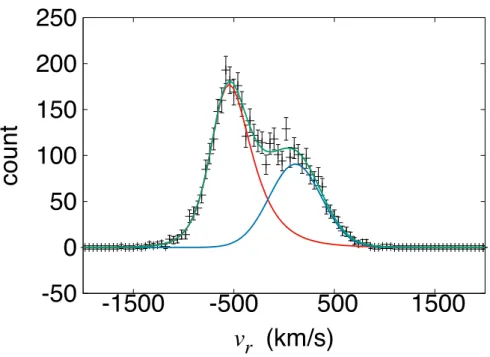
At small r, there are two peaks in histograms of radial velocities, reflecting the two distinct components as assumed in our model (see Fig. 4.6). As shown in Section 4.2, we add the splashback term to eq. (4.4) to reproduce the double peak feature. The model function we adopt for pvr,SB is the Gaussian distribution. Hence, at small r, pvr is
4.3 Radial Velocity Distribution 25 -200 0 200 400 600 800 1000 1200 -1500 -500 500 1500 count vr (km/s) (a) 5.0 Mpc/h < r < 5.2 Mpc/h
χ2/dof = 0.56 for SU-distribution, and χ2/dof = 7.34 for Gaussian distribution.
-200 0 200 400 600 800 1000 1200 1400 1600 1800 2000 -1500 -500 500 1500 count vr (km/s) (b) 10.0 Mpc/h < r < 10.2 Mpc/h
χ2/dof = 0.61 for SU-distribution, and χ2/dof = 10.73 for Gaussian distribution.
-500 0 500 1000 1500 2000 2500 3000 3500 4000 -1500 -500 500 1500 count vr (km/s) (c) 20.0 Mpc/h < r < 20.2 Mpc/h
χ2/dof = 0.85 for SU-distribution, and χ2/dof = 20.39 for Gaussian distribution.
-1000 0 1000 2000 3000 4000 5000 6000 7000 -1500 -500 500 1500 count vr (km/s) (d) 30.0 Mpc/h < r < 30.2 Mpc/h
χ2/dof = 1.41 for SU-distribution, and χ2/dof = 28.59 for Gaussian distribution.
Figure 4.5: Same as Fig. 4.4, but for radii larger than 2.8 Mpc/h. described as
pvr(vr; α, δ, λ, γ, ξ, µr, σr) =(1− α)SU(vr; δ, λ, γ, ξ)
+ αG(vr; µr, σ2r),
(4.6) where G(vr; µr, σr2) is the Gaussian distribution.
G(vr; µr, σ2r) = 1 √ 2πσ2 r exp { −(vr− µr)2 2σ2 r } , (4.7)
Note that µr and σr2 are functions of r. The physical meaning of the first term of the right
side hand of eq. (4.6) is the infall component of the phase space distribution, whereas the second term of the right side hand of eq. (4.6) is the splashback component. At large r, α goes to zero and eq. (4.6) is reduces to eq. (4.4). In Zu & Weinberg (2013), they adopted
-50
0
50
100
150
200
250
-1500
-500
500
1500
count
v
r
(km/s)
Figure 4.6: The radial velocity distribution at 1.2 Mpc/h < r < 1.4 Mpc/h for the middle galaxy cluster mass bin. Points with error bars are the histogram of radial velocities from our simulation, the red line is the best fit line of the first term of the right side hand of eq. (4.6) i.e. the infall component, the blue line is the best fit line of the second term of the right side hand of eq. (4.6) i.e. the splashback component, and the green line is the sum of the red and blue lines. χ2/dof = 0.38
two component model that consists of the infall and virial components. While the mean velocity of the virial component is always set to zero, the mean velocity of the splashback component is allowed to deviate from zero and is regarded as a model parameter. This is one of the main differences between our model and the model proposed in Zu & Weinberg (2013). As a result, our model in better agreement with the radial velocity distribution of simulated dark matter halos at r < 1.0 Mpc/h, than the model of Zu & Weinberg (2013) as shown in Fig. 4.6 and Fig. 4.7.
In Fig. 4.6, we show the radial velocity distribution at 1.2 Mpc/h < r < 1.4 Mpc/h for the middle galaxy cluster mass bin. We can see that our model function of eq. (4.6) is in good agreement with the histogram.
Fig. 4.7 shows the radial velocity distribution at small r other than 1.2 Mpc/h < r < 1.4 Mpc/h for the middle galaxy cluster mass bin. We can see that eq. (4.6) is in good agreement with the histogram even at other r.
4.3 Radial Velocity Distribution 27 -5 0 5 10 15 20 25 30 -1500 -500 500 1500 count vr (km/s) (a) 0 Mpc/h < r < 0.2 Mpc/h χ2/dof = 0.45 -10 0 10 20 30 40 50 60 -1500 -500 500 1500 count vr (km/s) (b) 0.2 Mpc/h < r < 0.4 Mpc/h χ2/dof = 0.74 -20 0 20 40 60 80 100 120 -1500 -500 500 1500 count vr (km/s) (c) 0.4 Mpc/h < r < 0.6 Mpc/h χ2/dof = 0.81 -20 0 20 40 60 80 100 120 140 160 180 -1500 -500 500 1500 count vr (km/s) (d) 0.8 Mpc/h < r < 1.0 Mpc/h χ2/dof = 0.73 -50 0 50 100 150 200 250 300 -1500 -500 500 1500 count vr (km/s) (e) 1.6 Mpc/h < r < 1.8 Mpc/h χ2/dof = 0.42 -50 0 50 100 150 200 250 300 350 -1500 -500 500 1500 count vr (km/s) (f) 2.0 Mpc/h < r < 2.2 Mpc/h χ2/dof = 0.43
-50
0
50
100
150
200
250
-1500
-500
500
1500
count
v
t
(km/s)
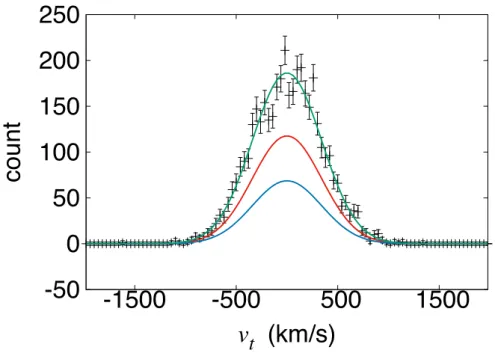
Figure 4.8: Same as Fig. 4.6, but for the tangential velocity. We use eq. (4.8) instead of eq. (4.6). χ2/dof = 0.66
4.4
Tangential Velocity Distribution
Next, we derive the tangential velocity distribution. The model function for pvt,infall and
pvt,SB are assumed to be the Gaussian distribution function. Specifically, pvt is described
as pvt(vt; α, σ 2 t,infall, σ 2 t,SB) =(1− α) 1 √ 2πσ2 t,infall exp ( − vt2 2σ2 t,infall ) + α√ 1 2πσ2 t,SB exp ( − vt2 2σ2 t,SB ) . (4.8)
Since we assume the spherically symmetric phase space distribution, the mean of vtmust
be zero. In eq. (4.8) we use α(r) calculated in eq. (4.6). Hence, we have only two parameters in eq. (4.8).
In Fig. 4.8, we show the tangential velocity distribution at 1.2 Mpc/h < r < 1.4 Mpc/h for the middle galaxy cluster mass bin. We can see that our model function eq. (4.8) is in good agreement with the histogram.
Fig. 4.9 shows the tangential velocity distribution at small radii other than 1.2 Mpc/h <
r < 1.4 Mpc/h for the middle galaxy cluster mass bin. We can see that eq. (4.8) is in
good agreement with the histogram even at other small radii.
Fig. 4.10 shows the tangential velocity distribution at larger radii for the middle galaxy cluster mass bin. Unlike the radial velocity, the Gaussian distribution is in good
4.4 Tangential Velocity Distribution 29
agreement with the histograms at larger radii for the tangential velocities. However at large radii, we can see that the histograms of tangential velocities from our simulation show slightly non-zero kurtosis, and cause worse χ2/dof.
-10 0 10 20 30 40 50 60 70 -1500 -500 500 1500 count vt (km/s) (a) 0 Mpc/h < r < 0.2 Mpc/h χ2/dof = 0.34 -20 0 20 40 60 80 100 120 140 160 -1500 -500 500 1500 count vt (km/s) (b) 0.4 Mpc/h < r < 0.6 Mpc/h χ2/dof = 0.64 -50 0 50 100 150 200 250 -1500 -500 500 1500 count vt (km/s) (c) 0.8 Mpc/h < r < 1.0 Mpc/h χ2/dof = 0.59 -20 0 20 40 60 80 100 120 140 160 180 200 -1500 -500 500 1500 count vt (km/s) (d) 1.8 Mpc/h < r < 2.0 Mpc/h χ2/dof = 0.31
4.4 Tangential Velocity Distribution 31 -50 0 50 100 150 200 250 300 -1500 -500 500 1500 count vt (km/s) (a) 2.6 Mpc/h < r < 2.8 Mpc/h χ2/dof = 0.99 -100 0 100 200 300 400 500 600 -1500 -500 500 1500 count vt (km/s) (b) 5.0 Mpc/h < r < 5.2 Mpc/h χ2/dof = 1.73 -200 0 200 400 600 800 1000 1200 1400 -1500 -500 500 1500 count vt (km/s) (c) 10.0 Mpc/h < r < 10.2 Mpc/h χ2/dof = 3.51 -500 0 500 1000 1500 2000 2500 3000 3500 -1500 -500 500 1500 count vt (km/s) (d) 20.0 Mpc/h < r < 20.2 Mpc/h χ2/dof = 6.18
0
0.2
0.4
0.6
0.8
0
0.5
1
1.5
2
2.5
α
(r
)
r (Mpc/h)
Figure 4.11: Radial distribution of α(r) for the middle galaxy cluster mass bin. Points with error bars are α(r) calculated by fitting eq. (4.6) to radial velocity distributions, and the solid line is the best fit line of eq. (4.9). The vertical lines show the upper and lower limits of the fitting range.
4.5
Radial Dependence of Parameters in The Model
In previous Sections, we adopt nine parameters to model the phase space probability distribution for each radial bin. To construct a full phase space PDF, we have to describe these parameters as a smooth function of r.
For α(r), we set the model function as
α(r) = Aα,1[tanh{(r − Aα,3)/Aα,2} − 1] , (4.9)
where Aα,1, Aα,2, and Aα,3 are free parameters. We choose this functional form just
to describe α(r) with a small number of free parameters. Fig. 4.11 shows the radial distribution of α(r). We can see that eq. (4.9) is in good agreement. We set the fitting range between vertical lines shown in Fig. 4.11, based on the reason that is given below. We show the cluster mass dependence of α(r) in Fig. 4.12. We can see that more massive clusters have larger fraction of the splashback component, and the larger splashback radius as shown in Mansfield et al. (2017).
For δ(r) and λ(r), we set the model function as
l(r) = Al,1exp (−rAl,2) + Al,3+ Al,4r. (4.10)
where l runs over δ and λ. Note that Al,1, Al,2, Al,3, and Al,4 are free parameters. Fig.
4.5 Radial Dependence of Parameters in The Model 33
0
0.2
0.4
0.6
0.8
0
0.5
1
1.5
2
2.5
3
α
(r
)
r (Mpc/h)
Figure 4.12: Radial distribution of α(r) for each galaxy cluster mass bin. Black symbols and line correspond to the middle mass bin, red to the high mass bin, and green to the low mass bin. Points show α(r) calculated by fitting eq. (4.6) to the radial velocity distribution, and lines are the best fit lines of eq. (4.9).
for α. We can see that eq. (4.10) is in good agreement with δ(r) and λ(r) within the fitting range.
We show the cluster mass dependence of δ(r) and λ(r) in Fig. 4.14. We can see that even at r > 20 Mpc/h, δ(r) and λ(r) show the dependence on the cluster mass.
For ξ(r) and γ(r), following Zu & Weinberg (2013), we set the model function as
l(r) = Al,1− Al,2rAl,3 + Al,4r, (4.11)
where l runs over ξ and γ. Note that Al,1, Al,2, Al,3, and Al,4 are free parameters. Fig.
4.15 shows ξ(r) and γ(r). The lower limit of the fitting range is same as the lower limit set α(r). We can see that eq. (4.11) is in good agreement with δ(r) and λ(r) within our fitting range.
We show the cluster mass dependence of ξ(r) and γ(r) in Fig. 4.16. We can see that even at r > 20 Mpc/h, ξ(r) and γ(r) depend on the galaxy cluster mass.
For µr, we set model function same as Zu & Weinberg (2013). The function form is
µr(r) = Aµr,1− Aµr,2r
Aµr ,3. (4.12)
Fig. 4.17 shows µr(r). The fitting range is same as α(r). We can see that eq. (4.12) is in
good agreement with µr(r).
We show the cluster mass dependence of µr(r) in Fig. 4.18. We can see that more
0 2 4 0 5 10 15 20 30 40 δ (r ) r (Mpc/h) (a) δ(r) for 0 Mpc/h < r < 40 Mpc/h 0 4 8 12 0 1 2 3 4 5 δ (r ) r (Mpc/h) (b) δ(r) for 0 Mpc/h < r < 5 Mpc/h 0 200 400 600 800 1000 0 5 10 15 20 30 40 λ (r ) (km/s) r (Mpc/h) (c) λ(r) for 0 Mpc/h < r < 40 Mpc/h 0 200 400 600 800 1000 0 1 2 3 4 5 λ (r ) (km/s) r (Mpc/h) (d) λ(r) for 0 Mpc/h < r < 5 Mpc/h
Figure 4.13: Same as Fig. 4.11, but for δ(r) and λ(r). We use eq. (4.10) instead of eq. (4.9). The lower limit of the fitting range, which is indicated by the vertical line, is same as the lower limit for α(r).
to the radius with α(r)∼ 0. This indicates that the infall component may include dark matter halos which are on their second orbit to falling into galaxy clusters.
For σr, σt,infall and σt,SB, we set model function same as δ(r) and λ(r). The function form
is
l(r) = Al,1exp (−rAl,2) + Al,3+ Al,4r, (4.13)
where l runs over σr, σt,infall, and σt,SB. Fig. 4.19 shows σr(r) and σt,SB(r). The fitting
range is same as α(r). We can see that eq. (4.13) is in good agreement with σr(r) and
σt,SB(r) within the fitting range.
We show the cluster mass dependence of σr(r) and σt,SB(r) in Fig. 4.20. We can see
that eq. (4.13) is in good agreement with σr(r) and σt,SB(r) within fitting range for other
cluster mass bins.
Fig. 4.22 shows σt,infall(r). The lower limit of the fitting range is same as the lower limit
4.5 Radial Dependence of Parameters in The Model 35 0 2 4 0 5 10 15 20 30 40 δ (r ) r (Mpc/h) (a) δ(r) for 0 Mpc/h < r < 40 Mpc/h 0 4 8 12 0 1 2 3 4 5 δ (r ) r (Mpc/h) (b) δ(r) for 0 Mpc/h < r < 5 Mpc/h 0 200 400 600 800 1000 0 5 10 15 20 30 40 λ (r ) (km/s) r (Mpc/h) (c) λ(r) for 0 Mpc/h < r < 40 Mpc/h 0 200 400 600 800 1000 0 1 2 3 4 5 λ (r ) (km/s) r (Mpc/h) (d) λ(r) for 0 Mpc/h < r < 5 Mpc/h
Figure 4.14: Same as Fig. 4.12, but for δ(r) and λ(r). We use eq. (4.10) instead of eq. (4.9).
range.
Then we show the galaxy cluster mass dependence of σt,infall(r) in Fig. 4.22. We can see
that eq. (4.13) is in good agreement with σt,infall(r). More massive clusters have larger
σt,infall(r) even at r > 20 Mpc/h.
We cannot determine parameters of the splashback component in the range that there is no splashback component, i.e. α ≪ 1. Hence, for α(r), µr(r), σr(r), and σt,SB(r), we
need to set upper limit of the fitting range. We set the upper limit as the radius that
α(r) calculated by fitting eq. (4.6) to radial velocity distributions become smaller than
0.1. We also set the lower limit of the fitting range for computational reasons. Note that the fitting range is set independently for each cluster mass bin. We show the upper and lower limits of the fitting range for each cluster mass bin in Table 4.1.
We summarize all the fitting results in Table 4.2. We show residuals of fitting, e.g., ∆α2/dof , which are typical differences between fitting lines and parameter values. We
-1000 -800 -600 -400 -200 0 200 400 0 5 10 15 20 30 40 ξ (r ) (km/s) r (Mpc/h) (a) ξ(r) for 0 Mpc/h < r < 40 Mpc/h -1000 -800 -600 -400 -200 0 0 1 2 3 4 5 ξ (r ) (km/s) r (Mpc/h) (b) ξ(r) for 0 Mpc/h < r < 5 Mpc/h -4 -2 0 2 0 5 10 15 20 30 40 γ( r) r (Mpc/h) (c) γ(r) for 0 Mpc/h < r < 40 Mpc/h -4 -2 0 2 0 1 2 3 4 5 γ( r) r (Mpc/h) (d) γ(r) for 0 Mpc/h < r < 5 Mpc/h
Figure 4.15: Same as Fig. 4.13, but for ξ(r) and γ(r). We use eq. (4.11) instead of eq. (4.10).
4.5 Radial Dependence of Parameters in The Model 37 -1000 -800 -600 -400 -200 0 200 400 0 5 10 15 20 30 40 ξ (r ) (km/s) r (Mpc/h) (a) ξ(r) for 0 Mpc/h < r < 40 Mpc/h -1000 -800 -600 -400 -200 0 0 1 2 3 4 5 ξ (r ) (km/s) r (Mpc/h) (b) ξ(r) for 0 Mpc/h < r < 5 Mpc/h -4 -2 0 2 0 5 10 15 20 30 40 γ( r) r (Mpc/h) (c) γ(r) for 0 Mpc/h < r < 40 Mpc/h -4 -2 0 2 0 1 2 3 4 5 γ( r) r (Mpc/h) (d) γ(r) for 0 Mpc/h < r < 5 Mpc/h
Figure 4.16: Same as Fig. 4.14, but for ξ(r) and γ(r). We use eq. (4.11) instead of eq. (4.10).
Table 4.1: The upper and lower limits of the fitting range for each cluster mass bin. cluster mass bin lower limit of the fitting range upper limit of the fitting range
low 0.6 Mpc/h 1.6 Mpc/h
middle 0.8 Mpc/h 2.0 Mpc/h
0
100
200
300
400
500
600
700
0
0.5
1
1.5
2
2.5
µ
r
(r
) (km/s)
r (Mpc/h)
Figure 4.17: Same as Fig. 4.11, but for µr(r). We use eq. (4.12) instead of eq. (4.9).
0
100
200
300
400
500
600
700
0
0.5
1
1.5
2
2.5
3
µ
r
(r
) (km/s)
r (Mpc/h)
4.5 Radial Dependence of Parameters in The Model 39 0 100 200 300 400 500 600 700 0 0.5 1 1.5 2 2.5 σr (r ) (km/s) r (Mpc/h) (a) σr(r) 0 100 200 300 400 500 600 700 800 0 0.5 1 1.5 2 2.5 σt,SB (r ) (km/s) r (Mpc/h) (b) σt,SB(r)
Figure 4.19: Same as Fig. 4.11, but for σr(r) and σt,SB(r). We use eq. (4.13) instead of
eq. (4.9). 0 100 200 300 400 500 600 700 0 0.5 1 1.5 2 2.5 3 σr (r ) (km/s) r (Mpc/h) (a) σr(r) 0 100 200 300 400 500 600 700 800 0 0.5 1 1.5 2 2.5 3 σt,SB (r ) (km/s) r (Mpc/h) (b) σt,SB(r)
Figure 4.20: Same as Fig. 4.12, but for σr(r) and σt,SB(r). We use eq. (4.13) instead of
eq. (4.9). 0 100 200 300 400 500 600 0 5 10 15 20 30 40 σt,infall (r ) (km/s) r (Mpc/h) (a) σt,infall(r) ; 0 Mpc/h < r < 40 Mpc/h 0 100 200 300 400 500 600 0 1 2 3 4 5 σt,infall (r ) (km/s) r (Mpc/h) (b) σt,infall(r) ; 0 Mpc/h < r < 5 Mpc/h
0 100 200 300 400 500 600 0 5 10 15 20 30 40 σt,infall (r ) (km/s) r (Mpc/h) (a) σt,infall(r) ; 0 Mpc/h < r < 40 Mpc/h 0 100 200 300 400 500 600 0 1 2 3 4 5 σt,infall (r ) (km/s) r (Mpc/h) (b) σt,infall(r) ; 0 Mpc/h < r < 5 Mpc/h
4.5 Radial Dependence of Parameters in The Model 41
Table 4.2: Fitting results. See also eqs. (4.9), (4.10), (4.11), (4.12), and (4.13).
cluster mass bin Aα,1 Aα,2 Aα,3 ∆α2/dof
low −0.2747 0.4920 1.1856 8.05× 10⁻⁴
middle −0.2503 0.4863 1.5298 7.37× 10⁻⁴
high −0.3036 0.8484 1.6639 58.95× 10⁻⁴
cluster mass bin Aδ,1 Aδ,2 Aδ,3 Aδ,4 ∆δ2/dof
low 757.5 8.072 0.9689 0.03891 59.74× 10⁻⁴
middle 103.1 4.608 1.2004 0.04353 64.82× 10⁻⁴
high 19.4 2.161 1.0473 0.02709 44.05× 10⁻⁴
cluster mass bin Aλ,1 Aλ,2 Aλ,3 Aλ,4 ∆λ2/dof
low 158008.0 7.891 160.0 18.49 523.3
middle 9565.6 3.416 201.0 20.08 464.6
high 9280.6 2.190 235.0 13.69 648.1
cluster mass bin Aξ,1 Aξ,2 Aξ,3 Aξ,4 ∆ξ2/dof
low 55.67 581.4 −0.7666 5.097 288.3
middle −55.79 819.8 −1.0118 11.192 506.7
high 43.85 1111.6 −0.6183 6.029 350.0
cluster mass bin Aγ,1 Aγ,2 Aγ,3 Aγ,4 ∆γ2/dof
low 0.6200 1.1753 −1.6962 0.004419 33.60−4
middle 0.5551 2.0867 −1.9243 0.017562 51.34−4
high 0.3661 1.8175 −1.9456 0.009608 48.71−4
cluster mass bin Aµr,1 Aµr,2 Aµr,3 ∆µ
2
r/dof
low 676808.0 676715.7 0.000366 866.1
middle 364923.6 364727.6 0.000763 322.3
high 245456.1 245075.1 0.001644 3557.7
cluster mass bin Aσr,1 Aσr,2 Aσr,3 Aσr,4 ∆σ
2
r/dof
low 2.7318 −1.7731 287.6 −86.799 6.551
middle 0.0013 −5.6642 382.9 −101.019 70.880
high 1980.8374 2.8624 345.7 −13.060 38.812
cluster mass bin Aσt,infall,1 Aσt,infall,2 Aσt,infall,3 Aσt,infall,4 ∆σ
2
t,infall/dof
low 981.2 3.521 250.7 2.201 13.59
middle 442.7 1.269 253.8 1.86 8.00
high 359.8 0.648 306.0 1.04 16.6
cluster mass bin Aσt,SB,1 Aσt,SB,2 Aσt,SB,3 Aσt,SB,4 ∆σ
2
t,SB/dof
low 4629.2 −0.4596 −3877.0 −3129.6 885.8
middle 3386.1 −0.3092 2683.1 −1556.9 453.4
4.6
Reconstruct v
losHistogram
By adopting best-fit parameters listed in Table 4.2 for eqs. (4.9), (4.10), (4.11), (4.12), and (4.13), we obtain smooth functions of eqs. (4.6) and (4.8), i.e., we have pvr(vr, r) and
pvt(vt, r) for each cluster mass bin. The histogram of vlos can be derived by projecting the
three-dimensional phase space distribution along the line-of-sight
pvlos(vlos, rproj) =
1 N (rproj) ∫ ∞ −∞ dvr ∫ ∞ −∞ dvt ∫ ∞ −∞
ddlosn(r)pv(vr, vt, r)δD(vlos− vlos′ ),
(4.14)
where,rproj is the projected distance from the cluster center, and dlos is the line-of-sight distance from the cluster center, n(r) is the number density of satellite-halos and sub-halos, δD(x) is the Dirac’s delta distribution, and pv(vr, vt, r) is phase space PDF (eq.
4.3). Note that r is defined as
r ≡
√
d2
los+ r2proj , (4.15)
and N is a normalization factor defined as
N (rproj)≡ ∫ vlos,Upper vlos,Lower dvlos ∫ ∞ −∞ dvr ∫ ∞ −∞ dvt ∫ ∞ −∞ ddlos ∫ ∞ −∞
dvlosn(r)pv(vr, vt, r)δD(vlos− vlos′ ) ,
(4.16)
where vlos,Upper and vlos,Lower are upper and lower limits of vlos we calculate, respectively. Because of practical reasons, we set vlos,Upper = 2000 km/s and vlos,Lower = −2000 km/s in this thesis. Note that we can also apply this cut to observational data, because vlos is a direct observable. Hence, this cut does not affect comparisons of our model with observations. Also, v′los is defined as
v′los≡ cos θ · vr+ sin θ· vt+ H · dlos, (4.17) where H is the Hubble parameter, and θ corresponds to the angle between the line from the cluster center and the line-of-sight (see also Fig. 4.23). At z = 0, H ≡ H0 = 100h km/s/Mpc.
In what follows, we set the integration range of vr and vt as −2000 km/s < vr, vt <
2000 km/s, because we find that there is almost no probability out of this range in the phase space distribution at any radii. We also set the integration range of dlos as
−40 Mpc/h < dlos< 40 Mpc/h, because When we are interested in −2000 km/s < vlos< 2000 km/s, and we take the integration range of vr and vt and the Hubble flow at z = 0
into account,−40 Mpc/h < dlos < 40 Mpc/h is sufficiently large.
In principle we can derive n(r) from observations, although in comparison with the N -body simulation results we use n(r) directly measured in the N --body simulation. Hence, all we have to determine is pv(vr, vt, r). Assuming that vr and vt are not correlated as we
see in Section 4.2, pv(vr, vt, r) is described as
pv(vr, vt, r) =
(1− α)SU(vr; δ, λ, γ, ξ)G(vt; 0, σ2t,infall)
+ αG(vr; µr, σr2)G(vt; 0, σt,SB2 ) .