カ ッ キ
ツ 類 の 寒 害
数易の幼樹の耐凍性
吉村不二男・大野芳信
(農学部果樹園芸学研究室)
(第1報)
Studies
on
the
cold
injury
of
citrus
trees.
Differences
in freezing resistance of citrusspecies.
Fujio YOSHIMURA and Yoshinobu Ono
(Laboratory of Fru・it-prodtictio・n, Facuiり”/ AgrtctiltuT・e) I
Summary
1. Using various citrus species grown in a green house from the previous late autumn, the resistance of the plants to freezing was observed by lowering the temperature of the refrigerator slowly down to − 5°C,−7°C,−8°C,−9°C, -10°C and −12°C respectively. The tissues arouiid the lateral shoot buds were first frozen at − 4 to 二5 °C,and the freezing spots appeared gradually on the leaves from their basal part at −5 to −6°C. Thus, the tem・ perature at which all plant parts were frozen was as follows: − 9°C for Natsumikan (Citrus Natsudaidai) and Orange (Citrus sinensis var. brasilensis) : -10°C for Lemon (Citrus limon), Hassaku (Citrus Hassakti), Hyuganatsu (Citrus Tamurana) and Buntan (Citrus grandis var. Hogen); and −11°C for Unshu (Citrus Unshu) and Daidai (Citrus Aurantium)。
2. When the temperature in each treatment was raised to −2 or −3°C from its minimum value, all of the frozen plants begin to thaw. They became as normal as the non-treated plants when kept at O °C for 4 or 5 days. However, it was noted that some of leaves were killed when the minimum temperature w瓦s −8°C・and some of stems were killed when it was −12°C, the degree of damage being most severe in Natsumikan, Lemon and Orange, and being least in Unshu and Daidai.
3. When the plants were moved to a warm place after the freezing treatment・they a11 developed new sprouts. However, their growth was markedly retarded by the treatment, particularly at freezing temperatures lower than − 8 °C. This retarding corresponded to the degree of freezing damage of the foliage. In conclusion, the cold resistance of citrus species was as follows : Daidai and UnshQ were the most resistant ; Buntati, Hassaku and Hyuganatsu were of medium resistance ; and Natsumikan, Lemon and Orange were the least resistant。
緒 言
最近カンキツ類の栽培か盛んとなり,その増植は相当な低温地帯にまで及び,それに伴って,耐 寒性品種の育成か望まれている。高知県の比較的暖かい地域にある当学部のカンキツ園では, ここ 数年間に再三にわたる甚だしい寒害をうけ,幼樹の半数以上か枯死した。その枯死歩合は品種によ
28 高知大学学術研究報告 第11巻 自然科学 n 第6号 , つていちじるしく異なり,文旦,八サク,日向夏ミカン,および夏ミカンでは全幼樹の全葉が枯れ 落ち,大半の樹が5,6月頃までに徐々に枯死した。 しかるに温州ミカンでは一部の葉が落ちる程 度で,枯死するものはなかった。すなわち,夏ミカンよりも温州ミカンの方が樹体の耐寒性が強か った。そこで,筆者は人為的に健全な幼樹を種々な低温にあわせて,その耐寒性を実験的に比較観 察することにした。 本稿は京都大学小林章教授の校閲をえた。心から感謝する。 ・ 実 験 材 料 と 方 法 実験1 ; 1959年11月下旬に箱植のダイダイ,温州ミカツ,法元文旦,八サク,ヴィラフランカ・ レモン,ワシントン・ネーブル・オレンジ,日向夏ミカンおよび夏ミカン(カラタチ台1年生)の 幼樹を温暖なガラス室(最低気温3.5°C,最高気温17.0°C)に搬入し,これらを1960年1月29日 から2月5日までの間で,順次,夕方(午後5時∼10時)から冷蔵庫に入れ,第1図に示すよう に,ほぽ自然に近い経過でO°Cから順次さげ,翌朝の明け方にそれぞれ,低極温一5°C, -7°’C および−9°Cに達するようにした。 いずれの場合も凍結処理前後12時間は冷涼な部屋(O∼5°C) に移した。なお,−7°C処理区だけは一度処理した一部の材料につき12時間後に再び−7°C処理を した。 以後は7月23日までガラス室にて普通に管理し,生育を比較観察した。 実験2;実験1の場合よりも低極温をさらに低くして処理した。 ・すなわち, 1960年12月下旬に。 。12・。 D゛゜tiont t t t t In a a a n n蕪万驚回 of freezing treatments in nu°be゛ of hours.
バ ︶ ゜ ' a j n j E J s a i u a j p a i e a J T 16 18 20 22 鉾 ・2 參,f・ 1 !0 Time
Fig. 1. Eχperimental design of the freezing treatments。
All plants were kept in a cool place o to 5°C for 12 hours before and after being subjected to freezing treatments. At the time designated for each treatment, in the evening of the eχperimental day, plants were placed in the refrigerator where the temperature was lowered at the rate of approχimately one degree per hour, finally reaching the value of −5°C,−7°C,−8°C,−9°C,−10°C and −12°C, respectively, early in the morning of the following day. Except for・ the treatment periods designated above, all plants were he】d at temperatures that varied from 3.5 to 17.0°C daily.
カンキツ類の寒害(第1龍) (吉村・大野) 29 鉢植の温州ミカン,法元文旦,八サク,ヴィラフランカ・レモンおよび夏ミカン(カラタチ台1年 生)の幼樹を一応温暖な処(最低気温O °C,最高気温16°C)においた後■ 1961年2月27日から3 月3日まで順次冷蔵庫に入れた。 その際の低極温はそれぞれ・-8°C,−10°Cおよび−12°Cであ る(第1図)。 処理後は7月5日まで温暖な圃場において普通に管理して,その生育状況を比較観 察した。
実 験 結 果
1.茎葉の凍結経過と凍死
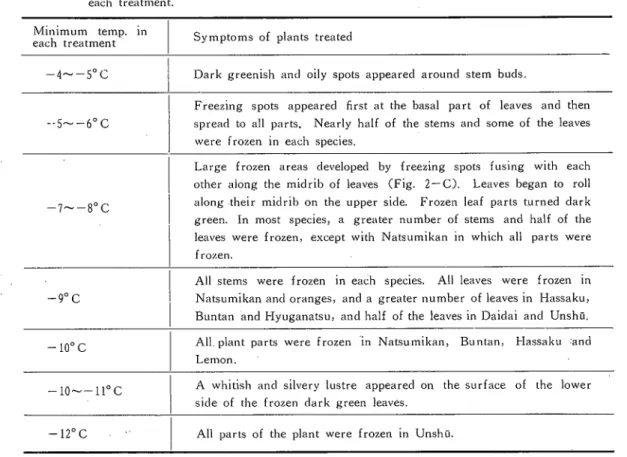
(i)凍結と症状: 樹休の凍結経過を示すと第1表および第2図のとおりである。車内の温度か
ー(4∼5)゜Cにさがると,金樹休の内で最初に凍結するのは茎の芽の附着部位で,濃緑色の油浸状
の斑点となった(第2図一A)。次いで,一一(5∼6)゜Cにさがると,中肋に沿った葉の基部に凍結斑
が現われ,次第に葉而全体に及んだ(第2区トB)。 その際,傷の部分や露の附着部位が特に早く
凍結した。さらにー(7∼8)゜Cにさがると,葉脈に沿って凍結斑が融合拡大した(第2図一:C)。温
度がさがるにつれて,葉が上方に向って円筒状に巻きはじめ,凍結部分の色が暗緑色にかわり,ほ
ぼ−10°Cで全樹体が凍結した。−(10∼11)゜Cになると,暗緑色に変じた葉の裏面に銀白色の光沢
を生じた(第2図一-D)。
(ii)種類別の凍結温度:凍結処理混度別に,種類開の凍結程度を比べると,−5°C処理ではい
ずれも茎の半分と葉の一部が凍結し,−7°C処理では,夏ミカンが全樹凍結した外は,種類間の差
が不明瞭で,概して,茎の大部分と葉の半分が凍結した。
−9°C処理になると,8種類ともに茎は
Table 1. Symptoms of plants tifterbeing kept in refrigerator, the temperature of which was lowered gradually from O°Cto the minimum temperature in each treatment. Minimum temp. in each treatment 4∼一5°C 5∼−6°C −7∼一8°C −9°C −10°C 10∼−11°C
Symptoms of plants treated
Dark greenish and oily spots appeared around stem buds
Freezing spots appeared first at the basal part of leaves and then spread to all parts. Nearly half of the stems and some of the leaves were frozen in each species.
Large frozen areas developed by freezing spots fusing with each other along the midrib of leaves (Fig. 2 ―C). Leaves began to roll along their midrib on the upper side. Frozen leaf parts tμΓned dark green. In most species, a greater number of stems and half of the leaves were frozen, except with Natsumikan in which all parts were
frozen. ・
All stems were frozen in each species. All leaves ・were frozen in Natsumikan and oranges, and a greater number of leaves in Hassaku. Buntan and Hyuganatsu, and half of the leaves in Daidai and Unshu。
一一
All.plant parts were frozen in Natsumikan, Buntan, Hassaku :and Lemon.
A whitish and silvery lustre appeared on the surface of the lower side of the frozen dark green leaves.
ろ0 高知大学学術研究報告 第11巻 自然科学 n 第6号
Fig. 2. Freezing symptoms of citrus Unshu when the temperature was gradually lowered to −12°C. Arrows point to the frozenヅparts.
全部凍結した。葉についていえば,夏ミカン,オレンジでは金葉か,八サク。文旦,レモン,日
向夏ミカンでは大半の葉が,ダイダイ,温州ミカンでは約半分の葉が凍結した。
−10°C処理では,
夏ミカン,文旦,八サク,レモンの全樹が凍結した。温州ミカンは−11°C以下になって(−12°C
処理)はじめて全樹が凍結した。
−7°Cの2回処理では,1回目よりも2回目の処理で,凍結斑が
高い温度からあらわれ,かつ,凍結量もいちじるしく多く,その傾向はとくに夏ミカンおよびオレ
ンジに顕著であった。
これらの凍紡中の樹の温度をあげて,−(2∼3)゜Cにすると,凍結斑が不明瞭となり,0°Cに戻
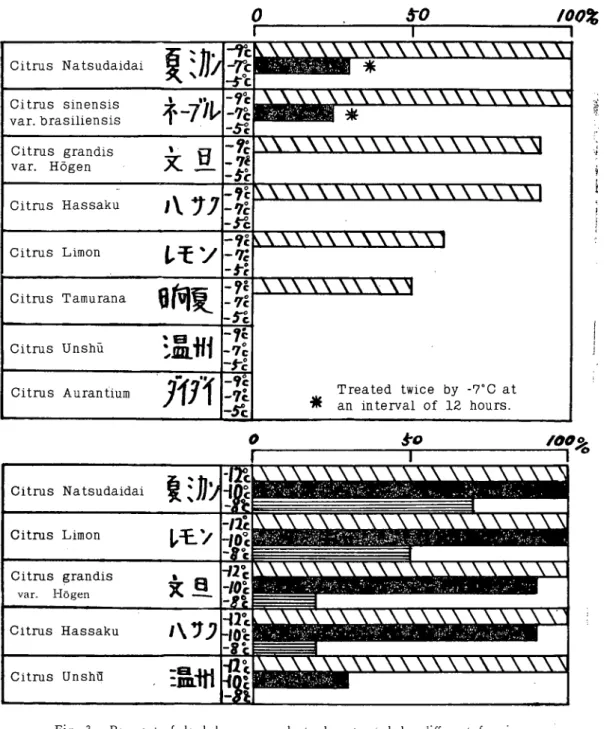
カンキツ類の寒害(第1報) .'大野 51 すと,葉が上方に反っている外は処理前とかわらず,4∼5日後には大部分が正常に戻った6ただ し,凍結処理の低極温がいちじるしく低い場合には組織が凍死した。凍死した葉は融解後24∼30時 間で乾枯し,梱色し褐変したままで,長期にわたって,樹上に固着し,とくに小葉は茎から離れ にくかった。茎では先端部が綴色し,褐変枯死した。枯死葉の発生状況を示すと第3,4図のとお 。 ♂ j{ , iりである。すなわち,−7°Cの1回処理。では枯死葉が全然現われなかったが,2回処理では夏ミヵ iOO% − 々 泌 ∼ 万 ︲ 。 グ ’ 、 I ’ 4 ‘ ・ ・ ね ず I ﹄ j i I 9 ・ I I r ︱ ・ l i ︲ t ‘ !
Citrus Natsudaidai 斐ミJフン
雲
哺こ
^\\\\\\\\\\\\\\\\\\\
四岑
Citrus sinensis
・ ・・
var.brasiliensis 予々/レ
-?1
-毀
-ぷ1
泰
Citrus grandis
・’ 冒
var. Hogen 又 -一侭 −″跨 -タ2・\\\\\\\\\\\\\\\\\\
Citrus
Hassaku j
χ、
77
浚
-n
\\\\ wwwwwww
Treated
豪 an interval 0f 12 hours.
twice by ’ワ゜C
at
Citrus Limon Lこliソ
−?£ −9i 一封CitrusTamurana BHl
1
-タi
CitrasUnshu lllL'111
幄
づi
CitrusAurantium
邱・;f
−?a
-71
哨:
∂如
哨!急
Citras Natsudaidai 賢ミカン
ミm
Citrus Limon レモン
一眼
老
\\\\\\\\\\\\\\\\\\\\
Citrus grandis ●
var. Hogen x旦
-/2'c 凌\\\ \\ \\\\\\\\\\\\\\\
Citrus
Hassaku lχサク
老
-il%
 ̄▽\\\\\\\\\\\\\\\\\\‘
Citrus Unshfl ijndtl
|
X \\\\\\\ wwwwww
㎜
Fig. 3. Per cent of dead leaves per plant when treated by different freezing temperatures. (Upper) Each individual species was treated on a different clay between January 29 and February 5, 1960. (Lower) Each individual species was treated on a different clay between February 27and March 3, 1961.
` ろ 2
1
高知大学学術研究報告 第11巻 自然科学 n 第6号 一一 一一一一
2 3 4 51 1 2 3 4
Fig. 4. Spring growth of plants on March 15 after being subjected to freezing treatments conducted on different clays between January 29 and February 5, 1960. 1 : Non-treatment, 2 : −5°C treatment, 3 : −7°C treatment, 4: −9°C treatment and 5 : Treated twice at -7°C.
5
ンおよびオレンジのー・部の葉,−8°C処理の温州ミカンを除く種類の半数の柴,−10°C処理の温
州ミカンの一部の葉および他の種類の殆んど金葉が,
-12°C処理のいずれの種類も全葉が凍死し
た。なお,
-12°C処理の夏ミカン,レモン,文旦,八サクの茎の頂部が凍死した。
2.凍結とその後の生育抑制
処理数ケ月後の生体増加重およびその時の状態を示すと第2,3表および第5,6図のとおりで
ある。
Table 2 Increasein fresh weight about 6 months after the freezing treatments
wereconducted on differentdays between January 29 and February 5,1960.
Citrus Aurantium ダイ ダイ Citrus Unshu 温州ミカン CitrusJ71勣g。。法元文旦 Citrus Tamurana 日向夏ミカン Citrus Hassaku 八 サー ク Citrus Limon レ モ ン C. Natsudaidai 夏 ミ カ ン Citrus sinensis 。 、、ヽ var. brasiliensis S レ ン ソ Non-treatment 一一 g 1.20(100) 0.79(100) 0.95(100) 0.79(100) 1.09(100) 1.43(100) 1.03(100) 0.87(100) −5°C treatment 0。87(73) 0.56(71) 0. 81(85) 0.63(81) 0.85(78) 1.39(97) 0.87(84) 0.65(75)
* Treated twice at −7°Cat an interval of 12 hours.
−7°C treatment 一一 g 0.84(70) 0.46(58) 0. 65(68) 0.47(60) 0.65(60) 0. 97(68) 0.41(40) 0.36(41) −7°C* treatment H g 0. 71(59) 0.43(54) 0.51(54) 0.40(51) 0. 52(48) 0.46(32) 0.38(27) 0.24(28) −9°C treatment - g 0.62(52) 0.37(47) 0. 36(38) 0. 29(37) 0.40(37) 0.39(27) 0.23(22) 0.05(6)
カンキヽン類の寒害 (第1報) (吉村・大野)
1 2 3 4 5 1 2 3 4 5
Fig. 5. Growth of plants on July 23 after being subjected to’the Freezing treatments conducted between January 29 and February 5, 1960. 1: Non- treatment, 2 : −5°C treatment, 31: −7°C treatment, 4 : -9°C treatment, and 5: Treated twice by − 7°C.
Tal〕le 3. Increase in fresh weig】it about 4.5 months after the freezing treatments were conducted on different days between February 27 and March 3, 1961.
ろろ Citrus Unshu ` Citrus grandis var.いHegen Citrus Haseaku Citrus Limon Citrus Natsudaidai 温州ミカン 法元文旦 八 サ ク レ モ ン 夏ミカ.ン Non-treatment g 0.49(100) 0.66(100) 0.68(100) 0.75(100) 0.57(100) −8°C treatment 一一 g 0.30(61) 0. 39(60) 0.30(44) 0.27(36) 0.20(35) −10°C treatment g O丿8(37) 0. 20(30) 0, 21(30) 0.20(27) 0.12(21) −12°C treatment g 0.07( 14) -0. 17(-26) -0. 22(-32) -0. 28(-37) -0. 22(-39)
54 高知大学学術研究棚告 第H巻 自然科学 U 第6号 −−−・−・----・- いずれの種類も凍結によってその 後の生育がいちじるしく阻害され た。その程度は−5°Cおよび−7° C処理では必ずしもその生育抑制 度と枝葉の耐寒性の順序と一致しな かづた。 しかし,−8°C, -9°C, −1・O°Cおよび−12°Cの如く,処理 極温か一・層低くなると,耐寒性の低 いものほど生育が抑制された。その 場合の抑制の程度はオレンジ,夏ミ カンおよびレモンで甚だしく,次い で,八サク,文旦,日向夏ミカンで あり,ダイダイおよび温州ミカンは 軽かった。・ 1 2 3 4
Fig. 6. Growth of plants on July 15 after being su卜 jected to the freezing treatments conducted on different clays between February 27and March 3. 1961-. 1: Non- treatment, 2 : −8°C treatment, 3 : −10°C treatment and 4: −12°C treatment. 考 察 一般に,カンキツ栽培の現況を気 温との関係でみると,1月平均気温 では5゜C以上,最低気温の平均では −5°C以上ないと,栽培は不可能と 云われ(3)。(4)ている。また,1月,2 月,の平均気温についてみると,4°C 以上の処に夏ミカン,八サク,金力 ンが,5∼6°Cの処にネーブル・オ レンジ,三宝カン,伊予カン,日向夏ミカン,ダイダイ,レモンが,7∼8°C以上の処にポンカ ン,グレープ・フルーツ(文旦)か栽培されている(1)。 したがって,平均気温からだけみると,高 知でのカンキツ栽培は十分に可能なはずである。 しかる‘に,実際には時々寒害をうけて,その栽培 か不振である。その理由としては,冬季の日最低気温が低いこと,とくに,その低極温がいちじる しく低いことがあげられる。 最近10年間で−5゜C(2)・(6)以下になった日を示すと,第4表のとおりである。 すなわち, 1959年 1月中旬には3日連続して,−5°C, -7°C, -9°Cに, 1960年12月末から1961年初頭にかけては 4日間および1月中旬と2月上旬に3日間−(5∼6)゜Cにさがっている。そのために,葉柄の基部 や芽の附近が灰褐色に枯死するとともに,葉が順次萎凋落葉し,4月,5月には多数の幼樹が枯死 した。 当実験においては,晩秋から引続いて温暖な場所で管理した材料を,ほぽ自然に近い経過をたど って温度をさげ,人為的に凍結させた。その結果,−7°C処理を2回繰返した場合でも,オレン ジ,夏ミカンの一・部の葉が−9°C処理では,オレンジ,夏ミカン,文旦,八サク,レモンおよび日 向夏ミカンの葉が, -12°C処理では温州ミカンの葉,および,文旦,八サク,レモン,夏ミカン の茎葉の大半が凍死した。 しかし,人為的に−10°Cにまでさげても,樹鉢のうちで最も早く凍る 芽の附近は凍死せず,処理後温暖な場所に1ヵ月ほどおくと,盛ん'に展芽仲長し,4∼6ヵ月後に は,生体重が増加した。 この点は,自然状態で日最低気温がー(5∼6)゜Cにもなると,大半が落葉 し,春季になって枯死するのと,やや趣を具にしている。おそらく,低温に遭う場合の植物体の内 外の条件やその後の外的条イ牛の相違に因るものと思われる。 また,既報(7)したように,当実験と
カンキツ類の寒害 (第1報) (吉村・大野) 一一 -一一-一一
Table 4. Date when the daily minimum temperature fell below −5°C between the years 1951 and 1961.
ろ5
December
January
February
1951 − 1952 1952 − 1953 14(−5.2)* 15 (-5.3) 1953 − 1954 1954 一 1955
16 (-5.5)
17 (-5.5)
22 (-5.3)
1956 ― 1957 j り 1 6 5 5 一 一 ぐ ぐ 4 5 2 25 (-6.3)
6 (-5.2)
j j j O 1 0 5 9 7 一 一 一 C ぐ ぐ 7 8 9 1 1 1 1959 − 196029 (-5.7)
28 (-5.3)
1960 ― 1961 30(−5.4) 31 (-5.0)1(べ6)
17 (-5.7)
18
2 (-5.7)
19 (-5.0)
(-6.3)
1(−5.0) 2 (-5.9) 3ト5.2) 15 (-5.1) * Numbers in parenthesis indicate the daily minimum temperature (゜C)全く同じ方法で,数種の実生を凍結させたのに,当実験の結果とは異り,−9°C処理ではもちろん −7°C処理でも文旦,八サク,夏ミカンの全葉が凍死し,その後長期にわたって樹体が徐々に枯死 した。これは供試した実生個体の茎の直径が僅か2∼4mmで,当実験供試の接木苗の8∼12 mm に比べて,ズイ(髄)部に多くの凍害を受けた(4)。(5)ためとも考えられる。 なお,当実験に供した 文旦,八サク,夏ミカンの接木苗がカンキツ類のうちでは耐寒性の最も強いカラタチ台に接いであ ることも,それぞれの実生苗木よりも耐寒性の強い原因でないかとも考えられる。 いずれにしても,凍結に対してカンキツ類は意外に強く,−7°Cに1日だけさがっても芽も葉 も枯れない。いま,耐凍性の高いものから低いものの順に列挙すると,ダイダイ,温州ミカン,文 旦,日向夏ミカン,八サク,レモン,夏ミカン,オレンジのとおりである。温州ミカンの耐寒性が ダイダイと同程度に強く,夏ミカンがレモン,オレンジと同程度に弱いことは意外であった。