Seroepidemiological Study of Anti-Adult T-Cell
Leukemia/Lymphoma Associated Antigen
Antibodies in Lae and Wewak of Papua New
Guinea (1991)
著者
TERASHI Shin'ichi, MALLETT Barry J., YAMBUIA
Gertrude, TALONU Tom
journal or
publication title
南太平洋海域調査研究報告=Occasional papers
volume
23
page range
47-52
URL
http://hdl.handle.net/10232/16783
"Man and the Environment in Papua New Guinea"
SEROEPIDEMIOLOGICAL STUDY OF ANTI-ADULT T-CELL
LEUKEMIA/LYMPHOMA ASSOCIATED ANTIGEN ANTIBODIES IN LAE AND WEWAK OF PAPUA NEW GUINEA (1991)
Shin'ichi TERASHI, Barry J. MALLETT, Gertrude YAMBUIA and Tom TALONU
Introduction
This seroepidemiological survey of a retrovirus induced human leukemia, named Adult T-cell Leukemia/Lymphoma (ATL), was started by TERASHI et al. (1986) in Papua New Guinea. Nearly all of the patients of ATL and many carriers of the HTLV-I (Human T-Lymphotropic Virus type-I) who are in a healthy condition will test positive for ATLA
(anti-ATL associated antigen Antibodies) in their sera.
Methods and Results
The human sera were collected from the out- and in-patients of Angau Memorial
Hospital (Morobe Province) and Wewak General Hospital (East Sepik Province) in Papua
New Guinea. A total of 138 sera were tested by a microtiter technique with a gelatin Par
ticle Agglutination method using a Serodia-ATLA kit (FUJIREBIO Inc., Tokyo, Japan).
The ATLA positive range was decided over 16 units of serum materials which were
concentrated by this test.
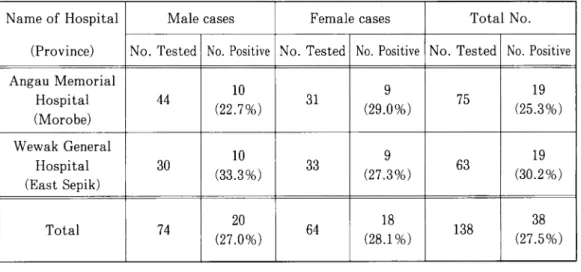
Table 1. ATLA* positive cases in Papua New Guinea (1991)
Name of Hospital (Province)
Male cases Female cases Total No.
No. Tested No. Positive No. Tested No. Positive No. Tested No. Positive
Angau Memorial Hospital (Morobe) 44 10 (22.7%) 31 9 (29.0%) 75 19 (25.3%) Wewak General Hospital (East Sepik) 30 10 (33.3%) 33 9 (27.3%) 63 19 (30.2%) Total 74 20 (27.0%) 64 18 (28.1%) 138 38 (27.5%)
Human sera were tested by PA method (FUJIREBIO Inc.)
48
S. Terashi et al.
Table 2. Age related ATLA* positive cases in Papua New Guinea (1991)
(ANGAU Memorial Hospital : Morobe Province)
Age
(Year old)
Male cases Female cases Total No.
No. Tested No. Positive No. Tested No. Positive No. Tested No. Positive
- 10 0 0 0 0 0 0 11 - 20 8 2 2 1 10 3(30.0%) 21 - 30 15 1( 6.7%) 4 1 19 2(10.5%) 31 - 40 2 0 2 1 4 1 41 - 50 3 1 1 0 4 1 51 - 60 2 1 1 1 3 2 Adult 14 5(35.7%) 21 5(23.8%) 35 10(28.6%) Total 44 10(22.7%) 31 9(29.0%) 75 19(25.3%)
Human sera were tested by PA method (FUJIREBIO Inc.)
ATLA* : anti-Adult T-cell Leukemia/Lymphoma associated antigen Antibodies
Table 3. Age related ATLA* positive cases in Papua New Guinea (1991)
(WEWAK General Hospital : East Sepik Province)
Age
(Year old)
Male cases Female cases Total No.
No. Tested No. Positive No. Tested No. Positive No. Tested No. Positive
- 10 8 2 8 1 16 3(18.8%) 11 - 20 5 2 6 1 11 3(27.3%) 21 - 30 1 0 3 2 4 2 31 - 40 3 1 2 0 5 1 41 - 50 0 0 0 0 0 0 51 - 60 2 0 0 0 2 0 Adult 11 5(45.5%) 14 5(35.7%) 25 10(40.0%) Total 30 10(33.3%) 33 9(27.3%) 63 19(30.2%)
Human sera were tested by PA method (FUJIREBIO Inc.)
ATLA* : anti-Adult T-cell Leukemia/Lymphoma associated antigen Antibodies
The results of the serological study on ATLA in both hospitals are showed in Table 1.
The incidences of ATLA positive are seen in 19cases out of 75 (25.3%) in Angau Memo rial Hospital and 19 cases out of 63 (30.2%) in Wewak General Hospital.
Finding the prevalence by age in both hospitals was too hard, because many inhabit ants did not know their ages (Table 2. and 3.). The birth place of the patients of Angau
Table 4. Birth or dwelling place of ATLA* positive cases in Papua New Guinea (1991)
(ANGAU Memorial Hospital)
Name of Province
Malec a s e s Female cases Total No.
No. Tested No. Positive No. Tested No. Positive No. Tested No. Positive
Morobe East Sepik Chinbu 18 5 5 6(33.3%) 1 2 20 4 2 4(20.0%) 3 1 38 9 7 10(26.3%) 4(44.4%) 3(42.9%) Madang Eastern Highlands Western Highlands Gulf 3 3 3 2 0 0 0 1 1 1 1 0 0 0 0 0 4 4 4 2 0 0 0 1 Milne Bay Central 1 0 0 0 1 1 0 1 2 0 1 Northern 1 0 0 0 0
West New Britain 1 0 0 0 0
West Sepik Western 1 1 0 0 0 0 0 0 0 0 New Ireland 0 0 0 0 0 0
East New Britain 0 0 0 0 0 0
Southern Highlands Manus 0 0 0 0 0 0 0 0 0 0 0 0 Enga North Solomons 0 0 0 0 0 0 0 0 0 0 0 0 Total 44 10(22.7%) 31 9(29.0%) 75 19(25.3%)
Human sera were tested by PA method (FUJIREBIO Inc.)
ATLA* : anti-Adult T-cell Leukemia/Lymphoma associated antigen Antibodies
Memorial Hospital is revealed by the name of the province in this series in Table 4. The
research in a three year survey from 1986 to 1988 in Papua New Guinea is summarized by
birth place in Table 5.
Discussion
The Adult T-cell Leukemia/Lymphoma (ATL) is caused by an infection of a retrovirus of HTLV-I. Anti-ATL associated antigen Antibodies (ATLA) in humam sera are detected in most ATL patients and in a relatively high percentage of the healthy individuals born in
ATL-endemic areas (HiNUMA et al., 1981).
In Japan, ATL-endemic areas are found in the southwestern regions, where healthy carriers were found at a high rate of 6-37% (HiNUMA et al., 1982) and at 2.2-8.7% in Niigata
prefecture (AOKI et al., 1985). In Okinawa, the southernmost part of Japan, 51 cases are found in every 170 patients (30.0%), including 20 ATL patients who tested positive for ATLA (Clark et al, 1985).
50 S. Terashi et al.
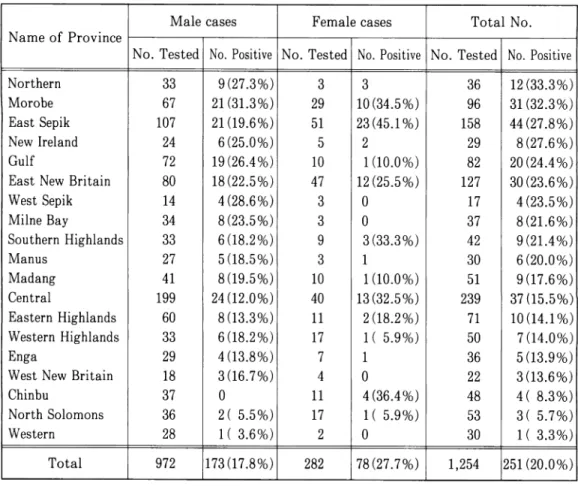
Table 5. Birth place of ATLA* positive cases in Papua New Guinea (1986-1988)
(Names of sampling places: Port Moresby, Lae, Mt. Hagen, Madang, Wewak, Rabaul & Arawa)
Male cases Female cases Total No.
Name of Province
No. Tested No. Positive No. Tested No. Positive No. Tested No. Positive
Northern 33 9(27.3%) 3 3 36 12(33.3%)
Morobe 67 21(31.3%) 29 10(34.5%) 96 31(32.3%)
East Sepik 107 21(19.6%) 51 23(45.1%) 158 44(27.8%)
New Ireland 24 6(25.0%) 5 2 29 8(27.6%)
Gulf 72 19(26.4%) 10 1(10.0%) 82 20(24.4%)
East New Britain 80 18(22.5%) 47 12(25.5%) 127 30(23.6%)
West Sepik 14 4(28.6%) 3 0 17 4(23.5%) Milne Bay 34 8(23.5%) 3 0 37 8(21.6%) Southern Highlands 33 6(18.2%) 9 3(33.3%) 42 9(21.4%) Manus 27 5(18.5%) 3 1 30 6(20.0%) Madang 41 8(19.5%) 10 1(10.0%) 51 9(17.6%) Central 199 24(12.0%) 40 13(32.5%) 239 37(15.5%) Eastern Highlands 60 8(13.3%) 11 2(18.2%) 71 10(14.1%) Western Highlands 33 6(18.2%) 17 1( 5.9%) 50 7(14.0%) Enga 29 4(13.8%) 7 1 36 5(13.9%)
West New Britain 18 3(16.7%) 4 0 22 3(13.6%)
Chinbu 37 0 11 4(36.4%) 48 4( 8.3%)
North Solomons 36 2( 5.5%) 17 1( 5.9%) 53 3( 5.7%)
Western 28 1( 3.6%) 2 0 30 1( 3.3%)
Total 972 173(17.8%) 282 78(27.7%) 1,254 251(20.0%)
Human sera were tested by PA method (FUJIREBIO Inc.)
ATLA* : anti-Adult T-cell Leukemia/Lymphoma associated antigen Antibodies ^ Transcribed data from TERASHI, Talonu, et al. 1990. South Pacific Study,
10 : 263-274.
In neighboring countries, only a few ATLA positive cases were reported in Taiwan (PAN
et al., 1985), Korea (LEE et al, 1986) and China (ZENG et al, 1984). Each population was
composed of healthy persons and patients with various diseases.
The West Indies/Caribbean basin is also known as an HTLV-I invaded area, especially in areas with high concentrations of black people. (CATOVSKY et al., 1982 ; BLATTNER et
al., 1982). Africa is also an HTLV-I endemic area (SAXINGER et al., 1984).
Our surveies in Oceania were started in 1983. No positive cases were found in our sur
vey on the Solomon Islands nor Viti Levu (Fiji) where we collected 72 and 156 sera,
respectively (MATSUMOTO, TERASHI & PARKER 1983 ; TERASHI et al., 1983).
In the Federated States of Micronesia, no positive cases out of 57 persons in Truk State though three tested positive out of 154 (1.95%) individuals in Pohnpei State (TERASHI et
al., 1986), and nine positive reactions out of 133(6.77%) inhabitants of Yap State (TERASHI
et al., 1987a) were detected for ATLA in the sera. In the Republic of Palau, nineteen
positive cases out of 176(10.8%) sera were found from inhabitants in our research work
(Terashi etal, 1987b).
In Papua New Guinea (PNG), the research survey for ATLA was started by TERASHI et
al. in 1986 and was also held by BABONA & NURSE (1988). It showed that PNG was a high
incidental country for ATLA positivity.
A report for ATLA by TERASHI, ISHIDA & TALONU (1990) pointed out the positivity of
27.7% patients of Papua New Guinean but only 7.3% in the foreign residency of PNG. The data for three years from 1986 to 1988 in PNG was summarized by the birth place of
residency in TERASHI, TALONU et al. (Table 5. : 1990. South Pacific Study, Vol. 10). It was
indicated that the ATLA positive test was higher if their birth place was near the costal area of the Pacific Ocean than it was if they were born near the Coral Sea or highlands as shown in Table 5. In the survey of this time, the difference of ATLA positivity was not so
clear because the sample tested was too small (Table 4.). In our report (1991), collected
samples indicated 13.1% and 12.6% in the sera of Port Moresby and Lae, respectively. Furthermore mother to fetal infection by her umbilical cord was a less likly route, because
the positive rate of ATLA was shown 6.9% and 0.02% in the samples of childbirth mother
and her umbilical cord blood, respectively.
Immunofloresence tests for the same sera collected from 1986 to 1988 indicated 33
positive casea out of 1,471 (2.2%) in Papua New Guinea (Imai, TERASHI, TALONU et al.
1990).
References
AOKI, T., et al. 1985. Int. J. Cancer, 35 : 301-306.
BABONA, D. V. & NURSE, G. T. 1988. Lancet, November 12 : 1148.
BLATTNER, W. A., et al. 1982. Int. J. Cancer, 30 : 257-264. CATOVSKY, D., et al. 1982. Lancet, March 20 : 639-643. Clark, J. W., et al. 1985. Cancer Res., 45 : 2849-2852.
HiNUMA, Y., et al. 1981. Proc. Natl. Acad. Sci. USA, 78 : 6476-6480.
HiNUMA, Y., et al. 1982. Int. J. Cancer, 29 : 631-635.
IMAI, J., TERASHI, S., TALONU T., et al. 1990. Jpn. J. Cancer Res., 81 : 1218-1221. LEE, S. Y., et al. 1986. Jpn. J. Cancer Res. (Gann), 77 : 250-254.
MATSUMOTO, T., TERASHI, S. & PARKER, M. 1983. Prompt Report 2nd Scientific Survey South Pac, (ed. NAKANO, K. et al.), : 113. Kagoshima Univ. Res. Center S. Pac,
Kagoshima.
PAN, I-H., et al. 1985. Jpn. J. Cancer Res. (Gann), 76 : 9-11. SAXINGER, W., et al. 1984. Science (Wash. D. C), 255 : 1473-1476.
TERASHI, S., et al. 1983. Prompt Report 2nd Scientific Survey South Pac, (ed. NAKANO, K.
et al.), : 108-112. Kagoshima Univ. Res. Center S. Pac, Kagoshima.
, et al. 1986. A Report of Scientific Survey in Papua New Guinea, (unpublished)
, et al. 1986. Prompt Report 4th Scientific Survey South Pac, (ed. NAKANO, K. et
al.),' 57-64. Kagoshima Univ. Res. Center S. Pac, Kagoshima.
, et al. 1987a. Prompt Report 5th Scientific Survey South Pac, (ed. NAKANO, K. et
S. Terashi et al.
, et al. 1987b. Prompt Report 5th Scientific Survey South Pac, (ed. NAKANO, K.
et al.), : 62-65. Kagoshima Univ. Res. Center S. Pac, Kagoshima.
, ISHIDA, T. & TALONU, T. 1990. Progress Report 1989 Survey of the Research Project,
"Man and the Environment in Papua New Guinea", Kagoshima Univ. Res. Center S. Pac. (ed. NAKANO, K. et al.), Occasional Papers, No.20 : 35-38.
, TALONU, T., et al. 1990. South Pacific Study. 10 : 263-274. (in Japanese)
, BABONA, D. & TALONU, T. 1991. Progress Report 1990 Survey of the Research Project, "Man and the Environment in Papua New Guinea", Kagoshima Univ. Res. Center S. Pac. (ed. HAYASHI, M.), Occasional Papers, No.21 : 45-48.