
近畿大学学術情報リポジトリ
24
0
0
全文
(2) 教 養 ・外 国 語 教 育 セ ン ター 紀 要. ACorpusAnalysisofDictionariesforJapaneseLearnersofEnglish toFacilitateEnglishTeachingandLearning. 11ntroduction InEnglisheducationinJapanatranslation-orientedapProachhasbeentraditionally usedinmanyJapanesehighschoolsundertheinfluenceofcollegeentrance examinations.Thissituationisduemainlytotheprevailingnotionthattheuseofdirect methodsinEnglishteachingisunsuitableforJapaneselearners.However,underthe governmentsnewinitiativetoimproveJapanesestudents'communicationabilitiesin English,therehasbeenagrowingtendencyamonghighschoolstowardadoptingan oralcommunication-orientedapproachtoJapaneseESLeducation.Thustherehasbeen agrowingshifttodayfromthetraditionalapproachtotheacquisitionofcommunicative competence,placingmostEnglishlearningprogramsinJapanhalfwaybetween translationandcommunicationskilldevelopmentapproaches. Underthecircumstances,highlyeffectiveESLeducationinJapanentailsthe selectionorcreationofmosteffectivedictionariesthatcanimprovelearners' communicationandtranslationabilities.ThoseareJapanese-English,English-Japanese, andEnglish-Englishdictionarieswhichcandeveloplearners'Englishcommunication abilitiesaswellashelpESLlearnerstranslateJapanesepolysemicwordseffectivelyinto Englishequivalentsandviceversathroughlearningcommonlyusedcollocationsof Englishvocabularies. Thusthispaperexaminestheeffectivenessofthosethreekindsofdictionariesfor Englishlearnersintermsofprioritizationandcategorizationofwords'meaningsbased ontheircollocationalfrequenciesshownbytheBankofEnglishcorpusl.Thispaperfirst providesabriefoverviewoftheliteratureofcorpuslinguisticsinconnectionwith 1TheBankofEnglishistheCOBUILDcorpus. ,acollectionofEnglishtexts,jointlyownedby HarperCollinsPublishersandtheUniversityofBirmingham.Thecorpustotals525million runningwordsasof2005.Thishugecollectioniscomposedofawiderangeofdifferenttypesof writingandspeech,whichcontainssamplesoftheEnglishlanguagefromhundredsofdifferent sources.Themajorityofthedataarewriting,whichcomesfromnewspapers,magazines,fiction andnon-fictionbooks,brochures,leaflets,reports,andletters.Thereisalsoalargecomponentof spokendata,whicharetranscriptionsofeverydaycasualconversation,radiobroadcasts,meetings, interviews,discussions,etc.Thematerialisup-to-date,withthemajorityoftextsoriginatingafter 1990.TheyaremainlyBritish,butAmericanandAustraliandataarealsoincluded.Thecorpusis partlyopentothepublic,andthefullversionisavailableatUniversityofBirmingham,thelatter ofwhichcanbeaccessedonlyforacademicpurposes.Thecorpususedforthispaperisthe Birminghamversion. 一234一.
(3) CorpusAnalysisofDictionariesforJapaneseLearnersofEnglishtoFacilitateEnglishTeachingandLearning. lexicographyandlanguagelearning,andthenabriefdescriptionofthemethodologiesof thiscorpusresearch,andcorpus-basedanalysisofthesemanticcategorizationand prioritizationofthefollowingtwowords:1.Englishequivalentsforthepolysemic Japaneseverb"suru"inseveralmostpopularJapanese-Englishdictionaries2.the polysemicEnglishverb``develop"inseveralmostpopularEnglish-JapaneseandEnglishEnglishdictionariesavailableinJapan.Thefinalchapterofferssuggestionsabouthowto revisetheabove-mentioneddictionariesbasedontheanalysistofacilitatetheacquisition ofcommunicationandtranslationabilitiesbyJapaneseESLlearners.. 2Literaturereview:Corpuslinguisticsandlexicographyforlanguagelearning Acorpusisabodyofwrittentextortranscribedspeech,whichissaidtoserveas abasisforlinguisticanalysisanddescription"(Kennedy,1998:1).Theauthor(ibid.)also statesthatcorpuslinguisticsis"onesourceofevidenceforimprovingdescriptionsof thestructureanduseoflanguagesandunderstandinghowtolearnorteachalanguage." Intheareaoflexicography,theuseofcorpus-basedtechniquesallowsresearchersto conductpreviouslyintractableresearchesinlinguisticsonrelativefrequencies"between words,meaningsandusages,whichcanbeusedbythedictionarywriterinthe categorizationandprioritizationofaword'smeanings.Hunston(2002:21-22)notesthat notnativespeakers'intuitionbutcorporaishelpfulintheassessmentofrelative frequency,arguingthat"intuitionisapoorguidetoatleastfouraspectsoflanguage: collocation,frequency,prosodyandphraseology."Biberetal.(1998:23-24)alsostates thatcorpus-basedlexicographicinvestigationstodayaddressthesixresearchquestions: 1.themeaningsassociatedwithaparticularword; 2.thefrequencyofawordrelativetootherrelatedwords; 3.non-linguisticassociationpatternsofaparticularword(e.g.,toregisters, historicalperiods,ordialects); 4.alistofcommonlyco-occurredwordswithaparticularword,andthe distributionofthese"collocational"sequencesacrossregisters; 5.thedistributionofthesensesandusesofaword;and 6.theuseanddistributionofsynonymsinacorpus. Intermsoflanguagelearning,SinclairandRenouf(1988)advocatecorpus-based lexicalsyllabusesforlanguagelearning,suggestingthemainpedagogicalemphasison themostfrequentwordsinthelanguage,theircentralpatternsofusageandthe. 一235一.
(4) 教 養 ・外 国 語 教 育 セ ン ター 紀 要. collocationstheyaretypicallypartof(Kennedy1998:289)."Goethals(2003:424)argues that"frequencyrankingwillbeaparameterforsequencingandgradinglearning materials"because"frequencyisameasureofprobabilityofusefulness"and"highfrequencywordsconstituteusefulcorevocabularies"(McEnery,etal.,2006:102).Leech (1997:16)arguesthat:Whatevertheimperfectionsofthesimpleequation"most frequent"_"mostimportanttolearn,"itisdifficulttodenythatfrequencyinformation becomingavailablefromcorporahasanimportantempiricalinputtolanguagelearning material(McEnery,etal.,2006:102). AsforESLlearners'attitudetowardmonolingual/bilingualdictionaries, researchers(Tomaszczyk,1979;Bejoint,1981;Baxter,1980;Kharma,1985)statethat beginningandintermediateEFLlearners'preferbilingualdictionariestomonolingual ones,whereasadvancedlearnersappreciatemonolingualdictionariesmore.However, Bejoint(1981)statedthatthoseadvancedlearnerswho"owned,usedandappreciated monolingualdictionariesonlyboughtthoserecommendedbytheirteachersandtheydid notknowofanyotheroptions"(Tono,2001:44).Thisclearlyindicatesthesignificance ofteachers'recommendationsandcommentsontheselectionofdictionariestotheEFL learners. However,thelimitationsofacorpusgoasfollows(Hunston,2002:22-23): 1.Acorpuswillonlyprovideinformationaboutthefrequencyofawordrelativeto otherrelatedwords,notitspossibility. 2.Allattemptstodrawgeneralizationsfromacorpusareinfactextrapolations. 3.Thecorpussimplyofferstheresearcherplentyofexamplesbutonlyintuition caninterpretthem. 4.Acorpuspresentslanguageoutofitscontextandneverrepresentsintonation, kinesics("bodylanguage"),andotherparalinguisticinformationentirely accurately.. 3Corpus-basedanalysisofJapanese-Englishdictionaries 3.1ReasonsforanalysisofEnglishequivalentsforaJapanesepolysemicverbsuru(literally,do) JapaneseEFLlearnersoftenhavedifficultytranslatingtheJapanesebasicverb " suru(literally,do)"intoEnglishduetoaninterlingualtransfererror.Infact,amajority ofaverageJapaneselearnersofEnglishoftentranslate``party-suru"(literally,party-do) into"doaart"insteadof"have/ive/holdaart"pygpy,andspeech-suruintodoa. 一236一.
(5) CorpusAnalysisofDictionariesforJapaneseLearnersofEnglishtoFacilitateEnglishTeachingandLearning. speech"insteadof"makeaspeech".Thesecommonlyoccurringerrorsarederived mainlyfromthetraditionalindirectmethod,orgrammar-translationmethodemployed intheJapaneseESLeducation.WhenJapanesehighschoolstudentstrytolearnanew Englishword(e.g.do),almostallofthemmemorizeonlyoneortwoJapanesemeanings (e.g.suru),andwhentheytranslatepolysemicEnglishwordscontextuallyintoJapanese, theyrefertoonlytwoorthreemeaningsinEnglish-Japanesedictionaries.Bythesame token,whentheytranslatepolysemicJapanesewordsintoEnglish,theyusuallycome upwithonlyoneortwoEnglishequivalents.Thisisoneoftheseriousdrawbackstothe indirecttranslationmethodofteachingEnglishintheJapaneseEFLeducation,which leadstounnaturalEnglishwritingbyJapaneseEFLlearners.Thustheuseofmost effectiveEnglish-JapaneseandJapanese-Englishdictionariesplaysavitalroleinthe indirecttranslationmethodofteaching.InJapanthesetwokindsareusuallyregarded assacrosanctastheBiblebyEFLlearners.ThusImadeacorpusresearchto investigatewhichEnglish-JapaneseandJapanese-Englishdictionariesaremosteffective fortheacquisitionofcommunicationandtranslationalskills.. 3.2ThemethodofthecorpusresearchonJapanese-Englishdictionaries Themethodforthiscorpusresearchgoesasfollows: 1.Thefrequencyofseveralverbcollocatesofthefournouns(party,trip,speech, andadvertisement)wasexaminedbytheBankofEnglishcorpus. 2.Therawcountoftheconcordancelinesandtherelativefrequencyofeach collocatewaspresented. 3.ThefollowingfivepopularJapanese-Englishdictionarieswereexaminedtofind whatverbcollocatesofeachnounentryarelistedandinwhatordereachverb collocatesarepresented:KenkyushaJapanese-EnglishDictionary,4thed. (2002);ProgressiveJapanese-EnglishDictionary,3rded.(2006);NewCentury Japanese-EnglishDictionary,2nded.(2006);GeniusJapanese-EnglishDictionary, 2nded.(2003);TheSuperAnchorJapanese-EnglishDictionary,2nded.(2004)) 4.TheresultsofNo.3werecomparedwiththoseofthecorpus(No.2)toanalyze theeffectivenessofeachdictionaryintermsofcollocationalfrequency.The analysisisbasedon"theruleofgeneralization,"whichmeansthatthetop70 0ffrequentcollocatesshouldbecoveredineachnounentryintheeffective Japanese-EnglishdictionariesforEFLlearnersandteachers.. 一237一.
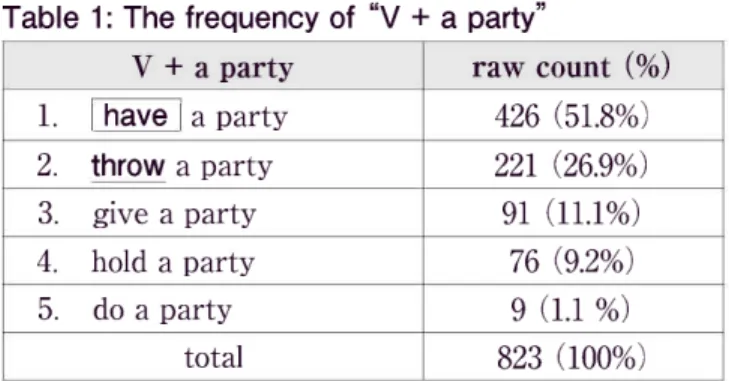
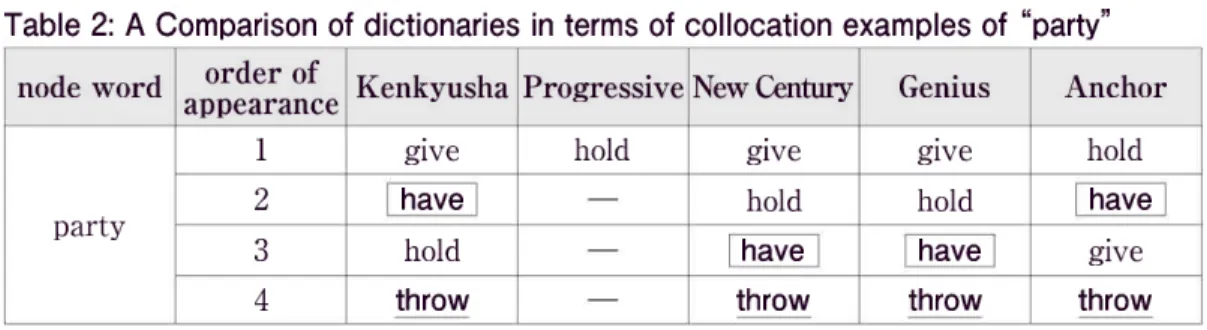
(6) ft*.NAMftil:/37—CV 3.3 Data analysis and review of dictionaries 3.3.1 Party-suru (literally, party-do) First, I consulted "th. the BoE corpus for the search. strings. "have@+a+party,". row@+a+party,""give@+a+party,""hold@+a+party,"and"do@+a+party". to find. the most frequently used English equivalent for the Japanese verb "party-suru." research findings (Table 1) demonstrate. that "have a party" (51.8%) is most frequently. used; "throw a party". (26.9%) comes second; "give a party". party". "Do a party". (9.2%) fourth.. The. (11.1%) third, and "hold a. comes fifth (1.1%), which is far less frequent. compared with "have a party." This data can be useful for teachers and students who are anxious. to know which collocates. are the best. The frequency. collocation "V+a party" can be summarized > throw. by the following inequality:. result. of the. "[have (52%). (27%) > give (11%) > hold (9%)] a party.". Table 1: The frequency of "V + a party" V + a party. raw count (%). 1. I have la party. 426 (51.8%). 2.. throw. 221 (26.9%). 3.. give. a party. 91 (11.1%). 4.. hold. a party. 76 (9.2%). 5.. do a party. a party. 9 (1.1 %). 823 (100%) take@a+trip / make@a+trip / go@+on+a+trip / have@a+trip / do@a+trip total. Next, I consulted the five Japanese-English for "party-suru.". dictionaries to find English equivalents. The example phrases or sentences in the entry noun "party" in each. dictionary revealed that the order of the four verb collocates, "give," "have," "hold" and "th row" in the dictionaries are quite different from that based on the BoE corpus. As seen in Table 2, "have a party," the most frequently used collocation (51.8 %) in the BoE corpus, do not appear in the first examples. in each dictionary: the two dictionaries. (Kenkyusha and Anchor) rank the collocation "have a party" second, and the other two dictionaries. (New Century and Genius) rank the collocation third. Three dictionaries. (Kenkyusha, New Century, and Genius) rank "give a party" the first, which is ranked third. (11.1 %) in the Bank of English. (BoE) corpus, and the other two dictionaries. — 238 —.
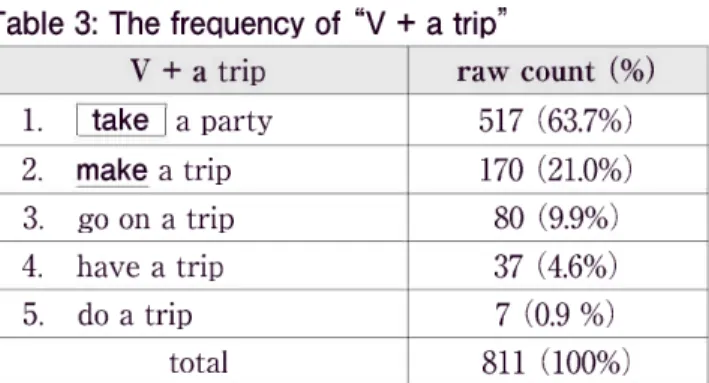
(7) CorpusAnalysisof Dictionariesfor JapaneseLearnersof Englishto FacilitateEnglishTeachingand Learning (Progressive. and Anchor) rank "hold a party" as the first, which is ranked fourth (9.2. %) in the BoE corpus.. Table node. 2: A Comparison word. order of appearance. of dictionaries. in terms. Kenkyusha. Progressive. of collocation. examples. of "party". New Century. Genius. give. give. hold. hold. Anchor. 1. give. 2. have. hold. hold. have. 3. hold. have. have. give. throw. throw. throw. party. * The boxed words The underlined. 4 throw are the most frequent. words. One dictionary. collocate . are the second most frequent. (Progressive). collocate.. showed a deficiency of illustrative. collocations; it. contains only the fourth frequently used collocation, "hold a party" (9.2%) instead of the top three collocations: "have a party," "throw a party," and "give a party" . This is quite problematical because the effective Japanese-English. dictionaries is expected to cover at. least the top 70 percent of collocates of the frequently used words. In the case of "V+a party," the effective Japanese-English a party". (51.8%) and "throw. dictionaries should cover the two collocates: "have. a party". (26.9%) in accordance. with the rule of. generalization, but Progressive does not. None of the five dictionaries indicate that the collocation "do a party" (1.1% on the BoE) is incorrect or unnatural, which is important information for EFL learners to develop their writing or translation abilities.. 3.3.2 Ryoko-suru (literally, trip-do) Next, corpus research was conducted on the frequency. of English equivalents. of. ryoko-suru by the query of the strings: "take@a+trip," "make@a+trip," "go@+on+a+trip," "h ave@a+trip," and "do@a+trip." The raw count and relative occupancy of take a trip, make a trip, go on a trip, have a trip and do a trip are shown in Table 3. This can be shown by the inequality "[take (64%) > make (21%) > go on (10%)] a trip." Based on "th e rule of generalization," the top two collocates take a trip (63.7 %) and make a trip (21.0%) must be covered in the dictionaries. Table 4 shows that New Century Anchor employ these two collocates in order of frequency, whereas Progressive. and. shows. the top three collocates in the reverse order of frequency as "go on a trip" first, "make. — 239 —.
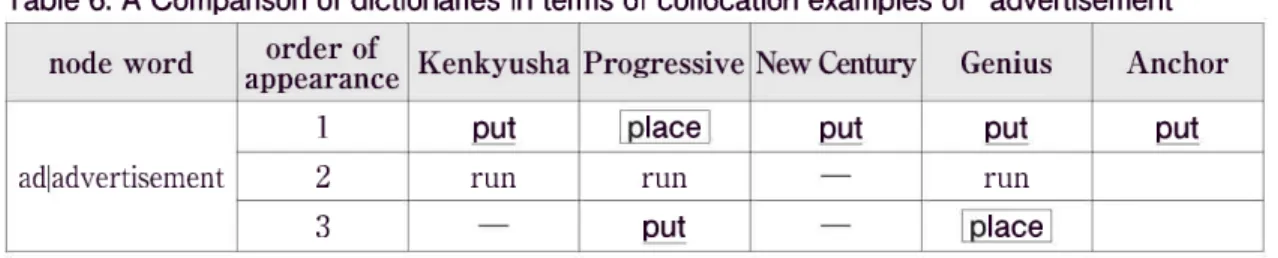
(8) ft*. • i-111,11-1t1-. —CV. a trip" second, and "take a trip" third. This is quite problematical. because Japanese. learners of English often refer to only the first collocational example when they consult a dictionary. Thus, placing the most frequently used collocate first is essential for the creation of effective dictionaries for EFL learners. The result also shows that "do a trip" hits only seven concordance lines (0.9%), which means this collocate is quite unnatural, compared with others.. Table. 3: The. frequency. of "V + a trip". raw count (%). V + a trip. 1. I take la party. 517 (63.7%). 2.. make. 170 (21.0%). 3.. go on a trip. 80 (9.9%). 4.. have. 37 (4.6%). 5.. do a trip. a trip. a trip. 7 (0.9 %) 811 (100%). total take@a+trip. Table node. / make@a+trip. 4: A comparison word. trip. order of appearance. / go@+on+a+trip. of dictionaries Kenkyusha. / have@a+trip. in terms. examples. of "trip". New Century. Genius. take. make. take. make. take. make. make. go. 2. go. make. 3. of collocation. Progressive. 1. on. / do@a+trip. on. take. go. Anchor. on. 3.3.3 Kokoku-suru (literally, advertisement-do) Finally, corpus research. was conducted. on the English equivalents. suru," by using the strings "place@+an+ad'Advertisement,". of "kokoku-. "put@+an+aaadvertisemen. t," "run@+an+ad;advertisement," "take@+out-Pan+ad;advertisement," "d o@+an+adi,advertisement ," and "insert@+an+adi,advertisement." The results in Tables 5 and 6, which can be shown by the inequality: "[place (50%) > put (25%) > run (17%)] a party," demonstrate that against the high frequency of "pl ace an ad/advertisement" (49.8%) on the corpus, only one dictionary (Progressive) shows "place an advertisement". in the first place and three dictionaries. New Century, and Anchor) do not even contain "place an advertisement.". — 240 —. (Kenkyusha, Four out of.
(9) Corpus Analysis of Dictionaries for Japanese Learners of English to Facilitate English Teaching and Learning the five dictionaries. present. "put an ad" first, which. is far less frequent. than. "place an. ad" on the BoE corpus.. Table 5: The frequency. of "V +an ad/advertisement". V + an adladvertisement. raw count (%). 1. 1place 1an adladvertisement. 128 (49.8%). 2.. put an adladvertisement. 65 (25.3%). 3.. run an adladvertisement. 44 (17.1%). 4.. take out an adladvertisement. 15 (5.8%). 5.. do an adladvertisement. 4 (1.6%). 6.. insert. 1 (0.4%). an adladvertisement. 257 (100%). total. place@+an+adladvertisement / put@+an+adladvertisement / run@+an+adladvertisement / take@+out+an+adladvertisement / do@+an+adladvertisement / insert@+an+adladvertisement. Table 6: A Comparison node. of dictionaries. order of appearance. word. adladvertisement. in terms of collocation. Kenkyusha. Progressive. 1. put. lace. 2. run. run. 3. The above-mentioned. New Century. of "advertisement" Genius. put. put. three case studies indicate that three. cover only less than 30 % of the top frequently dictionary. put. lace. put. as a Japanese-English. Anchor. run. suru" , New Century and Anchor as in "advertisement-suru"). problematical. examples. (Progressive as in "partyout of the five dictionaries. used collocations, for language. which is quite. learners. who aim to. improve their communication and translation abilities.. 4 Corpus-based. analysis of English-Japanese. and English-English dictionaries -. 4.1 Reasons for analysis of the English polysemic verb develop Most Japanese EFL learners have difficulty using polysemic English words such as develop correctly English translations. and effectively. They cannot come up with the verb of Japanese. sentences. cancer," "I developed the habit of getting. "develop" in. that mean "my mother has developed her up early," "I have developed an interest in. — 241 —.
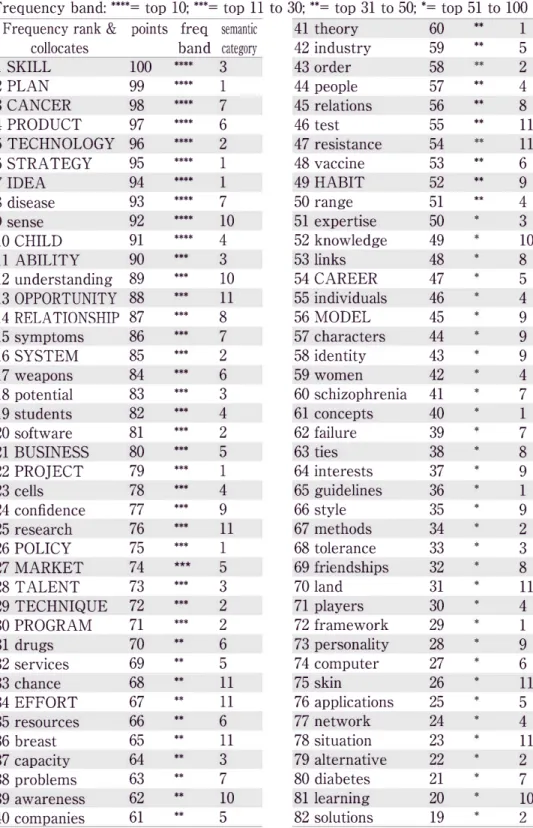
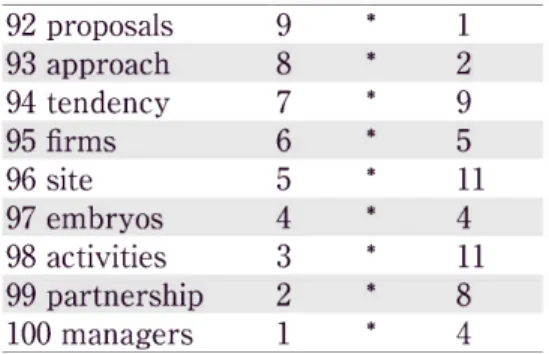
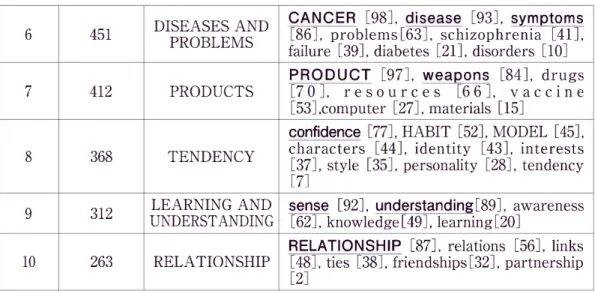
(10) ft*. • i-111,11-1t1---./. —CV. math," or "he is developing his taste for music." This is also caused mainly by the indirect, translation method of teaching, in which EFL teachers usually present students with only one Japanese equivalent. "hatten-suru". (literally, grow bigger). for develop in. order to facilitate language learning with little regard for word's polysemic nature. In order to alleviate this problem with Japanese EFL education, language teachers need to present at least three frequently used collocations based on effective dictionaries that present frequently used collocations in order of relative frequency, and encourage their students to consult them to learn useful collocations for communication in English. A corpus research English-English. can help teachers. dictionaries,. whereas. select the most effective. English-Japanese. /. corpus linguistics can improve the contents of. those dictionaries for successful language acquisition.. 4.2 The method of the corpus research on English-Japanese and English-English dictionaries Ishikawa (2008:144) states that examining what nouns most frequently co-occur with a node word can. help us identify the semantic tendency of the verb. Based on. this theory, this corpus research was conducted by the following procedures: 1. The top 100 noun collocates of "develop" were extracted. from the collocation list of. the BoE corpus, which was then sorted by frequency in t-score order with a span of 3:3. The nouns in singular and plural forms were processed as the lemma (e.g.: child and children were treated as the lemma CHILD). The nouns in American and British spellings were processed. as the lemma (e.g. programme (s) and program (s) were. treated as the lemma PROGRAM.) 2. The top 100 noun collocates of develop (Table 9) were grouped. into the following. eleven semantic categories: ways; groups and people; ideas and plans; diseases and problems;. products;. ability;. business;. leaning. and understanding;. tendency;. relationships; and miscellaneous. 3. 100 points were given to the collocate ranked. No. 1 (SKILL),. 99 points to the. collocate ranked No. 2 (PLAN) and the like. 1 point was given to the collocate ranked No.100 (managers). All the points were added up within each category. 4. Excluding the miscellaneous category. (which contains opportunity, situation, chance;. research, test; efforts/effort; breast, skin; resistance; land, areas, site; culture; contacts; and activities) leaves the top 10 semantic categories (Table 10), which were sorted in order of their total points.. — 242 —.
(11) CorpusAnalysisof Dictionariesfor JapaneseLearnersof Englishto FacilitateEnglishTeachingand Learning 5. All the examples of noun collocates of develop were listed up with their definition numbers. in the entry. (Genius. English-Japanese. Dictionary. verb develop from the eight English-Japanese Dictionary,. 4th ed. (2006), Longman. (2006), Luminus English Japanese Dictionary. English-Japanese. Dictionary,. English-Japanese. (2001), The Super Anchor. 3rd ed. (2003), E-Gate English-Japanese. (2006), CORE-LEX English Japanese Dictionary. Dictionary. (2005), Progressive English Japanese. Dictionary, 4th ed. (2002), New Global English Japanese Dictionary three English-English. dictionaries. (2000)) and the. dictionaries (Cambridge Advanced Learner's Dictionary, 2nd ed.. (2005), Collins COBUILD Advanced Dictionary. of English. (2008), and Longman. Dictionary of Contemporary English, 1st revised ed. (2009)), all of which are currently available in Japan. (Tables 12 and 13) 6. The semantic. categories. and their order of appearance. in the dictionaries. were. compared with those of the top 10 semantic categories created in the procedure No.4 to investigate which dictionary employs the most appropriate. semantic categories in. order of frequency, and which dictionary illustrate the entry develop with the most frequently used collocates in each semantic category.. 4.3 Data analysis and review of dictionaries 4.3.1 The top 100 frequently used noun collocates. of develop. Table 9 shows a list of the top 100 noun words that frequently co-occur with the node develop, which was obtained from the collocation search of the Bank of English corpus. The frequency. band and the number. of semantic. category. presented in this table will be used in the analysis of the dictionaries later.. — 243 —. of each noun.
(12) ft*. • i-111,11-1t1-. —CV. Table 9: The frequency band and semantic categories of the top 100 noun collocates of develop in t-score order (with a 3:3 span) Frequency band: ****=top 10; ***=top 11 to 30; **= top 31 to 50; *= top 51 to 100 Frequency. rank &. points. semantic. 41 theory. 60. band. category. 42 industry. 59. 3. 43 order. 58. collocates. freq. 1 SKILL. 100. 2 PLAN. 99. 3 CANCER 4 PRODUCT. 98. 5 TECHNOLOGY. 97 96. 6 STRATEGY. 95. 7 IDEA. 94. 8 disease. 93. 9 sense 10 CHILD. 92 91. 11 ABILITY. 90. 12 understanding. 89. 13 OPPORTUNITY. 88. 14 RELATIONSHIP. 87. 15 symptoms 16 SYSTEM 17 weapons 18 potential 19 students 20 software 21 BUSINESS 22 PROJECT 23 cells 24 confidence 25 research 26 POLICY 27 MARKET 28 TALENT 29 TECHNIQUE 30 PROGRAM 31 drugs 32 services 33 chance 34 EFFORT 35 resources 36 breast 37 capacity 38 problems 39 awareness 40 companies. 86 85 84 83 82 81 80 79 78 77 76 75 74 73 72 71 70 69 68 67 66 65 64 63 62 61. ****. ****. ****. ****. ****. ****. ****. ****. ****. ****. ***. ***. ***. ***. ***. ***. ***. ***. ***. ***. ***. ***. ***. ***. ***. ***. ***. ***. ***. ***. **. **. **. **. **. **. **. **. **. **. 1. **. **. 1 5 2. **. 44 people 45 relations. 57. 6 2. 46 test 47 resistance. 55 54. 1. 48 vaccine. 53. 1. 49 HABIT. 52. 7. 50 range. 51. 10 4. 51 expertise 52 knowledge. 50 49. 3 10. 3. 53 links. 48. 8. 10. 54 CAREER. 47. 5. 11. 55 individuals. 46. 4. 8. 56 MODEL. 9. 7 2. 57 characters. 45 44. 7. 56. **. **. 4 8 11 11. **. **. **. 6 9 4. 9. 6. 58 identity 59 women. 43 42. 9 4. 3. 60 schizophrenia. 41. 7. 4. 61 concepts. 40. 1. 2. 62 failure. 39. 7. 5 1. 63 ties 64 interests. 38 37. 8 9. 4. 65 guidelines. 36. 1. 9. 66 style. 35. 9. 11. 67 methods. 34. 2. 1. 68 tolerance 69 friendships. 33. 3. 70 land. 32 31. 8 11. 2. 71 players. 30. 4. 2. 72 framework. 29. 1. 6. 73 personality. 28. 9. 5 11. 74 computer. 27 26. 6 11. 5 3. 11. 75 skin 76 applications. 25. 5. 6. 77 network. 24. 4. 11. 78 situation. 23. 11. 3. 79 alternative. 2. 7 10. 80 diabetes. 22 21. 5. 81 learning 82 solutions. — 244 —. 20. 7 10. 19. 2.
(13) CorpusAnalysisof Dictionariesfor JapaneseLearnersof Englishto FacilitateEnglishTeachingand Learning 83 84 85 86 87 88 89 90 91. culture training management materials scientists procedures areas contacts disorders. 18 17 16 15 14 13 12 11 10. * * * * * * * * *. 11 5 5 6 4 2 11 11 7. 92 proposals 93 approach 94 tendency 95 firms 96 site 97 embryos 98 activities 99 partnership 100 managers. 9 8 7 6 5 4 3 2 1. * * . * * * * * *. 1 2 9 5 11 4 11 8 4. 4.3.2 The top 10 semantic categories of develop Next, the top 100 noun collocates of develop are categorized into the following ten semantic groups. Table 10 shows the top 10 semantic categories with noun collocates. The top 20 frequent collocates out of the 100 noun collocates (Table 9) are highlighted in bold letters, which are regarded memorize. as the most important. collocates for learners. and thus should be covered in all the English-Japanese. / English-English. dictionaries for learners.. Table 10: The top 10 corpus-based. rank. semantic categories. of develop. (The underlined words are the top 20 frequent collocates) semantic categories noun collocates [points] points IDEAS AND PLANS. PLAN [99] , STRATEGY [95] , IDEA [94], PROJECT [79] , POLICY [75] , theory [60], concepts [40] , guidelines [36] , framework [29] , proposals [9]. 559. WAYS. TECHNOLOGY[96], SYSTEM [85], software [81] , TECHNIQUE [72], PROGRAM [71], order [58] , methods [34], alternative [22] , solutions [19] , procedures [13] , approach [8]. 3. 520. GROUPS AND PEOPLE. CHILD [91], students [82], cells[78], people [57], range[51], individuals [46], women[42], players [30], network [24], scientists [14] , embryos [4] , managers [1]. 4. 493. 1. 2. 5. 616. 454. ABILITY. SKILL [100], ABILITY[90], potential [83], TALENT [73] , capacity [64] , expertise [50], tolerance [33]. BUSINESS. BUSINESS [80], MARKET [74], services [69], companies [61],industry[59], CAREER[47], applications [25], training [17], management [16], firms [6]. -. 245 -. to.
(14) C* • i-r1,1,1-1t1---./. CANCER [98], disease [93], symptoms [86], problems [63], schizophrenia [41], failure [39], diabetes [21], disorders [10]. DISEASES AND PROBLEMS. 6. 451. 7. 412. PRODUCTS. 8. 368. TENDENCY. PRODUCT [97], weapons [84], drugs [70], resources [66], vaccine [53],computer [27], materials [15] confidence [77], HABIT [52], MODEL [45], characters [44], identity [43], interests [37], style [35], personality [28], tendency [7]. sense [92], understanding [89], awareness [62], knowledge [49] , learning [20] RELATIONSHIP [87], relations [56], links 10 263 RELATIONSHIP [48], ties [38], friendships [32], partnership [2] Miscellaneous (numbered 11 in the semantic category in Table 9) : opportunity, situation, chance; research, test; EFFORT; breast, skin; resistance; land, areas, site; culture; contacts; and activities 9. LEARNING AND UNDERSTANDING. 312. Semantic positivity vs. negativity Semantic positivity. and negativity. is one of the most important. factors to be. considered when EFL students learn polysemic words. Based on the research findings shown in Table 10, the negative. semantic. category. of develop. (DISEASES. AND. PROBLEMS) is marked 451 points out of 4448 points (the sum of all collocates). (See. Table 11). Although the percentage of the negative collocates is relatively small (about 10 %), the collocates such as "develop one's cancer / disease / symptoms / problems" are all related to medicine and very important expressions for daily conversations. Thus those negative. collocates. should. take higher. priority. in meanings. listed. in the. dictionaries for improving EFL learners' communication skills.. Table 11: Examples of positive / negative noun collocates of develop node. word:. develop. examples. positive collocates 90 % (3997 points). plan, idea, technology, system, software, business, product, confidence, relationship,. negative collocates 10% (451 points). CANCER [98], disease [93], symptoms [86], problems [63], schizophrenia [41], failure [39], diabetes [21], disorders [10]. -. 246 -. skill, etc.. ability,.
(15) CorpusAnalysisof Dictionariesfor JapaneseLearnersof Englishto FacilitateEnglishTeachingand Learning 4.3.3 Corpus-based The tables. analysis of English-Japanese. and English-English dictionaries. 12 and 13 show all the noun collocates. Japanese. and English-English. numbers. and the differentiation. dictionaries.. of develop in the English-. The first column indicates. of transitive. or intransitive;. collocates; the third column, the semantic category number. the definition. the second column, the (which is shown in Table. 10); and the fourth column, the frequency band (which is shown in Table 9).. 4.3.3.1 The coverage of the top 20 collocates These tables demonstrate. that English-English dictionaries cover more collocates. of develop in agreement with the frequency of corpus than English-Japanese. dictionaries.. For example, Cobuild and Longman both contain nine out of the top twenty collocates, whereas. two English-Japanese. collocates,. dictionaries. (Genius and Longman. EJ) covers six. which are the best two among the eight English-Japanese. examined, and two English-Japanese. dictionaries. dictionaries. (CORE-LEX and Progressive. contain. only one collocate).. 4.3.3.2. Differences. semantic categories. between. the 10 corpus-based. semantic. categories. and the. in dictionaries.. Anchor and Cobuild cover nine of the ten semantic categories; the former fails to cover the ninth category second category. (LEARNING AND UNDERSTANDING). and the latter the. (WAYS). Genius and Longman EJ cover eight categories, the missing. categories of the former are WAYS (2nd) and GROUPS AND PEOPLE (3rd) and those of the latter. are GROUPS AND PEOPLE. (3rd) and BUSINESS. (5th). Progressive,. which fails to cover six out of the ten categories, shows the greatest deviation from the 10 corpus-based semantic categories.. 4.3.3.3 Mixed semantic categorization Some dictionaries category.. For instance,. combine words from different semantic Genius presents. one category. categories. containing. into one. ability, industry,. knowledge, and muscle, all of which should be divided into individual categories such as ABILITY, BUSINESS, LEARNING AND UNDERSTANDING. and MICELLANEOUS.. Cobuild has one category that contains skill, relationship, understanding. — 247 —. and instinct,.
(16) ft* • i-111,1,1ft 37—CV which should be categorized into ABILITY (4th), RELATIONSHIP (10th), LEARNING AND UNDERSTANDING (9th),and TENDENCY (8th), respectively, based on the top 10 corpus-based semantic categories. 4.3.3.4 Distinction between positivity and negativity As mentioned earlier, it is essential for EFL learners to grasp the semantic positivity and negativity of a polysemic word. For this purpose, dictionaries should support learners by drawing a clear distinction between positivity and negativity in their semantic categorization. Genius, Anchor, and Longman are successful in this respect, but other dictionaries place negative collocates and positive collocates in the same category. The typical example is Progressive that groups negative collocates (problem and illness) together with positive collocates (facts, interest, tendency, and taste) in the third semantic category of transitive. This mixed placement of positive and negative usages confuses ESL learners when they try to learn the meanings of polysemic words, making it time-consuming for them to find a negative collocation among the positive samples. In other words, clear distinction between positive and negative collocates in the dictionary greatly facilitates the learning of the core usage of polysemic words.. — 248 —.
(17) Corpus Analysis of Dictionaries for Japanese Learners of English to Facilitate English Teaching and Learning. Tables. 12: Noun collocates. in English-Japanese. dictionaries. T: transitive I: intransitive [Top 20 collocates are underlined.] Frequency band: ****=top 10; ***=top 11 to 30; **= top 31 to 50; *= top 51 to 100 Luminus T or I. order of appearance. collocates. Anchor semantic category. freq. band. T or I. order of appearance. collocates. business. 5. mind. mind. 1. idea. 1. semantic category. freq. band. 1 1. energy. business. ****. 5. ***. 7 2. **. product. bodies. land. talent **. idea 3. 4. **. energy. 1. 7 2. argument. T strength. technology. T 3. eye. **. products 2. ****. wasteland. 4 skills. 4. **. taste. 4 habit. 8. trouble 5. 8 dislike. cold. cold 5. 6. 1 I. ****. disease 6 6. film. fever. blossoms. trouble 6. Japan. man. panda 2. cancer. 3. film. film. 6. 3. 1. **. friendship I. idea 2 situation 3. -. 249 -. film. 10 1. ****.
(18) T. ft*.MCIMRV-tv-EW. Longman. Genius T or or. order of appearance. collocates. semantic category. freq. band. AM i. T or or. order of appearance. EJ. collocates. semantic category. freq. band. ^. ability skill 1. relationship. 10. Internet. 7. incident. 6. industry. 5. knowledge. 9. IT. 1. insects. muscle. strength **. 2. product. ways. 2. drugs. fever. T. 2. 6 rash. .. 7 ****. products. **. ideas 1. problem 4. accident. 6. IT. 3. disease. 6. tendency. 8 taste. humour. skills. 4. ****. 8 liking. T. 5. knowledge 9. habit. understanding. theory plan. 1. 6. **. **. 1 argument. **. I. 7. film. problem. 6. situation. 7 picture facts. 9. **. T. blossom 1 situation I 2. cancer. 3. films. ***. ideas. idea. 8. ****. affection 4. 6. ****. plans. difficulty. 5. **. 7. resources. 3. ***. 4. 6. **. -. 250 -. 8. trouble. 9. land. 10. films. 6. **.
(19) T. Corpus Analysis of Dictionaries for Japanese Learners of English to Facilitate English Teaching and Learning. E-Gate T or or. order of appearance. collocates. CORE-LEX semantic category. freq. band. T... or or. order of appearance. collocates. semantic category. freq. band. III. ...^. ^. muscles. business. 5. 1 skill. **. 4. muscles. 1 hatred. 2. *. interest 2. friendship. 10. cold. 6. *. 8 *. habits resources. 7. property. 5 1. **. 3 field T. 3. 4 5. resources. 7. 4. argument. product. 7. 5. background. economy. 5. 6. film. theories. 1. hospital 1. 6. pictures. I. 7. facts. 9. technology. 2. work. 5. flu. 6. 2. 1 I *. situation 2. problem. 3. photography. situation. 6. -. 251 -. symptoms. 6. **.
(20) T. ft*.MCIMRV-tv-EW. Progressive T or or. order of appearance. collocates. Global semantic category. freq. band. AM i. T or or. order of appearance. collocates. semantic category. freq. band. ^. faculties. 3. science. 1 physique. taste. 8. industry. 5. 1. farming 2 *. land. muscles. valves. resources. 7. **. 2 horsepower habit. area. 8. T. argument. 1. 3 .*. facts 3. *. interest. **. idea cancer. 6. *. 9 tendency. 4. *. habit 8. problem. 5. fact. 6. film French. argument. 1 film. 6. theme. 1 ***. strategies 5. cold I. 1. blossom 1 I. 9. 6. illness 4. .*. interest. taste. eels flu. 6. 2. signs. 6. 3. film. -. 252 -. 2. case. 3. symptoms. 4. photographs. 6. 6. .*.
(21) Corpus Analysis of Dictionaries for Japanese Learners of English to Facilitate English Teaching and Learning. Tables. 13: Noun collocates. Frequency. in English-English. Cobuild. Longman. collocates. CC9.1. O. 10. 9. confrontation. 6. friendship. 10. child. 3. ****. 1. difficulty. 1. 6. **. idea. 1. product. 7. system. 2. drug. 7. style. **. ****. **. affection. land. quality. property. sense. 3 **. 3 9. awareness. habit. knowledge 8. 4. quality. 8. relationship. 10. understanding. 9. friendship. 10. instinct. 8. illness. fault product. theory. 8. taste. ****. skill. skill. ****. 5. **. 6. **. ability. disease. 6. fault. 6. problem 7. 8. ****. 6. idea. ****. **. difficulty trouble. ****. 6 7. 4. course **. ****. 6. 4. 1. argument. points 9. land. 10. pictures. .. 1. story. theme photographs -. strategy products. 7. technology. 2. oracles. 6. problem. 253 -. ****. **. 5. site. 6. photos. ****. ****. **. ****. 6 habit. restaurant. 1. illness 4. 8 ****. relief. 2. **. 2. **. **. policy. technology **. ****. 4. talents. 2. 5. muscles skills. strength. country. finance. city tree. **. idea. 12. a) ct. ct. 5. weapons. 11. O Ca 0.1. C.) •-, -r-ci. es' "t ct t)41ii 1.). economy. cancer. 9. collocates. knowledge. reputation. 8. '. Cl.) ct `1=4 co. 6. industry. 7. F-1. 5. tourism. 6. Og. clashes. business. 5. 4-1C). market. row. 4. C) -;-. ;-, •c & 'lt ct t)42 CllCt .., ci.) ct z Q. =I. problem. 3. 0.). 4-1C.) C.) •-, Og Pi. es'"t ct z:)4ii 1.) -ci ,1 collocates ,...,,t a)ct OPo z c...) P.,. bodies. 2. Cambridge. 81). 1 4-. 1. dictionaries. band: ****=top 10; ***=top 11 to 30; **=top 31 to 50; *= top 51 to 100 [Top 20 collocates are highlighted in bold letters.]. aj. Og '10 a•l. learners'. 8. **.
(22) ft*. • i-111,11-1t1---./. 5 Conclusion This research demonstrates. how effectively the corpus can be used to examine the. effectiveness of Japanese-English,. English-Japanese,. and English-English dictionaries for. English learners in terms of prioritization and categorization of words' meanings based on the collocational frequency. The Corpus-based analysis of the semantic categorization and prioritization. of the two words. several popular Japanese-English in several. popular. following. suggestions. (the polysemic Japanese. verb. "suru" shown in. dictionaries; and the polysemic English verb "develop". English-Japanese. and English-English. about how to revise. the contents. dictionaries). provide. the. of the above-mentioned. dictionaries' entry with the use of corpus data, which can facilitate the development. of. Japanese ESL learners' communication and translation abilities: 1. Dictionaries need to present frequently used collocations based on the corpus data 2. Dictionaries need to contain the top 70 % frequently used collocations based on the corpus data. 3. Each semantic category should be placed in order of frequency. based on the. corpus data. 4. Dictionaries. need to provide by the inequality, information about the relative. frequency of collocations obtained from the corpus research. Despite some limitations of the corpus research, corpus linguistics has a profound impact on second language teaching and acquisition. Since the corpus is increasing day by day to catch up with the evolutionary change of English, it is necessary corpus-assisted. to create. online bilingual or monolingual portable dictionaries, which can greatly. facilitate the development of ESL learners'. communication and translation abilities.. References Baxter, J. (1980) The Dictionary. and Vocabulary. handful? TESOLQuarterly. Behaviour:. A Single Word or a. 14, 325 - 336.. Bejoint, H. (1981) The foreign Student's. Use of Monolingual English Dictionaries:. a. Study of Language Needs and Reference Skills. - Applied Linguistics 2, 207 - 222. Biber, D., Conrad, S. and Reppen, R. (1998) Corpus Linguistics. Cambridge: Cambridge University Press.Carter, R. and McCarthy, M. (eds.) (1988) Vocabulary and Language Teaching. London: Longman.. — 254 —.
(23) CorpusAnalysisof Dictionariesfor JapaneseLearnersof Englishto FacilitateEnglishTeachingand Learning Fligelstone,. A. McEnery, A, and Knowles, G. (eds) Teaching and Language Corpora, 1-23. London: Longman.. Goethals, M. (2003) "EET: the European English Teaching Vocabulary-List" in B. Hunston, S. (2002) Corpora in Applied Linguistics. Cambridge: Cambridge. University. Press. Ishikawa,. S. (2008) Eigo Corpus to Gengo Kyoiku Education].. [English. Corpus and Language. Tokyo: Taishukan.. Kennedy, G. (1998) An Introduction. to Corpus Linguistics. London; Longman.. Kharma, N. (1985) Wanted: A Brand-New Type of Learners'. Dictionary. - Multilingua. 4, 85-90. Leech, G. (1997) "Teaching and Language Corpora: A Convergence" Lewandowska-Tomaszczyk. (ed.) Practical. 417-427. Frankfurt:Peter. in A.Wichmann,. Applications in Language and Computers,. Lang.. McEnery, T., Xiao, R. and Tono, Y. (2006) Corpus-based language studies: An advanced resource book. London and New York: Routledge. Sinclair, J.M. and Renouf, A. (1988) 'A lexical syllabus for language learning' - in Carter and McCarthy (1988). 140-160. Sinclair, J. (1991) Corpus, Concordance, Collocation. Oxford: Oxford University Press. Stubbs, M. (1996) Text and Corpus Analysis. Oxford: Blackwell. Tomaszczyk, J. (1979) Dictionaries: Users and Uses. - Glottodidactica 12, 103 - 119. Tono, Y. (2001) Research. on Dictionary. Use in the Context of Foreign. Language. Learning. Tubingen: Max Niemeyer Verlag. General corpora used in this study The Bank of English Corpus. HarperCollins Publishers; University of Birmingham. Dictionaries used in this study Japanese-English. Dictionaries. Genius Japanese-English. Dictionary, 2nd ed. (2003) Tokyo: Taishukan.. Kenkyusha Japanese-English. Dictionary, 5th ed. (2002) Tokyo: Kenkyusha.. Accessed online on Nov. 14, 2009 (http://www.excite.cajp/dictionary/japanese New Century Japanese-English. Dictionary, 2nd ed. (2006) Tokyo: Sanseido.. Accessed online on Nov. 14, 2009 (http://dic.yahoo.co.jp/) Progressive Japanese-English. Dictionary, 3rd ed. (2006) Tokyo: Shogakkan.. — 255 —. _english/).
(24) ftA. • i-111,111t1---./. —CV. Accessed online on Nov. 14, 2009 (http://dic.yahoo.co.jp/) The Super Anchor Japanese-English English-Japanese. Dictionary, 2nd ed. (2004) Tokyo: Gakken. Dictionaries. CORE-LEX English-Japanese. Dictionary (2005) Tokyo: Obunsha.. E-Gate English-Japanese. Dictionary (2006) Tokyo: Benesse.. Genius English-Japanese. Dictionary, 4th edition (2006) Tokyo: Taishukan.. Longman English-Japanese. Dictionary (2006) Tokyo: Kirihara.. Luminus English-Japanese. Dictionary (2001) Tokyo: Kenkyusha.. New Global English Japanese Dictionary (2000) Tokyo: Sanseido Accessed online on Nov. 14, 2009 (http://dic.yahoo.cajp/dsearch?enc=UTF-8&p=develop&dtype=l&stype=l&dname=lss) Progressive English-Japanese. Dictionary, 4th ed. (2002) Tokyo: Shogakkan.. Accessed online on Nov. 14, 2009 (http://dic.yahoo.co.jp/dsearch?enc=UTF-8&p=develop&stype=--&dtype=1) The Super Anchor English-Japanese. Dictionary, 3rd edition (2003) Tokyo: Gakken.. English-English Dictionaries Cambridge Advanced Learner's Dictionary, 2nd ed. (2005), Accessed online on Nov. 14, 2009 (http://dictionary.carnbridge.org/) Collins COBUILD Advanced Dictionary of English (2008) Longman Dictionary of Contemporary Accessed. online. English, 1st revised ed. (2009). on Nov. 14, 2009. (http://www.ldoceonline.com/dictionary/. develop). — 256 —.
(25)
図
+4
関連したドキュメント
東京大学 大学院情報理工学系研究科 数理情報学専攻. [email protected]
情報理工学研究科 情報・通信工学専攻. 2012/7/12
Projection of Differential Algebras and Elimination As was indicated in 5.23, Proposition 5.22 ensures that if we know how to resolve simple basic objects, then a sequence of
In the study of dynamic equations on time scales we deal with certain dynamic inequalities which provide explicit bounds on the unknown functions and their derivatives.. Most of
Additionally, we describe general solutions of certain second-order Gambier equations in terms of particular solutions of Riccati equations, linear systems, and t-dependent
In this paper, we propose an exact algorithm based on dichotomic search to solve the two-dimensional strip packing problem with guillotine cut2. In Section 2 we present some
In order to solve this problem we in- troduce generalized uniformly continuous solution operators and use them to obtain the unique solution on a certain Colombeau space1. In
We use the monotonicity formula to show that blow up limits of the energy minimizing configurations must be cones, and thus that they are determined completely by their values on
