Industrial Policy in Asia
著者
Kuchiki Akifumi
権利
Copyrights 日本貿易振興機構(ジェトロ)アジア
経済研究所 / Institute of Developing
Economies, Japan External Trade Organization
(IDE-JETRO) http://www.ide.go.jp
journal or
publication title
IDE Discussion Paper
volume
128
year
2007-10-01
INSTITUTE OF DEVELOPING ECONOMIES
IDE Discussion Papers are preliminary materials circulated to stimulate discussions and critical comments
IDE DISCUSSION PAPER No. 128
Industrial Policy in Asia
Akifumi KUCHIKI*
October 2007
Abstract
This paper examines three types of industrialization that have occurred in East Asia: the Japanese, Chinese and generic Asian models. Industrial policies in Japan and the Republic of Korea (ROK) initially protected local companies from foreign
investors by imposing high tariffs on foreign investors. But Japan began introducing liberalization policies to attract foreign direct investment (FDI) in the 1960s, and the ROK began to welcome foreign technology in the 1970s. Meanwhile, the governments of the ASEAN countries and Taiwan established export-processing zones (EPZ) to invite FDI by offering preferential treatment, such as tax deductions and
exemptions. China adopted similar industrial policies and also established EPZs, attracting the capital and know-how of multinationals and thereby strengthening the international competitiveness of local enterprises. This paper reaches the following three conclusions. First, it would have been difficult for East Asian
countries to grow without FDI. Second, central governments were a crucial factor in these countries’ growth strategies. Third, EPZs offering preferential treatment can effectively enhance aggregate growth in developing countries, and the Asian experience shows that this strategy can be applied to other countries that satisfy
Keywords: Keywords: industrial policy, export-processing zones, foreign direct investment, government intervention, market competition, priority production method, production rationalization method, import-substituting industrialization, export-oriented policy
JEL classification: O14,G18,R11
* Executive Vice President, Japan External Trade Organization (JETRO) E-mail: [email protected]
The Institute of Developing Economies (IDE) is a semigovernmental, nonpartisan, nonprofit research institute, founded in 1958. The Institute merged with the Japan External Trade Organization (JETRO) on July 1, 1998.
The Institute conducts basic and comprehensive studies on economic and related affairs in all developing countries and regions, including Asia, the Middle East, Africa, Latin America, Oceania, and Eastern Europe.
The views expressed in this publication are those of the author(s). Publication does not imply endorsement by the Institute of Developing Economies of any of the views expressed within.
INSTITUTE OF DEVELOPING ECONOMIES (IDE), JETRO 3-2-2, WAKABA,MIHAMA-KU,CHIBA-SHI
CHIBA 261-8545, JAPAN
Introduction
What are the roles of governments in industrialization? Can industrial policy effectively foster domestic firms and enhance economic growth? Most East Asian economies began growing rapidly in the latter half of the 1980s, which lasted until the Asian currency crisis in 1997. The East Asian Miracle published by the World Bank in 1993 pointed out common factors such as trade liberalization and openness to foreign direct investment, but it did not focus on how industrialization policy differed among the countries of East Asia.
Can we classify typical patterns of industrialization policies for economic growth in East Asia? Komiya, Okuno and Suzumura (1988) found that industrial policies helped Japanese companies become competitive with multinational corporations by cushioning the dynamic inefficiencies of Japanese markets through the protection of infant
industries. Hamada (1974) studied export-processing zones (EPZ) and found that their establishment was a key factor in the introduction of foreign direct investment (FDI). However, no paper has classified growth patterns to clarify the differences in the industrialization policies of individual East Asian countries.
This paper classifies East Asian growth patterns into three models: Japanese, Asian and Chinese. Tables at the end of the paper help to show the differences in the
respective models’ institutions, regulations and laws.
The Japanese model was based on government-guided industrial policy, under which the government selected key industries, gave them preferential treatment including tax deductions and exemptions, and tried to help them become competitive with foreign multinational corporations. The government intervened in markets to complement goods and services that could not be supply efficiently (Komiya, Okuno, and Suzumura
The Asian model was centered on the central government establishing EPZs to attract FDI. Foreign companies enjoyed the same preferential treatment that domestic firms did under the Japanese model, but were requested to export competitive products to the global market.
The Chinese model was similar to the Japanese model, except in its use of FDI. The model intended to foster domestic companies as so-called “pillar industries” by guiding industrial policy and forming alliances between domestic companies and foreign multinationals. The most typical case was seen in China’s automotive industry, where the government selected eight domestic firms, gave them preferential treatment and permitted each company to make alliances with up to two foreign companies, such as GM, Ford or Citroen.
This paper clarifies the differences and similarities of the three models and elaborates the policy implications drawn from the analysis.
The key lessons derived from the East Asia experience are as follows: first, FDI played a key role in developing East Asia's international competitiveness; second, governments set industrial policy not only by protecting domestic firms but also by inviting foreign investors; and third, special economic zones such as export-processing zones were used to attract foreign investors.
This paper is organized as follows: Section 2 compares the various industrialization policies seen in East Asia. Section 3 explains Japan’s industrial policies. Section 4 shows how FDI played an important role in the Asian EPZ model. Section 5 divides Chinese industrial policy between 1979 and 2002 into four sub-periods and explains the characteristics of each one. Section 6 compiles the findings of this paper.
1. Comparison of Industrialization Policies in East Asia
There are two entirely opposite two concepts of industrialization policy in East Asia. As shown in Figure 1, the neoclassical concept is based on market competition without government intervention, while the right side of Figure 1 show government intervention to protect and support infant industries. One concept is based on the importance of market competition and the other on government intervention.
The neoclassical concept maintains that price competition in the private sector results in the most efficient allocation of resources from the point of the Pareto efficiency, or Pareto optimality The World Bank implements structural adjustment programs in developing countries to create competitive markets by requesting governments to abolish price controls. Government regulations that prevent market competition are moderated and eventually removed.
The importance of government intervention is seen in Japanese industrial policy after World War II. The government directly controlled production, distribution and pricing to achieve an efficient allocation of resources after the war. This policy supported the development of industries and made a great contribution to postwar economic recovery. In the latter half of the 1980s, when socialist countries suffered from economic problems and shifted to market economies, many countries like Russia and Vietnam tried to apply similar government-led industrial policies.
However, ASEAN countries from the latter half of the 1980s combined market competition with government intervention. This is the Asian model (see Figure 1.). The Asian model gives preferential treatment to enterprises to develop their international competitiveness. Economic growth from the latter half of the 1980s was the result of the introduction of foreign investment in export-processing zones under export-promotion policies. Foreign investment was introduced in Thailand through export-processing zones in Malaysia through free-trade zones. Although The prototype Asian model was
seen in Taiwan from 1965, in Table 1.
Japan and ROK in Table 1 are examples of government intervention. The difference from the Asian model is that the industrial policies in Japan and ROK included
protection against foreign imports in the form of high tariffs and restriction of foreign investment. These policies were helpful in protecting domestic industries from foreign companies, but they also resulted in internationally uncompetitive companies.
Protectionist policies were applied from the 1950s, but the World Bank and the
International Monetary Fund promoted structural adjustment programs to make markets free and competitive by the 1980s, which made it difficult for countries supported by these bodies to maintain protectionism.
Table 1 compares the growth patterns among Malaysia, Taiwan, ROK, Japan and China. Japanese industrial policies from 1945 to 1960 mostly depended on domestically sourced managers, capital, technology, capital goods and parts and components,
although a high percentage of the technology was transferred from foreign countries. High customs duties were applied to protect domestic firms. The ROK applied the same policies to protect its domestic industries, but the difference with Japan was that the ROK depended more foreign countries for capital, technology and parts and
components. This was partly because the ROK had to accelerate its economic growth to catch up quickly in the 1970s, since the level of per-capita income was low and the world economy was being liberalized.
Malaysia’s economy grew rapidly from 1986 to 1996 by introducing foreign capital through free-trade zones. Growth was brought about by the liberalization of trade and capital policies that did not require protectionist measures. Since foreign multinationals were allowed to enter Malaysia with their management, capital and parts and
components, growth was swiftly accelerated.
When China began reforming and opening up the country in 1979, it implemented industrial policies similar to those adopted by Japan and the ROK, but it also introduced
policies adopted by Malaysia to establish free-trade zones, which it called special economic zones and economic development zones. The government then undertook economic liberalization, partly due to requests from the World Bank, International Monetary Fund (IMF) and World Trade Organization (WTO), resulting in the introduction of foreign investment.
2. Industrial Policy in Japan
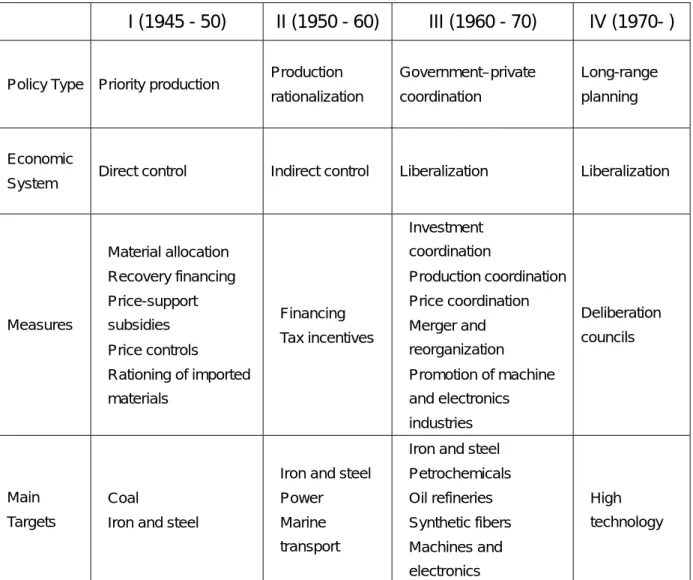
Referring to Table 2, this section analyzes Japan's industrial policies and makes clear the following two facts: first, policies before the 1960s protected domestic companies by imposing high tariffs on imports; and second, Japan could no longer implement such policies from the 1970s because the globalization of the world economy forced the Japanese economy to liberalize and make its domestic companies internationally competitive.
The priority-production method that was applied immediately after World War II was taken as an emergency measure during a very chaotic period. The government directly controlled production, including raw material allocation, pricing, financing,
price-support subsidies and the rationing of imported materials. The policy gave priority to the production of coal, iron and steel.
Thereafter, in the 1950s, production was rationalized through the government's indirect control of raw materials, production and distribution. The policy concentrated on capital financing. Since the aim was to support domestic industries, capital financing was targeted at iron and steel, electric power and shipbuilding.
Industrial policy shifted to government coordination of the private sector in the 1960s. During this time, however, the government came under pressure to liberalize the economy, so it had to take account of international competition. As a result, scale of
economy became a key focus. The need for mergers and acquisitions led to government coordination of investment, production and pricing in the private sector. Not all of these measures, however, could be called "liberalization." From the 1970s, the machine and electronic industries were also promoted, beginning their rise to prominence in
industrial Japan. Income differences between large enterprises and both small and midsize enterprises suggested the existence of a dual economy, so the government began to also support the latter beginning in the 1960s, which contributed greatly to their development of technologies and resulting growth from the 1970s.
In the 1970s, the main role of the government became long-term vision planning. By the 1980s, however, the tend toward economic liberalization made it difficult for the government to intervene for the purpose of supporting domestic industries. Therefore, the government shifted to long-range planning to encourage the development of high-technology industries.
One of the major differences between the Japanese and Asian models is that Japan focused on production rationalization and capital financing/loans for strategically targeted enterprises, while the Asian model used tax breaks to attract foreign capital. In the 1980s, when multinationals were attempting to lower costs, tax breaks helped China to lure foreign capital, including Japanese factories. Japanese enterprises were
particularly attracted to China's economic development zones, including
the high-technology industrial development zones, as well as the special economic zones.
In the 1960s, Japan’s participation in the OECD and the IMF Article 8 scheme put pressure on the country to liberalize its industrial policy. Enterprises with sufficient economy of scale could achieve international competitiveness, so mergers and
reorganization became a strategic measure to increase the size of key enterprises. This situation was similar to that of China in the 1990s, when the government tried to enhance international competitiveness by enlarging the size of key enterprises through
the merger and reorganization of state-owned enterprises. The Chinese policy to encourage technology innovation among small and midsize enterprises (SMEs) also matched the Japanese strategy of the 1960s. Once these measures are fully implemented, the role of the Chinese government will decrease significantly and its industrial policy will shift to strategic long-term planning.
A. Transition to Market Economy to Mid-1960s: Gradualism
Japan's transition from a controlled economy to a market economy can be characterized as gradualism rather than shock therapy. The sequencing of the transition was as follows: 1) strengthening of supply side (priority production program), which included private-sector development (dissolution of big business groups), macroeconomic stabilization (Dodge Line) and structural adjustment; 2) industrial rationalization; and 3) cooperation between government and business. Both industrial rationalization and government-business cooperation are applicable to current developing countries.
1) Strengthening Supply Side (1946 – 1948)
To reconstruct the Japanese economy, it was deemed necessary to strengthen the coal and steel industries. The policy was to give priority to the steel industry in the allocation of coal, and then give priority to the coal industry in the
allocation of steel. The program’s immediate objective was to strengthen the capacity of basic raw-material supply.
This policy was executed under the direct control of the government. The measures included allocation of raw materials, financing from the
of imports.
In 1947, the production of steel and coal hit a record high in volume in Japan, and the production of mining and manufacturing industries increased by 23 percent. In l948, growth increased even further to 33 percent.
a) Private-Sector Development (1946 – 1947)
To promote competition in the private sector, the zaibatsu (big business groups) were dissolved and an antimonopoly law was enacted. The 10 groups that were designated for dissolution included Mitsui, Mitsubishi, Sumitomo and Yasuda, and reorganization orders from General Headquarters (GHQ) were issued to l8 companies. For instance, the two giant trading firms Mitsubishi Corporation and Mitsui & Co., Ltd., were divided into l20 and 170 companies respectively. Through this process, family-controlled zaibatsu (multiple enterprises) ceased to exist. Competition was further
promoted by the enactment of the antimonopoly law.
b) Macroeconomic Stabilization (1948)
GHQ announced nine economic-stabilization principles in December 1948, and upon the arrival of a mission headed by Joseph Dodge in 1949, effective demand was cut by imposing a reduced government budget. This policy was called the “Dodge Line.” Dodge reformed the taxation system, reduced subsidies greatly, attained a balanced budget and started a return to market principles. As a result, hyperinflation was controlled and the
economy moved toward macroeconomic stabilization.
c) Structural Adjustment (1949 – 1951)
and to set and unify the exchange rate. About 63,000 items were under price control at the end of 1948, but this was reduced to about 80 by the end of 1951. The multiple exchange rates that existed for price-gap subsidies were unified, and a single exchange rate of 360 yen to the U.S. dollar was established in 1949 to make international trade possible.
2) Industrial Rationalization (1951 – 1960)
Industrial policies were introduced in this period. Key measures included preferential taxation, including special depreciation (1951), import tax exemption for important machinery (1952) and export income-tax deduction (1953). Other measures included low-interest credit allocated by the Japan Development Bank (which was established in 1951 to replace the
Reconstruction Finance Bank), technology import approvals (based on foreign-currency allocations) and import quotas for the steel industry (1950).
A distinctive feature in the 1950s was that the government targeted priority industries and designated priority enterprises. The process was controlled by the government to some extent, but was not under government’s direct management. Financing, or the allocation of credit, was particularly important because it aimed at fostering domestic capital. Financing from the Japan Development Bank played a key role in supplying funds to basic industries in the early stages.
3) Cooperation between Government and Business (1960 – 1970)
Trade liberalization measures were implemented throughout the 1960s. Liberalization of trade and foreign exchange was announced in 1960, and in 1964 Japan joined the Organization for Economic Cooperation and
Development (OECD) and lifted foreign-exchange restrictions.
Trade liberalization was carried out in three steps from 1961 and was 90 percent complete by 1964. Liberalization of capital was initiated in 1967 and finished in 1973. An event that reflected the economic climate of the time was the House of Representatives' rejection of a bill to to create priorities in taxation and financing for automobiles, specialty steel and petrochemicals.
As liberalization progressed, the promotion of heavy and chemical industries was carried out in the 1960s. Cooperation and coordination between government and business helped to make enterprises more competitive in the face of
liberalization. Macroeconomic management was based on the theories of Keynes (investment to produce savings) and Harrod Domar (private investment in plant and equipment to create effective demand with a multiplier effect while also increase supply capacity).
4) Industrial Policy since Mid-1960s: Focus on Longer Term
a) Changes in Industrial Policy
Industrial policy in Japan changed dramatically in the middle of the 1960s (and from the 1970s for the computer industry). Measures to restrict imports and promote exports were gradually lifted and protectionist policies were ended. Tariff rates were reduced to the point where today Japan has a lower average tariff level than both the United States and the EU.
In recognition of its increasing role in the world economy by the1980s, Japan began to vigorously promote imports, which included shifting the focus of the Japanese External Trade Organization from promoting Japanese exports to foreign imports. Other policies promoted international cooperation in joint research and economic development, and investments to help
stimulate the world economy.
b) Basic Attitude behind Industrial Policy
The basic attitude behind Japan’s industrial policy has been to support the free-trade principle. For instance, several Japanese industrial sectors, such as textiles and rubber footwear, came under severe pressure due to imports (particularly from East Asia) around 1980, but the government did not extend help in the form of import protection.
Japan’s industrial-policy tools are indirect and inductive in nature, and are designed to encourage competitive private firms to maximize initiative and entrepreneurship. However, where imperfections exist in the mobility of capital and labor, information flow, etc., and where external economies and diseconomies cannot be adequately addressed by market mechanisms alone, Japanese industrial policy helps to provide a framework that enables market forces to function better.
c) “Soft Technology” of Public Administration
The formulation of long-range vision, such as the Technopolis Law of 1983, is basic to the designing of industrial policy. There exist various kinds of visions: some cover overall industrial structure while others relate to specific problems, such as industrial adjustment or energy. Visions are not formulated by the government alone, but through councils composed of representatives from various sectors, including financial institutions and other industrial circles, academia, media, labor, small business, consumers and local pubic entities (Industrial Structure Council, etc.). In the 1980s, the effort involved not only economists but also political scientists, sociologists, engineers, historians, and writers.
The drafting of long-term perspectives is crucial to government-business cooperation and constitutes one of the main roles of the Ministry of
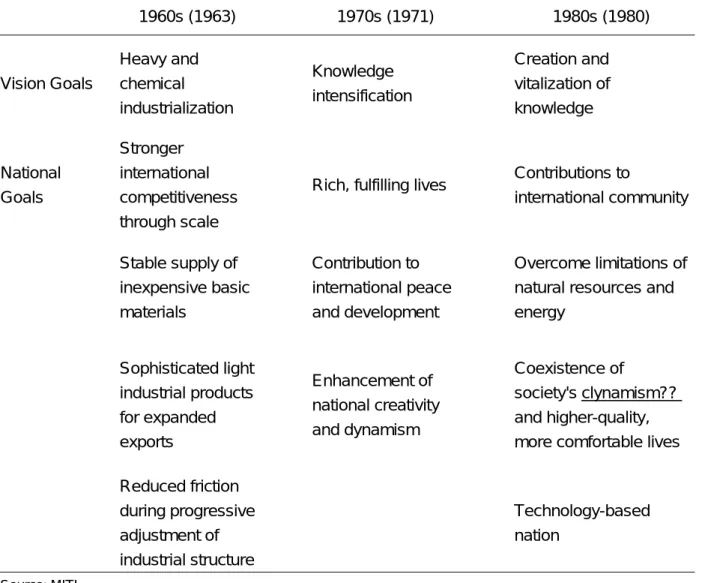
Economy, Trade and Industry (METI). Having a vision reduces uncertainty about the future, invigorates the market and promotes competition. Since METI is not in a position to intervene and control the activities of private companies, it plays the role of advisor and consultant. METI’s budget is relatively small (see Table 5) and its legal authority is not necessarily powerful, so it leverages the “soft technology” of public administration, as reflected in its future-oriented vision and consensus-based policymaking. Master visions are formulated at the beginning of each decade (Table 6 summaries the visions in past decades). The vision of MITI (METI’s
predecessor) in the 1970s indicated the importance of the computer industry or “mechatronics.” Based on this vision, industrial colleges quadrupled the number of students in their data-processing departments between 1970 and 1979. The vision also focused on “knowledge intensification,” which
referred not only to the computer industry, but also a new approach to coping with the challenges of raising productivity. The goal was to emphasize knowledge factors in every industrial field. While the vision was unable to predict the dollar shock of 1971 or the oil shock of 1973, knowledge intensification helped in the recovery from these crises.
One of the slogans of MITI’s vision for the 1980s was “technology-based nation.” MITI recognized that technology creation was essential both for Japan to contribute to the world economy, as well as for the economic security of the nation. According to a widespread opinion, however, there would be no more technological revolution. Furthermore, Japan’s
expenditures on research and development as a percentage of GNP were 1.7 percent in l977, the lowest among the advanced nations (Germany was 2.3
percent, United States 2.2 percent, Britain 2.2 percent and France l.8 percent).
MITI’s vision targeted the raising Japan’s R&D spending to 2.5 percent by 1985 and 3.0 percent by 1990, and ultimately this is what happened. Moreover, the government’s share (27 percent in 1977 compared with around 50 percent in other advanced nations) decreased still further to 20 percent in 1990, with private companies increasingly shouldering the burden. The “technology-based nation” concept set a marker for Japanese business and vitalized their commitment to an all-new age of high technology, proving that “the vision is mightier than the budget.”
3. Industrial Policy in East Asia
This section shows that export-processing zones in most Asian countries contributed to enhanced economic growth in the 1980s and 1990s, prior to the Asian financial crisis in 1997. EPZs are industrial zones where tenant companies receive preferential
treatment, such as tax deductions or exemptions, to import materials that were later exported in finished or semifinished products. The degree to which taxes are lowered depends on the percentage of a company's total production that is exported.
In the Asian model (see Table 3), governments had two basic roles: promotion of international competitiveness and market intervention. Wholly owned foreign
subsidiaries were permitted to entered the local market to help develop the international competitiveness of the local industry. Foreign investors entering new countries often face problems finding good partners, so approval of 100% ownership by most ASEAN countries was a critical factor in attracting foreign capital, since the entrants did not have to search for capital partners.
Other methods for enhancing international competitiveness were also used. These included the depreciation of the local currency to reduce labor costs in foreign currency terms, and the deduction of local content requirements to enable foreign investors to use better quality components.
Governments intervened in the market by means of tax deductions and/or
exemptions. Tax holidays, for example, exempted enterprises from paying corporate income taxes in the first five years of profitability. Another policy was to exempt tariffs on imported capital equipment and components. In addition, many countries gave foreign investors incentives to export their products. For instance, tax breaks were given to enterprises that exported at least 80% of their production. The Asian model was particularly effective in attracting foreign investors to economic development zones in China.
Notice, however, that China employed two types of policies. the Asian model of economic development zones, and government-guided policy. The next section explains how the latter differed in China and Japan.
The prototype EPZ was seen in Kaohsiung, Taiwan, which became a model for EPZs in Malaysia, Thailand and China's Guangdong Province. The model is suitable for other East Asian countries, provided that they satisfy the preconditions of political and
macroeconomic stability and public security. Under this model, the quasi-public sector provided production sites, that is, industrial zones with well developed infrastructure, and the government selected key industries in which to provide preferential treatment to foreign investors. A high export ratio was the only condition required for companies to receive incentives, such as 100% ownership and preferential taxation.
But simply offering EPZs is not enough unless multinational corporations are actually attracted to expand their production overseas. The most important incentives are those that help multinationals reduce costs, namely, low wages, attractive exchange rates and low taxes. Cost reduction had a decisive impact on the decisions of Taiwanese,
ROK and Japanese companies to invest overseas from 1985 to 1990 (see regression analyses presented in Appendix).
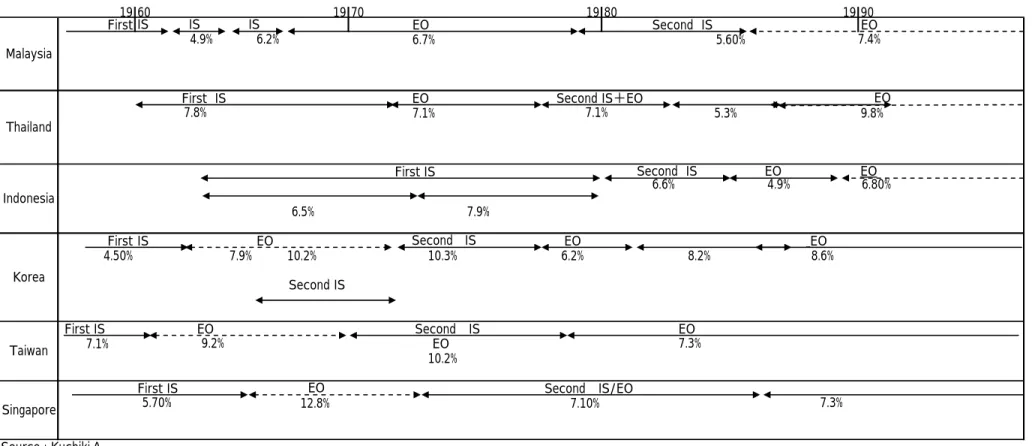
In the following sections, a number of cases are presented with respect to 1) deregulation of foreign investment; 2) preferential treatment and other measures; 3) industrial parks; and 4) designation of specific sectors. It is also shown that FDI increases rapidly in response to such policies, with beneficial effects on exports, employment and economic growth. The ASEAN countries and ANIEs (Asian Newly Industrialized Economies) adopted import-substitution industrialization policies that proved successful in the early stages of their economic development (see Figure 2). But they were soon faced with saturated markets because of their relatively small markets and low income levels. As a result, the ASEAN countries shifted toward
export-promotion from the mid-1980s (see Figure 3).
A. Malaysia: High Growth, Personnel Development and Free-Trade Zones
1) Import substitution (1957 – 1967)
Malaysia implemented a moderate first phase of import substitution after its independence in 1957. The World Bank proposed a policy of replacing imports with domestic products, and the government generally followed the suggestion, although it did not control exchange rates, imposed few limits on import
volumes and set relatively low import tariff rates (see Kohama, Yamazawa, and Hirata [1987]).
2) Export promotion (1968 – 1979)
goods, but the domestic market was too small to support this policy. As a result, an export-promotion policy was adopted with the enactment of an
investment-incentive law in 1968. The law identified industries that exported finished and semifinished goods as qualifying for preferential treatment, which centered on exemption from corporate taxes for five to eight years. Other exemptions included the development tax (5 percent of profits), the 3 percent excess-profits tax and the 40 percent corporate tax. In addition, in 1971 a law introduced free-trade zones, which essentially functioned as export-processing zones.
3) Import substitution revisited (1980 – 1985)
Beginning in 1970, the Malaysian economy shifted its dependence from rubber and tin to palm oil and crude oil (by 1985, crude oil accounted for 30 percent of Malaysian exports). Amidst this shift, the government implemented the second phase of its import-substitution policy in 1980. The plan to shift to heavy industries was launched by the establishment of the Heavy Industries Corporation of Malaysia (HICOM), and investment priority was shifted to steel, cement, automobiles, chemicals and other such industries. But the country’s macroeconomic stability worsened dramatically in the early 1980s: the fiscal deficit was 20 percent of GNP and the external current-account deficit amounted to 10 percent of GNP. The country’s foreign debt kept growing until it exceeded 40 percent of GNP in 1986, and the debt service ratio rose to more than 15 percent. In 1985, the country suffered from its first year of negative economic growth since 1961.
Negative economic growth forced Malaysia to strengthen its export-oriented industrialization. The nation’s previous policy, called the New Economic Policy (or Bumiputra Policy), had been implemented after ethnic riots in 1969. One of the primary goals had been to restructure society to lessen economic disparity among ethnic groups and regions, so the priority was equity rather than
efficiency. In 1986, however, a new export-promotion law shifted the priority to efficiency, including authorization of wholly owned foreign subsidiaries,
launching a period of deregulation, privatization and economic liberalization. Deregulation of FDI was an epoch-making shift because it permitted total foreign ownership of companies under certain conditions (see Aoki (1994). The conditions were either that the company export more than 80 percent of its products, or export more than 50 percent of its products while employing more than 350 full-time regular workers.
About this same time, Japanese companies were starting to shift production to other countries because of the appreciation of the Japanese yen. This shift induced massive FDI by Japanese firms, a development which the Japanese termed an “historic opportunity.” In addition to Japan, foreign investors from Taiwan and ROK also invested in Malaysia's free-trade zones during this period.
One major aspect of Malaysian industrialization was the designation of 12 industries as leading sectors in the country's industrial master plan of 1986. The non-resource industries were electric/electronic manufactures, textiles/garments, machinery, transport equipment and steel, and the resource industries were wood processing, rubber manufacturing, palm oil manufacturing, food processing, chemicals/petrochemicals, nonferrous metals and nonmetal manufactures.
The Malaysian economy entered a high-growth phase in 1988. The transition to this phase did not follow the conventional "flying geese" pattern of gradual
development from textiles and processing to lesser labor-intensive industries. Instead, the government established a high-tech sector in a single stroke (see Aoki [1994], p. 51. As a result, Malaysia began to record high rates of economic growth after 1988, with per-capita GNP reaching US$2,500 in l991.
At this point, the focus of industrialization shifted to the development of human resources and the fostering of "supporting" (supplier) industries. Concern had been mounting in regard to the economy’s shortage of labor due Malaysia’s small population of about 18 million. Once the shortage of skilled and
semiskilled workers became acute, it became necessary to develop human resources to make up for labor shortages. In the early 1990s, Malaysia also supplemented its human-resource development measures with foreign labor from Indonesia, Bangladesh and other countries.
Another problem was the weak link between local firms and the foreign companies operating in free-trade zones, but this was overcome by connecting the two entities through the development of supporting industries. By
successfully dealing with this problem, and its domestic labor shortage, Malaysia managed to maintain high economic growth in the first half of the 1990s.
B. Thailand: Successful Introduction of FDI
Thailand’s industrial modernization got under way with a series of
liberalization steps taken in the late 1950s. These steps included abolishing a multiple exchange-rate system and doing away with large national corporations. Subsequent industrialization was carried out in four phases (see Ikemoto and Wonghanchao [1994]).
1) Import substitution (1960 – 1971)
Thailand’s policy to replace imports with domestically produced goods was made explicit with the implementation of laws for new tariffs and
industrial-investment promotion, both of which took effect in 1960. As a result, tariff rates were raised to protect domestic industries and preferential tax treatment was given to importers of machinery, raw materials and other intermediate goods for industrial use. From 1962, preferential conditions were authorized for priority industries, such as exemption from corporate income tax for five years; exemption from import tariffs on machinery, parts and raw materials necessary to set up ventures; and reduction or exemption from all or partial import tariffs on other investment assets for five years.
The import substitution policy achieved a certain success: some Thai-made products fully satisfied domestic demand in the early 1970s (Institute of Developing Economies(1994)). On the other hand, the import of intermediate and capital goods increased as industrialization progressed, resulting in a sharp rise in the trade deficit from 1967 through 1970. As a result, the nation was forced to switch to export promotion.
2) Export promotion (1972 – 1976)
In 1972, the industrial investment promotion law was again amended and a new export promotion law took effect. The former reduced or exempted import tariffs and operating taxes for export-oriented corporations and increased the deduction of export sales from taxable income. The export promotion law offered reimbursements for tariffs on imports of raw materials used in exports; tax credits for tariff payments and operating taxes on raw materials used for
exports; and financing for export operations.
The policy changes were not implemented smoothly, however, in part because of social unrest in the country.
3) Import substitution revisited (1977 – 1982)
In 1976, a coup led by Admiral Sagat Chalawyu succeeded and the following year the new administration formulated the country's fourth five-year plan, aimed at the stabilization of the Thai economy. It allowed the protection of heavy industries that were producing intermediate and capital goods. At the same time, the administration placed priority on the development of exports, agro-industry, regional industries and small businesses. It also launched the East Coast Development Program as a large-scale regional industrial plan.
4) Export promotion through FDI (1983 – 1996)
In the fifth five-year plan introduced in 1983, the government specially emphasized FDI and allowed export companies to be fully owned by foreign investors. The Industrial Estate Authority of Thailand constructed industrial estates and the first EPZ was established at Bangchan near Bangkok in 1970. The Lad Krabang Industrial Estate was completed in 1979 as an EPZ and was filled up by 1987. In addition, the government divided the country into three regions and encouraged investment in specific areas.
From 1987, Thailand began achieving high economic growth rates of 9.5 percent, 13.3 percent, 12.3 percent and 11.6 percent, respectively. During this period, drastic deregulation was implemented in the automobile and textile industries. The high rates of economic growth exposed various problems in the
Thai economy, including infrastructure deficiencies, human-resource shortages, an income gap between urban areas and rural villages and the need to promote small businesses.
C. Indonesia: Structural Adjustment under Deregulation
1) Import substitution (1966 – 1982)
Compared with Thailand and Malaysia, Indonesia launched its import substitution policy rather late. Once the policy was launched, however, it was implemented for a relatively long time. The first phase lasted from 1966 to 1979 and can be subdivided into two sub-phases: 1966–1973 (introduction of selected FDI) and 1974–1979 (intensive protection of domestic industries) (see Oguro [1995]). The foreign-investment law took effect in 1967, but from 1970 onward the government grew more selective in choosing foreign partners, so preferential treatment was extended only to foreign investors in priority industries.
Furthermore, from 1970 to 1973, some 44 industries were made ineligible to receive foreign investment.
Meanwhile, oil revenue soared as oil prices rose in 1973. The period from 1974 through 1979 saw intensive protection of domestic industries. In 1974, the government decided to expand the scope of foreign-investment regulations to additional industries and to nationalize foreign-affiliated companies. This second phase of import substitution lasted from 1979 to 1983. The government tried to nationalize 52 basic industries, such as petrochemicals and basic metals, along with steel, shipbuilding, aerospace and automobiles, but the plan was
2) Structural adjustment (1983 – 1996)
The rupiah’s drastic devaluations in 1979, 1983 and 1986 compelled Indonesia’s switch to an export-oriented policy. In 1983, the country began to implement structural adjustments recommended by the International Monetary Fund and the World Bank, aiming to receive lending from these two institutions. Malaysia differed from Indonesia in this regard because it did not receive
lending to carry out structural adjustment measures.
Deregulation was implemented in all sectors of the Indonesian economy, including finance, import-licensing and other systems. In the years since, the country continued to implement deregulation measures. Two export-processing zones were established, in 1986 and 1992, and the government allowed the establishment of foreign-owned companies in limited areas. Unlike Malaysia and Thailand, however, foreign investors were not offered preferential taxation, financing, etc.
In 1994, the government authorized 100 percent ownership by foreign
investors, which led to a significant increase in FDI and faster economic growth.
D. ROK: Toward an Advanced Industrial Nation (See Okuda [1993])
1) Import substitution (until 1961)
In the post-Korean War recovery period until 1961, the ROK government implemented an import substitution policy, mostly for consumer goods, with a priority on industries such as sugar, fertilizer, spun yarn, cement and glass. But a saturation point was soon reached because of the small size of the domestic market and constraints on economic growth due to a current-account deficit.
Therefore, the country was forced to change its policy.
2) Export orientation (1962 – 1980)
The ROK’s industrial policy was shifted to export promotion to develop labor-intensive exports such as textiles and plywood. During this period, which lasted until 1980, the policy was implemented according to the country’s economic development plan to promote exports, as follows:
● first five-year plan (1962−1966): priority on exports
● second five-year plan (1967−1971): consumer goods exports and replacement of intermediate-goods imports with domestic goods
● third five-year plan (1972−1976): industrialization centered on heavy and chemical industries
● fourth five-year plan (1977-1981): development of knowledge- and information-intensive industries
Priority industries were defined for each five-year economic plan. The first plan focused on exporting manmade fiber yarn, fertilizer, cement and refined oil products. The second plan focused on exporting consumer goods and on
replacing intermediate-goods imports with domestic products, with an emphasis on the petrochemical, medicine and machinery industries. Also, the Massan export-processing zone was established during this plan, in 1970. The third plan was centered on the heavy and chemical industries, with an emphasis on
machinery, steel and shipbuilding. However, the heavy industrialization plan was not implemented smoothly, leading to both positive and negative results. The fourth plan placed emphasis on industrial machinery, steel and electric
equipment/parts, as well as related fields such as knowledge- and
information-intensive industries. Annual per-capita GDP rose from about $100 in 1960 to more than $1,000 in 1977, and then to $1,800 in 1981.
3) Toward maturity (l980 – 1984)
The ROK economy experienced negative growth in 1980, following many years of steady high growth. The downturn came as a result of a combination of events, including political turmoil after the assassination of former President Park, the second oil shock of 1979, a bad rice harvest and rising foreign debt due to overdependence on foreign loans. To improve the current-account balance, the government implemented measures to cool down excessive consumption,
resulting in a relatively low average annual growth rate of 8.4 percent in the 1980s.
4) Economic boom (1984 – 1989)
In the next period, the ROK enjoyed an economic boom due to the “three lows,” i.e., a low-valued won, low crude-oil prices and low international interest rates. The depreciated won strengthened the competitiveness of exports and the fall of crude oil-prices sharply reduced the cost of imports. In addition, low international interest rates reduced the burden of interest payments on foreign debt, which stood at $48.8 billion at the end of 1985 (see Okuda [1993]). The external current-account balance jumped from a $900 million deficit in 1985 to a $14.1 billion surplus in 1988, and the economy averaged annual growth of more than 12 percent.
foreign investment, in part because several domestic business groups (chaebol) were providing the necessary entrepreneurship, while the country used foreign loans to fund industrial development (Japan depended mainly on domestic borrowing). However, the ROK’s open use of foreign technology to further development differed from methods used by the rest of East Asia. Therefore, export-processing zones were not the sole factor in the country’s economic development.
5) Maturity (1990 – 1996)
In the early 1990s, the ROK economy slowed down due to three main factors. First, the currency appreciated from 809 won to the dollar in 1985 to 760 won in 1991. Second, wages and prices increased. Third, international trade friction arose due to competition with industrialized nations in the fields of consumer electronics, automobiles and other goods as the ROK increased its international market shares thanks to the “three lows.”
Although the ROK economy grew under strict regulation, deregulation has been an important issue since 1993 (see Ishizaki [1994]). In view of the
economy’s overdependence on a group-centered structure, the administration of President Kim Ybung-sam judged that if deregulation were implemented under existing conditions, chaebol domination would strengthen and other companies would be put at a greater disadvantage. So the administration devised a plan to open up corporate stock ownership wider and spread out ownership of the chaebol, as well as to limit inheritance and gift-giving (via public-interest corporations), to mitigate corporations’ dependency on borrowing, to limit mutual financial guarantees and to limit investment in affiliated companies, among other measures (see Mizuno [1993]).
Deregulation implemented in 1993 resulted in, for example, construction of previously banned plant buildings and liberalization of interest rates in the financial field. The ROK is now undergoing a dramatic change from regulation-centered industrial policy to deregulation.
E. Taiwan: Toward a Sophisticated Industrial Structure (See Taniura (1988)
1) Import substitution (1950s)
The policy adopted by the government of Taiwan to protect and develop industries in its infant stage consisted of high import tariff rates and trade regulation. The main targets of protection and promotion were spinning and state-owned industries.
Ten spinning companies, including Chung Shing Textile, Hua Nang Textile and Taipei Textile, fled Shanghai and launched operations in Taiwan between l949 and 1952. The government enacted a law to promote the spinning industry in 1949 and set up the Spinning Panel of the Taiwan District Production
Operation Management Committee as a promotional organization in 1950. Preferential treatment included rationing of raw materials for spun cotton, advantageous exchange rates, an outsourcing system (contracting out spinning and textile production) and assistance with the procurement of operating funds and foreign currency.
The protected state-owned industries were enterprises that had been sold to the private sector under a farmland reform program in 1952 (the owners of these enterprises were mainly former landowners). The firms included Taiwan Cement, Taiwan Tea and Taiwan Pulp and Paper.
2) Export promotion (1960s)
An ordinance to promote exports was put into effect in 1960, giving
exporters preferential treatment including income tax exemptions for five years, permission to remit unlimited overseas profits to Taiwan, expansion of the scope of investment from manufacturing into other areas, such as gas and water, and acquisition of public and farming lands. U.S. foreign aid to Taiwan was
discontinued in 1965, creating a need to promote exports and balance Taiwan’s external current account.
To achieve this goal, conditions to set up and manage export-processing zones were introduced in 1965. The zones, which offered bonded processing with the framework of an industrial park, became the prototype model for introducing foreign investment in Asian developing countries. Bonded processing exempted firms from import tariffs and other charges on the condition that they would export their resulting products. Other preferential treatment included permission to possess foreign currency in proportion to the value of the exports.
Foreign investors were allowed to import capital and intermediate goods to manufacture products for export, taking advantage of low-cost labor.
Export-processing zones were set up in Kaohsiung, Taichung and Nanzi. The foreign investors were predominantly Japanese and American, and the residents in the EPZs mainly manufactured electronic equipment, primary metal and chemical products. Japanese companies used the Kaohsiung EPZ for exports to third-country destinations, while U.S. firms made products and parts destined for parent companies. As a result, exports by foreign-affiliated companies as a percentage of Taiwan’s total exports reached 23 percent in 1974 figures (see Taniura [1988]).
3) Export-oriented import substitution (1970s)
Foreign investment in the early 1970s came mostly from Chin, Japan and the United States. Investment by these three countries in 1973 was more than double that of the previous year. At the time, Taiwanese industry was mainly small and midsized enterprises, andin the early 1970s several small business groups based on family-style operations were set up. By 1983, the most successful of these groups were Taiwan Plastics, Cathay, Yulong, Taiwan Spinning Co., Tatung, Far Eastern, Taiwan Cement and Shinkong Synthetic Fibers Corporation. Among them, however, Taiwan Plastics was the only one with a size comparable to Taiwan’s state-owned enterprises.
The worldwide recession induced by the 1973 oil crisis led the Taiwanese economy into its first year of no growth in the post-World War II period. In order to put the economy back on track, the country’s first six-year plan introduced heavy industrialization as an import substitution policy in 1976. The government cut back on preferential measures for excessively labor-intensive industries and put emphasis on heavy and chemical industries, including basic industries that required large amounts of capital, industries that required high technology and industries that were able to boost exports or develop new domestic markets.
Important preferential measures were implemented in 1977. For instance, the starting date for five-year income tax exemptions for capital- and
technology-intensive industries was extended from two years to three, regardless of product launch date. Companies that went public received a 10 percent
deduction in income tax for three years from the date of public offering. The limit on the ratio of internal reserves to unpaid dividends was raised from 50 percent to 100. Import tariffs on machines and equipment for research and
testing were eliminated, and research and testing expenses were treated as deductions. Income from inventions and patent rights became tax exempt. Meanwhile, certain inefficient heavy industrial and chemical firms, mostly state owned, were closed down.
4) Increasingly complex industrial structure (1980s)
The government strengthened selected capital- and technology-intensive industries through foreign investment, helping Taiwan to emerge in the 1980s as a newly industrialized Asian economy with steadily increasing wages and a high-tech industrial base.
While large corporations in Taiwan tend to sell in the domestic market, small and medium size enterprises tend to export, giving them a major role in the economy. Taiwanese investment in other foreign countries such as China soared from the late 1980s, in part because of the surge in domestic wages. and a hollowing out of Taiwanese industries happened.
Today, investment in high-tech, heavy and chemical industries is rising. The government is establishing free-trade/processing zones with centralized facilities for research and development, financing and transportation, such as the Tainan Science Park City Special Zone.
F. Singapore: Services and High-Tech Industry Promotion
1) Import substitution (late 1950s – 1965)
The government of Singapore formulated a national economic development plan (1961-1964) in which laws for industry creation and industry expansion
were enacted (1959) to provide a base for investment promotion. The Economic Development Board (EDB) was established as the main body to facilitate the government’s goals. But the island-state lost an opportunity to expand trade with Malaysia following its independence from Malaysia in 1965, so, badly damaged by this separation, the Singaporean economy then rebuilt its fortunes by shifting from import substitution to export promotion.
2) Export promotion (1966 – early 1970s)
Export-oriented industrialization was implemented by attracting FDI through laws advantageous to foreign investors, replacing the two laws enacted in 1959 to promote import substitution. The new legislation (see Kitamura [1992]) included a 1967 law promoting economic expansion by offering preferential tax treatment to key industries, and a 1968 employment law that unified, simplified and reduced labor conditions. An amended labor-management law in 1968 gave labor unions bargaining rights.
Another measure to stimulate exports expanded the role of government through four organizations. The first organization was Jurong Town Corporation, which was spun off from the Economic Development Board to become the exclusive manager of the Jurong Industrial Park, which successfully attracted foreign capital. The second organization was the Development Bank of
Singapore, which also became independent to serve as the core organization for industrial and development financing.
The third body was the government-owned International Trading Company, which promoted exports, imports and third-country trading. The fourth
“organization” was actually a number of state-owned enterprises in shipbuilding, basic metals, chemicals, textiles, food and other industries. Many of these
state-owned enterprises became the local partners in joint ventures with foreign investors.
3) Capital- and technology-intensive development (late 1970s – early 1980s)
Export promotion improved the employment situation, resulting in
unemployment falling from more than 7 percent in 1968 to 4 percent in 1974. Unemployment thereafter approached zero, so labor supply became very tight and the government found itself faced with the task of developing capital- and technology-intensive industries. Several policies were implemented to that end. First, the National Production Board and Skill Development Fund were set up to promote the development and training of human resources required for
corporations and industries in the new age. Second, the National Wage
Committee, originally established in 1972 and comprising government officials, company managers and representatives from labor unions, was given authority to issue recommendations on wage increases. Third, the National Wage
Committee announced in 1979 a high-wage policy by which average annual wage increases could be as high as 20 percent within a three-year period. The new wage policy induced labor-intensive foreign capital to withdraw from Singapore (for instance, a Japanese company shifted production to Sri Lanka and other countries). In retrospect, the policy had a negative effect on the economy.
4) Increasingly complex industrial structure (1986 – 1996)
The government set up an economic committee to investigate the factors behind the country’s recession and received the committee’s final report in 1986.
Based on this report, the government decided to create an industrial structure based mainly in services, where Singapore enjoyed comparative advantages. The policy recognized the economic achievements of neighboring countries and Singapore’s limitations in being able to provide labor and infrastructure.
Specifically, two sectors were designated for investment promotion: first, service industries dependent on FDI and expected to drive new growth
(business/professional, medical, agri-technology, computer and
experiment/testing services); and second, high-tech industries related to these services (electrical, telecommunications, information technology, bioengineering, pharmaceuticals, optical, etc.). Overall, Singapore’s economic development has been successful, with annual per-capita income rising to more than $10,000.
4. Industrial Policy in China
China’s market is large enough that Chinese corporations can follow domestic industrial policy and concentrate on domestic sales, yet the government realizes that the international competitiveness of Chinese corporations is necessary for them to survive in the global market. The government therefore has to balance these two approaches. An example is seen in the automobile industry, where China devised the strategy of allying domestic corporations with foreign multinationals. Here it could be said that Chinese industrial policy is a hybrid of the Japanese government-guided and Asian EPZ models.
Policies for industrializing China since 1979 have differed from the Japanese model due to three reasons: First, in the transition from a planned to market economy,
state-owned enterprises had to be reformed concurrently to increase their productivity. The government attempted to develop a group of enterprises, called “pillar industries,” by merging and reorganizing state-owned enterprises in the automobile, machinery,
electronics, petrochemical and construction industries.
Second, foreign investors were invited to help foster domestic industries by expanding the domestic capital base and advancing the state of domestic technology.
Third, support for domestic industries had to be carried out within the framework of globalization. The governing principle of the World Bank and IMF is based on market competition, and this could not be ignored because China was receiving loans from the Work Bank. China’s accession to the WTO was also made conditional to market
competition, making it difficult to implement protectionist policies, such as high tariffs. The banking sector also has had to be reformed concurrently, because of its close relationship with the transition to a market economy. The problem is non-performing loans, such as those held by the four largest state-owned commercial banks that were involved with the socialist “soft-budget” system, whereby loans were provided to state-owned enterprises without strict limits. This is why financing for the pillar industries must be carried out concurrently while dealing with non-performing loans.
A. Chinese industrialization policy
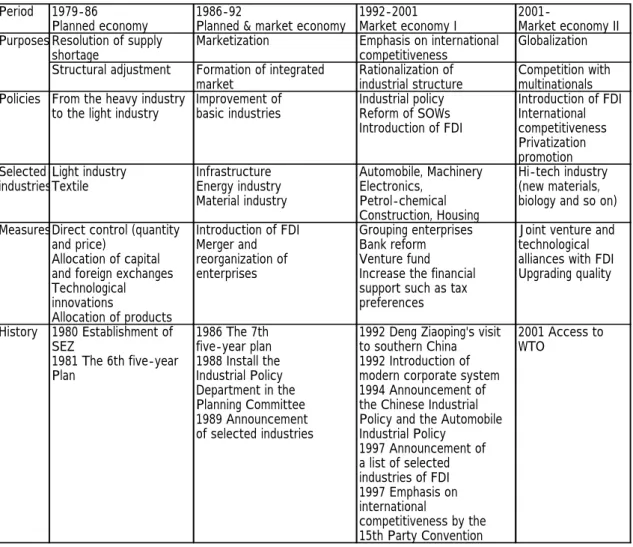
Industrial policy from 1979 was divided into three periods, as shown in Table 4. In 1992 the government introduced the concept of Japanese-style industrial policy and by 1997 implementation was in full swing. As described above, this involved the restructure of state-owned enterprises and the attraction of foreign capital.
Developments up to this point are summarized in Table 4. Policy can be classified into three major periods: planned economy (1979 to 1986), mixture of planned and market economy (1986 to 1992) and market economy I (1992 to 2001) and market economy II (from 2001).
In the planned economy, the government directly controlled all production, distribution and consumption. In the planned/market economy the government
controlled production quantity but not consumption quantity. In the market economy, most economic activities have been determined through competition.
In the first period of the planned economy, the objective was to resolve insufficient supply. The government attempted to adjust industrial structure and switch emphasis from heavy industries to light industries. The textile industry was a typical example. Quality?Quantity? and prices were controlled directly and a
product allocation coupon system was applied. Quantity control was achieved through capital rationing and output quotas. In addition, the government intervened to encourage technological innovation.
This policy was introduced in the sixth five-year plan announced in 1981 and started from 1984. However, the effects were limited because the government could not give financial support to the targeted industries. From 1987, structural
adjustment policies were launched to balance demand and supply by reducing overcapacity within given industries, so these policies were not designed to foster industries.
The planned/market economy period introduced a market economy and an integrated market. The objective was the development of basic sectors such as infrastructure and raw materials. Transportation infrastructure, coal, oil and iron and steel were targeted in industrial policy. Mergers and reorganizations, as well as the introduction of foreign multinationals, were important measures. The term
“industrial policy” was used for the first time in 1986, in the seventh five-year plan. The Industrial Policy Department was established in the National Planning
Committee in 1988. Leading industries targeted by industrial policy were selected in 1989.
The objective in the market economy period has been to foster domestic enterprises that could be competitive in international markets. At the same time overcapacity created by industrial policies in the first two periods needed to be
adjusted or eliminated (this was the rationalization of industrial structure, which we will not discuss here). The three main policies of this period have been: 1)
implementation of industrial policy, 2) reform of state-owned enterprises and 3) introduction of foreign capital. The aim has been to create leading industries that could serve as a core for new economic growth.
Industrial policies announced in 1994 designated four leading industries: automobiles, electronics and machinery, construction and petrochemicals. Later, service industries such as information and housing were added. Industrial policies for the machinery and electronic industry were discussed, but the results were not made public because of difficulties in the coordination of central and local
government interests.
In the reform of state-owned enterprises, the introduction of a modern
management system was called for in 1992. However, this reform did not proceed well and in 1998 Prime Minister Zhu Yong Ji announced a new three-year plan to re-implement the reform. Third, from 1992, the introduction of foreign capital began to play a critical role in China’s economic growth. In 1996, however, the resulting economic boom ran out of steam, so a new list of industries targeted for FDI was announced in 1997.
In contrast, Japanese industrial policy never targeted specific industries for FDI because Japan did not rely on foreign investment.
In the ninth five-year plan starting in 1996, industrial policy focused on
agriculture, infrastructure, pillar industries and service industries. Pillar industries included building materials, housing, petroleum and automobiles. The government set 2000 as the target year. Structural adjustment was focused on the textile industry, improved quality in the steel industry, and improved profitability in the coal industry to reduce excess capacity. Social progress was also targeted. Overall, the
economic structure.
At the 15th Communist Party Convention in 1997, the importance of
international competitiveness was affirmed. A new industrial policy included the development of a housing industry. Five major changes were made in industrial policy:
• Balanced supply and demand, instead of just strengthening supply in leading industries.
• More market competition, following many failures due to government intervention.
• De-emphasis of state ownership. • More labor mobility.
• Preferential treatment for SMEs, including the establishment of a financing department for this purpose.
These changes basically encouraged domestic enterprises to become competitive with foreign companies in export markets. The government decided that preferential treatment was not necessarily needed for state-owned enterprises and that
distinctions between foreign and local capital were unnecessary. State-owned enterprises should be reformed to be competitive with foreign companies.
The Board of National Affairs held a meeting in June 1997 in which Wu Bangguo proposed that the reform of state-owned enterprises should follow the ROK and Japanese models by grouping enterprises into conglomerates. But then the Asian financial crisis occurred and had a serious impact on Chinese industrial policy. Slower growth in Asian countries, particularly the ROK and Japan, forced the government to reconsider the plan.
At the same time the government became aware of the need to implement industrial policies with more emphasis on international competition. Therefore, policy became more pro-FDI than in Japan. The principle of respecting market
competition was also emphasized over government intervention. This was a key way in which policy contributed to China's industrial development. The issue of
international competitiveness could not be avoided, and the Chinese government was unlikely to continue pursuing the policies that Japan did in the 1950s. Chinese industrialization has been based on three basic policies: reform of large state-owned enterprises, introduction of FDI in economic development zones and government guidance. All three have aimed to make domestic enterprises more competitive with foreign enterprises. This shift became clear 1997.
B. Measures for implementing industrial policy
Industrial policy has been implemented through financing measures, tax measures, administrative measures and legal measures. In the early 1990s, the emphasis was placed on financing, including low-interest loans, a capital stock quota and approval of financial corporations. In the 10th five-year plan and industrial policies targeting the 21st century, the Economic and Trade Committee started to strengthen tax measures.
1) Financing for leading industries
The four main state-owned commercial banks provided loans to maximize profits and to implement industrial policy. Since these banks were playing an important role in industrial policy, it was difficult to privatize the commercial banks. For instance, a loan from the Chinese Construction Bank, one of the commercial banks, was partly determined by industrial policy. Projects guaranteed by the government had priority in receiving loans. However, the government did not introduce the "Main Bank System" used in Japan (under this system, a company's main bank would provide loans if the company faced
financial difficulties). As a result of events during the Asian financial crisis, the Chinese government judged that the Main Bank Systems of the ROK and Japan were limited in their ability to maximize economic efficiency.
By the ninth five-year plan, high-technology had become a targeted sector. A real estate company (Huasu Group Company) was picked for a national
scientific project involving measuring instruments and received research funds. A "specific project fund" financed infrastructure projects, such as roads, telecommunications and railways. This fund was opened to the manufacturing industry in the 1980s to develop the automobile industry.
State-owned commercial banks implemented "specific project financing." The Planning Committee was mainly involved in the implementation of
financing and the People's Bank of China, the central bank, also participated in these decisions. Approval for such financing made it easier for other banks to provide co-financing (in the same way that financing by the Japan Development Bank encouraged financing by Japanese commercial banks in the postwar period).
Specific project financing was also available through local governments, a system in which local governments would provide and manage funds for specific enterprises. The system was abolished with the development of commercial banks in 1994. From this point, the quotas once imposed on financing gave way to profitability as the main consideration when banks extended funds.
2) Foreign exchange rationing
Foreign exchange rationing was effective in the 1980s due to a shortage of foreign currency. Under certain conditions foreign exchange rationing
effectively supported the importation of capital equipment. However, the measure was no longer needed by the mid-1990s, when foreign reserves exceeded US$100 billion.
3) Trade policy
In general, trade policy includes tariffs and non-tariff measures, such as import quotas. In the case of China, however, effectiveness was limited by widespread smuggling.
4) Tax incentives
The effects of preferential taxation were also limited in China. Positive effects were seen in coastal areas, economic development zones and state-owned high-tech enterprises. For example, favorable treatment was extended to
companies using consolidated accounting when mergers occurred among the some 120 state-owned enterprises in 1994 and 1995. Such treatment included the acceptance of specific project funds (mentioned above) as a pre-tax cost.
5) Rationed stock issues
Stock issuances were rationed in accordance with industries targeted by industrial policy. Issuances were granted by priority, and changed each year as industrial policy evolved. However, since listings were not determined by industrial policy alone, the effects of policy were limited. For example, a poor performer was not nominated for issuance even if it was in a targeted industry. Listings were decided by the National Development Planning Committee, the