
IRUCAA@TDC : Loss of Heterozygosity and Microsatellite Instability on the Long Arm of Chromosome 2 in Human Oral Squamous Cell Carcinoma
13
0
0
全文
(2) Loss of Heterozygosity and Microsatellite Instability on the Long Arm of Chromosome 2 in Human Oral Squamous Cell Carcinoma. KAKIMOTO. Yo s h i d o u , ・ N U M A S AWA. Y A M A M O T O N o b u h a r u ,・ T A K E D A. Hideyuki, ・. E i z o u ,・ Y A M A U C H I. T o m o h i r o , ・ S H I B A H A R A Ta k a h i k o. O r a l a n d M a x i l l o f a c i a l S u r g e r y, T o k y o D e n t a l C o l l e g e ( C h i e f : P r o f . S H I B A H A R A Ta k a h i k o ). ラ ン ニ ン グ タ イ ト ル : Loss. of. heterozygosity. chromosome 2q in oral cancer. 表 : 3 枚 図 : 1 枚. 連 絡 先 : 柿 本. 吉 堂. 〒 261-8502 千 葉 県 千 葉 市 美 浜 区 真 砂 1-2-2 東 京 歯 科 大 学. 口 腔 外 科 学 講 座. E-mail;[email protected] TEL. ;043(270)3974. FAX. ;043(270)3975. 原 稿 の 分 類 ・ ・ ・ Short Communication. 1. on.
(3) Abstract Frequent. allelic. heterozygosity. imbalances,. (LOH). and. including. microsatellite. loss. of. instability. (MSI), have been found on the long arm of chromosome 2 ( 2 q ) i n s e v e r a l t y p e s o f h u m a n c a n c e r. T h i s s t u d y w a s designed to identify the tumor suppressor locus (or loci) associated with oral squamous cell carcinoma (SCC) on 2q.. In. order. to. understand. the. details. of. genetic. alterations on chromosome 2, we performed polymerase chain reaction analysis of microsatellite polymorphisms corresponding. to. 10. loci. on. this. chromosome.. We. identified a novel tumor suppressor locus in this region in primary oral SCCs. To further determine the role of 2q deletions in oral cavity carcinogenesis, 19 oral SCCs (19 sets of primary and corresponding normal tissues) were examined for allelic imbalances (LOH or MSI) on 2q using 10 microsatellite markers. Among these 19 patients, 11 (57.9%) showed LOH at one or more loci. Deletion mapping commonly. of. these. deleted. tumors. revealed. regions. on. the. four. discrete,. chromosome. arm.. Furthermore, we detected MSI in 4 of those tested cases (21.1%).. We. compared. our. results. with. the. clinicopathologic features. A number of sites displaying LOH on 2q could be detected in early stage lesions, and. 2.
(4) the. frequencies. clinical. stages,. of. LOH. but. no. tended. to. be. statistical. higher. in. later. correlation. was. observed. Our results suggest that allelic imbalances on 2q are involved in the development of oral SCC and that at least one or more putative tumor suppressor genes contributing. to. the. pathogenesis. of. this. disease. are. present on 2q.. Key words: Chromosome 2, Oral squamous cell carcinoma, l o s s o f h e t e r o z y g o s i t y, M i c r o s a t e l l i t e i n s t a b i l i t y, T u m o r suppressor gene. 3.
(5) INTRODUCTION. The activation of oncogenes and inactivation of tumor suppressor genes are considered to play important roles in multistep carcinogenesis in humans1).. Losses. of alleles on a specific chromosome suggest the presence of a tumor suppressor gene.. Such allelic losses have. been detected as a loss of heterozygosity (LOH) and microsatellite instability (MSI)2-3), demonstrating their usefulness for the mapping of DNA regions in which an unknown tumor suppressor gene may be present4). I n t h i s s t u d y, a s s u m i n g t h a t a n o v e l t u m o r suppressor specific to oral squamous cell carcinoma is present on chromosome 2, we prepared a detailed deletion map of 2q by a comparison of tumor and normal tissue DNAs in individual patients with oral squamous cell carcinoma, and investigated the following items: 1) Evaluation of LOH and MSI, and identification of the locus of a novel unknown tumor suppressor gene specific to oral squamous cell carcinoma, and 2) association with clinicopathological characteristics.. 4.
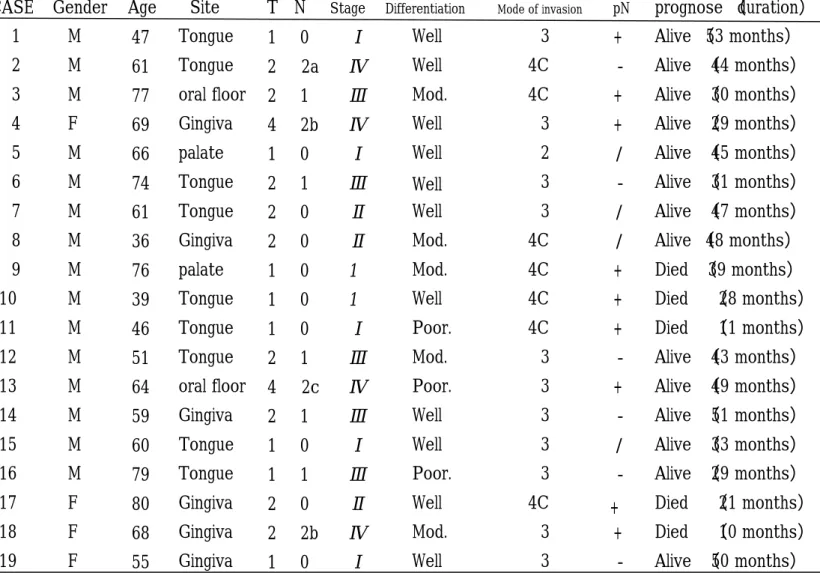
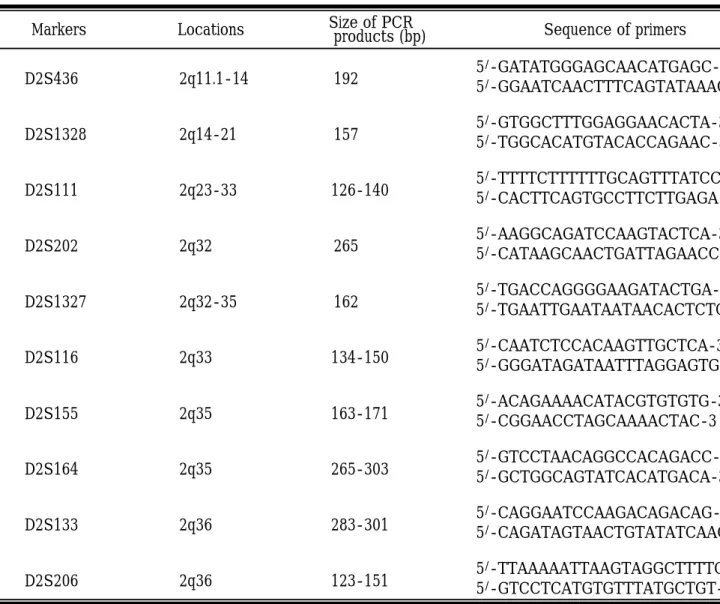
(6) MATERIALS AND METHODS The subjects were 19 patients diagnosed with oral Squamous cell carcinoma at the Oral Maxillofacial surgery Department of Tokyo Dental College Chiba Hospital from whom sample specimens could be obtained. The primary tumor and corresponding normal tissues were used (Table 1).. From the tumor and normal tissues,. DNA was extracted and purified by phenol-chloroform extraction, and washed and concentrated by ethanol precipitation.. Each DNA sample was adjusted to 50. ng/µl, and used as a template for the polymerase chain reaction (PCR) to amplify the DNA. PCR microsatellite analysis was performed using markers of 10 microsatellite regions on the long arm of chromosome 2 (Table 2).. In statistical analysis, the. significance of the relationship between the frequencies of LOH and MSI and the clinicopathological c h a r a c t e r i s t i c s w a s a n a l y z e d u s i n g F i s h e r ’s d i r e c t probability method.. 5.
(7) RESULTS LOH was noted at least at one gene locus in 11 of the 19 patients (57.9%). patients (21.1%).. MSI was noted in 4 of the 19. Deletion maps of the 19 patients. were prepared, and one common deficient region was identified on this chromosome (Fig. 1).. The gene locus. with a high frequency of LOH was D2S206 in the 2q36 region (33.3%). The relationship between the clinicopathological factors and the presence of LOH and MSI was investigated.. LOH was more frequently noted in. females, and MSI was noted only in males.. Regarding. the location, LOH was frequently detected in the gingiva, and MSI was noted only in the tongue.. On comparison. of the T and stage classifications, LOH was frequently detected in early-stage cases (Table3). The correlation between the imbalance of alleles (LOH and MSI) and the clinicopathological factors was a n a l y z e d b y F i s h e r ’s d i r e c t p r o b a b i l i t y m e t h o d , b u t n o significant correlation was noted.. 6.
(8) DISCUSSION Deletion maps of the 19 patients were prepared, and one region with a high frequency of LOH, which may be a common deficient region on 2q, was identified at D2S206 in the 2q36 region.. In this region, a deficient. region common to granular cell tumor has recently been identified by Watson et al.5), suggesting that a tumor suppressor gene related to oral squamous cell carcinoma and granular cell tumor is present in this region.. Since. no gene in the 2q36 region has been cloned, the identification of the region considered to be a common deficient region in the 2q36 region strongly suggested that a novel unknown tumor suppressor gene is present. LOH was frequently detected in the gingiva in relatively early cancer, suggesting that inactivation of the tumor suppressor gene occurred in an early step, and the frequency of inactivation may vary depending on the location.. Extensive analysis of an increased number of. patients, and large-scale gene analysis with frequent and careful course observation of oral cancer patients are necessary for the realization of an optimal treatment for individual patients.. 7.
(9) REFERENCES 1 ) F e a r o n , E . R . , Vo g e l s t e i n , B . : A g e n e t i c m o d e l f o r colorectal tumorigenesis. Cell 61: 759-767, 1990. 2). Ishwad,. C.S.,. Ferrell,. R.E.,. et. al.:. Microsatellite. instability in oral cancer. Int. J. Cancer (Pred Oncol) 64: 332-335, 1995. 3). Ogawara,. K.,. Uzawa,. K.,. et. al.:. Frequent. m i c r o s a t e l l i t e i n s t a b i l i t y i n o r a l c a n c e r. O n c o l . R e p . 4 : 161-165 ,1997. 4) Weinberg, R.A.: Tumor suppressor genes. Science 254: 1138-1146, 1991.. 5). Watson,. R.H.,. Roy. W. J .. J r. ,. et. al.:. Loss. of. heterozygosity at the α -inhibin locus on chromosome 2q. is. not. a. feature. of. human. granulosa. Gynecol. Oncol. 65: 387-390 ,1997.. 8. cell. tumors..
(10) Table 1:CASE CASE. Gender. Age. Site. T N. Stage. Differentiation. Mode of invasion. pN. prognose (duration). 1. M. 47. Tongue. 1. 0. Ⅰ. Well. 3. +. Alive (53 months). 2. M. 61. Tongue. 2. 2a. Ⅳ. Well. 4C. -. Alive (44 months). 3. M. 77. oral floor. 2. 1. Ⅲ. Mod.. 4C. +. Alive (30 months). 4. F. 69. Gingiva. 4. 2b. Ⅳ. Well. 3. +. Alive (29 months). 5. M. 66. palate. 1. 0. Ⅰ. Well. 2. /. Alive (45 months). 6. M. 74. Tongue. 2. 1. Ⅲ. 3. -. Alive (31 months). 7. M. 61. Tongue. 2. 0. Ⅱ. Well Well. 3. /. Alive (47 months). 8. M. 36. Gingiva. 2. 0. Ⅱ. Mod.. 4C. /. Alive (48 months). 9. M. 76. palate. 1. 0. 1. Mod.. 4C. +. Died (39 months). 10. M. 39. Tongue. 1. 0. 1. Well. 4C. +. Died. (28 months). 11. M. 46. Tongue. 1. 0. Ⅰ. Poor.. 4C. +. Died. (11 months). 12. M. 51. Tongue. 2. 1. Ⅲ. Mod.. 3. -. Alive (43 months). 13. M. 64. oral floor. 4. 2c. Ⅳ. Poor.. 3. +. Alive (49 months). 14. M. 59. Gingiva. 2. 1. Ⅲ. Well. 3. -. Alive (51 months). 15. M. 60. Tongue. 1. 0. Ⅰ. Well. 3. /. Alive (33 months). 16. M. 79. Tongue. 1. 1. Ⅲ. Poor.. 3. -. Alive (29 months). 17. F. 80. Gingiva. 2. 0. Ⅱ. Well. 4C. 18. F. 68. Gingiva. 2. 2b. Ⅳ. Mod.. 3. + +. 19. F. 55. Gingiva. 1. 0. Ⅰ. Well. 3. -. Died. (21 months). Died. (10 months). Alive (50 months). M: Male, F: Female. Well: well differentiated, mod: moderately differentiated, poor: poorly differentiated.
(11) Table 2:Microsatellite markers Markers. Locations. Size of PCR products (bp). Sequence of primers. D2S436. 2q11.1-14. 192. 5/-GATATGGGAGCAACATGAGC-3/ 5/-GGAATCAACTTTCAGTATAAACCC-3. D2S1328. 2q14-21. 157. 5/-GTGGCTTTGGAGGAACACTA-3/ 5/-TGGCACATGTACACCAGAAC-3 /. D2S111. 2q23-33. 126-140. 5/-TTTTCTTTTTTGCAGTTTATCC-3/ 5/-CACTTCAGTGCCTTCTTGAGA-3 /. D2S202. 2q32. 265. 5/-AAGGCAGATCCAAGTACTCA-3/ 5/-CATAAGCAACTGATTAGAACC-3. D2S1327. 2q32-35. 162. 5/-TGACCAGGGGAAGATACTGA-3/ 5/-TGAATTGAATAATAACACTCTGTGC-3. D2S116. 2q33. 134-150. 5/-CAATCTCCACAAGTTGCTCA-3/ 5/-GGGATAGATAATTTAGGAGTGGG-3. D2S155. 2q35. 163-171. 5/-ACAGAAAACATACGTGTGTG-3/ 5/-CGGAACCTAGCAAAACTAC-3 /. D2S164. 2q35. 265-303. 5/-GTCCTAACAGGCCACAGACC-3/ 5/-GCTGGCAGTATCACATGACA-3 /. D2S133. 2q36. 283-301. 5/-CAGGAATCCAAGACAGACAG-3/ 5/-CAGATAGTAACTGTATATCAAGGGG-3. D2S206. 2q36. 123-151. 5/-TTAAAAATTAAGTAGGCTTTTGGTT-3/ 5/-GTCCTCATGTGTTTATGCTGT-3 /. /. /. /. /. /.
(12) Table 3: Frequencies of LOH and MSI (%) in relation to clinicopathological factors. Gender Site. T classification. TNM stage. Differentiation. pN Mode of invasion. Prognosis. MSI (+). MSI (%). 53.3%. 4/15. 26.7%. 3/4 4/9. 75% 44.4%. 0/4 4/9. 0% 44.4%. other. 5/6 2/4. 83.3% 50%. 0/6 0/4. 0% 0%. T1 T2. 5/8 6/9. 62.5% 66.7%. 2/8 2/9. 25% 22.2%. T4 I. 0/2 5/7. 0% 71.4%. 0/2 1/7. 0% 14.3%. II III IV. 2/3 2/5 2/4 7/11. 66.7% 40% 50% 63.6%. 1/3 2/5 0/4 2/11. 33.3% 40% 0% 18.2%. 4/5 0/3. 80% 0%. 1/5 1/3. 20% 33.3%. (+) (-) 2. 5/9 4/6 1/1. 55.6% 66.7% 100%. 0/9 2/6 0/1. 0% 33.3% 0%. 3 4C. 5/11 5/7. 45.5% 71.4%. 4/11 0/7. 36.4% 0%. Alive Died. 7/14 4/5. 50% 80%. 4/14 0/5. 28.6% 0%. Male Female Tongue Gingiva. well mod. poor.. LOH (+). LOH (%). 8/15.
(13) Fig. 1: Deletion mapping of the long arm of chromosome 2 11.1 11.2 12 13 14.1 14.2 14.3 21.1 21.2 21.3. Case No.. 1. 2. 3. 4. 5. 6. 7. 8. 9 10 11 12 13 14 15 16 17 18 19. D2S436 D2S1328. 22 23 24.1 24.2 24.3 31. D2S111 D2S202 D2S1327 D2S116 D2S155. 32.1 32.2 32.3. D2S164. 33 34. D2S133 D2S206. 35 36 37.1 37.2 37.3. Chr.2q. LOH : Loss of heterozygosity. ROH : Retain of heterozygosity. MSI : Microsatellite instability NI : Not informative. Commonly deleted region.
(14)
図
関連したドキュメント
PD-L1 expression was upregulated in macrophages and dendritic cells (DCs) in high-grade invasive human OSCC tissues or co-cultured with mesenchymal-phenotype OSCC cells in
In this study, PD-L1 protein extracted from the cell membrane was found to be downregulated in OSC-20 cells compared with OSC-19 cells, despite a higher PD-L1 expression in the
(24) Similarly, T26 inhibited both Pim-3 kinase activity in a cell-free system and in vitro cell proliferation of human pancreatic cancer cell lines at micromo- lar
NELL1 (a) and NELL2 (b) mRNA expression levels in renal cell carcinoma cell lines OS-RC-2, VMRC-RCW, and TUHR14TKB and control HEK293T cells were analyzed using quantitative
To mimic RAGE-dependent tumor malignant behaviors and assess the inhibitory effects of papaverine, the present study used an established human fibro- sarcoma cell line HT1080
Abbreviations: DSBs, DNA double-strand breaks; ESCC, esophageal squamous cell carcinoma; γ H2AX, H2AX phospho rylation; HDACs, histone deacetylases; HR, homologous
As it is involved in cell growth, IER3 expression has been examined in several human tumors, including pancreatic carcinoma, ovarian carcinoma, breast cancer, and
Treatment with CH11 caused a relocalization of the 681 antigen: signals were no longer detectable in the cell nucleus, and instead cell bodies, in particular the region near
