
IRUCAA@TDC : Influence of different rubber dam application on intraoral temperature and relative humidity
8
0
0
全文
(2) Bull Tokyo Dent Coll (2014) 55(1): 11–17. Original Article. Influence of Different Rubber Dam Application on Intraoral Temperature and Relative Humidity Akiko Haruyama1,2), Atsushi Kameyama1,2), Chihiro Tatsuta3), Kurumi Ishii3), Toshiko Sugiyama2), Setsuko Sugiyama2) and Toshiyuki Takahashi2,3) Division of General Dentistry, Department of Clinical Oral Health Science, Tokyo Dental College, 2-9-18 Misaki-cho, Chiyoda-ku, Tokyo 101-0061, Japan 2) Division of General Dentistry, Tokyo Dental College Chiba Hospital, 1-2-2 Masago, Mihama-ku, Chiba 261-8502, Japan 3) Tokyo Dental College School of Dental Hygiene, 1-2-2 Masago, Mihama-ku, Chiba 261-0011, Japan 1). Received 10 July, 2013/Accepted for publication 7 November, 2013. Abstract The purpose of this study was to investigate the effect of type of rubber dam and application method on the moisture exclusion effect. The intraoral temperature and relative humidity were compared among various moisture exclusion appliances. Various dry field techniques were applied to 5 subjects and intraoral temperature and relative humidity measured 5 min after placing a digital hygro-thermometer in the mouth. The relative humidity was 100% in all subjects when moisture was excluded by means of cotton rolls alone. When only tooth 36 was exposed, relative humidity was significantly lower with latex, urethane, or 3-dimensional sheets than with cotton rolls alone, and was similar to the level of humidity in the room. When a local rubber dam was used, the relative humidity was significantly higher than the indoor humidity (p<0.05). No significant differences were noted in the intraoral temperature or relative humidity between exposure of 4 teeth and 1 tooth, but variation in the relative humidity was more marked in 4- than in 1-tooth exposure. The creation of an air vent did not influence the moisture exclusion effect. These results suggest that the rubber dam isolation technique excludes moisture to a level equivalent to the humidity in the room when only a single tooth is exposed, but the moisture exclusion effect may be inconsistent when several teeth are exposed. Key words:. Rubber dam — Moisture exclusion — Intraoral temperature — Relative humidity — Isolation technique. Introduction. many merits in root canal treatment and restoration. For example, it can prevent contamination of the operating field due to invasion. The rubber dam isolation technique offers 11.
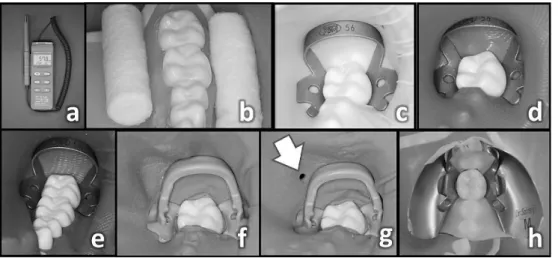
(3) 12. Haruyama A et al.. by saliva, blood, or gingival crevicular fluid, and can also enhance safety by preventing injury of the surrounding oral soft tissue through contact with tools or leakage of drugs. In addition, it can prevent accidental ingestion and aspiration when treatment devices or drugs fall into the mouth. Therefore, its use is recommended in root canal treatment and restoration. However, the rubber dam isolation technique is not applied actively in dental practice15). In 2000, the Federation Dental International (FDI) proposed the concept of minimal intervention (MI) in the treatment of caries14). Since then, caries treatment in the molar region has shifted from indirect metal restoration and amalgam filling to direct bonding restoration using composite resin. However, the humidity of the oral environment makes high in vitro adhesion difficult to achieve1,6,18). Contamination of the adhered surface by saliva or blood may also inhibit bonding3,5,9,11,13,17). This suggests the potential of the rubber dam isolation technique in preventing such contamination and reducing humidity12). The need for moisture exclusion during conservative restoration, therefore, is clear, and various types of rubber dam are now commercially available. In applying rubber dam isolation to root canal treatment, only the tooth to be treated is exposed. For restoration of class 2, 3, or 4 cavities including the adjacent surface, it is necessary to simultaneously expose the adjacent tooth as recovery of the contact point is necessary. Many previous studies on the moisture exclusion effect of rubber dams investigated their application in single tooth exposure2,8,12), and it is unclear whether an equivalent moisture exclusion effect can be obtained when several teeth are exposed. Moreover, the effects of the shape of the rubber dam sheet, the material, and how it is applied on moisture exclusion remain to be fully clarified. To clarify the effect of the type of rubber dam and method of application on the moisture exclusion effect, we investigated differences in intraoral temperature and relative. humidity among 4 types of rubber dam. We also investigated the influence of the exposure of different numbers of teeth and an air vent on the intraoral temperature and relative humidity. The null hypothesis of this study was that differences in the moisture exclusion method would not influence the intraoral temperature or relative humidity.. Materials and Methods 1. Subjects The subjects comprised 5 female students (20–21 years old) at the Tokyo Dental College School of Dental Hygiene. All the subjects were generally healthy and had no symptoms of dry mouth or defects in the left lower molar region (teeth 34–37). Informed consent for inclusion was obtained from each subject after the objectives and content of the study had been fully explained using documents. The study content was reviewed by the Tokyo Dental College Ethics Committee (approval number 232; approved March 22, 2012). 2. Experimental group setting and procedure The following 7 groups were established (Figs. 1b–h). 1) Group I (control) One cotton roll each was placed on the buccal and lingual sides of tooth 36 (Fig. 1b). 2) Group II (latex sheet, tooth 36 exposed) A large hole was made in a widely-used latex rubber sheet (Royal Shield Powder Free Latex Dental Dams, Elastomade Accessories, Malaysia) using a rubber dam punch (YDM, Tokyo, Japan) and the sheet fixed with an Ivory #56 rubber dam clamp (YDM) and Young’s frame (YDM)(Fig. 1c). 3) Group III (highly extensible sheet, tooth 36 exposed) A medium-sized hole was made in a highly extensible sheet (Roeko Flexi Dam non-latex, Colténe/Whaledent, Langenau, Germany) using a rubber dam punch and the sheet fixed with an Ivory #56 rubber dam clamp and exclusive frame (Colténe/Whaledent) (Fig. 1d)..
(4) Rubber Dam Changes Intraoral Humidity. 13. Fig. 1 Measurement devices used and experimental procedure (a) hygro-thermometer (Model CTH-1100); (b) Group I, simple moisture exclusion using cotton rolls; (c) Group II, rubber dam isolation with single tooth (tooth 36) exposure using latex sheet (Latex Dental Dam); (d) Group III, rubber dam isolation with single tooth (tooth 36) exposure using highly extensible sheet (Roeko Flexi Dam); (e) Group IV, 4 contiguous teeth (teeth 34–37) exposure using highly extensible sheet (Roeko Flexi Dam); (f) Group V, single tooth (tooth 36) exposure using 3-dimensional sheet (OptiDam); (g) Group VI, single tooth (tooth 36) exposure using 3-dimensional sheet (OptiDam) with preparation of an air vent (arrow); (h) Group VII, partial rubber dam isolation of tooth 36 using a modified rubber dam clamp (Sairenji Dam Protector).. 4) Group IV (highly extensible sheet, teeth 34–37 exposed) Two medium-sized holes and 2 smaller holes were made in a highly extensible sheet (Roeko Flexi Dam non latex) using a rubber dam punch and teeth 34–37 exposed. To hold the sheet, an Ivory #56 rubber dam clamp was attached to tooth 37 and a rubber wedge (Wedjets, Colténe/Whaledent) inserted into the interdental region between teeth 33 and 34. The sheet was then fixed with a Flexi Dam-exclusive frame (Colténe/Whaledent) (Fig. 1e). 5) Group V (3-dimensional latex sheet, tooth 36 exposed) To expose tooth 36, the nipple of a 3-dimensional rubber dam sheet (OptiDam Posterior, KerrHawe SA, Bioggio, Switzerland) was cut with scissors. The sheet was then applied in the mouth and fixed using an exclusive clamp (Soft Clamp, KerrHawe SA) and frame (Anatomical frame OptiDam, KerrHawe SA)(Fig. 1f). 6) Group VI (3-dimensional latex sheet, tooth 36 exposed+air vent). The procedure was the same as that for Group V, except that a large hole was made as an air vent in the posterior-most intraoral region of the sheet using a rubber dam punch. The sheet was then applied as described above (Fig. 1g). 7) Group VII (local rubber dam, tooth 36 exposed) The latex rubber dam sheet used in Group II was trimmed into a barrel shape, attached to a Sairenji Dam Protector (Sairenji Trading, Tokyo, Japan) using the procedure specified by the company, and applied to tooth 36 (Fig. 1h). To reduce the load of 5-min mouth-opening on the temporomandibular joint, an auxiliary tool for mouth-opening (Open-EX Bite-Block, Hager & Werken, Duisburg, Germany) was placed between the right upper and lower molar regions in all groups. 3. Measurement devices and methods Prior to measurement, the temperature and relative humidity in the measurement room were determined and recorded using.
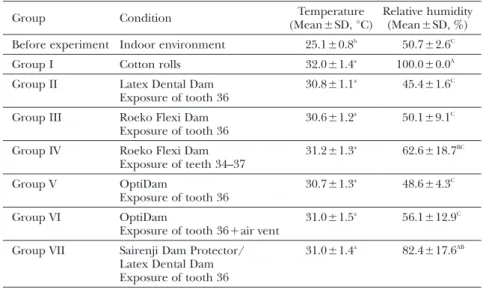
(5) 14. Haruyama A et al.. Table 1 Intraoral temperature and relative humidity with application of various moisture exclusion methods (n=5) Group. Temperature Relative humidity (Mean±SD, °C) (Mean±SD, %). Condition. Before experiment Indoor environment Group I. Cotton rolls. 25.1±0.8b. 50.7±2.6C. a. 100.0±0.0A. a. 32.0±1.4. Group II. Latex Dental Dam Exposure of tooth 36. 30.8±1.1. 45.4±1.6C. Group III. Roeko Flexi Dam Exposure of tooth 36. 30.6±1.2a. 50.1±9.1C. Group IV. Roeko Flexi Dam Exposure of teeth 34–37. 31.2±1.3a. 62.6±18.7BC. Group V. OptiDam Exposure of tooth 36. 30.7±1.3a. 48.6±4.3C. Group VI. OptiDam Exposure of tooth 36+air vent. 31.0±1.5a. 56.1±12.9C. Group VII. Sairenji Dam Protector/ Latex Dental Dam Exposure of tooth 36. 31.0±1.4a. 82.4±17.6AB. Same letter indicates absence of significant difference in temperature or relative humidity (Tukey’s HSD test, p>0.05).. a digital hygro-thermometer (Model CTH1100, Custom, Tokyo)(Fig. 1a). Each subject was fitted with the auxiliary device for mouthopening and the dry field technique applied, immediately followed by placement of the probe tip (sensor unit) of the digital hygrothermometer in the mouth. The region approximately 1 cm directly above the occlusal surface of tooth 36 was fixed with a finger and intraoral temperature and humidity measured 5 min after attachment. Measurements were performed on the same day in all groups. The data were subjected to a one-way analysis of variance followed by Tukey’s HSD Test (p<0.05) for a between-group comparison. For the statistical analysis, IBM SPSS statistics 18 for Windows (IBM Japan Inc., Tokyo, Japan) was used.. Results The mean (±standard deviation) intraoral temperature and relative humidity in each group are shown in Table 1. The measured room temperature was 25.1. ±0.8°C (range: 24.1–25.8°C). The intraoral temperature was significantly higher than this in all groups (p<0.05), and there was no significant difference among Groups I–VII (p>0.05). The relative humidity in the measurement room was 50.7±2.6% (range: 47.6–53.8%). The intraoral relative humidity was not sig nificantly different from this when the latex (Group II), highly extensible (Group III), or 3-dimensional sheets was used (Group V) (p>0.05); it was significantly higher, however, than when moisture exclusion was achieved using a local rubber dam (Group VII) or cotton rolls (Group I)(p<0.05). No significant difference was noted between with exposure of a single tooth (#36)(Group III) and exposure of 4 contiguous teeth (#34–37)(Group IV) using a highly extensible sheet (p=0.611) or between with (Group V) and without (Group VI) an air vent using a 3-dimensional sheet (p=0.954). However, the variation among subjects was greater in Group IV than in Group III, and in Group VI than in Group V..
(6) Rubber Dam Changes Intraoral Humidity. Discussion The objectives of this study were to: 1) investigate the influence of type of rubber dam sheet on intraoral temperature and relative humidity; 2) compare intraoral temperature and relative humidity between use of the rubber dam isolation technique with exposure of a single and multiple teeth; and 3) investigate the influence of the presence or absence of an air vent made in the rubber sheet to make breathing easier on the intraoral temperature and relative humidity. Seven groups were established in all. The statistical analysis revealed that the intraoral temperature was significantly higher than the room temperature, and that moisture exclusion did not significantly influence the intraoral temperature. In contrast, differences in the moisture exclusion appliance significantly influenced intraoral relative humidity. Therefore, the null hypothesis was partially rejected. The intraoral temperature was significantly higher than the room temperature in all groups receiving moisture exclusion treatment (Groups I–VII). Earlier studies found that when a latex sheet rubber dam was applied, the intraoral temperature was equivalent to that in the open mouth without moisture exclusion2,8), and a similar tendency was also observed in the present study. We used three types of sheet: a widely used latex sheet, a highly extensible sheet, and a 3-dimensionally molded latex sheet. Although the thickness differed among the three types of sheet, no significant difference was noted among the groups. This suggests that the type and thickness of the rubber dam do not markedly influence the intraoral temperature in routine dental practice. The relative humidity in the measurement room (50.7±2.6%) was slightly lower than that previously measured by us using the same device2,8). According to the annual weather data in Japan, the relative humidity is low in winter and high in summer10). The data were collected mainly in summer in the previous report8), but the present experiment was performed in winter. No difference was noted. 15. in the temperature because the experiment was performed in an air-conditioned room, but the humidity was not controlled. Therefore, the difference in humidity between this and the earlier study may have been due to differences in the experimental period. The application of a rubber dam to exclude moisture is recommended in conservative restoration treatment, as it can eliminate saliva or blood from the operating field. It is also recommended for root canal treatment. In actual dental practice, however, moisture is more commonly excluded by simply using cotton rolls. This method might also prevent contamination by saliva or blood on the adhered surfaces of both direct and indirect bonded restorations1,6,18). However, the present results revealed that the relative humidity of the operating field was significantly higher than that of the indoor environment. Therefore, use of cotton rolls alone may be insufficient to control the level of moisture on the adhered surface. The rubber dam isolation technique using a standard latex sheet, a highly extensible sheet, a Flexi Dam, a 3-dimensional latex sheet, or OptiDam reduced the relative humidity to a level similar to the indoor level before the experiment. It has been reported that when composite resin is bonded to dentin in a standard in vitro experimental room environment (25°C, 50% relative humidity), the bonding strength is significantly greater than that under conditions similar to the intraoral environment (37°C, 100% relative humidity)3,5,6,9,11,17,18). One-step resin bonding systems are now widely used, but these bonding materials contain many solvents such as acetone and water, and the polymerization rate and adhesiveness decrease when solvent removal is not ensured before polymerization4,7,16). If bonding is applied under 100% relative humidity, solvent removal may be more difficult, even with high-pressure air blowing. Therefore, a rubber dam should be selected for moisture exclusion, particularly when the restoration involves the use of bonding materials. In routine dental practice, contiguous teeth.
(7) 16. Haruyama A et al.. surrounding the one to be restored are often exposed, including the adjacent surface. When contiguous teeth 34–37 were exposed here, no significant difference was noted in the intraoral environment from that when only tooth 36 was exposed. The relative humidity, however, was more than 10% higher in 3 of the 5 subjects when the contiguous teeth were exposed compared to that with single tooth exposure, and the variation was very large. The space between the teeth and the rubber sheet may have increased, as sheet tension rises with an increase in the number of exposed teeth. The Flexi Dam, in particular, has high elasticity, so when high tension is applied, the hole in the sheet readily expands. Avoidance of excessive pulling while attaching the frame is the key to maintaining dry conditions. The OptiDam is a unique latex rubber dam sheet that does not require a hole to be made because nipples are prepared beforehand by 3-dimensional molding. Accordingly, the tension on the sheet being applied in the mouth is smaller than that with conventional rubber sheets. Since it fits well, a better moisture exclusion effect was obtained here when only tooth 36 was exposed, similarly to with the latex and urethane sheets. Rubber dam attachment often causes choking, making it necessary to secure a respiratory route. Here we compared the intraoral environment between with and without an air vent created for this purpose in the corner of the OptiDam. No significant change was noted in either the temperature or relative humidity. The preparation of an air vent was expected to induce contamination of the operating field by expired gas, but no major influence was noted, and this may have been due to the 1.5-cm distance between the operating field and the air vent. The Sairenji Dam Protector is a modified rubber dam clamp used to exclude the tongue and buccal mucosa. This clamp has several hooks, and a rubber dam sheet can be attached to the clamps. When using this device, the intraoral relative humidity was significantly higher than with the other. rubber dams, suggesting that no effective moisture exclusion effect can be obtained unless the oral cavity is entirely covered with a rubber dam sheet.. Conclusion The effects of the type of rubber dam, umber of teeth exposed, and an air vent n made in the rubber dam sheet on the intraoral temperature and relative humidity were investigated and the following conclusions obtained. 1. Simple moisture exclusion using cotton rolls alone is unsuitable for dry-field techniques because of the 100% relative humidity. 2. Using the rubber dam isolation technique for single tooth exposure, the intraoral relative humidity can be adjusted to be close to that in the room, but it is impossible to lower the intraoral temperature. 3. The relative humidity-reducing effect of a local rubber dam is less than that of a full rubber dam. 4. The moisture exclusion effect of a rubber dam with exposure of several teeth in the molar region was similar to that with single tooth exposure, but the possibility of variation in the effect cannot be ruled out. 5. Air vent preparation at a site distant from the exposed tooth does not have a major influence on the moisture exclusion effect.. Acknowledgements The authors would like to thank KaVo ental Systems Japan Co., Ltd. for providing D the OptiDam and Mokuda Dental Co., Ltd. for providing the Roeko Flexi Dam used in this study.. References 1) Abdalla AI, Davidson CL (1998) Bonding efficiency and interfacial morphology of one-bottle.
(8) Rubber Dam Changes Intraoral Humidity. adhesives to contaminated dentin surfaces. Am J Dent 11:281–285. 2) Abo H, Kameyama A (2009) Usefulness of various isolation equipment: Evaluating the conditions and effects of intra-oral installation. Adhes Dent 27:111–117. (in Japanese) 3) Besnault C, Attal JP (2001) Influence of a simulated oral environment on dentin bond strength of two adhesive systems. Am J Dent 14:367–372. 4) Cadenaro M, Antoniolli F, Sauro S, Tay FR, Di Lenarda R, Prati C, Biasotto M, Contardo L, Breschi L (2005) Degree of conversion and permeability of dental adhesives. Eur J Oral Sci 113:525–530. 5) Chiba Y, Miyazaki M, Rikuta A, Moore BK (2004) Influence of environmental conditions on dentin bond strengths of one-application adhesive systems. Oper Dent 29:554–559. 6) Fritz UB, Finger WJ, Stean H (1998) Salivary contamination during bonding procedures with a one-bottle adhesive system. Quintessence Int 29:567–572. 7) Ikeda T, De Munck J, Shirai K, Hikita K, Inoue S, Sano H, Lambrechts P, Van Meerbeek B (2008) Effect of air-drying and solvent evaporation on the strength of HEMA-rich versus HEMA-free one-step adhesives. Dent Mater 24:1316–1323. 8) Kameyama A, Asami M, Noro A, Abo H, Hirai Y, Tsunoda M (2011) The effects of three different dry-field techniques on intraoral temperature and relative humidity. J Am Dent Assoc 143:274–280. 9) Miyazaki M, Rikuta A, Tsubota K, Yunoki I, Onose H (2001) Influence of environmental conditions on dentin bond strengths of recently developed dentin bonding systems. J Oral Sci 43:35–40. 10) National Astronomical Observatory of Japan (Ed) (2012) Monthly mean relative humidity, Chronological Scientific Table, p.222, Maruzen Publishing, Tokyo. 11) Nystrom GP, Holtan JR, Phelps RA 2nd,. Becker WS, Anderson TB (1998) Temperature and humidity effects on bond strength of a. 17. dentinal adhesive. Oper Dent 23:138–143. 1 2) Plasmans PJ, Creugers NH, Hermsen R J, Vrijhoef MM (1994) Intraoral humidity during operative procedures. J Dent 22:89–91. 13) Rikuta A, Yoshida T, Tsubota K, Tsuchiya H, Tsujimoto A, Ota M, Miyazaki M (2008) Influence of environmental conditions on orthodontic bracket bonding of self-etching systems. Dent Mater J 27:654–659. 14) Tyas MJ, Anusavice K J, Frencken JE, Mount GJ (2000) Minimal intervention dentistry: a review — FDI Commission Project 1–97. Int Dent J 50:1–12. 15) Unal GC, Kaya BU, Tac AG, Kececi AD (2012) Survey of attitudes, materials and methods preferred in root canal therapy by general dental practice in Turkey: Part 1. Eur J Dent 6:376–384. 16) Van Landuyt KL, Mine A, De Munck J, Jaecques S, Peumans M, Lambrechts P, Van Meerbeek B (2009) Are one-step adhesives easier to use and better performing? Multifactorial assessment of contemporary one-step self-etching adhesives. J Adhes Dent 11:175– 190. 17) Werner JF, Tani C (2002) Effect of relative humidity on bond strength of self-etching adhesives to dentin. J Adhes Dent 4:277–282. 18) Yoo HM, Pereira PNR (2006) Effect of blood contamination with 1-step self-etching adhesives on microtensile bond strength to dentin. Oper Dent 31:660–665. Reprint requests to: Dr. Atsushi Kameyama Division of General Dentistry, Department of Clinical Oral Health Science, Tokyo Dental College, 2-9-18 Misaki-cho, Chiyoda-ku, Tokyo 101-0061, Japan Tel: +81-3-6380-9167 Fax: +81-3-3262-3420 E-mail: [email protected].
(9)
図
関連したドキュメント
The ASEP (Asymmetric Simple Exclusion Process) is a physical model in which particles hop back and forth (and in and out) of a one-dimensional
We give a Dehn–Nielsen type theorem for the homology cobordism group of homol- ogy cylinders by considering its action on the acyclic closure, which was defined by Levine in [12]
Existence of nonperturbative nonlocal field theory on noncommutative space and spiral source in renormalization.. group approach of
Our bound does not prove that every Cayley graph is a ˇ Cerný Cayley graph, but it does work for certain Cayley graphs of cyclic groups, dihedral groups, sym- metric groups,
The goal of the present paper is a description of the singularities of the Selberg zeta function in terms of the group cohomology of Γ with coefficients in certain infinite
A connection with partially asymmetric exclusion process (PASEP) Type B Permutation tableaux defined by Lam and Williams.. 4
(4S) Package ID Vendor ID and packing list number (K) Transit ID Customer's purchase order number (P) Customer Prod ID Customer Part Number. (1P)
9 Influence of pumping on chloride content Concrete temperature (Fig. 8) increased after pumping, and chloride content (Fig. 9) was slightly decreased but leveled out
