
博 士 論 文
MULTI-CRITERIA EVALUATION OF A DISTRIBUTED
ENERGY SYSTEM FOCUSING ON GRID
STABILIZATION AND CARBON EMISSION
REDUCTION
系統電力の安定化と炭素排出削減に焦点を当てた
分散型エネルギーシステムの多基準評価に関する研究
北九州市立大学国際環境工学研究科
2021 年 2 月
張 麗婷
LITING ZHANG
Doctoral Thesis
MULTI-CRITERIA EVALUATION OF A DISTRIBUTED
ENERGY SYSTEM FOCUSING ON GRID
STABILIZATION AND CARBON EMISSION
REDUCTION
February 2021
ZHANG LITING
The University of Kitakyushu
Faculty of Environmental Engineering
Department of Architecture
Gao Laboratory
Preface
DESs can save energy cost, reduce environmental impact and improve the reliability of the power grid. However, its high investment and improper capacity caused poor economic benefits. Moreover, the current evaluation method with a single criterion is relatively simple and one-sided, which cannot reflect the comprehensive benefits of the DES. Therefore, this research proposed a distributed energy system (DES) composed of photovoltaic, energy storage and gas engine, and its grid stabilization and carbon reduction potentials were analyzed. Focusing on these advantages, a multi-criteria evaluation method was established to optimize the system. Finally, different case study scenarios of the DES utilization were demonstrated. It is hoped to improve the core competitiveness of the DES and promote its development.
I
Acknowledgements
This work could not have been completed without the support, guidance, and help of many people and institutions, for providing data and insights, for which I am very grateful.
First, a special acknowledgment is given to my respectable supervisor, Professor Weijun GAO, for his support in many ways over the years and for giving me the opportunity to study at the University of Kitakyushu. He has exquisite academic skills and a rigorous work style, and friendly and amiable. His patient instruction and constructive suggestions are beneficial to me a lot. The thesis could not be finished without his guidance and help.
Second, particular thanks go to all the teachers and professors who have taught me for their instruction and generous support during these years. Also, I would also like to thank all university colleagues, Dr. Fanyue QIAN, who gives me guidance and research supports; and Ms. Dan Yu, Ms. Tingting XU, Ms. Xueyuan Zhao, and Ms. Zhonghui Liu from whom I get tremendous love and encouragement as well as technical instruction; moreover, Dr. Jinming JIANG, Mr. Daoyuan Wen also give me the help, cooperation, and supports of research and daily life in Japan.
Finally, I would like to express my deepest thanks to my parents for their loving considerations and great confidence in me that made it possible to finish this study.
V
Multi-criteria evaluation of a distributed energy system focusing on
grid stabilization and carbon emission reduction
ABSTRACT
With the rapid growth in energy demand and concerns about climate change coupled
with the depletion of fossil fuels, the countries around the world are looking forward to
an alternative approach of more clean, efficient, and reliable energy consumption. As a
clean and low emissions system located at or near its end-users characterized with
poly-generation systems, the distributed energy system (DES) attracts increasing attention.
However, the implementation of DES is still hindered mainly due to the high investment
cost and improper design, caused by lack of a comprehensive evaluation. At present,
the evaluation method of the DES is relatively simple and one-sided, which cannot
reasonably and accurately evaluate the comprehensive benefits of the DES. Therefore,
this study proposed a DES composed of photovoltaic, energy storage and gas engine,
and its grid stabilization and carbon reduction potentials were analyzed. After that, a
multi-criteria evaluation method is established and proposed to optimize the design of
the proposed DES focusing on the grid stabilization and carbon emission reduction.
Finally, two different case study scenarios of the DES utilization were demonstrated. It
is hoped to improve the core competitiveness of the DES and promote its development.
In Chapter 1,
RESEARCH BACKGROUND AND PURPOSE OF THE STUDY.Firstly, the
significance of the DES for addressing the energy shortage and the environmental
problem is expounded through the advantages of the DES. In addition, the current
development status of the DES is investigated and the technologies that can be applied
to distributed energy systems are introduced. The promotion difficulties of the
distributed energy system are discussed as well. And the research purpose and structure
process of this study are described in the final.
In Chapter 2,
LITERATURE REVIEW OF THE DISTRIBUTED ENERGY SYSTEM. The
research in the design and evaluation of the distributed energy system were reviewed.
The DES is a complex system composed of multiple devices and can supply multiple
energy sources, its configuration design and operation strategy determine the
achievements of the system, which is the main research focus of the DES. Moreover,
different evaluation methods will have a significant impact on the configuration and
operation strategy of the distributed energy system. Therefore, the evaluation methods
of the DES proposed by previous literature were sorted out.
In Chapter 3,
THEORIES AND METHODOLOGY OF THE STUDY. In this part, the
methodological research and the mathematic models were presented. Firstly, the
VI
research motivation in this study was expounded. Then, the models of the proposed
energy system were established. At the same time, the reliability, economic and
environmental performance of the DES were quantitative analyzed. Moreover, the
simulation models and algorithms used in the follow-up study were provided.
In Chapter 4, ECONOMIC AND ENVIRONMENTAL ANALYSIS OF
DISTRIBUTED ENERGY SYSTEM FOCUSING ON GRID STABILIZATION. In
order to explore the grid stabilization impact of distributed energy systems, two novel
indices of the DES were proposed called “independence ratio” and “peak shaving ratio”
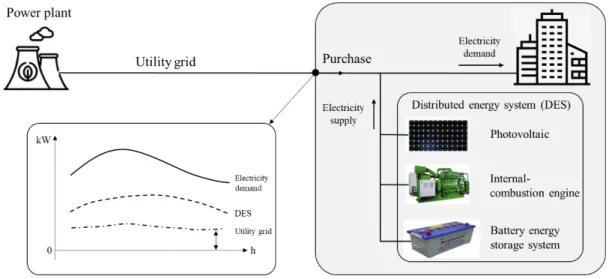
to analyze the ability of self-supply and the effect of peak load reduction. And a DES
model composed of photovoltaic, gas internal combustion engine and battery energy
storage systems was established. Then, the impact of DESs with different combinations
on the grid stabilization is analyzed by taking the Smart Community in Higashida,
Japan as an example. After that, the economic and environmental performance of the
DES with the economic optimal combinations were analyzed under different
independence ratios and peak shaving ratios.
In Chapter 5,
MULTI-CRITERIA ASSESSMENT FOR OPTIMIZING DISTRIBUTED ENERGY SYSTEM. Different configurations of the equipment will profoundly affect the
performance of the distributed energy system, especially the grid stabilization and CO2
emission reduction effect. A reasonable and comprehensive evaluation method is
helpful to improve the core competitiveness of the DES. In this part, a multi-criteria
evaluation method based on economic, reliability and environmental performance was
proposed, and the effect of different evaluation criteria on the configuration
optimization of each equipment in the distributed energy system was compared and
analyzed. Firstly, the PV penetration is used as the variable to establish different
configuration application scenarios of the DES. By introducing peak load price and
carbon tax, the grid stabilization and carbon emission reduction effect were converted
into economic benefits, and a configuration optimization model of the DES with the
objective of minimizing the total cost was established based on the Genetic Algorithm.
Then, compared with the obtained optimal combinations of the DES under different
evaluation criteria, the impact of grid stabilization and emission reduction effect on the
configuration optimization of equipment in the DES was analyzed.
In Chapter 6,
PROMOTION AND UTILIZATION OF THE DISTRIBUTED ENERGY SYSTEM: A CASE STUDY OF COMBINED COOLING, HEATING AND POWER SYSTEM.
As a typical DES, the utilization of the CCHP system and the impact of different factors
on promoting the system were discussed. Firstly, according to the actual configuration
of a CCHP system in an amusement park, three CCHP systems with different
penetration were proposed and simulated by TRNSYS simulation software. Secondly,
VII
the economic and environmental performance of these different penetration CCHP
systems were evaluated based on the dynamic payback period and carbon dioxide
emissions. Then, the impacts of investment cost, energy prices, investment subsidy, and
a carbon tax on the promotion of the DES were discussed through the sensitivity
analysis. Some advice on developing the DES were suggested according to the analysis
results.
In Chapter 7,
PROMOTION AND UTILIZATION OF THE DISTRIBUTED ENERGY SYSTEM: A CASE STUDY OF EMERGENCY POWER SYSTEM. The utilization of the DES
as emergency power system was analyzed. The study is divided into two parts. Firstly,
the integration of the stand-alone emergency power systems was optimized to improve
the regional reliability with the least cost. Secondly, when the power failure in the whole
region, the distributed generation was considered as emergency power to integrate with
the emergency power system. The impact of different connected modes on the
reliability and economic benefits of the overall power system is compared through four
case studies. The reliability and cost-saving after application of the DESs were
improved.
In Chapter 8,
CONCLUSION AND PROSPECT. The conclusions of whole thesis were
deduced, and the future work of distributed energy system was put forward.
VIII
張 麗婷 博士論文の構成
MULTI-CRITERIA EVALUATION OF A DISTRIBUTED ENERGY SYSTEM FOCUSING ON GRID STABILIZATION AND CARBON EMISSION REDUCTION
CHAPTER ONE
RESEARCH BACKGROUND AND PURPOSE 1) Energy challenges
2) Advantages of distributed energy system 3) Development of the distributed energy system
4) Introduction of distributed energy system CHAPTER TWO
LITERATURE REVIEW OF THE DISTRIBUTED ENERGY SYSTEMS
1) Design and operation of distributed energy systems 2) Evaluation of the distributed energy system
CHAPTER THREE
THEORIES AND METHODOLOGY OF THE STUDY 1) Equipment and system model
2) Evaluation criteria method 3) Simulation model and algorithm
CHAPTER SEVEN
PROMOTION AND UTILIZATION OF THE DISTRIBUTED ENERGY SYSTEM: A CASE STUDY
OF EMERGENCY POWER SYSTEM 1) Optimization of emergency power system integration 2) Reliability and economic improvement after integration
of the distributed generation CHAPTER FOUR
ECONOMIC AND ENVIRONMENTAL ANALYSIS OF DISTRIBUTED ENERGY SYSTEM FOCUSING
ON GRID STABILIZATION 1) Grid stabilization indices proposed 2) Independence and peak shaving ratio calculation
3) Economic and environmental analysis
CHAPTER FIVE
MULTI-CRITERIA ASSESSMENT FOR OPTIMIZING DISTRIBUTED ENERGY SYSTEM
1) Evaluation criteria propose
2) Optimization configuration of the distributed energy system CHAPTER SIX
PROMOTION AND UTILIZATION OF THE DISTRIBUTED ENERGY SYSTEM: A CASE STUDY OF
COMBINED COOLING, HEATING AND POWER SYSTEM
1) System comparison
2) Sensitivity analysis in the impacts of different factors on promoting the distributed energy system
CHAPTER EIGHT CONCLUSION AND PROSPECT
I
TABLE OF CONTENTS
ABSTRACT
... ISTRUCTURE OF THIS PAPER
... IVCHAPTER 1: RESEARCH BACKGROUND AND PURPOSE OF THE STUDY
1.1 Background... 1-11.1.1 Energy challenges ... 1-1 1.1.2 Advantages of distributed energy system ... 1-5 1.1.3 Development of distributed energy system ... 1-9
1.2 Distributed energy system ... 1-15
1.2.1 Technology of the distributed energy system ... 1-15 1.2.2 Promotion difficulties of the distributed energy system ... 1-19
1.3 Research structure and logical framework ... 1-20 Reference... 1-24
CHAPTER 2: LITERATURE REVIEW OF THE DISTRIBUTED ENERGY
SYSTEM
2.1 Overview of distributed energy system ... 2-1 2.2 Design and operation analysis of the distributed energy system ... 2-7
2.2.1 Optimal configuration design of the distributed energy system ... 2-7 2.2.2 Operation strategy of the distributed energy system ... 2-13
2.3 Evaluation of the distributed energy system ... 2-19
2.3.1 Economic performance of the distributed energy system ... 2-20 2.3.2 Environmental performance of the distributed energy system ... 2-23 2.3.3 Reliability performance of the distributed energy system ... 2-25
Reference... 2-29
CHAPTER 3: THEORIES AND METHODOLOGY OF THE STUDY
3.1 Motivation ... 3-1 3.2 Model establishment ... 3-2
3.2.1 Devices and distributed energy systems model ... 3-2 3.2.2 Performance analysis ... 3-15 3.2.3 Simulation model and algorithm ... 3-20
II
CHAPTER 4: ECONOMIC AND ENVIRONMENTAL ANALYSIS OF THE
DISTRIBUTED ENERGY SYSTEM FOCUSING ON GRID STABILIZATION
4.1 Content ... 4-1 4.2 Methodology ... 4-2
4.2.1 Distributed energy system model ... 4-2 4.2.2 The independence and peak shaving performance of distributed energy systems ... 4-4 4.2.3 The economic and environmental analysis of the distributed energy systems ... 4-5
4.3 Research object introduction and basic data ... 4-7
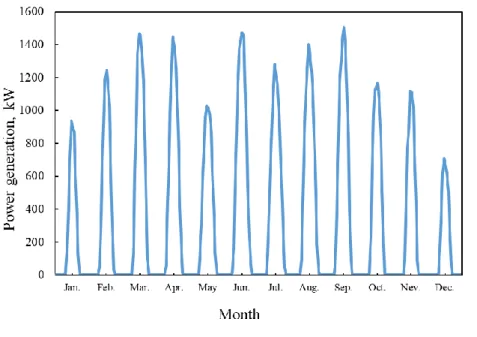
4.3.1 Research object ... 4-7 4.3.2 PV production ... 4-9 4.3.3 Study cases ... 4-10
4.4 The comparison results of the study cases ... 4-12 4.5 The economic and environmental analysis focusing on grid stabilization ... 4-14
4.5.1 Distributed energy system with PV and ICE ... 4-14 4.5.2 Distributed energy system with PV, ICE and BESS ... 4-16
4.6. Summary ... 4-21 Appendix ... 4-22 Reference... 4-24
CHAPTER 5: MULTI-CRITERIA ASSESSMENT FOR OPTIMIZING THE
DISTRIBUTED ENERGY SYSTEM
5.1 Content ... 5-1 5.2 Methodology ... 5-3
5.2.1 Operation strategy model of the distributed energy system ... 5-3 5.2.2 Evaluation criteria ... 5-5 5.2.3 Configuration optimization model ... 5-6
5.3 Research object and PV penetration prediction ... 5-8 5.4 Optimal design and comparison ... 5-12
5.4.1 The results under objective function of annual basic cost ... 5-12 5.4.2 The results under objective function of annual basic cost and peak load cost ... 5-16 5.4.3 The results under objective function of annual basic cost, peak load cost and CO2
emission cost ... 5-19 5.4.4 The results comparison under three objective functions ... 5-21
5.5 Sensibility analysis ... 5-26
III
5.5.2 Carbon tax change ... 5-27
5.6 Summary ... 5-30 Reference... 5-31
CHAPTER 6:
PROMOTION AND UTILIZATION OF THE DISTRIBUTED
ENERGY SYSTEM: A CASE STUDY OF COMBINED COOLING, HEATING
AND POWER SYSTEM
6.1 Content ... 6-1 6.2 Methodology ... 6-1
6.2.1 Establishment of the CCHP system model ... 6-1 6.2.2 Evaluation criteria ... 6-4
6.3 Case study ... 6-6
6.3.1 Introduction of the research case ... 6-6 6.3.2 Simulation model ... 6-9
6.4 Results and discussion ... 6-12
6.4.1 Simulation results of the energy consumption and generation ... 6-12 6.4.2 Comparison of economic and environment performance in three systems ... 6-16 6.4.3 Impact of different factors on the economic performance of CCHP system ... 6-18 6.4.4 Sensitivity analysis ... 6-23
6.5 Summary ... 6-24 Appendix ... 6-26 Reference... 6-30
CHAPTER 7: PROMOTION AND UTILIZATION OF THE DISTRIBUTED
ENERGY SYSTEM: A CASE STUDY OF EMERGENCY POWER SYSTEM
7.1 Content ... 7-1 7.2 Reliability and economic analysis of emergency power system integration ... 7-2
7.2.1 Overview of the Issues ... 7-2 7.2.2 Methodology of emergency power system optimization ... 7-3 7.2.3 Application of the emergency power system integration ... 7-11 7.2.4 Impact of characteristics parameters of EPSs on the total cost ... 7-16
7.3 Reliability and economic analysis of distributed generation as emergency power ... 7-18
7.3.1 Reliability analysis of power system ... 7-18 7.3.2 Case comparison ... 7-19 7.3.3 Results and discussion... 7-23
IV
Appendix ... 7-29 Reference... 7-32
CHAPTER 8:
CONCLUSION AND PROSPECT
8.1 Conclusion ... 8-1 8.2 Prospect ... 8-5
Chapter 1
RESEARCH BACKGROUND AND PURPOSE OF
THIS STUDY
CHAPTER ONE: RESEARCH BACKGROUND AND PURPOSE OF THIS STUDY
RESEARCH BACKGROUND AND PURPOSE OF THIS STUDY ... 1-1
1.1 Background ... 1-1 1.1.1 Energy challenges ... 1-1 1.1.2 Advantages of distributed energy system ... 1-5 1.1.3 Development of distributed energy system ... 1-9 1.2 Distributed energy system ... 1-15 1.2.1 Technology of the distributed energy system ... 1-15 1.2.2 Promotion difficulties of the distributed energy system ... 1-19 1.3 Research purpose and core content ... 1-20 Reference ... 1-24
CHAPTER 1: RESEARCH BACKGROUND AND PURPOSE OF THIS STUDY
-1-1- 1.1 Background
1.1.1 Energy challenges
Energy is an important material basis for human survival and civilization development, which is related to the national economy and people's livelihood and national strategic competitiveness. At present, economic globalization is facing a new situation, and the global energy production and consumption revolution is booming, in which energy science and technology innovation play a core leading role. The rational development of energy and scientific utilization are the necessary guarantee to realize sustainable development. With the development of human civilization, the demand for energy is sharply increasing. The energy consumption structure, which is mainly based on fossil fuels like coal and oil, has caused a series of energy crisis while promoting the progress and development of society.
1) Rapid depletion of fossil fuels
Since the dawn of the industrial revolution, fossil fuels have been the driving force behind the industrialized world and its economic growth. According to the Statistical Review of World Energy, the primary direct energy consumption of the fossil fuels from insignificant levels in 1800 to an output of nearly 140,000 TWh in 2019 (Fig.1-1). At present, about 85% of all primary energy in the world is derived from fossil fuels with oil accounting for 33.06%, coal for 27.04% and natural gas for 24.23% [1]. Global fossil fuel consumption is on the rise, and new reserves are becoming harder to find. Fig.1-2 shows the future energy reserves for coal, gas and oil.Those that are discovered are significantly smaller than the ones that have been found in the past. Oil reserves are a good example: 16 of the 20 largest oil fields in the world have reached peak level production – they’re simply too small to keep up with global demand [2].
Fig.1-1 Global coal consumption, measured in terawatt-hours. (Resource: BP Statistical Review of World Energy: All data has normalised to terawatt-hours (TWh) using a
CHAPTER 1: RESEARCH BACKGROUND AND PURPOSE OF THIS STUDY
-1-2-
Fig.1-2 Future reserves for coal, gas and oil (Source: CIA World Factbook and Statista).
Globally, we currently consume the equivalent of over 11 billion tonnes of oil from fossil fuels every year. Crude oil reserves are vanishing at a rate of more than 4 billion tonnes a year – so if we carry on as we are, our known oil deposits could run out in just over 53 years. If we increase gas production to fill the energy gap left by oil, our known gas reserves only give us just 52 years left.Although it’s often claimed that we have enough coal to last hundreds of years, this doesn’t take into account the need for increased production if we run out of oil and gas. If we step up production to make up for depleted oil and gas reserves, our known coal deposits could be gone in 150 years [2].
2) Environmental deterioration
Fig.1-3 CO2 emission trends from 1800 to 2018 by fuel type (Source: Global Carbon Project
CHAPTER 1: RESEARCH BACKGROUND AND PURPOSE OF THIS STUDY
-1-3-
Global reliance on fossil energy is causing serious environmental deterioration. Fig.1-3 shows the CO2 emission trends from 1800 to 2018 by fuel type [3]. The CO2 emission from fossil fuel
combustion is the largest largest contribution [4]. In 2018, nearly 35 billion tons of CO2 were emitted
from fossil fuel consumption and this has 3.5 times since 1950.
a) Global CO2 emissions by sector
a) Annual CO2 emissions by sector
Fig.1-4 Global CO2 emissions (Source: (Source: CAIT Climate Data Explorer via. Climate
Watch).
CHAPTER 1: RESEARCH BACKGROUND AND PURPOSE OF THIS STUDY
-1-4-
CO2 emissions derive from the energy sector, of which the energy consumption for electricity and
heat is the main source of emissions (Fig.1-4) [5]. However, the current high-speed development of the economy will result in the continuous growth of power and heat demand. Energy demand will double by 2050. If the current proportion of fossil fuels remains the same, carbon emissions will certainly exceed the upper limit allowed to keep the global average temperature rise below 2℃. Such high emissions will have a disastrous impact on the global climate. The CO2 emission
increasing caused by excessive consumption of fossil energy leads to a series of environmental pollution problems such as air pollution, acid rain, greenhouse effect [6]. There is a growing body of evidence indicating that there will be challenges with supplying enough fossil energy for continued growth of economies and related emissions. The depeletion of fossil fuel has often been identified as a major challenge for the world in the 21st century together with anthropogenic climate change [7]. Therefore, there is a desperate need to find alternatives to fossil fuels and take advantage of state-of-the-art techniques to enhance energy efficiency and reduce emission.
3) Power grid insecurity
Electricity is at the heart of modern economies and it is providing a rising share of energy services. Demand for electricity is set to increase further as a result of rising household incomes, with the electrification of transport and heat, and growing demand for digital connected devices and air conditioning. The power systems based on fossil fuels, has the characteristics of large-scale and centralized. The network needed for its transmission and distribution is relatively complex. Most of the users are concentrated in a specific area, so the flexibility of load change and the safety of energy supply are poor. Once a small failure is happened in the supply chain, all users in the area are suffering electricity loss. This is troublesome because it could lead to supply inadequacy risks that cause more power outages, which can affect everything from national security and the digital economy to public health and the environment. For example, in 2003, a large-scale blackout occurred in Manhattan, New York City, USA, and then affected the eastern part of the United States and parts of Canada. The subway was shut down, the airport was closed, and even some people were trapped in elevators, which had a serious impact on people's normal life and industrial safety. Table 1-1 shows the large-scale power grid outages that have occurred over the years in the world [8,9]. It is indicated that the traditional energy supply has technical and security disadvantages.
Moreover, it is also a challenge for many countries that the existing power structure cannot support the rapid growth of power demand. For example, Japan's energy situation presents an unprecedented and severe situation after the 2011 East Japan Earthquake. The widespread shutdown of nuclear power plants has led to planned power rationing in parts of Japan during the peak period, and the problem of insufficient power supply in the power system has become increasingly prominent. Recognising the importance of rethinking Japan’s energy and power supply policies in the post‐Fukushima era, the Government of Japan adopted an updated Strategic Energy Plan (the 4th Basic Energy Plan) in April 2014. This Plan provides a new course for Japan’s energy policy. Two basic principles are reflected in this Plan [10]. First, it reiterates the so‐called “3E+S” focus of the nation’s energy policy, emphasising energy security, economic efficiency, and environmental protection without compromising safety. Second, it emphasises the need to look at both supply and demand side options by creating a supply‐demand structure that is multi‐layered, diversified, and flexible [11].
CHAPTER 1: RESEARCH BACKGROUND AND PURPOSE OF THIS STUDY
-1-5-
Table 1-1 Large-scale power grid blackouts and causes that have occurred over the years [8,9]
Time Blackouts Cause of accident Load loss (GW)
August 10, 1996
Blackout in the western United States power system
grid
High voltage line
discharges to trees 30.5
August 14, 2003
Blackout in interconnected North America power
system grid
Single line failure 61.8
September 28, 2003 blackout in Italy power system grid
Lightning strikes the tree causing a short
circuit
14.21
July 1, 2006 Huazhong (Henan) Power Grid Accident
Substation differential protection device
misoperation
2.6
November 4, 2006 Blackout in Western Europe power system grid
Exceeding the predicted trend and the overload caused by multiple network
breaks
16.72
March 7, 2009 Shanghai grid short circuit event
Maintenance
personnel misuse 1.435 2019.7.13 New York blackout Transformer Fire Lasts about five
hours. Facing the challenges of resource shortage, environmental pollution, energy insecurity and other energy crises, countries around the world are constantly exploring new areas of energy development. There are two key to reliaze the energy structure transition. One is to change the energy structure based on fossil energy, accelerate the development and utilization of renewable energy, and strive for diversified, cleaned, efficient energy supply and consumption; the second is to greatly improve the comprehensive utilization efficiency of energy to achieve the goal of a low-carbon and safe energy system estabilishment.
Distributed energy system (DES), a clean and low emissions system located at or near its end-users can accommodate high shares of renewable resources and is characterized with high-efficiency poly-generation systems. Currently, identified as an alternative approach of energy utilization to solve energy problems, the DES attracts increasing attention over these years.
1.1.2 Advantages of distributed energy system
Distributed energy system (DES) is the use of small-scale power generation technologies such as renewable energy resources, energy storage and so on located close to the load being served. meanwhile, multiple technologies are combined and complement each other,as shown in Fig.1-5. In different countries, the definition of DER system is different, for instance, the definition in China is “the DES is an energy system that intelligently combines distributed energy resources close to the consumer side, increases the reliability and economy of energy services, and reduces environmental
CHAPTER 1: RESEARCH BACKGROUND AND PURPOSE OF THIS STUDY
-1-6-
impact” [12]. The broader definition also includes other resources linked to the distribution network, such as combined heat and power (CHP) system or combined cooling heating and power (CCHP) system. As for the specific forms of distributed energy, it includes: natural gas distributed energy connected to the distribution network or located near the load center, distributed renewable energy and distributed energy storage, demand side response, energy efficiency technology and so on. Compared with the conventional energy supply system, the DES has several advantages.
Fig.1-5 Schematic diagram of distributed energy system [13] 1) Close to the consumer side and variable capacity
As the general definition of the DES, the system is close to the consumer side or the energy resources. That is the electricity come form rather than another region or city, the resources located in the business, the hospitals, college campuses or the communities which near the them serve. The distributed energy sits at different position on the grid. Maybe it not at the center of the electricity supply system, but it can at any position that the customers need. The capacity of power generation devices can be changed according to the demand of the customers or other needed. Distributed generation allows me to use a variety of power generating technologies, decreasing my dependence on any one resource. With stock portfolios, organizations, and energy, there is strength in diversity.
2) Energy conservation and high-efficiency
Distributed energy system is considered to be an effective energy saving system. First of all, renewable energy can be widely used in distributed energy system to reduce the dependence on traditional fossil energy. Secondly, equipment such as combined heating and power (CHP) can be used to improve the efficiency of primary energy. Third, because the system is sited close to the customer and other characteristics can reduce energy waste in the transport process to save energy. Fig.1-6 depicts the comparison of the energy efficiency of separate power and heat supply and centralized supply. It can be seen that the natural gas distributed energy system will increase the separate supply from 55% to 87% through the cascade utilization of energy.
CHAPTER 1: RESEARCH BACKGROUND AND PURPOSE OF THIS STUDY
-1-7-
Fig.1-6 Comparison of the energy efficiency of cogeneration with conventional coal power plant and heating system [14]
3) Maximizing clean energy
In order to combat climate change effectively, the IEA promotes the use of renewable energies for electricity production as one important solution. Next to being just as reliable, renewables have two advantages in comparison to traditional fossil fuels: they are flexible and variable in use. As centralised fossil fuel utilities and nuclear plants start to phase out, they will make room for sustainable resources like solar power, wind and biofuels (and gas as a transition resource). Although both wind and solar are used for centralised power generation (e.g., offshore wind or solar farms), they have great potential to be employed as distributed source across any country. An intelligent grid architecture of combined and interconnected micro, mini and medium-sized grid structures allows the coexistence of many different electricity generating utilities. The distributed energy is more efficient than centralised generation and provides the appropriate architecture for the change to renewable energy supplies in the future. Looking ahead a few years, as old power plants become obsolete, this system would enable electricity generation to fall back into the hands of consumers, who also become producers (or prosumers). Policy-making in the energy sector should take this into account and make an informed choice for a more efficient, more reliable, cleaner and economically efficient future of electricity. Consumers and the environment will appreciate it.
4) Flexible controlling
Distributed energy system is considered as one of the effective controls means to adjust peak power consumption and reduce grid load. Power can be stored during peak hours through storage or other technologies, released during peak hours or replenished to balance the grid with power generation equipment. This management control is called peak shaving, one of the most important control of the DES. This helps the facility to reduce the demand charges and the utility by maintaining a constant demand during the day and at night.
CHAPTER 1: RESEARCH BACKGROUND AND PURPOSE OF THIS STUDY
-1-8-
Fig.1-7 Schematic diagram of peak shaving of the DES [15] 5) Improving reliability
Distributed energy system can effectively improve the reliability of the power grid. And another contribution is to improve the energy resilience. The difference between energy reliability and energy resilience is that energy reliability refers to the ability to prevent system interruption, while energy resilience refers to the ability of the system to recover from an interruption. Massive power plants have to remain on-grid for most of their lifetime, distributed power generators can be used more flexibly and provide electricity when and where it is needed–if circumstances change, decentralised utilities offer much greater flexibility to adapt. This comes at great benefits for the overall resilience of the grid: distributed generation systems are able to “provide power to critical facilities during times of large-scale power disruptions and outages”. Distributed energy systems can have the ability to sell excess power to the grid or to provide the electricity to the grid in an emergency. As shown in Fig.1-8, the distributed energy system shows less vulnerable than centrilized energy system [16]. Storms, falling tree branches, brownouts, and acts of terror all threaten the grid, and when it fails, it typically leaves tens of thousands of customers (or millions in extreme cases) without power for long periods of time.
Distributed energy is distributed to the nearby load end, which can form an effective supplement to the traditional large power grid. The establishment of distributed energy microgrid in the load center of disaster prone areas can improve the power supply reserve, facilitate the black start after fault, and improve the overall disaster resistance and emergency power supply capacity of the power grid. As a supplementary form of large-scale power grid, in special cases (such as earthquake, snowstorm, flood, hurricane and other unexpected disasters), distributed energy microgrid can be used as backup power supply to support the receiving end grid; at the same time, distributed energy microgrid system can be quickly separated from the large power grid to form an isolated network, so as to ensure the uninterrupted power supply of important users. In natural disaster prone areas, through the layout and construction of different forms and scales of distributed energy microgrid, the power supply to important loads can be quickly restored on site after disasters[37].
CHAPTER 1: RESEARCH BACKGROUND AND PURPOSE OF THIS STUDY
-1-9-
Fig.1-8 The vulnerablitiy comparison of centrilized and distributed energy system. (Source: US Department of Energy) [16]
1.1.3 Development of distributed energy system
Distributed energy is an efficient way to use distributed resources to meet the energy consumption demand of users nearby [17]. Due to the different user demand and energy development strategy in different periods, the development process of distributed energy can be divided into three stages: cogeneration, renewable energy integration and smart grid [18].
1) Cogeneration. Cogeneration started in the 1970s to improve the efficiency of energy utilization. The typical form of energy utilization is distributed natural gas cogeneration. In 1978, the United States promulgated the public utility management policy act to encourage the development of high-efficiency small-scale cogeneration power supply. In 1979, Denmark promulgated the "heating law" to develop cogeneration with natural gas and biomass as fuel. In 1981, Japan built the first gas multi generation project in the Tokyo National arena [19].
The combined cooling heating and power (CCHP) system can effectively improve the efficiency of energy utilization by cascade utilization of energy and providing electricity, heat, cold energy and domestic hot water to users. If the grid connected power energy complementary mode is adopted, the overall economic benefits and utilization efficiency of the system can be increased. Therefore, the development and application of CCHP is in line with the general trend of coordinated development of energy and environment [20]. CCHP is applied in developed countries such as the United States, Japan and the United Kingdom The CCHP system is different from the traditional centralized energy supply system and the primary energy is mainly natural gas. The comprehensive benefits in energy saving, environment improvement and power supply are more obvious. Therefore, through decades of development, the comprehensive energy efficiency and air quality of these countries have been improved unprecedentedly [21].
CHAPTER 1: RESEARCH BACKGROUND AND PURPOSE OF THIS STUDY
-1-10-
Regulatory Policy Act (PURPA) was proposed. In the PURPA, utilities are required to interconnect with and purchase electricity from cogeneration systems, in order to give industrial and institutional users access to the grid and allow excess electricity to be sold back. With the help of the PURPA and the federal tax credit for CHP investment, the installed capacity of CHP/CCHP systems grew to 45 GW in 1995 from 12 GW in 1980 [22]. Due to the intense competition and instability in the electricity market, the development of CHP/CCHP plants slowed down in 1990s. Only 1 GW installed capacity increased from 1995 to 1998. To boost the development, together with the Environmental Protection Agency (EPA), the U.S. Department of Energy (DOE) proposed the “Combined cooling heating & power for buildings 2020 vision”, which aimed to double the installed capacity in 2010. Following the proposed document, the installed capacity grew significantly to 56 GW in 2001. The mid-term goal of 2010 is to reduce the generation cost of distributed energy system, improve the energy comprehensive utilization efficiency and reliability of distributed energy system, and make the distributed energy system account for 20% of the newly installed generating capacity . Then in 2004, with a total installed capacity of 80 GW, the goal of 92 GW has been almost achieved. In 2009, after the Energy Policy Act in 2005, the installed capacity has achieved 91 GW . According to “the White Paper on CHP in a Clean Energy Standard” [23], the U.S. DOE aims to have an 11% increase, from current 9%, of CHP share of the U.S. electric power by 2030.. By 2020, the United States will achieve the goal of the world's most clean, efficient and safe country in terms of power production and transmission through the maximum use of distributed energy systems with good revenue. According to statistics, there are more than 6000 distributed cooling, heating and power generation stations in the United States, including more than 200 University distributed energy stations. According to the plan of the Department of energy, by 2020, more than 50% of the newly-built office buildings or shopping malls in the United States will adopt the mode of CO generation of cooling, heating and electricity. At the same time, 15% of the existing building energy supply systems will be retrofitted.
In the United Kingdom, the number and installed capacity of CHP/CCHP plants increased dramatically from 1999 to 2000, during which the UK government took methods of fiscal incen- tives, grant support, regulatory framework, promotion of innova- tion, and government leadership and partnership to support the development of CHP/CCHP. Before 2000, the installed capacity kept around 3.5 GW, while in 2000, it increased to 4.5 GW. From then on, the UK government continuously drafted a series of policies to target at achieving 10 GW of good quality installed CHP plants. In the end of 2010, the total installed capacity in the UK reached 6 GW [22].
Due to its geographical location, Japan is in short supply of domestic energy, so it pays special attention to the development and utilization of new energy and the improvement of energy utilization. In 1981, Japan's first domestic cooling, heating, and power cogeneration system was completed in Tokyo National Arena. Since then, Japan has also begun to vigorously develop distributed energy projects. In December 2005, the Kyoto Economic Energy Project was put into operation. This distributed energy supply system includes 50KW photovoltaic power generation, 50KW wind power generation, 5×80kW biological power generation and a 250kW fuel cell and 100KW battery. The system is reliable and safe, and has achieved good economic and environmental benefits.
CHAPTER 1: RESEARCH BACKGROUND AND PURPOSE OF THIS STUDY
-1-11-
energy in the electricity market of EU is as high as 10%. According to the energy development plans of European countries, the utilization of distributed new energy is mainly promoted [24]. In 2000, Germany promulgated the renewable energy law to promote the development of new energy through flexible pricing mechanism. The scale of distributed new energy generation has exceeded that of distributed combined heat and power system. With the maturity of technology and the increase of clean and low-carbon demand, distributed new energy as an important way of new energy utilization has been widely concerned.
Renewable energy has the characteristics of clean, natural regeneration, wide area distribution, low energy density, intermittency and so on, and has the characteristics of obvious distributed energy in nature. Renewable energy does not exist the possibility of energy exhaustion. Therefore, the development and utilization of renewable energy has been paid more and more attention by many countries, especially in the countries with energy shortage. With the recovery of nuclear energy and the rapid development of renewable energy in the world, the development of clean energy is growing year by year, and its growth rate is second to natural gas. According to statistics, the global renewable energy consumption in 2017 increased by 16% compared with 2016, and maintained a double-digit growth rate. Among them, solar energy growth rate is 29.6%, wind energy growth rate is 15.6%. Taking nuclear, hydropower and natural gas into account, the global clean energy consumption ratio in 2017 reached 38%, which exceeded 28% of coal consumption and 34% of oil consumption. Fig.1-9 present the renewables share of power generation by region [1].
Fig.1-9 Renewables share of power generation by region (Percentage) (Source: BP Statistical Review of World Energy 2020)
At the same time, electricity generation structures also changed with the renewable energy development. Among the renewable energies, the solar and wind electricity generation is regarded as an important party in hybrid distributed energy resource (HDER) system. The photovoltaic (PV) and wind farms (WFs) can constitute a part of the power generation of HDER system, to meet the peak demand or storage the produced electricity to energy storage system for future utilization. Therefore, the development and application of solar PV and wind can promote the development of DES. The PV and wind electricity generation in some countries in 2016 and a predictive value in
CHAPTER 1: RESEARCH BACKGROUND AND PURPOSE OF THIS STUDY
-1-12-
2022 is shown in Fig.1-10. Fig.1-10 shows that only a few countries’ electricity generation by the PV and wind is more than 10%, but the additional PV and wind share in 2022 present a good increasing of the two energy [25].
Fig.1-10 The PV and wind electricity generation in some countries in 2016 and a predictive value in 2022 (Source: RENEWABLES 2017. 2016 generation data for OECD countries based on IEA (2017b), World Energy Statisticsand Balances 2017, www.iea.org/statistics/)
Note: The shares represent variable renewable electricity generation as a percentage of total electricity output, not of total electricity consumption. In countries with high shares of variable generation, such as Denmark, generation and consumption differences may be large as a result of
electricity trading.
Prior to the 2011 Fukushima earthquake, Japan’s energy mix was highly dependent on coal and nuclear power, with minimal contributions from renewable energy technologies. In years preceding 2011, the renewable energy mix consisted mainly of hydropower and biomass. Following the Great East Japan Earthquake, Japan saw a major shift to oil and natural gas. In 2012, Japan implemented a Feed-in Tariff (FiT) for renewable energy production. The policy states that electric power companies are obliged to purchase electricity generated from renewable energy sources, on a fixed period contract at a fixed price. The implementation of the FiT has allowed capital investment for renewable energy supply to increase greatly. Fig.1-11 shows the renewable generation of Japan. This in turn has resulted in a major increase in the installation of solar photovoltaic. So much so that in both 2014 and 2015, Japan was one of the three largest solar installation markets [26]. Implemented in 2015, the Long-term Energy Supply and Demand Outlook provides a more detailed look into the consequences of the 2011 earthquake, and the future of Japan’s energy mix. The policy also looks into the continued diversification of Japan’s energy supply; away from fossil fuels and towards renewable energy technologies. The target states that by 2030, Japan’s self-sufficiency rate aims to increase to approximately 24.3% [27]. The main aim of this target is to increase
self-CHAPTER 1: RESEARCH BACKGROUND AND PURPOSE OF THIS STUDY
-1-13-
sufficiency to levels greater than they were, prior to the 2011 earthquake. The 2015 Outlook also emphasises the importance of a well balanced power mix being implemented in order to achieve environmental suitability, economic efficiency, safety and a stable supply.
Fig.1-11 Renewable energy generation of Japan (Source: bp Statistical Review of World Energy 2020)
China has become a global leader in renewable energy. It has vast resources and great potential for future development. In 2013, China installed more new renewable energy capacity than all of Europe and the rest of the Asia Pacific region. China currently has the world's largest installed capacity of hydro, solar and wind power. The share of renewables in China’s energy mix was 13% in 2010, including an estimated 6% traditional use of biomass, and 7% modern renewables. Hydro power (3.4%) and solar thermal (1.5%) accounted for most of China’s modern renewable energy use. In 2015, the renewable sources provided 24% of its electricity generation, with most of the remainder provided by coal power plants. In 2017, renewable energy comprised 36.6% of China's total installed electric power capacity, and 26.4% of total power generation, the vast majority from hydroelectric sources [28]. Nevertheless, the share of renewable sources in the energy mix had been gradually rising in recent years. Fig1-12 shows the renewable generation of China. The main drivers for this shift are the increasing cost-competitiveness of renewable energy technologies and other benefits such as improved energy security and decreased air pollution. According to Energy Production and Consumption Revolution Strategy 2016-2030, by 2030, 50% of total electric power generation will be from non-fossil energy sources, including nuclear and renewable energy. Renewable energy will shift from meeting new electricity needs to replacing existing electricity needs that have been traditionally satisfied by thermal power productions. It is expected that renewable energy will become the main power source by 2030 [29].
CHAPTER 1: RESEARCH BACKGROUND AND PURPOSE OF THIS STUDY
-1-14-
Fig.1-12 Renewable energy generation of China (Source: bp Statistical Review of World Energy 2020)
3) Smart grid. A report of the Navigant Research proposed that the DES will be a core role for the future deployment of energy infrastructure which is refer to the technology advances, business model innovation, changing regulations, and sustainability and resilience concerns [30]. Although sometimes controversial, distributed energy systems have had a significant impact on the popularity of the power industry. According to the report from the Navigant Research that the global DES investment capacity is expected to grow from 132.4 GW in 2017 to the 528.4 GW in 2026. With the continuous development of renewable energy and internet technology, distributed generation is developing towards the direction of multi energy complementary and integrated energy system. Smart grid are modern, localized, small-scale grids integrated use of digital technology with power grids[31,32]. Contrary to the traditional, centralized electricity grid (macrogrid), it can effectively integrate various sources of DES, especially Renewable energy sources. Germany has focused on the issue of multi-organic coordination. Australia has provided subsidies for the photovoltaic and energy storage system in rural and remote areas [33]. China has issued documents in recent 2 years to support the pilot projects of multi-energy complementary, integrated optimization, "Internet +", and intelligent energy. In recent years, Japan has proposed building a regional self reliance energy system and smart communities.
CHAPTER 1: RESEARCH BACKGROUND AND PURPOSE OF THIS STUDY
-1-15- 1.2 Distributed energy system
As we all known, distributed energy refers to a comprehensive energy utilization system distributed at the user end. It is a system that determines the unit configuration and capacity scale by optimizing the resources, environment and economic benefits. It pursues the maximization of terminal energy utilization efficiency, adopts demand-responsive design and modular combination configuration, which can meet various energy needs of users and optimize and integrate the supply and demand of resource allocation. The DES is a complex system, which is mainly reflected in the following points. 1) Multiple energy resources input and multiple energy output is a reason of the complex, for instance, the input resources can include fossil energy (oil, coal, natural gas, etc.), hydrogen (H2), biomass, solar energy, wind energy and so on; the multiple energy output may include the electricity, heating (for space heating, hot water and so on) and cooling. That may the DER system is more complex than the conventional power plant only uses one resource for power generation, or the thermal plant only uses one resource for the thermal generation. 2) The DES may consist of multiple devices and components. For instance, the power generation can adopt a variety of devices, like gas engine, gas turbine, fuel cell, reciprocating engine and so on; if the system should meet the heating and cooling demand, the heart recovery devices, absorption chiller, adsorption chiller, electrical chiller, solar thermal, geothermal thermal gas engine and so on; in order to overcome the fluctuation of energy supply, the power system must have certain energy storage capacity, the storage device can classify to electrical storage device and thermal storage device. In addition to the power generation device, thermal generation, thermal convention and energy storage devices, some auxiliary devices and components also constitute the complexity of system, like DC-DC converter, DC-DC-AC converter, pump, fans, pipe, wire and so on.
We can understand distributed energy systems from the perspective of distributed energy conversion and classification of distributed energy systems, as shown in Fig.1-13.
Diesel Shale gas Hydro energy Geothermal energy Natural gas Natural gas Solar energy wind energy Marine energy Environmental resources Multi-energy imput Micro miniature power conversion Electricity Hot water Refrigeration Steam Seawater desalination Multi-energy output
Fig.1-13 Flow chat of distributed energy conversion
1.2.1 Technology of the distributed energy system
Mudathir Funsho Akorede et al. [34] presented a block diagram of the main technologies of DER system is shown in Fig.1-14.
CHAPTER 1: RESEARCH BACKGROUND AND PURPOSE OF THIS STUDY
-1-16-
Fig.1-14 The main technologies of DER system [34]
(Notes: MT: Micro-turbines; CT: Combustion turbines; WECS: Wind energy conversion system; BESS: Battery energy storage system; SMES: Superconducting magnetic energy storage; CAES: Compressed air energy storage; PS: Pumped storage; PEMFC: proton exchange membrane fuel
cell; AFC: alkaline fuel cell; PAFC: phosphoric acid fuel cell; SOFC: solid oxide fuel cell; MCFC: molten carbonate fuel cell)
(1) Solar energy power generation
Conversion of solar energy directly to electricity has been technologically possible since the late 1930s, using photovoltaic systems (PVs). These systems are commonly known as solar panels. PV solar panels consist ofdiscrete multiple cells, connected together either in series or parallel, that convert light radiation into electricity. PV technology could be stand-alone or connected to the grid. Solar photovoltaic power generation is a power generation method that uses the photovoltaic effect of solids (semiconductors) to directly transfer light energy to electrical energy. The solar photovoltaic power generation system consists of three parts: solar panels, batteries, and controllers. The continuous reduction of manufacture cost, solar photovoltaic power generation will present a good development prospect.
(2) Wind power generation
Power generation is the main form of wind energy utilization. Wind turbines can be powered either individually or in combination with other forms of power generation, such as diesel generators or micro-gas turbines, to supply power to a unit or an area, or to integrate power into conventional
CHAPTER 1: RESEARCH BACKGROUND AND PURPOSE OF THIS STUDY
-1-17-
grid operations. Windmills or wind turbines convert the kinetic energy of the streaming air to electric power. Investigation has revealed that power is produced in the wind speed of 4–25 m/s range [35]. The size of the wind turbine has increased rapidly during the last two decades with the largest units now being about 4 MWcompared to the 1970s in which unit sizes were below 20 kW. For wind turbines above 1.0 MW size to overcome mechanical stresses, they are equipped with a variable speed system incorporating power electronics. Single units can normally be integrated to the distribution grid of 10–20 kV, though the present trend is that wind power is being located off shore in larger parks that are connected to high voltage levels, even to the transmission system. The power quality depends on the system design. Direct connection of synchronous generators may result in increased flicker levels and relatively large active power variation. At present, wind energy has been found to be the most competitive among all renewable energy technologies.
(3) Gas turbines (GT)
A gas turbine, otherwise known as a combustion turbine, is a rotary engine that extracts energy from a flow ofcombustion gas. It has a combustion chamber in-between the upstream compressor coupled to a downstream turbine. Gas turbines are generally divided into three main categories, namely: heavy frame, aeroderivative, and micro-turbine. The technology is largely based upon aircraft auxiliary power units and automotive style turbo chargers [36]. Energy is added to the gas stream in the combustor, where air is mixed with fuel and ignited. Combustion increases the temperature, velocity and volume ofthe gas flow. This is directed through a nozzle over the turbine’s blades, spinning the turbine and powering the compressor. Energy is extracted in the form of shaft power, compressed air and thrust, in any combination, and used to power aircraft, trains, ships, generators, and even tanks [9].
(4) Fell cell
Fuel cell is a kind of power generation device which can convert the chemical energy of hydrogen and other fuels into electrical energy directly through electrochemical reaction without combustion. Because fuel cell does not involve combustion and is not limited by Carnot cycle, the energy conversion rate is high [37]. In addition, the fuel cell does not use mechanical transmission parts and has no noise pollution; the reaction products are mainly electricity, heat and water, and the emission of harmful gases is very little. Therefore, fuel cell is an efficient, environment-friendly, high reliability, quiet energy conversion mode, which is one of the research hotspots in the field of energy. Fig.1-14 is a system block diagram of fuel cell power plant.So far, many types of fuel cells have been developed, and there are many classification methods. According to the types of electrolytes, they can be divided into five categories: alkaline fuel cell, phosphoric acid fuel cell, proton exchange membrane fuel cell, molten carbonate fuel cell and solid oxide fuel cell [38].
(5) Energy storage
Energy storage technology can meet the demand of electric energy or thermal / cold energy for a period of time by storing electric energy, which has the functions of peak shaving and valley filling, frequency and voltage regulation, smooth transition and reducing grid fluctuation [39]. Energy storage technology can solve the problem of intermittent renewable energy limited by environmental factors, and ensure the balance of supply and demand of energy system [40]. According to the
CHAPTER 1: RESEARCH BACKGROUND AND PURPOSE OF THIS STUDY
-1-18-
different energy storage principles of energy storage technology, energy storage technology can be divided into physical energy storage, electrical energy storage and heat storage technology [41]. Fig.1-15 shows the statistical results of the relative development of different energy storage technologies. At present, more energy storage technologies are in the stage of technology development and market demonstration. By the end of 2017, the total installed capacity of energy storage projects has reached 175.4gw. Among them, the most mature commercial pumped storage accounts for the largest proportion of installed capacity, accounting for 96%; the installed capacity of electrochemical energy storage is 2.93GW, accounting for only 1.7%.
Fig.1-15 Development of different energy storage technologies.
(6) cooling, heating and power (CCHP) distributed energy system
The cooling, heating and power (CCHP) distributed energy system is mainly composed of power generation equipment, waste heat utilization equipment, peak shaving equipment and relevant main and auxiliary equipment, which is the use of heat engine or power station from a single fuel or energy source near the user side at the same time to produce electricity and heat to meet the changing needs of users [42]. The power generation unit (PGU) provides electricity for the user. Heat, produced as a by- product, is collected to meet cooling and heating demands via the absorption chiller and heating unit. If the PGU cannot provide enough electricity or by-product heat, additional electricity and fuel need to be purchased to compensate for the electric gap and feed the auxiliary boiler, respectively. In this way, three types of energy, i.e., cooling, heating and electricity, can be supplied simultaneously. A well-designed gas cooling, heating and power distributed energy system should balance the cost saving, improve the comprehensive utilization efficiency and energy saving rate of primary energy, and reduce pollutant emissions.
This kind of combined systems can exhibit excellent energy, environmental and economic performance. Indeed, feeding different technologies with different fuels for producing different energy vectors gives birth to a variety of alternatives for more effective design and planning of the energy systems. In addition, the possibility of co-generating hydrogen and of using it as a storage energy vector, in case exploiting volatile electricity production from renewable sources such as wind or sun, represents a further variable that could be advantageously exploited. Hence, the possible benefits from the combined production of multiple energy vectors (e.g., electricity, heat, cooling, hydrogen, or other chemical products) paves the way to future scenarios focused on the development
Energy storage
technology Physical energy storage Electrical energy storage Heat storage technology
Technology development stage
Flywheel energy storage (high speed)
Hydrogen storage technology Metal air battery, Super
capacitor energy storage
Market demonstration stage
Compressed air energy storage
Molten salt energy storage, Ice energy storage Sodium sulfur battery,
lithium battery
Commercialization
stage Pumped storage
Thermal / cold water storage Lead acid battery,
CHAPTER 1: RESEARCH BACKGROUND AND PURPOSE OF THIS STUDY
-1-19-
of multi-generation (or poly- generation) solutions [43].
1.2.2 Promotion difficulties of the distributed energy system
Due to the advantages of high efficiency, energy conservation and environmental protection, distributed energy system has been vigorously developed by the government. However, the practices of DES have shown that the actual operation performance is not as good as expected in many cases. Nearly half of the more than 40 DES projects in China have been out of service due to economic problems [44]. There are some main barriers:
1) Economic aspect:
Even though lower fuel and operating costs may make the DES cost competitive on a life-cycle basis, higher initial capital costs can mean that the DES provides less installed capacity per initial dollar invested than conventional energy system. Thus, investments of the DESs generally require higher amounts of financing for the same capacity. Depending on the circumstances, capital markets may demand a premium in lending rates for financing the DES projects because more capital is being risked up front than in conventional energy projects [45].
2) Technology aspect:
The unreasonable capacity of the system equipment is the most important issue. Distributed energy supply system has a wide range of optional system forms, main and auxiliary equipment and their capacity. There is no universally applicable technical scheme. Its configuration is closely related to the climate characteristics, load demand, energy price and supply of the user's area, which puts forward high requirements for the system configuration determination. For the optimal configuration of regional distributed energy supply system, the main task is to determine the system structure and form reasonably, optimize the type, capacity and number of main equipment, and obtain the comprehensive performance of economic, environmental and other aspects of the whole year, so as to provide decision-making reference for owners, provide selection basis for design, and provide guidance for operation strategy formulation. Improper configuration of distributed energy supply system will lead to waste of equipment investment, failure to give full play to economic benefits, low system operation efficiency and other problems, and even lead to system failure in extreme events .
3) Evaluation aspect:
The economic performance of the DES can be directly reflected through quantitative indicators such as annualized cost or payback period, but the social benefits brought by the advantages of energy-saving, environmental protection and improving the reliability of the power grid can not be directly compared with the economic benefits. As a result, the current evaluation method of the DESs usually uses energy-saving or economic benefits only, which is relatively simple and one-sided [46,47]. The single criterion cannot reasonably and accurately reflect the comprehensive benefits of the DESs. Energy efficiency, economic sustainability and environmental protection are the most important aspects of the distributed energy system. However, as they often mutually influence each other, how to reach a reasonable compromise is critical [44]. A considerate evaluation method from multiple perspectives is needed for helping the promotion of the DESs.
CHAPTER 1: RESEARCH BACKGROUND AND PURPOSE OF THIS STUDY
-1-20- 1.3 Research purpose and core content
1.3.1 Research purpose and core content
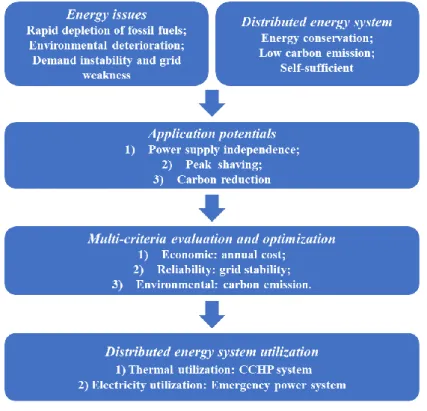
The research purpose and logic of the article is shown in Fig.1-16 below. From the energy challenges of the energy shortage, environmental problems, and insecurity of power grid, this research explores the application potential in the grid stabilization and carbon emission reduction of distributed energy system. And a multi-criteria evaluation is proposed to optimize the design of the distributed energy system to improve the core competitiveness of the distributed energy system. Finally, different case study scenarios of the DES utilization are demonstrated. It is hoped to provide help for the promotion of distributed energy system.
Fig. 1-16 Research logic of the article
1.3.2 Chapter content overview and related instructions
The chapter names and basic structure of the article are shown in Fig.1-17. The brief chapters introduction are shown in Fig.1-18.
CHAPTER 1: RESEARCH BACKGROUND AND PURPOSE OF THIS STUDY
-1-21-
Fig.1-17 Chapter name and basic structure
Fig.1-18 Brief chapter introduction
In Chapter 1, Research Background and Purpose of the Study:
With the rapid growth in energy demand, concerns about climate change, high prices of fossil fuels and the depletion of fossil fuels, the distributed energy system has been playing proactive roles in sustainable energy development. In view of the current energy problems, the significance of the distributed energy system for future energy development is discussed in this chapter. In addition, the current development status of the distributed energy system is investigated and the technologies that can be applied to distributed energy systems are introduced. The promotion difficulties of the distributed energy system are discussed as well.
![Table 1-1 Large-scale power grid blackouts and causes that have occurred over the years [8,9]](https://thumb-ap.123doks.com/thumbv2/123deta/8004112.1250235/27.892.130.768.140.664/table-large-scale-power-blackouts-causes-occurred-years.webp)
![Table 3-1 Emission conversion factors of natural gas and electricity [23–25].](https://thumb-ap.123doks.com/thumbv2/123deta/8004112.1250235/113.892.135.760.336.413/table-emission-conversion-factors-natural-gas-electricity.webp)


![Table 4-2 Technical parameters of the units in the distributed energy systems [10–13]](https://thumb-ap.123doks.com/thumbv2/123deta/8004112.1250235/137.892.128.764.148.369/table-technical-parameters-units-distributed-energy-systems.webp)

