
A study of English Sentence Adverbs: How does Modality Contribute to Sentence Adverbs?
76
0
0
全文
(2) A Study of English Sentence Adverbs: How ctoes Modality Contribute to Sentence Adverbs?. A Thesis Presented to The Faculty of the Graduate. Course at. Hyogo University of Teacher. Education. In Partial Fulfillment of the Requirements for the Degree of Mas'ter in School Education. by Yoshimitsu Fujiwara (Student Number: M91460G) '. December l992.
(3) CONTEN [Ir S. Acknowledgments. Introduction . . . . . . . . . . . . . . . . . . . . . '. 1. Chapter 1. Characteristics of Sentence Adverbs . . . . .. 3. 1.l. Definition of Sentence Adverbs . . . . . . .. 3. 1.2. 0ccurrence Positions of Sentence Adverbs . .. 5. I.3. Classification of Sentence Adverbs . . . . .. 6. ' 2. 0ccurrence Constraints on Sentence Adverbs .. h. ll. 2.1. 0ccurrence Constraints in Sentence Types . .. ll. 2.2. Co-occurrence Constraints on Sentence Adverbs. 2Å}. ' of Sentence Adverbs ... . . 3. Foregoing Studies 3.l. Approaches by InterpretatÅ}on Rules . . . . .. ' 3.l.l. Jackendoff's Study . . . . . . . . . . . . . 3.l.2. Abe's Study . .-. . . . . . . . . . . . . . . ' ' 3.1.3. Some Problems of the Interpretation Rules . .. 3.2. Approaches of Moddiity . . . • • - • - • • •. 24. 24 24. 27 31 33. 3.2.l. Nakau's Studies . . . . . . . . . . . . . . .. 33. 3.2.2. Kasai's Studies . .'. . . . . . . . . . . . . ' 3.2.3. Some Problems of Modal Approaches . . . . . .. 39. 42.
(4) 4. Modal Approach to the Constraints . . . . . .. 44. 4.l. Justification of Modal Approach . . . . . . .. 44. 4.2. Definition of Modality . . . . . . . . . . .. 46. 4.2.l. Definition of Modality . . . . . . . . . . .. 46. 4.2.2. Definition of Sentence Modality . . . . . . .. 49. 4.3. A Refined Modal ApProach to the Constraints .. 50. 4.3.l. Criterion of Modality . . . . . . . . . . . . ' ' 4.3.2. The Constraints and the Criterion of Modality. 50 51. 4.3.3. The Constraints and Modal Hierarchy . . . . .. 54. 4.3.4. A Further Explanation by the Modai Hierarchy. 57. Conclusion...................... 59. '. '. WorksCited .................... '. Abstract. 61.
(5) Acknowledgments ' I would like here to dcknowledge some of my debts to people who have directly or indirectly contributed to this '. First of all, I must thank Professor Ichiro Tange, my academic adviser, for hÅ}s supervision and support for two ' years. '. His proper guidance and encouragement made '. possible the writing of this paper. ' I would also like tQ thank Albert J. Chick, who gave. me some useful comments and suggestions on some example '. sentences as an informant. : To the faculty members of Hyogb University of Teacher Education for their lectures and instructions.. To my fellow students of the Graduate Course at Hyogo University of Teacher Education for their encouragement.. I would like to acknowledge a deep debt to Noriyuki. Ohnishi, Principdl of Hyogo Prefectural rwa High School and the former principal Hiromichi Inoue, who alLow me to. leave school for these two years when all the staff have been endeavoring' to make the school better.. Finally I arn grateful to Hyogo Prefecture Boad of ' Education for providing me with the opportunity to study '. at Graduate Course of Hyogo University of Teacher Education..
(6) Introduction '. It is generally agreed that English adverbs roughly. fail into two major classes in terms of the categories which they modify; some rnodify predÅ}cates (henceforth. `predicate modifying adverbs'), while others modify i. sentences (henceforth `sentence adverbs'). The present. paper is an attempt to clarify the reasons for the occurrence constraints on sentence adverbs. . Some examples of the constraints are iliustrated by Jackendoff (l972). Consider the followÅ}ng examples: (l) a• Did Frdnk eastLy beat all his opponents?2' 3 b. *Did Frank probabLy beat aZl his opponents?. (?) et. Biil apparentty ha? never seen anything to. ' compare with thdt. b.??Never has Bill apparentLs seen anything to ' '5 ' '. compare with thdt. .. i. Richmond H. Thomason and Robert C. Stalndker, "A Semantic Theory of Adverbs," Ltnguistic Inqutry 4 (1973): 201• ,. Ray S. Jackendoff, Semantic InteTpretatton tn. Generattve Grammar (Mass.: The MIT Press, 1972) 84. 3 Jackendoff 84. 4' Jackendoff 85. 5 Jackendoff 85•.
(7) (3' a' {:[;;:,9st MaX Ib.22zf.:llyj] was ciimbing the. walls of thei garden. ' b' *il:IZ'.:Igy'] MaX i:[;l g,91y} was ciimbing the. 2. ' walls of the garden.. (la), which has a predicate modifying adverb eastty, is. acceptable; while (lb), which is accompanied by a '. sentence adverb probabLy, is not acceptable. Comparing (2a) with (2b), we may say that inverted sentences dre incompatible with sentence adverbs. From the sentences in (3), it is entirely fair to state that their acceptab"ity. depends on the order of sentence adverbs. ' Several attempts have been made by linguists to. clarify the reasons for these constraints. In this article, I shall support the argument that sentence adverbs are modal expressions. In addition, my refined '. modal approach, which consists of `criterÅ}on of modality'. and `modal hierarchy', wili be offered to account for the constraints.. 1. jackendoff. 89.. 2. Jackendoff 89. 2.
(8) l. Characteristics of Sentence Adverbs. l.1. Definition of Sentence Adverbs. The category `adverbial' is a heterogeneous and peripheral category, as being pointed out by Quirk et al. i (i985); partly because it includes not only words but also many different kinds of '. phrases and clauses. On the basis. ' of its function, `adverbial' can be divided into adjuncts,. subjuncts, disjuncts and conjuncts (the term `adverbial' 2. is used as a cover term); and the term `adverb' is. ' 3 defined as one word adverbial.. Next, let us consider the definition of sentence adverbs. Quirk et al. (l985) define them like this: "they. tend to qual,ify, by their meaning, a whole sentence or clause, rather than just pdrt of a clause (such as a verb, 4 or a verb and object). . . ."' And "i hey add that: "these. adverbials are subdivided into DISJUNCTS (. . . comment on. the form or content of the clause) and CONJUNCTS (. . . ' i. '. Randolph 9uirk, Sidney Greenbaum, Geoffrey Leech dnd Jan Svartvik, A Comprehenstve Gra7nmar of the Eng'Lish Language (London: Longman, l985) 51. . 2'. Renaat Declerck, A Comprehenstve Descrtpttve. Grammar of EngLtsh (Tokyo: Kaitakusha, 1991) 214. 3. For a similar definition of `adverb" and. `adverbial', see Ernst 15'16. 4 Quirk, et al. 52..
(9) 1. have a connective function)." That is to say, sentence adverbials consist of disjuncts and conjuncts.. There are, however, some objectÅ}ons. against this. classification. Nakau (1980) argues that conjuncts are. •2 is as follows: not part of sentence adverbs. His reason However, conjuncts are somewhat peculiar. It is possible to say that they are not adverbs but conjunctions. The reason is that they hdve. the very same function that conjunctions essentially have. Without doubt they are. outside the proposition.. . . . but the fundamental difference. between conjuncts and sentence adverbs is that conjuncts do not have the function of qualifying propositional contents. It is because their. function is linking not two propositional contents but two sentences which consist of. proposition and modality.. That is, his definition excludes conjuncts from sentence. adverbs. Although sentence adverbs `tend to qualify a. whole sentence or clause', conjuncts do not tend to qualify it; because Quir')< et ai. (2985) defines conjuncts. like this: "they have the function of conjoining indepen' ' of contributing dent units rather than one another facet 3 of information to a single integrdted unit." Furthermore,. the definiÅ}ion of Declerck (1991) is this: "conjuncts are i 2. Quirk, et al. 52. Minoru Nakau, "Bun-fukushi no Hikaku," BzL7npo, ed.. Tetsuya Kunihiro, Vol. 2 of Ntcht-et-go. IIthahu Ko2a (Tokyo: Taishukan, l980) l64-165. 3 Quirk, et al. 631.. 4.
(10) used to express the logical relation between '. '. ' now and the preceding speaker is saying. what the i context.". Therefore, conjuncts are obviously excÅ}uded. from the. definition of sentence ddverbs; in other words, 2 ddverbs are disjuncts.. sentence. 1.2. 0ccurrence Positions of Sentence Adverbs. Numerous attempts have been made by scholars to show '. the positions of sentence adverbs. 'Roughly speaking,. there are three positions in whSch sentence adverbs can be. put: initial position, medial position and end position. 4 Curme (1931) describes:. We sornetimes find the sentence adverb at the very beginning of the sentence, or after the verb at or near the end of the sentence; in the former case foilowed by a slight pause and in the latter case preceded by a pause, which in both cases marks the adverb or adverbial element as a sentence modifier: `UnfortunateLy (pause)s the message ne'ver arrived,' `The message, unfortunateLy, never arrived,' or `The message never arrived (pause), unfortunately.' . . . i. Declerck 234.. 2. From the discussions above, adverbs are divided. into `predicate modifying adverbs', `sentence adverbs' and. `conjuncts'. For the same classification as this (but. the terms are slightly different), see Ando 86.' 3. For a sampling of useful source materials, see 9uirk, et al. 490-501; Declerck 216-218; Ota 485-491; Jackendoff 47'I07; and Greenbaum, Usage. George O. Curme, S[yntax (Tokyo: rvlaruzen, 1931) 132.. ' 5. '.
(11) Okada (1985), on the other hand, displays the occurrence. positions of sentence adverbs ona tree diagram. He. writes that sentence adverbs can occur at initial position, end position and medidl position of the ' sentence (strictly speaking, the positions between subject. NP and auxiliary verb and between modal auxiliary and perfectÅ}ve auxiliary have), and that these positions helve i commd-intonation in rnany cases.. These arguments are supported by McCawley's '. observations (1983), which examines the distribution of a sentence adverb probabLy:. 2. (4)>6iKl<TheenemL;6tft<wil>61ft<havttti;{qi;festroyedthevillageA*/,26k.Å~. ' ' (5/fuThevillage>Jstlsill/o$<ave/.><beet7qestroyed2:xbythe. '. 3. en9M) ai/ '26i}.. I.3. Classification of Sentence Adverbs. The classification of Sentence Adverbs is much connected with the constraints on their occurrences, which i. Nobuo Okada, Fuhusht to SonJyu-bun, Vol. 9 of. Shtn Etbunzpo Sensho (Tokyo: TdÅ}shukan) 140-141. z. Jarnes D. McCawley, "The Syntax of Sorne English Adverbs," Papers from the Ntneteenth RegtonaL Meeting, Chtcago Lingzttsttc Soctety (l983): 266. 3 McCawiey 266.. 6.
(12) I will examine in Chdpter 3. So the classification in this chapter will be the basis of my investigation into ' ' the constrdints in the next chapter.. Several efforts have been made to classify sentence adverbs. Jackendoff (i972) divides sentence adverbs into two, major classes: speaker-oriented adverbs and subject' '. 1'. oriented adverbs. He states that the speaker-oriented. adverbs "are understood as relating the speaker's attitude 2. toward the event expressed by the sentence", and the subjecVoriented adverbs "sornehow comment on the subject 3 of the sentence." However, he regards as sentence adverbs '. the words such as often, carefuLLy, qutchLy, stea'LthtLy 4. and so on. According to my definition, they are not. sentence adverbs but predicate modifying adverbs. Quirk et al. (l985) and Declerck (l991) consider often, qutchLy ' ' ' ' and steaLthtLly as adjuncts, and carefuLLy as a subjunct.. A further classification is made by Beilert (1977). Her proposal is based on Jackendoff (1972). In i 2. 3 4. Jackendoff 56-57. Jackendoff 56. Jackendoff 56. Jackendoff 88.. or. rrena Bellert, "On Semantic and Distributional Properties of Sentential Adverbs," Lingutsttc Inqutr[y 8 (1977): 337-351.. 7.
(13) order to refine Jackendoff (l972), she uses truthconditions, and divides speaker-oriented adverbs into some. subclasses. Her classification however contains rr frequency adverbs, domaÅ}n adverbs and conjunctive adverbs, which my definition does not categorize as sentence adverbs. Consequently, their ciassifications are not successful in representing the classes of adverbs. ' '. The endeavors of 9uirk eg ai. (l985) and Declerck. (i991), on the other hand', seem to be successful in repre-. senting classes of sentence adverbs. Fig's-1 and 2 '. indicate their classifications, which I made up according ' i to their works: g;gl.:.-,:-7:{,, ::!,:lsielrl•.a.".d7.Va".",e.r...,l..,,..,. Disjuncts. - ( general17, personally. etc.). 2?.g:.:::,{, e:::/ef.:e:r,t,S.l':ei727• ciear7-. etc.). • (correctly. avaazing7y. etc.). Fig. I CIassification of Sentence Adverbs by Quirk et dl. ' [[l::inliSjUnCtS ( PerSOlla777. serious/-. etc.) DlsJuncts Truth-evaluating disjuncts ( obyious17. probably, etc.) Fact-evaluating disjuncts ( aifa7ing/-, odd/7, etc.) disjuncts Subject-evaluating disjuncts ( clever7y. foo7ish7y. etc.) ' Fig. 2 Classification of Sentence Adverbs by Declerck.. Sentence adverbs as we have noticed from the figures '. i. For. see Quirk,. the source materials which I et al . 615-623; and Declerck 8. used to make 232-234.. up,.
(14) above, are divided into two main classes: style disjuncts. (henceforth Style) and content disjuncts (henceforth Content). Quirk et al. (l985) define Style as: "Style disjuncts convey the speaker's comment on the style and form of what he is saying, defining in some way under what '. conditions he is speaking as the `authority' for the i. utterrance." The same holds true of the definition of 2. Declerck (l991). As for Content, Quirk et al. (l985) refer it as: "content disjuncts . . . make observations ' on the actual content of the utterance and its truth 3 conditions." The same is ttue of Declerck's definition.. Their classifications are the sarne but two differences.. The first is that Quirk et al. (l985) divide Style into ... two subclasses; whÅ}le Decierck (l991) does not divide it. '. The second difference is that Quirk et al. (l985) '. classify Content into `degree of truth' and `vaiue '. judgement'; Declerck (1991), on the other hand, divides it. into `Fact-evaludting disjuncts' (henceforth Fact'. '. evaluating), `Truth-evaluating disjuncts' (henceforth. Truth-evaiuating) and `Subject-evaluating disjuncts' i. Quirk, et al. 615.. 2. Declerck 232. ' 3 Quirk, et al. 615. 4 Declerck 232. '. 9.
(15) (henceforth Subject-evaluatÅ}ng). Although their classifi'. cdtions are slightly different, the members included in '. them are the same. `Truth-evaluating' corresponds to. `degree of truth'; `Fact-evaluating' and `Subject' i evdluating' are identical wÅ}th `value judgement'. '. Finally, let us consider the classification by Nakau. (i980). Fig. 3 indicates his classification, whÅ}ch I. '2. made .up according to his study: '. sfi:ggi;-g[g,i.iii!.i/g/fijli.:i,ei',iEO.g"./Xt,i,f.,a2i,ei':ig.il,:•ff;•'C-,l2tg). se". ( mise77. c7ever7.p'. etc.) Fig. 3 Classification of Sentence Adverbs by Nakau.. His classification is the same as Declerck's. Speech-act, ' Truth-judgrnen't, Value-judgment and Subject-oriented vaiue-. judgment correspond to Style, Truth-evaluating, Factevaluating and Subject-evaiuating, respectively.. All members of sentence adverbs that these three ' attempts establish conform to rny definition of sentence. adverbs. They seem to be successful in ciassifying sentence adverbs. In this paper, I will adopt,Declerck's classification and terms. i ' For the same classification of Content as Declerck,. see Sawada 6. • 2. Nakau (l980) uses Japanese terms to refer to each. class; in this paper X translated them into English.. 10.
(16) 2. 0ccurrence CQnstraints on Sentence Adverbs. 2.l. Occurrence Constraints in Sentence Types. As we have seen in Introduction, there are' some ' ' constraints which prevent sentence adverbs from occurring.. In this chapter, the constraints will be clarified in ' terms of my classification. ,. ' First, let us consider the constraints in questions. ' Consider the following examples: i (6) a. Sertously, do you intend to resÅ}gn? 2 b. TruthfztZLy, is Meriin a genius? (6) shows that Style can occur in questions. Next, let us ' consider whether FacVevaluating can occur in questions. Here are two illustrative examples: tt (7) a. *FortunateLy, did John examine all the 3 cases? 4 b. *SurprtstngLy, will they leave early? ' ' (7) illustrates that Fact-evaluating can not occur in. questions. Next, what about Truth-evaluating? Consider: i. Nakau, "Bun-fukushi" 210.. 2. 3. Nakau, "Bun-fukushi" 210. Okada, Fukusht i52.. 4'Masachiyo Amano, "Ni Shurui no Bun-fukushi no. Bun-shushoku ni Kan-suru Seigen ni tsuite," Etgogahzt l5 (l976): 47..
(17) (8) = (lb) *Did Frank probabL[y beat all his oppo-. nents? (g) {::ii,] ,.,. z[;e[e,ii. ....,i '. ' evtdentLy. (IO) *Who ce-tatnLy finished2 edting dinner?. .t above, we notice that Truth-evaluating From the examples cannot occur in questions. As for Subject-evaiuating, the exarnples below show that it can not occur in questions:. cLeverL[y decide to come here?. (li). zotseLy drop his cup of coffee?. *Did John. 3. carefuLLy stop smoking? '. us look Å}nto the constraints in tag. Secondly, let. questions. Tag. questlons ' have two functions. Tags with. on one hand, are the same in function. rising intonations,. 4. as yes-no questlons;. the other, have. tags with falling intonations, on. the function of speaker's •confirmation.. ' is illustrated by Leech and Svartvik. The latter function 5. (l975):. i. 2 3. Bellert 344. Jackendoff 84. Bellert 340.. 4. Mdrianne Celce-MurcÅ}a and Diane Larsen-Freemdn, The GrammarBoolr: An ESL/E17L Teacher 's Course (Mdss.: Newbury House, l983) l61.. i2.
(18) If the tag question has a falling tone, the positive or negative bias is stronger, and the. tag question rnerely asks for routine. confirmation of what the. speaker already. believes. The sentence is more like a statement than a question.. Here, I arn concerned only with tag questions which have falling tones.. Now consider the constraints in Tags. To begin with,. let us consider whether Style can occur or noti Consider the following:. ' (12) SertousLy, we haven't heard much of our two i heros lately, have we? (12) shows that Style can occur in tags. Furthermore, the. fact thdt Style can occur in question sentences proves 2 that it can occur in both types of tag questions. Next, concerning the constraints on Fact-evaluating, one exarnple ' is given by Nakau (l980): ' (13) *SurprtstngLy, John objected to the plan, didn't 3 he? Judging from (13), it is impossÅ}ble for Fdct-evaluating to 5. Geoffrey Leech and Jan Svartvik, A Commitntcat-Lve. Gramnzar of EngLtsh (London: Longman, l975) ll2.. '. Sidney Greenbaum, Studtes tn EngLtsh AdverbtaL. Usage (London: Longman, l969): 81. 2 Okada, Fukusht 163. 3 Nakau, "Bun-fukushi" l76.. 13.
(19) occur in tags. Now, on Truth-evaluating, consider (l4):. (14) a. Frank probabLy beat all his opponents, i didn't he? b. Charley evtdentLy discovered a flaw in my 2 drgument, didn't he? Examples above indicate that Truth-evaluating can occur in. tags. As for Subject-evaluating, the following examples 3 demonstrate thdt it can not occur in tags:. ('5' {:g:[Zf.:1gy'] Joh" lropped hÅ}s cup of coffee,. '. didn't he?. ' (l6) ?RtghtLy, John sent a gift to Mary, didn't he? '. (l7) *John cLeverLy stopped smoking, didn't he? '. In (l5) and (17), the sentences are not acceptable. My ' informant remarked about (l6) that; it Å}s not acceptable, ' but can not be rejected `completely', and he finds it very. difficult to place it there. He adds, furthermore, that cLeverLy in (17) may be used to modify what the speaker just said in expressing his/her second thought in spoken '. '. ' i. 2. Jackendoff 85. Jackendoff 85.. 3. The acceptability of these examples were judged by my informant, who is d British teacher. In this paper, the sentenees without their sources mean that they were judged by him. '. 14.
(20) English. But it is not the tags with which I am concerned. So the examples above make it clear that Subject-evaluating can not occur in tags.. Thirdly, let us discuss the constraints in inverted ' sentences. Consider the following sentences: ' (18) a. ?17ranhL[y, never have I set out to educate my readers .. ' b. *Never have I franhLy set out to educate my readers. c. *Never have I set out to educdte my readers,. franhLy. (l9) *FranhLN,. *StrtctLy,. so fast did Tom run that he got to. ?GeneraLLy, ?BrtefLy,. Texas in ten. minutes. franhLy.. (20). Never did. Torn run so fast, *strtctLy. *generaLLy.. These sentences show that Styie is difficult to occur in inverted sentences. My informant mentioned that (18c) ' might be acceptable, if franhLy is separated from the rest ' of the sentence by a long pause. But he said it expresses the (19),. speaker's except. second thought in spoken English. As for '. the items whÅ}ch are marked with *, he '. 15.
(21) suggested it is very difficuit to judge the sentences.. According to his remark about (20), franitLJy is acceptable; but if it is at initial or medial position, it is not acceptable; because he marked the sentences (l8) '. and (l9) with ? and *. In conclusion: Style is not easy. to occur in inverted sentences. In this paper, I will mdrk thdt type of sentences with `*?'.. Next we shall' look Å}nto the constraints on other. ' ' sentence adverbs in inverted sentences. Let us bring them. together. The examples are given below: (21) a. = (2b)??Never has Bill apparentLy seen' anythÅ}ng to compare with that. b.??So fast did Torn probabLy run that he got to i Texas in ten minutes.. PosstbLy 2. (22) a. *Never will they probabLy leave early. certatnLy b. *Never did JOh" igpO..tbh.[iill'g[]r:Il[le[tlIi. 4 c. *Not utseLy did they accept the award. i. 2 3. Jackendoff 85. Okadd, Fuhusht ll6.. ' Akira Ota, Httet rto Imt: Imtron Josetsu (Tokyo:. Taishukan, l980) 493.. 16.
(22) d.[i::i:ly] did John :9e:Åí:eLy run so fast• 1. '. utseLy. 2. e. *Never did they wtseLy accept the award. It can be concluded that Fact-evdluating, Truth-evaluating. and SubjecVevaluating are not compatible with inverted sentences.. '. Furthermore, let- us look into the constraint in imperative sentences. Consider the foliowing sentences:. (23) g::;i,igha.,) s2:li i:ii.2ie :?.:"i,ii.' ,..3. *OddLy (enough). (24). 4. a.. *CLeverLy,. come and see me tomorrow.. *CertatnLy, *CertatnLy, b.. *AnnoytngLy,. {12.Il. *J7ooLtshLIy,. *AdmtttedLiy,. 4. Nakau "Bun-fukushi" ,. l87.. 1. Okada, Fuhusht 147. 2. Ndkau, "Bun-fukushi". I87.. 3. Greenbaum, Usage 85. 4. Okada, Fuhusht l52. 5. Greenbaum, Usage ll2. 17. John at once , 5 do lt at once.
(23) The exarnples shown above lead to the conclusion that;. Style can occur in imperatives, while other sentence ' adverbs can not.. There are, however, varying opinions as to whether sentence adverbs are compatible with imperatives or not. The difference depends on whether Style is cdtegorized as ' '. sentence adverbs. For instance, Schreiber (l971), who. categorizes Fact-evaluating anq Truth-evaluating as sentence adverbs, describes: "sentence adverbs do not i. occur in imperatives." Moreover, Sawada .(1978), who regards Content as sentence adverbs, notes that: "English ' sentence adverbials are not compatible with imperatives ' 2 (probably with `hortatory' sentences)." In this study,. Style and Content are defined as sentence adverbs, so. that their opinions can not be objections against my argument.. '. On the other hand, Davies (l986) states that sentence. adverbs can occur in imperatives. He provides two adverbs: perhaps and tnctdentaLLy. He describes that: i. '. Peter A. Schreiber, "Some Constraints on the. Forrnation of English Sentence Adverbs," Ltngutstic fnqutr[y 2 (1971) 85. 2. Harumi Sawada, "Nichi-ei-go Bun-fukushi-rui. (Sentence Adverbials) no Taisho Gengogaku-teki Kenkyu:. Speech act Riron no Shiten kara," Gengo Kenlt[yzL 74 (1978) 22.. 18.
(24) "perhaps seems to be compdtible with an imperative used to. convey a tentative suggestion rather than a forthright i. command." But it is irrelevant to my discussion, because 1 consider forthright commdnds as imperatives. This is corroborated by Konishi ed. (1989) in saying thdt: ' "perhaps is not normaliy compdtible with imperatives used 2. to convey a pure `command'." His examples are given below as (25): 3 (25) a. *Perhaps drive the car. 4 b. *Perhaps come tomorrow. ' '. Exarnples in (25) are not tentative suggestions but forthright commdnds, so that they are unacceptable. As for tnctdentaLLy, it Å}s not my concern, since it is a member of conjuncts. Therefore, only Style can occur in 5 lmperaUves . '. Finally, let us inquire into the constraints in optative sentences. There is no disagreement on the point '. Eirlys Davies, The EngLtsh fmperattve (London:. Croom Helm, 1986) 12. ' 2. Tomoshichi Konishi, ed. A Dtctionary of EngLtsh. PVord Grammar on Adjectives and Adverbs (Tokyo: Kenkyusha,. l989) 1370. 3 Konishi, ed. I370.. 4 5. Konishi, ed. 1370.. For a sampiing of useful source materials, see. Quirk, et al. 627; and Greenbaum, Usage 85.. 19.
(25) that Content is not compatible with optatives. However, scholars disagree about Style. Okada (1985) remarks thdt ' all sentence adverbs are not compatible with optatives. Here are some illustrative examples by Okada (l985): (26)*FranhLy,. *CandtdLy, ' {::g y.:"..h:",: a..g::9,,"ime! !S.:.gz;l?t"gLy'. *CertatnLy, ' There is an objection agdinst this argurttent; Style. can occur in optatives, but Content cannot. Consider: 2 (27) a. HonestL[y, God save him! b. TruthfuLLy, God save him!. (27) indicates that Style can occur in optatives. Added to these examples, Greenbaum (1969) asserts that: "many. [style disjuncts] may freely appedr in front of imperatzve and optative clauses, and even when the clauses. are negated. . . . Other style disjuncts seem to be 4. unacceptable in these types'of clauses." It follows from this remark that `some' Style such as franhLy and i. 2 3 4. Okada, Fuhusht l52. Amano 58. Amano 58. Greenbaum, Usage 85.. 20.
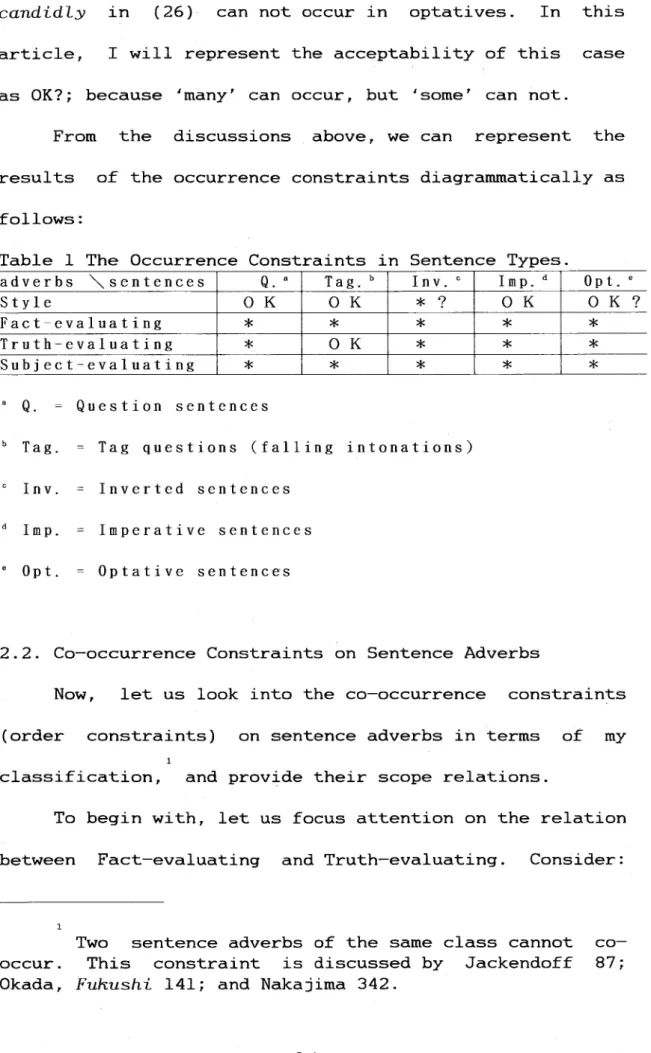
(26) candtdL[y in (26) can not occur in optatives. In this article, I will represent the acceptaPility of this case as OK?; because `many' can occur, but `some' can not.. From the discussions above, we can represent the results of the occurrence constraints diagrammatically ds follows:. ' Table 1 The Occurrence Constraints in Sentence Types.. adverbsXsentences Style. Fact-evaluating Truth-evaluating Subject-evaluating. Q.a. Tag.b. Inv.c. OK *. OK * OK *. * * *. * *. *?. Imp.d. OK *. OK? *. * *. * *. a Q. = Question sentences b Tag. == Tag questions (falling intonations). C Inv. = Inverted sentences d Imp. = Imperative sentences e Opt. = Optative sentence's. 2.2. Co-occurrence Constraints on Sentence Adverbs. Now, let us look into the co-occurrence constrainPs. (order constraints) on sentence adverbs in terms of my i classification, and provide their scope relations. ' To begin with, let us focus attention on the reiation. between Fact-evaluating and Truth-evaluating. Consider: i. Two sentence adverbs of the same class cannot cooccur. This constraint is discussed by Jackendoff 87; Okada, 17uhusht i41; and Nakajima 342. '. 21. Opt.e.
(27) (28' a (.ZZe,:giil.\a:.:a:.gv:;:,;} been trying i to climb the walls.. b i.Sgl,igwwA.h:.:af.fi::::glx] had hzs 2 own opinion of the matter. Thus it is clear that Fact-evaluating has wider scope than Truth-evaluating.. Next, consider the scope reiation between Factevaluating and Subject-evaluating: (29' {.g:P.Zil'ta\a:.:a:.gaz:I;.:,:;] been trying to. 3 decide whether to climb the walls.. (29) shows that Fact-evaluating has to precede Subjectevaluating. '. Furthermore, let us look into the odering of Truth-. evaluating and SubjecVevaluating. (30) provides an i:o) {.:ig2eeii. M:.c;]e.gus] was ciimbzng the eXaMP. 1. Okada, Fuhusht 145.. Heizo Nakajima, "The V System and Bounding. Cdtegory," Ltngutsttc AnaLysts 9 (l982): 342. 3 Okada, Fuhushl l45.. 22.
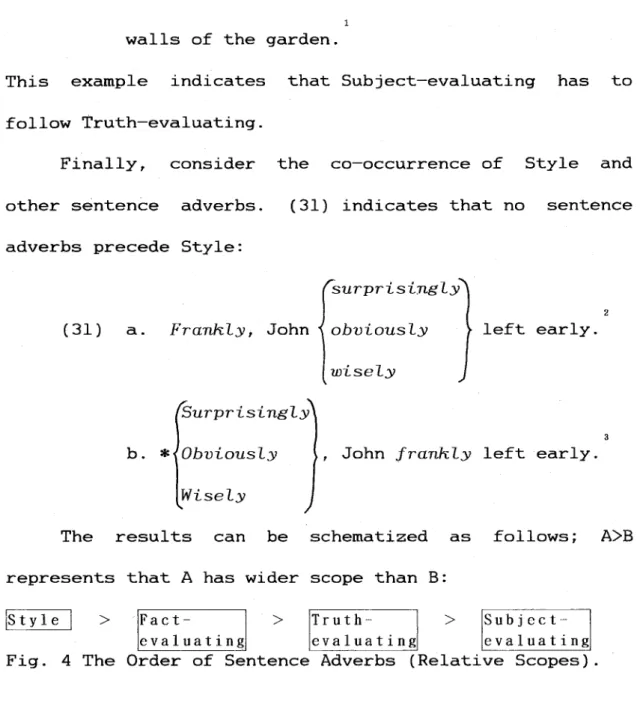
(28) i walls of the garden.. This example indicates that Subject-evaluating has to ' follow Truth-evaluating.. Finally,' consider the co-occurrence of Style and. ' other sentenCe adverbs. (31) indicates that no sentence adverbs precede Style:. surprtstngtJy. 2. (31) a. FranhLy, John obvtousLy left early. u)tseLy SurprtstngLy 3 b. * ObvtousLy , John franhLy left early. PVtseL y. The results can be schematized as follows; A>B represents that A has wider scope than B:. pm > Fact- > Truth- > Subjectevaluating evaluating evaluating. Fig. 4 The Order of Sentence Adverbs (Relative Scopes).. 1. Koo-ich Abe, "Adverbs, Quantifiers, Can Logical Form Represent `Meaning'?,-" PhtLoLogy l (i980): llO. 2 '3. Okada, Fuhusht l44. Okada, Fuhusht l44.. 23. .and Negatives:. Ltngutsttcs and.
(29) 3. Foregoing Studies of Sentence Adverbs ' 3.1. Approaches by Interpretation Rules. 3.I.I. Jackendoff's Study. As was pointed out in 2.3, Jackendoff (l972) divides sentence adverbs (he calls S adverbs) into two categories.. He argues that these adverbs and manner adverbs (i.e. predicate modifyÅ}ng adverbs in thÅ}s article) can be interpreted in terms of his three interpretation rules. The rules are stated as foliows:. (32) P speaker: !f Fl Å}s a daughter of S, embed the reading of S (including any members of F to the. right of Fl) as an argument to the reading df i Fl. (33) P subject: If Advl is a daughter of S, embed. the•reading of S (including any members of F to the right of Advl) as one argument to Advl, and. embed the derived subject of S as the second 2 argument to Advl.. (34) P manner: If {igv} is dominated by VP, attach its semantic markers to the reading of the verb i 2. Jdckendoff I07. 'Jackendoff 107..
(30) 1 without changing the functional structure. (32) is the rule appropriate to speaker-oriented adverbs (e.g. evldentLy, happtly, franhLy). Rule (33) operates on. subject'oriented adverbs , (e.g. carefuZL[y, cLumstly,. cLeverLy). Rule (34) functions approprÅ}ate to manner adverbs. Jackendoff, furthermore, suggests that the rules appropriate to speaker-oriented adverbs and manner adverbs '. apply to PPs, S (parentheticals) and epistemic modals,. •2. which are designated as F in his rules; Fl is a token of ' of adverbs. These rules account F, and Advl is a token for the occurrence constraints with which I am concerned ' '. in ' this paper. . '. Noviz let us discuss the constraints on sentence. ' ' ' adverbs in the light of Jackendoff's proposal. First, we ' shall consider the occurrence constraints. He suggests. that subject-aux Å}nversion causes incompatibility of sentence adverbs with questions and inverted sentences.. He describes: "inversion would introduce some semantic factor not present in noninverted forms, and this factor 3 would be incompatible with the readings of S adverbs." ' ' In his conclusion, sentence adverbs are not compatible ! 2. Jackendoff 107. Jackendoff I06.. 3 Jackendoff s6.. '. 25.
(31) with questions and inverted sentences; but they are compatible with tags, because tags are not inverted forms.. As for the constraints in imperatives and optatives, he does not deal with them.. Next, we will look at his explanation as to the ordering (co-occurrence) constraints. He observes that if. a subject-oriented adverb follows a speaker-oriented adverb, the sentence is acceptable, while the opposite '. order does not work. These constraints can be explained. by the rules above. Here, it is helpful to see his ' illustrative examples and explanation: (35) a. ProbabLy Max carefu'Lly was climbing the i wal1s. b. *CarefuLLy Max probabLy was climbing the. 2'. walls.-. '. In (35a), P subject applies to carefuZLy, and P speaker applies to probahly. Thg arguments of carefuLLy have the reading of the subject MAX and the reading of the rest of. the sentence, which does not include probahty. Thus the. reading including carefuLLy but excluding probabLy is. CAREFUL (rvlAX, CLIMB (MAX, THE WALLS)). This is '. acceptable. The reading including probah-ty is thus i. 2. Jackendoff 90. Jackendoff 91.. 26.
(32) PROBABLE (CAREFUL (MAX, CLIMB (MAX, THE WALLS))); thÅ}s reading includes carefuL'Ly, because carefuLtLy is put to. the rÅ}ght of probabLs. This sentence is therefore. acceptable. On the other hand, in (35b) P speaker dpplying to probabLy1akes as an argument the reading of. the rest of the sentence. Thus it produces PROBABLE (CLIMB (MAX, THE WALLS). This reading is acceptable, P subject applying to caTefu-tLJy, howeveir, offers CAREFUL (MAX, PROBABLE (CLIMB (MAX, THE WALLS))), which is an ill-. formed reading. Therefore, he argues that his rules can account for the constraints.' ' ' '3.1.2. Abg's Study. We shall here look at the proposal by Abe (l980).. His attempt is based on Jackendoff (i972), and his ' clas,sjficatÅ}on of adverbs Ss the same as Jackendoff's. Xn. order to account for the constraints, the interpretation i rules dnd The Scope Hierarchy are provided. ' To begin with, let us look at three Å}nterpretation rules:. 2 (36) S Adverb Interpretation Rule i. Abe (1980) proposes VP Adverb Xnterpretation Rule and Quantifier Interpretation Rule. I shall omit them, because they are not concerned with this study. 2. Abe li4.. 27.
(33) [s . . . Adv . . . ]-[sn ADJ, NP(...)]. where (i) the NP is a speaker dnd `n' has bne. vdlue in the case of a speakeroriented adverb. (iO the NP is identical with the subject ' NP and '`n' has zero vdlue in the case of•a subject-orÅ}ented adverb ' ' i (37)(Sentence) Negative Interpretation Rule. [s . . . Neg . . . ]-[s Neg(...)] 2 tt (38)Property Interpretation Rule (A--expression). (36). Betsy loves Peter->(Betsy),Ax(x loves Peter) '. amalgamates two rules of sentence adverbs 'of. ' ' ' Jackendoff (l972) into one; (i) is the rule appropridte to. speaker-oriented ddverbs, (iO is the one approprÅ}ate to. subject-oriented adverbs. If an adverb is a speakerorÅ}ented one, the parameter `n' indicates l; Å}f an adverb '. is a subject-oriented one, the parameter is O. These. figures correspond to sl and sO in The Scope Hierarchy.. The rule (37) is the rule to interpret a sentence ' .tt negation. (38) is the one to interpret a sentence.. Next let us briefly look at the rules concerning the scope:. 1 2. Abe ll5. Abe 115.. 28.
(34) (39). The Scope'1 Hierarchy '. sl scope--speaker-oriented adverb sO scope--subject-oriented adverb, quantifier, .. negative '. (40). VP scope---VP adverb 2 The Scope Violation. Xf the Scope Hierarchy is violated, the sentence wÅ}ll be' ill-formed. (41). 3 The Scope Order Hypothesis. Scope Assignments of items which have the same. scope depend upon the surface order between restrictive iterns.. ' If a sdntence adv'erb violate$ The Scope Hierarchy, it will. be ill-formed according to (40). If •more thdn one element. in the same scope co-occurred, the surface order will be ' (41). the scope orderaccording to. Now let. us focus attention on his, explanation for the. constralnts. . As for the incompatibility. of sentence '. adverbs with questions, he considers questÅ}ons (yes-no questions. 4. and wh-phrases) as sl scope. Therefore, he. 1. Abe ll2-l13. 2. Abe Il3. 3. Abe Il3. 4. Abe 118-l19.. 29.
(35) asserts orÅ}ented. that questions do not co-occur. with speaker-. adverbs. To see this, let. us. take up his '. examples, which are iliustrated as (42):. CLearLy, when will they. (42). a. * EvtdentL[y, will they leave. ObvtousLy, will they leave When will they, cLear'Ly,. b. * WÅ}ll they, evtdentLy, Will they, obtitousL[y, Let us turn to the incorrtpatibility sentences. Consider (43) and (44): ' ' (43) *Never did John probabL[y run so fast '. (44) *[sO (NEVER) [sl (PROBABLE, speaker) 4 Ax (x ran so fast))]]. ieave? early? i or stay?. leave? leave early? 2 leave or stay?. with inverted 3. (John,. The reason of the ill-formedness in (43). is that a. negative (sO scope) precedes probabLy (sl. scope); it. produces a scope violation. As for the '. imperatives and optatives, he also does. constraints in. not deal with. them.. Finally, let us briefly look at his i 2 3 4. Abe ll8. Abe ll8. Abe lll. Abe 116.. 30. explanation of.
(36) the co-occurrence constrai.nts. Consider (45) and (46):. (45) a. ProbabLy, Max carefuLLy was climbing the (speaker-oriented) (subjecVorÅ}ented) i walls of the garden. b. *CarefuLLy, Max probabLy was climbing the (subject-oriented) (speaker-oriented) 2 wails of the garden. (46) a. [sl (PROBABLE, speaker) [sO (CAREFUL, rvlax). (Max,Ax (x was clirnbing the walls of the 3 gdrden))]] ' b. *[sO (CAREFUL, Max) [sl (PROBABLE, speaker) .t. (Max,Ax (x was climbing the wails of •the 4 garden))]] (45b) violates [rhe Scope Hierarchy. [Vhis is because, in. (46b), sO scope precedes sl scope. (46a) is acceptable, ' since sl scope precedes sO scope. '. 3.l.3. Some Problems of the lnterpretation Rules. What we have seen so far is two attempts at investigating into the constraints on sentence adverbs in. terms of the interpretation rules. Some problems, '. i. 2 3 4. Abe llO. Abe 110. Abe ll6. Abe ll6.. 31.
(37) however, lie in these proposals. !n the remainder of this section I shall discuss the problems. ' The first problem is about their classSfication. X. proposed four classes of sentence adverbs, while Jackendoff and Abe offer only two classes. Furthermore, ' they regard as sentence adverbs some items which are. excluded from sentence adverbs in 2.3. Secondly, they discussed the co-occurrence constraints in terms of the bipartite classification, although I proposed that four ' ' '. classes differ from each other in their manner of. occurrence and co-occurrence.. The third problem is about the incompatibilrty with. questfons. Jackendoff states that `semantic effect' in ' subject-aux inversion creates the incompatibility, but he ' ' does not advance his arguments about,it. In Abe's remark,. questions are sl scope, so that sl scope adverbs (i.e. speaker-oriented adverbs) are incompatible with questions.. However, he does not consider sO scope adverbs (i.e. ' subject-oriented adverbs). According to his argument, if. sO scope adverbs (subject-oriented adverbs) foUow '. -t questions (sl scope), the question sentences couid be '. acceptable. My observation evidences, however, that sentence adverbs except Style are not compatible with ' questÅ}ons. Therefore it seems that his argument is not. ' correct. !n addition, they fail to refer to Style. ' ' 32.
(38) The fourth problem is that sentence adverbs cannot. occur in inverted sentences. Jackendoff does not look ' into the `semantic effect',•whereas Abe is concerned only '. with the inversion whereanegation is preposed. His observations do not give us. any explanations about (21b) (repeated here as (47)):. (47) = (21b)??So fdst did Tom probabLJy run that he got to Texas in ten minutes.. Finally, Abe only describes the scope hierarchy of. sentence adverbs, negation, etc. He does not offer the reason why such hÅ}erarchy exists.. 3.2. Approaches of Modality 3.2.I. Nakau's Studies. The attempt by Nakau is different from those which have been introduced so far, because he censiders sentence. adverbs as `modal expressions'. In the light of speech '. acts, he considers that a sentence is made up of •1 `modality' and `proposÅ}tion'. Before turning to his explanation of the constraints, it is helpful to see the '. definitions of modality and proposition. Proposition i. ' rvlinoru Nakau, "Modariti to Meidai," Etgo to Nthongo. to: Hayasht Ettchi KyoJ'u Kanrekt K'tnen Ronbunshu, ed. Hayashi Eiichi Kyoju Kanreki Kinen Ronbunshu Kanko Iinkai (Tokyo: Kurosio, l979) 223. 33.
(39) (propositÅ}onal content) is the sentential element that a '. speaker presents as a real world situation (event, status,. action, process, etc.) which exists in the objective i. world. Modality, on the other hand, is the sentential '. element that a speaker expresses as his/her mental. attitude at the instant of the utterance; it is a 2 subjective world for the speaker.. Nakau explicates the constraints in terms of the relation between the modal prqperties of sentence adverbs ' ' and those of sentence modaiity contained in a sentence. The term `sentence modality' is explaÅ}ned by Nakdu (l979). as follows. There are cases where a subject element and a. predicate element form the modality such as declarative '. mood, interrogative mood and imperative mood; each ' is generated by the way of combination sentence modality 3 of the subject and the predicate.. In terms of his classification of sentence adverbs,. let us observe their properties of moddlÅ}ty. They are shown in Table 2, which I made according to Nakau (1980).. Now let us look at 'hÅ}s explanation about the ... constraints. ' He claims that the acceptability of a. 1,. Nakau, "Bun-fukushi" l59. 2. '. Nakau, "Bun-fukushi" l59. ' 3 Ndkdu, "Modariti" 225.. 34.
(40) Table 2' The PropertÅ}es of Classes ". Sentence Adverbs by Nakau. The Properties of. Modality T-T--T-T'MrmMTIii It expresses the speaker's way of presentSpeech-act iing an utterance at the instant of making it (Style) It does not haye to do with the content. ) propositio Truth-judgment the assessment of the truth j It express of thepro propositional content at the int (Truththe speaker's utterance. (i.e. st'antof evaluating) 2It asserts the truth value of the proposiI. .(Le. .. tional • It expresg.es content.) the speaker's value judgment. Value-judgment. l on the propositional content at the in-. (Fact' -. ' evaluating) ' ' 't. Subject-oriented value-judgment (Subjectevaluating). l l. stant of his/her utterance.• (i.e. It presup' poses that the propositional content is true in order to make a value judgment.) , It expresses the speaker's value judgment his/her on the subject at the instant of utterance. (i.e. It presupposes that the order to propositional content is true in make a value judgment.). " The class names in the above column are used in Nakau ' ' into English, and rhe parenthe(198 .0),.which I translated ' ' :::::.names below aie the ones which are adopted in this .. ' ' sentence' w-th a sentence adverb depends on the relation. between modality of' a sentence adverb and its sentence. tt ' of a sentence adverb modality. In short, if the modality ' is compatible with the sentence modality, the sentence, ' will be well-formed.'. First, let us look at the constraÅ}nts in questions. ' ' ' ' ' the acceptability We can predict of sentence adverbs with ' ' ' questxon sentences, by means of comparxng the modality of. 35.
(41) sentence adverbs with the sentence moddlity. That is to say, the comparison of the properties in Table 2 with the. interrogative mood will clarify the acceptability. The '. property of the interrogative mood is that the speaker does not know whether the proposition is true, dnd he/she i asks for the truth value. '. If we compare the modality of Style with the. interrogdtive mood, we cannot see any conflicts between. them. The sentence is acceptable. It is possible to '. restrict the way of asking a question. The property of '. Style is to restrict the way of a speaker's utterance, and. interrogative mood is to ask whether the proposÅ}tzon is. true or not. As for Truth-evaluating, it describes the truth value of the propositÅ}onal content. Interrogative ' ' mood, on the other hand, assurnes that the truth value of the proposition is not clear. Truth-evaluating Å}ndicates ' the truth value of the proposition, whUe interrogative rnood does not indicate it. Hence a cgnflict is produced.. Fact-evaluating dnd Subject-evaluating are not compatible. with questions. It is because they presupPose that the '. '. propositional content is true, while the interrogative. mood does not indicate its truth. These resuits are ' identical with my observation in the prevxous chapter. i. Nakau, "Bun-fukushi" 200.. 36.
(42) What about the constraints in tag questions? ' Modality of tag questions (falling tones) is `a speaker's i. confirming attitude'. Atag question with aTruth-. evaluating means a confirmatÅ}on of the truth value of the ' propositional content. It creates no conflicts. Truth' '. ' evaluating expresses a speaker's assertion of the truth '. value, so that a tag question with it means a confirmation. of a speaker's assertion of the truth value. A tag question with a Fact-evaluating or a Subject-evaluating. creates a conflict, since both of them indicate that a speaker presuppose the truth of the propositional content.. To `presuppose' something means that the speaker is sure 2. of it. It is strange for a speaker to confirm his/her belief which is self-evident. As for Style and Subject' evaluating, Nakau does not discuss them in his artÅ}cles.. Now on inverted sentences, Nakau suggests that `preposing' by inversÅ}on means a speaker's attitude of. emphasis. Emphasis expresses a speaker's certainty. '. '. '. ' Consider the.following example: '. (48) = (2b) b.??Never has Bill apparentLy seen i. 2 3 4. Nakau, "Bun{ukushi" l76. Nakau, "Bun-fukushi" 168. Nakau,'"Bun-fukushi" l99. Ndkau, "Bun-fukushi" 200. '. 37.
(43) anything to compare with that. In (48), the incompatibility of a Truth-evaluating with an '. inverted sentence is caused by the conflict of the nagative certainty of never (i.e. the modality of never. preposing) with the modality of apparent'Ly (i.e. an assertion of the truth value `apparent'). Next, let us '' take up his examples about Subject-evaludting ((49c) is not an inverted sentence, but it is unacceptable for the same reason):. (49) a. = (22c) *Not zotseLy did they accept the. award. b. = (22e) *Never did they iDtseZ[y accept the. award.. '. •• 1. c. *None of them zDtseLy accept the award.. He argues that the reason for the unacceptability of (49). is due to' the negative scope. The negation in each sentence has wider scope than the modal expression iotseL[y.. It creates ill-formedness, since modal expressions cannot. occur in the scope of negation. The reason is 'that the object of negation has to exist in a spedker's mind before 2. his/her utterdnce. rn his papers, the constraints on Style and Fact-evaluating are not examined. ' i. 2. Nakau, "Bun-fukushi" l87. Nakau, "Bun-fukushi" l88.. 38.
(44) 3.2.2. Kasai's Studies. Kasai has been dealing with `modality' in a series of. his works. He argues that sentence adverbs are `modal expressions'. His definitin of modality and his account i of the constraints are identical with Nakau's, excepF that '. the scope of modal expressions in Kasai's studies is ' ' wider than those in Nakau's studies. He takes up thirteen 2 categories as modal expressions. His fundamentai remark. is that `speaker's mental attitude (i.e. modality) must 3. be consistent'. It means that unless the combination of their modalities creates a conflict, a sentence adverb can '. occur with a sentence or with another sentence adverb. That is to say, his remark is in complete agreement with ' Nakau's argument that the conflict between two kinds of modality produces an Ul{ormed sentence. ' Let us now focus attention on his account of the i. Seizo Kasai,•"`*Did Frank Probably Beat All His Opponents?' no Kozo: Hat.suwa ni okeru Washa no Shin-teki. Taido no Ikkan-sei ni tsuite (4)," "ohhatdo Datgaku Bungaku-bu Kiyo 34 (1986): 2. 2. Seizo Kasai, "`*Did Frank Probably Beat All His Opponents?' no Kozo: Hatsuwa ni okeru Wdsha no Shin-teki. Taido no Ikkan-sei ni tsuite (5)," ffohkatd6 Datgahu Bungaku-bu KtJyo 35 (l987): 44-56. 3. Seizo Kasai, "`*Did Frank Probably Beat All His Opponents?' no Kozo: Hatsuwa ni okeru Washa no Shin-teki Taido no Ikkdn-sei," Hohhatdo Datgahu Bungahu-bu KtNo 30 (l981): 94.. 39.
(45) constraints. We will find here more developed arguments. than Nakau's. The initial drgument is about the constraÅ}nts in inverted sentences. He argues that to i change `word order' expresses a speaker's mental attitude.. `Emphasis' urges a speaker to prepose a particular element. Inverted sentences are thus modal expressions.. Nakau, as we have already seen, offers two distinct accounts of the constraints in inverted sentences. One is. the same as Kasai's. Inverted sentences express a speaker's emphasis. The other is not the same. Nakau ' argues that modal expressions must not be within the scope. of negation. In the next chapter I will adopt Kasai's argument that inverted sentences are modal expressions, ' so that the inconsistancy in Nakau's argument will be. resolved. It does not mean, however, that I will not reject Nakau's argurnent.. The second argument which Kasai developed is about. the co-occurrence constraints. He tries to modify and '. improve the adverb hierarchy proposed by Nakajima (l982), 2. because Nakajima's hierarchy does not contain Style. i 2. Kasai, "Shin-teki" 82.. Tamotsu Mdtsunami, Yoshihiko Ikegami and Kunihiko. rmai, eds. (l983: 580-581) describes that Style is a member of Group-A; however, my observation shows thdt Style has wider scope than other adverbs.. 40.
(46) Before turning to Kasai's arguments, it is helpful to see. Nakajima's hierarchy. following The classes of adverbs (1984) according to Nakajima are summarized by Kasai' '. i. (l982): (50). a. Group-A: speaker's attitude, opinion, judgement fortunateLy, happtLy, sadLy, surprtstngLy, astontshtngLy, thanhfuLLy.... b. Group-B: probdbility of truth of proposltxon probabLy, posstbLy, maybe, certatn-Ly,. evtdentLy, cLearLy.... c. Group-C: adverbs of time, frequency, manner, instrurnent, place, etc. are. "restrictive adverbs" in the sensd that. tt. they modify a whole V (or V') and restrict ' the meaning of the VP. d.. Group-D: manner adverbs. The order (a) to (d) is the order of scope; Group-A has the widest, scope, and Group-D has the narrowest. Here, I only focus. attention on Group-A and B.. ' Seizo Kasai, "`*Did Frank Probabiy Beat All His Opponents?' no Kozo: Hatsuwa ni okeru Washa no Shin-teki i. Taido no. Ikkan-sei ni tsuite (2)," Hohhatdo Datgaku. Bungahu-bu Ktyo 32• (l984): 130.. 41.
(47) Although Style is not illustrated in (50), it has the. widest scope as we have seen in Chapter 2. So Kasai (l984) discusses the scope Of sentence advetbs in the light of modality. They have three classes: 1. the class. concerning the truth of a proposÅ}tion (i.e. Truthevaluating), 2. the class about proposition excluding class l U.e. Fact-evaluating), and 3. the ciass about the. way to express the proposition (i.e. Style). These classes form the hierarchy, in which 3-is closest to the i speaker, whereas l is closest to the proposition. The. impor'tant point here is that his argument is further. developed from Nakau's idea, in that he offers the explanation as to the co-occurrence constraints. '. ' 3.2.3. Some Problems of Modal Approaches '. Many constraints on sentence adverbs have been '. expiained by two approaches of modality (henceforth medal approach). It must be noted, however, that two approaches. have some problems. I will here tdke up what are left '. First, there remain some constraints untouched. In Nakau's study, he does not touch upon the occurrences of '. Style and Subject-evaluating in tag questions, and Style. 1•. Kasai, "Shin-teki (2)" 133-l34.. 42.
(48) and Fact-evaluating in inverted sentences, while Kasai is concerned only with moddl adverbs (i.e. Truth-evaluating).. Now,' the second problem is the inconsistency found in Nakau's explanation. 'He provides two accounts of the '' ' occurrence constraints in inverted sentences. One is that. the conflict between speaker's certainty shown in `preposing' one particular element and modality of a sentence adverb creates unacceptability of the sentence.. The other account is that since negation has wider scope than modal expressions (i.e. sentence adverbs), (49a) and (49b) are unacceptable. Kdsai, on the other hand, arriVes '. at the conclusion that a change of word order produces modality. This is identical with the former account by Nakau.. The third problem is that they do not account for the constraints in imperatives and optatives. The final problem is about the co-occurrence constraints. Nakau is '. not concerned with it, whereas Kasai proposes a modal '. hierarchy which is formed by Style, FacVevaluating and '. Truth-evaluating. My observation, however, shows that '. '. ' sentence adverbs have four classes and that they form a. hierarchy. That is, he does not deal with Subjectevaluating. These four problerns are not discussed in their works. In the next chapter, they wiil be resolved by a more refined modal approach.. 43.
(49) 4. Modal Approach to the Constraints ' 4.l. Justification of Modal Approach. The attempt to regard sentence adverbs as modal expressions is made by not only Nakau ahd Kasai but also. Lyons (l977). He takes up four sentence adverbs (i.e. franhLy, fortunateLy, posstbLN, iDtseLy), which correspond. to my four classes of sentence adverbs, and describes '. that "they [sentence adverbs] are used by the speaker in order to express, parenthetically, his opinion or attitude towards the proposition that the sentence expresses or the i. situation that the proposition describes." `Spedker's. opinion or attitude towards the proposition' in his remark 2 means modality, which will be defined in the next section.. Now let us discuss the redson why modal approach should be adopted. To begin with, we shall briefly look at the problems of the approaches of interpretation rules. '. First, I pointed out that they classified sentence adverbs into two classes, and that they discussed the co-occurrence constraints Å}n terms of these two classes. However, this problem can be disregarded, sÅ}nce it is the i. John Lyons, Semanttcs vol. 2. (Cambridge: Cambridge University Press, 1977) 452. cambri' dll6 un5• J..g'lti:e5"..g?Oggsgi;di6ijoda"t[y (cambridge:.
(50) issue of definition of sentence adverbs. Next,' on the constraint in questions, Jackendoff and Abe do not mention. Style. In addition, Ja6kendoff does not inquire into the `semantic effect'. Abe's argument, on the other hand, is. misleading, because it makes us predict that subjectoriented adverbs are compatibie with questions. As for the constraint in inverted sentences, Jackendoff does not. look into the `sernantic effect', whUe Abe's attempt can. apply only to the preposed negatives. Finally, Abe does not make any inquiries into The Scope Hierarchy. These problems can be resolved by the modal approach.. First, on,the constraint in questions; as we have seen in. the previous chapter, it can account for the constraints. on Style and •the `semantic effect'. It indicates that `semantic effect' is produced by modality (i.e. speaker's '. mental attitude),. becaqse the acceptability of the. sentence with a sentence adverb depends on the relation between their modalities. The same is true of inverted sentences. Secondly, it can apply not only to sentences with preposed negation but to other inverted. sentences. Here, I will not pursue the problem of cooccurrence constraints, because they will be resolved in 4.3.. ' It follows from the discussions above that the modal ' approach can explain the problems that the interpretation. 45.
(51) rules cannot account for. I will adopt this approach, and. refine it in order to resolve some problems with this approach in 4.3. ' 4.2. Definition of Modality ' 4.2.1. Definition of Modality. Before turning to a refined modal approach, I have to. define modality and sentence modality. Palmer (l986) i defines modality as foliows:. ModalÅ}ty in language is, then, concerned with subjective characteristics of an utterance, and. it could even be further argued that. subjectivity is an essential criterÅ}on for modality. Modality could, that .is to say, be. defined as the grammaticalization of speakers' (subjective) attitudes and opinions. '. In this quotation, `speakers' (subjective) attitudes and opinions' is identicai with `speaker's rnental attitude'. advocated by Nakau and Kasai. Nakau (l979) defines it. as a mental attitude of `speaker' `at the instant of 2 his/her utterdnce'. ' [rhe same holds true of Kasai (l986),. as we have seen in 3.2.2. That is also supported by the ,3 study of Jdpanese modality Å}n Masuoka (l991). These four i 2 3. Palmer l6. Nakau, "Modaliti" 224.. Takdshi Masuoka, Modarttt no Bumpo (Tokyo:. Kurosio, 1991) 34-35.. 46.
(52) scholars agree on the point of `speaker's rnental attitude'. Palraer, however, does not describe `at the instant of speaker's utterance'.. Why is modality defined as expressions `at the. instant of the speaker's utterance'? Nakau (l979) describes that the mental attitude which does not in"olve '. the speaker's instantaneous present represents "the objective expression which the speaker considers to be far. 1-. from hÅ}mself/herself," and that it'forms proposition. '. Kasai (l987) points out that "time expressions having no. direct relations to the speaker's instantaneous present. are the expressions in which the speaker considers 2 himself/herself objectively." In this paper, their strict '. discrimination between rnodalÅ}ty and proposition is ' favorable to my arguments. ' ' Besides that, one more discussion has to be given in. this section, because there is a slight difference in the. category of rnodality between Nakau, Kasai and Masuoka. ' Kasai (l987) points out that the categories of modality in. Nakau's studies ar.e modal auxiliaries, interjections, the 3 phrases iike `Z think', mood and advqrbial expressions. i 2 3. Nakau, "Modariti" 229.. Kasai, "Shinteki (5)" 57. Kasai, "Shin-teki (5)" 58.. 47.
(53) But as we have seen in 3.2.1, Nakau also regards as modal. expressions inverted sentences '(i.e. speaker's mentai. attitude of certainty) and tag questions (i.e. speaker's mentai attitude of confirmation). On the other. hand, Kasai (1987) adds to modal expressions the ' categories such as modal adjectives, stress, intonation, i speech, word order, etc. Added to these, rvlasuokd (l991) ' ' classifies modality into two major categories: primary. modality and secondary modality. He notes that primary 2 modality is identical with the modality defined by Nakay,. and that secondary modaiity covers the elements such as 3. negation, tense and so on. The fuller study of these ' categories except negation lzes outside the scope of this ' paper, so r wUl not pursue this question further. I will ' consider only Nakau's categories as modality for the time ' being. There are 'two reasons for this. One'is that his. categories are taken over by Kasai and Mdsuoka; and the. other is that they are sufficient•, for the study of. sentence' adverbs. . i. Kasai, "Shin-teki (5)" 45-56. 2. Masuoka 45: note 12.. 3. ,. .,gaSUg:S..g!igkg3Z•Aag::•2x"2at.sgg:2Sary..xodael•sx. objectively; it seems to be proposition according to Nakau's defÅ}nÅ}tion.. 48.
(54) As for the negation, it should be considered as ' proposition, as seen in 3.2.l, since the object of. negation must be within the speaker's mind before his/her. utterance. Although I take Nakau's position with reference to the definition and the categories of ' Kasai's argument about the modality modality, I will.adopt. of word order and intonation. He describes that a change. of word order itself creates modaiity. It advances '. '. Nakau's argument, as was pointed out in 3.2.2. In '. addition, it can apply not only'to (21a) but also (21b),. although Abe's proposal can only apply to (21a). On the '. other hand, it was implied by Nakau that intonation has. tt. modality, as we have seen in the discussion about tags.. ' 4.2.2. Definition of Sentence Modality. In the remainder of this section, r will consider `sentence modality'. It is becduse the relation between. the modality of sentence adverbs and that of sentences (i.e. sentence modality) accounts for the constraÅ}nts. ' Sentence modality, as illustrated in Nakau's quotation in ' 3.2, consists of subject and predicate. Hailida' y (l985). offers the same definition as Nakau: "Subject dnd Finite '. are closely linked together, and combine to forrn one i constituent which we call the Mood." Then let us look into the types of sentence rnodality. '. 49.
(55) Palmer (l986) and Lyons (l977) considers declaratives, '. imperatives and interrogatives to be basic types of i. sentence modality. Halliday (l985) regards these three types of sentence modality and exciamatives as sentence 2. moddlity. In addition to these four sentence modality, I. wi!l consider tag questions to be included in sentence. modality, as we have seen in 3.2.l; and Z will add optatives to sentence modality. It can be said that 3 optatives express the modality of `speaker's wish'.. 4.3. A Refined Modal Approach to the Constraints 4.3.l. Criterion of Modaiity ' Nakau and Kasai point out that a conflict between two. kinds of modality causes unacceptability. rt seems to be a filter which keeps out the sentences with inconsistent modality. Here I will summarize their arguments about the ' modality: Criterion of Modality. The speakerls mental attitude (modalrty) must be 1. M. A. K. Halliday, An Introductton to Grammar (London: Edward Arnold, l985) 73. i 2 3. FuncttonaL. Palmer 23-33; and Lyons 745. Halliday, Jntroductton 44, 83'85.. 9uirk, et al. (l985: 839) describes. function of optatives is `speaker's wish'.. 50. that. the.
(56) consistent in his/her utterance and the attitude is. t to be at the instant of his/her utterance.. In what follows, Z shall advance further the arguments (i.e. modal approach) about the constraints on sentence ddverbs in terms of thÅ}s criterion.. Although its validity for the constraznts has been '. shown in thÅ}s chapter, some problems that the modal '. approach has were pointed out in the previous chapter. The problems are as follows; complete explanations were. not given on the occurrence constraints, and enough. discussions were not offered on the co-occurrence '. constraints. In the rernainder of this chapter, I shall refine the modal approach to resolve the problems.. 4.3.2. The Constraints and the Criterion of Modality. Although the studies by Nakau and Kasai answer sorne questions of thb constraints, there remtiin some untouched '. questions. In this section, I will verify my approach (the cri.terion of modality and the modal hierarchy), and answer the untouched questions.. To begin with, let us consider the constraints in tag questions. Nakau leaves two questions untouched: the. constraints on Style and Subject-evaluating. First, consider the constraint on Style. A tag with d Style is. acceptable, because a Style can restrict the way of 51.
(57) speakers' confirmation. So my criterion is satisfied. '. The second question is about the constraint on Subjectevaluating. Table 2 (p.35) shows that it presupposes the. truth of the propositional content. Thus it is strange for speakers to confirm the `presupposed' truth, since the. presupposed element indicates that he/she believes its ' truth; namely, the criterion of modality is not sdtisfied. The same is true of Fact-evaluating and [[ruth-evaluating. ' Secondly, let us consider the constraints in inverted '. sentences. Nakau did not deal with Style and Fact'. '. evaluating. However, if we compare the modality of ' inverted sentences with each modality of sentence adverb,. it can be predicted that Style may occur in them, and that ' other sentence adverbs cannot occur. The reasons are ds. follows. The inverted.sentences express modality whose function it is to emphasize the preposed element. On the ' '. other hand, Fact-evaluating and Subject-evaluating presuppose the truth of the proposition. The presupposed. element can not be emphasized. So they cannot occur in. inverted sentences; that is, my criterion is not satisfied. As for Truth-evaluating, it denotes the `assessment' of the proposition in reiation to the truth. value which the speaker believes; whereas the preposed. element in inverted sentences expresses the speaker's. `certainty'. So a conflict is produced. Next, on the 52. '. '. '.
(58) constraint on Style, it is not easy to occur in inverted. sentences, because `preposing' restrÅ}cts the way to present the utterdnce (sentence). Preposing has the same. function (property) as Style. Two categories which concern the restriction of the utterance can occur Å}n the. same utterance, which sometimes causes it difficult. to judge the acceptability. If there is not any consistency between these two categories, it will be acceptable. I shail return to this point in 4.3.4.. Thirdiy, consider the constraints in imperatives.. Sentence adverbs other than Style cannot occur in. imperatives, because there is a conflict between imperative mood and modality of a sentence adverb (except ' '. Style). rmperative mood denotes the' modality of '. `command', whereas sentence adverbs (except Style). indicates the modality of `assessment' or `value-. judgment'. T.f they occur Å}n the same utterance (sentence), it will be eliminated by my criterion, since they are in distinct modality. Now let us turn to Style.. A Style in an imperative sentence (utterance) restricts. the way to present the command sentence. We cannot see any conflict in thdt'utterance.. Finally, let us look into the constraints in '. optatives. Xts modality is the speaker's mental attitude of `wish'. It differs from the speaker's mental attitude 53.
(59) of `assessrnent' or `value-judgment'. If an optative. sentence has a sentence adverb (except Style), the ' sentence will have two distÅ}nct modality. Then it will be. eliminated according to rny criterion. As for Styie, it seems to be difficult to judge the acceptability, as is shown by differences in the scholar's views. However, my '. criterion tells us that Style can occur in optatives. unless two kinds of modality produCe a conflict. Actually, it seems that (27) has no conflicts; in (27), honestLy and truthfuLLy are successful in restricting the ' way to express a wish `God save him'. But (26) seems to. have conflicts, because frankLy and candtdLy seem to be. incompatible with the speaker's `wish'. ' 4.3.3. [rhe Constraints and Modal Hierarchy. Now it remains to discuss the co-occurrence constraints. Kasai's modal approach to these constraints. (1984) was shown in 3.2.2; but it did not deal with Subject-evaluating. My hierarchy (i.e. Fig. 4), on the '. ' other hand, incorporates Subject-evaluating as the. narrowest scope. Fig. 4 shows that sentence adverbs form the hierarchy, whose order is `from the element concerning the speaker to the one concerning the proposition', as was. pointed out in 3.2.2. In this hierarchy, Styie is the closest element to the speaker, while Subject-evaluating 54.
(60) is the closest eiement.. to the proposition.. Now ! will combine. this hierarchy with Table l:. Table 3 The Constraints and the Relative Scopes ' Inv. Tag. adverbsXsentences Q.. Imp.. Opt.. OK?. spa 2if. Style. OK. l*. Fact-evaluating. OK. *?. OK. *. *. *. *. Truth-evaluating. *. OK. *. *. *. Subject-evaluating. *. *. *. *. *. prb O a sp = speaker. b pr = proposition. This diagram makes two points clear. The first point is that the closer an element is to the speaker, the wider the scope of the element is. Secondly, we can see the gap between Style and Fact-evaluating, because the behavior of. Style differs from other sentence adverbs. In Table 3, a wavy line is drawn between them for the convenience' sake.. Xt suggests that sentence modality is put between Style ' and Fact-evaluating. This is also concluded from the fact. that Style can only occur at the initial poistions of questions, imperatives and optatives. Greenbaum (1969). points out that Style may freely appear in front of i. questions, imperatives and optatives. In addition, i. Greenbaum, Usage 84-85.. 55.
(61) examples (6), (23) and (27) indicate that Styie can occur at the initial position; while (51) and (52) show that it. can not appear at other positions. Consider: ' (51) *Did, frankLy, Ron sell them fifteen chickens with no left wing?. 1.. '. (52) *Could Evan franhLN have been at the coffee 2 house all afternoon? '. That is, Style has wider scope than sentence modality. To sum up: the modality of sentence adverbs and sentence modality form one hierarchy. The closer a modality is to. the speaker, the wider its scope is. The closer a modality is to the proposition, the narrower its scope is. The reason why only Style can occur in front of questiions,. imperatives and optatives is that only Style has wider. scope than sentence modality. '' A simildr view is proposed by Masuoka (l991). He. describes the hierarchy of modality in his study of 3. noted here that his study. Japanese., It- must be'. 4 corroborates my argument that modality form a hierarchy. ' ' i Thomas Boyden Ernst, TozDards an Integrated TheorJy. of Adverb Positton tn EngLtsh (Ind.: Indiana University LinguÅ}stics Club, 1984) i17. ' 2. . Konishi, ed. 747. 3 4. ' Masuoka 41-44.. Masuoka (l991: 10) describes that Japanese is so '. 56. •'.
(62) 4.3.4. A Further Explanation by the Modal. Hierarchy. In this section, I will advance the the modal hierarchy. To make rny argument. argument as to more explicit,. X will re-forrn the hierarchy into Fig. 5:. s. Style Sentence Fact- Truth- Subject-. Proposition. modality evaluating evaluating evaluating Fig. 5 Modal Hierarchy of Sentence Adverbs. Hg. 5 provides a unified explanation for. constraints on sentence ddverbs. First,. the two consider the. '. occurrence constraints. Only Style can occur in '. sentences '. such as imperatives, questions and optatives;. and it can. appear only at the initial positions of these '. sentences.. It ls because Å}t has wider scope thdn the. sentence. modality. Other sentence adverbs, on the other. hand, can. not appear in any sentence types other than. declaratives,. because they cannot have wider scope than sentence i modality. Declaratives are modally unmarked, so that any ' modal expressions can appear in them. Therefore, such constraints can be predicted from Fig. 5.. highly structurized modality can provide i. in modality that the study of Japanese many suggestions for us.. Palmer 28-29. 5 7-.
(63) There are, however, two problems about the constraints. One is about tag questions. The property of tags seems to be different from other sentence modality.. Style and Truth-evaluating are compatible with tags, but. others are not. It is because Fact-evaluating and. Subject-evaluating presuppose the truth of the ' proposition. That is to say, they differ from others in. the property (i.e. presupposition) of modality. My criterion of modality accounts for this difference. The other problem is about Å}nverted sentences. They are not. the same in kind as other sentence modalities that I ' defined before. They seem to restrict the wdy to present a sentence by means of `preposing' in order to emphasize.. Its function seems to be similar to that of Style rather. than to thdt of sentence modality. It suggests that inverted sentences have the same rank as Style or the '. rank which is closer to the spedker than Style. As a consequence, Style may be difficult to occur in Å}nverted '. sentences. As it is too involved a subject to be treated here in detail, I will not pursue this question '. further .. '. Secondly, let us look into the account of the cooccurrence constraints. Unless a narrower scope sentence adverb precedes a wider scope sentence adverb, it is acceptable. These constraints can be predicted from Fig. 8.. 58.
(64) Conclusion. What I have discussed Å}n this paper is the reason. why sentence adverbs have some constrdints on their occurrences. There are two types of constraints: occur-. rence constraints on sentence adverbs in different sentence types and co-occurrence constraints on sentence. adverbs. Xn order to account for them, the notion of `modality' was introduced: `speaker's mental attitude in. his/her utterance' at the instant of the utterance. ' Besides, it is pointed out that modality has two proper-. ties. One Å}s that the modality rnust be consistent '. (criterion of modality), the other is that it forms a hierarchy (modai hierarchy).. The constraints Å}n sentence types can be predicted. from the modal hierarchy (Fig. 5). If the modality of a sentence adverb •hds wider scope than the modality of a. sentence, it can occur in that sentence. If it has narrower, it cannot occur in that sentence. In addition, it can account for the fact that Style can occur onZy at. initial positions of questions, Å}mperatives and optatives. As for the co-occurrence constraints, my ' hierarchy accounts for the orderÅ}ng of sentence adverbs in. co-occurrence. If an adverb of wider scope Å}n the hierarchy precedes an adverb of narrower scope, it will be.
(65) acceptable.. However, there remain some questions which this paper. did not deal with. The first question is about the property of sentence adverbs in clauses. Sentence adverbs ' in subordinate,clauses have some different properties, as is pointed out by Amano (l976) and Okada (l985). The next questÅ}on is' about the modality. Although I focused attention only on the rnodality of sentences and sentence. adverbs, further discussions on.them would be necessary.. For example, secondary modality proposed by Masuoka '. (l991), modal adjectives, which Kasai considers as. ' rnodality, and tense as modality. Furthermore, I have to. look more closely into the constraints in tags and inverted sentences. Although there are some untouched questions, the approach in this paper (i.e. criterion of '. modality and modal hierarchy) could not be denied. I wouid like to continue to investigate into thern further.. 60.
(66) Works Cited '. Abe,. Koo-ichi. (l980) "Adverbs, 9uantifiers, and. Negatives: Can LogÅ}cal Form Represent `meaning'?" ' Ltngutst-ics and PhtLoLogN l: llO-l21. '. Akmajian, Adrian, Susan M. Steele, and Thomas Wasow. (l979) "The Category AUX in Universal Grammar." LingLttsttc Inqutr[y 10; l-64.. Amano, Masachiyo. (1976) "Ni Shurui no Bun-fukushi no Bun-Shushoku ni Kan-suru Seigen ni tsuite." Etgogaku 15: 44-64. '. Ando, Sadao (l985) Zohu Etgo Kyosht no Bumpo Kenhyu. Tokyo: Taishukan. ' ' Irena. (l977) "On 'Semantic Bellert, and Distributional. Properties of Sentential Adverbs." Ltngu-Lstic Inqutry 8: 337-351.. Bolinger, Dwight. (1972) Degree lalords. The Hague: ' '. Celce-Murcia, Marianne, and Diane Larsen-Freeman. (l983). The Grammar Booit: An ESL/E17L Teacher's Course. '. ' Mass.: Newbury House. '. Close, R. A•. (l975) A Reference Grammar for Students of ' EngLtsh. London: Longman. -. Corum, Claudia. (l975) "A Pragmatic Analysis of Parenthetic Adjuncts." Papers from the ELeventh. tt. RegtonaL Meettng. Chtcago Ltngutstic Soctety. 61.
図


関連したドキュメント
Lomadze, On the number of representations of numbers by positive quadratic forms with six variables.. (Russian)
A wave bifurcation is a supercritical Hopf bifurcation from a stable steady constant solution to a stable periodic and nonconstant solution.. The bifurcating solution in the case
S., Oxford Advanced Learner's Dictionary of Current English, Oxford University Press, Oxford
This problem becomes more interesting in the case of a fractional differential equation where it closely resembles a boundary value problem, in the sense that the initial value
In this article we prove the following result: if two 2-dimensional 2-homogeneous rational vector fields commute, then either both vector fields can be explicitly integrated to
While early experiments with algebraic multigrid solvers have shown promising results [2], herein we focus on a domain decomposition approach based on the finite element tearing
Actually it can be seen that all the characterizations of A ≤ ∗ B listed in Theorem 2.1 have singular value analogies in the general case..
Only in case of very low loads or low dimming duty cycle values, discontinuous mode can occur: this means the supply current can swing from zero when the load is off, to the
