x71
ANALYTICAL SCIENCES 2008, VOL. 24 x71
2008 © The Japan Society for Analytical Chemistry
Cratoxylum formosum ssp. pruniflorum belongs to the Cratoxylum genus, and has a local Thai name, “Tui Khon”. The decoction of the leaves of this plant has been used for the treatment of diuretic, stomachic, and tonic effects,1 as well as for diarrhea and flatulence,2 and for food poisoning and internal bleeding.3 The major secondary metabolites of this plant are xanthones and anthraquinones.4 We have isolated a number of xanthones and anthraquinones from the roots and barks of this plant.4,5 We previously reported the crystal structure of macluraxanthone,6 which exhibits antibacterial activity against S. faecalis.4 A structural modification was applied to macluraxanthone in order to study any changes in the bioactivities of the derivative. The title compound, or 12-(1,1- dimethyl-2-propenyl)-5-hydroxy-2,2-dimethyl-2H,6H-pyrano-[3,2-b]xanthen-6-one-diyl-9,10-di-p-bromobenzenesulfonate is a partial synthesis product from tosylation of macluraxanthone, which was isolated from the barks of Cratoxylum formosum ssp.
pruniflorum. We herein report on the crystal structure of the
title compound.
Macluraxanthone (20.0 mg, 50.7 mmol) was stirred overnight at room temperature with p-bromobenzenesulfonyl chloride
X-ray Structure Analysis Online
Synthesis and Crystal Structure of Di-p-bromobenezenesulfonyl-
macluraxanthone
Nawong B
OONNAK,* Suchada C
HANTRAPROMMA,*
†Hoong-Kun F
UN,** and
Chatchanok K
ARALAI*
*Department of Chemistry, Faculty of Science, Prince of Songkla University, Hat-Yai, Songkhla 90112,
Thailand
**X-ray Crystallography Unit, School of Physics, Universiti Sains Malaysia, 11800 USM, Malaysia
The title compound was synthesized and characterized by single crystal X-ray diffraction. The compound crystallizes in the triclinic space group P1; a = 7.4092(5), b = 13.9154(11), c = 16.9139(11)Å, a = 101.576(4), b = 95.892(4) and g =
99.859(4)˚, V = 1666.1(2)Å3, Z = 2 and D
x = 1.661 g cm–3. In the molecular structure, the xanthene ring system is essentially planar and the chromene ring adopts a screw boat conformation. The 1,1-dimethyl-2-propenyl substituent is planarly attached to the attached benzene ring whereas the two p-bromobenzenesulfonyl groups are bisectionally and axially attached to the attached benzene ring. O–H·O intramolecular hydrogen bonds were observed in the molecular structure. In the crystal packing, the molecules are linked by weak C–H·O intermolecular interactions forming chains along the c-axis. The crystal structure is stabilized by intramolecular O–H·O hydrogen bond and weak C–H·O intra- and intermolecular interactions.
(Received October 16, 2007; Accepted January 28, 2008; Published on web May 2, 2008)
This paper is dedicated to His Majesty, Thai King Bhumibol Adulyadej on the occasion of his 80th Birthday Anniversary which fell on December 5th, 2007.
† To whom correspondence should be addressed. E-mail: [email protected] and [email protected]
Fig. 1 Chemical structure of (I).
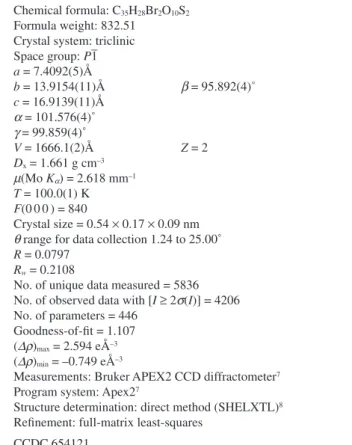
Table 1 Crystal and experimental data Chemical formula: C35H28Br2O10S2 Formula weight: 832.51
Crystal system: triclinic Space group: P1 a = 7.4092(5)Å b = 13.9154(11)Å b = 95.892(4)˚ c = 16.9139(11)Å a = 101.576(4)˚ g = 99.859(4)˚ V = 1666.1(2)Å Z = 2 Dx = 1.661 g cm–3 m(Mo Ka) = 2.618 mm–1 T = 100.0(1) K F(0 0 0 ) = 840 Crystal size = 0.54 ¥ 0.17 ¥ 0.09 nm
q range for data collection 1.24 to 25.00˚ R = 0.0797
Rw = 0.2108
No. of unique data measured = 5836 No. of observed data with [I ≥ 2s(I)] = 4206 No. of parameters = 446
Goodness-of-fit = 1.107 (Dr)max = 2.594 eÅ–3 (Dr)min = –0.749 eÅ–3
Measurements: Bruker APEX2 CCD diffractometer7 Program system: Apex27
Structure determination: direct method (SHELXTL)8 Refinement: full-matrix least-squares
x72 ANALYTICAL SCIENCES 2008, VOL. 24 (32.3 mg, 126.8 mmol) and K2CO3 (21.1 mg, 152.1 mmol) in
CH2Cl2 (3 ml). After the reaction was complete, the water (10 ml) was added to the reaction mixture. The resulting solution was then extracted with CH2Cl2 (10 ml ¥ 3 times). The organic extract was dried over anhydrous sodium sulfate and evaporated under reduced pressure to give a crude extract, which was further purified by column chromatography over silica gel eluted with 5% acetone–hexane to yield the title compound (50.2 mg). Yellow needle-shaped single crystals of the title compound were obtained after recrystallization from CH3OH–CHCl3 (1:4 v/v), M.p 455 – 456 K.
The crystallographic and experimental parameters used for data collection and determination of the structure are given in Table 1. All non-hydrogen atoms were refined anisotropically, All H atoms were placed in calculated positions with the C–H distances in the range 0.93 – 0.96 Å. The Uiso values were constrained to be 1.5Ueq of the carrier atoms for hydroxyl and methyl H atoms, and 1.2Ueq(C) for the remaining H atoms. The final refinement converged well. The largest peak and hole in the final difference map were 2.59 Å–3 at 1.12 Å from atom Br1 and –0.75 Å–3 at 0.71 Å from atom Br1, respectively. An ORTEP plot of the molecule at 50% probability is shown in Fig. 3. In the structure of the title compound, the xanthene ring system (C4–C16/O2) is almost planar, with all the atoms lying within 0.044(7)Å of the mean plane of the xanthene. The three rings of xanthene are individually nearly planar, with largest deviation from the ring plane of 0.011(7)Å, 0.023(7)Å and 0.013(7)Å for rings A, B and C, respectively. The dihedral angle between rings A and B is 2.2(3)˚ and those of B and C forms a dihedral angle of 1.7(3)˚. The chromene ring D adopts a screw
boat conformation. The hydroxyl group at C5 and the 1,1-dimethyl-2-propenyl substituent at C15 are planarly attached to the benzene ring. The torsion angle C19–C15–C16–C4 = – 175.0(6)˚. One of the two p-bromobenzenesulfonyl groups (C24–C29/S1/O5/O7/O8/Br1) is bisectionally attached to the benzene ring A which can be indicated by the torsion angle S1– O5–C11–C10 = 66.9(3)˚ whereas another p -bromobenzenesulfonyl group (C30–C35/S2/O6/O9/O10/Br2) is axially attached to benzene ring A with a torsion angle, S2–O6– C12–C13, of –96.4(7)˚. The dihedral angles between the C24– C29 and C30–C35 benzene rings with respect to ring A are 61.4(4)˚ and 46.5(4)˚, respectively. The dihedral angle between the two bromobenzene rings is 76.6(4)˚. The structure shows an intramolecular O–H·O hydrogen bond, namely O3–H1O3·O4 (Table 2). In the crystal packing viewed along the b-axis, as shown in Fig. 3, weak C–H·O intermolecular interactions, C31– H31A·O10iii (symmetry code: iii = 1–x, 1–y, 2–z) (Table 2) link the molecules into chains along the c-axis. These chains, forming layers parallel to the ac plane, are interconnected by weak C–H·O interactions. The crystal of (I) is stabilized by intramolecular O–H·O hydrogen bonds, weak C–H·O intra- and intermolecular interactions (Table 2).
Acknowledgements
The authors thank the Directed Basic Research in Medicinal Chemistry (Thailand Research Fund), grant No. 4880019, and Prince of Songkla University for financial support. The authors also thank the Malaysian Government and Universiti Sains Malaysia for the Scientific Advancement Grant Allocation (SAGA), grant No. 304/PFIZIK/635003/A118.
References
1. G. M. Kitanov, I. Assenov, and D. The Van, Pharmazie,
1988, 43, H12.
2. E. F. Aderson, Econ. Bot., 1986, 40, 442.
3. P. W. Grosvenor, P. K. Gothard, M. C. William, A. Supriono, and D. O. Gray, J. Ethnopharmacology, 1995,
45, 75.
4. N. Boonnak, C. Karalai, S. Chantrapromma, C. Ponglimanont, H. K. Fun, A. Kanjana-Opas, and S. Laphookhieod, Tetrahedron, 2006, 62, 8850.
5. N. Boonnak, C. Karalai, S. Chantrapromma, C. Ponglimanont, A. Kanjana-Opas, K. Chantrapromma, and H. K. Fun, Canadian J. Chem., 2007, 85, 341.
6. H. K. Fun, S. L. Ng, I. A. Razak, N. Boonnak, and S. Chantrapromma, Acta Cryst., 2006, E62, o130.
7. Bruker. APEX2 Version 1.27, SAINT and SADABS; Bruker AXS Inc., Madison: Wisconsin, USA, 2005. 8. G. M. Sheldrick, SHELXTL Version 5.1; Bruker AXS Inc.,
Madison: Wisconsin, USA, 1998.
Fig. 2 Molecular structure of (I) with the atomic-numbering scheme. Thermal ellipsoids of non-H atoms are drawn at the 50% probability level. The hydrogen-bond is drawn as a dashed line.
Table 2 Hydrogen-bond geometry (Å, ˚)
D-H···A D-H H···A D···A D-H···A
i = –x, 1–y, 1–z; ii = 1+x, y, z; iii = 1–x, 1–y, 2–z and iv = 1–x, 1–y, 1–z.
Fig. 3 Crystal packing of (I), viewed along the b-axis. Hydrogen bonds are drawn as dashed lines.