
The Rat Pig-a Mutation Assay in Single and 28 Day-repeated Dose Study of Cyclophosphamide: The PIGRET Assay Can Detect the In Vivo Mutagenicity Earlier than the RBC Pig-a Assay
8
0
0
全文
(2) Takafumi Kimoto et al.. tive cells in rats have been developed, the Japanese collaborative study for rat Pig-a assay took the method using an erythroid marker HIS49 antibody (14). The participant laboratories evaluated the transferability and reproducibility of both Pig-a assay in total red blood cells (RBC Pig-a assay) and Pig-a assay in reticulocytes (PIGRET assay) under the single treatment of typical mutagens, N-nitroso-N-ethylurea (ENU), 7,12dimethylbenz[a ]anthracene (DMBA), or 4-nitroquinoline-1-oxide (4NQO). The results were successful in terms of the fact that all Pig-a data among laboratories were similar with low variability. In particular, the PIGRET assay, an improved method for measuring Pig-a mutant cells in reticulocytes (RET) with magnetic enrichment of CD71 positive cells, might be a useful tool for detecting the increase of Pig-a mutant frequency (MF) since RET Pig-a MF increase more rapidly with time than RBC Pig-a MF. As an extension of this collaborative study, the participants planned to evaluate other genotoxic compounds with the comparison between the single treatment and the 28 days repeat dosing. In this study, we have demonstrated the single and 28-day repeated dose study of cyclophosphamide, which is well-known DNA-reactive alkylating agent, in both the RBC Pig-a assay and PIGRET assay.. a repeated dose study, rats were treated with 28 daily consecutive doses of 0, 2.5, 5, or 10 mg/kg CP with daily monitoring of body weights. The top dose in the 28-day repeated dose study was determined by a 14-day repeated dose study that was conducted in this facility. An apparent body weight decrease was found in the 15 mg/kg and 30 mg/kg under the condition of the preliminary study. All preparations were administrated to rats in a volume of 10 mL/kg. Peripheral blood was collected from the tail vein or abdominal aorta of all animals before and at approximately 1 (day 8), 2 (day 15), and 4 weeks (day 29) after the first treatment, and was promptly mixed with K2-EDTA to prevent clotting. Pig-a mutation assay: Blood processing for both the RBC Pig-a assay and the PIGRET assay were described in the previous manuscript (14). As for the RBC Pig-a assay, 3 mL of blood/EDTA mixture were suspended in 200 mL of phosphate buffered saline (PBS), and cells were labeled with 0.125 mg of biotin-conjugated anti-rat erythroid marker antibody (HIS49 antibody) and 1 mg of FITC-conjugated anti-rat CD59 antibody. After the 1 h incubation in the dark at room temperature, the samples were vortexed and centrifuged for 5 min at 1,680 × g to discard supernatant. Then 0.2 mg of APC-conjugated streptavidin in 200 mL of PBS were added and the cells were incubated for 15 min in the dark at room temperature. After the centrifugation for 5 min at 1,680 × g, the samples were re-suspended in 1 mL of PBS. As for the PIGRET assay, approximately 80 to 200 mL of blood/EDTA were mixed with 200 mL of PBS, and then the cell suspension was layered onto Lympholyte-Mammal (Cedarlane Laboratories; Burlington, Ontario, Canada) and centrifuged to separate the nucleated cells and platelets from the RBCs. The RBC fraction was washed and then gently mixed with 100 mL of PBS. The resulting suspension was placed in a new tube containing 1 mL of PE-conjugated anti-rat CD71 and incubated for 15 min in a refrigerator. After being washed with 2 mL of 1 × IMagTM Buffer (BD Biosciences) and centrifuged (1,680 × g, 5 min), the cells were mixed with 50 mL of BD IMagTM PE Particles Plus-DM (BD Biosciences) and incubated for 15 min in a refrigerator. The samples were enriched for CD71positive cells by processing with a BD IMagnetTM magnetic stand (BD Biosciences) according to the manufacturer's instructions. The enriched samples were labeled with HIS49 and anti-CD59 antibodies as indicated for total RBC labeling, with the exception that the incubation time for labeling enriched RETs was half that for the total RBCs. The final volume of the cell suspension was 500 mL. Flow cytometric analysis for both the RBC Pig-a assay and the PIGRET assay were described in previous. Materials and Methods Reagents: Cyclophosphamide hydrate (Endoxan) was purchased from Shionogi & Co., Ltd. (Osaka, Japan). Water for injection was purchased from Fuso Pharmaceutical Industries, Ltd. (Osaka, Japan). Antirat CD59 antibody (clone TH9, FITC-conjugated), antirat CD71 antibody (clone OX-26, PE-conjugated), antirat erythroid marker (clone HIS49, biotin-conjugated), and streptavidin-APC were purchased from BD Biosciences (Tokyo, Japan). Animals: All experimental procedures were conducted in accordance with the Guiding Principles for the Care and Use of Laboratory Animals (Teijin Pharma Ltd., Tokyo, Japan), and each experimental protocol was approved by the Committee for Animal Experiments of the Teijin Institute for Biomedical Research. Male CD (SD) rats were obtained from Charles River Laboratories (Yokohama, Japan); the rats received feed and water ad libitum. Seven-week old rats were administrated CP by gavage after an eight-day acclimation period. CP was dissolved in water for injection at a concentration of 20 mg/mL and then diluted it to various concentrations for the administration. In the single dose study, rats were treated with single dose of 0, 20 or 50 mg/kg CP with monitoring body weights at once a week. The top dose was determined based on the previous study in which the 10-day repeat dosing of 5 mg/kg (50 mg/kg in total) showed the statistically significant increase of Pig-a MF at 4 weeks after the first dosing. In 192.
(3) Rat Pig-a Mutation Assay with Cyclophosphamide. analysis with Bartlett's test ( p < 0.05 for parametric, p > 0.05 for non-parametric).. manuscript (14). All data acquisition and analysis were conducted under a FACSCanto II equipped with a FACSDiva ver. 6.1 software (BD Biosciences). Approximately one million HIS49-positive cells were acquired to enumerate the frequency of CD59-negative RBCs or RETs. Hematology and blood biochemistry test: Hematology was evaluated with the ADVIA120 system (Siemens Japan K.K., Tokyo, Japan). Blood biochemistry test was conducted with the Clinical Analyzer 7180 (Hitachi High-Technologies, Tokyo, Japan). Peripheral blood for these tests was collected from the abdominal aorta of all animals at necropsy. Statistical analysis: For body weights, hematology, blood biochemistry test and MF data, the Dunnett's multiple comparison test (nonparametric or parametric, one-sided) between the control group and each of the treatment groups was conducted following the variance. Results Single dose study with CP: There were no statistical differences in body weights between the control group and treatment groups (Fig. 1A). As for the observation of clinical sign, two individuals in 50 mg/kg treatment group showed blood in the urine at day 3. These signs were not observed from day 4. No signs were observed in others during the study. Clinical test was conducted at the endpoint; however, there was no change in any parameters by the treatment of CP. The results of RBC Pig-a assay and PIGRET in the single dose study are shown in Fig. 2. A dose related increase of Pig-a MF was found in the PIGRET assay at day 8. Only high dose group showed a statistically significant increase of Pig-a MF in both the RBC Pig-a assay and. Fig. 1. Monitoring of body weight in cyclophosphamide treatment studies. The mean body weight of each treatment group is shown. A: The data on single dose study. B: The data on 28-day repeated dose study. Each symbol shows the mean of each group. Note that two mortalities from each of the 5 and 10 mg/kg/day treatment groups on day 28 were found. 193.
(4) Takafumi Kimoto et al.. Fig. 2. Frequencies of CD59-negative RBCs or RETs in rats treated with a single dose with CP. Peripheral blood from all animals were processed for RBC Pig-a assay and PIGRET at before (pre) and days 8, 15, and 29 after the treatment. All individual data are exhibited as scatter plots and a bar shows the mean of each group. Statistically significant differences from vehicle controls are indicated at the p < 0.05, or 0.01 levels (*, or **, respectively).. 194.
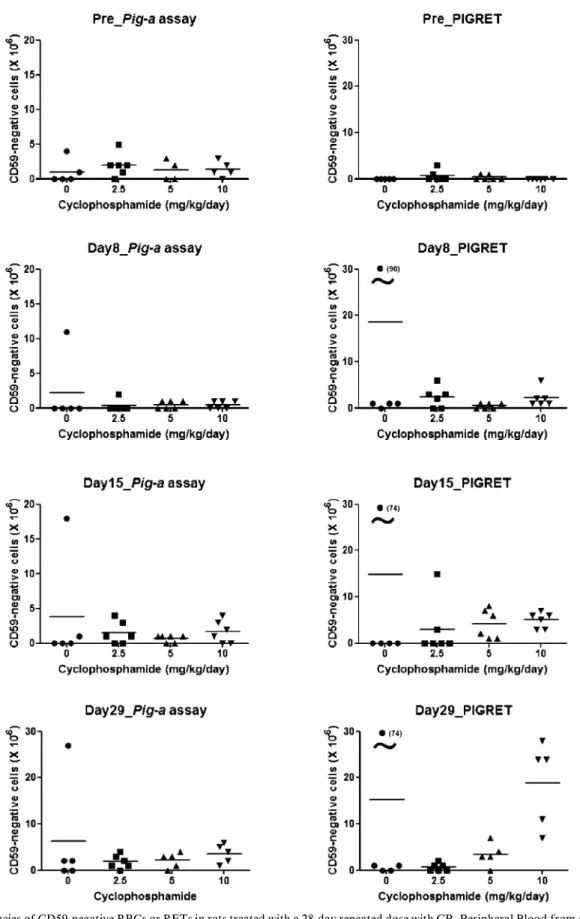
(5) Rat Pig-a Mutation Assay with Cyclophosphamide. time points. While the Pig-a MFs of all animals at before dosing were stable at low, the outlier in the control group showed high Pig-a MFs from day 8, that was more than 11 × 10-6 and more than 74 × 10-6 in the RBC Pig-a assay and PIGRET assay, respectively. It was not clear why the outlier increased the spontaneous Pig-a MF during the vehicle treatment. We therefore excluded the outlier data based on the in-house background MF data that was under 5 × 10⁻⁶, and then performed statistics for the additional analysis. The result indicated that the significant increase in Pig-a MF was found between control and high dose group in the PIGRET assay at day 29, while no statistically significant changes in Pig-a MF was found in the RBC Piga assay at any time points.. PIGRET assay at day 15. 28-day repeated dose study with CP: Statistically significant decreases in daily body weights were found between control and high dose groups from day 25 (Fig. 1B). No clinical signs except for the two mortalities from each the 5 and 10 mg/kg treatment groups on day 28 were found in the study. Pleural effusion, which is one of symptom generated by severe infection, was found in 4 of 5 animals in the high dose group at necropsy. Therefore, the dead found in 5 and 10 mg/kg groups might be an incidence caused by a suppression of immune system, given that the statistically significant decreases in the number of white blood cells, lymphocytes, and basophils were found in all CP treatment groups. The ratio of reticulocyte in the blood showed the statistically significant increase in the high dose group. In the blood chemistry test, the high dose group showed statistically significant changes in some parameters as shown in Table 1. These changes were known adverse effects in human treated with CP as well (15). The results of RBC Pig-a assay and PIGRET assay in the 28-day repeated dose study are shown in Fig. 3. Since the outlier in the control group was found from day 8, no statistically significant increases in the both RBC Pig-a assay and PIGRET assay were found at any Table 1. Study. Single dose study. 28-days repeat dose study. Dose1) mg/kg/day (group). 0 (vehicle) 20 (low) 50 (high). 0 (vehicle) 2.5 (low) 5 (middle) 10 (high). Discussion In the study of single dosing with CP, the Pig-a MF in reticulocyte increased earlier than that in total RBC (Fig. 2). The data indicated that the PIGRET assay, which uses magnetic-enrichment of RETs for enumerating mutant cells in an efficient manner, can detect the increase of MFs by the single treatment of CP more rapidly with time than the RBC Pig-a assay. The manuscript by Bhalli et al., demonstrated that the single treatment via intraperitoneal injection of 80 mg/kg CP. Summary of experiments measuring Pig-a mutant cells in rats treated with cyclophosphamide. Days of blood collection after the first treatment. Pre2), 8, 15, and 29. Pre, 8, 15, and 29. Parameters. Results. Body weight Clinical sign RBC3) Pig-a assay PIGRET5) assay Hematology (end point) Blood biochemistry test (end point). Day 3: Blood in the urine (2/6 in high dose group) Day 8: Increase Pig-a mutant frequency4) in PIGRET (high dose) Day 15: Increase Pig-a mutant frequency in both RBC Pig-a assay and PIGRET (high dose). Body weight Clinical sign RBC Pig-a assay PIGRET assay Hematology (end point) Blood biochemistry test (end point). Day 25, 27, 28, 29: Suppression of mean body weight (high dose) Day 28: Mortality (1/6 in middle dose and 1/6 in high dose) Day 29: Pleural effusion at necropsy (4/5 in high dose), decrease the mean number of WBCs6), lymphocytes and basophils (all CP7) dose), decrease the mean subset of lymphocytes and eosinophils (middle dose) Increase the mean subset of neutrophils and monocytes and the mean number of monocytes (high dose) Increase the z reticulocytes (high dose) Decrease AST8), ALT9), ALP10), TP11), and Alb12) (high dose) Increase UN13) and creatinine (high dose) Increase Pig-a mutant frequency in PIGRET (high dose)14). The route of administration was gavage. 2)Preliminary. 3)Red blood cells. 4)Frequency of CD59-negative cells. 5)Pig-a assay in reticulocytes. White blood cells. 7)Cyclophosphamide. 8)Alanine aminotransferase. 9)Alanine transaminase. 10)Alkaline phosphatase. 11)Total protein. 12)Albumin. 13)Urea nitrogen. 14)Statistically significant increase ( pº0.05) was found in case that the outlier in the vehicle group was excluded from the statistical analysis. 1). 6). 195.
(6) Takafumi Kimoto et al.. Fig. 3. Frequencies of CD59-negative RBCs or RETs in rats treated with a 28-day repeated dose with CP. Peripheral Blood from all animals were processed for RBC Pig-a assay and PIGRET at before (pre) and days 8, 15, and 29 after the treatment. All individual data are exhibited as scatter plots and a bar shows the mean of each group (n = 5 or 6/group). Statistically significant increase (p < 0.05) was found between the vehicle control group and high dose group in the PIGRET assay at day 29 if the outlier in the control group was excluded from the statistical analysis.. 196.
(7) Rat Pig-a Mutation Assay with Cyclophosphamide. could induce the increase of Pig-a mutant cells in the RBC population from 4 weeks after the treatment (16). In addition, 3-day treatment study of CP performed by Dertinger et al., showed a statistically significant increase in the Pig-a MF in both RETs and RBCs from 15 days after the first treatment (6). Our result in the single treatment of 50 mg/kg CP showed similar kinetics manner to the 3-day treatment of 15 mg/kg CP (15 × 3 = 45 mg/kg), suggesting that CP has a mutagenic potential. While the statistically significant increases were found at day 8 and day 15, the Pig-a MFs at day 29 did not show the increase in both assays. Previous manuscript on Pig-a manifestation studies with ENU treatment indicated that the persistent increase with accumulation of mutant cells was found after the dosing, suggesting that the increase of the Pig-a MF by ENU were based on the mutation in stem cells (12,13). In contrast with previous ENU studies, the temporary increase of the Pig-a mutant cells in the CP single treatment might be originated from erythroid progenitors that were limited with continuous proliferation due to their property of differentiation. The Pig-a MF of PIGRET assay in the single treatment of 50 mg/kg CP was maximum at day 8, suggesting that cells with Pig-a mutation by the CP treatment at an early phase were mainly consisted of erythroid progenitors. In the study of 28 days treatment with CP, only the increase of the Pig-a MF in RET was found at day 29 when the outlier had been excluded from the statistical analysis. The mean RET Pig-a MF on day 29 in the high dose group (10 mg/kg/day) was 18.8 × 10⁻⁶. It was consistent with another report by Dertinger et al., showed the statistically significant increase of RET Piga MF on day 29 in the high dose group (5 mg/kg/day) (6). Given that the result of hprt mutant lymphocyte frequency reported by Walker et al., the increase of the hprt MF in rats treated with CP was weak (17). We previously evaluated the mutagenicity of CP in rats with another Pig-a assay method which employed anti-CD45 antibody to determine RBCs by exclusion of white blood cells (18). That approach hardly detected the weak mutagenicity of CP due to the high back ground Pig-a MF. Alternatively, using the erythroid antibody for RBC and RET Pig-a assay accomplishes the low background Pig-a MF which enables it to detect the small increase of Pig-a MF. Since the spontaneous Pig-a MFs in this study were low, the weak response of CP mutagenicity at day 29 could be detected by the PIGRET assay. In this 28-day repeated dose study, mutagenicity of CP was detected only in the PIGRET assay. It might be possible to detect the increase of Pig-a MF in RBCs as well as that in RETs at later on day 29 based on the previous report by Dertinger et al (6). They have shown the CP treatment with 28 days repeat dosing. led to be increased the Pig-a MF in both RET and RBC on days 29 and 42. Therefore, taking the Pig-a assay protocol for the repeated dose study is feasible to detect the mutagenicity of CP in both RET and RBC. In the repeated dose study, an outlier in the vehicle control group was found after the treatment. It was not known exactly what triggered the increase of its spontaneous Pig-a MF. Such outliers were fairly infrequently found in the past studies due to the technical problem for blood specimen preparation or inherited abnormalities (14). In case that the outlier was found in the study, as discussed at the 6th International Workgroup on Genotoxicity Testing (IWGT) meeting in 2013, a historical control data would be useful to exclude it for assessing the mutagenic risk of chemicals with accuracy. In conclusion, though it includes a conditional result in the repeated dose study, we could detect the increase of Pig-a MF in rats under the single or 28 days repeated dose treatment with CP. Both the RBC Pig-a assay and PIGRET assay are reliable for detecting the mutagenicity of chemicals, however, as one of the views, the PIGRET assay particularly has an advantage in terms of the fact that it can evaluate the mutagenic potential of chemical at an early time point during the single or repeated dose study.. Acknowledgements: This work was partly supported by the Japan Health Sciences Foundation, Grant Nos. KHB1006 and KHB 1209. Conflict of interest statement: The authors declare that there are no conflicts of interest.. References 1. 2. 3. 4. 5. 197. Dobrovolsky VN, Miura D, Heflich RH, Dertinger SD. The in vivo Pig-a gene mutation assay, a potential tool for regulatory safety assessment. Environ Mol Mutagen. 2010; 51: 825–35. Bryce SM, Bemis JC, Dertinger SD. In vivo mutation assay based on the endogenous Pig-a locus. Environ Mol Mutagen. 2008; 49: 256–64. Miura D, Dobrovolsky VN, Kasahara Y, Katsuura Y, Heflich RH. Development of an in vivo gene mutation assay using the endogenous Pig-A gene: I. Flow cytometric detection of CD59-negative peripheral red blood cells and CD48-negative spleen T-cells from the rat. Environ Mol Mutagen. 2008; 49: 614–21. Miura D, Dobrovolsky VN, Mittelstaedt RA, Kasahara Y, Katsuura Y, Heflich RH. Development of an in vivo gene mutation assay using the endogenous Pig-A gene: II. Selection of Pig-A mutant rat spleen T-cells with proaerolysin and sequencing Pig-A cDNA from the mutants. Environ Mol Mutagen. 2008; 49: 622–30. Schuler M, Gollapudi BB, Thybaud V, Kim JH. Need and potential value of the Pig-a in vivo mutation assay― A HESI perspective, Environ Mol Mutagen. 2011; 52:.
(8) Takafumi Kimoto et al.. 6. 7. 8. 9. 10. 11. 12. 685–9. Dertinger SD, Phonethepswath S, Avlasevich S, Torous DK, Mereness J, Bryce SM, et al. Efficient monitoring of in vivo Pig-a gene mutation and chromosomal damage: Summary of 7 published studies and results from 11 new reference compounds, Toxicol Sci. 2012; 130: 328–48. Dobrovolsky VN, Boctor SY, Twaddle NC, Doerge DR, Bishop ME, Manjanatha MG, et al. Flow cytometric detection of Pig-A mutant red blood cells using an erythroid-specific antibody: application of the method for evaluating the in vivo genotoxicity of methylphenidate in adolescent rats, Environ Mol Mutagen. 2010; 51: 138–45. Kawagoe K, Takeda J, Endo Y, Kinoshita T. Molecular cloning of murine Pig-a, a gene for GPI-anchor biosynthesis, and demonstration of interspecies conservation of its structure, function, and genetic locus. Genomics. 1994; 23: 566–74. Keller P, Payne JL, Tremml G, Greer PA, Gaboli M, Pandolfi PP, et al. FES-Cre targets phosphatidylinositol glycan class A (PIGA) inactivation to hematopoietic stem cells in the bone marrow. J Exp Med. 2001; 194: 581–9. Phonethepswath S, Bryce SM, Bemis JC, Dertinger SD. Erythrocyte-based Pig-a gene mutation assay: demonstration of cross-species potential. Mutat Res. 2008; 657: 122–6. Miura D, Shaddock, JG, Mittelstaedt, RA, Dobrovolsky, VN, Kimoto, T, Kasahara Y, et al. Analysis of mutations in the Pig-a gene of spleen T-cells from N-ethyl-Nnitrosourea-treated Fisher 344 rats. Environ Mol Mutagen. 2011; 52: 419–23.. 13. 14. 15. 16. 17. 18. 198. Miura D, Dobrovolsky VN, Kimoto T, Kasahara Y, Heflich RH. Accumulation and persistence of Pig-A mutant peripheral red blood cells following treatment of rats with single and split doses of N-ethyl-N-nitrosourea. Mutat Res. 2009; 677: 86–92. Dertinger SD, Phonethepswath S, Franklin D, Weller P, Torous DK, Bryce SM, et al. Integration of mutation and chromosomal damage endpoints into 28-day repeated dose toxicology studies. Toxicol Sci. 2010; 115: 401–11. Kimoto T, Horibata K, Chikura S, Hashimoto K, Itoh S, Sanada H, et al. Interlaboratory trial of the rat Pig-a mutation assay using an erythroid marker HIS49 antibody. Mutat Res. 2013; 755: 126–34. Cyclophosphamide for Injection, USP/ Cyclophosphamide Tablets, USP. Document of Food and Drug Administration. Revised April 2012. http://www.accessdata. fda.gov/drugsatfda_docs/label/2012/012141s089lbl.pdf Bhalli JA, Shaddock JG, Pearce MG, Dobrovolsky VN. Sensitivity of the Pig-a assay for detecting gene mutation in rats exposed acutely to strong clastogens. Mutagenesis. 2013; 28: 447–55. Walker DM, Seilkop SK, Scott BR, Walker VE. Hprt mutant frequencies in splenic T-cells of male F344 rats exposed by inhalation to propylene. Environ Mol Mutagen. 2004; 43: 265–72. Kimoto T, Chikura S, Suzuki K, Kobayashi XM, Itano Y, Miura D, et al. Effective use of the Pig-a gene mutation assay for mutagenicity screening: measuring CD59deficient red blood cells in rats treated with genotoxic chemicals. J Toxicol Sci. 2012; 37: 943–55..
(9)
図


関連したドキュメント
Economic and vital statistics were the Society’s staples but in the 1920s a new kind of statistician appeared with new interests and in 1933-4 the Society responded by establishing
We present sufficient conditions for the existence of solutions to Neu- mann and periodic boundary-value problems for some class of quasilinear ordinary differential equations.. We
In Section 13, we discuss flagged Schur polynomials, vexillary and dominant permutations, and give a simple formula for the polynomials D w , for 312-avoiding permutations.. In
Analogs of this theorem were proved by Roitberg for nonregular elliptic boundary- value problems and for general elliptic systems of differential equations, the mod- ified scale of
Then it follows immediately from a suitable version of “Hensel’s Lemma” [cf., e.g., the argument of [4], Lemma 2.1] that S may be obtained, as the notation suggests, as the m A
Definition An embeddable tiled surface is a tiled surface which is actually achieved as the graph of singular leaves of some embedded orientable surface with closed braid
Correspondingly, the limiting sequence of metric spaces has a surpris- ingly simple description as a collection of random real trees (given below) in which certain pairs of
[Mag3] , Painlev´ e-type differential equations for the recurrence coefficients of semi- classical orthogonal polynomials, J. Zaslavsky , Asymptotic expansions of ratios of
