
ヒゲナガゾウムシ科昆虫3種類の染色体
4
0
0
全文
(2) Journal of Hokkaido University of Education (Section 11 B) Vol. 26, No. 1 August 1975. -<fc;SS%1sr*<N.B5?- (Si 2 gli B) ^ 26 ^ ^ 1 -f Bgffi 50 ^ 8 fl. A Chromosome Study on Three Anthribid Beetles (Coleoptera) Yasushi TAKENOUCHI Biological Laboratory, Sapporo College, Hokkaido University of Education, 064 Sapporo. ^i^i ^: bv-f- ^~'y"r> ^ ^^^A 3 mm^? -»Sig(ir±<NLS./?:<fe!NgTI!LEg. According to the already existent literature the chromosomes of only five beetle species. belonging to the Anthribidae family have been established so far (Takenouchi, 1958, 1968; Virkki, 1965). Recently the present author had a chance to investigate the chromosomes of three species. of this family, the results of which are described in this paper. Material and Methods Five males of Platystomus sella.t.us Roelofs and a single male of Tropideres japonicus Roelofs were obtained on July 6, 1973, from Toyama in the suburbs of Sapporo. And two males of Habrissus longipes Sharp were captured on July 1, 1973 from the same place mentioned above.. The testes of adult males were prepared by Smith's squash method (1943) and stained with 0.6 % methyl green and 0.15 % basic fuchsin (1:1) ( Smith and Takenouchi, 1969). The photomicrographs and a drawing from the original enlarged about 3,600 times were made. Observations Platystomu.s sellatus Roelofs Five males were examined and four specimens provided several excellent MI metaphases.. Every plate showed well-defined chromosomes of different sizes (Figs. 1 and 2 ) which consisted of 10 autosomal bivalents and a sex-bivalent of a typical parachute form (Xy^,). Among the haploid complement the largest element and a larger element were outstanding and the size seriation of other chromosomes was gradual. The sex bivalent was not the smallest in the complement.. Tropideres japoniciis Sharp A single male studied fortunately furnished the first metaphases, in which 11 bivalents of varying sizes were detected (Fig. 3 ). Two elements were extremely large in the haploid complement. The size seriation of other chromosomes was gradual. The sex-bivalent was remarkable for its parachute form. The larger three elements may have been ring bivalents consisting of two metacentric univalents respectively.. Habrissiis longipes Sharp. (D.
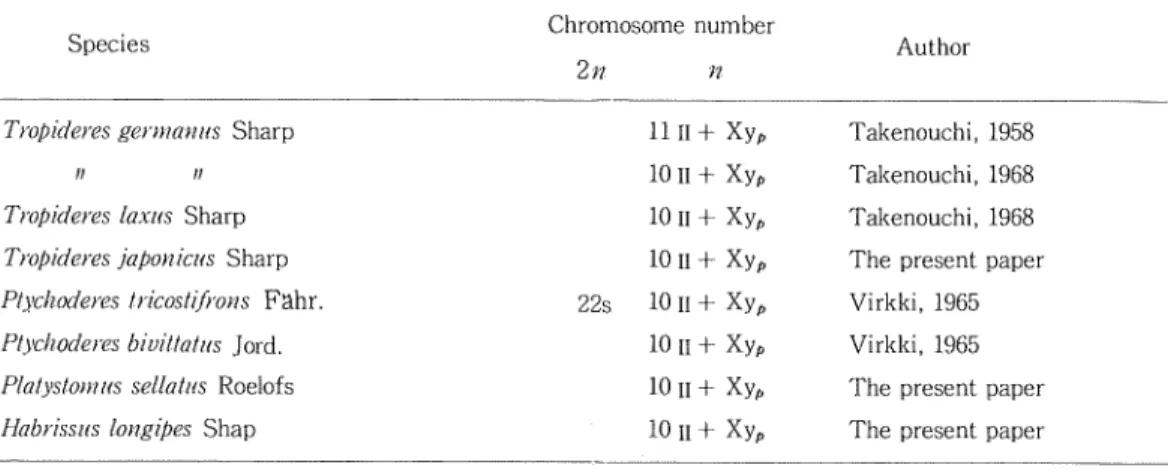
(3) Y. TAKENOUCHI One of the two examined males provided several first spermatocyte chromosomes. The first metaphase showed 11 bivalents of various sizes consisting of 10 autosomal bivalents and an Xy^i sex bivalent (Fig. 4 ). Two of them were outstanding in the complement on account of their extremely large sizes, the others being of medium and small sizes. One of the smaller bivalents was the Xy^.. V^sS!!S&S::SSMi9j 'i 3 MllSSSS^SSSSSiiSS 'I Figs. 1-4. 1 and 2, first meiotic metaphases of Platystomiis sellatus. 3 , the same of Tropideres japonicus. 4, the same of Habrissus longipes. ca X 3,600.. Discussion. , Three out of four anthribid beetles studied so far show that they have the chromosome formula, 10 n + Xyp, respectively. However, one species, Tropideres germanns Sharp, has two forms with different chromosome numbers : the one was characterized by 10 n -f- Xyp., the other. by 11 ii + Xyp (Takenouchi, 1958, 1968; Virkki, 1965). This fact suggests that the standard number of the genus Tropideres may be 10 n + Xyp and that lln + Xyp is caused by a centric fusion as Virkki (1965) had stated. The chromosome formulae established in three new anthribid beetle species belonging to three different genus, namely, Tropideres, Platystomus, and Habrissns are all 10 n + Xyp. These results may well ascertain that the standard chromosome number. of Tropideres is surely 10 n+ Xyp. Summary The chromosomes of three anthribid beetles, Platystomns sellattns, Tropideres japonic'us, and Habrissiis long'ipes, were studied. The results are summarized in Table 1.. Acknowledgement The author is deeply grateful to Dr. K. Morimoto, Kyushfi Branch, Government Forest Experiment Station, Kumamoto, for the indentification of the species. The author's thanks are also due to Mr. N. Ikahata, for his cooperation in collecting the materials..
(4) A Chromosome Study on Three Anthribid Beetles. Table 1. Summary of chromosome studies in the Anthribidae Chromosome number. Species. 2n n. Troptderes gennanns Sharp. Author. 11 II + Xy^. Takenouchi, 1958. 10 II + Xy<>. Takenouchi, 1968. Tropideres laxus Sharp. 10 II + Xy,. Takenouchi, 1968. Tropideres japonicns Sharp. 10 II + Xy<,. The present paper. Ptychoderes tricostifrons Fahr.. 10 ii + Xy,. Virkki, 1965. 11. II. 22s. 10 ii + Xyp. Virkki, 1965. Platystomus sellatns Roelofs. 10 II + Xy,,. The present paper. Habrissus longipes Shap. 10 ii + Xy,. The present paper. Plyclioderes bivittatus Jord.. References Smith, S. G., 1943 Techniques for the study of insect chromosomes. Can. Entomol. 75 : 21—24. Smith, S. G. and Y. Takenouchi, 1969 Chromosomal polymorphism in Pissodes weevils : Further on incompatibility in P. terminalis. Can. J. Genet. Cytol. 11 : 761-782. Takenouchi, Y., 1958 The chromosomes of Tropideres germanns Sharp (Anthribidae, Coleoptera). Zool. Mag. 67 : 27. Takenouchi, Y., 1968 On the chromosomes of two anthribid beetles (Coleoptera). Chrom. Inform. Serv. 9 : 2728, Virkki, N., 1965 Chromosomes of certain anthribid and brentid beetles from El Salvador. Ann. Acad. Scad. Sci. Fenn. Ser. A, IV Biol. 83 : 4-11.. Errata to Chromosome Numbers of Japanese Weevils of Curculionoidea (Coleoptera) by Takenouchi, Y.. 1972 KONTYU Vol. 40, No. 2 : 123-132. In p. 131 of this paper, the author said that the results of Antlionomus bisignifer Schenkling (2n = 19, n == 9 + X) (Takenouchi, 1963) is surely wrong. No XOsex-determining mechanism was obtained.But very recently Dr. K.. Morimoto said that A. bisignifer had many taxonomically different types and so the author's finding might be right. Therefore, this species is the first with XO sex-determining system in the Curculionidae. (Takenouchi, Y. 1963. A further investigation on the chromosomes in twenty-three species of weevils (Curculionidae, Coleoptera). J. Hokkaido Gakugei Univ. 2nd Ser. 13 : 160-175).. 3).
(5)
図
関連したドキュメント
If we do the surgery on one curve (so the set of canonical tori becomes a torus cutting off a Seifert piece, fibering over the M¨ obius band with one exceptional fiber) then there is
In § 6, we give, by applying the results obtained in the present paper, a complete list of nilpotent/nilpotent admissible/nilpotent ordinary indigenous bundles over a projective
These estimates involve three exponents which are usually associated to infinite graphs: the spectral dimension δ s (which is by definition twice the exponent of n − 1 in local
All three problems (1*, 2*.1 2*.2) are open; there are conjectures which would provide complete answers to these problems and some partial results supporting these conjectures
Hence, for these classes of orthogonal polynomials analogous results to those reported above hold, namely an additional three-term recursion relation involving shifts in the
Hence the bound given in Corollary 6 is 6, and the catenary degree of S is also 6 (this computation can be performed by using [6], or the implementation of the algorithm presented
Aphid species 2,3 Armyworm Beet Armyworm 1,3 Corn Earworm Diamondback Moth 3 Fall Armyworm 1 Flea Beetle species Grasshopper species Japanese Beetle (Adult) Leafhopper species
Aphid species 2,3 Beet Armyworm 1,3 Blister Beetle species Colorado Potato Beetle 3 Cucumber Beetle species (Adult) European Corn Borer 4 Fall Armyworm 1 Flea Beetle species
