An Interactive Fuzzy Satisficing Method for Fuzzy
Random Multiobjective 0-1 Programming Problems
through Probability Maximization Using Possibility
Masatoshi Sakawa, Takehisa Hontani, Kosuke Kato and Takeshi Matsui
Graduate School of Engineering, Hiroshima University
1-4-1, Kagamiyama, Higashi-Hiroshima, Hiroshima, 739-8527, Japan
E-mail:
{sakawa, m095797, kosuke-kato, tak-matsui}@hiroshima-u.ac.jp
Abstract—In this paper, we focus on multiobjective 0-1
pro-gramming problems under the situation where stochastic uncer-tainty and vagueness exist at the same time. We formulate them as fuzzy random multiobjective 0-1 programming problems where coefficients of objective functions are fuzzy random variables. For the formulated problem, we propose an interactive fuzzy satisficing method through probability maximization using of possibility.
I. INTRODUCTION
In the contemporary society, the case that we have to make a decision based on uncertain data or information is increasing. The stochastic programming [5], [2], [4], [21] and the fuzzy programming [24], [14], [20], [19], [18] have developed so far.
In these researches, the randomness and fuzziness have been treated separately. But, in the real decision making problem, there are many situations including two kinds of uncertainty at the same time. For example, we can think the situation that the parameters included in a formulated problem are given by uncertain numbers. As a concept to express such a situation, the concept of fuzzy random variables was proposed [12], [17], [11], [13] and its application to the mathematical programming have been done, e.g., linear programming involving fuzzy random variable coefficients by Wang and Qiao [22], interactive fuzzy random multiobjective mathematical programming by Katagiri et al. [7], [6], [8], [9], [10], fuzzy random multiobjective quadratic programming in portfolio problem by Ammar [1], multi-objective inventory problems under fuzzy random environment by Xu and Liu [23] and the survey of fuzzy stochastic linear programming by Luhandjula [15].
In particular, for multiobjective 0-1 programming problems including fuzzy random variables in the coefficients of ob-jective functions, Katagiri et al. [9] proposed an interactive method based on the expectation optimization model and the variance minimization model using possibility and necessity. In this paper, for fuzzy random multiobjective 0-1 program-ming problems, we propose an interactive fuzzy satisficing method based on the probability maximization model using possibility.
In section II, we formulate fuzzy random multiobjective 0-1 programming problems. In section III, we introduce fuzzy goals to objective functions in the problems. In section IV, we discuss the formulation through the probability maximization model using possibility and propose an interactive fuzzy sat-isficing method. In section V, to demonstrate the usefulness of the proposed method, we apply it into an illustrative numerical example. Finally, in section VI, we conclude this paper and refer to further research.
II. FUZZYRANDOMMULTIOBJECTIVE0-1
PROGRAMMINGPROBLEMS
Fuzzy random variables have been mathematically defined in various ways before now [12], [17], [11], [13]. For example, Kruse and Meyer [11] defined a fuzzy random variable as follows.
Definition 1 (Fuzzy random variable): Let (Ω, B, P ) be a
probability space, F (R) the set of fuzzy numbers with com-pact supports and X a measurable mapping X→ F (R). Then X is a fuzzy random variable if and only if given ω ∈ Ω, Xα(ω) is a random interval for any α∈ (0, 1], where Xα(ω) is an α-level set of the fuzzy set X(ω).
Although there exist some minor differences in several defini-tions of fuzzy random variables, fuzzy random variables could be roughly understood to be a random variable whose observed values are fuzzy sets. In this paper, we consider the following fuzzy random multiobjective 0-1 programming problem:
minimize C˜¯lx, l = 1, 2, . . . , k subject to Ax≤ b x∈ {0, 1}n , (1)
where x is an n dimensional 0-1 decision variable column vector, A is an m×n coefficient matrix, b is an m dimensional constant column vector. Each element ˜C¯lj of vector ˜C¯l, l = 1, 2, . . . , k is a fuzzy random variable characterized by the
following membership function:
µC˜¯lj(τ ) = L (¯ dlj− τ ¯ βlj ) , if τ ≤ ¯dlj R ( τ− ¯dlj ¯ γlj ) , otherwise, (2) Fifth International Workshop on Computational Intelligence & Applications
Fig. 1. An example of the membership function µC˜¯lj(·) of a fuzzy random
variable ˜C¯lj.
Fig. 2. An example of the membership function µC˜¯
lx
(·) of the lth objective function.
where the function L(t) = max{0, λ(t)} is a real-valued continuous function from [0,∞) to [0, 1], and λ(t) is a strictly decreasing continuous function satisfying λ(0) = 1. Also, R(t) = max{0, ρ(t)} satisfies the same conditions. Furthermore, ¯dl, ¯βland ¯γl, l = 1, 2, . . . , k are n dimensional random variable row vectors defined as ¯dl = d1l + ¯tld2l,
¯
βl= β1l + ¯tlβ2l and ¯γl= γ1l + ¯tlγ2l by a random variable ¯tl whose mean is Ml.
Since each coefficient of objective functions is a fuzzy random variable whose observed values are L-R fuzzy num-bers, each objective function becomes a fuzzy random variable characterized by the following membership function by the calculation of L-R fuzzy numbers based on the extension principle: µC˜¯lx(υ) = L (¯ dlx− υ ¯ βlx ) , if υ≤ ¯dlx R ( υ− ¯dlx ¯ γlx ) , otherwise. (3)
III. INTRODUCTION OFFUZZYGOALS
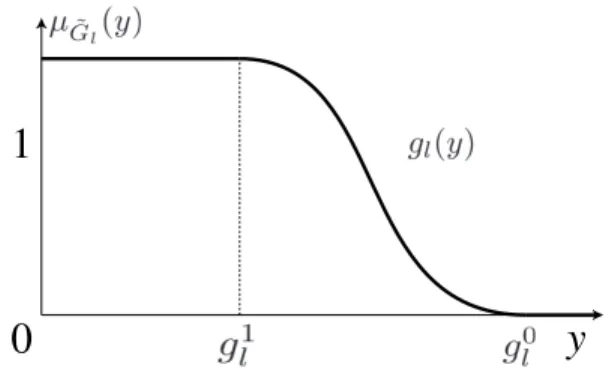
Now, in order to consider the vagueness of the decision maker’s judgments as human, we introduce fuzzy goals ˜Gl, l = 1, 2, . . . , k such as “ ˜C¯lx should be substantially less than
y
1
0
Fig. 3. An example of the membership function µG˜l(y) of a fuzzy goal ˜Gl.
Fig. 4. The degree of possibility ΠC˜¯
lx( ˜Gl).
or equal to a certain value” characterized by the following membership function for each objective function:
µG˜l(y) = 1, if y < g1 l gl(y), if g1l ≤ y ≤ g0l 0, if y > gl0, (4)
where gl(·) is a strictly decreasing function.
IV. PROBABILITYMAXIMIZATIONMODELUSING
POSSIBILITY
If we regard µC˜¯
lx
(·)as a possibility distribution, the degree
ΠC˜¯
lx( ˜Gl) of the possibility satisfying the fuzzy goal ˜Glunder
the distribution is given by the follows using the possibility:
ΠC˜¯ lx( ˜Gl) = supυ min { µC˜¯ lx(υ), µG˜l(υ) } . (5)
In this research, we consider the following problem to maximize the degree of possibility that each fuzzy goal is fulfilled in place of (1): maximize ΠC˜¯lx( ˜Gl), l = 1, 2, . . . , k subject to Ax≤ b x∈ {0, 1}n . (6)
Since possibilities ΠC˜¯lx( ˜Gl) in (6) vary at random because
of the randomness of ¯dl, ¯βland ¯γl, problem (6) is a stochastic multiobjective 0-1 programming problem. Here, the maximiza-tion of ΠC˜¯lx( ˜Gl) in (6) is replaced with the maximization of
Pr
[
ΠC˜¯lx( ˜Gl)≥ hl ]
based on the probability maximization model to maximize the probability that ΠC˜¯lx( ˜Gl) is greater
than or equal to a certain permissible level hl: maximize Pr [ ΠC˜¯ lx( ˜Gl)≥ hl ] , l = 1, 2, . . . , k subject to Ax≤ b x∈ {0, 1}n . (7) For any elementary event, inequalities ΠC˜¯lx( ˜Gl)≥ hl, l = 1, 2, . . . , k can be transformed as:
ΠC˜¯lx( ˜Gl)≥ hl ⇔ sup υ min { µC˜¯lx(υ), µG˜l(υ) } ≥ hl ⇔ ∃υ : µC˜¯lx(υ)≥ hl, µG˜l(υ)≥ hl ⇔ ∃υ : L (¯ dlx− υ ¯ βlx ) ≥ hl, R ( υ− ¯dlx ¯ γlx ) ≥ hl, µG˜ l(υ)≥ hl ⇔ ∃υ : {¯dl− L∗(hl) ¯βl}x ≤ υ ≤ {¯dl+ R∗(hl)¯γl}x, υ≤ µ∗G˜ l(hl) ⇔ {¯dl− L∗(hl) ¯βl}x ≤ µ∗G˜l(hl) where L∗(·), R∗(·) and µ∗˜ Gl
(·) are pseudo-inverse functions
defined as L∗(hl) = sup{r | L(r) ≥ hl}, R∗(hl) = sup{r | R(r)≥ hl}, µ∗G˜l(hl) = sup{r | µG˜l(r)≥ hl}, 0 < hl≤ 1.
In addition, if we assume {d2l − L∗(hl)β2l}x > 0, l = 1, 2, . . . , k for all x ∈ {x ∈ {0, 1}n | Ax ≤ b} and we denote the distribution function of the random variable ¯tl by Tl(·), we obtain Pr [ ΠC˜¯ lx( ˜Gl)≥ hl ] = Pr [ {¯dl− L∗(hl) ¯βl}x ≤ µ∗G˜l(hl) ] = Pr [ {(d1 l + ¯tld2l)− L∗(hl)(β1l + ¯tlβ2l)}x ≤ µ∗G˜l(hl) ] = Pr [ ¯ tl≤ {L∗(h l)β1l − d 1 l}x + µ∗G˜ l (hl) {d2 l − L∗(hl)β2l}x ] = Tl ( {L∗(hl)β1 l − d 1 l}x + µ∗G˜l(hl) {d2 l − L∗(hl)β2l}x ) .
Then, problem (7) is transformed into the following equiv-alent deterministic multiobjective 0-1 programming problem:
maximize pl(x) = Tl ( {L∗(hl)β1 l − d 1 l}x + µ∗G˜l(hl) {d2 l − L∗(hl)β2l}x ) , l = 1, 2, . . . , k subject to Ax≤ b x∈ {0, 1}n . (8) We introduce fuzzy goals like “pl(x) should be substantially greater than or equal to a certain value” to consider the vagueness of the decision maker’s judgments on pl(x) in (8).
Then, problem (8) is reformulated as the following problem: maximize (µ1(p1(x)), . . . , µk(pk(x))) subject to Ax≤ b x∈ {0, 1}n . (9)
In order to derive a satisficing solution to (9), we develop an interactive fuzzy satisficing method that the decision maker interactively updates the reference membership levels ¯µl, l = 1, 2, . . . , k reflecting his aspiration level to each fuzzy goal considering the optimal solution to the following minimax problem minimize max l=1,...,k{¯µl− µl(pl(x))} subject to Ax≤ b x∈ {0, 1}n . (10)
Introducing an auxiliary variable v, (10) is rewritten as: minimize v subject to µ¯l− µl(pl(x))≤ v, l = 1, 2, . . . , k Ax≤ b x∈ {0, 1}n , (11) equivalently, minimize v subject to pl(x)≥ µ∗l(¯µl− v), l = 1, 2, . . . , k Ax≤ b x∈ {0, 1}n (12)
where µ∗l(·) is a pseudo-inverse function defined as µ∗l(s) = inf{r | µl(r)≥ s}, 0 < s ≤ 1.
Then, problem (12) can be rewritten as: minimize v subject to {L ∗(hl)β1 l − d 1 l}x + µ∗G˜l(hl) {d2 l − L∗(hl)β2l}x ≥ T∗ l(µ∗l(¯µl− v)), l = 1, 2, . . . , k Ax≤ b x∈ {0, 1}n (13)
where Tl∗(·) is a pseudo-inverse function defined as Tl∗(s) = inf{r | Tl(r)≥ s}, 0 < s ≤ 1.
We consider the method to obtain the solution for the problem (13) using branch-and-bound method. When we solve by branch-and-bound method, we consider the following con-tinuous relaxed problem:
minimize v subject to {L ∗(hl)β1 l − d 1 l}x + µ∗G˜l(hl) {d2 l − L∗(hl)β2l}x ≥ T∗ l(µ∗l(¯µl− v)), l = 1, 2, . . . , k Ax≤ b 0≤ xj≤ 1, j = 1, 2, . . . , n x∈ Rn (14)
Here, it is equivalent to obtaining minimum v existing feasible solutions to obtain minimum v of the problem. It
is equivalent to obtaining minimum v where an executable solution exists to obtain minimum v of problem(14). Note that the following inequalities hold
¯
µmax− 1 ≤ v ≤ ¯µmax
where ¯µmax is the maximal value of all ¯µl, l = 1, 2, . . . , k. Obtaining the optimal value of v to problem (14) is equiv-alent to finding the minimum of v so that the set of feasible solutions to (14) is not empty. Although (14) is a nonlinear programming problem, we can easily find the minimum of v by the algorithm based on the bisection method and the simplex method since the constraints of (14) are linear if v is fixed.
After the minimum value v∗ of v is obtained, in order to determine x∗ corresponding to v∗ uniquely, we substitute v∗ for the constrains of problem (14) and solve the following linear fractional programming problem:
minimize −{L ∗(h1)β1 1− d 1 1}x − µ∗G˜1(h1) {d2 1− L∗(h1)β21}x subject to {L ∗(hl)β1 l − d 1 l}x + µ∗G˜l(hl) {d2 l − L∗(hl)β2l}x ≥ T∗ l(µ∗l(¯µl− v∗)), l = 1, . . . , k Ax≤ b 0≤ xj ≤ 1, j = 1, 2, . . . , n x∈ Rn . (15) Since (15) is a linear fractional programming problem, using the variable transformation by Charnes and Cooper [3]
t = 1
{d2
1− L∗(h1)β21}x
, y = t· x, t > 0
and letting τl= Tl∗(µ∗l(¯µl− v∗)), (15) is transformed into the following equivalent linear programming problem:
minimize −{L∗(h1)β11− d 1 1}y − µ∗G˜1(h1)· t subject to [τl{d2l − L∗(hl)β2l} +{d1l − L∗(hl)β1l}]y −µ∗ ˜ Gl(hl)· t ≤ 0, l = 1, . . . , k {d2 1− L∗(h1)β21}y = 1 Ay− t · b ≤ 0 0≤ yj≤ t, j = 1, 2, . . . , n t≥ 0 . (16)
[Interactive Fuzzy Satisficing Method]
Step 1: In order to specify membership functions µG˜l(·) of fuzzy goals Glfor objective functions, the following optimization problems to minimize and maximize the expectation of each objective function are solved.
minimize (d1l + Ml· d2l)x subject to Ax ≤ b x∈ {0, 1}n , l = 1, 2, . . . , k (17) maximize (d1l + Ml· d2l)x subject to Ax ≤ b x∈ {0, 1}n , l = 1, 2, . . . , k (18) Since these problems are linear 0-1 programming problems, they can be solved by the branch and bound method using linear programming. On the basis of optimal values to these problems, ask the de-cision maker to determine the membership functions µG˜l(·) and permissible levels hl, l = 1, 2, . . . , k. Step 2: In order to specify membership functions µl(·)
of fuzzy goals for pl(·), the following optimization problems to minimize and maximize each of pl(·) are solved. minimize pl(x) subject to Ax≤ b x∈ {0, 1}n , l = 1, 2, . . . , k (19) maximize pl(x) subject to Ax≤ b x∈ {0, 1}n , l = 1, 2, . . . , k (20)
Since these problems are reduced to linear fractional 0-1 programming problems, they can be solved by the branch and bound method using the variable transformation by Charnes and Cooper [3] and linear programming. On the basis of optimal values to these problems, ask the decision maker to determine the membership functions µl(·), l = 1, 2, . . . , k.
Step 3: Set the initial reference membership levels ¯µl, l = 1, 2, . . . , k to 1.0.
Step 4: For the reference membership levels ¯µl, l = 1, 2, . . . , k, solve the corresponding minimax
prob-lem: minimize max l=1,...,k{¯µl− µl(pl(x))} subject to Ax≤ b x∈ {0, 1}n . (21)
This problem can be solved by the branch and bound method using the bisection method, the variable transformation by Charnes and Cooper [3] and linear programming.
Step 5: If the decision maker is satisfied with the current solution obtained in step 4, the algorithm is termi-nated. Otherwise, update the reference membership levels ¯µl, l = 1, 2, . . . , k and return to Step 4. In Step 4, we can use a branch-and-bound method based on bisection method and simplex method to solve the minimax problem (13).
V. NUMERICALEXAMPLE
To demonstrate the effectiveness of the proposed interactive satisficing method for fuzzy random multiobjective 0-1 pro-gramming problem, we consider the following problem (22)
as a numerical example: minimize C˜¯11x1+ ˜C¯12x2+ ˜C¯13x3+ ˜C¯14x4 + ˜C¯15x5+ ˜C¯16x6+ ˜C¯17x7 + ˜C¯18x8+ ˜C¯19x9 + ˜C¯110x10, minimize C˜¯21x1+ ˜C¯22x2+ ˜C¯23x3+ ˜C¯24x4 + ˜C¯25x5+ ˜C¯26x6+ ˜C¯27x7 + ˜C¯28x8+ ˜C¯29x9 + ˜C¯210x10, minimize C˜¯31x1+ ˜C¯32x2+ ˜C¯33x3+ ˜C¯34x4 + ˜C¯35x5+ ˜C¯36x6+ ˜C¯37x7 + ˜C¯38x8+ ˜C¯39x9 + ˜C¯310x10, subject to x1+ x2+ x3+ 0.3x4+ 0.3x5+ x6 +2x7+ x8+ 0.1x9+ 1.5x10 ≤ 5, 200x1+ 600x2+ 300x3+ 200x4 +200x5+ 2000x6+ 1000x7 +700x8+ 100x9 +700x10≤ 2500, x1+ x2+ x3+ x4+ x5+ x6+ x7 +x8+ x9+ x10≤ 6, x1+ x2+ x3+ x4+ x5+ x6+ x7 +x8+ x9+ x10≥ 1, xj∈ {0, 1}, j = 1, . . . , 10 (22)
In the problem (22), each parameters for each objective function is given as the following numbers:
d11= (−2, −3, −2, −1, −1.5, −2.5, −4, −3, −0.5, −3), d12= (6, 5, 3, 2, 4, 8, 12,−5, −3, −5), d13= (5, 6, 4, 3, 3, 6, 10, 6, 1, 7), d21= (0.3, 0.5, 0.2, 0.1, 0.2, 0.5, 0.8, 0.7, 0.05, 0.8), d22= (0.4, 0.5, 0.2, 0.2, 0.3, 0.6, 1.1, 0.4, 0.2, 0.4), d23= (0.6, 0.7, 0.2, 0.3, 0.1, 0.5, 1.0, 0.5, 0.01, 0.3), β11= (0.1, 0.2, 0.1, 0.1, 0.1, 0.2, 0.3, 0.2, 0.1, 0.1), β12= (0.1, 0.2, 0.1, 0.2, 0.2, 0.3, 0.4, 0.2, 0.2, 0.2), β13= (0.2, 0.2, 0.1, 0.1, 0.1, 0.2, 0.1, 0.1, 0.1, 0.1), β21= (0.01, 0.02, 0.01, 0.01, 0.01, 0.02, 0.03, 0.02, 0.01, 0.01), β22= (0.01, 0.02, 0.01, 0.02, 0.02, 0.03, 0.04, 0.02, 0.02, 0.02), β23= (0.02, 0.02, 0.01, 0.01, 0.01, 0.02, 0.01, 0.01, 0.01, 0.01), γ11= (0.2, 0.4, 0.2, 0.2, 0.2, 0.4, 0.6, 0.4, 0.2, 0.2), γ12= (0.2, 0.4, 0.2, 0.4, 0.4, 0.6, 0.8, 0.4, 0.4, 0.4), γ13= (0.4, 0.4, 0.2, 0.2, 0.2, 0.4, 0.2, 0.2, 0.2, 0.2), γ2 1= (0.02, 0.04, 0.02, 0.02, 0.02, 0.04, 0.06, 0.04, 0.02, 0.02), γ2 2= (0.02, 0.04, 0.02, 0.04, 0.04, 0.06, 0.08, 0.04, 0.04, 0.04), γ2 3= (0.04, 0.04, 0.02, 0.02, 0.02, 0.04, 0.02, 0.02, 0.02, 0.02),
and random variables ¯tl, l = 1, 2, 3 are assumed to be Gaussian random variables with mean 0 and variance 52.
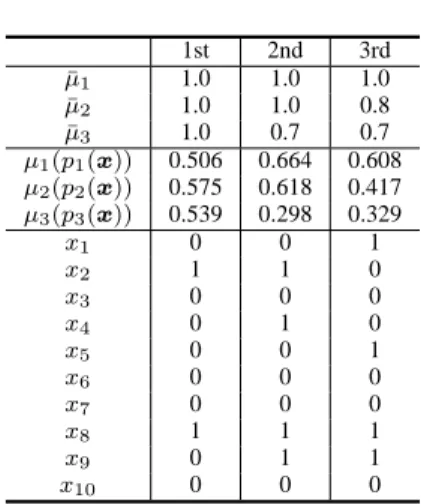
TABLE I PROCESS OF INTERACTION 1st 2nd 3rd ¯ µ1 1.0 1.0 1.0 ¯ µ2 1.0 1.0 0.8 ¯ µ3 1.0 0.7 0.7 µ1(p1(x)) 0.506 0.664 0.608 µ2(p2(x)) 0.575 0.618 0.417 µ3(p3(x)) 0.539 0.298 0.329 x1 0 0 1 x2 1 1 0 x3 0 0 0 x4 0 1 0 x5 0 0 1 x6 0 0 0 x7 0 0 0 x8 1 1 1 x9 0 1 1 x10 0 0 0
For this numerical example, we apply the interactive fuzzy satisficing method proposed in the previous section and the result is summarized in Table I.
After solving all of (17) and (18) by the branch and bound method using and linear programming, ask the decision maker to determine the membership function µG˜l(·) for each objective function ˜C¯lx in (1) and permissible levels h1= 0.6, h2= 0.6, h3= 0.6.
For these permissible levels, all of (19) and (20) are solved by the branch and bound method using the variable transfor-mation [3] and linear programming, ask the decision maker to determine the membership function µl(·) for each objective function pl(·) in (8).
Then, the initial reference membership levels ¯µl, l = 1, 2, 3 are set to 1.0 and the corresponding minimax problem (21) is solved. The result is shown in the second column of Table I. Since the decision maker prefers to improve µ1(p1(x)) at the sacrifice of µ3(p3(x)), he updates the reference membership levels to ¯µ1= 1.0, ¯µ2= 1.0, ¯µ3= 0.7.
Again the minimax problem for the updated reference membership levels is solved and the result is shown in the third column of Table I. Since the decision maker feels that µ3(p3(x)) is too low, he updates the reference membership levels to ¯µ1= 1.0, ¯µ2= 0.8, ¯µ3 = 0.7 to enlarge µ3(p3(x)) even if µ2(p2(x)) decreases.
After the corresponding minimax problem is solved, the result is obtained shown in the fourth column of Table I. Since the decision maker is satisfied with the result, the algorithm is terminated.
VI. CONCLUSION
In this paper, we focused on multiobjective 0-1 program-ming problems whose coefficients of objective functions are fuzzy random variables. After introducing fuzzy goals for objective functions to reflect the vagueness of the decision maker’s judgment as human, we regarded the minimization of objective functions as the maximization the degree of possibility that each objective function fulfills the correspond-ing fuzzy goal. Since the degree of possibility is a random
variable, we adopted the probability maximization model as a decision making model. Then, we reduced the fuzzy random multiobjective 0-1 programming problem to a deterministic multiobjective 0-1 programming problem and discussed an interactive fuzzy satisficing method to derive a satisficing solution for the decision maker. In the discussion, we showed that all problems in the proposed interactive method can be solved by the branch and bound based on linear programming. In the future, we will discuss the case based on the degree of necessity and other stochastic programming models, and consider fuzzy random multiobjective integer programming problems.
REFERENCES
[1] E.E. Ammar, On solutions of fuzzy random multiobjective quadratic
pro-gramming with applications in portfolio problem, Information Sciences,
Vol. 178, No. 2, pp. 468–484, 2008.
[2] A. Charnes and W.W. Cooper, Chance constrained programming, Man-agement Science, Vol. 6, No. 1, pp. 73–79, 1959.
[3] A. Charnes and W.W. Cooper, Programming with linear fractional
functionals, Naval Research Logistic Quarterly, Vol. 9, No. 3–4, pp.
181–186, 1962.
[4] A. Charnes and W.W. Cooper, Deterministic equivalents for optimizing
and satisficing under chance constraints, Operations Research, Vol. 11,
No. 1, pp. 18–39, 1963.
[5] G.B. Dantzig, Linear programming under uncertainty, Management Science, Vol. 1, No. 3–4, pp. 197–206, 1955.
[6] H. Katagiri, E.B. Mermri, M. Sakawa, K. Kato and I. Nishizaki, A
possibilistic and stochastic programming approach to fuzzy random MST problems, IEICE Transaction on Information and Systems, Vol. E88-D,
No. 8, pp. 1912–1919, 2005.
[7] H. Katagiri, M. Sakawa, K. Kato and I. Nishizaki, A fuzzy random
multiobjective 0-1 programming based on the expectation optimization model using possibility and necessity measures, Mathematical and
Computer Modelling, Vol. 40, No. 3–4, pp. 411–421, 2004.
[8] H. Katagiri, M. Sakawa and H. Ishii, A study on fuzzy random portfolio
selection problems using possibility and necessity measures, Scientiae
Mathematicae Japonicae, Vol. 61, No. 2, pp. 361–369, 2005. [9] H. Katagiri, M. Sakawa and I. Nishizaki, Interactive decision making
us-ing possibility and necessity measures for a fuzzy random multiobjective 0-1 programming problem, Cybernetics and Systems: An International
Journal, Vol. 37, No. 2, pp. 59–74, 2006.
[10] H. Katagiri, M. Sakawa, K. Kato and I. Nishizaki, Interactive
multiob-jective fuzzy random linear programming: maximization of possibility and probability, European Journal of Operational Research, Vol. 188,
No. 2, pp. 530–539, 2008.
[11] R. Kruse and K.D. Meyer, Statistics with Vague Data, D. Riedel Publishing Company, Dordrechut-Holland, 1987.
[12] H. Kwakernaak, Fuzzy random variables - I. definitions and theorems, Information Sciences, Vol. 15, No.1, pp. 1–29, 1978.
[13] Y.K. Liu and B. Liu, Fuzzy random variables: a scalar expected value
operator, Fuzzy Optimization and Decision Making, Vol.2, No. 2, pp.
143–160, 2003.
[14] M.K. Luhandjula, Multiple objective programming problems with
pos-sibilistic coefficients, Fuzzy Sets and Systems, Vol. 21, No. 2, pp. 135–
145, 1987.
[15] M.K. Luhandjula, Fuzzy stochastic linear programming: survey and
future research directions, European Journal of Operational Research,
Vol. 174, No. 3, pp. 1353–1367, 2006.
[16] M.K. Luhandjula and M.M. Gupta, On fuzzy stochastic optimization, Fuzzy Sets and Systems, Vol. 81, No. 1, pp. 47–55, 1996.
[17] M.L. Puri and D.A. Ralescu, Fuzzy random variables, Journal of Mathematical Analysis and Applications, Vol. 114, No. 2, pp. 409–422, 1986.
[18] H. Rommelfanger, Fuzzy linear programming and applications, Euro-pean Journal of Operational Research, Vol. 92, No. 3, pp. 512–527, 1996.
[19] M. Sakawa, Fuzzy Sets and Interactive Multiobjective Optimization, Plenum Press, New York, 1993.
[20] M. Sakawa, H. Yano and T. Yumine, An interactive fuzzy satisficing
method for multiobjective linear programming problems and its ap-plication, IEEE Transactions on Systems, Man, and Cybernetics, Vol.
SMC-17, No. 4, pp. 654–661, 1987.
[21] S. Vajda, Probabilistic Programming, Academic Press, 1982. [22] G.-Y. Wang and Z. Qiao, Linear programming with fuzzy random
variable coefficients, Fuzzy Sets and Systems, Vol. 57, No. 3, pp. 295–
311, 1993.
[23] J. Xu and Y. Liu, Multi-objective decision making model under fuzzy
random environment and its application to inventory problems,
Infor-mation Sciences, Vol. 178, No. 14, pp. 2899–2914, 2008.
[24] H.-J. Zimmermann, Fuzzy programming and linear programming with
several objective functions, Fuzzy Sets and Systems, Vol. 1, No. 1, pp.