第 54 卷 第 5 期
2019 年 10 月
JOURNAL OF SOUTHWEST JIAOTONG UNIVERSITY
Vol.54 No.5 Oct. 2019
ISSN: 0258-2724 DOI:10.35741/issn.0258-2724.54.5.8
Computer science
A
SSESSMENT OF
M-S
ERVICE
A
CCEPTANCE IN
E
DUCATIONAL
C
ONTEXT
Dr. Mohamed Adel Al-Shaher
Computer Science - Information Technology, University of Thi-Qar, Iraq [email protected], [email protected], [email protected]
Abstract
The paper investigatesstudents’perspectiveregardingtheroleofSmartphonesinan educational context. The method consists in conducting a questionnaire among 80 respondents – final-year students from four universities in Baghdad, Iraq; and data processing through Statistical Package for Social Sciences (SPSS 22.0) by applying recurrence, rate, mean score, standard deviation, autonomous example t-test and One Way ANOVA. Such a blended approach allows demonstrating that smartphones play a positive role in helping students learn and get educated. This study is significant for E-learners as it offers an innovative method of teaching; however a sound pedagogical infrastructure and training is needed.
Keywords: smartphone for learning, educational assessment, mobile learning, digital literacy, 21st century learning 摘要 : 本文研究了学生对智能手机在教育环境中的作用的看法。 该方法包括对 80 位受访者进行问卷调查-来自伊拉克巴格达四所大学的最后一年学生; 通过应用重复性,比率,平均得分,标准差,自主样本 t 检 验和单向方差分析,通过社会科学统计软件包(SPSS 22.0)进行数据和数据处理。 这种混合方法可以证明 智能手机在帮助学生学习和教育方面发挥了积极作用。 这项研究对电子学习者而言意义重大,因为它提供 了一种创新的教学方法。 但是,需要完善的教学基础设施和培训。 关键词: 用于学习的智能手机,教育评估,移动学习,数字素养,21 世纪学习
I.
I
NTRODUCTIONInstruction empowers individuals to communicate with each other. Taking into account its role in social, political, monetary and natural advancement, the significance of training should not be underestimated. Training capacities serve as a vehicle for cooperation and an instrument of correspondence. The need to impart viably in the cutting-edge world is inarguable, and in this context, it sparks the interest of scholars in learning. Education is seen as the most widely used language worldwide [1,2]. Thus, according to Baruah [3], education is a global language among the non-local speakers of various dialects, and moreover, training is
developing every day. Bashar [4] accounts for the ways in which British and Americans sponsor language teaching and programs for promoting language learning. Schools and universities in Iraq are currently running many language programs, too.
The use of mobile technology started in the 21st century, and it gave birth to Mobile-Assisted Learning (MAL), which refers to learning languages via mobile devices/phones. Mobile Learning makes learning more private and individual, besides it makes learning possible in both formal and informal situations. Students make use of smartphones for learning translation
and retranslation, reading online books, and practicing their communication skills [4]. Smartphones offer private learning opportunities as well as collaborative learning opportunities. Students are now more able to engage in online discussions on social media like discussion forums or Facebook, and they are able to practice and learn better pronunciation with the help of English language learning channels on YouTube. These social aspects help promote collaborative learning among ESL learners [4].
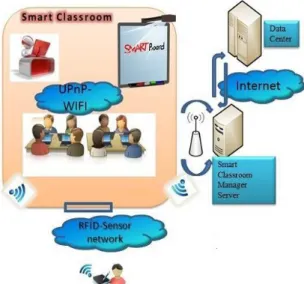
Figure 1. Proposed Segments of Smart Classroom for assessment.
Iraqi learners study English as a foreign language, however in the learning process they
face certain difficulties like a lack of proficiency, time and practice [5]. These days, due to the widespread use of technology, researchers and teachers are using it for language teaching/learning effectively. To employ mobile gargets like smartphones for learning languages is now very common to students worldwide, therefore it is essential to investigate whether smartphones really help students in learning. Students of today are addicted to technology and use several learning Apps on their smartphones. Being available on smartphones connected with the Internet, educational Apps have made learning easy for students. Thus, researchers are also taking interest in examining the potential of smartphones in the educational process [6].
These days, smartphones are used for the basic purpose of communication and also as an effective learning tool, as they have all the features of computers inbuilt in them. This study explores students’ perspective on learning via amartphones at university level as perception which reflects people’sattitudeandacceptability towards something and effects their decisions, too. Ishaq [7] describes attitudes as those showing one’s favorable or non-favorable attitude towards something. So it is necessary to investigate students’ perspective about learning with the help of smartphones.
Table 1.
Class Management highlights bolstered by the past investigations with multiple features of learning through mobile technology
Research Tracking Fetch Data Assessment Authority and dealing Link Class Assets Shared Access Failover healing Article [4]
Article [7]
Article [13]
Articles [19] [20]
In the 21st century, teaching practices are revolutionized as classes are more student-entered instead of being teacher cstudent-entered. Today, teachers are only the facilitators in the educational process, and learners have become more independent and autonomous. SMS are demonstrated to be used by teachers to control their classes. Several studies have been conducted aiming to investigate smartphone features for promoting learning in the classroom,
and [7] to show how text messages help teachers in teaching. Described by several scholars in their independent studies [8, 9], explored the use of English as a learning tool. Smartphones provide access to advanced technology, and in order to take advantage from it, one needs to explore how learners use smartphones and how they help them in learning. This aspect of mobile learning needs to be investigated further.
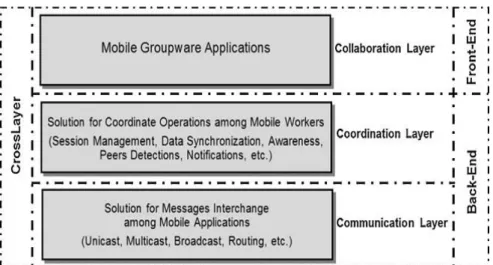
Figure 2. The proposed layer architecture that helps portable cooperative applications and assessment of learning. The Aim of the Study
With the passage of time teaching practices have been revolutionized as now in the current century learning has become a social activity and mobile.Thisstudyexploresstudents’perspective on how smartphones play an important role in learning. It also investigates how learners use smartphones aiming to develop proficiency in education, their interest in using learning apps, their learning activities and patterns. It was argued in [10] that learners can be engaged in learning activities and they can be guided in a better way after exploring their current practices of learning via smartphones.
This study is of considerable significance as its results would contribute to m-learning research, which is the latest field of investigation and inquiry in this era, and studies are required to be conducted in this field. However this area of research is quite new for Iraq, so the current study would work as a basis for future researchers. This paper provides the results of the assessment of smartphone or mobile service acceptance in an educational context. This study is innovative in the sense that it analyzes the role of smartphones in learning in Iraq. This study would be helpful for ELT students, teachers, researchers and practitioners to get a clear picture of the situation how smartphones assist in learning. Students will take advantage of this study by learning how others use smartphones for learning both inside and outside the classroom as well as outside and would get to know and explore new learning Apps on their smartphone. This study will also increase acceptance among students and teachers about learning via smartphones and it will result in increasing the efficiency of teaching and learning.
Smartphones are universal so researchers are now incorporating them into their research projects to investigate their potential for helping
in learning [12]. M-learning was called as a harbinger of future learning [14-16]. Scientists likewise contrasted m-learning and discussion and action-based learning [17]. Instructors need an appropriate academic structure to use cell phones for learning in classes in a superior manner.
II.
B
ACKGROUNDIt is crucial to investigate students’ perspective because they are an important part of the learning and/or teaching process, and their perspective would indicate acceptance and preparedness for using smartphones as a learning tool. Researchers state that mobile learning is very effective, but in some areas educationists still need to be convinced regarding its potential as an effective learning/teaching tool, and the cross-cultural view of it may convince them to use it in their settings, too.
Kulowiec [17] conducted a study on 54 EFL teachers and 26 students to explore their perspective on using an online dictionary. Positive results were found regarding learning vocabulary via online dictionaries as they are available for students in their smartphones without time or place restrictions. In addition to that, researchers report that there are not only standard or authentic dictionaries but also substandard and unauthentic ones that are available online. Therefore, the user needs to be careful while installing a dictionary on his smartphone.
Kvavik [18] led an examination on undergraduates of 9-12 grades and instructors in Louisiana State University and Agricultural and Mechanical College to research their point of view on how utilizing Internet based life on cell phones can upgrade students’ commitment to learning. Discoveries of that review demonstrated that instructors were exceptionally for utilizing
web based life through cell phones for students’ commitment to learning in their classes. It was found that using mobile devices for learning increased students’ interest in learning, and students were found more motivated.
It was investigated in [19] how integration of smartphones facilitates learning English as a foreign language in India. They concluded that integrating mobile phones in teaching and learning process makes teaching more effective, so it is helpful for teachers as well as students. Because of Internet connectivity and learning apps in phones, EFL teachers need to re-design their teaching styles and strategies to get benefit from technology in the classroom. It helps learners to work independently as autonomous learners, and teachers are only the facilitators to help them when they need.
Students’ views on using mobile phone for learning at Aljouf University in Saudi Arabia was explored in [20]. Review technique was utilized for information accumulation from an example of 52 college graduate students, and the results were found positive, as the students were found supportive towards learning via their hand help mobile phones.
Learners’ attitude towards using mobile phones for learning purposes was studied in [21]. Students showed positive attitude, they liked learning via mobile phones and were found motivated. The use of mobile phones for improving students’ writing skills was explored in [22]. They used a questionnaire for data collection from Intermediate level students studying in Iraq. Again positive results were found as majority of the students were found in favor of improving their writing skills via their mobile devices. It was concluded that learning via Mobile-phones really helps students to improve their writing skills in English as a second/foreign language, and the researchers strongly recommended integrating mobile learning in the learning process.
The utilization of portable word references for learning a language was investigated in [23]. By utilizing the review method for information accumulation from the example size of 100 English graduates at the University of Baghdad, Iraq, the scholars arrived at the conclusion that the electronic word reference played an essential role in the educational process. Further they explained their positive discoveries by the fact that graduate students agreed to utilize the electronic word reference in order to improve their jargon by adapting new phonetic things on consistent schedule through their cell phone lexicon.
A. Research Questions Research question were:
1. How smartphones help students in learning?
2.Whatarestudents’perspectiveson the role of Smartphones in learning?
3. What attitude do learners show regarding learning via smartphones?
4. Is there any similarity or difference among their perception about the role of Smartphones in learning
B. Hypothesis
H1: Smartphones play an important role in learning and education.
III.
M
ETHODOLOGYThis is a descriptive study, and a comprehensive self-reported questionnaire was used to collect data. The setting for this study was four sections of a special education (resource) math classroom in a large urban Southwestern school district. All of the classrooms were located in a public middle school serving students in grades six through eight. The middle school included a variety of instructional settings, including special education (self-contained and resource) and general education (single teacher and co-taught classrooms). The community served by this school is diverse and includes a variety of cultures, languages, ethnicities, and economic backgrounds. The principal completed a facilities acknowledgment form prior to the beginning of the study.
The classes used in this study were classrooms delivering direct, explicit math instruction to students with disabilities. The majority of instruction in these classes focused on academic supports in mathematics. Most of the students attended resource classrooms for their core content instruction (i.e., math and English language arts). The classrooms were selected for participation using convenience sampling, however specific sections of the math class were assigned to either the TMI or the MAI randomly. Each classroom was equipped with a wireless Internet connection (Wi-Fi) which was password protected and accessible to the students, teachers, and the research team. The students were seated at individual desks facing towards the whiteboard. The mobile device used for this study was an android operating system with 7 inches display Wi-Fi, 8 GB tablet.
There were two students assigned to each tablet, and any identifying data such as email
accounts were removed from the device prior to releasing it to the next student. Each student had an individual, password-protected Google account that they used to access the learning videos. Students were given two days of training on how to navigate the device and the platform. A. Sample and Sampling Techniques
Total 80 students studying in the final year of graduation and post-graduation for educational assessment were selected from 4 universities in Iraq through convenient cluster sampling method.
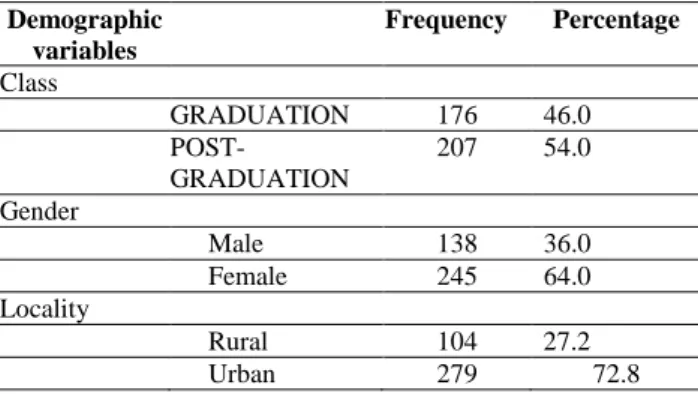
Detail is given in the following Table 2.
Table 2. Sample Detail Demographic variables Frequency Percentage Class GRADUATION 176 46.0 POST-GRADUATION 207 54.0 Gender Male 138 36.0 Female 245 64.0 Locality Rural 104 27.2 Urban 279 72.8
B. Research Instruments
Data were collected through a Questionnaire which was designed after reviewing already designed and tested questionnaires. The questionnaires were altered them according to this setting and the nature of the current study. Then it was checked by professors, then pilot tested, and it was divided into major factors through Exploratory Factor Analysis (EFA) for the sake of analysis namely SMS and email, pronunciation and online materials, vocabulary, grammar and translation, Oral/written skills, collaborative learning, independent learning, helpful learning tool, training and use. This questionnaire had 3 main sections.
1. Section 1 was about participants’ class, gender and residence.
2. Section 2 included 77 questions and responses were to be measured on 5 point like scale strongly agree to strongly disagree.
3. Section 3 included 3 open ended questions to get a clear view of the situation.
C. Data Collection and Data Analysis
Researcher distributed 80 questionnaires personally and received 73 back. Mean score, recurrence, standard deviation were estimated through One Way ANOVA, free just as combined example t-test. The instructor got preparing on the arrangement of the scripted exercises and the execution of the advanced exercises. During this training, the teacher reviewed the instructional materials, asked questions, and participated in a simulation of the lesson. The teacher received feedback from the student investigator. At the end of the training, the teacher was provided with all the materials needed to implement the lesson. A class set of the tablets was provided to the teacher for student use during the study.
IV.
R
ESULTSEach perusing aptitude was broke down separately. Additionally, examination among male and female understudies was likewise made so as to gauge their capability in perusing perception. The outcomes are introduced in forbidden structures as pursues.
Table 3.
Meanofstudents’response: Indicates understudies' point of view with respect to the job of cell phone in learning and it is discovered extremely high as mean was 3.99, and standard deviation 0.874. It demonstrates members' sure reaction
No. of students
Mean SD
Students’responseregarding the role of Smartphone in learning English as a whole
80 99 0.874
Table 4.
Graduation vs. Post-Graduation level students: Show a comparison of graduation and post-graduation level students and non-significant differences were seen about 9 major factors written in above table
Factors t-value p-value Mean
Attitude for learning via smartphone .573 .567 GRADUATION = 54.43, POST-GRADUATION = 54.04
SMS and email 1.153 .250 GRADUATION = 24.38, POST-GRADUATION = 23.99
Pronunciation and online materials -.614 .540 GRADUATION = 40.16, POST-GRADUATION = 40.45
Vocabulary, Grammar and Translation -1.403 .161 GRADUATION = 28.84, POST-GRADUATION = 29.34
Oral and written Skills -.502 .616 GRADUATION = 39.88, POST-GRADUATION = 40.12
Collaborative Learning -.395 .693 GRADUATION = 43.41, POST-GRADUATION = 43.63
Independent Learning .656 .512 GRADUATION = 27.28, POST-GRADUATION = 27.01
A helpful learning tool -.828 .408 GRADUATION = 32.43, POST-GRADUATION = 32.77
Training and Use -.262 .794 GRADUATION = 16.02, POST-GRADUATION = 16.09
Table 5.
Males’vs.females’preferences:Indicates that non-significantdifferencewasfoundinmaleandfemales’perspectives9 factors of questionnaire as reported in above table No. 4
Factors t-value p-value Mean
Attitude for learning via smartphone -.163 .870 M = 54.14, F = 54.26
SMS and email -1.791 .074 M = 23.77, F = 24.40
Pronunciation and online materials -1.364 .173 M = 39.88, F = 40.56 Vocabulary, Grammar and Translation -1.756 .080 M = 28.70, F = 29.35 Oral and written Skills -1.520 .129 M = 39.52, F = 40.28 Collaborative Learning -.287 .775 M = 43.43, F = 43.59 Independent Learning -.590 .556 M = 26.98, F = 27.22 A helpful learning tool -.748 .455 M = 32.41, F = 32.73
Training and Use -1.604 .110 M = 15.80, F = 16.20
Table 6.
Rural vs. urban students Comparison: Shows results of t-test about participants’ residence. Rural and urban students’ opinions were compared and non-significant differences were found in their opinions
Factors t-value p-value Mean
Attitude for learning via Smartphone 2.074 .039 R = 55.38, U = 53.79
SMS and email .012 .990 R = 24.17, U = 24.17
Pronunciation and online materials .266 .790 R = 40.42, U = 40.28 Vocabulary, Grammar and Translation .471 .638 R = 29.25, U = 29.06 Oral and written Skills -.062 .950 R = 39.98, U = 40.01 Collaborative Learning .354 .723 R = 43.69, U = 43.47 Independent Learning -.941 .347 R = 26.83, U = 27.25 As helpful learning tool 1.529 .127 R = 33.13, U = 32.42 Training and Use -.575 .565 R = 15.94, U = 16.10
V.
D
ISCUSSIONDiscoveries demonstrate that smartphones help undergraduates in learning, and undergraduates had an inspirational frame of mind with respect to the utilization of smartphones for learning purposes. Cell phones because of its size and web availability makes adapting simple for undergraduates. Undergraduates utilize web based learning assets as indicated by their accommodation. It likewise advances coordinated effort in learning errands. Understudies as autonomous students learn English with fun without impediments of time and spot by utilizing these internet learning materials as their cell phones learning Apps just as YouTube channels for learning. Understudies concurred that their jargon is upgraded by
utilizing on the web word references interpreters. They practice relational abilities online as it gives them chances to impart in English via web-based networking media to online network of educators, addresses, different understudies and they additionally take an interest in huge open online courses (MOOC). This encourages them improve their intonation and articulation and spur them to convey adequately and with certainty. So cell phone can possibly be utilized as getting the hang of/educating apparatus. Understudies concurred that preparation workshops are required for successful usage of cell phones as a learning instrument supportive learning Apps, Software, sites and online assets and so forth. Specialist talks about research question as per the
discoveries of ebb and flow study in the accompanying passages.
First research Question is 'How Smartphone helps undergraduates in learning? Disclosures exhibit that bigger piece of individuals has moving temper towards learning by methods for their phones and they consider it a not too bad gadget for practicing their 4 language capacities specifically tuning in, talking, examining, making and it moreover redesigns their language. Mobile phone urges undergraduates to adjust new words and suggestions and their language is overhauled by using a versatile dictionary similarly, because of talking in English on their smartphone [23-24]. Their social capacities are cleaned in view of diligent practice as their oral aptitudes are cleaned by listening to English sound/video on their smartphone described in [27] also agreed that their talking skill is improved by correspondence in English language by methods for their Smartphone. Electronic books open online help understudies develop extraordinary scrutinizing aptitudes. Wireless urges undergraduates to examine for no specific reason or information in English. Undergraduates work on perusing and composing messages, formal or casual notes, messages, and remarks in the English language on their telephone, which encourages them to practice their composed abilities in routine life. Past examines additionally presumed that cell phone helps in improving undergraduates' language aptitudes explored in [28]. They expressed that undergraduate students composition aptitudes is improved by composing right English in messages by means of their telephone, and undergraduate students likewise demonstrated positive results and a good frame of mind about learning through smartphones.
Undergraduates were discovered willing and inspired to learn online materials by means of their Using cell phone for learning is superior to anything PCs as it gives brisk assistance in getting to materials, learning implications of words, interpretation and retranslation. Online materials are utilized as extra with printed one as it is valuable for picking up/educating purposes. The utilization of smartphone inside study hall is superior to PCs because of its accessibility and light weight. Undergraduates concurred that they would be progressively eager to utilize their smartphones for learning exercises. The vast majority of teachers enable their undergraduate students to utilize their cell phone for learning purposes in and outside the study hall. Undergraduates unreservedly impart in English by means of their cell phone when contrasted
with close and personal correspondence. It was highlighted in [29,30,31] that smartphones give access to Learning materials outside the study hall also.
Research Questions essentially are to explore undergraduate students' demeanor and discernments about the structure of the English language capability through the smartphone. The discoveries demonstrate that understudies learn the right spelling and language structure through redress programming accessible in their smartphones. Legitimate English online materials are as per undergraduates' degree of comprehension. Use of social media like Facebook, WhatsApp and Twitter on undergraduates' cell phones advances synergistic learning and right utilization of the English language in them. Undergraduates composed and read posts on Facebook in English. They demonstrated inspirational disposition about learning by means of their cell phones.
The next research question was what are similitudes or contrasts of undergraduates' feeling about learning by means of cell phones? Undergraduates indicated positive reaction towards learning by means of their cell phones and discoveries demonstrate that 78% undergraduates use Learning Apps on their cell phones. They use it for getting additional data just as playing instructive games. 80% undergraduates concurred that cell phone ought to be taken into consideration learning in the homeroom and 65% undergraduates concurred that it redirects their consideration from instruction to social exercises. 90% undergraduates concurred that educators request that they use cell phone to access learning materials accessible online like utilizing lexicon, sounds/video exercise addresses, learning sites and programming. They get ready introductions, tasks and assignments by downloading important materials on their cell phones effectively. Learning through a cell phone makes learning a private issue as explored in [29,32,33] additionally concurred and contended that it privatizes undergraduates’ realizing when they learn materials on their telephone. Undergraduates like to utilize it as a learning gadget because of possibilities of its being untouched accessible helpful and convenient thing.
VI.
C
ONCLUSION ANDR
ECOMMENDATIONSEducation and learning English is fundamental for Iraqian students now due to being an official language, the language of
science and social communication in the country. Cell phones are discovered useful in getting the hang of as indicated by students' own comfort and straightforwardness. They demonstrated a positive reaction towards learning by means of their shrewd gadgets because of web availability, fast access to learning materials and applications, programming and destinations. Essential reason for this examination was to explore the role of smartphones in learning, and undergraduates' viewpoint about it. Based on the discoveries of this examination it is presumed that smartphones assume a fundamental job in helping undergraduates learn education in formal just as in casual settings as a successful instructive apparatus. They practice relational abilities autonomously additionally found that students utilize their cell phones for their individual adapting needs. Students appreciate learning through their cell phone because of its conveyability and accommodation of utilization when contrasted with PC or a hardback book.
Taking a gander at the discoveries it is prescribed that preparation is required for better and viable use of cell phones for learning and furthermore to make students increasingly free and self-sufficient. Students should be guided to utilize cell phones adequately for learning purposes. Along these lines, legitimate preparing, and academic structure is an unquestionable requirement to exploit learning by means of cell phones. Future research might be directed to ask the genuine utilization of cell phones for learning and undergraduates' learning accomplishments by means of cell phones. Trial and longitudinal investigations might be led to see the capability of cell phones for learning with the progression of time. Research might be directed to explore viability of incorporating cell phones in learning exercises in study halls. Cell phones improve undergraduates' capability at graduation and Master level in Iraq and job of cell phone in upgrading understudies' learning ought to be explored in different pieces of the world also to get increasingly solid outcomes.