西 南 交 通 大 学 学 报
第 56 卷 第 2 期
2021 年 4 月
JOURNAL OF SOUTHWEST JIAOTONG UNIVERSITY
Vol. 56 No. 2
Apr. 2021
ISSN: 0258-2724 DOI:10.35741/issn.0258-2724.56.2.1
Research article Social Sciences
T
HE
E
FFECTS OF
COVID-19
Q
UARANTINE ON
O
NLINE
E
XAM
C
HEATING
:
A
T
EST OF
COVID-19
T
HEORETICAL
F
RAMEWORK
新冠肺炎夸脱碱对在线考试作弊的影响:新冠肺炎理论框架的测试
Dr. Yousif Abdelrahim
Department of Management, Prince Mohammad Bin Fahad University
617, Al Jawharah, Khobar, Dhahran, Kingdom of Saudi Arabia, yabdеlrahim@pmu.еdu.sa
Received: January 28, 2021 ▪ Review: March 6, 2021 ▪ Accepted: April 5, 2021 ▪ Published: April 30, 2021
This article is an open-access article distributed under the terms and conditions of the Creative Commons Attribution License (http://creativecommons.org/licenses/by/4.0)
Abstract
This study aims to quantitatively test the newly developed theoretical framework model for the relationship between COVID-19, stress, anxiety, and university students' online exam cheating in the United States of America during COVID-19. The newly developed model primarily explains how COVID-19 quarantine influences university students' levels of anxiety and stress, and therefore, influences the frequency of online exam cheating behavior among college students. The researcher collected primary data of 251 male and female university students in the United States of America via Survey Monkey and tested the six hypotheses using the structural modeling equation technique. The study results confirm that COVID-19 quarantine has a significant relationship with stress and anxiety. The relationship between COVID-19 quarantine and stress is more significant than the relationship between COVID-19 quarantine and anxiety. The results also validate the significant and positive relationship between COVID-19 quarantine and stress and COVID-19 quarantine and anxiety. COVID-19 quarantine causes more anxiety than stress among university students, influencing students' behavior to cheat more on online exams. Theoretically, this study Translates a qualitative research question from a prior study that developed the COVID-19 theoretical framework into an accurate prediction of anticipated outcomes. This study also develops a conceptual framework for the relationship between COVID-19, anxiety, stress, and online exam cheating. Besides, this study refined six hypotheses from previously generated propositions. Finally, the study results could be used as general guidelines for university educators and administrators when thinking and deciding on exams, assignments, and how to monitor online exams.
Keywords:E-Cheating, Anxiety, Stress, COVID-19, Depression
摘要 这项研究旨在定量测试新开发的理论框架模型,用于研究新冠肺炎期间美国的新冠肺炎,压
学生的焦虑和压力水平,从而影响大学生在线考试作弊行为的频率。研究人员通过调查猴子收集 了美国 251 名男女大学生的主要数据,并使用结构建模方程技术验证了这六个假设。研究结果证 实,新冠肺炎检疫与压力和焦虑有显着关系。新冠肺炎隔离与压力之间的关系比新冠肺炎隔离与 焦虑之间的关系更为重要。结果还证实了新冠肺炎隔离与压力和新冠肺炎隔离与焦虑之间的显着 正相关。在大学生中,新冠肺炎隔离所引起的焦虑比压力更大,这会影响学生的行为,使他们在 在线考试中更多地作弊。从理论上讲,该研究将先前研究的定性研究问题转化为对新冠肺炎理论 框架的开发,从而将其转化为对预期结果的准确预测。这项研究还为新冠肺炎,焦虑,压力和在 线考试作弊之间的关系建立了概念框架。此外,本研究从先前产生的命题中提炼出六个假设。最 后,在思考和决定考试,作业和如何监控在线考试时,研究结果可以用作大学教育者和管理人员 的一般指南。 关键词: 电子作弊,焦虑,压力,新冠肺炎,抑郁
1. INTRODUCTION
Cheating on exams is one of the universal academic dishonesty practices among college and university students [1]. Hence, the United States of America (USA) universities and colleges are no exception to the phenomenon of academic dishonesty, including cheating on online exams. Generally speaking, the education culture has increasingly dominated by the need to achieve high grades, besides the pressure to graduate with an honorary degree and acquire a job in an excellent firm pressure. [2]. In addition to the pressure on students resulting from many parents' expectations, the recent COVID-19 pandemic quarantine that brought into existence unpredictability for people worldwide has brought forth anxiety and stress. Hence, COVID-19 quarantine is more likely to bring about anomic conditions, resulting in some university students becoming egocentric concerning ethical considerations [25].
This study's primary goal is to examine the impact of COVID-19 pandemic quarantine on college and university students' online exam cheating in the United States of America and develop a conceptual framework for the relationship between COVID-19, stress, anxiety, and online exam cheating among university students. Online exam cheating includes many forms such as using cell phones and social media groups, accessing online exam-related websites during exam time, storing exam-related materials answers on Universal Serial Bus (USB) ports and computers [8].
Few researchers have conducted studies testing the impact of COVID-19 pandemic quarantine on college and university students' levels of stress, depression, and anxiety during online exams and class assignments. For instance, online learning has caused anxiety, depression, and stress from severe to moderate to
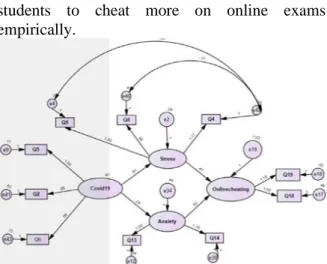
mild among college and university students [3], [4]. AlAteeq, Aljhani, and AlEesa [5] published a study recently in Saudi Arabia universities on the influence of COVID-19 quarantine students' levels of stress and confirmed a positive and significant correlation between the rise in stress levels among female students and online classes during the COVID-19 pandemic quarantine. Besides, Islam, Barna, Raihan, Khan, and Hossain [6] and Aylie, Mekonen, and Mekuria [7] found that COVID-19 pandemic lockdown resulted in mental health problems among university students, including anxiety, stress, and depression. The literature review shows that prior studies have found either the correlation between COVID-19 quarantine, anxiety, depression, and stress or confirmed the positive relationship between anxiety and cheating, stress and cheating, and depression and cheating. Nevertheless, prior studies did not recognize COVID-19 quarantine as a critical factor influencing university and college students' e-cheating. Furthermore, prior studies did not explain why COVID-19 quarantine has caused students to cheat more on online exams empirically. Finally, prior studies have developed a theoretical framework for the relationship between COVID-19 quarantine, anxiety, and stress but not a conceptual framework for such a relationship. Hence, this study aims to fill the gaps mentioned above in the literature by examining the proposed theoretical framework developed by Abdelrahim, Y. [21] to understand whether COVID-19 quarantine has contributed to the rise in online exam cheating among university and college students in the USA. This study also develops a conceptual framework for the relationship between COVID-19 quarantine, anxiety, stress, and online exam cheating (see Figures 1 and 2). Finally, the study aims to explain why COVID-19 quarantine has caused
students to cheat more on online exams empirically.
Figure 1. The conceptual framework for the relationship between COVID-19, anxiety, stress, and E-cheating
These research study findings could help university and college administrators understand why the rise in online exam cheating during COVID-19 quarantine is noticeable and why it is essential to use online exam monitoring cameras and software throughout online exams. The study findings could also help faculty members scrutinize their evaluation practices to reduce stress and anxiety among students throughout the COVID-19 pandemic quarantine. As such, faculty members can address academic dishonesty, anxiety, and stress among students. Faculty members could benefit from this study's results considering the number of exams, assignments, and individual projects assigned to students during the COVID-19 pandemic quarantine. Besides, colleges and universities need to think carefully about academic integrity in and outside the classrooms to foster a culture of acceptable academic ethical behavior. The study findings could help researchers and educators better understand why online exam cheating is a widespread phenomenon among university students during the COVID-19. Finally, the new conceptual framework could facilitate more quantitative research studies and robust studies throughout the world.
II. LITERATURE REVIEW AND HYPO-
THESES DEVELOPMENTA. COVID-19, Stress, and Anxiety
Anxiety is defined by Brooks and Schweitzer [11] as a "state of distress and physiological perception of emotion or remarkably alert in response to motives, such as the potentiality for unwanted consequences and unusual situations." Hence, anxiety is understood to include stress, nervousness, and fear, which are believed aversive and bothersome emotion [12]. Stress is the body's response to any different, sensitive or physical action that necessitates a response or an adaptation from our body. Stress could develop from any event or thought that causes a person to feel frustrated, nervous, or angry. Stress is a body reaction to new and challenging stimuli that requires substantial effort and determination. In other words, stressful conditions frighten to exceed a single person [13]. Researchers recognized that the earliest depressive events usually generate acute sad life episodes [14]. Besides, stressful life episodes often come before anxiety disorders [15]. The author believes that the COVID-19 pandemic lockdown situation is typically stressful, as affirmed by a research study conducted by AlAteeq, Aljhani, and AlEesa [5], amidst male and female Saudi university students.
The COVID-19 pandemic has brought about psychological and emotional suffering and psychological problems such as anxiety, stress, and depression [7]. COVID-19-quarantine associated concerns such as social distancing, social isolation, distress, and economic consequences could also produce psychological mediators, including anger, fear, guilt, annoyance, worry, loneliness, frustration, sadness, nervousness, and feelings of helplessness [9]. The COVID-19 pandemic uneasiness is happening amid many people suffering from everyday mental health issues throughout a catastrophe and even following a crisis [10]. University students are more likely to feel everyday life pressure and additional academic and distress brought by COVID-19 quarantine and uncertainty. Therefore, the author expects that COVID-19 pandemic quarantine to have a positive relationship with anxiety and stress and posit hypothesis 1 (H1) a hypothesis 2 (H2):
H1: There is a positive relationship between
COVID-19 quarantine and university students' levels of stress.
H2: There is a positive relationship between
COVID-19 quarantine and university students' levels of anxiety.
B. Stress, Anxiety, and Exam Cheating Students' academic lives are stressful due to numerous societal and personal expectations [16]. For instance, the stress created by parents' expectations is the cause of students' suicide committed each one hour inside India, as announced by the National Crime Records Bureau [17]. There are five different academic stress sources identified by Rajendran and Kaliappan [22], including personal inadequacy, fear of failure, unsuitable study buildings, challenges linked to instructor connections, plus contacts with instructors. Online education, which has been performed globally at colleges and universities as a choice to on-campus teaching, has produced anxiety, stress, and depression among college and university scholars from mild to medium to critical [3], [4]. A recently published research by AlAteeq, Aljhani, and AlEesa [5] on university undergraduates' stress levels throughout COVID-19 quarantine observed a significant positive correlation between high-stress levels and undergraduate female students within virtual classrooms. According to a recent study done by Islam, Barna, Raihan, Khan, Hossain [6], Bangladesh university students have suffered from moderate and severe stress and anxiety due to COVID-19 lockdown. Kouchaki and Desai [18] also found that anxiety is positively related to unethical behavior. As reported by Dienstbier [19] in two different experiments, anxiety and stress have raised female cheating perception. Cultural stress is also a significant predictor of students' common academic unethical behaviors [20]. Accordingly, the anxiety and stress caused by the COVID-19 pandemic quarantine are expected to contribute to students' online exam cheating amongst several university students. Following that brief discussion, the author hypothesizes the following hypotheses 3 (H3), hypothesis 4 (H4), hypothesis 5 (H5), and hypothesis 6 (H6):
H3: COVID-19 pandemic quarantine indirectly and positively influences university students' online exam cheating through stress.
H4: COVID-19 pandemic quarantine indirectly and positively influences university students' online exam cheating through anxiety.
H5: The stress caused by the COVID-19
pandemic quarantine causes university students to cheat more on online exams.
H6: The anxiety caused by the COVID-19
pandemic quarantine causes university students to cheat more on online exams.
III. METHODOLOGY
A. The Study Sample and Data Collection The study's primary quantitative datasets were collected using self-administered questionnaire surveys distributed via the SurveyMonkey platform. In this research study, the author collected primary data of 251 male and female university students in the USA via Survey Monkey. The five-Likert-scale questionnaire items range from one (1= never) to five (5= Very often). The scale items were borrowed from four different resources. Stress and anxiety were measured by seven items borrowed from the global measure of perceived stress (the PSS) developed by Cohen, Kamarck, and Mermelstein [26]. COVID-19 was measured by six items borrowed from the COV19-QoL scale developed by Repišti, Jovanović, Kuzman, Medved, Jerotić, Ribić, Majstorović, Simoska, Novotni, Milutinović, and Stoilkovska [22]. Finally, cheating was measured by five items borrowed from the academic dishonesty scale developed by Bashir and Bala [27]. The respondents' age ranges from eighteen to twenty-three-year-old, who are fresh women/freshmen, senior, sophomore, and junior university students in the USA. The respondents spent between three to four minutes answering all the survey questions. The survey response rate was 84%.
B. Hypotheses Test
In the first step and before testing the six hypotheses, the author used SPSS 26 software analysis technique to check the scale factor loadings and suggested dimensions. Following the SPSS 26 confirmatory analysis, the factor loadings show that the measurement has four dimensions (i.e., COVID-19, anxiety, stress, and online exam cheating) (Table 1).
In the second step, the author used analysis of a moment structures (AMOS) statistical software analysis in SPSS 26 module for Structural Equation Modeling (SEM) to conduct confirmatory factor analysis (CFA) for the scale items reliability and tested the six hypotheses. The CFA shows that the measurement has four reliable dimensions, including COVID-19, anxiety, stress, and e-cheating. The Cronbach's reliability (α) shows that the scale reliability for the four dimensions exceeds 0.70 (Table 2).
The author checked the model fit through the model indices in AMOS graphics results and tested the hypotheses in the last step. The model fit indices show that the author's model fits the data (Table 3).
Finally, the regression weights in the AMOS graphics output supported the positive and significant relationships between COVID-19 and anxiety, COVID-19 and stress, anxiety and e-cheating, and stress and e-cheating (Table 4).
IV. FINDINGS
The results from the regression weights in AMOS show a positive and significant relationship between COVID-19 quarantine and the levels of anxiety among university students (p-value = 0.034, p-value <0.05). The study results also show a positive and significant relationship between COVID-19 quarantine and stress levels among university students (p-value = 0.000, p-value <0.0001). These significant relationships between COVID-19 and anxiety and COVID-19 quarantine and stress are consistent with the findings of Fawaz and Samaha [3], Kecojevic, and Basch, Sullivan, and Davi [4], AlAteeq, Aljhani, and AlEesa [5], Aylie, Mekonen, and Mekuria [7]. Stress appears to be a more powerful sign of COVID-19 quarantine than anxiety. In addition, the study results found that there is a positive and significant relationship between anxiety and online exam cheating (p-value= 0.025, p-value <0.05), and stress and online exam cheating (p-value= 0.31, p-value <0.05). These results confirm the findings of Kouchaki and Desai [18], Dienstbier [19], Kilmer III [20].
V. DISCUSSION
Some college and university students noticed that their circumstances had altered dramatically throughout the COVID-19 pandemic quarantine. According to a recent study conducted by Abdelrahim, Y. [21], Students perceived worry of being infected themselves; angry, doubtful about their fate, unfocused, nervous, bored, headaches, isolated, worried, alone, sad, difficulty sleeping, and no desire to eat. As inferred by Taylor, Kuch, Koch, Crockett, and Passey [23], those are feelings of stress. Those anxiety and stress feelings felt by university students throughout COVID-19 pandemic quarantine echo the findings of AlAteeq, Aljhani, Fawaz and Samaha [3], Kecojevic, and Basch, Sullivan, and Davi [4], AlEesa [5], and Aylie, Mekonen, and Mekuria [7]. Therefore, the positive and significant relationship between COVID-19 pandemic quarantine and anxiety and COVID-19
quarantine and stress is not surprising but consistent with prior studies.
The significant and positive relationship between anxiety and online exam cheating and stress and online cheating was highly expected to be true for three different reasons. Firstly, in a recent qualitative study done by Abdelrahim, Y. [21], among university students in Bangladesh, many students admitted that they have cheated on online exams due to the stress suffered through COVID-19 quarantine and their worry about their GPAs. Secondly, in three studies conducted by Kouchaki and Desai [18], Dienstbier [19], and Kilmer III [20], the researchers found a positive relationship between anxiety and unethical behavior; anxiety and stress increase female cheating perception. Thirdly, the institutional anomie theory developed by Messner and Rosenfield [24] explains how some cultural values in some societies, such as cultural achievement and conformity, affect individuals' abnormal behavior and eventually bring in specific conditions. The high levels of anxiety and stress throughout COVID-19 quarantine trigger an individual's self-serving ethical rationalizing. Students who underwent high levels of anxiety or anxiety will find themselves have no moral worry or fear about obtaining their personal goals utilizing unethical behavior, in this case, study case online exam cheating.
VI. CONCLUSIONS
This research study endeavors to quantitatively examine the recently developed theoretical framework model for the relationship between COVID-19 pandemic quarantine, stress, anxiety, and university students' online exam cheating (i.e., e-cheating). The recently developed model fundamentally demonstrates how COVID-19 quarantine affects university students' levels of anxiety and stress, and therefore, influences the frequency of online exam cheating behavior among college students. The author collected primary data of 251 male and female university students in the USA via Survey Monkey and used the Institutional anomie theory to support the argument. Using the structural modeling equation (SEM) technique, the study results confirm that COVID-19 quarantine has a unique relationship with stress and anxiety. The relationship between COVID-19 quarantine and stress is more significant than the relationship between COVID-19 quarantine and anxiety. The study results also validate the significant and positive relationship between COVID-19 quarantine and stress, COVID-19 quarantine, and anxiety. As, such COVID-19
quarantine causes more anxiety than stress among university students, and therefore, influences students' behavior to cheat more on online exam cheating. Theoretically, this study translates a qualitative research question from a prior study that developed the COVID-19 quarantine theoretical framework into an explicit prediction of anticipated outcomes. This study also developed a conceptual framework (i.e., research paradigm) for the relationship between COVID-19, anxiety, stress, and stress that specifies future research direction. Besides, this study refined the six hypotheses from previously generated propositions. In that context, this study is the first to test the COVID-19 theoretical framework empirically. This research study has developed six testable hypotheses, which opens the door to more future tests and hypotheses regarding university students' ethical behavior, stress, and anxiety.
Those research study conclusions could help college and university administrators agree that using lockdown software and monitoring cameras are crucial throughout online exams. Numerous officials are still unwilling to purchase and execute software programs capable of monitoring online exam dishonesty. The findings could further help teachers examine their evaluation practices to decrease student stress and anxiety through COVID-19 quarantine. Faculty members maintain several choices to evaluate students' achievement during the academic year. They should decrease the number of midterm exams and assignments throughout COVID-19 quarantine to reduce stress and anxiety among university students, particularly in society.
Furthermore, colleges and universities should reconsider academic sincerity in their programs to produce a society of academically acceptable ethical behavior. Overcoming anxiety and stress among school students is only one way to curb students' unethical behavior. Educators must understand their role in building the cornerstone for today's students and future business employees and owners.
VII. RESEARCH LIMITATIONS
These study findings are limited to university students in the USA. The researcher surveyed university students for this study in one country via survey monkey thought-out the COVID-19 pandemic. Hence, the influence of COVID-19 quarantine has been narrowed to a single culture in the USA, single society, and age (i.e., eighteen to twenty-three years old). Surveying students from different cultures might have provided this research study with a deeper perspective on
diverse respondents' investigation dilemmas. In other words, the generalizability of the findings could have been better. Future researchers should collect their primary data during the COVID-19pandemic and investigate these study findings in different countries worldwide.