The
Goeritz
groups
of
Heegaard
splittings for
3-manifolds
Sangbum
Cho1
Department of Mathematics Education, Hanyang University
Yuya
Koda2
Department
of
Mathematics,
Hiroshima University
1
Introduction
This note is adapted from the talk at
2015
Intelligence of Low-dimensional Topologyheld in Research Institute for Mathematical Sciences, Kyoto University. We refer the
readers to [6], [7], [8] and [9] for the details.
Everyclosedorientable3-manifold
can
be decomposed into twohandlebodies of thesame
genus, which is called
a
Heegaardsplittingof themanifold. The genus of the handlebodiesis called the genus of the splitting. The 3-sphere admits a Heegaard splitting of each
genus $g\geq 0$ (see [27]), and lens spaces and $S^{2}\cross S^{1}$ admit Heegaard splittings of each
genus $g\geq 1$ (see [3]).
Given a
Heegaard splittingof a3-manifold, the Goeritz groupof the splitting is thegroupof isotopy classes of orientation preserving diffeomorphisms of the manifold that preserve
the splitting. When
a
genus-gHeegaardsplittingfora
manifoldis unique up toisotopy,wecall the Goeritz group ofthe splitting the genus-g Goeritz group ofthe manifold without
mentioning a specific splitting of the manifold. The Goeritz groups have been interesting
objects in the study of Heegaard splittings. For example,
some
interesting questionson
Goeritz groups were proposed by Minsky in [12]. A Goeritz group will be “small” when
the gluing map of the two handlebodies that defines the Heegaard splitting is sufficiently
complicated. Indeed, Namazi [21] showed that theGoeritz group is actually a finite group
when the Heegaard splitting has high” Hempel distance. Here, we just mention that the
Hempel distance is a
measure
of complexity of the gluing map that defines the splitting.We refer to [13] for its precise definition. Finite generating set of Goeritz groups have
been obtained for the following manifolds:
1Thefirst-named author is supported in part by Basic Science Research Program throughthe National Research
Foun-dation of Korea(NRF-2015R1A1A1A05001071) funded by the Ministry ofScience,ICT andFuture Planning.
$2The$second-named author issupportedinpart byGrant-in-AidforYoungScientists(B) (No. 26800028), Japan Society forthe Promotion of Science.
$\bullet$ The genus-3 Heegaard
splitting of the
3-torus
$S^{1}\cross S^{1}\cross S^{1}$ (see [16]).$\bullet$ The $genus-(g+1)$
Heegaard splitting of the genus-g handlebody (see [25]).
$\bullet$
Heegaard splittings obtained by once-stabilizing Heegaard splittings of sufficiently large Hempel distance (see [17]).
$\bullet$ Heegaard splittings
obtainedby connecting thegenus-l Heegaard splitting of$S^{2}\cross S^{1}$
and Heegaard splittings of sufficiently large Hempel distance (see [8]),
On the other hand, finite presentations ofGoeritz groups have been obtained for:
$\bullet$ The genus-2
Heegaard splitting of the 3-sphere $S^{3}$ (see [11], [24], [1] and [4]).
$\bullet$ The genus-2
Heegaard splittings of the lens spaces $L(p, 1)$ (see [5]).
$\bullet$ The genus-2 Heegaard
splittings of$S^{2}\cross S^{1}$ (see [6]).
$\bullet$
The genus-2 Heegaard splittings of non-prime 3-manifolds (see [7]).
$\bullet$ The genus-2 Heegaard splittings of lens spaces
$L(p, q)$, where $1\leq q\leq p/2$ and$p\equiv\pm 1$ $(mod q)$ (see [9]).
Inthis note,
we
survey finitepresentations of theGoeritz groups ofthe genus-2 Heegaardsplittings of$S^{2}\cross S^{1}$,
some
lens spaces,andnon-prime 3-manifolds. We then explain
some
applications to the theory of unknotting tunnels and the spaces of Heegaard splittings.
Throughout the note, $(V, W;\Sigma)$ will denote a genus-2 Heegaard splitting of a given
3-manifold $M$
.
That is, $V$ and $W$ are genus-2 handlebodies such that $V\cup W=M$ and$V\cap W=\partial V=\partial W=\Sigma$is a genus-2 closed orientable surface, which is called aHeegaard
surface in $M$
.
Any disks in a handlebodyare
always assumed to be properly embedded,and their intersection is transverse and minimal up to isotopy. For convenience,
we
willnot distinguish disks (or union of disks) and homeomorphisms from their isotopy classes
in their notation. Finally, Nbd(X) will denote a regular neighborhood of $X$, where the
ambient space will always be clear from the context.
2
Primitive disk
complexes
Since ourmain target inthis note is a finitepresentationof eachGoeritzgroup, we begin
with recalling a specialized version ofBass-Serre StructureTheorem, which is actually the
Theorem 2.1 (Serre [26]). Suppose that
a
group $G$ actson a
tree $\mathcal{T}$ without inversionon
the edges.
If
there exists a subtree $\mathcal{L}$of
$\mathcal{T}$such that every vertex (every edge, respectively))of
$\mathcal{T}$ is equivalent modulo $G$ to a unique vertex (a unique edge, respectively))of
$\mathcal{L}$.
Then
$G$ is the
free
productof
the isotropy groups $G_{v}$of
the vertices $v$of
$\mathcal{L}$, amalgamated along
the isotropy groups $G_{e}$
of
the edges $e$of
$\mathcal{L}.$Due tothis theorem, our plan is to construct asimplicial complex
on
which the Goeritzgroup acts simplicially and co-compactly, without edge inversions.
Let $V$ be a handlebody of genus $g\geq 2$. The disk complex $\mathcal{K}(V)$ of $V$ is defined to be
the simplicial complex whose vertices
are
the isotopy classes of essential disks in $V$ suchthat the collection ofdistinct $k+1$ vertices spans a $k$-simplex if and only if they admit a
set of pairwise disjoint representatives. The disk complex is $(3g-4)$-dimensional and is
not locally finite.
The following is a key property of a disk complex.
Theorem 2.2 ([20], [4]).
If
$\mathcal{L}$is a
full
subcomplexof
the disk complex $\mathcal{K}(V)$ satisfyingthe following condition, then $\mathcal{L}$
is contractible.
$\bullet$ Let $E$ and $D$ be disks in $V$ representing vertices
of
$\mathcal{L}$. If
they intersect each othertransversely and minimally, then at least
one
of
the disksfrom
$surger1/$on
$E$ alongan
outermost subdiskof
$D$ cutoff
by $D\cap E$ represents a vertexof
$\mathcal{L}.$Rom the theorem,
we see
that the disk complex itself is contractible, and its fullsub-complex spanned by the vertices of non-separating disks, whcihwe call the non-separating
disk complex, is also contractible. We denote by $\mathcal{D}(V)$ the non-separating disk complex
of$V.$
Consider the
case
that $M$ is a genus-2 handlebody $V$. Then the complex $\mathcal{D}(V)$ is2-dimensional, and every edge of$\mathcal{D}(V)$ is contained in infinitely but countably many
2-simplices. For any two non-separating disks in $V$ which intersect each other transversely
andminimally, it iseasy to
see
that $\langle$both” ofthe two disks obtained from surgery
on one
along
an
outermost subdisk of another cut off by their intersectionare
non-separating.This implies, from Theorem 2.2, that $\mathcal{D}(V)$ and the link of any vertex of $\mathcal{D}(V)$ are all
contractible. Thus the complex $\mathcal{D}(V)$ deformation retracts to a tree in the barycentric
subdivision of it. Actually, this tree is a dual complex of $\mathcal{D}(V)$. A portion of the
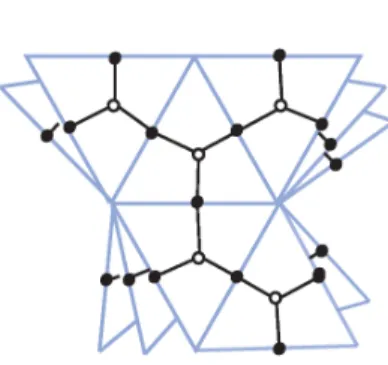
non-separating disk complex of $V$ together with its dual tree isdescribed in Figure 1.
Nowwereturn to thegenus-2 Heegaardsplitting $(V, W;\Sigma)$ of$M$, where $M$is $S^{3},$ $S^{2}\cross S^{1}$
or a lens space. An essential disk $E$ in $V$ is called primitive if there exists
an
essentialdisk $E’$ in $W$ such that $\partial E$ intersects $\partial E’$ transversely in a single point. Such
a
diskEl 1: A portionof the non-separating disk complex$\mathcal{D}(V)$ofa genus-2 handlebody $V$with its dual tree.
that both $WUNbd(E)$ and $VUNbd(E’)$
are
solid tori. Primitive disks are necessarilynon-separating.
The primitive disk complex $\mathcal{P}(V)$ for the splitting $(V, W;\Sigma)$ is defined to be the full
subcomplex of $\mathcal{D}(V)$ spanned by the vertices of primitive disks in V. Rom the structure
of$\mathcal{D}(V)$, we observe that every connected component of any full subcomplex of $\mathcal{D}(V)$ is
contractible. In the following, we will
see
thatthe primitivedisk complexis 1-dimensionalor
2-dimensional, dependingon
the manifold $M$, and it is actually suitable for finding afinite presentation of the
Goeritz
group.3
The
Goeritz
groups
3.1 The 3-sphere
Let $(V, W;\Sigma)$ be the genus-2 Heegaard splitting $(V, W;\Sigma)$ of $S^{3}$. In
this case, the
following holds:
Lemma 3.1 ([4]). The primitive disk complex $\mathcal{P}(V)$ is 2-dimensional and contractible.
The complex$\mathcal{P}(V)$ is actually isomorphic to $\mathcal{D}(V)$.
Using this complex (more precisely, the barycentric subdivision of the dual complex
of $\mathcal{P}(V)$, which is a tree),
one
has the following presentation of the Goeritz group byTheorem 2.1:
Theorem 3.2 ([11], [24], [1] and [4]). The Goeritzgroup
of
the genus-2 Heegaard splitting$(V, W;\Sigma)$
of
$S^{3}$ has the following presentation:$\langle\alpha|\alpha^{2}\rangle\oplus\langle\beta, \gamma, \delta|\gamma^{2}, \delta^{3}, \gamma\beta\gamma\beta^{-1}\alpha, \gamma\delta\gamma\delta^{-1}\rangle.$
Figure 2 illustrates thegenerators$\alpha,$ $\beta,$ $\gamma$and
$\delta$
in the abovepresentationof the Goeritz
$\alpha$(hyperellipticinvolution) $\beta$(order$\infty$)
$\gamma(invo|ut\dot{\ovalbox{\tt\small REJECT}}on)$ $\delta$
(order 3)
$H2$: Thefourgenerators $\alpha,$$\beta,$
$\gamma$ and $\delta$
of the Goeritz group.
3.2 $S^{2}\cross S^{1}$
Let $(V, W;\Sigma)$ be the genus-2 Heegaard splitting of $S^{2}\cross S^{1}$
.
In this case,we can
showthat there exists
a
unique non-separating disk $E_{0}$ in $V$ such that $\partial E_{0}$ also boundsa
diskin $W$. Then we
can
show the following:Lemma 3.3 ([6]). The primitive disk complex $\mathcal{P}(V)$ is exactly the link
of
$E_{0}$ in $\mathcal{D}(V)$.In particular, the complex$\mathcal{P}(V)$ is
a
tree.Using the barycentric subdivision of$\mathcal{P}(V)$,
we
can
obtain the following presentation ofthe Goeritz group by Theorem 2.1:
Theorem 3.4 ([6]). The Goeritz group
of
the genus-2 Heegaard splittingof
$S^{2}\cross S^{1}$ hasthe following presentation:
$\langle\epsilon\rangle\oplus\langle\alpha|\alpha^{2}\rangle\oplus\langle\beta, \gamma, \sigma|\gamma^{2}, \sigma^{2}, (\gamma\beta\sigma)^{2}\rangle.$
The element $\epsilon$ is the Dehn twist about the disk $E_{0}$, which extends to adiffeomorphism
of the whole of $S^{2}\cross S^{1}$ since $\partial E_{0}$ bounds a disk also in $W$. The other generators are
almost the
same
as in the case of $S^{3}.$3.3 Lens spaces
The structure of primitive disk complexes for lens spaces is much more complicated
Recall that thefundamental group of the genus-2 handlebody is the freegroup $\mathbb{Z}*\mathbb{Z}$ of
rank two. An element of $\mathbb{Z}*\mathbb{Z}$ primitive ifit is
a
member ofa
generating pair of$\mathbb{Z}*\mathbb{Z}.$Primitive elements of$\mathbb{Z}*\mathbb{Z}$ have been well understood by [22].
A simple closed
curve
in the boundary ofagenus-2 handlebody $W$ represents elementsof $\pi_{1}(W)=\mathbb{Z}*\mathbb{Z}$. We call
a
pair of essential disks in $W$ a complete meridian systemfor $W$ if the union of the two disks cuts off $W$ into
a
3-ball.Given
a complete meridiansystem $\{D, E\}$, assign symbols $x$ and $y$ to the circles $\partial D$ and $\partial E$ respectively. Suppose
that an oriented simple closed curve $l$ on $\partial W$ that meets $\partial D\cup\partial E$ transversely. Then $l$
determines aword in terms of$x$ and $y$which can be read offfrom the the intersections of
$l$ with $\partial D$ and $\partial E$ (after a choice of orientations
of$\partial D$ and $\partial E$), and hence $l$ represents
an element of the free group $\pi_{1}(W)=\langle x,$$y\rangle.$
Let $(V, W;\Sigma)$ be the genus-2 Heegaardsplittingof
a
lens space $L=L(p, q)$.
Anysimpleclosed curve on the boundary of the solid torus $W$ represents an element of$\pi_{1}(W)$ which
is the free group of rank two. We interpret primitive disks algebraically as follows, which
is a direct consequence of [11].
Lemma
3.5.
Let $D$ bea
non-separating disk in V. Then $D$ is primitiveif
and onlyif
$\partial D$ represents
a
primitiveelement
of
$\pi_{1}(W)$.
Due to Lemma 3.5,
we
canuse
the classical combinatorial group thoery (theOzborn-Zieschang’s criterion [22]) to study the structure of the primitive disk complex. In
par-ticular, we obtain the following:
Lemma 3.6. Given
a
lens space $L(p, q),$ $1\leq q\leq p/2$, witha
genus-2 Heegaard splitting$(V, W_{1}\Sigma)$, suppose that$p\equiv\pm 1$ $(mod q)$. Let $D$ and $E$ be primitive disks in $V$ which
intersect each other transversely and minimally. Then at least one
of
the two disksfrom
surgery on $E$ along an outervnost subdisk
of
$D$ cutoff
by $D\cap E$ is primitive.Remark that Lemma 3.6 and Theorem 2.2 imply that primitive disk complex $\mathcal{P}(V)$ for
$L(p, q)$, $1\leq q\leq p/2$ is contractible provided $p\equiv\pm 1$ $(mod q)$
.
Actually, wecan
showthat this is the only
case
for $\mathcal{P}(V)$ to be connected:Lemma 3.7. For a lens space $L(p, q)$ with $1\leq q\leq p/2$, the primitive disk complex $\mathcal{P}(V)$
is contractible
if
and onlyif
$p\equiv\pm 1$ $(mod q)$.If
$p\not\equiv\pm 1$ $(mod q)$, $\mathcal{P}(V)$ consistsof
infinitely many trees.
Figure 3 shows the shape of primitive disk complexes $\mathcal{P}(V)$ for $L(p, q)$, $1\leq q\leq p/2.$
As we can see in the figure, the primitive disk complex is 1-dimensional or 2-dimensional,
depending on the parameter $(p, q)$ of
a
lens space. The number on each edge shows the$L(2,1)$ $L(\rho, 1)$, $p\leq 4$ $L(p, q)$, $q>3,$ $\rho\neq 2q+1$
$L(3,1) L(5,2) L(2q+1, q) , q\leq 3$
$H3$: Aportion of eachprimitive diskcomplex$\mathcal{P}(V)$.Considering the action of the Goeritz groups
on
the primitivedisk complexes in detail,we
finally get the following:Theorem 3.8. The genus-2 Goeritz group
of
a
lens space $L(p, q)$, $1\leq q\leq p/2$, with$p\equiv\pm 1$ $(mod q)$ has the following presentations:
1.
If
$q=1$, thenwe
have: (a) $\langle\beta,$$\rho,$$\gamma|\rho^{4},$$\gamma^{2},$ $(\gamma\rho)^{2},$$\rho^{2}\beta\rho^{2}\beta^{-1}\rangle$
if
$p=2$;(b) $\langle\alpha|\alpha^{2}\rangle\oplus\langle\beta,$$\delta,$$\gamma|\delta^{3},$$\gamma^{2},$ $(\gamma\delta)^{2}\rangle$
if
$p=3$; (c) $\langle\alpha|\alpha^{2}\rangle\oplus\langle\beta,$ $\gamma,$$\sigma|\gamma^{2},$ $\sigma^{2}\rangle$if
$p\geq 4,\cdot$2.
If
$q>1$, thenwe
have:(a) $\langle\alpha|\alpha^{2}\rangle\oplus\langle\beta_{1},$$\beta_{2},$ $\gamma_{1},$
$\gamma_{2}|\gamma_{1^{2}},$$\gamma_{2^{2}}\rangle$
if
$p=5$; (b) $\langle\alpha|\alpha^{2}\rangle\oplus\langle\beta_{1},$$\beta_{2},$$\gamma_{1},$$\gamma_{2},$$\sigma|\gamma_{1^{2}},$$\gamma_{2^{2}},$$\sigma^{2}\rangle$if
$p=2q+1$ and $q\geq 3$, or$p>5$ and$q=2$;
(c) $\langle\alpha|\alpha^{2}\rangle\oplus\langle\beta,$
$\gamma,$$\sigma_{1},$$\sigma_{2}|\gamma^{2},$$\sigma_{1^{2}},$$\sigma_{2^{2}}\rangle$
if
$q^{2}\equiv 1$ $(mod p)$;(d) $\langle\alpha|\alpha^{2}\rangle\oplus\langle\beta_{1},$$\beta_{2},$$\gamma_{1},$$\gamma_{2},$$\sigma_{1},$$\sigma_{2}|\gamma_{1^{2}},$$\gamma_{2^{2}},$$\sigma_{1^{2}},$
3.4 Non-prime 3-manifolds
Let $(V, W;\Sigma)$ be a genus-2 Heegaard splitting $(V, W;\Sigma)$ ofanon-prime 3-manifold $M.$
Remarkthat in this
case
$M$ might admit severalnon-isotopic genus2
Heegaard splittings.When $M=(S^{2}\cross S^{1})\#(S^{2}\cross S^{1})$, $M$ is the double of the genus-2 handlebody $V$
.
Thisimplies that the Goeritz group of $(V, W;\Sigma)$ is isomorphic to the genus-2 handlebody
group, whose presentation is well-understood. Thus in the following
we
assume that atleast one summand of the connected sum is a lens space. There is no primitive disks
in $V$ in this case, but
we can
use
the semi-primitive disks. An essential disk $E\subset V$ issemi-primitive if there exists
a
Haken sphere $P$ for the splitting $V \bigcup_{\Sigma}W$ disjoint from$\partial E$
.
Thenthe semi-primitive disk complex$S\mathcal{P}(V)$ is defined tobe the full subcomplex of
$\mathcal{D}(V)$ spanned by semi-primitive disks in $V.$
Lemma 3.9 ([7]). 1.
If
$M$ is the connected sumof
two lens spaces, then thesemi-primitive disk complex $\mathcal{S}\mathcal{P}(V)$ is
a
tree.2.
If
$M$ is the connectedsum
of
$S^{2}\cross S^{1}$ and a lens space, then the semi-primitive diskcomplex$S\mathcal{P}(V)$ is a
cone
on a tree.A Haken sphere $P$ of $(V, W;\Sigma)$ is said to be reversible if there exists
an
element 9 of $\mathcal{G}$fixing $P$ setwise such that
$g$ restricted to $P$ is an orientation-reversing homeomorphism
on $P$
.
We say that the splitting $(V, W;\Sigma)$ is symmetric if it admitsa
reversible Hakensphere.
Theorem 3.10. Let $M_{1}$ be a lens space or $S^{2}\cross S^{1}$, and let $M_{2}$ be a lens space. Let
$(V, W;\Sigma)$ be a genus two Heegaard splitting
for
$M_{1}\# M_{2}$. Then the Goeritz groupof
$(V, W;\Sigma)$ has the following presentation:
1.
If
$M_{1}$ is a lens space,(a) $\langle\alpha|\alpha^{2}\rangle\oplus\langle\beta,$
$\gamma_{1},$$\gamma_{2}|\gamma_{1^{2}},$$\gamma_{2^{2}}\rangle$
if
$(V, W;\Sigma)$ is not symmetric;(b) $\langle\alpha|\alpha^{2}\rangle\oplus\langle\beta,$ $\gamma_{1},$$\delta|\gamma_{1^{2}},$ $\delta^{2},$$\delta\beta\delta=\alpha\beta\rangle$
if
$(V, W;\Sigma)$ is symmetric; 2.If
$M_{1}=S^{2}\cross S^{1},$ $\langle\alpha|\alpha^{2}\rangle\oplus\langle\beta,$ $\gamma,$$\sigma|\gamma^{2},$ $\sigma^{2}\rangle\oplus\langle\tau\rangle.$4
Tree of
knot tunnels
Let $(V, W;\Sigma)$ be agenus-2 Heegaard splitting $(V, W;\Sigma)$ of$M$, where $M$ is $S^{3},$ $S^{2}\cross S^{1}$
or a lens space.
Aknot $K$ in $M$ is said to be of tunnel number-l ifthere is
an
arc $\tau$ meeting $K$ only inits endpoints so that $Nbd(K\cup\tau)$ is isotopic to $V$ in $M$. The
arc
$\tau$ is called a tunnel forLet $\tau$ be
a
tunnel ofa
tunnel number-l knot $K$ in $M$. Up to isotopy, theco-core
ofa
thickening of$\tau$
can
be regardedas a
non-separating disk in $V$ as illustrated in Figure 4.$\otimes 4$: Correspondence between a tunnel and anon-separatingdiskin $V.$
Conversely, each non-separating disk $D$ in $V$ can be considered as a tunnel ofthe
core
loop of the solid torus cut off from $V$ along $D$
.
For instance when $M=S^{3}$,a
primitivedisk corresponds to the trivial tunnel of the trivial knot,
see
Figure 5.$rightarrow$
$|\Phi 5$: Correspondence between the trivial tunnel and aprimitive diskin $V.$
In this way, each tunnel corresponds to avertex of$\mathcal{D}(V)$. However, this correspondence
has an indeterminacy because there
are
many isotopies thatmove
the union $Nbd(K\cup\tau)$a
knot $K$ and its tunnel $\tau$ to $V$.
In fact, each tunnel corresponds to infinitely manyvertices of$\mathcal{D}(V)$. However, this indeterminancy is exactly up to the Goeritz group $\mathcal{G}=$
$\mathcal{M}C\mathcal{G}_{+}(M, V)$
.
Thus, there is a one-to-one correspondence between the collenction of(equivalent classes of) tunnels and the set of vertices of the quotient $\mathcal{D}(V)/\mathcal{G}$ that
comes
from $\mathcal{D}(V)$. This quotient complex $\mathcal{D}(V)/\mathcal{G}$ provide
us
a bird’s- eye view of the set oftunnels of tunnel number-l knots in $M$. If the Goeritz group $\mathcal{G}$ and its action on $\mathcal{D}(V)$
are well-understood, we have a precise description of the quotient $\mathcal{D}(V)/\mathcal{G}.$
For $S^{3}$, Cho-McCullough [10] showed the following:
Theorem 4.1 ([10]). Let $\mathcal{T}$ be the dual complex
of
$\mathcal{D}(V)$, which is a tree. Every tunnelfor
a tunnel number-l knot in $S^{3}$ isdetermined uniquely (up to equivalence)) by a
finite
sequence
of
consecutive verticesof
the tree $\mathcal{T}/\mathcal{G}$ starting at the unique vertex comingfrom
a triple $\{D, E, F\}$
of
pairwise disjoint primitive disks in $V.$Since
now
we know the Goeritz group and its action on $\mathcal{D}(V)$ very well,we are
readyto describe the quotient complex$\mathcal{D}(V)/\mathcal{G}$ also for $S^{2}\cross S^{1}$ and lens spaces. For example,
$rightarrow^{/\mathcal{G}}$
$\mathcal{D}(V)$
Corollary 4.2. Let $\mathcal{T}$ be
the dual complex
of
$\mathcal{D}(V)$, which is a tree. Every tunnelfor
atunnel number-l knot in $S^{2}\cross S^{1}$ is determined uniquely (up to equivalence)) by a
finite
sequence
of
consecutive verticesof
the tree$\mathcal{T}/\mathcal{G}$ starting at the unique vertex comingfrom
a triple $\{E_{0}, D, E\}$
of
pairwise disjoint disks in $V$, where $E_{0}$ is the unique diskdefined
inSection 3.2, and $D$ and $E$
are
primitive disks.5
Space of
Heegaard splittings
Let $M$ be a closed, orientable 3-manifold, and suppose that $\Sigma$ is a Heegaard
surface
of$M$
.
Due to [18], the space ofleft cosets $\mathcal{H}(M, \Sigma)$ $:=Diff(M)/Diff(M, \Sigma)$ is called thespace
of
Heegaard splittings equivalent to $(M, \Sigma)$. We note that this is a huge space andour
main interest is its homotopy type. Remark that $\pi_{0}(\mathcal{H}(M, \Sigma))$ is exactly the set ofisotopy classes of Heegaard splittings equivalent to $(M, \Sigma)$.
Let $(V, W;\Sigma)$ be the genus-2 Heegaard splitting of a lens space $L=L(p, q)$ with $1\leq$
$q\leq p/2$. By [2] and [3], $\pi_{0}(\mathcal{H}(L(p, q), \Sigma))$ consists of one or two points depending on
whether or not $L(p, q)$ admits
an
orientation-reversing diffeomorphism onto itself. ForTheorem 5.1 ([18]). 1. Up to the Smale Conjecture, $\pi_{i}(\mathcal{H}(L(2,1), \Sigma))\cong\pi_{1}(S^{3}\cross S^{3})$
for
$i\geq 2.$2.
If
$p\geq 3,$ $\pi_{i}(\mathcal{H}(L(p, 1), \Sigma))\cong\pi_{1}(S^{3})$ $fori\geq 2.$3.
If
$q\geq 2,$ $\pi_{i}(\mathcal{H}(L(p, q), \Sigma))\cong 0$for
$i\geq 2.$On
the other hand, $\pi_{1}(\mathcal{H}(L(p, q), \Sigma))$ remains unknown. However, by [18]we
havea
short exact sequence
$1arrow\pi_{1}(Diff(M))arrow\pi_{1}(\mathcal{H}(M, \Sigma))arrow G(M, \Sigma)arrow 1,$
where $G(M, \Sigma)$is thekernel of the naturalhomomorphism$\mathcal{M}C\mathcal{G}(M, \Sigma)arrow \mathcal{M}C\mathcal{G}(M)$. We
remark that, in general, the group $\pi_{1}(Diff(M))$ is not finitely-generated for a reducible
3-manifold $M$. In our case, due to the Smale the Smale Conjecture for the elliptic
3-manifolds by [14], $Diff(L(p, q))$ is homotopy equivalent to the isometry groups of $L(p, q)$,
which implies that $\pi_{1}(Diff(L(p,$$q$ is finitely presented. Recalling the mapping class
groups of lens spaces
are
finite by [2],we see
that theGoeritz
group $\mathcal{M}C\mathcal{G}_{+}(L(p, q))$is virtually isomorphic to the group $G(M, \Sigma)$
.
In particular, $\mathcal{M}C\mathcal{G}_{+}(L(p, q))$ is finitelypresented if and only if so is $G(M, \Sigma)$. Hence by Theorem 3.10, the following holds:
Corollary 5.2. For the genus-2 Heegaard splitting $L(p, q)=V \bigcup_{\Sigma}W$
of
a lens space$L(p, q)$, where$p\equiv\pm 1$ $(mod q)$ and $1\leq q\leq p/2,$ $\pi_{1}(\mathcal{H}(L(p, q), \Sigma))$ isfinitely presented.
References
[1] Akbas, E., A presentation for the automorphisms of the 3-sphere that preserve a
genus two Heegaard splitting, Pacific J. Math. 236 (2008),
no.
2,201-222.
[2] Bonahon, F., Diff\’eotopies des espaces lenticulaires, Topology 22 (1983),
no.
3,305-314.
[3] Bonahon, F., Otal, J.-P., Scindements de Heegaard des espaces lenticulaires, Ann.
Sci.
\’Ec.
Norm. Sup. (4) 16 (1983), no. 3,451-466.
[4] Cho, S., Homeomorphismsof the 3-sphere that preserve aHeegaard splitting of genus
two, Proc. Amer. Math. Soc. 136 (2008), no. 3, 1113-1123.
[5] Cho, S., Genus two Goeritz groups of lens spaces, Pacific J. Math. 265 (2013), no.
1, 1-16.
[6] Cho, S., Koda,
y.,
The genus two Goeritz group of $\mathbb{S}^{2}\cross \mathbb{S}^{1}$, Math. Res. Lett. 21
[7] Cho, S., Koda, Y., Diskcomplexes and genus two Heegaard splittings for non-prime
3-manifolds, to appear in International Mathematics Research Notices.
[8] Cho, S., Koda, Y., Seo, A., Arc complexes, sphere complexes and Goeritz groups,
arXiv:
1403.7832.
[9] Cho, S., Koda, Y., Connectedprimitive disk complexes and genustwo Goeritz groups
of lens spaces, arXiv:
1505.04993.
[10] Cho, S., McCullough, D., The tree of knot tunnels, Geom. Topol. 13 (2009),
no.
2,769-815.
[11] Gordon, C. McA., Onprimitivesets of loops in the boundary of a handlebody,
Topol-ogy Appl.
27
(1987),no.
3,285-299.
[12] Gordon, C. McA., Problems. Workshop
on
Heegaard Splittings, pp. 401-411, Geom.Topol. Monogr. 12, Geom. Topol. Publ., Coventry, 2007.
[13] Hempel, J., 3-manifolds as viewed from the curve complex, Topology 40 (2001),
631-657.
[14] Hong, S., Kalliongis, J., McCullough, D., Rubinstein, J. H., Diffeomorphisms
of
elliptic 3-manifolds, Lecture Notes in Mathematics, 2055. Springer, Heidelberg, 2012.
[15] Johnson, J., Mapping class groups of medium distance Heegaard splittings, Proc.
Amer. Math. Soc. 138 (2010), 4529-4535.
[16] Johnson, J., Automorphisms of the three-torus preserving
a
genus-three Heegaardsplitting, Pacific J. Math. 253 (2011),
no.
1,75-94.
[17] Johnson, J., Mapping class groups of once-stabilized Heegaard splittings,
arXiv:1108.5302.
[18] Johnson, J., McCullough, D., The space of Heegaard splittings, J. Reine Angew.
Math. 679 (2013),
155-179.
[19] Koda, Y., Automorphisms of the 3-sphere that preserve spatial graphs and
handlebody-knots, to apper in Math. Proc. Cambridge Philos. Soc.
[20] McCullough, D., Virtually geometrically finite mapping class groups of3-manifolds,
J. Differential Geom. 33 (1991),
no.
1, 1-65.[21] Namazi, H., Big Heegaard distance implies finite mapping class group, Topology
[22] Osborne, R. P., Zieschang, H., Primitives in the free group
on
two generators, Invent.Math. 63 (1981),
no.
1,17-24.
[23] Rolfsen, D., Knots and links, Mathematics Lecture Series, No.
7.
Publishor
Perish,Inc., Berkeley, Calif., 1976.
[24] Scharlemann, M., Automorphismsof the 3-spherethat preserve
a
genustwoHeegaardsplitting, Bol. Soc. Mat. Mexicana (3) 10 (2004), Special Issue,
503-514.
[25] Scharlemann, M., Generating the genus $g+1$ Goeritz group ofa genus 9 handlebody,
Geometry and topology down under, 347-369, Contemp. Math., 597, Amer. Math.
Soc., Providence, RI, 2013.
[26] Serre, J.-P., Trees, Translated from the French by John Stillwell, Springer-Verlag,
Berlin-New York,
1980.
[27] Waldhausen, F., Heegaard-Zerlegungen der 3-Sph\"are, Topology 7 (1968),
195-203.
Department of Mathematics Education
Hanyang University
Seou1133-791,
KOREA
$E$-mail address: [email protected]
Department of Mathematics Hiroshima University
1-3-1 Kagamiyama, Higashi-Hiroshima, 739-8526,
JAPAN
$E$-mail address: [email protected]