渦管の
3
次元不安定性再考
九大数理 福本 康秀
(Yasuhide Fukumoto)
Graduate School of
Mathematics,
Kyushu University
概要 3 次元流中において 1 本の渦管に着目したとき, まわりの渦や背景流の影響は, まず 移流として, 次にその渦管の中心線上の各点を原点とする局所線形ひずみ流として近似的 にとりこむことができよう. 渦度に垂直な断面内に速度成分をもつ 2 次元純粋ずり流中 におかれたまっすぐな渦管は 3 次元撹乱に対して線形不安定であることが, 単純な設定 のもとで Widnall 等によって具体的に明らかにされた 1). Widnall 不安定’ はそれ以後の 渦管の安定性の議論における中心をなす
:
局所純粋ずり流によって断面がわずかに楕円形に変形した渦柱を基本流にとる. 断面 が円形の渦は中立安定である. とくに, 渦度分布が一様のものが ‘Rankine の渦’ で, そ の上に立つ無限個の固有振動モードは ‘Kelvin 波’ とよばれる. 渦度ベクトルに垂直な断面 (x 架平面) 上に渦中心を原点とする極座標 $(r, \theta)$ を導入しよう. 純粋ずり流は $\cos 2\theta$ と
sin20 によって特徴づけられる. いわゆる, ‘四重極子’ 流である. この四重極子場を介し
て, Kelvin 波のうちの右巻き・左巻きの屈曲モード ($e^{\dot{|}\theta}$, $e^{-\dot{|}\theta}$
成分) が共鳴を起こして指 数関数的に成長する, というのがそのシナリオである. 本研究では, Widnall 不安定’ をハミルトンカ学系におけるスペクトル理論の枠組み に乗せ, これを別の側面から眺めてみる. Krein の理論によると, 単独の Kelvin モード に微小摂動を加えても不安定化することはなく, 少なくとも 2 個のモードの波数 $k$ と周 波数 $\omega$ が一致して始めて不安定化が可能になる. すなわち, $(k, \omega)$ 平面上に描かれた分 散関係を表す 2 木, もしくはそれ以上の, 曲線が交差しなければならない. 円形渦に対す
る摂動が四重極子流である場合には, $e^{\dot{|}m\theta}$, $e^{\dot{|}n\theta}$ 型の角度依存性をもつ 2 つの Kelvin モー
ドが, 関係 $|m-n|=2$ を満たすときに限って, 分散曲線の交点上で共鳴を起こし得る.
実際, 2 つの屈曲モード $m=1$ と $n=-1$ はこの条件を満たしている. しかし, 分散曲
線が交差すればいつでも不安定化するというわけではない. 攪乱がもつエネルギーの符号
が問題で, 同符号のエネルギーをもつ攪乱同士では不安化は起こり得ず, 片方の攪乱のエ
ネルギーが正で他方が負であることが共鳴不安定のための必要条件である.
さて, Widnall&Tsai (J. Fluid Mech. 1976) での固有値・固有関数の表式は不定積
分を残したままになっており, 当時の数値計算では十分な精度が得られなかったようで ある. 実はこの積分は実行できて線形安定性問題の解が Bessel 関数を用いてあらわに書 き下せることに気づいた. 固有値・固有関数の高精度数値計算をもとに Widnall&Tsai (1976) の不備を修復し, さらに, Widnall 不安定’ と‘楕円型不安定’ との関係について 検討を加える (\S 4). 屈曲波の分散曲線の交点上で必ずパラメータ共鳴不安定が起こる. Kelvin 波のエネル ギーの計算を実行し, この結果が Krein 理論と矛盾しないことを示す (\S 5). これらの結果の要約については FukumotO&Hattori (2002 も参照されたい. 数理解析研究所講究録 1271 巻 2002 年 210-219
210
1Introduction
Moore
&Saffman
(1975) and Tsai&Widnall
(1976), hereinafter being referred to as MS75 and TW76 respectively, addressed athree-dimensional linear stability problem ofa
straight vortex tubeembeddedin aplane pureshearflowwith its principalaxes
perpendic-ular to thetubeaxis, anduncovered theessence ofaparametricresonancebetween the left-and right-hleft-anded helical
waves
driven by the imposed shear. TheMoore-Saffman-Tsai-Widnall instability is rather successfully adapted to
an
explanation for the short-waveinstability of vortex rings (Widnall&Tsai 1977).
This paper makes
an
attempt at simplifying the results of TW76. We show that theEuler equations for the disturbance flow field
are
solvable, to first order in the shear strength $\epsilon$, solely in terms of the Bessel and the modified Bessel functions, without hav-ing to include integrals. Compact formulae are available for the growth rate and the wavenumber range of unstable modes, whereby the numerical accuracy is considerably improved. Numerical computation leads us to abeliefthat the parametric resonance in-stability comes into Play at every intersection point ofbending waves. It is found that, inthe short-wave limit, only the non-rotating modes survive; the maximum growth rate of rotating
resonance
instability modes decays to zero, whereas that ofnon-rotating modesapproaches $9\epsilon/16$, the value derived by Waleffe (1990).
Aclue to
an
understanding of the wavenumber dependence ofspectra lies in Krein’s theory of parametricresonance
in Hamiltonian systems (Krein 1950; MacKay 1986). Asingle Kelvin wave cannot be fed by aperturbation breaking the circular symmetry. The perturbation is the pure shear
or
aquadrupole field which is proportional to $\cos 2\theta$ and$\sin 2\theta$in polar coordinates $(r, \theta)$. Subjected to aquadrupole field, two Kelvin
waves
of theform $\exp(im\theta)$ and $\exp(in\theta)$ with azimuthal wavenumber difference $|m-n|=2$
can
becooperatively amplifiable when the $\mathrm{e}\mathrm{i}\mathrm{g}\mathrm{e}\mathrm{n}\mathrm{v}\mathrm{a}1\mathrm{u}\mathrm{e}\mathrm{s}-i\omega_{0}$ collide on the imaginary axis
as
the parameter $k_{0}$ isvaried, provided eitherthat thecollisioneigenvalue iszero orthat thesignsof the wave energy are different from each other at
anon-zero
collision frequency. Sincethe
wave
energy is quadratic in amplitude, nonlinear solution of waveson
the Rankinevortex would be wanted. Cairns’ formula (Cairns 1979) offers
an
efficient machinery tobypass this procedure.
In \S 2,
we
give aconcise description ofTsai-Widnall’s formulation. Section3accom-modates the linear dispersion relation. In \S 4,
we
integrate the linearized Euler equationsto $O(\epsilon)$ and examine how thequadrupole field affectsthe eigenvaluesofthe Kelvinwaves.
The eigenvalue problem to $O(\epsilon)$ encounters asingularity at $\omega_{0}=0$
.
Care is exercised forthese static
waves
in \S 4.2, which precedes ageneralcase
of$\omega_{0}\neq 0$ in\S 4.3.
In \S 5, theexcess energy necessary toexcite the Kelvin waves is calculated through Cairns’ formula.
2Setting of stability
problem
In the absence of shear, the basic flow is astraight vortex tube with circular
core
ofradius $a$ and circulation $\Gamma$, surrounded by
an
irrotational flow ofinfinite expanse. Letus
introduce cylindrical coordinates $(r, \theta, z)$ with the $z$-axis along the centerline ofthe
core
The radial coordinate $r$ is normalized by the
core
radius $a$, the velocity by the maximumazimuthalvelocity $\Gamma/2\pi a$, and thepressureby$\rho(\Gamma/2\pi a)^{2}$ with$\rho$beingthe densityoffluid.
Suppose that the pure shear flow ofstrength $\epsilon$ is externally imposed. Let the r- and $\theta$-components of velocity field be $U$ and $V$, and the pressure be $P$. We denote by 4 the velocity potential for the irrotational flow field outside the
core.
The perturbation solution in powers of$\mathrm{e}$ is represented, to$O(\epsilon)$,as
$U$ $=$ $\epsilon U_{1}(r, \theta)+\cdots$ , $V=V_{0}(r)+\epsilon V_{1}(r, \theta)+\cdots$ ,
$P$ $=$ $P_{0}(r)+\epsilon P_{1}(r, \theta)+\cdots$ , $\Phi=\Phi_{0}(\theta)+\epsilon\Phi_{1}(r, \theta)+\cdots$ (2.1)
The subscript designates order in $\epsilon$
.
The leading-0rder flow is the Rankine vortex:$V_{0}=\{$ $r$ $1/r$, $P_{0}=\{$ $r^{2}/2-1$ $(r\leq 1)$ $-1/(2r^{2})$ $(r>1)$ (2.2)
The first-0rder perturbation is apure shear flow. Within the core,
$U_{1}=-r\sin 2\theta$, $V_{1}=-r\cos 2\theta$, $P_{1}=0$ for r $<R(\theta, \epsilon)$. (2.3) The velocity potential for the exterior flow is
$\Phi_{1}=(r^{-2}-r^{2})\sin 2\theta/4$
.
(2.4)The boundary shaper $=R(\theta, \epsilon)$ of the
core
cross-section isan
ellipse of small eccentricitywith the major axis along the x axis $(\theta=0)$:
$R(\theta,\epsilon)=1+\epsilon\cos 2\theta/2+O(\epsilon^{2})$
.
(2.5)We inquire into evolution of three-dimensional disturbances of infinitesimal amplitude superposed on this steady strained vortex. Suppose that the boundary of the core is disturbed to
$r=R(\theta, \epsilon)+\eta(\theta, z, t, \epsilon)$, (2.6)
where
we
assume
superposition of normal modes for the disturbance amplitude$\eta$.
Follow-ing the prescription ofMS75 and TW76,
we
seek the solution for the disturbance velocity $\overline{v}$, the disturbancepressure$\tilde{p}$ and the externaldisturbance velocity-potential
$\tilde{\phi}$ in apower
series of$\epsilon$ to first order:
$\tilde{v}=(v_{0}+\epsilon v_{1}+\cdots)e^{:(kz-\omega t)}$ , $\tilde{\phi}=(\phi_{0}+\epsilon\phi_{1}+\cdots)e^{:(kz-(\nu t)}$
.
(2.7)Concomitantly, the wavenumber k and the frequency $\omega$
are
also expandedas
k $=k_{0}+\epsilon k_{1}+\cdots$ , $\omega$ $=\omega_{0}+\epsilon\omega_{1}+\cdots$ (2.8)
3Kelvin
waves
Suppose that an infinitesimal-amplitude wave is superposed on the Rankine vortex, by
deforming the circular core into
$r=\eta(\theta, z, t)=1+A_{0}^{(m)}\exp[i(m\theta+k_{0}z-\omega_{0}t)]$. (3.9)
As aconsequence, the disturbance flow field (2.7) takes, to $O(\epsilon^{0})$, the following form:
$v_{0}=v_{0}^{(m)}(r)e^{im\theta}$ , $\pi_{0}=\pi_{0}^{(m)}(r)e^{im\theta}$, $\phi_{0}=\phi_{0}^{(m)}(r)e^{:m\theta}$ (3.10)
With this form, the linearized Euler equations and the boundary conditions
are
cast into an eigenvalue problem. Define$\eta_{m}^{2}=[4/(\omega_{0}-m)^{2}-1]k_{0}^{2}$, (3.11)
and denote the $z$-component of disturbance velocity by $w$
.
The bending
waves
$(m=\pm 1)$ play the key role in the Moore-Saffman-Tsai-Widnallinstability. Writingsimply $\eta\pm$ for $\eta\pm 1$ and using the $\mathrm{s}\mathrm{u}\mathrm{p}\mathrm{e}\mathrm{r}\mathrm{s}\mathrm{c}\mathrm{r}\mathrm{i}\mathrm{p}\mathrm{t}\pm \mathrm{f}\mathrm{o}\mathrm{r}m=\pm 1$of the flow field, the eigenfunction and dispersion relation become
$\phi_{0}^{(\pm)}=K_{1}(k_{0}r)\alpha_{0}^{(\pm)}$ for
$r>\eta$, (3.12)
and
$\pi_{0}^{(\pm)}=J_{1}(\eta_{\pm}r)\beta_{0}^{(\pm)}$ , $w_{0}^{(\pm)}= \frac{k_{0}}{\omega_{0}\mp 1}J_{1}(\eta_{\pm}r)\beta_{0}^{(\pm)}$,
$u_{0}^{(\pm)}= \frac{i}{2}[-(\frac{1}{\omega_{0}\pm 1}+\frac{1}{\omega_{0}\mp 3})\eta_{\pm}J_{0}(\eta_{\pm}r)+\frac{2}{\omega_{0}\mp 3}\frac{J_{1}(\eta_{\pm}r)}{r}]\beta_{0}^{(\pm)}$ ,
$v_{0}^{(\pm)}= \pm\frac{1}{2}[(\frac{1}{\omega_{0}\pm 1}-\frac{1}{\omega_{0}\mp 3})\eta_{\pm}J_{0}(\eta_{\pm}r)+\frac{2}{\omega_{0}\mp 3}\frac{J_{1}(\eta_{\pm}r)}{r}]\beta_{0}^{(\pm)}$ for $r<\eta$,
(3.13)
where
$\alpha_{0}^{(\pm)}=\frac{iJ_{1}(\eta_{\pm})}{(\omega_{0}\mp 1)K_{1}(k_{0})}\beta_{0}^{(\pm)}$ , (3.14)
and
$\eta\pm J_{1}(\eta_{\pm})K_{0}(k_{0})-k_{0}J_{0}(\eta_{\pm})K_{1}(k_{0})\pm\frac{2(\omega_{0}\pm 1)k_{0}}{(\omega_{0}\mp 1)^{2}\eta\pm}J_{1}(\eta_{\pm})K_{1}(k_{0})=0$. (3.15)
4Effect of
pure
shear
4.1
The equations for
disturbances
We explore how the pure shear (2.3) of$O(\epsilon)$ modifies Kelvin’s dispersion relation. Given
both types of bending
waves
to $O(\epsilon^{0})$,$v_{0}=v_{0}^{(+)}e^{i\theta}+v_{0}^{(-)}e^{-i\theta}$, (4.1
then the
wave
excited to $O(\epsilon)$ possess the following angular dependence:$v_{1}=v_{1}^{(+)}e^{\dot{|}\theta}+v_{1}^{(-)}e^{-\dot{|}\theta}+v_{1}^{(0)}+v_{1}^{(3)}e^{3:\theta}+v_{1}^{(-3)}e^{-3\theta}|.$, (4.2)
The general solution for the potential for the exterior velocity is readily obtainable as
$\phi_{1}^{(\pm)}=K_{1}(k_{0}r)\alpha_{1}^{(\pm)}-k_{1}rK_{0}(k_{0}r)\alpha_{0}^{(\pm)}$ , (4.3)
where $\alpha_{1}^{(\pm)}$ is aconstant imparted to the homogeneous part ofsolution.
The Euler equations for the vortical disturbance in the
core
is reduced toasecond-orderordinary differentialequationfor thedisturbance pressure $\pi_{1}^{(\pm)}$ in the following way:
$[ \frac{d^{2}}{dr^{2}}+\frac{1}{r}\frac{d}{dr}-\frac{1}{r^{2}}+\eta_{\pm}^{2}]\pi_{1}^{(\pm)}=\{\frac{8\omega_{1}}{(\omega_{0}\mp 1)^{3}}k_{0}^{2}-2\frac{k_{1}}{k_{0}}\eta_{\pm}^{2}\}J_{1}(\eta_{\pm}r)\beta_{0}^{(\pm)}$
$+k_{0}^{2} \{\pm[\frac{1}{(\omega_{0}+1)^{2}}-\frac{1}{(\omega_{0}-1)^{2}}]\eta_{\mp}rJ_{0}(\eta_{\mp}r)-\frac{3\pm 2\omega_{0}}{(\omega_{0}\pm 1)^{2}}J_{1}(\eta_{\mp}r)\}\beta_{0}^{(\mp)}$ (4.4)
The boundary conditions to be imposed at the core interface $(r=1)$ read, to $O(\epsilon)$,
$\frac{d\phi_{1}^{(\pm)}}{dr}-u_{1}^{(\pm)}=\frac{1}{4}\frac{du_{0}^{(\mp)}}{dr}\mp\frac{i}{2}v_{0}^{(\mp)}+\frac{1}{2}\phi_{0}^{(\mp)}-\frac{1}{4}\frac{d^{2}\phi_{0}^{(\mp)}}{dr^{2}}$ , (4.5) $\pi_{1}^{(\pm)}-i(\omega_{0}\mp 1)\phi_{1}^{(\pm)}=i\omega_{1}\phi_{0}^{(\pm)}\mp\frac{i}{2}\phi_{0}^{(\mp)}+\frac{i}{4}(\omega_{0}\mp 1)\frac{d\phi_{0}^{(\mp)}}{dr}-\frac{1}{4}\frac{d\pi_{0}^{(\mp)}}{dr}$
.
(4.6)So far
we
have kept track ofthe formulation ofTW76. Weare now
in aposition to show that (4.4) is explicitly solvable in acompact form. It will turn out that the solution suffers from asingularity at $\omega_{0}=0$ (see (4.17)), which calls foran
individual treatment.We begin with the
case
of$\omega_{0}=0$ in \S 4.2, and thecase
of$\omega_{0}\neq 0$ follows in\S 4.3.
4.2
The
case
of
$\omega 0$ $=0$When restricted to$\omega_{0}=0$, (3.11) becomes
$\eta_{+}=\eta_{-}=\sqrt{3}k_{0}$
.
(4.7)Inspection tells
us
that ageneral solution of(4.4) finite at $r=0$ is$\pi_{1}^{(\pm)}=J_{1}(\sqrt{3}k_{0}r)\beta_{1}^{(\pm)}+\{\pm\frac{4\omega_{1}}{\sqrt{3}}k_{0}+\sqrt{3}k_{1}\}rJ_{0}(\sqrt{3}k_{0}r)\beta_{0}^{(\pm)}+\frac{\sqrt{3}}{2}k_{0}rJ_{0}(\sqrt{3}k_{0}r)\beta_{0}^{(\mp)}$ ,
(4.8)
where $\beta_{1}^{(\pm)}$ is aconstant associated with the homogeneous solution. The disturbance
radial velocity field in the
core
is deduced atonce
by returning to the Euler equationsas
$u_{1}^{(\pm)}= \mp\frac{i}{3}\{\sqrt{3}k_{0}J_{0}(\sqrt{3}k_{0}r)+\frac{J_{1}(\sqrt{3}k_{0}r)}{r}\}\beta_{1}^{(\pm)}$
$+i \{\omega_{1}[-\frac{7k_{0}}{3\sqrt{3}}J_{0}(\sqrt{3}k_{0}r)+(\frac{4k_{0}^{2}}{3}r-\frac{1}{9r})J_{1}(\sqrt{3}k_{0}r)]$
$\mp k_{1}[\sqrt{3}J_{0}(\sqrt{3}k_{0}r)-k_{0}rJ_{1}(\sqrt{3}k_{0}r)]\}\beta_{0}^{(\pm)}\pm ik_{0}^{2}rJ_{1}(\sqrt{3}k_{0}r)\beta_{0}^{(\mp)}$ , (4.2)
Substitution of (4.3), (4.8) and (4.9), along with the solution (3.12) and (3.13) for the Kelvin waves, into the boundary conditions (4.5) and (4.6) with $\omega_{0}=0$, yields a coupled system of linear algebraic equations for $\alpha_{1}^{(\pm)}$ and $\beta_{1}^{(\pm)}$. This
is further simplified
with the aid of the dispersion relation (3.15). Hereinafter we
use
the shorthand notation$\mathrm{a}\mathrm{s}K_{0}=K_{0}(k_{0})$ and $K_{1}=K_{1}(k_{0})$
.
The resulting equationsare
thencollected in matrix form$\{$ $-(k_{0}K_{0}+K_{1})\pm iK_{1}$ $\pm\frac{*}{3}[\sqrt{3}k_{0}J_{0}(\sqrt{3}k_{0})+J_{1}(\sqrt{3}k_{0})])(\beta_{1}^{(\pm)}\alpha_{1}^{(\pm)})=(\begin{array}{l}F^{(\pm)}G^{(\pm)}\end{array})$ , (4.10) $J_{1}(\sqrt{3}k_{0})$ where $F^{(\pm)}=iJ_{1}( \sqrt{3}k_{0})\{[\frac{\omega_{1}}{3}(4k_{0}^{2}-5-\frac{7k_{0}K_{0}}{K_{1}})\mp\frac{2k_{1}}{k_{0}}(1+\frac{k_{0}K_{0}}{K_{1}})]\beta_{0}^{(\pm)}$ $\pm(k_{0}^{2}-\frac{1}{2}-\frac{k_{0}K_{0}}{2K_{1}})\beta_{0}^{(\mp)}\}$, (4.11) $G^{(\pm)}=J_{1}( \sqrt{3}k_{0})\{[\mp\omega_{1}(\frac{11}{3}+\frac{4k_{0}K_{0}}{K_{1}})-\frac{2k_{1}}{k_{0}}(1+\frac{2k_{0}K_{0}}{K_{1}})]\beta_{0}^{(\pm)}$ $-( \frac{3}{2}+\frac{2k_{0}K_{0}}{K_{1}})\beta_{0}^{(\mp)}\}$. (4.12)
As is common, the matrix in (4.10) is identical with that to $O(\epsilon^{0})$. This solvability
condition supplies $\omega_{1}$ as afunction of$k_{0}$.
The non-real $\omega_{1}$ is permissible only when (??) for $m=\mathrm{i}1$ simultaneously posses
anontrivial solution $(\beta_{0}^{(+)}, \beta_{0}^{(-)})\neq 0$, being indicative of parametric
resonance
(MS75;$\mathrm{T}\mathrm{W}76)$
.
The instabilityoccurs
around the intersection point$k_{1}=0$ of the dispersion
curves
with $m=1\mathrm{a}\mathrm{n}\mathrm{d}-1$.
The maximum$\epsilon\sigma_{1\max}$ of the growth rate, attained at $1=0$,
and the half width $\epsilon\Delta k_{1}$ of the unstable wavenumber range takes compact
form:
$\sigma_{1\max}$ $=$ $\frac{3}{2}\{2(\frac{k_{0}K_{0}}{K_{1}})^{2}+\frac{3k_{0}K_{0}}{K_{1}}+k_{0}^{2}+1\}/\{$6 $( \frac{k_{0}K_{0}}{K_{1}})^{2}+\frac{8k_{0}K_{0}}{K_{1}}+2k_{0}^{2}+3\}$ ,
(4.13)
$\Delta k_{1}$ $=$ $\frac{K_{1}}{4K_{0}}\{2(\frac{k_{0}K_{0}}{K_{1}})^{2}+\frac{3k_{0}K_{0}}{K_{1}}+k_{0}^{2}+1\}/(\frac{k_{0}K_{0}}{K_{1}}+1)$ (4.14)
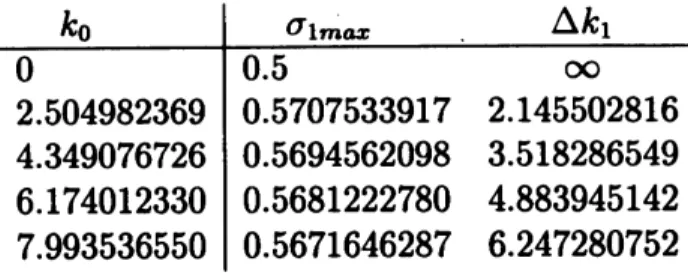
We list in Table 1the numerical values of$\sigma_{1\max}$ and $\Delta k_{1}$ for afirst few intersection points
with $\omega_{0}=0$
.
In the short-wavelength regime $(k\gg 1)$, (4.13) and (4.14) become
$\sigma_{1\max}$ $=$ $\frac{9}{16}(1+\frac{1}{12k_{0}}-\frac{7}{48k_{0}^{2}}+\frac{5}{64k_{0}^{3}}+\cdots)$ , (4.15)
$\Delta k_{1}$ $=$ $\frac{3k_{0}}{4}(1+\frac{1}{3k_{0}}+\frac{5}{24k_{0}^{3}}+\cdots)$
(4.16)
Table 1: The maximum growth rate $\epsilon\sigma_{1\max}$ and the half-wi th $\epsilon\Delta k_{1}$ of unstable band to
$O(\epsilon)$
.
Thecase
of$\omega_{0}=0$The leading term of (4.15) is the well known value of the growth rate for the elliptical
instability elaborated by Waleffe (1990). Roughly speaking, the Moore-Saffman-Tsai-Widnall instability for the static
waves
comprises the long-wave displacement instability and the short-wave instability. The latter is akin to and gives way, in the short-wavelimit, to the elliptical instability.
4.3
The
case
of
$\omega_{0}\neq 0$The general
case
of$\omega_{0}\neq 0$ is dealt with in parallel with thecase
of$\omega_{0}=0$.
Likewise,a
general solution of(4.4) finiteat $r=0$isexpressible solely intermsof the Bessel functions:
$\pi_{1}^{(\pm)}=J_{1}(\eta_{\pm}r)\beta_{1}^{(\pm)}-\{\frac{4\omega_{1}k_{0}^{2}}{(\omega_{0}\mp 1)^{3}\eta\pm}-k_{1}\frac{\eta\pm}{k_{0}}\}rJ_{0}(\eta_{\pm}r)\beta_{0}^{(\pm)}$
$- \{\frac{1}{4}\eta_{\mp}rJ_{0}(\eta_{\mp}r)\mp\frac{(\omega_{0}\mp 1)^{2}(\omega_{0}+3)(\omega_{0}-3)}{32\omega_{0}}J_{1}(\eta_{\mp}r)\}\beta_{0}^{(\mp)}$ , (4.17)
where$\beta_{1}^{(\pm)}$ is constant. Asanticipated at the end of\S 4.1, (4.17)divergeswhen$\omega_{0}=0$
.
In\S 4.2, this singularity
was
curedby virtually makingthecoefficient$\beta_{1}^{(\pm)}$of the homogeneouspart in (4.17) infinite so
as
to cancel this infinity.Repeating the
same
procedure,we
eventually obtain theexpressions of$\sigma_{1\max}$ and $\Delta k_{1}$.
The detail is reported elsewhere
as
theyare
lengthy. Theyare
evaluated numerically atmany of intersectionpoints,showing $|{\rm Im}\omega_{1}|>0$with
no
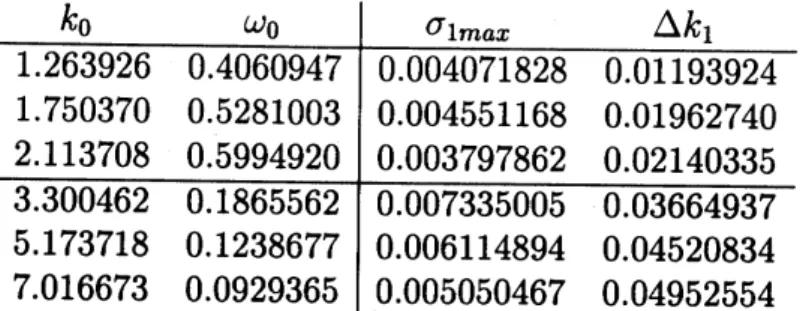
exception. Table 2accommodatesthe numerical results for afew crossingpoints that
occur
along the branch of the secondradial mode and offthe axis of$\omega_{0}=0$ but close to it.
Onlythe first
row
$(k_{0}\approx 1.263926)$ agreeswith the numerics of TW76 uptothe firsttwodigits, butfor theothers,
no
digit ofnumericalvaluescoincideswith the correspondingone
of TW76. Comparing with Table 1, we confirm the exclusive prevalence of non-rotating modes.
5Energetics
X We are reminded of the point that the spectral stability of aHamiltonian system can
be lostonly by eigenvalue collisions ofpositive- and negative-energy
waves or
by collisionsTable 2: The maximum growth rate $\epsilon\sigma_{1\max}$ and the half-wi th $\epsilon\Delta k_{1}$ of unstable band to
$O(\epsilon)$
.
Thecase
of$\omega_{0}\neq 0$of eigenvalues at 0(Krein 1950; MacKay 1986). Thus
we are
tempted to evaluate theenergy
of the Kelvinwaves.
Cairns (1979) invoked
an
analogy from plasma physics and devised atrick forcalcu-lating
wave
energy that dispenses with adetailed knowledge of the global field. For themoment, weswitch offthe pureshear, but deal with the whole family of the Kelvin
waves.
A fundamental ingredient is the pressure on both edges of the vortex
core
$r=\eta(\theta, z, t)$as
given by (3.9). Let the augmented pressureon
the vortex, through the interface $r=\eta$,acted by the surrounding fluid be $p_{>}(z, \theta, t)$, and the pressure on the surrounding fluid
acted by the internal fluid be $p_{<}(z, \theta, t)$, and pose the following form:
$p_{>}(\theta,$z,$t)=D_{>}A_{0}^{(m)}e^{:(m\theta+k_{0}z-\omega_{0}t)}$, $p_{<}(\theta,$z,$t)=D_{<}A_{0}^{(m)}e^{\dot{*}(m\theta+k_{\mathrm{O}}z-\omega_{0}t)}$
.
(5.1)Set the difference of the coefficients
as
$D(k_{0},\omega_{0})=D_{>}(k_{0}, \omega_{0})-D_{<}(k_{0},\omega_{0})$ . (5.2)
The requirement of continuity $D=0$ ofpressure
across
the interface is no other than thedispersion relation. Cairns’ formula prescribes the wave energy $E^{(m)}$, per unit length in
$z$, to be
$E^{(m)}=- \frac{\pi}{2}\omega_{0}\frac{\partial D}{\partial\omega_{0}}(A_{0}^{(m)})^{2}$ (5.3)
We recall the pressure $P_{0}$ of the Rankine vortex and the disturbance pressure $\pi_{0}^{(m)}$
inside the
core.
Puttingthese together and using the dispersion relation,we
can
evaluate$P_{0}+\pi_{0}^{(m)}\exp[i(m\theta+k_{0}z-\omega_{0}t)]$ at
$r=\eta-0$ to first order in
wave
amplitude $|A_{0}^{(m)}|$complying with the form (5.1), with its coefficient provided by
$D_{<}=1- \frac{(\omega_{0}-m)^{2}(\eta_{m}/k_{0})^{2}J_{|m|}(\eta_{m})}{\eta_{m}J_{|m|-1}(\eta_{m})-(|m|+\frac{2m}{\omega_{0}-m})J_{|m|}(\eta_{m})}$
.
(5.4)The disturbance pressure $\pi_{0}^{(m)}$ in the exterior
region is constructed from the disturbance
velocity potential $\phi_{0}^{(m)}$ through $\pi_{0}^{(m)}=i\omega_{0}\phi_{0}^{(m)}-im\phi_{0}^{(m)}/r^{2}$
.
We evaluate the boundarvalue of the augmented pressure at r $=\eta+\mathrm{O}$ as above:
$D_{>}=1- \frac{(\omega_{0}-m)^{2}K_{|m|}}{k_{0}K_{|m|-1}+|m|K_{|m|}}$
.
(5.5)Difference (5.2) between (5.5) and (5.4) is
$D=(\omega_{0}-m)^{2}\{$$\frac{(\eta_{m}/k_{0})^{2}J_{|m|}(\eta_{m})}{\eta_{m}J_{|m|-1}(\eta_{m})-(|m|+\frac{2m}{\omega_{0}-m})J_{|m|}(\eta_{m})}-\frac{K_{|m|}}{k_{0}K_{|m|-1}+|m|K_{|m|}}\}$
.
(5.6)
Provided that $\omega_{0}\neq m$
as
dictated in $(??)$, the condition $D=0$ indeed restores Kelvin’sdispersion relation (??). The remaining task is simply to takedifferentiation of (5.6) with
respect to $\omega_{0}$ under the constraint of$D=0$
.
By arepeateduse
of $D=0$,we
eventuallyarrive at arepresentation of the
wave
energy in atidy form:$E^{(m)}= \frac{2\pi\omega_{0}}{\omega_{0}-m}\{1+\frac{(k_{0}/\eta_{m})^{2}K_{|m|}}{k_{0}K_{|m|-1}+|m|K_{|m|}}[$$\frac{2(\omega_{0}+\sqrt)}{\omega_{0}-}\sqrt$
$+( \frac{m(\omega_{0}+m)}{2}+k_{0}^{2})\frac{K_{|m|}}{k_{0}K_{|m|-1}+|m|K_{|m|}}.]\}(A_{0}^{(m)})^{2}$ (5.7)
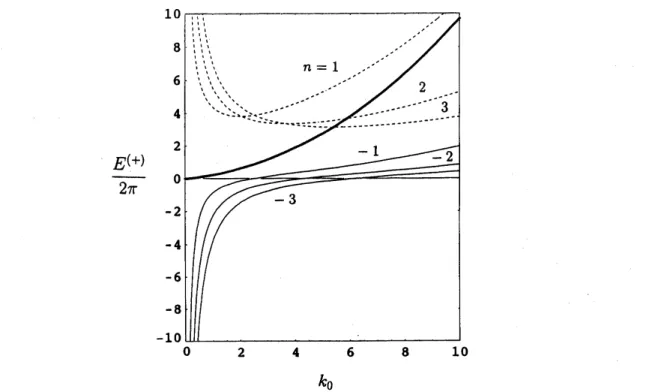
With aview to gaining an insight into the result of\S 4, we sketch in figure 1the wave
energy $E^{(+)}$, divided by $2\pi$, of the left-handed helical
wave
$(m=1)$as
afunction of$k_{0}$
.
Thewave
energy of $m=-1$ is exactly thesame
at thesame
value of $k_{0}$ for thesame
order of branch,as
is evident from the invariance property of (5.7) with respectto areplacement $m=-m$, $\omega_{0}arrow-\omega_{0}$
.
Theenergy
of the primary mode is drawn withasolid thick line, and that of the first three branches ofretrograde higher radial modes
$(|\omega_{0}|<1)$, counted
as
$n=-1,$$-2,$-3, and of the first three branches of cograde higherradial modes $(|\omega_{0}|>1)$, counted
as
$n=1,2,3$,are
drawn with solid and dashed lines respectively. Here the minus sign is tentatively used in the counter of branch for the sake of convenience. The energy of the primary mode is positive in the entire wavenumberrange. It starts from
zero
at $k_{0}=0$ and increases monotonically with?.
The energy ofacograde higher mode as well is positive, but it increases without bound
as
$k_{0}arrow 0$ andmonotonically decreases with $k_{0}$
.
The energy of aretrograde higher mode is negative for $k_{0}$ smaller than the value at which the dispersion curve transversally crosses the axis of$\omega_{0}=0$. It becomes negative infinity in the limit of$k_{0}arrow 0$, monotonically increases with
$k_{0}$, and changes its sign at the intersection point. This singular behaviour is reflective of
confinement of
wave
amplitude in thecore.
The
wave
energy for bending waves, calculated from Cairns’ formula, exhibitsno
con-tradiction with the spectra calculated in
\S 4.
Theresonance
instability of non-rotatingwaves $(\omega_{0}=0)$, the dominant one, manifests itselfat adegenerate eigenvalue with
mul-tiplicity two whose eigenfunction has
zero
energy. Theresonance
instability ofrotatingwaves
$(\omega_{0}\neq 0)$ stems froman
eigenvalue collision either between the primary mode andanegative-energy retrograde higher mode or between apositive-energy and
anegative-energy retrograde higher modes.
$\frac{E^{(+)}}{2\pi}$
$k_{0}$
Figure 1: The
wave
energy $E^{(+)}$, normalized by $2\pi$, of the the bendingwave
with $m=1$as
functions of $k_{0}$, as given by (5.7). The solid thick line corresponds to the primarymode, solid lines to the retrograde higher radial modes, and dashed lines to the cograde
higher radial modes.
References
[1] Bayly, B. J. (1986). Phys. Rev. Lett. 57, 2160-2163..
[2] Cairns, R. A. (1979). J. Fluid Mech. 92, 11-14.
[3] Fukumoto, Y.
&Hattori,
Y. (2002). To appear in Proc.of
IVTAM Symposium onTubes, Sheets and Singularities in Fluid Dynamics (eds. H. K. Moffatt and K. Bajer)
Kluwer.
[4] Krein, M. G. (1950). Dokl. Akad. Nauk. SSSR 73, 445-448.
[5] MacKay, R. S. (1986). In Nonlinear Phenomena and Chaos, Ed. S. Sarkar, Adam
Hilger, Bristol, pp. 254-270.
[6 Moore, D. W.
&Saffman,
P. G. (1975). Proc. Roy. Soc. Lond. A 346, 413-425.[7] Tsai, C.-Y.
&Widnall,
S. E. (1976). J. Fluid Mech. 73, 721-733.[8] Waleffe, F. (1990). Phys. Fluids A 2, 776-780.
[9 Widnall, S. E.