Maillet type
theorem,
convolution
equations and
multisummability
of formal solutions
By
Hidetoshi
TAHARA*
and Hiroshi
YAMAZAWA**
Abstract
Let $P(\lambda)$ bea polynomial of degree$m$. In thisnote, weconsiderthefollowing linear singular
partial differentialequation (E)
$P(t \partial_{t})u=\sum_{j+|\alpha|\leq L}a_{j,\alpha}(t)(t\partial_{t})^{j}\partial_{x}^{\alpha}u+f(t, x)$
with $(t, x)\in \mathbb{C}_{t}\cross \mathbb{R}_{x}^{N}$ $(or (t, x)\in \mathbb{C}_{t}\cross \mathbb{C}_{x}^{N})$ and with holomorphic coefficients $a_{j,\alpha}(t)$
.
First,we present a Maillet type theorem for formal solutions of this equation (E), then we give an
analogue of Maillet type theorem in convolution partial differential equations, and finally we
givean applicationto multisummability of formal solutions of(E). Only the results arewritten
in this note: the details will be published elsewhere.
\S 1.
PreliminariesWe denote by $(t, x)$ the variables in $\mathbb{C}_{t}\cross \mathbb{R}_{x}^{N}$
.
Let $D_{r}=\{t\in \mathbb{C};|t|<r\}$ with $r>0,$and let $V$ be
an
open subset of $\mathbb{R}_{x}^{N}$. For $\sigma>0$,we
denote by $G^{\{\sigma\}}(V)$ the set of allfunctions
$u(x)\in C^{\infty}(V)$ satisfying the estimates$\sup_{x\in V}|\partial_{x}^{\alpha}u(x)|\leq Ch^{|\alpha|}(|\alpha|!)^{\sigma}, \forall\alpha\in \mathbb{N}^{N}$
for
some
$C>0$ and $h>0.$ $A$ function$u(x)\in G^{\{\sigma\}}(V)$ is called a functionof the Gevreyclass of order $\sigma$. For $u(x)\in G^{\{\sigma\}}(V)$ we write
$\Vert|u\Vert|_{\rho}=\sum_{|\alpha|\geq 0}\Vert\partial_{x}^{\alpha}u\Vert_{V}\rho^{|\alpha|}(|\alpha|!)^{\sigma}$
2010 Mathematics Subject Classification(s): Primary $35C10$; Secondary $35A10,35A20.$
Key Words: Maillet type theorem, convolution equation, multisummability
*Sophia University, Tokyo 102-8554, Japan.
**Shibaura Institute of Technology, Saitama-shi, Saitama337-8570, Japan.
数理解析研究所講究録
where $\Vert\cdot\Vert_{V}$ denotes the supremum
norm on
$V$. Wesee: a
function $u(x)\in C^{\infty}(V)$belongs to the class $G^{\{\sigma\}}(V)$ if and only if $1|u\Vert|_{\rho}$ is convergent in
a
neighborhood of$\rho=0.$
Similarly,
we
denoteby $G^{\{1,\sigma\}}(D_{r}\cross V)$the set of all functions $f(t, x)\in C^{\infty}(D_{r}\cross V)$ holomorphic in $t\in D_{r}$ and satisfying the estimates$\sup_{(t,x)\in D_{r}\cross V}|\partial_{x}^{\alpha}f(t, x)|\leq Ch^{|\alpha|}(|\alpha|!)^{\sigma}, \forall\alpha\in \mathbb{N}^{N}$
for
some
$C>0$ and $h>0$.
We write also$\Vert|f(t)\Vert|_{\rho}=\sum_{|\alpha|\geq 0}\frac{\Vert\partial_{x}^{\alpha}f(t)\Vert_{V}}{(|\alpha|!)^{\sigma}}\rho^{|\alpha|}.$
\S 2.
Maillet type theoremLet $m$ be a positive integer, let $\Lambda$ be a finite subset of $\mathbb{N}\cross \mathbb{N}^{n}$, and let us consider
the following model equation:
(2.1) $P(t \partial_{t})u=\sum_{(j,\alpha)\in\Lambda}a_{j,\alpha}(t)(t\partial_{t})^{j}\partial_{x}^{\alpha}u+f(t, x)$, where
$P(\lambda)=\lambda^{m}+c_{1}\lambda^{m-1}+\cdots+c_{m-1}\lambda+c_{m}$
is a polynomial of degree $m,$ $a_{j,\alpha}(t)((j, \alpha)\in\Lambda)$
are
holomorphic functionson
$D_{r}$ and$f(t, x)\in G^{\{1,\sigma\}}(D_{r}\cross V)$. It is eaey to
see
that ifthe conditions (2.2) $P(n)\neq 0$ for any $n=0,1,2,$$\ldots$ , and(2.3) $a_{j,\alpha}(0)=0$ for any $(j, \alpha)\in\Lambda$
are
satisfied, the equation (2.1) hasa
unique formal solution(2.4) $\hat{u}(t, x)=\sum_{n=0}^{\infty}u_{n}(x)t^{n}\in G^{\{\sigma\}}(V)[t].$
We denote by $ord_{t}(a)$ the order of the zero of the function $a(t)$ at $t=0$. We
set $q_{j,\alpha}=ord_{t}(a_{j,\alpha})((j, \alpha)\in\Lambda)$: since (2.3) is supposed, we have $q_{j,\alpha}\geq 1$ for any
$(j, \alpha)\in\Lambda$
.
We define the index $s\geq 1$ by(2.5) $s=1+ \max[0, (j,\alpha)\in\Lambda\max\frac{j+\sigma|\alpha|-m}{q_{j,\alpha}}].$
About the estimates ofthe coefficients $u_{n}(x)(n=0,1, \ldots)$ of the formal solution (2.4),
MULTISUMMABILITY OF FORMAL SOLUTlONS
Theorem 2.1 (Maillet type theorem). Suppose the conditions (2.2) and (2.3). Let
$\hat{u}(t, x)$ be the unique
formal
solutionof
(2.1). Then, thereare
constants $A>0,$ $H>0$and $\rho>0$ such that
(2.6) $\Vert|u_{n}\Vert|_{\rho}\leq AH^{n}n!^{s-1}, n=0,1,2, \ldots$
In [2], this kind of theorem is called a Maillet type theorem. Similar results
are
obtained in [8] for formalsolutions in$G^{\sigma}(V)[t]$ of nonlinearpartialdifferentialequations
in the
case
$\sigma\geq 1$.
We note that in the above theoremour
assumption is $\sigma>0.$\S 3.
Convolution partial differential equationsNext, let us give an analogue of Maillet type theorem in the following convolution partial differential equation
$P(k \xi^{k})w=f(\xi, x)+\sum_{(j,\alpha)\in\Lambda}a_{j,\alpha}(\xi)*k(\mathscr{M}_{j,\alpha}[\partial_{x}^{\alpha}w])$
on
$S_{I}\cross V,$where $P(\lambda)$ is a polynomial of degree $m$, and $\Lambda$ is
a
finite subset of $\mathbb{N}\cross \mathbb{N}^{n}.$\S 3.1.
An analogue of Maillet type theoremFor an open interval $I=(\theta_{1}, \theta_{2})$ we write $S_{I}=\{\xi\in \mathcal{R}(\mathbb{C}\backslash \{0\});\theta_{1}<\arg\xi<\theta_{2}\}$
(where$\mathcal{R}(\mathbb{C}\backslash \{0\})$denotes the universal coveringspace of$\mathbb{C}\backslash \{0\}$), and $|I|=\theta_{2}-\theta_{1}$. For
$k>0$ and two holomorphic functions $f(\xi)$ and $g(\xi)$ on $S_{I}$ we define the $k$-convolution
$(f*kg)(\xi)$ of $f(\xi)$ and $g(\xi)$ by
$(f*kg)( \xi)=\int_{0}^{\xi}f(\tau)g((\xi^{k}-\tau^{k})^{1/k})d\tau^{k}, \xi\in S_{I}.$
Let $k>0$ and $\sigma>0$ be fixed. For $(j, \alpha)\in \mathbb{N}\cross \mathbb{N}^{n}$ we write
$\mathscr{M}_{j,\alpha}[W]=\{\begin{array}{l}\xi^{k\sigma|\alpha|-k}\overline{\Gamma(\sigma|\alpha|)}*k((k\xi^{k})^{j}W) , if |\alpha|>0,(k\xi^{k})^{j}W, if |\alpha|=0.\end{array}$
In this section,
as
a model we will consider the following convolution partial differ-ential equation (3.1) $P(k \xi^{k})w=f(\xi, x)+\sum_{(j,\alpha)\in\Lambda}a_{j,\alpha}(\xi)*k(\mathscr{M}_{j,\alpha}[\partial_{x}^{\alpha}w])$ on $S_{I}\cross V$, where $P(\lambda)=\lambda^{m}+c_{1}\lambda^{m-1}+\cdots+c_{m-1}\lambda+c_{m}$173
is
a
polynomialof
degree $m$.
We
suppose: $k>0$ isa
real number, $0<|I|<2\pi/k,$$\sigma>0,$ $f(\xi, x)\in G^{\{1,\sigma\}}(S_{I}\cross V)$, and $a_{j,\alpha}(\xi)((j, \alpha)\in\Lambda)$
are
holomorphic functionson
the sector $S_{I}$. Moreover,
we
suppose that thereare
real numbers $\mu>0$ and $q_{j,\alpha}>0$$((j, \alpha)\in\Lambda)$ such that the estimates
$\Vert|f(\xi)\Vert|_{\rho}\leq F|\xi|^{\mu-k}\exp(c|\xi|^{k})$
on
$S_{I},$$|a_{j,\alpha}(\xi)|\leq A_{j,\alpha}|\xi|^{q_{j,\alpha}-k}\exp(c|\xi|^{k})$ on $S_{I}$ $((j, \alpha)\in\Lambda)$
hold for
some
$\rho>0,$ $F\geq 0,$ $c>0$ and $A_{j,\alpha}\geq 0((j, \alpha)\in\Lambda)$.
Under these assumptions,
we
set(3.2) $s=1+ \max[0, (j,\alpha)\in\Lambda\max(\frac{j+\sigma|\alpha|-m}{q_{j,\alpha}+k[j+\sigma|\alpha|-m]_{+}})].$
For a real number $x$
we
write $[x]_{+}= \max\{x, 0\}$.
We set$\mathcal{K}=\{q_{j,\alpha}+k[j+\sigma|\alpha|-m]_{+};(j, \alpha)\in\Lambda\}$ :
since this is a finite set, we
can
write $\mathcal{K}=\{\kappa_{1}, \ldots , \kappa_{\ell}\}$ where $\kappa_{1},$$\ldots,$$\kappa_{\ell}$
are
distinctpositive real numbers. We set
$\mathscr{N}=\mu+\sum_{i=1}^{\ell}\mathbb{N}\kappa_{i},$
that is,
a
real number $n$ belongs to $\mathscr{N}$ if and only if$n$ is expressed in the form $n=$
$\mu+\kappa_{1}q_{1}+\cdots+\kappa_{\ell}q_{\ell}$ for
some
$q_{i}\in \mathbb{N}(i=1,2, \ldots, \ell)$. Since $\mathscr{N}$ isa
discreat set ofpositive real numbers,
we can
write it in the form $\mathscr{N}=\{n_{0}, n_{1}, n_{2}, \ldots\}$ with $n_{0}=\mu,$$0<n_{0}<n_{1}<n_{2}<\ldots$, and $n_{p}arrow\infty$ $(as parrow\infty)$.
We let $\lambda_{1},$
$\ldots,$$\lambda_{m}$ be the roots of $P(\lambda)=0$
.
We
denote by$p:\mathcal{R}(\mathbb{C}\backslash \{0\})arrow \mathbb{C}$ thenatural projection. We have
Theorem 3.1 (Analog of Maillet type theorem). Suppose the condition
$\lambda_{i}\in \mathbb{C}\backslash \overline{p(S_{kI})}$
for
$i=1,2,$$\ldots,$$m.$
Then, the equation (3.1) has a
formal
solution$w(t, x)= \sum_{n\in \mathscr{N}}w_{n}(\xi, x), w_{n}(\xi, x)\in G^{\{1,\sigma\}}(S_{I}\cross V)(n\in \mathscr{N})$
which
satisfies
the estimates(3.3) $\Vert|w_{n}(\xi)\Vert|_{\rho}\leq\frac{AH^{n}n!^{s-1}}{\Gamma(n/k)}\frac{|\xi|^{n-k}}{(|\xi|^{k}+1)^{m}}\exp(c_{1}|\xi|^{k})$ $on$ $S_{I},$ $\forall n\in \mathscr{N}$
MULTISUMMABILITY OF FORMAL SOLUTlONS
This is
an
analogue of Maillet type theorem. We note that theformula
(3.2) is verysimilar to the formula (2.5) in Maillet type theorem: this indicates that
we can
prove Theorem 3.1 bya
similar argument to the proofof Theorem 2.1.\S 3.2.
Analyticcontinuation in
$\xi$Let us show the possibilityofanalytic continuation ofthe solution of (3.1). First
we
define $k_{1}>0$ by the following:
Lemma 3.2. Let $\mathcal{S}$ be the one in (3.2). Then we have:
(1) $s=1$ holds,
if
and onlyif
$j+\sigma|\alpha|\leq m$ holdsfor
any $(j, \alpha)\in\Lambda$. In this case,we set $k_{1}=k.$
(2) $s>1$ holds,
if
and onlyif
$j+\sigma|\alpha|>m$ holdsfor
some $(j, \alpha)\in\Lambda$. In thiscase,
we
have$s-1<1/k$
andso
wecan
define
a real number $k_{1}>0$ by the relation$1/k_{1}=1/k-(s-1)$
.
For $\epsilon>0$
we
write $S_{I}(\epsilon)=\{\xi\in S_{I};0<|\xi|<\epsilon\}$. By combining the estimate (3.3)inTheorem 3.1 with the argument in [7]
we
haveTheorem 3.3 (Analytic continuation). Suppose the condition
$\lambda_{i}=0or\lambda_{i}\in \mathbb{C}\backslash \overline{p(S_{kI})} fori=1,2, \ldots, m.$
If
afunction
$w(\xi, x)\in G^{\{1,\sigma\}}(S_{I}(\epsilon)\cross V)$ (where $\epsilon>0$)satisfies
(3.1) and$\Vert|w(\xi)\Vert|_{\rho}\leq C|\xi|^{\mu-k}$ $on$ $S_{I}(\epsilon)$
for
some
$C>0$, then $w(\xi, x)$ has an analytic continuation$w^{*}(\xi, x)\in G^{\{1,\sigma\}}(S_{I}\cross V)$ asa solution
of
(3.1) thatsatisfies
thefollowing:for
any $I_{1}\Subset I$ thereare
$\rho_{1}>0,$ $M>0$and $c_{1}>0$ such that
$M|\xi|^{\mu-k}$
(3.4) $\Vert|w^{*}(\xi)\Vert|_{\rho_{1}}\leq\overline{(|\xi|^{k}+1)^{m}}\exp(c_{1}|\xi|^{k_{1}})$ $on$ $S_{I_{1}}.$
\S 4.
Entire functions of finite orderFor $x=(x_{1}, \ldots, x_{N})\in \mathbb{C}^{N}$ we write $|x|=|x_{1}|+\cdots+|x_{N}|$. We say that $f(x)$ is
an
entire
function
if it isa
holomorphic functionon
$\mathbb{C}^{N}$: for$\gamma>0$
we
say that $f(x)$ isan
entire
function of
order$\gamma$ if it isa
holomorphic functionon
$\mathbb{C}^{N}$ satisfying$|f(x)|\leq A\exp(a|x|^{\gamma})$ on $\mathbb{C}^{N}$
for
some
$A>0$ and $a>0$.
We denote by $Exp^{\{\gamma\}}(\mathbb{C}^{N})$the
setof
all entirefunctions
oforder $\gamma$. Similarly, for $\delta>0$ and $\gamma>0$
we
denote by $Exp^{\{\gamma\}}(D_{\delta}\cross \mathbb{C}^{N})$ the set of allholomorphic functions $u(t, x)$
on
$D_{\delta}\cross \mathbb{C}^{N}$ satisying the estimate$|u(t, x)|\leq B\exp(b|x|^{\gamma})$
on
$D_{\delta}\cross \mathbb{C}^{N}$for
some
$B>0$ and $b>0.$For $\gamma>0$ we set $\sigma=1-1/\gamma$; then
we
have $\sigma<1$ and $\gamma=1/(1-\sigma)$.
As
to theestimates ofderivatives of entire function,
we
have the followingProposition 4.1. Let $\gamma>0$ and let $f(x)$ be
an
entirefunction.
Set $\sigma=1-1/\gamma.$Thefollowing two conditions are equivalent: (1) $f(x)$ belongs to the class $Exp^{\{\gamma\}}(\mathbb{C}^{N})$
.
(2) For any compact subset $K$
of
$\mathbb{C}^{N}$ there are $A>0$ and $h>0$ such that the following estimates hold:(4.1) $\max_{x\in K}|\partial_{x}^{\alpha}f(x)|\leq Ah^{|\alpha|}(|\alpha|!)^{\sigma}, \forall\alpha\in \mathbb{N}^{N}.$
This result says that if $f(x)$ belongs to $Exp^{\{\gamma\}}(\mathbb{C}^{N})$, we have the estimates (4.1)
which isthe
same as
theestimates of afunction in the Gevreyclass of order$\sigma=1-1/\gamma.$We note that $0<\sigma<1$ is equivalent to $\gamma>1$
.
Therefore, Theorems 2.1, 3.1 and 3.3are
valid also in thecase
wherewe
repace $G^{\{1,\sigma\}}(D_{r}\cross V)$ by $Exp^{\{\gamma\}}(D_{r}\cross \mathbb{C}^{N})$ with$\gamma>1$. This leads
us
to the next\S 5.
Before proceeding to
\S 5,
let us explain how touse
the $Exp^{\{\gamma\}}$-version of Theorem3.3. For example, let
us
consider (4.2)$P(t^{k+1} \partial_{t})u=F(t, x)+\sum_{(j,\alpha)\in\Lambda}A_{j,\alpha}(t)(t^{k\sigma|\alpha|}(t^{k+1}\partial_{t})^{j}\partial_{x}^{\alpha}u)$
where $k>0,$ $F(t, x)\in Exp^{\{\gamma\}}(S_{I}(\delta)\cross \mathbb{C}^{N})$ with $|F(t, x)|\leq A|t|^{\mu}\exp(a|x|^{\gamma})$ for
some
$A>0,$ $\mu>0$ and $a>0$, and $A_{j,\alpha}(t)$ is
a
holomorphic functionon $S_{I}(\delta)$ with $A_{j,\alpha}(t)=$$O(t^{q_{j,\alpha}})$ $(as tarrow 0)$ for
some
$q_{i,j,\alpha}>0$.
If $|I|>\pi/k$ holds, by applying the $k$-Boreltransform $\mathcal{B}_{k}[\cdot]$ to (4.2)
we
have(4.3) $P(k \xi^{k})w=f(\xi, x)+\sum_{(j,\alpha)\in\Lambda}a_{j,\alpha}(\xi)*k(\mathscr{M}_{j,\alpha}[\partial_{x}^{\alpha}w])$
with $w(\xi, x)=\mathcal{B}_{k}[u](\xi, x),$ $f(\xi, x)=\mathcal{B}_{k}[F](\xi, x),$ $a_{j,\alpha}(\xi)=\mathcal{B}_{k}[A_{j,\alpha}](\xi)((j, \alpha)\in\Lambda)$
.
Thus,
we
can
apply Theorem 3.3 with $\sigma=1-1/\gamma.$In the above calculation, we used the $k$-Borel transform $\mathcal{B}_{k}[F](\xi, x)$ of $F(t, x)$ etc.
in the form
MULTISUMMABILITY OF FORMAL SOLUT10NS
where $\mathscr{C}(\xi)$ is
a
contour starting from $0e^{i(\arg\xi+\pi/2k+d)}$and ending to $0e^{i(\arg\xi-\pi/2k-d)}$ with $0<d< \min\{\arg\xi-\theta_{1}, \theta_{2}-\arg\xi, \pi/k\}$ in $S_{I}(\delta)$
.
\S 5.
Multisummability offormal solutionsIn this last section,
we
will givean
application of results (with $G^{\{1,\sigma\}}(D_{r}\cross V)$replaced by $Exp^{\{\gamma\}}(D_{r}\cross \mathbb{C}^{N}))$ in
\S \S 2
and3
to the problemof
multisummability of formal solutions of the equation(E)
$P(t \partial_{t})u=\sum_{(j,\alpha)\in\Lambda}a_{j,\alpha}(t)(t\partial_{t})^{j}\partial_{x}^{\alpha}u+f(t, x)$ ,
where $(t, x)\in \mathbb{C}_{t}\cross \mathbb{C}_{x}^{N},$
$P(\lambda)=\lambda^{m}+c_{1}\lambda^{m-1}+\cdots+c_{m-1}\lambda+c_{m}$
is
a
polynomial of degree $m,$ $a_{j,\alpha}(t)((j, \alpha)\in\Lambda)$are
holomorphic functions on $D_{r}$ and$f(t, x)\in Exp^{\{\gamma\}}(D_{r}\cross \mathbb{C}^{N})$
.
As
before,we denote
by $ord_{t}(a_{j,\alpha})$ the order of thezero
of $a_{j,\alpha}(t)$ at $t=0$
.
Without
loss of generalitywe
may suppose that$a_{j,\alpha}(t)\not\equiv 0$ for all
$(j, \alpha)\in\Lambda.$
As is
seen
in \S 2, if the conditions$P(n)\neq 0$ for any $n=0,1,2,$
$\ldots$ , and
$a_{j,\alpha}(0)=0$ for any $(j, \alpha)\in\Lambda$
are
satisfied,we
know that the equation (E) hasa
unique formal solution(5.1) $\hat{u}(t, x)=\sum_{n=0}^{\infty}u_{n}(x)t^{n}\in Exp^{\{\gamma\}}(\mathbb{C}^{N})[t].$
If $\Lambda\subset\{(j, \alpha)\in \mathbb{N}\cross \mathbb{N}^{N};j+|\alpha|\leq m\}$, by Theorem 2.1 and Lemma 3.2
we
see
that the formal solution $u(t, x)$ is convergent in
a
neighborhood of $(t, x)=(0,0)$.
Ifotherwise, that is, if
(5.2) $j+|\alpha|>m$ for
some
$(j, \alpha)\in\Lambda,$this
formal
solution is not convergent in general. Thus,our
problem is:Problem 5.1. Under what condition
on
$\gamma$ $(in the$assumption$f(t, x)\in Exp^{\{\gamma\}}(D_{r}\cross$ $\mathbb{C}^{N}))$, is the formal solution (5.1)multisummable?
As to the
definition
of multisummability,we
can
refer to [5] and [1].Standard
argu-ments
on
the summabilityor
multisummability of formal solutions inpartialdifferential
equations
can
befound
in [7] and [3]. In thecase
of heat equation, the necessary and sufficient condition for the formal solution to be Borel summable is established in [4].See
also [6].\S 5.1.
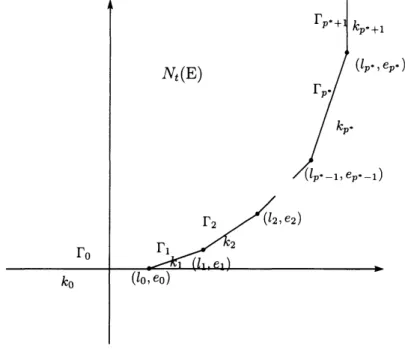
Newton polygon with respect to $t$For $(a, b)\in \mathbb{R}^{2}$,
we
write $C(a, b)=\{(x, y);x\leq a, y\geq b\}$. We define the $t$-Newtonpolygon $N_{t}(E)$
of
the equation (E) by theconvex
hull of the unionof
sets $C(m, 0)$ and$C(j, ord_{t}(a_{j,\alpha}))((j, \alpha)\in\Lambda)$; that is,
$N_{t}(E)=$the
convex
hull of $[C(m, 0) \cup\bigcup_{(j,\alpha)\in\Lambda}C(j, ord_{t}(a_{j,\alpha}))].$Note that the term $t^{p}(t\partial_{t})^{j}\partial_{x}^{\alpha}$ corresponds to $C(j,p)$ $(not C(j+|\alpha|,p))$: therefore,
our
$t$-Newton polygon is different from the usual Newton polygon. We are observing onlythe $t$-variable. The figure of$N_{t}(E)$
can
be drawnas
follows:Figure 1. $t$-Newton polygon
As is seen in Figure 1, the verteces of $N_{t}(E)$ consists of$p^{*}+1$ points
$(l_{0}, e_{0}), (l_{1}, e_{1}), (l_{2}, e_{2}), \ldots, (l_{p^{*}-1}, e_{p^{*}-1}), (l_{p}*, e_{p^{*}})$;
theboundary of$N_{t}(E)$ consists of
a
horizontal halfline $\Gamma_{0},$ $p^{*}$-segments $\Gamma_{1},$$\Gamma_{2},$$\ldots,$$\Gamma_{p}*,$
MULTISUMMABILITY OF FORMAL SOLUT10NS
then
we
have$k_{0}=0<k_{1}<k_{2}<\cdots<k_{p^{*}}<k_{p^{*}+1}=\infty.$
Since $ord_{t}(a_{j,\alpha})\geq 1$ is supposed,
we
have $(l_{0}, e_{0})=(m, 0)$.We denote by $(N_{t}(E))^{o}$ the interior of the set $N_{t}(E)$. Fkom now, we suppose the
following condition:
(5.3) $(j, \alpha)\in\Lambda$ and $|\alpha|>0\Rightarrow(j, ord_{t}(a_{j,\alpha}))\in(N_{t}(E))^{o}$
which is equivalent to
$(j, ord_{t}(a_{j,\alpha}))\in\bigcup_{i=1}^{p^{*}+1}\Gamma_{i}\Rightarrow|\alpha|=0.$
\S 5.2.
Singulardirections
In the
case
$p^{*}\geq 1$, letus
define the set of singular directions. For $i=1,2,$$\ldots,p^{*},$we
set$I_{i}=\{(j, 0)\in\Lambda;(j, ord_{t}(a_{j,0}))\in\Gamma_{i}\}, i=1,2, \ldots,p^{*}$
For $(j, 0)\in I_{1}\cup I_{2}\cup\cdots\cup I_{p^{*}}$
we
set $q_{j,0}=ord_{t}(a_{j,0})$; thenwe
have$a_{j,0}(t)=t^{q_{j,0}}a_{j,0}^{0}(t)$ with $a_{j,0}^{0}(0)\neq 0$
for
some
holomorphic function $a_{j,0}^{0}(t)$. We set(5.4)
$P_{1}( \lambda)=\sum_{(j,0)\in I_{1}}a_{j,0}^{0}(0)\lambda^{j-m}-1=a_{l_{1},0}^{0}(0)\lambda^{l_{1}-m}+\cdots-1,$
and for $2\leq i\leq p^{*}$,
we
set(5.5)
$P_{i}( \lambda)=\sum_{(j,0)\in I_{i}}a_{j,0}^{0}(0)\lambda^{j-l_{i-1}}=a_{l_{i},0}^{0}(0)\lambda^{l_{i}-l_{i-1}}+\cdots+a_{l_{i-1},0}^{0}(0)$
.
We call $P_{i}(\lambda)$ the
characteristic
polynomial on $\Gamma_{i}$ and we denote by$\lambda_{i,1}, \ldots, \lambda_{i,l_{i}-l_{i-1}}$
the roots of $P_{i}(\lambda)=0$ that
are
called the characteristic roots on $\Gamma_{i}$.
Since $a_{l_{i}}^{0}(0)\neq 0$and $a_{l_{i-1}}^{0}(0)\neq 0$ hold,
we
have$\lambda_{i,d}\neq 0$ for all $1\leq i\leq p^{*}$ and $1\leq d\leq l_{i}-l_{i-1}.$
Definition 5.2. We define the set $\Xi$ of singular directions by
$p^{*}l_{i}-l_{i-1}$
$\Xi=\bigcup_{i=1} \bigcup_{d=1}\{\frac{\arg\lambda_{i,d}+2\pi j}{k_{i}};j=0, \pm 1, \pm 2, \ldots\}.$
\S 5.3.
Statement of main result In the equation (E),we
have supposed:(5.6) $f(t, x)\in Exp^{\{\gamma\}}(D_{r}\cross \mathbb{C}^{N})$.
In order to state
our
condition on the exponent $\gamma$, we need to define the set $\mathscr{C}$ of admissible exponents. We set(5.7) $\Lambda^{*}=\{(j, \alpha)\in\Lambda;(j+|\alpha|, ord_{t}(a_{j,\alpha}))\not\in N_{t}(E)\}.$
If$(j, \alpha)\in\Lambda^{*}$, by the definition of$N_{t}(E)$
we
have $|\alpha|>0$and bythe assumptionwe
have$ord_{t}(a_{j,\alpha})\geq 1>e_{0}(=0)$. Therefore, if
we
set $\Lambda_{i}^{*}=\{(j, \alpha)\in\Lambda^{*};e_{i-1}<ord_{t}(a_{j,\alpha})\leq$$e_{i}\}$ $(i=1,2, \ldots,p^{*}+1 with e_{p^{*}+1}=\infty)$,
we
have$\Lambda^{*}=\Lambda_{1}^{*}\cup\cdots\cup\Lambda_{p^{*}}^{*}\cup\Lambda_{p^{*}+1}^{*}.$
We note:
Lemma 5.3.
If
$(j, \alpha)\in\Lambda_{i}^{*}$for
some
$1\leq i\leq p^{*}+1$, we have$0<j+|\alpha|-l_{i-1}-(ord_{t}(a_{j,\alpha})-e_{i-1})/k_{i}<|\alpha|.$
Let
us
define:Definition 5.4 (Definition of$\mathscr{C}$). We define the set $\mathscr{C}$ of admissible exponents for
(E) in the following way.
(1) In the
case
$1\leq i\leq p^{*}$: if $\Lambda_{i}^{*}=\emptyset$we
set $\gamma_{i}=\infty$ and $\mathscr{C}_{i}=(0, \infty)$; if$\Lambda_{i}^{*}\neq\emptyset$we
set
$\gamma_{i}=\min_{(j,\alpha)\in\Lambda_{i}^{*}}(\frac{|\alpha|}{j+|\alpha|-l_{i-1}-(ord_{t}(a_{j,\alpha})-e_{i-1})/k_{i}})$
and set $\mathscr{C}_{i}=(0, \gamma_{i})$ which is a nonempty open interval.
(2) In the case $i=p^{*}+1$: if $\Lambda_{p^{*}+1}=\emptyset$ we set $\gamma_{p^{*}+1}=\infty$ and $\mathscr{C}_{p^{*}+1}=(0, \infty)$; if
$\Lambda_{p^{*}+1}\neq\emptyset$ we set
$\gamma_{p^{*}+1}=\min_{(j,\alpha)\in\Lambda_{p^{*}+1}^{*}}(\frac{|\alpha|}{j+|\alpha|-l_{p}*})$
and set $\mathscr{C}_{p^{*}+1}=(0, \gamma_{p^{*}+1}]$ which is
a
nonempty half-open and half-closed interval.(3) Then,
we
define $\mathscr{C}$ byMULTISUMMABILITY OF FORMAL SOLUT10NS
By Lemma 5.3 we have
$1<\gamma_{i}\leq\infty, i=1,2, \ldots,p^{*}+1$
and
so we
have $(0,1+\epsilon)\subset \mathscr{C}$ forsome
$\epsilon>0.$The following theorem is the main result of this note.
Theorem 5.5 (Tahara-Yamazawa [9]). Suppose the condition
(5.8) $\gamma\in \mathscr{C}$
and let
$\hat{u}(t, x)=\sum_{n=0}^{\infty}u_{n}(x)t^{n}\in Exp^{\{\gamma\}}(\mathbb{C}^{N})[t]$
be the unique
formal
solution
of
(E). Thenwe
have:(1)
If
$p^{*}=0,\hat{u}(t, x)$ is convergent on $D_{\delta}\cross \mathbb{C}^{N}$for
some
$\delta>0.$(2)
If
$p^{*}\geq 1$,for
any$d\in \mathbb{R}\backslash \Xi$ we canfind
$\epsilon>0,$ $\delta>0$ and a holomorphic solution$u(t, x)$
of
(E) on $S(d, \pi/2k_{p^{*}}+\epsilon;\delta)\cross \mathbb{C}^{N}$ with$S(d, \pi/2k_{p^{*}}+\epsilon;\delta)=\{t\in \mathcal{R}(\mathbb{C}_{t}\backslash \{0\});0<$$|t|<\delta,$$|\arg t-d|<\pi/2k_{p}*+\epsilon\}$ such that thefollowing
asymptotic relation holds:
(5.9) $|u(t, x)- \sum_{n=0}^{N-1}u_{n}(x)t^{n}|\leq AH^{N}N!^{1/k_{1}}|t|^{N}\exp(b|x|^{\gamma})$
on $S(d, \pi/2k_{p^{*}}+\epsilon;\delta)\cross \mathbb{C}^{N}$
for
any $N=0,1,2,$$\ldots$
for
some
$A>0,$ $H>0$ and $b>0.$Example 5.6. (1) Let
us
consider(5.10) $(t\partial_{t}+1)u=f(t, x)+t\partial_{x}^{2}u+t^{2}(t\partial_{t})^{3}u,$
where $(t, x)\in \mathbb{C}^{2}$ and $f(t, x)\in Exp^{\{\gamma\}}(D_{r}\cross \mathbb{C})$
.
In this case,we
havea
unique formalsolution $\hat{u}(t, x)\in Exp^{\{\gamma\}}(\mathbb{C})[t]$ and
$\Xi=\{\pi j;j=0, \pm 1, \pm 2, \ldots\}, \mathscr{C}=(0, \infty)$
.
Therefore, for any$\gamma>0$, the formal solution $\hat{u}(t, x)$ is Borel summable in any direction $d\in \mathbb{R}\backslash \Xi.$
(2) Let
us
consider(5.11) $(t\partial_{t}+1)u=f(t, x)+t\partial_{x}^{3}u+t^{2}(t\partial_{t})^{3}u,$
where $(t, x)\in \mathbb{C}^{2}$ and $f(t, x)\in Exp^{\{\gamma\}}(D_{r}\cross \mathbb{C})$. In this case,
we
havea
uniqueformal
solution $\hat{u}(t, x)\in Exp^{\{\gamma\}}(\mathbb{C})[t]$ and
$\Xi=\{\pi j;j=0, \pm 1, \pm 2, \ldots\}, \mathscr{C}=(0,3)$.
Therefore, if $0<\gamma<3$ holds,
the
formal solution $\hat{u}(t, x)$ is Borel summable in anydirection $d\in \mathbb{R}\backslash \Xi.$
(3) Let
us
consider(5.12) $(t\partial_{t}+1)u=f(t, x)+t^{3}\partial_{x}^{4}u+t^{2}(t\partial_{t})^{3}u,$
where $(t, x)\in \mathbb{C}^{2}$ and $f(t, x)\in Exp^{\{\gamma\}}(D_{r}\cross \mathbb{C})$
.
In this case,we
havea
unique formalsolution $\hat{u}(t, x)\in Exp^{\{\gamma\}}(\mathbb{C})[t]$ and
$\Xi=\{\pi j;j=0, \pm 1, \pm 2, \ldots\}, \mathscr{C}=(0,4].$
Therefore, for any $0<\gamma\leq 4$, the formal solution $\hat{u}(t, x)$ is Borel summable in any
direction $d\in \mathbb{R}\backslash \Xi.$
References
[1] Balser, W., FromDivergentPower Series to AnalyticFunctions -Theory and Application
of
Multisummable Power Series –, Lecture Notes in Math. 1582, Springer, 1994.[2] G\’erard, R. and Tahara, H., Singular nonlinear partial
differential
equations, Aspects of MathematicsVol. E28, Vieweg-Verlag, Wiesbaden, Germany, 1996.[3] Luo, Z., Chen, H. and Zhang, C., Exponential-type Nagumo norms and summabolity of
formal solutions of singular partial differential equations, Ann. Inst. Fourier (Grenoble)
62 (2012), 571-618.
[4] Lutz, D. A., Miyake, M. and Sch\"afke, R., Onthe Borel summability of divergent solutions of the heat equation, Nagoya Math. J. 154 (1999), 1-29.
[5] Martinet, J. and Ramis, J. P., Elementary acceleration and multisummability, I, Ann.
Inst. Henri Poincar\’e 54 (1991), 331-401.
[6] Miyake, M., Borel summability of divergent solutions of the Cauchy problem to
non-Kowalevskian equations, Partial
Differential
Equations and Their Applications (Wuhan, 1999), World Sci. Publ., 1999, pp. 225-239.[7] Ouchi, S., Multisummability of formal solutions of some linear partial differential equa-tions, J.
Differential
Equations 185 (2002), 513-549.[8] Tahara, H., Maillet typetheorems and Gevrey regularity in timeof solutionstononlinear
partial differential equations, Formal and Analytic Solutions
of
Differential
andDifference
Equations, Banach Center Publ. 97, 2012, pp. 125-140.[9] Tahara, H. andYamazawa, H., Multisummability of formal solutionstothe Cauchy
prob-lem for somelinear partial differential equations, preprint.
[10] Yamazawa, H., Borel summability foraformal solution of$(\partial/\partial t)u(t, x)=(\partial/\partial x)^{2}u(t, x)+$
$t(t\partial/\partial t)^{3}u(t,$x), Formal and Analytic Solutions