Alloying effect of Nickel-Cobalt based binary metal catalysts
supported on α-alumina for ammonia decomposition
Naohiro Shimoda*
†, Ryo Yoshimura, Takahiro Nukui, Shigeo Satokawa*
Department of Materials and Life Science, Faculty of Science and Technology, Seikei University, 3-3-1 Kichijoji-kitamachi, Musashino-shi, Tokyo, 180-8633, Japan 1
Abstract
The development of a base metal catalyst which shows high performance for the ammonia (NH3) decomposition have been conducted. For the Ni and Co based catalysts using α-Al2O3 as a support, the performance of the single metal catalysts was lower than that of the γ-Al2O3 supported catalysts. However, its performance was greatly improved by using a binary metal catalyst system. Based on the XRD analysis, it was found that Ni and Co supported on α-Al2O3 were alloyed. TEM observation confirmed that the metal particle size in the α-Al2O3 supported Ni-Co catalyst is smaller than that of the single metal catalysts (Ni/α-Al2O3 or Co/α-Al2O3). Furthermore, in-situ XRD and H2-TPR measurements revealed that the Ni-Co alloy forms during the reduction process. The optimum mixing ratio of Ni and Co components was 1:1, and the optimum pre-reduction temperature before the performance test was 600 °C. Studies on the differences of support oxides proved that the improvement effect by alloying can be similarly obtained with the SiO2 supported catalyst, indicating that the catalyst using the support with less interaction between the active metal and the support is more likely to obtain the performance improvement effect by alloying.
Keywords: Ammonia decomposition; Nickel; Cobalt; Alumina support, Alloying effect Introduction
In recent years, hydrogen (H2) fuel which
does not emit carbon dioxide (CO2) at combustion
time is attracting attention from the viewpoint of environmental problems and energy problems.
However, H2 has the disadvantage of being
difficult to store and transport (Becherif et al.,
2015). Therefore, ammonia (NH3) has recently
attracted as one of the alternative energy carriers.
Especially, NH3 has many advantages such as
liquefaction at normal temperature, high hydrogen content, and non-carbon-containing substances so
that no CO2 is generated at the time of
decomposition. When decomposing NH3 into H2
(Eq. (1)), it is necessary to decompose on-site. Therefore, various catalysts that is active for the Received on MM DD, YYYY; accepted on MM DD, YYYY
Correspondence concerning this article should be addressed to Naohiro Shimoda (E-mail: [email protected]) and Shigeo Satokawa (E-mail: [email protected])
†Present address: Department of Applied Chemistry, Graduate School of Technology, Industrial and Social Sciences, Tokushima
University, 2-1 Minamijosanjima, Tokushima-shi, Tokushima 770-8506, Japan
NH3 decomposition reaction have been studied
widely.
2𝑁𝐻3→ 𝑁2+ 3𝐻2 ∆𝑟𝐻°= 46 𝑘𝐽 𝑚𝑜𝑙−1 (1)
The history of NH3 decomposition process is old, and Fe based catalyst was mainly employed (Ertl et al., 1980). After that, noble metals such as Ru and Rh, base metals such as Ni, Co, Fe and Mo, some carbides such as MoC and VC, some nitrides such as MoNX and FeNX (Hashimoto et al., 2000; Yin et al., 2004b; Choi, 1999; Liang et al., 2000) were studied as the active species of NH3 decomposition catalyst. Among these catalysts, Ni and Ru based catalysts were found to exhibit high activity (Liu et al., 2007; Duan et al., 2013), Ru based catalyst have higher activity than Ni base catalyst (Choudhary et al., 2001). The metal oxide The final authenticated version is available online at: https://doi.org/10.1252/jcej.18we226
used as a support of the catalyst is considered to be oxides of elements belonging to periodic tables 2 to 5 and 12 to 15. Indeed, many single metal oxides such as SiO2, Al2O3 (Choudhary et al., 2001), ZrO2 (Yin et al., 2006), MgO (Zhang et al., 2006), and Pr6O11 (Nagaoka et al., 2010) are studied. As another support material, carbon based supports such as carbon nanotubes (CNTs) and graphite carbon black (GC) (Yin et al., 2004a; Li et al., 2007), and binary metal oxides such as Mg-Al hydrotalcite type compounds (Sato et al., 2017), [Ca24Al28O64]4+(e-)4 (Hayashi et al., 2013), and CeZrO2 (Deng et al., 2012) have been also reported.
In the NH3 decomposition reaction, NH3 molecules adsorb and dissociate on the surface of the active metal, resulting in adsorbed N and H atoms. Subsequently, they associate with each other and desorb as N2 and H2 molecules (Hashimoto et al., 2000; Liang et al., 2000). According to the simulation study by a density functional theory (DFT) method, the reaction mechanism of NH3 decomposition is proposed as follows: Over Ni and Co based catalysts, NH3 molecules first adsorb to the top of one metal atom first, and then spillovers while increasing the number of metal atoms coordinated each time an H atom desorbs. In these studies, the rate-limiting step of NH3 decomposition reaction is considered to be binding and desorption (recombination desorption) of adsorbed N atoms. Therefore, the supports that gives electrons to active metals are suitable, because the electron back donation leads to the enhancement of desorption of N atoms. Indeed, it is reported that the basic components can electron-donate to the active metals and lead to an improvement in the activity, and high performance catalysts to which an alkali metal such as K, Cs, and Ba is added have been reported (Raróg-Pilecka et al., 2003; Duan et al., 2012; Okura et al., 2015; Nagaoka et al., 2014). Additionally, there is a report that alkaline earth metals such as Ba are used as a structure promoter, and alkali metals such as K and Cs have a role as an electronic accelerator (Yin et al., 2006).In addition, it is reported that rare earth oxides are strongly basic and have been used
as supports for NH3 decomposition catalysts, and the activity can be further improved with a promoter such as K component (Nagaoka et al., 2014). Furthermore, carbon-based materials that are electron rich are considered to be excellent supports, and it is reported that Ru based catalysts supported on carbon nanotubes possess a high metal dispersion and are particularly active (Yin et al., 2004b; Huang et al., 2013).
Noble metal based catalysts using Ru and Rh can obtain an excellent performance in NH3 decomposition reaction, but it is a problem that they are expensive. For this reason, in the present study, we have focused attention on base metal catalysts with active species of Ni, Co, and Fe, which are base metals but have relatively high performance. Furthermore, by using an alloying catalyst, the arrangement of the metal species is considered to be changed. As a result, it is expected that the bonding distance and electron arrangement between the adsorbed nitrogen atoms and the metal are changed, leading to easy cleavage of the bond between the nitrogen atom and the metal. Therefore, we have evaluated the performance of binary metal catalyst combining three metals of Ni, Co and Fe for NH3 decomposition reaction.
1. Experimental 1.1. Catalyst preparation
All the catalysts used in this work were prepared by the impregnation method. As supports,
γ-Al2O3 (BET surface area: 148 m2 g-1) was
provided from Japan Reference Catalysis
(JRC-ALO-8) and α-Al2O3 (BET surface area: 3 m2 g-1)
was prepared from AlOOH (Sasol, CATAPAL 200) via the heat treatment in air at 1300 °C for 2 h. In
addition, SiO2 (Fuji-Silicia, CARiACT Q-50, BET
surface are: 73 m2 g-1) and TiO
2 (Evonik Degussa,
P25, BET surface are: 3 m2 g-1) were used as
supports. An aqueous solution of nickel (II) nitrate
hexahydrate (Ni(NO3)2∙6H2O, Kanto Chemical
Co.), cobalt (II) nitrate hexahydrate
(Co(NO3)2∙6H2O, Kanto Chemical Co.), and iron
(III) nitrate hexahydrate (Fe(NO3)3∙6H2O, Kanto
metal content for all the prepared catalysts was adjusted to 10wt% in their metallic state. In the case of binary metal catalyst preparation, total weight ratio of both metals was 10 wt% in their metallic state. With respect to mixing ratio, the molar ratio of both metals appropriately changed. The obtained samples were calcined in air at 600 °C for 2 h and then pressed, crushed, and sieved to particle size of 150 to 250 μm for the
catalytic performance tests of NH3 decomposition.
1.2. Catalytic performance test of NH3
decomposition
Catalytic performance tests of NH3
decomposition were carried out in a fixed-bed flow reactor (i.d. 6 mm) at 400-600 °C under atmospheric pressure. The 50 mg of each catalyst was set in the reactor and then reduced in 10%
H2/N2 (80 mL min-1) at 600 °C for 5 h prior to the
performance test. A reaction gas mixture of 1.02%
NH3/Ar was fed to the catalyst bed at the total flow
rate of 120 mL min-1. The contact time (W/F:
weigh of catalyst / flow rate of reaction gas) was
2.45 kg-cat s L-NH3-1 (0.0245 kg-cat s L-total-1).
The dry gaseous compositions of the inlet and outlet gases were analyzed using a JASCO FT-IR 4200, non-dispersive infrared spectroscopy (ND-IR) apparatus equipped with a 2 L gas cell. 1.3. Catalyst characterization
1.3.1. X-ray diffraction (XRD)
The crystalline phase of the catalysts was determined by powder X-ray diffraction (XRD, Ultima ІV, Rigaku) equipped with a D/teX Ultra detector (Ni-filtered Cu Kα radiation, λ = 1.54 Å). The typical working conditions, such as the acceleration voltage and current were 40 kV and 40 mA. The lattice plane distance (d) of (111) plane metallic Ni and Co phases was determined by the Bragg’s equation (Eq. (2)).
d = 2 λ
sin 𝜃 (2)
where λ is the X-ray wavelength (0.154 nm), and
θ is the Bragg angle.
1.3.2. In-situ XRD
Variations in crystal structure of metal
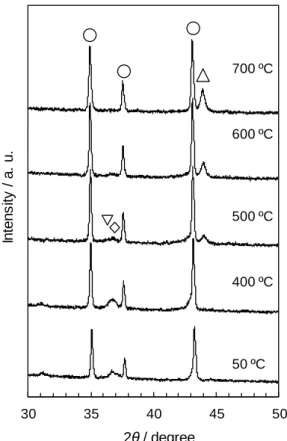
species during the high temperature reduction process were investigated by in-situ XRD measurement (Ultima ІV, Rigaku) equipment with an atmosphere controllable cell. The XRD measurement was conducted at 50 °C, 400 °C,
500 °C, 600 °C, and 700 °C in ca. 4% H2/Ar. The
measurement conditions are the same as the XRD measurement at room temperature in the 1.3.1 section.
1.3.3. H2-temperature programmed reduction (H2
-TPR)
The H2-TPR measurement was conducted
using a BEL-CAT-ADVANCE (MicrotracBEL). Prior to measurement, the catalyst sample was preheated in air at 300 °C for 0.5 h and cooled down to 50 °C in He atmosphere. Subsequently, the
sample was heated up to 900 °C in 4% H2/Ar of 30
mL min-1 at a heating rate of 10 °C min-1.
1.3.4. Transmission electron microscope (TEM) The morphology of each catalyst was observed using a transmission electron microscope (TEM, JEM-2100F, JEOL). The operating voltage, emission current, and dark current were 200 kV, 230 μA, and 93–97 μA, respectively. The catalyst sample was crushed into powder and dispersed in ethanol with ultrasonic agitation, followed by transfer onto a copper grid.
1.3.5. Nitrous oxide pulse
To investigate the metal active sites in the
catalyst, N2O pulse measurement was carried out
using a BEL-CAT-ADVANCE (MicrotracBEL) equipped with thermal conductivity detector. For pretreatment, the catalyst sample was initially
2 h prior to the measurement, and then cooled
down to 50 °C in H2 atmosphere. Subsequently, the
0.032 mL of N2O was pulsed repeatedly to the
sample until the amount of N2O at the outlet
reached a constant value at 50 °C in He atmosphere.
The reduced metal species is oxidized by N2O to
produce N2. The N2 and N2O in the outlet gas were
separated using an active carbon column and the
consumption amount of N2O was determined.
2. Results and discussion
2.1. Catalytic performance of single metal catalysts First, we have evaluated the performance of single metal catalysts using γ-Al2O3 as a support with the metal loading amount of 10 wt%. The NH3 conversion for Ni/γ-Al2O3, Fe/γ-Al2O3, and Co/γ-Al2O3 catalysts are shown in Fig. 1A. The conversion reached ca. 100%, which is the equilibrium conversion, for Ni/γ-Al2O3 at ca. 550 °C and for Co/γ-Al2O3 at ca. 600 °C, respectively. But their conversions at the low temperature region were almost equivalent. In contrast, the Fe/γ-Al2O3 exhibited lower performance than the other catalysts. As a reference, the catalytic performance of 1.0 wt% Ru/γ-Al2O3 have been evaluated, resulting that the conversion reached equilibrium conversion at 450 °C (a result is not shown). Next, the performance tests have been also carried out for single metal catalysts using α-Al2O3 as a support in the same manner. The NH3 conversion for Ni/α-Al2O3, Fe/α-Al2O3, and Co/α-Al2O3 catalysts are shown in Fig. 1B. There was no difference in the catalytic performance among three catalysts. From these results, it was found that the NH3 decomposition performance at 500 °C is highest for Ni/γ-Al2O3 catalyst. Furthermore, in order to
improve the NH3 decomposition performance of
these base metal-based catalysts, we have examined the use of binary metal catalysts in which the base metal catalysts are combined with each other.
2.2. Catalytic performance of binary metal catalysts
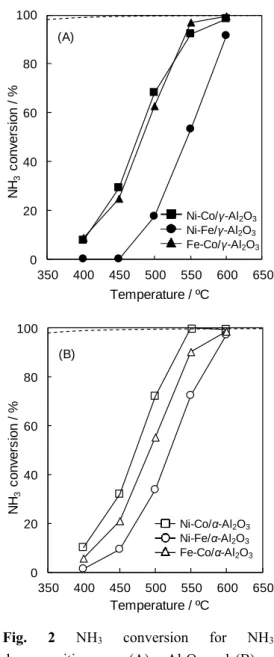
The NH3 conversion for the three catalysts such as Ni-Co/γ-Al2O3, Co-Fe/γ-Al2O3, and Ni-Fe/γ-Al2O3 are shown in Fig 2A. The total loading amount of metals was adjusted to 10wt% in their metallic state, and the molar ratio of metals was adjusted to 1:1. Among the γ-alumina supported catalysts, the performance of the Ni-Co/γ-Al2O3 and Ni-Fe/γ-Al2O3 were high and the performance
Fig. 1 NH3 conversion for NH3 decomposition
over (A) γ-Al2O3 and (B) α-Al2O3 supported
mono-metal catalysts: (square) Ni, (circle) Co, (triangle) Fe. Reaction conditions: 1.02%
NH3/Ar balance; W/F: 2.45 kg-cat s L-NH3-1;
catalyst weight: 0.050 g. (dot-line) equilibrium
NH3 conversion. 0 20 40 60 80 100 350 400 450 500 550 600 650 Temperature / ºC NH 3 c o n v e rs io n / % Ni/γ-Al2O3 Co/γ-Al2O3 Fe/γ-Al2O3 (A) 0 20 40 60 80 100 350 400 450 500 550 600 650 NH 3 c o n v e rs io n / % Temperature / ºC Ni/α-Al2O3 Co/α-Al2O3 Fe/α-Al2O3 (B)
of the Fe-Co/γ-Al2O3 was significantly low. Similarly, the NH3 conversion of binary metal catalysts such as Ni-Co/α-Al2O3, Co- Fe/α-Al2O3, and Ni-Fe/α-Al2O3 are shown in Fig. 2B. When α-Al2O3 was used as a support, we found that the performance of the binary metal catalyst of Ni and Co was the highest.
Considering the above results, particular attention was given to Ni catalysts and Co catalysts which exhibited high NH3 decomposition performance. Fig. 3 represents the results of comparing the conversion of NH3 at 500 °C for Ni and Co based catalysts. For the case of the γ-Al2O3 supported catalysts, the NH3 conversions for the Ni/γ-Al2O3, Co/γ-Al2O3, and Ni-Co/γ-Al2O3 which are single metal catalysts are approximately 69%, 66%, and 68%, respectively, which were almost identical. In contrast, for the α-Al2O3 supported catalysts, the conversion of Ni/α-Al2O3 and Co/α-Al2O3 were as low as 50%, while the binary metal catalyst, Ni-Co/α-Al2O3, was ca. 73%, which was the highest conversion. Generally, in the reaction process over heterogeneous catalysts, the catalytic performance is considered to be high performance, as the metal dispersion of the active metal species is high, that is, the smaller the particle size. However, in this work, by using the Ni-Co binary metal catalyst, the catalyst with the α-Al2O3 support having a low specific surface area, which is generally expected to have low metal dispersion, showed the highest performance for NH3 decomposition. 0 20 40 60 80 100 350 400 450 500 550 600 650 Temperature / ºC NH 3 c o n v e rs io n / % NH 3 c o n v e rs io n / % Temperature / ºC Ni-Co/α-Al2O3 Ni-Fe/α-Al2O3 Fe-Co/α-Al2O3 (A) (B) 0 20 40 60 80 100 350 400 450 500 550 600 650 Ni-Co/γ-Al2O3 Ni-Fe/γ-Al2O3 Fe-Co/γ-Al2O3
Fig. 2 NH3 conversion for NH3
decomposition over (A) γ-Al2O3 and (B)
α-Al2O3 supported bi-metal catalysts: (square)
Ni-Co, (circle) Ni-Fe, (triangle) Fe-Co. The molar ratio of both metals = 1:1. Reaction
conditions: 1.02% NH3/Ar balance; W/F:
2.45 kg-cat s L-NH3-1; catalyst weight: 0.050
g. (dot-line) equilibrium NH3 conversion.
0 20 40 60 80 100 NH 3 c o n v e rs io n a t 5 0 0 º C / %
Fig. 3 NH3 conversion at 500 ºC for Ni and Co
based catalysts for NH3 decomposition tests
2.3. Characterization of the catalyst 2.3.1. XRD
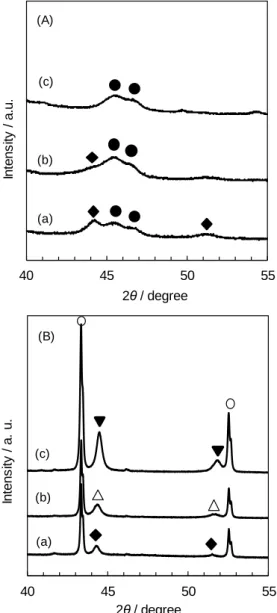
The XRD patterns of Ni/γ-Al2O3, Co/γ-Al2O3, and Ni-Co/γ-Al2O3 catalysts after the NH3 decomposition tests are shown in Fig. 4A. It is
noted that the diffraction peaks assigned to the
γ-Al2O3 support in all catalysts were broad. No
diffraction peak derived from the oxide phase of the active metal component was confirmed for all the catalysts, and the diffraction peaks derived from each metal component appeared. This indicates that the metal species as the active species was reduced from the oxide to the metal at 600 °C. It is expected that the diffraction peaks ascribed to Ni and Co metallic phases that are active metals will appear with considerably weak intensity at 2θ = ca. 44° and 51° for each catalyst. Indeed, for the Co containing catalysts
(Ni-Co/γ-Al2O3 and Co/γ-Al2O3), the diffraction peaks
assigned to Co metal or Co-Ni alloy appeared at ca. 44° and 51°. By contrast, the diffraction peaks assigned to Ni metal hardly appeared for the
Ni/γ-Al2O3. We consider that the metal Ni species are
considerably dispersed. In addition, since the peak
intensities of Ni, Co, and Ni-Co phases for the
XRD patterns of Ni-Co/γ-Al2O3 catalyst were weak, it is unclear that whether Ni-Co alloy phase was formed or not.
Fig. 4B shows the XRD patterns of Ni/α-Al2O3, Co/α-Al2O3, and Ni-Co/α-Al2O3 catalysts after the NH3 decomposition tests. For all the spent catalysts, the diffraction peaks attributed to each metal component as well as α-Al2O3 as a support were confirmed. The diffraction peaks derived from metallic Ni and Co phases appeared at ca. 45° and 51° for the Ni/α-Al2O3 and Co/α-Al2O3 catalysts. In addition, as compared with the results of the γ-Al2O3 supported catalysts, the difference in position of the diffraction peaks was clear for the α-Al2O3 supported catalysts. For the Ni-Co/α-Al2O3 catalyst, the diffraction peaks derived from metal components appeared at between the peak positions of metallic Ni and metallic Co phases. This result implied that the binary metal catalyst Ni-Co/α-Al2O3 is alloyed by the reduction treatment at 600 °C prior to the performance test.
2.3.2. H2-TPR
Reduction behavior of single metal catalysts such as Ni/α-Al2O3, Co/α-Al2O3, and Fe/α-Al2O3 catalysts and a binary metal catalyst Ni-Co/α-Al2O3 catalyst after the preparation has been
40 45 50 55 In te n s it y / a .u . (A) (a) (b) (c) 2θ / degree 40 45 50 55 In te n s it y / a . u . (B) (a) (b) (c) 2θ / degree
Fig. 4 XRD patterns of the spent Ni and Co
based catalysts after NH3 decomposition tests
shown in Figs. 1 and 2: (A-a) Co/γ-Al2O3,
(A-b) Ni-Co/γ-Al2O3, (A-c) Ni/γ-Al2O3, and (B-a)
Co/α-Al2O3, (B-b) Ni-Co/α-Al2O3, (B-c)
Ni/α-Al2O3. Symbols:() γ-Al2O3, () α-Al2O3,
studied. We note that before TPR measurement, the metal component in the catalyst exists in oxidized state. Fig. 5a shows the H2-TPR profile of the Ni/α-Al2O3 catalyst. The reduction peak attributed to the reduction of Ni species was observed at ca. 460 °C. In addition, small reduction peak was also
confirmed at ca. 580 °C. As shown in Fig. 5b, for the Co/α-Al2O3 catalyst, two distinct reduction peaks attributed to the reduction of Co species were observed at ca. 340 °C and 410 °C, and the small peak was slightly observed at ca. 700 °C. These plurality of reduction peaks mean the presence of multiple reduction steps. For the reduction of Ni species in the supported catalysts, a peak separation is observed due to changes in the compound, the particle size, and the interaction with the support (Shimoda et al., 2018). For the reduction of Co species, there is a report of two reduction step in which Co3O4 is reduced to CoO and then reduced to metallic Co (Luisetto et al., 2012; Muñoz et al., 2014). In addition, there is a report that the reduction peak shifts to higher temperature by the interaction with alumina as a support (Shimoda et al., 2018). Fig. 5c shows the H2-TPR profile of Ni-Co/α-Al2O3 catalyst. The reduction peaks appeared at ca. 310 °C, 410 °C, and 570 °C. It is reported that the reduction peak in the H2-TPR profile occurs at a slightly lower
Temperature / ºC 100 300 500 700 900 (c) (b) (a) H2 c o n s u m p ti o n ra te / a . u .
Fig. 5 H2-TPR profiles of the prepared Ni and
Co based catalysts: (a) Ni/α-Al2O3, (b)
Co/α-Al2O3, (c) Ni-Co/α-Al2O3.
(b) Co/-Al2O2 20 nm
(c) Ni-Co/-Al2O3 50 nm (d) Ni-Co/γ-Al2O3 20 nm
(a) (a) Ni/-Al2O3 50 nm
Fig. 6 TEM images of the spent catalysts: (a) Ni/α-Al2O3, (b)
temperature in the formation process of Ni-Co alloy (Sengupta et al., 2014; Gonzalez-Delacruz et al., 2012), and the similar tendency was obtained in this reduction profile.
2.3.3. TEM observation
In order to confirm the particle size of the metal and the alloy state, the microstructure of the spent catalysts after the performance test was observed by TEM. It is noted that α-Al2O3 was large crystal grains with the size of several micrometers. From the TEM image of Ni/α-Al2O3 shown in Fig. 6a, it is found that the metal Ni particles in the Ni/α-Al2O3 catalyst are spherical and the size of the Ni particles was considerably scattered. From the TEM image of Co/α-Al2O3 shown in Fig. 6b, many Co particles were in a rod shape, and the average particle size was ca. 35 nm in length and ca. 15 nm in width. Fig. 6c represents the TEM image of Ni-Co/α-Al2O3. The size of the metal particles on the support was smaller and more uniform in size than those in the Ni/α-Al2O3. The average particle size was ca. 30 nm, but it was not possible to distinguish whether Ni and Co components were alloyed or not based on the TEM observation. By contrast, for the Ni-Co/γ-Al2O3 catalyst shown in Fig. 6d, the morphology of the alumina support varied significantly. The γ-Al2O3 has been reported to be acicular crystals, which is confirmed by the TEM observation in this work. The metal particles in the Ni-Co/γ-Al2O3 catalyst were quite small and it was difficult to distinguish shape and size.
2.3.4. N2O pulse
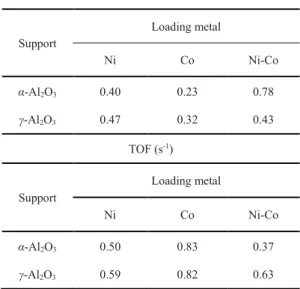
Table 1 summarizes the amount of N2O
consumption for various α-Al2O3 supported
catalysts in the N2O pulse measurement. Consumption of a certain amount of N2O was confirmed for all the catalysts. From these values, we tried to calculate the metal dispersion and the particle size of metallic Ni and Co, but they were largely different from the particle size by the TEM observation. For this reason, the number of active sites in the catalyst has been relatively compared
N2O consumption amount (cm3 g-1) Support Loading metal Ni Co Ni-Co α-Al2O3 0.40 0.23 0.78 γ-Al2O3 0.47 0.32 0.43 TOF (s-1) Support Loading metal Ni Co Ni-Co α-Al2O3 0.50 0.83 0.37 γ-Al2O3 0.59 0.82 0.63
using N2O consumption per 1 g of the catalyst. As a result, the consumption amount of N2O for the
Ni-Co/α-Al2O3 catalyst was 0.78 cm3 g-1, which
was larger than that of Ni/α-Al2O3 (0.40 cm3 g-1)
and of Co/α-Al2O3 (0.23 cm3 g-1). These results
suggest that the active metal is alloyed by the reduction treatment for a binary metal catalyst, and the particle size of its alloy becomes small. This is consistent with the fact that the metal particle size of the alloyed catalyst becomes smaller than that of the single metal catalysts in the TEM observation.
In contrast, the amount of N2O consumption for the
γ-Al2O3 supported catalysts were 0.43 cm3 g-1 for
Ni-Co/γ-Al2O3, 0.47 cm3 g-1 for Ni/γ-Al2O3, and
0.32 cm3 g-1 for Co/γ-Al
2O3, respectively.
Comparing with the α-Al2O3 supported catalysts,
the different in N2O consumption amount between
the γ-Al2O3 supported catalysts were small.
This result indicates that the alloying effect by the reduction treatment at 600 °C prior to the performance test is small for the binary metal
catalyst of Ni-Co/γ-Al2O3. Furthermore, when the
TOF (turnover frequency) values at 500 ºC for the
α-Al2O3 supported catalysts were compared from
Table 1 Amount of N2O consumption for the
spent Ni and Co based catalysts after NH3
decomposition shown in Figs. 1 and 2 and the
TOF (turnover frequency) values for NH3
the obtained data, it was found that the order was
Ni-Co/α-Al2O3 < Ni/α-Al2O3 < Co/α-Al2O3. This
result implies that the effect of increasing the number of active sites mainly contributes to the improvement factor of the catalyst performance due to the binary metal catalyst than the electronic effect on the active sites.
2.4. NH3 decomposition over Ni-Co based
catalysts
2.4.1. Molar ration of Ni to Co
We have studied the composition ratio of Ni and Co to aim for further improvement of the binary metal catalysts of Ni and Co with the
α-Al2O3 support which exhibited the highest
performance. Various catalysts were prepared with the Co/(Co+Ni) of 0.0, 0.3, 0.5, 0.7, and 1.0 in
terms of molar ratio of metal, and the NH3
decomposition performance was compared (Fig.
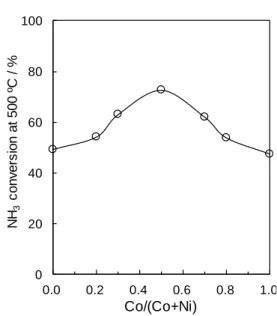
S1). In addition, Fig. 7 shows the comparison of the NH3 conversion at 500 °C between various Ni-Co/α-Al2O3 catalysts. As a result, it was found that NH3 conversion was the highest in the case of Co/(Co+Ni) = 0.5, and the binary metal catalysts showed better performance than the single metal catalysts. According to this result, we conclude the catalytic performance can be improved by
complexing the two metals of Ni and Co components, that is, by the alloying effect.
2.4.2. Reduction treatment
In order to reveal the optimal temperature of
the reduction treatment for the catalyst prior to the performance test, the Ni-Co/α-Al2O3 catalyst with
the Co/(Co+Ni) of 0.5 was reduced at 500 °C,
600 °C, 700 °C, and 800 °C, and subsequently the NH3 decomposition performance was evaluated (Fig. S2). The NH3 conversion at 500 °C was 60% for the case with the reduction temperature of 800 °C, 65% for the case at 700 °C, 72% for the case at 600 °C, and 73% for the case at 500 °C, respectively. The NH3 decomposition performance when the catalyst was reduced at 500 °C and 600 °C were almost identical and highest, indicating that the catalytic performance tends to decrease as the reduction temperature increases. 2.4.3. Crystalline phase of the catalyst
The XRD patterns of the Ni-Co/α-Al2O3 catalysts with the Co/(Co+Ni) of 0 to 1.0 after the performance test are shown in Fig. 8A. The diffraction peak ascribed to Co (111) plane appeared at ca. 44.3 ° for the Co/α-Al2O3, and the peak ascribed to Ni (111) plane appeared at ca. 44.5 ° for the Ni/α-Al2O3. The diffraction peak position for the Ni-Co/α-Al2O3 catalysts with different Ni to Co composition ratios were between those for the Co/α-Al2O3 and Ni/α-Al2O3 catalysts. The diffraction peak for the Ni-Co/α-Al2O3 catalysts shifted to the higher angle side as the amount of Ni content increased. In addition, all the diffraction peaks assigned to metal species appeared in the single-phase diffraction patterns. Therefore, it is considered that they exist in the solid solution state. The relationship between the composition ratio of Ni and Co and the lattice plane distance (d) based on each XRD peak is plotted as shown in Fig. 8B. It was found that the d value increases almost linearly as the amount of Co increases, which this trend applies to Vegard's law. In other words, it is implied that Ni and Co species in the binary metal catalysts after the NH3 0 20 40 60 80 100 0.0 0.2 0.4 0.6 0.8 1.0 NH 3 c o n v e rs io n a t 5 0 0 º C / % Co/(Co+Ni)
Fig. 7 Effect of molar ratio of Co/(Co+Ni) on
NH3 conversion at 500 ºC over Ni-Co/α-Al2O3
decomposition tests with the reduction treatment at 600 °C were solid-solved and alloyed.
The result of in-situ XRD measurement under the reduction atmosphere in 4% H2/Ar at various temperatures for the Ni-Co/α-Al2O3 catalyst is shown in Fig. 9. At 50 ºC, in addition to the diffraction peak derived from the support, two peaks assigned to NiO phase and Co3O4 phase were observed 2θ = ca. 45 º separately. Since their peaks were independent from each other, two oxides are considered to be not solid solution in the oxide state. When the temperature was raised, the peaks of the oxides decreased and almost disappeared at 500 ºC, and the diffraction peak
attributed to an alloy of Ni and Co appeared. Furthermore, when the temperature was increased to 600 ºC and 700 ºC, the peak intensity of the Ni-Co alloy increased and became sharp significantly. We conclude that Ni and Co species are considered to form a Ni-Co alloy during the reduction atmosphere at 600 ºC. It was reported that a Cu-Ni alloy was formed in the reduction process in Cu-Ni/SiO2 in the previous study by Saw et al. (Saw et al., 2014), and the same phenomena may occur in the Ni-Co/α-Al2O3 system in our present study.
2.5. Arrhenius plot
For the NH3 decomposition test using each catalyst, Arrhenius plots were prepared. From the data on the NH3 conversion, it was assumed that the reaction was a primary reaction against NH3, 43 43.5 44 44.5 45 45.5 2θ / degree In te n s it y / a . u . Ni (111) Co (111) Co/(Co+Ni) 0 0.2 0.3 0.5 0.7 0.8 1.0 (A) 2.030 2.035 2.040 2.045 2.050 0.0 0.2 0.4 0.6 0.8 1.0 Co/(Co+Ni) (B) L a tt ic e p la n e d is ta n c e , d / n m
Fig. 8 (A) XRD patterns and (B) relationship between Co/(Co+Ni) and lattice plane
distance for the spent Ni-Co/α-Al2O3 catalysts
after NH3 decomposition tests.
In te n s it y / a . u . 30 35 40 45 50 700 ºC 600 ºC 500 ºC 400 ºC 50 ºC 2θ / degree In te n s it y / a . u .
Fig. 9 In-situ high temperature XRD patterns
for the prepared Ni-Co/α-Al2O3 catalyst with
the Co/(Co+Ni) of 0.5. Symbols: () α-Al2O3,
( ◇ ) Co3O4, () NiO, () Ni or Co.
and the reaction rate constant (k) and the apparent activation energy (Ea) were calculated. First, when the reaction rate formula is as follows:
𝑟 = −𝑑
𝑑𝑡𝐶 = 𝑘𝐶 (3)
where r is the reaction rate, C is the NH3 concentration, and t is the reaction time. Here, Eq. (3) can be transformed into Eq. (4).
−ln𝐶0
𝐶 = 𝑘𝑡 (4)
where C0 is initial NH3 concentration. Since (C0
-C)/C0 means the conversion, letting the NH3
conversion be x, the k can be expressed by Eq. (5).
ln ( 1
1−𝑥) = 𝑘 (5)
The apparent activation energy (Ea) and the frequency factor (A) for NH3 decomposition over each catalyst were calculated from the Arrhenius plot in which the inverse of the reaction temperature (1/T) and k were plotted by Eq. (6).
ln𝑘 = ln𝐴 −𝐸𝑎
𝑅𝑇 (6)
where R is the gas constant (8.314 J K mol-1).
Arrhenius plots in NH3 decomposition over the Ni and Co based catalysts are shown in Fig. S3. Since the linear relationship was obtained for all the catalysts, we consider that the NH3 decomposition reaction was an apparent first reaction to NH3 under this reaction condition (1%
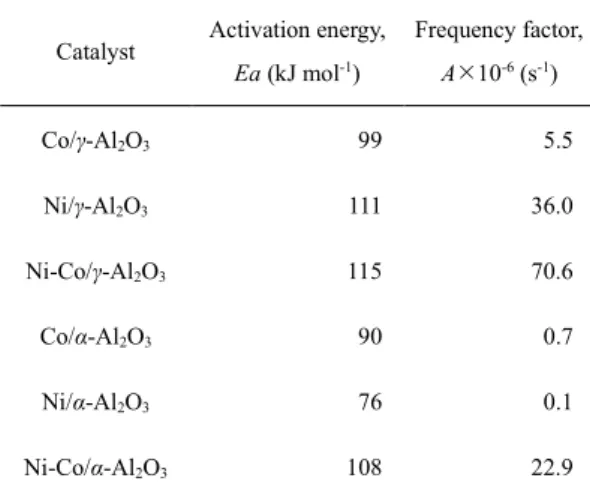
NH3/Ar). The calculated apparent Ea and A of each catalyst from Arrhenius plot are summarized in Table 2. The Ea value for the Ni-Co/α-Al2O3 was
108 kJ mol-1 which was larger than those for the
Co/α-Al2O3 and Ni/α-Al2O3 and the γ-Al2O3
supported catalysts also showed the similar
tendency. According to the literature, it was
reported that the Ea value of the Ni/CNTs catalyst
for NH3 decomposition was 90 kJ mol-1 (Yin et al.,
2004b) and that of the Ni/SiO2/Al2O3 catalyst was
92 kJ mol-1 (Choudhary et al., 2001). In addition,
the Ea value of 110 kJ mol-1 was reported for
zeolite supported Ni catalyst (Inokawa et al., 2015).
For the supported catalyst for NH3 decomposition,
the Ea value is considered to vary due to the difference in active metal species and the support materials, and the modification effect of the third
element, and the Ea values of ca. 53 to 150 kJ mol
-1 was reported as literature data (Mukherjee et al.,
2018). The A value for the Ni-Co/α-Al2O3 was 22.9
s-1 which was quite higher compared with those for
the Ni/α-Al2O3 and Co/α-Al2O3. By contrast,
although an increase in the A value was recognized, the difference in the A due to the binary metal was
not large for the γ-Al2O3 supported catalysts. These
results imply that the performance of the catalyst would greatly influence the frequency factor, that is, the number of active sites.
2.6. Catalytic performance of other oxide supported Ni-Co catalysts
It is widely known that catalytic performance changes in the oxide supported metal catalysts due to the interaction between the active metal and the support. Therefore, to elucidate whether the
improvement effect of the catalytic performance
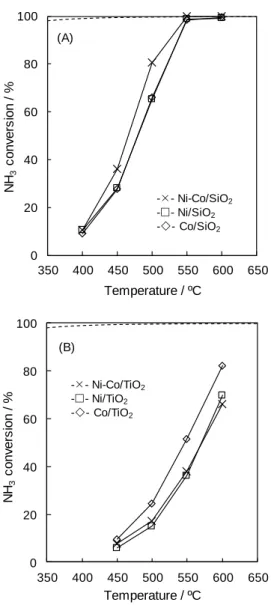
by alloying can be obtained for the other oxides used as a support, the Ni, Co, and Ni-Co catalysts with SiO2 and TiO2 supports (Co:Ni = 1:1) were prepared, and their NH3 decomposition performance was evaluated. Fig. 10A shows the NH3 decomposition performance of Ni/SiO2, Co/SiO2, and Ni-Co/SiO2 catalysts, which is generally considered to have the weak metal-support interaction. The NH3 conversion at 500 °C Catalyst Activation energy,
Ea (kJ mol-1) Frequency factor, A10-6 (s-1) Co/γ-Al2O3 99 5.5 Ni/γ-Al2O3 111 36.0 Ni-Co/γ-Al2O3 115 70.6 Co/α-Al2O3 90 0.7 Ni/α-Al2O3 76 0.1 Ni-Co/α-Al2O3 108 22.9
Table 2 Apparent activation energy and
frequency factor for NH3 decomposition over
was 65% for the Ni/SiO2, 65% for the Co/SiO2, and 80% for the Ni-Co/SiO2, respectively. This indicates that the effect of improving the performance could be obtained for the Ni-Co binary metal catalyst even for the SiO2 supported system with the similar trend as α-Al2O3 supported
catalyst. And it is worth noting that the SiO2
-supported Ni-Co catalyst exhibited the higher
performance than the α-Al2O3 supported Ni-Co catalyst.
By contrast, the Ni-Co catalyst using the TiO2 (Fig. 10B) which has the strong metal support
interaction (SMSI) showed the similar
performance to single metal catalyst. For the
γ-Al2O3 supported catalysts, there was no positive
effect by alloying on the catalytic performance as shown in Fig. 3. And we noted that even if the
loaded amounts of Ni and Co increased to the total
of 40 wt%, these tendencies were the same (Fig.
S4) for the γ-Al2O3 supported catalysts. But, the
catalytic performance was improved by increasing the loading amount, namely, the 40 wt% Ni-Co/α-Al2O3 catalyst exhibited the NH3 conversions of ca. 96% at 500 °C and of ca. 55% at 450 °C. From these results, we conclude that in the Ni and Co based catalyst system, the behavior of alloying of the metal component varies depending on the kind of the oxide support, which affects the catalytic performance of NH3 decomposition.
Conclusion
In the present work, we have conducted the development of a base metal catalyst which shows high performance for the NH3 decomposition reaction. For the Ni and Co based catalysts using α-Al2O3 as a support, the performance of the single metal catalysts was lower than that of the γ-Al2O3 supported catalysts. However, its performance was greatly improved by using a binary metal catalyst. Based on the XRD analysis, it was found that Ni and Co supported on α-Al2O3 were alloyed. TEM observation confirmed that the metal particle size in the α-Al2O3 supported Ni-Co catalyst is smaller than that of the single metal catalysts (Ni/α-Al2O3 or Co/α-Al2O3). The optimum mixing ratio of Ni and Co components was 1:1, and the optimum reduction temperature before the test was 600 °C. Furthermore, in-situ XRD and H2-TPR measurements revealed that the Ni-Co alloy forms during the reduction process. Studies on the differences of support oxides proved that the improvement effect by alloying can be similarly obtained with the SiO2 supported catalyst, indicating that the catalyst using the support with
Temperature / ºC 0 20 40 60 80 100 350 400 450 500 550 600 650 NH 3 c o n v e rs io n / % (A) -- Ni-Co/SiO2 -- Ni/SiO2 -- Co/SiO2 0 20 40 60 80 100 350 400 450 500 550 600 650 (B) NH 3 c o n v e rs io n / % Temperature / ºC -- Ni-Co/TiO2 -- Ni/TiO2 -- Co/TiO2
Fig. 10 NH3 conversion for NH3
decomposition over (A) SiO2 and (B)TiO2
supported Ni and Co based catalysts. Reaction
conditions: 1.02% NH3/Ar balance; W/F:
2.45 kg-cat s L-NH3-1; catalyst weight: 0.050
less interaction between the active metal and the support is more likely to obtain the performance improvement effect by alloying.
Acknowledgments
TEM analysis was supported by the Cooperative Research Program of Catalysis Research Center, Hokkaido University (Grant 14B1009).
Literature Cited
Becherif, M., Claude, F., Hervier, T. and Boulon, L.; "Multi-stack Fuel Cells Powering a Vehicle," Energy Procedia, 74, 308-319 (2015)
Choi, J.-G.; "Ammonia Decomposition over Vanadium Carbide Catalysts," J. Catal., 182, 104-116 (1999)
Choudhary, T. V., Sivadinarayana, C. and Goodman, D. W.; "Catalytic ammonia
decomposition: COx-free hydrogen
production for fuel cell applications," Catal.
Lett., 72, 197-201 (2001)
Deng, Q.-F., Zhang, H., Hou, X.-X., Ren, T.-Z. and
Yuan, Z.-Y.; "High-surface-area Ce0.8Zr0.2O2
solid solutions supported Ni catalysts for ammonia decomposition to hydrogen," Int. J.
Hydrogen Energy, 37, 15901-15907 (2012)
Duan, X., Ji, J., Qian, G., Fan, C., Zhu, Y., Zhou, X., Chen, D. and Yuan, W.; "Ammonia decomposition on Fe(110), Co(111) and Ni(111) surfaces: A density functional theory study," J. Mol. Catal. A: Chem., 357, 81-86 (2012)
Duan, X., Qian, G., Liu, Y., Ji, J., Zhou, X., Chen, D. and Yuan, W.; "Structure sensitivity of ammonia decomposition over Ni catalysts: A computational and experimental study," Fuel
Process. Technol., 108, 112-117 (2013)
Ertl, G. and Huber, M.; "Mechanism and Kinetics of Ammonia Decomposition on Iron," J.
Catal., 61, 537-539 (1980)
Gonzalez-delaCruz, V. M., Pereñiguez, R., Ternero, F., Holgado, J. P. and Caballero, A.; "In Situ XAS Study of Synergic Effects on Ni–
Co/ZrO2 Methane Reforming Catalysts," The
Journal of Physical Chemistry C, 116,
2919-2926 (2012)
Hashimoto, K. and Toukai, N.; "Decomposition of ammonia over a catalyst consisting of ruthenium metal and cerium oxides supported on Y-form zeolite," J. Mol. Catal. A: Chem., 161, 171-178 (2000)
Hayashi, F., Toda, Y., Kanie, Y., Kitano, M., Inoue, Y., Yokoyama, T., Hara, M. and Hosono, H.; "Ammonia decomposition by ruthenium nanoparticles loaded on inorganic electride
C12A7:e−," Chemical Science, 4, 3124-3130
(2013)
Huang, D.-C., Jiang, C.-H., Liu, F.-J., Cheng, Y.-C., Chen, Y.-C. and Hsueh, K.-L.; "Preparation of Ru–Cs catalyst and its application on
hydrogen production by ammonia
decomposition," Int. J. Hydrogen Energy, 38, 3233-3240 (2013)
Inokawa, H., Ichikawa, T., Miyaoka, H.; “Catalysis of nickel nanoparticles with high thermal stability forammonia decomposition,” Appl.
Catal. A: General, 491, 184-188 (2015)
Li, L., Zhu, Z. H., Yan, Z. F., Lu, G. Q. and Rintoul, L.; "Catalytic ammonia decomposition over Ru/carbon catalysts: The importance of the structure of carbon support," Applied
Catalysis A: General, 320, 166-172 (2007)
Liang, C., Li, W., Wei, Z., Xin, Q. and Li, C.; "Catalytic Decomposition of Ammonia over
Nitrided MoNx/γ-Al2O3
and NiMoNy/γ-Al2O3 Catalysts," Ind. Eng. Chem.
Res., 39, 3694-3697 (2000)
Liu, Y., Wang, H., Li, J., Lu, Y., Wu, H., Xue, Q. and Chen, L.; "Monolithic microfibrous nickel catalyst co-modified with ceria and alumina for miniature hydrogen production via ammonia decomposition," Applied Catalysis
A: General, 328, 77-82 (2007)
Luisetto, I., Tuti, S. and Di Bartolomeo, E.; "Co
and Ni supported on CeO2 as selective
bimetallic catalyst for dry reforming of methane," Int. J. Hydrogen Energy, 37, 15992-15999 (2012)
Lund, C.R.F., Wu, G.; “Low-temperature
ammonia decomposition catalysts for
hydrogen generation,” Appl. Catal. B:
Environmental., 226, 162-181 (2018)
Muñoz, M., Moreno, S. and Molina, R.; "The effect of the absence of Ni, Co, and Ni–Co catalyst pretreatment on catalytic activity for hydrogen production via oxidative steam reforming of ethanol," Int. J. Hydrogen Energy, 39, 10074-10089 (2014)
Nagaoka, K., Eboshi, T., Abe, N., Miyahara, S.-i., Honda, K. and Sato, K.; "Influence of basic
dopants on the activity of Ru/Pr6O11 for
hydrogen production by ammonia
decomposition," Int. J. Hydrogen Energy, 39, 20731-20735 (2014)
Nagaoka, K., Honda, K., Ibuki, M., Sato, K. and
Takita, Y.; "Highly Active Cs2O/Ru/Pr6O11as a
Catalyst for Ammonia Decomposition," Chem.
Lett., 39, 918-919 (2010)
Okura, K., Okanishi, T., Muroyama, H., Matsui, T. and Eguchi, K.; "Promotion effect of rare-earth elements on the catalytic decomposition
of ammonia over Ni/Al2O3 catalyst," Applied
Catalysis A: General, 505, 77-85 (2015)
Raróg-Pilecka, W., Szmigiel, D., Kowalczyk, Z., Jodzis, S. and Zielinski, J.; "Ammonia
decomposition over the carbon-based
ruthenium catalyst promoted with barium or cesium," J. Catal., 218, 465-469 (2003) Sato, K., Abe, N., Kawagoe, T., Miyahara, S.-i.,
Honda, K. and Nagaoka, K.; "Supported Ni catalysts prepared from hydrotalcite-like compounds for the production of hydrogen by ammonia decomposition," Int. J. Hydrogen
Energy, 42, 6610-6617 (2017)
Saw, E. T., Oemar, U., Tan, X. R., Du, Y., Borgna, A., Hidajat, K. and Kawi, S.; "Bimetallic Ni–
Cu catalyst supported on CeO2 for
high-temperature water–gas shift reaction: Methane suppression via enhanced CO adsorption," J.
Catal., 314, 32-46 (2014)
Sengupta, S., Ray, K. and Deo, G.; "Effects of
modifying Ni/Al2O3 catalyst with cobalt on
the reforming of CH4 with CO2 and cracking
of CH4 reactions," Int. J. Hydrogen Energy, 39,
11462-11472 (2014)
Shimoda, N., Koide, N., Kasahara, M., Mukoyama, T. and Satokawa, S.; "Development of oxide-supported nickel-based catalysts for catalytic decomposition of dimethyl sulfide," Fuel, 232, 485-494 (2018)
Yin, S.-F., Xu, B.-Q., Ng, C.-F. and Au, C.-T.; "Nano Ru/CNTs: a highly active and stable catalyst for the generation of COx-free hydrogen in ammonia decomposition,"
Applied Catalysis B: Environmental, 48,
237-241 (2004a)
Yin, S.-F., Xu, B.-Q., Wang, S.-J. and Au, C.-T.;
"Nanosized Ru on high-surface-area
superbasic ZrO2-KOH for efficient generation
of hydrogen via ammonia decomposition,"
Applied Catalysis A: General, 301, 202-210
(2006)
Yin, S.-F., Zhang, Q.-H., Xu, B.-Q., Zhu, W.-X., Ng, C.-F. and Au, C.-T.; "Investigation on the catalysis of COx-free hydrogen generation from ammonia," J. Catal., 224, 384-396 (2004b)
Zhang, J., Xu, H., Ge, Q. and Li, W.; "Highly
efficient Ru/MgO catalysts for NH3
decomposition: Synthesis, characterization and promoter effect," Catal. Commun., 7, 148-152 (2006)