145
Research Note
Old
Paper
Used
for the
Asutosh
Museum
Manuscript
of Pancaraksa
Its Significance in the History of Nepalese Paper-making
●
Masatoshi A. Konishi
Introduction
It is well known that the Pancaraksa manuscript now stored and partly exhibited in the Asutosh Museum, University of Calcutta, is one of the oldest dated manu-scripts, if not the earliest, written on the Nepalese paper so far known to us. It is not only the oldest Nepalese paper with clear date on its colophon, but the oldest example among any of the dated manuscripts throughout the Indian Subcon-tinent. Although we have got some literary evidences on the uses of Indian paper in early periods like the 13-14th centuries, there are few literary references in case of the Nepalese paper in the contemporary sources and documents. We have thus to rely more or less solely on such extant specimens of paper in order to know the history of paper-making in Nepal and in South Asia in general.
There has been a tendency in the field of Indological, Buddhist and historical studies as well, to generally neglect the importance of paper as ' carrier ' of the documents on which they rely. But the study of paper would certainly throw much light, not only on the technological history of paper as such, but also on geo-graphical and socio-economic relations between the makers and users of paper, which has served so much for the socio-religious, economic, political and cultural
communications among the people since the spread and adoption of the paper.') Among the types of paper still handmade in certain parts of the world, the tradi-tional Nepalese paper is very well known by its beauty and strong durability. Nepal has contributed to the world in many aspects, but the paper stands atop among her contributions. Though Nepal had not developed such big and ancient civilizations like the neighbouring countries, she has retained her own originality 小西正捷 Masatoshi A. KONISHI, Rikkyo University, South Asian Studies. Other
publications include:
Cultural Patterns of the Indian People. (in Japanese) Tokyo, Hosei University Press. History and Culture of Bengal. (in Japanese) Tokyo, Hosei Universicty Press.
and characteristics in between the two great civilizations of India and China. Nepal has in fact played such important roles in every step of the history in the cultural, religious, socio-economic and political intercourse between the North and North-eastern parts of India and the SouthNorth-eastern part of Tibet. The entrepots through the lofty mountains and deep valleys were the cultural centres, and we can still see old temples and monasteries situated in those centres preserving many ancient manuscripts and documents, mainly the Buddhistic sutras, either hand-written or printed by wood-blocks on hand-made paper.
Some of these sutras, or the paper as the carrier at least, could have been brought from Tibet or China through Tibet, and even India-made paper had been used in later times, but we should remember here that the Paiicaraksil manuscript of the Asutosh Museum, for instance, had been made in a typical Nepalese way of paper-making technology as early as in A.D. 1105, when India still did not know the paper-making technology of her own.2 Although we are yet to see how this paper-making tradition is related to the earlier Tibetan or Chinese technological tradi-tions, at least we are certain that it was established earlier than in India proper ,
and had not been influenced by the later Indian technological tradition, which is quite distinct from the Nepalese one, till rather recent times.3 On the other hand, Nepalese tradition did not influence India much except for a few neighbouring regions, and both seem to have developed quite independently .
However, besides the extant manuscripts on the Nepalese paper , we have got really meagre literary evidences on the use of indigenous paper of Nepal, thus we have to pay much attention to such old extant specimens like the Pancaraksd manu-script, and carefully examine them in relation with the other documents on materials other than paper, too, in order to trace back the origin of the Nepalese handmade paper in its proper context. Although we cannot yet say with certainty what sort of material was first adopted as the carrier of documents, it seems to be possible that either cotton sheets (kcirpeisalkcirpiisikapatra), or the bark of certain types of trees like birch (bhojpatra) and aloe-wood (sacipat of Assam) were used for the purpose as in India.4) In fact, a document written on the aloe-wood bark (Aqui-laria agallocha) has been reported by Trier ,5) though it is a late specimen of the 15th century. Wright writes in his book, History of Nepal published in 1877,6) that birch barks have not been used in Nepal unlike in North India (like Kashmir) , but there are possibilities that birch barks have carried scripts on them in Nepal , too, at least as amulets, if not as literary documents.7) As for the parchment, there appears an item carmapatra' in Turner's Nepalese dictionary ,8) but Trier con-siders that it is a term simply corresponding to those imported from Europe or other places, and parchment was in fact not in use in Nepal .
Old Paper Used for the Asutosh Museum Manuscript of Pancaraksii 147 Early Paper Manuscripts in Nepal
As regards the paper manuscripts in Nepal after the 12th century, there remains little to add to the detailed and learned study already accomplished by Trier.9) He has made full use of the manuscripts stored in Cambridge University,10) British Museum,11) Royal Library of Copenhagen,12) and various specimens scattered in Nepal, Tibet, India, England, France and USSR.13) I shall also try to show my own analysis of the Kesar ' Library manuscripts in Kathmandu14) and others in the later part of this paper, but I shall state here the results only briefly in this present context.
The manuscripts before the 12th century are generally written on tclipatra or palm-leaves, and not on paper. A few such specimens going back to the 9th cen-tury are known among the manuscripts of Cambridge University (2 examples), and British Museum and Kesar Library also (one example respectively). The last mentioned one (Kesar MS No. 699) is a copy of jyurveda comprising 127 pieces, but incomplete and badly damaged. The size is 53.5 x 4.4 cm. and said to be of A.D. 877. There are several palm-leaf manuscripts of the 10th century in various places, and palm-leaf was abundantly used for manuscripts during the 11-16th centuries, especially during the 14-15th centuries.
There is, however, a bunch of paper manuscripts said to be of the 10th century in the National Archives, Kathmandu,15) though there is a possibility that it was brought from somewhere else. The paper is made of high-level Thymelaeaceae fibres resembling Daphne bholua, which is one of the commonest materials for the traditional Nepalese paper-making, but the size, format, binding method and the writing point differ so much from the typical Nepalese manuscripts. Trier con-siders that it might have come from the Northwestern part of India or even from West Turkestan, but if it is of the 10th century in date, its Indian origin is impos-sible, and one should consider that this particular manuscript is of much later date. Another example of Kesar Library (MS No. 119) is tentatively dated around A.D. 1000. It is a complete set (150 sheet) of Buddhistic Lankcivatilrasiitra written in Newar script, and the size (35.5 •~ 9.5 cm.) is obviously influenced by the older palm-leaf format. There is no other example dating back before the 12th century so far as we know.
The earliest and surely datable example of the 12th century manuscripts is the Pailearakci manuscript of the Asutosh Museum, Calcutta. It has a colophon dated Newar (Nepali) sariavat (hereby abbreviated to ' NS ') 225 or A.D. 1105, during the reign of Siriahadeva of the Thakuri Dynasty (8-or-9th to 12th century) prior to the IVIallas.16) The format, c. 38 •~ 8.5 cm, is more or less after that of palm-leaf manu-scripts of the same period, but somewhat shorter and broader, thus carrying greater number of lines. There bears a beautiful miniature painting of the Tantric
Bud-dhistic deity/deities in the centre of each sheet, and two holes with page numbers are open on both sides of the painting for the purpose of tying them up. The scripts are quite neatly written with a pen in 9 lines.17) The paper itself consists of four thin layers, thus thick and tough but still soft. According to Trier who ex-amined the piece of this manuscript through microscopical analysis, it is made of
Thymelaeaceae fibre of the highlevel type, resembling Daphne bholua in the length and width of the fibre.18)
In general, century-long oxidation and withering is obvious in that the proper bast fibres have turned into a pale red-violet colour, and that they immediately dis-solved in cuoxam, not simply because they are heavily-mechanically treated. Ac-cording to a number of spectrographical X-ray analysis, the slightly brownish paper did not seem to have been treated with any inorganic substances. It does not seem to have been treated either with starch-paste to improve the surface as in later examples, though Trier found a few big round starch grains. The sample showed no distinct imprint of the mould used for the shifting, so a fine-meshed cot-ton shieve must have been used as in the cases still prevalent in some parts of Nepal, where the wet paper is kept on the shieve till it dries up in the sun, without being peeled off and piled on one after another to squeeze water. The latter case is the typical example observed in India in general, and here also one sees the dif-ference between the Indian and the Nepalese ways of paper-making, at least at pre-sent.
It is also interesting to note that this early example made in Nepal has been brought to Bengal in India. Though it is not certain how this particular piece was transferred and finally came to be stored in the Asutosh Museum, we know his-torically that both Nepal and Tibet had close connections and cultural intercourses with East Indian regions like Bengal and Bihar from the 11th century to the end of the 12th century. Bihar and Bengal were then the last bases for the Tantricised Buddhism, and naturally after the beginning of the 12th century many Buddhist monks of East India fled to Nepal due to the repeated Muslim invasions in certain parts of North India.
The fact that many of the Nepalese Buddhistic manuscripts are written in the Reinjand style script prevalent in Bengal at that time, rather than in Newdr-lz:pi so commonly adopted since the 9th century, would also tell this story.19) This can be also related to the fact that the Nepalese people started making paper following the Tibetan technology with which they were so well acquainted by this time, partly to meet the increasing demands of paper for writing and copying the Buddhistic sutras as well. It may be also related to still another fact that the Nepalese paper-making technology thus established did not necessarily give immediate in-fluence on Bengal or any other regions in India, as the biggest users of paper, the Buddhist monks, have sought shelters in Nepal leaving India, and the way of
move-Old Paper Used for the Asutosh Museum Manuscript of Paiicaraksd 149 ment was not vice versa, viz, not from Nepal to India.
There need to be more precise and critical discussions as for these historical problems, but we shall briefly see here a few more examples of the extant paper manuscripts in the 12th century Nepal. Kesar Library MS No. D-161, Jyotisara-ratnamcild dated NS 302 (A.D. 1182), and ditto No. 118, Namasathgiti dated NS 242 (A.D. 1122) are such examples. Both are of the size of c. 26-or-27 x 5 cm., and the quality of the paper, etc. are more or less the same as the Asutosh Museum manuscript. Besides, two more manuscripts dated NS 230 (A.D. 1110) and 245 (1125) have been cited by R.L. Mitra, but the date is doubtful because of their somewhat broader size and the yellow dyeing with hartdl (As2 S3), a practice not usual in Nepal before the 16th century.20)
13-14th Century Examples
It was still common to use palm-leaf for manuscripts during the 13th century, but it is to be noted here that sutras written with gold or silver ink on blue-black paper appear at this particular stage. Trier cited nine such examples, and according to him, they were made from fibres of hemp or ramie, on moulds of what seem to be mats of grass straw with 35-45 lines per 50 mm.21) This may show certain tech-nological connection with the Chinese paper-making, but it is not treated with starch but thoroughly polished on both sides, viz, two layers out of four, after being dyed blue-black.
Such sutras, mainly dharani, became common only after the 17th cuntury as we see among the manuscripts of Cambridge University and the Asiatic Society, Cal-cutta, but they appear in Japan as early as in the 8th century continuing until the 17th century, and some 30 such examples are known so far.22) The earliest among them is dated A.D. 741 (KonkOrny5-saishe5-15-ky5), and many of the 8-9th century specimens are known to have been brought in from T'ang Dynasty China by eminent Buddhist scholar-monks like Ganjin, SaichO, Ennin and others.23) If the Chinese had been already using this particular type of paper by then, one should consider that they were also introduced to Nepal from China through Tibet at around this time. The 13th century actually saw active communications between Nepal and Tibet, and Nepalese crafts were most flourishing at that time . Many Newar craftsmen were invited to Tibet and much Nepalese influence can be seen in the contemporary Tibetan crafts. It is true that Nepal is partly invaded by India during the reign of Anantamalla (c. 1274-1310), an early king of the Malla Dynasty , but we cannot see that Indian influence was there for the introduction of paper then as Trier considers, while we should notice that the scripts adopted in Nepal then were largely in Reiiljand style which could have been originated in Bengal rather than in Nepal.24) At least it may be put that these manuscripts well repre-sent the products of Nepal, literally in between India and the Chinese world .
As regards the 14th century examples and aftermath, the descriptions should be brief. We shall only see here that palm-leaf was still common during the 14-15th
centuries, and only seven to eight examples of paper manuscripts are known to us.25) However, the number of paper manuscripts rapidly increases in the 16th century,
and it seems to have overtaken that of the palm-leaf manuscripts well before the 17th century. This period corresponds to the later Mallas when Nepal had been enjoying active trade relationships with China through Tibet, or with India further south. Already by 1500, Kashmiri merchants had arrived in Kathmandu through Tibetan side, and the strong influences from Tibet (and thereby from China indi-rectly) could be seen.26) It is possible to see here the strong Tibetan influence on the Nepalese paper-making technology, but it seems to be more appropriate to con-sider that Nepalese demand on paper became so great then under the commercial and religious influences from Tibet.
The aforesaid aspects can be well traced when the manuscripts of the Kesar Library and the National Archives, Kathmandu, are analyzed. It is said that the
Table 1 Analysis of the palm-leaf and paper manuscripts of the Kesar Library, Kathmandu. (after Konishi 1982).
Old Paper Used for the Asutosh Museum Manuscript of Paiicaraksd 151 Kesar Library has some 2500 paper manuscripts and 530 palm-leaf manuscripts, and the National Archives has some 2230 paper manuscripts and 1670 palm-leaf manuscripts. While most of the palm-leaf manuscripts range between the 11-17th centuries, specially around the 14-15th centuries, paper manuscripts are said to be of the dates generally after the 17th century. In order to clarify this aspect the author took up the case of the Kesar Library Collection, and with the kind help and permission rendered by Dr. Michael Witzel, then the Director of the Nepal-German Manuscripts Preservation Project, I could go through some 3000 pieces of unpublished cards and extracted 105 palm-leaf manuscripts and 232 paper manu-scripts, all clearly dated on the colophons. I further tried to classify them into several types, viz. Indian and Nepalese in case of the paper manuscripts, and ac-cording to the sathvat employed thereby. In Table 1, ' NS ' represents Nepali (Newar) Sariavat, ' VS ' being Vikram Sal-twat and ' SS ' Saka Sariavat.27) I fol-lowed here the analytical computation method adopted by Hoernle in 1900 on In-dian paper and palm-leaf manuscripts,28) and it came to be clear that the number of paper manuscripts clearly exceeds that of palm-leaf manuscripts by 1540-50, and the latter comes to be almost extinct by the 18th century. This date 1550 seems to be somewhat later than the cases in North and Northwestern India, but chrono-logically well in accordance with East India like Bengal with which Nepal had close connections, though the technological traditions are totally different from each other.
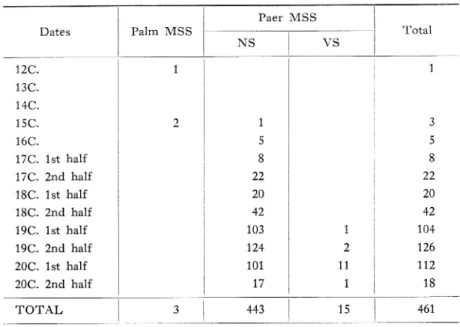
H. Takaoka in Nagoya, Japan, has also put his idea recently that palm-leaf manu-scripts gave place to paper manumanu-scripts sometime in the 16th or 17th century,29) though it is not the date of introduction of paper-making technology as he considers, but the period when paper-using became in fact quite popular in Nepal. Pancaraksa manuscript well dates back to the 12th century as we have already seen, and Taka-oka himself has included six paper manuscipt examples dated before the 17th cen-tury in his list. In order to clarify this matter, too, I utilized here his laborious work and analized them by the same method applied for the Kesar Library Collection.30) Although he does not give us the total number of the manuscripts in his list, I could count that some 1560 manuscripts are included therein, and the dated examples are 461 among them, of which 3 are on palm-leaf and 458 are on paper. They in all occupy 29.6% of the total number, and the percentage is quite high comparing to the case of the Kesar Library (less than 8.7%), which actually contained so many old manuscripts including palm-leaf specimens which are rarely dated in general. In other words, Takaoka's list consists of rather recent examples with paper manu-scripts datable between the 18-20th centuries as its bulk, with less examples of old specimens like undated palm-leaf manuscripts. Anyway, the result is as observed in the Table 2, and we see here too that the number of paper manuscripts increases right after the 16th century.
From the above discussions, especially by the two tables prepared by me, it is so clear that Pancaraksa manuscript of the Asutosh Museum is exceptionally old, and is a precious example to know the history of paper-making, not only in Nepal but in South Asia in general, too. It is rather surprising that it is so clearly dated in such an early period, and we have to say that we are lucky enough to have such an ex-ample in the complicated history of paper-making in Nepal and in South Asia, and to clarify the problem so far less-tackled.31)
Notes
1) M.A. Konishi, " Old Paper Manuscripts and the Establishment of the Paper-making Technology in India ", Hyakumanto, 52: 29-45 (in Japanese), 1981. 2) M.A. Konishi, " Paper-making Traditions in South Asia ", in T.C. Sharma &
D.N. Majumdar (eds.), Eastern Himalayas, Cosmo, New Delhi, 1980; ditto, " Nepalese Hand -made Paper-the History and Tradition " , Kikan Minzoku-gaku, 21: 42-53 (in Japanese), 1982; ditto, " Paper as known in Mediaeval India-a Sidelight on the Islamization of India " in Project Report on Islamiza-tion of Asia and Africa, 7: 65-74 (in Japanese), ILCAA, Tokyo, 1983; ditto, " Early Stages of Paper -making in India and Nepal ", Journal of Intercultural Studies, 10: 59-66, KUFS Publication, Osaka, 1983.
3) For the difference of these two distinct traditions, see my papers in the notes (1) and (2), passim.
Old Paper Used for the Asutosh Museum Manuscript of Pancaraksa 153 4) M.A. Konishi, " Writing Materials before Paper Used in India ", Chao
Uni-versity Asian Historical Studies, 6: 1-18 (in Japanese), 1982.
5) Jasper Trier, Ancient Paper of Nepal, Jutland Archaeological Society Publica-tions X: 130, 135, Pits. 123-4, Aarhus, 1972.
6) D. Wright, History of Nepal, Cambridge, 1877; as quoted by Trier, ibidem. 7) According to Dr. Michael Witzel, the then Director of the Nepal Research
Centre, Kathmandu, there is one birch bark manuscript in the Kesar Library in Kathmandu, though the date is unknown.
8) R.L. Turner, Dictionary of the Nepali Language, London, 1931. 9) Trier, op. cit., Chap. V, esp. pp. 130ff.
10) Cecil Bendall, Catalogue of the Buddhist Sanskrit Manuscripts in the University Library, Cambridge, Cambridge, 1883.
11) Ditto, Catalogue of the Sanskrit Manuscripts in the British Museum, London, 1902.
12) Trier's researches. Vide Trier, op. cit.
13) Luciano Petech, Mediaeval History of Nepal, Roma, 1958.
14) Kesar Pustakalaya Collection, or Kesar Samser Jang Bahadur Rapa.15. Collec-tion, is noted by its quality and quantity of the Nepalese manuscripts, and the catalogue is being prepared by the Nepal-German Manuscripts Preservation Project under Dr. Michael Witzel.
15) Trier, op. cit.: 131, Pl. 117.
16) Petech (op. cit.: 54) gives the dates of Sirhhadeva as c. 1110-1125, but it is known from the manuscript that he had been already on the throne by 1105. Here lies the historical importance of the Pancaraksa manuscript, too. 17) It is not a wood-block print as Beatty writes. Cf. William B. Beatty, "The
Handmade Paper of Nepal ", The Paper Maker, XXXI-2: 13, 1962. Since it is so often quoted, one should be careful about the matter.
18) Trier, op. cit.: 132-3, 199, Pits. 121, 215-16. 19) Ibidem: 131, 137.
20) Ibidem: 133; after R.L. Mitra, The Sanskrit Buddhist Literature of Nepal, Cal-cutta, 1882.
21) Trier, op. cit.: 133-4, Pits. 118-9.
22) R. Yamada, " Materials of Manuscripts ", in his Sanskrit Buddhist Literature (in Japanese), Kyoto, 1959.
23) Ibidem: 15, fn. 5. Also vide Max Muller, Buddhist Texts from Japan, An-ecdota Oxoniensia I-Pt. III, 1881; E.O. Reischauer, Ennin's Travels in T'ang China, 1955: 202.
24) H. Takaoka, A Microfilm Catalogue of the Buddhist Manuscripts in Nepal, I: Introduction, Nagoya, 1981.
Journal of the Japanese Association for South Asian Studies , No. 2 Witzel and Takaoka report one each. Details are omitted here. 26) Trier, op. cit. : 27-28.
27) Konishi, " Early Stages of Paper-making in India and Nepal ", op. cit. : 64ff. 28) A.F.R. Hoernle, "An Epigraphical Note on Palm-leaf, Paper and Birch-bark " ,
fourn. Asiatic Soc. of Bengal, LXIX: 93-134, 1900. The table is reproduced in Konishi, " Early Stages- ", op. cit., 1983.
29) Takaoka, op. cit. : Introduction. The manuscripts documented in his Cat-alogue seem to be of private collections in various places in Nepal, but the details are unfortunately unknown.
30) Takaoka simply mentions that most of the paper manuscripts are on " Nep-alese paper ", but certainly Indian paper could have been also used especially in the cases of later periods, which comprise actually the bulk of his data. 31) The author likes to thank especially Dr. Michael Witzel, who later moved to
Instituut Kern, Leiden, and now to Harvard University , and my thanks should also go to Dr. Jasper Trier of Forhist, Museum Moesgard , Denmark, who helped me immensely for preparing this essay. Dr. Niranjan Goswamy of the Asutosh Museum, Calcutta, allowed the author to examine the Pancaraksa manuscript minutely, and the staffs of the Asiatic Society and the National
Old Paper Used for the Asutosh Museum Manuscript of Paiicarak.sa 155 要 旨 ア シ ュ ト シ ュ ・ ミ ュ ゼ ア ム 蔵 『パ ン チ ャ ラ ク シ ャ ー 』 古 写 本 紙 料―― そ の ネ パ ー ル 製 紙 史 上 の 位 置 小 西 正 捷 西 暦1105年 に あ た る 年 号 を 奥付 に もつ,カ ル カ ッタ 大 学 付 属 ア シ ュ トシ ュ.ミ ュ ゼ ア ム所 蔵 の仏 典 『パ ンチ ャ ラ ク シ ャ ー』 写 本 は,ネ パ ー ル紙 に書 かれ た,南 ア ジ ァ にお け る最 古 の紙 本 文 書 例 で あ る.製 紙 技 術 導 入 以 前 の文 書 素材 は,貝 葉 や 綿 布,樺 皮,木 片 等 で あ つた が,ネ パ ー ル で は カ シ ュ ミー ル 地 方 に 一 時用 い られ た樺 皮 は用 い られ ず,一 方 貝 葉 は,製 紙 技 術 導 入 後 は る か の ち の,17-18世 紀 に い た る ま で用 い ら れ た こ とが知 られ て い る. カ トマ ン ド ゥの ケ ーサ ル ・シ ャ ム シ ェル ・ジ ャ ン ・バ ハ ー ドゥル ・ラ ナ ・コ レク シ ョン(通 称 ケ ーサ ル ・ライ ブ ラ リー)所 蔵 の 約3000点 に お よぶ 古 文 書 を調 査 す る機 会 を得 た筆 者 は,そ の うち よ り奥 付 を もつ 文 書 計337点(う ち貝 葉 文 書105点,紙 本 文 書232点)を 抽 出 し,さ らに紙 本 文 書 をイ ン ド製 の紙 か ネパ ール 製 の紙 か,ま た そ の奥 付 に あ る年 代 の紀 元 の如 何 に よ つて 細 分 して,そ の歴 史 的 意義 を明 らか に した.そ れ に よ る と,こ とに16世 紀 半 ば に お い て貝 葉 は あ ま り用 い られ な くな り,か わ つ て紙 本 が 一 般 的 と な つて,貝 葉 に と つて か わ る よ うす が 明 らか で あ る.12世 紀 初 頭 に,お そ ら くはチ ベ ッ ト(な い しは チ ベ ッ ト経 由 で 中 国)か らの製 紙 技 術 が ネパ ー ル に伝 わ っ て い た に も かか わ らず,そ れ が 一般 化 す る まで400年 以 上 が か か つ て い る こ とに は,さ ま ざ ま な歴 史 的 背 景 が 考 え られ る.ネ パ ー ル を め ぐ る,イ ン ドや チベ ッ トとの 関係 の み な らず,そ こ に は宗 教 的 か つ 社 会経 済 的 背景 も関 つて い た こ とで あ ろ う. 本 稿 で はそ の点 につ い て も 考 究 す る と と もに,こ とに12-14世 紀 こ ろの,ネ パ ー ル にお け る 紙 本 文 書 の 古 例 を検 討 し,『 パ ン チ ャ ラ ク シ ャー 』 写 本 の歴 史 的 位 置 づ け とそ の重 要 性 を説 い た.ま た そ の 過程 で,高 岡 秀 暢 氏 が リス ト化 した 約1560点 の文 書 よ り,年 代 の付 され て い る計461点 の古 文 書 を抽 出 し,同 様 の考 察 に よ つて,筆 者 の 論 点 を裏 付 け よ う と した.