*Humanities and Social Studies Education **Niigata College of Nursing
Verbal and non-verbal management of repair in NS-NNS English conversation and
the potential of overseas field data as teaching material
Ivan B. BROWN ・Simon ELDERTON
(平成28年
9月
7日受付;平成28年11月14日受理)
ABSTRACT
Through conversational analysis (CA) of video recordings of interactions that took place in the U.K. between a Japanese speaker and local English speakers, this paper demonstrates the richness of such data, specifically in terms of repair practices in which verbal and non-verbal actions work in coordination to arrive at satisfactory repair outcomes. The three extracts presented contain extended repair sequences from living- room conversations between native (NS) and non-native (NNS) speakers of English that occurred during a home visit. All three repair sequences arise essentially as other-initiated self-repair in order to deal with temporary problems in understanding. However, each sequence develops in a different way, leading respectively to (1) an embedded pronunciation drill,(2) an extended topicalization of the trouble source, and (3) re-organization of discourse structure for an inquiry. There was no elaborate use of gestures, but non- verbal behavior nonetheless played a significant role in the co-constructed interactional management of repair in each case. Finally, the potential use of such data in EFL conversation instruction is briefly discussed. KEY WORDS
L2 conversation intercultural communication teaching materials
conversation analysis non-verbal repair
1 Introduction
The nature of the ability to interact competently in a second language (L2) and how it is developed have been researched from varying perspectives. One such area of research has involved the application of conversation analysis (CA), which has a social, qualitative and emic approach to the micro-analysis of naturally occurring talk-in-interaction, and deals with features and processes such as turn-construction, turn-taking, sequence structure, conversational repair, topic management, story-telling and identities in discourse. L2 interactional data for CA have been collected in wide range of situations, including lessons in classrooms (Richards, 2006), one-on-one tutoring sessions (Seo, 2011), elicited but informal “conversation for learning” sessions (Burch, 2014), Internet chat rooms (Jenks, 2013), and outside classrooms in real service encounters and business communications (Theodórsdóttir, 2011a, 2011b). In addition, multimedia technology has facilitated increased research interest in the role of non-verbal behavior-gaze, gesture, body orientation, material objects-in face-to-face interaction (e.g. Goodwin, 1986, 1994, 2000; Hayashi, 2005;
Sidnell, 2005). More recently, studies of non-verbal aspects of L2 interaction have also emerged (see Gulberg, 2010, for a review), including some from CA perspectives (see Seo, 2011, for a review). However, there is still insufficient attention to how verbal and non-verbal actions interlace with each other in specific aspects of L2 interaction such as repair, and how the findings might be employed in the enhancement of L2 conversational instruction. In this paper we analyze three extended repair sequences from video- recorded interactions that took place during a home visit in the U.K., involving a Japanese speaker and local English speakers.
In CA, repair refers to a set of interactional practices for dealing with trouble in speaking, hearing or understanding that temporarily disrupts the flow of the main conversational activity, and is not uncommon in interactions between speakers of the same first language (Schegloff, Jefferson, & Sacks, 1977). Given that any opportunities that learners of a foreign language have to use that language in real-life situations are highly likely to involve having to communicate without “native-like” familiarity with the language and culture, no matter how many years or how diligently they have studied, such interactional competences are essential for L2 conversation (Wong & Waring, 2010). A basic repair sequence typically involves a trouble source and a repair segment. In line with CA’s emic perspective, a word or utterance is not considered a trouble source on the basis of researchers’ or teachers’ own judgements about what is
“incorrect” or “inappropriate”, but whether or not the participants themselves treat it as problematic in their interaction. A repair segment begins with repair initiation, includes some attempt to remedy the interactional trouble and ends with a repair outcome, usually leading to a return to the main business of the conversation, or occasionally a topicalization of the trouble source (Brouwer, Rasmussen, & Wagner, 2004; Jefferson, 1987). Repair sequences are often classified according to who initiates them (self-initiated vs. other-initiated) and who does the repairing (self-repair vs. other-repair).
Among CA-based studies on non-verbal behavior in L2 interaction and learning, Markee (2004) demonstrated the value of CA-based examination of non-verbal behaviors in capturing critical moments in L2 learning and illuminating the socially distributed nature of human cognition, and Lazaraton (2004) highlighted the importance of non-verbal input which L2 learners receive. Olsher (2004) and Mori and Hayashi (2006) investigated the practice of “embodied completion” of turns, reporting on its recipient- designed nature, the former among Japanese EFL learners and the latter between L1 and L2 speakers of Japanese. Focusing on repair, Olsher (2007) demonstrated the role of gestures in enhancing the comprehensibility of repeated utterances. Seo (2011) analyzed a long repair sequence from an ESL tutoring session, showing how a range of semiotic modalities (talk, gaze, gestures, body orientation, and material objects) were deployed in repair, demonstrating: “(a) how nonverbal behaviors emerge as critical modalities in repair sequences that started from the lack of shared linguistic resources between the participants; (b) the kinds of important actions that are performed by nonverbal behaviors (e.g., specifying, disambiguating the meaning of verbal utterances); (c) how an L2 learner’s moment-by-moment changes in the status of lexical knowledge observably occur in concert with the tutor’s enhanced multimodal practices;
and (d) how gestures are also consistently negotiated as reciprocal means in a way that is similar to the negotiation of verbal utterances” (pp. 127-128).
The data in this study come from a larger project to build up a corpus of recorded and transcribed English conversations involving Japanese and non-Japanese speakers in various situations and contexts.
One part of the project involved a Japanese speaker’s (pseudonym: “Kōtarō” / “K”) 13-day sojourn in the U.K., recording interactions in a range of non-classroom situations. From this, three extracts from two conversations, which took place during a home visit, are presented here. In Extracts 2 and 3, a researcher (“R”) occasionally enters the conversation as a mutual acquaintance, as part of a peripheral participation framework (Goffman, 1981). Transcription symbols are explained in the appendix, and some non-verbal actions or states are shown in images from the video included as numbered figures, while others are simply described by text in double parentheses. The images have been edited somewhat to remove some personal features of the host’s home and to draw attention to the relevant non-verbal behaviors. The thin arrows indicate gaze and the fat arrows indicate movement of a body part.
2 Extracts and analyses
Extracts 1 and 2 are from the same single recording of interactions between Kōtarō and “Paula” (or
“P”; pseudonym for that day’s host). Kōtarō initiated the conversation by asking Paula about her church- going habits, since he was planning to attend a Sunday morning church service, as a cultural learning experience, with Paula’s neighborhood friend “Andrea”, with whom he stayed for a few days on a homestay.
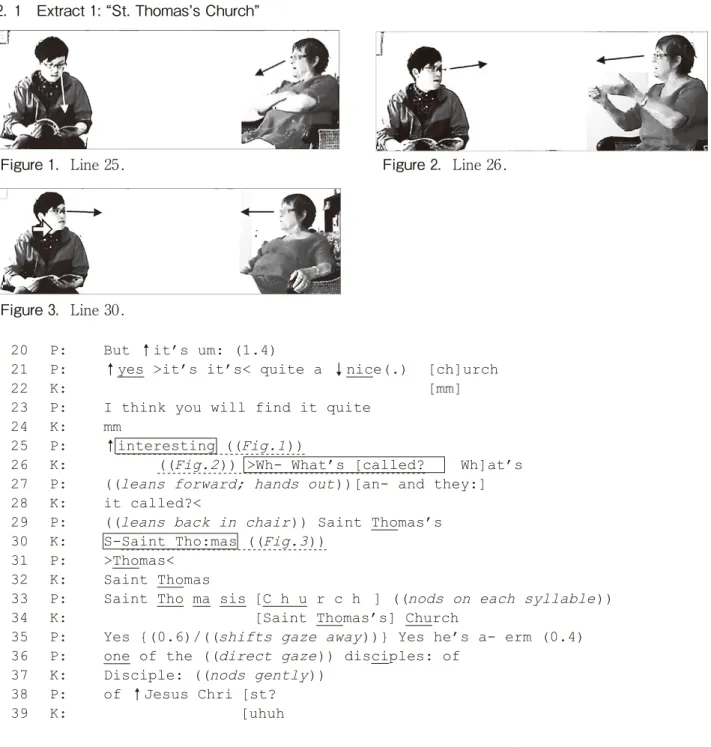
2. 1 Extract 1: “St. Thomasʼs Church”
20 P: But ↑it’s um: (1.4)
21 P: ↑yes >it’s it’s< quite a ↓nice(.) [ch]urch
22 K: [mm]
23 P: I think you will find it quite 24 K: mm
25 P: ↑interesting ((Fig.1))
26 K: ((Fig.2)) >Wh- What’s [called? Wh]at’s 27 P: ((leans forward; hands out))[an- and they:]
28 K: it called?<
29 P: ((leans back in chair)) Saint Thomas’s 30 K: S-Saint Tho:mas ((Fig.3))
31 P: >Thomas<
32 K: Saint Thomas
33 P: Saint Tho ma sis [C h u r c h ] ((nods on each syllable)) 34 K: [Saint Thomas’s] Church
35 P: Yes {(0.6)/((shifts gaze away))} Yes he’s a- erm (0.4) 36 P: one of the ((direct gaze)) disciples: of
37 K: Disciple: ((nods gently)) 38 P: of ↑Jesus Chri [st?
39 K: [uhuh
From lines 20 to 26, neither Kōtarō nor Paula are gazing at the other (Fig. 1). From lines 20 to 23, Paula extends her previous explanation about the characteristics of the church with a general assessment, doing some self-repair work in line 20 to 21 initiated by verbal perturbations and restarting the subject “it”.
Line 27 shows a projection of an extended exposition, but Kōtarō had already asked a question in line 26.
He also self-repairs “What’s called?” with insertion to “What’s it called”, which also serves to recover from the overlap, which, in conjunction with his direct gaze (Fig. 2), secures Paula’s response to his question.
Paula’s post-overlap embodied withdrawal in line 29 indicates that she abandons her previously planned explanations to answer the question with the name of the church. Kōtarō initiates repair in line 30 by orienting to Paula’s answer as a trouble source in terms of a hearing problem. He does this by repeating the name as a way of offering a candidate for demonstrating understanding, and moving his chin slightly forward (Fig. 3) as a way of signalling increased attention and uncertainty. Paula corrects his long vowel in “Thomas” through pointedly short syllables and temporarily eliding “Saint” for focus. Kōtarō accepts this repair in line 32 but Paula then extends the repair sequence by moving onto another trouble source, Kōtarō’s elision of the genitive “s”. She repairs this in line 33, both verbally, emphasizing the extra syllable
Figure 1.Line 25.
Figure 3.Line 30.
Figure 2.Line 26.
more than usual, and non-verbally, by nodding to emphasize the number of syllables, in what Brouwer (2004) termed as “doing pronunciation”. Kōtarō takes up this repair in line 34 by repeating, and Paula indicates her acceptance of this in line 35. The pause and shift in gaze indicate that this repair segment is over and the topic is moving into a new phase. Having spent effort collaboratively on understanding and confirming the name of the church, Paula adds a remark about the significance of the name. Kōtarō repeats the word “disciple” in line 37, somewhat ambiguously, indicating that it may be an unfamiliar word for him, while avoiding an obvious repair initiation with flat intonation and gentle nod, thereby not marking it out for attention. Paula does not treat it as a repair initiation and completes her sentential turn-constructional unit (TCU). Although the main repair in this extract which focused on the morphological form and pronunciation of “St. Thomas” was somewhat intensive, neither the form nor the pronunciation became topicalized.
2.2 Extract 2: “Quarter past ten”
Extract 1 ends 50 seconds into the conversation, and Extract 2 begins a little over five minutes after that. Given that there was a short interruption by third parties and short spells of reading and smartphone use, it maybe that the material on this recording cannot be considered as a single unified conversation. The extended repair sequence in Extract 2 contrasts with that of Extract 1 in that it becomes substantially topicalized, possibly reflecting the likelihood that the participants are aware of each other’s interest in issues of language. This episode begins with a substantial break in conversation, during which Kōtarō is operating his smartphone and Paula is passively observing what is happening among her family in her residence. Paula looks down at the watch on her left wrist, then establishes eye-contact (Fig. 4) and attempts to confirm an arrangement with Kōtarō.
250 K: [{5.5/((Looking down at smartphone……… ))} ] 251 P: [ (( Looks down at watch; left hand moves to chest)) ] 252 P: ((Fig.4)) >So ↑you’ve got to be at (Andrea’s) at<
253 P: quarter past ten:
254 (0.5)
255 K: Kordbass:? ((Fig.5)) 256 P: Quarter past ten 257 (0.5)
258 K: mm? (0.6) AH >YEAH yeah yeah?<
259 P: Yeah [yeah]
260 K: [past] ten?
261 P: <Quarter past(h) ten=
262 K: =AH QUAR-ah ((Fig.6)) yeah quar:ter [past ten ]=
263 R: [Yeah hehn]=
264 K: =((claps hands)) 265 R: Ye [ah ]
266 P: [Quar]ter past [ten yes]
267 K: [ah yeah]
268 P: we sev- have so many=
Figure 4.Line 252. Figure 5.Line 255. Figure 6.Line 262.
269 K: =[yeah]
270 P: =[diff]erent ways ten fiftee:n 271 K: yeah [yeah]
272 P: [or ].hh quarter past [ten
273 K: [yeah
274 P: °we’d probably say°
275 K: It’s ↑>kind↓of(.)difficult< to hear: the qua- quar:ter or 276 K: >you know [I just heard< quarter or yeah ]
277 P: [I know: yes yes yes ]
278 R: [ah : : ]
279 K: >We Japanese< say: .hhh usual(.)ten fiftee:n 280 P: [Yes ]
281 R: [Just]the numbers 282 K: [Yeah just numbers]
283 R: [Righ:t ] 284 P: [Yeah yeah ] 285 K: [Yeah]
286 P: [Yeah]
287 R: Mm:
288 P: Well ↑we do:
289 K: uh:
290 P: Quite a lot 291 K: Yeah
292 P: But (.) in: conversation 293 K: [yeah ]
294 R: [Mm: ]
295 P: we (.) obviously (.) have lots of variations
Paula’s elicit of confirmation, an adjacency pair (AP) first pair-part (FPP) in lines 252 to 253, is met with a pause followed by an attempted repeat of the trouble source with rising intonation and sudden forward-shift of the head led by the chin (Fig. 5), a clear initiation of repair from Kōtarō suggesting a hearing or understanding problem, leading to an insertion repair sequence. Paula responds to this by repeating the trouble source with slower emphasized consonants and raised eyebrows, but there is a second pause with an open-class repair initiator (mm?), a third pause, then an apparent change-of-state token (Heritage, 1984) through raised volume, “Ah” and a rapid triple “yeah”, but there is still some ambiguity suggested in the rising intonation. Paula’s “yeah yeah” seems to display an understanding that the repair segment is over. However, Kōtarō again repeats part of the trouble source, eliciting a second, even more emphasized repeat from Paula, though again with no explicit gestural enhancement. There is another change-of-state indication from Kōtarō in line 262, this time repeating for confirmation what seems to be the core of the trouble source, “quarter”. This change of state is made much more emphatic than the last by the drastic shift in head position and raised right index finger (Fig. 6), followed by a complete repeat of the trouble source and a clap of the hands. After a three-way high-involvement affirmative closing of the repair segment (lines 265-267), Paula topicalizes in a sociolinguistics-oriented way the trouble source in line 268, leading to a topic sequence which lasts for some 70 lines of transcript, and the FPP in lines 252 to 253 never receives an explicit answer as a second pair-part (SPP), though Kōtarō’s first affirmative change-of-state token in line 258 may be a possible candidate. In lines 275 to 278, Kōtarō orients back to the necessity of the repair as a hearing problem, which is aligned to by Paula and a researcher, shifting the topic focus from a sociolinguistic one to an L2-hearing one, then shifts it again by invoking his membership category (Sacks, 1992) as a Japanese speaker and referring to a cultural-
linguistic norm, in aligned collaboration with the researcher and Paula (lines 279-286). Paula then implies commonality through invoking her own membership category as an English speaker (lines 288 and 290), before bringing the sequence round full circle back to sociolinguistic variation (lines 292-295). Later, after the 70 lines of this exchange and a pause, Paula compliments Kōtarō on his progress as an English language learner, “No, I think you’re doing very well,” thereby orienting to her acknowledgement of his interest in language, which is arguably related to the topicalization of the trouble source in this repair sequence.
2.3 Extract 3: “And how long are you staying here?”
The conversation in Extract 3 is part of a conversation involving a first-time meeting between Kōtarō and “Peter” (“P”), an acquaintance of Paula’s who visits the same residence for a home lunch involving all parties, to take place after this conversation.
186 K: [Mm yeah ]
187 R: [It’s the] [ perfect place for ( )]
188 P: [((gaze to K; Fig.7))
189 P: [ Un: >how ↑long are<] you staying here?
190 K: [ ((facing R; oblique gaze to P)) 191 (0.5)
192 K: Ah: I will (0.3) a-a-
193 K: ((direct gaze at P)) so(.)how long ha- have I ((Fig.8)) 194 P: .h N- ↑Yes [>w’can< ]star:t there: ((Fig.9))
195 K: [>How lon]g:< ((shifts gaze slightly sideways)) 196 K: Ah: [yeah ah : : ]
197 R: [haha ]
198 P: [How long: have ↑you:](0.3) [stayed here ]
199 K: [So: a coup-] (0.6)
200 K: ↑>three days ago?< ((returns gaze to P)) (0.4) 201 K: ↓Maybe ↑two ↓days ago? ((shifts gaze to R)) 202 (0.7)
203 R: [ .h h h: ]
204 K: [>we- we’ve< ] arrived=
205 R: =That’s right [Saturday night]
206 K: [Yeah yes: ] Figure 7.Line 188.
Figure 8.Line 193. Figure 9.Line 194. Figure 10.Line 209.
207 P: [Yes: ] 208 R: We got here
209 P: ((Fig.10)) An:d you’re going: [back to]=
210 K: ((gaze to P)) [Ah: go ]=
211 P: =Japan ↑when?=
212 K: =Aoh::- (1.2) ↓eh:
213 K: ((nodding)) ↑thirteen of August(h) (0.5) yah=
214 P: =↑Right
215 K: I->I [will leave:]
216 P: [o↓kay: ]
217 K: here: (.) ((opens hands out)) to Japan:
218 K: ((claps hands lightly)) 219 K: ↑Yeah
The topic sequence immediately prior to the extract was concerned with Paula’s residence, and mainly between Peter and the researcher (“R”), but at the beginning of the extract Peter shifts his gaze from R to Kōtarō from before R’s last utterance on the topic in line 187, and initiates a new topic (line 189) directly with Kōtarō through his gaze and a next-speaker-selection gesture with his left arm (Fig. 7). This is met with pauses, non-lexical perturbations and a false start from Kōtarō, before he initiates repair by indicating a hearing or understanding problem, eliciting clarification of the question by starting with “so”
and an attempted reformulation of part of the question, signifying possible orientation to uncertainty around the target of the question or time-frame (“have I”) along with a restrained gesture to himself (Fig.
8). Peter then aligns himself with Kōtarō’s repair initiation and use of the present perfect tense, taking on a somewhat teacher-like discourse identity (Richards, 2006), splitting his inquiry into two parts and framing the structure of the subsequent discourse as such with his overtly guiding discourse markers to initiate each part, both verbal and non-verbal (line 194 & Fig. 9; then lines 209-211 & Fig. 10), the first one more explicit and pointed than the second. During this topical sequence, Kōtarō engages in some local self- repair work, including an abandonment (“a coup-” in line 199 to “three” in line 200) and a substitution (“three” in line 200 to “two” in line 201), accompanied by gaze shifts to a “thinking face” (Goodwin &
Goodwin, 1986) in line 195 and elicitation of confirmation (line 201). Kōtarō marks his base-AP SPP as a conclusive response to Peter’s original base-AP FPP or topic initiation (line 189) with a forward hand- opening gesture emblematic of his returning to Japan (line 217) and another satisfactory hand clap in line 218 before his elated and closing “Yeah” in line 219.
3 Discussion and concluding remarks
3.1 Summary and discussion of the extracts
Our analyses of these extracts has revealed the following: (1) There was very little or no elaborate gesture work in the repair sequences in these extracts; (2) Nevertheless, non-verbal acts played significant roles in repair initiation and some repair segments, securing heightened mutual attentiveness in all cases of self-initiated other-repair, enhancing attention to morphological-phonological features (Extract 1), emphasizing changes of state upon clarification (Extract 2), suggesting problematic nature of trouble source (Extract 3) and facilitating re-organization of discourse structure of response to an inquiry (Extract 3). The minimal use of emblematic or iconic gestures may have been related to cultural factors (Japanese communication styles and tendency for polite and restrained deference to elders), interpersonal factors (lack of familiarity) or L2 proficiency— Kōtarō had achieved relatively advanced qualifications in English proficiency.
3.2 The potential use of authentic interactional data as L2 teaching materials
It is taken for granted that learners of a second or foreign language require input of sufficient quality and quantity in order to develop their knowledge and skills. However, while “input” is often assumed to be linguistic, features of interaction, non-verbal actions, context and environment may also be valuable, not only in enhancing the contextual cues for input, but also in being input in their own right, serving as models for L2 interactional practices in potentially difficult situations. As a role-model, Kōtarō’s level of proficiency and interactional competence may appear as an unattainable dream for some young and inexperienced Japanese EFL learners. However, the trouble sources and repair initiations are conceptually relatively straightforward, such that high school and university learners in Japan should be able to grasp the basics of the repair situation with some appropriately structured guidance from their teacher. The bursts of rapid speech, overlaps and culturally referenced idiomatic expressions may be very hard to deal with and potentially demotivating if the significance of the material for learners is not introduced and explained properly. Nevertheless, occasional exposure to short extracts of such conversations, knowing that they are not expected to understand every word, may help learners to develop realistic mental representations of what interacting in the L2 can be like for a Japanese speaker in real-life situations, stimulating the development of the learners’ possible future L2 selves (Dörnyei, 2005, 2009) as competent communicators who can deal with unpredictable situations.
3.3 Concluding remarks
This study has demonstrated how non-verbal behavior, no matter how subtle and low-key, can work in concert with verbal utterances to initiate and carry out repair sequences to achieve successful repair outcomes, and tentatively suggests how such data could be used to stimulate EFL learners’ L2 interactional competence.
Acknowledgements
This work was supported by JSPS KAKENHI Grant Number 26370659. The authors would like to thank the participants who kindly agreed to be recorded and have their interaction transcribed, analyzed and used in research publications, conference presentations and teaching materials. They are also grateful to the reviewers for their helpful suggestions. Finally, the authors take responsibility for any remaining shortcomings in the paper.
References
Brouwer, C. E.
(2004
). Doing pronunciation: A specific type of repair sequence. In R. Gardner & J. Wagner
(Eds.
), Second language conversations
(pp. 93-113
). London: Continuum.
Brouwer, C. E., Rasmussen, G., & Wagner, J.
(2004
). Embedded corrections in second language talk. In R. Gardner & J.
Wagner
(Eds.
), Second language conversations
(pp. 75-92
). London: Continuum.
Burch, A. R.
(2014
). Pursuing information: A conversation analytic perspective on communication strategies. Language Learning, 64, 651-684.
Dörnyei, Z.
(2005
). The psychology of the language learner: Individual differences in second language acquisition. Mahwah, NJ: Lawrence Erlbaum.
Dörnyei, Z.
(2009
). The L2 motivational self system. In Z. Dörnyei & E. Ushioda
(Eds.
), Motivation, language identity and the L2 self
(pp. 9-42
). Clevedon, UK: Multilingual Matters.
Goffman, E.
(1981
). Forms of talk. Philadelphia: University of Pennsylvania Press.
Goodwin, C.
(1986
). Gestures as a resource for the organization of mutual orientation. Semiotica, 62, 29-49.
Goodwin, C.
(1994
). Recording human interaction in natural settings. Pragmatics, 3, 181-209.
Goodwin, C.
(2000
). Action and embodiment within situated human interaction. Journal of Pragmatics, 32, 1489–1522.
Goodwin, M. H., & Goodwin, C.
(1986
). Gesture and coparticipation in the activity of searching for a word. Semiotica, 62, 51
-75.
Gullberg, M.
(2010
). Some reasons for studying gesture and second language acquisition
(Hommage à Adam Kendon
).
International Review of Applied Linguistics, 44, 103–124.
Hayashi, M.
(2005
). Joint turn construction through language with the body: Notes on embodiment in coordinated participation in situated activities. Semiotica, 156, 21-54.
Heritage, J.
(1984
). A change-of-state token and aspects of its sequential placement. In J. M. Atkinson & J. Heritage
(Eds.
), Structures of social action: Studies in conversation analysis
(pp. 299-345
). Cambridge: Cambridge University Press.
Jefferson, G.
(1987
). On exposed and embedded correction in conversation. In G. Button & J. R. E. Lee
(Eds.
), Talk and social organisation
(pp. 86-100
). Clevedon, UK: Multilingual Matters.
Jefferson, G.
(2004
). Glossary of transcript symbols with an introduction. In G. H. Lerner
(Ed.
), Conversation analysis: Studies from the first generation
(pp. 13-34
). Amsterdam: John Benjamins.
Jenks, C.
(2013
). ‘Your pronunciation and your accent is very excellent’: Orientations of identity during compliment sequences in English as a lingua franca encounters. Language and Intercultural Communication, 13, 165-181.
Lazaraton, A.
(2004
). Gesture and speech in the vocabulary explanations of one ESL teacher: A microanalytic inquiry.
Language Learning, 54, 79-117.
Markee, N.
(2004
). Conversation analysis for second language acquisition. In E. Hinkel
(Ed.
), Handbook of research in second language teaching and learning
(pp. 355-374
). Mahwah, NJ: Lawrence Erlbaum.
Mori, J., & Hayashi, M.
(2006
). The achievement of intersubjectivity through embodied completions: A study of interactions between first and second language speakers. Applied Linguistics, 27, 195-219.
Olsher, D.
(2004
). Talk and gesture: The embodied completion of sequential actions in spoken interaction. In R. Gardner & J.
Wagner
(Eds.
), Second language conversations
(pp. 221-245
). London: Continuum.
Olsher, D.
(2007
). Gesturally enhanced repeats in the repair turn: Communication strategy or cognitive language-learning tool? In S. G. Gafferty & G. Stam
(Eds.
), Gesture: Second language acquisition and classroom research
(pp. 109-130
). New York, NY: Routledge.
Richards, K.
(2006
). ‘Being the teacher’: Identity and classroom conversation. Applied Linguistics, 27, 51-77.
Sacks, H.
(1992
). Lectures on conversation,
(2 vols., edited by G. Jefferson
). Oxford: Blackwell.
Schegloff, E. A.
(2007
). Sequence organization in interaction: A primer in conversation analysis. Vol 1. Cambridge: Cambridge University Press.
Schegloff, E. A., Jefferson, G., & Sacks, H.
(1977
). The preference for self-correction in the organization of repair in conversation. Language, 53, 361-382.
Seo, M. S.
(2011
). Talk, body, and material objects as coordinated interactional resources in repair activities in one-on-one ESL tutoring. In G. Pallotti & J. Wagner
(Eds.
), L2 Learning as social practice: Conversation-analytic perspectives
(pp.
107-134
). Honolulu: University of Hawai'i, National Foreign Language Resource Center.
Sidnell, J.
(2005
). Gesture in the pursuit and display of recognition: A Caribbean case study. Semiotica, 156, 55-88.
Theodórsdóttir, G.
(2011a
). Language learning activities in real-life situations: Insisting on TCU completion in second language talk. In G. Pallotti & J. Wagner
(Eds.
), L2 Learning as social practice: Conversation-analytic perspectives
(pp.
185-210
). Honolulu: University of Hawai’i, National Foreign Language Resource Center.
Theodórsdóttir, G.
(2011b
). Second language interaction for business and learning. In J. K. Hall, J. Hellermann, & S. P.
Doehler
(Eds.
), L2 interactional competence and development
(pp. 93-116
). Bristol, UK: Multilingual Matters.
Wong, J., & Waring, H. Z.
(2010
). Conversation analysis and second language pedagogy: A guide for ESL/EFL teachers. New
York: Routledge.
Appendix: Explanation of CA Transcription Symbols Used Transcription
Symbol Meaning Transcription
Symbol Meaning
↑ or ↓ shifts into especially high or low
pitch ? interrogative-like rising intonation
at the end of an utterance . affirmative-like falling intonation at
the end of an utterance , continuing intonation .hhh A row of h’s with a dot in front of it
indicates an inbreath, without the dot an outbreath.
:: prolongation of immediately prior sound (more: := longer stretching) Underline some unusually marked form of
stress (pitch and/or volume; longer
= heavier)
[ ] Overlapping speech: Left is the onset of overlap; right is the end. UPPER-CASE
LETTERS especially loud relative to the surrounding talk.
°word° quieter than the surrounding talk
>word< faster speech, compared to
surrounding talk <word> slower speech, compared to surrounding talk
(1.4) elapsed time of a pause or gap (in seconds)
(.) a brief interval (±0.1s) within or between utterances
= no break or gap (or to emphasize continuity of talk by a single speaker across breaks in the transcript)
((comment)) transcriber’s descriptions
( ) or
(word) The transcriber could not hear, or was uncertain about what was said.
wor(h)d plosiveness, often associated with laughter, crying, coughing, etc. All of the above symbol uses are based on Jefferson (2004, pp.24-31)
((Fig.4)) >So ↑you’ve got to be Kordbass:? ((Fig.5))
The words enclosed by a box were spoken at the point where a still frame from the video was taken. The frame is included as a figure, referred to in parentheses which are linked to the spoken words with a dotted underline. {(°hhh)/(0.2)} Curly braces are sometimes used to indicate the duration of a breath or other
sound when its effect can be heard as a pause or gap of silence (Schegloff, 2007, p.269).