DOI: http://dx.doi.org/10.14246/irspsd.3.3_16
Copyright@SPSD Press from 2010, SPSD Press, Kanazawa
Conceptual Research on Decision Making Meetings for Urban Water Management
Yan MA1,2, Yunfeng LI3*
1 Institute of Geographic Sciences and Natural Resources Research, CAS 2 School of Architecture, Fuzhou University
3 Nihonkai Consultant Co.,LTD
* Corresponding Author, Email: [email protected] Received 15 April, 2014; Accepted 20 December, 2014
Key words: Urban Water Management, Multi-Agent System (MAS), Cellular Automata (CA)
Abstract: We will introduce an integrated model of Online Decision Making Meetings (ODMM) for sustainable management of water resources, which combines online meetings with an agent-based simulation function. This model is able to supply the decision makers with visualized simulation results of different policy scenarios and then support them to have online discussions, communication and make final decisions. The model consists of a remote server, a simulation model for background processing and clients. We assume that several departments related to water resource management will join this meeting and make proposals based on their data and policy. These departments are clients in our model and they are granted with special authority according to their departments. During an online meeting, the clients can choose global parameters for a simulation model that relates to their department based on their roles. Afterwards, simulations for different scenarios can be conducted by the model and the simulation results will be displayed for and visualized by the clients through the server on time. Thus, the government planners can easily view the simulation results regarding different policy scenarios using this tool, thereby making informed decisions and policy implementations.
1. INTRODUCTION
Based on the development trend of information technology, we introduce a new planning support model in our present research. An integrated model of Online Decision Making Meetings (ODMM) for sustainable management of water resources was developed, which combined online meeting functions with agent-based simulation. This model was developed via online meeting technology and an Agent-Based Modeling (ABM) method. It aims at supporting water related policy making meetings for urban areas. We assume several water resource management related departments would participate in such a meeting, making proposals based on their data and policies. A web conferencing software named “TeamViewer” and decision- making support software developed upon “NetLogo” are integrated to develop a visible and easy-to-communicate environment.
Water is one of the key resources for urban development. Since water is such an important resource for human life, different levels of government, from the United Nations and down to local government, must hold meetings
16
to decide water related policies. With urbanization, people tend to gather in cities, leading to the prediction that the world’s urban population will reach 5 billion by 2030, nearly double the amount in 2010 (United Nation, 2007;
UN Water, 2010). These concentrated human activities in urban areas result in intensive demand on all types of natural resources, with water amongst the most vital. For cities which lack water resources, the development of a city is closely related to the ability to manage existing water resources (Vairavamoorthy et al., 2008; Zhang et al., 2010). For example, the Chinese government has established the most restrictive water management policies in Guidelines of the Twelfth Five-Year Plan for National Economic and Social Development. These policies include not only the total amount of water resources controlled, but also water quality requirement, waste water reuse, and optimization of industrial structures.
Conventionally, people from relevant departments participate in meetings at pre-determined places for several days’ discussions, negotiations and communications till they reach agreements on targeted policies. This kind of conventional decision meeting has its own advantages, such as face-to-face communication. However, it needs people gathering at a physical meeting place according to a pre-determined time schedule which may not be convenient to all that are involved. Along with the development of information technology, online meetings are widely employed, especially by companies, so that managers can communicate with their employees in a timely manner, no matter where they are. This new meeting mode enables us to think of new ways of communicating through virtual online space.
To develop the ODMM model, ABM and Cellular Automata (CA) are applied to provide simulation functions. ABM is employed to simulate the water consumption of an urban area and CA is used for simulating the spatial processes where the agents are living. ABM is an emerging approach to modelling complex processes and phenomena in the social sciences in recent years (Torrens and Benenson, 2005; Torrens, 2007; Batty et al., 1997). Being the basis of ABM, the definition of an agent is as summarized by Wooldridge and Jennings in 1995, “An agent is a computer system, situated in some environment, which is capable of flexible autonomous action in order to meet its design objectives.” ABM offers a way to model social systems that are composed of agents who interact with and influence each other, learn from their experiences, and adapt their behaviours so they are better suited to their environment. For these advantages, ABM is widely used in urban studies (Ettema, 2011; Dawn and Filatova, 2008; Parker et al., 2003; Noth et al., 2003; Fontaine and Rounsevell, 2009), economic applications (Diappi and Bolchi, 2006; Moeckel et al., 2003), etc.
The detail of the ODMM will be introduced and illustrated in the following sections.
2. MODEL DEVELOPMENT 2.1 Framework of ODMM
In our present research, a web-based conferencing software namely
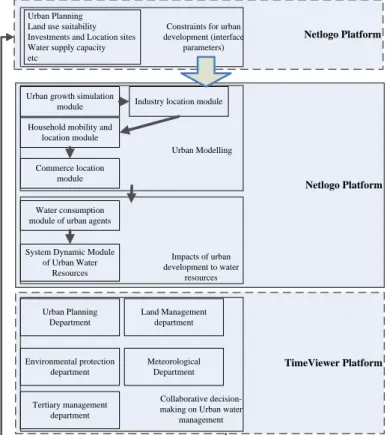
"TeamViewer" is combined with a decision-making support model developed on "NetLogo" platform to achieve a visible and convenient online meeting environment. Thus, the ODMM model can be separated into two parts: the NetLogo platform for urban modelling and the TeamViewer platform for collaborative online meetings (as shown in Figure 1). On the
NetLogo platform, the interface of ODMM and the simulation model for background processing is developed. The simulation model is developed using Cellular Automata (CA) and multi-agent system (MAS) methods. The CA method is used for simulating urban growth and land use change, the spatial process of urban development, which is the basis of further agent- based simulation.
The framework of the ODMM is shown in Figure 1, the whole model is developed on NetLogo platform and TeamViewer platform, respectively.
On the NetLogo platform, the background simulations are organized, which includes urban modelling and impacts of urban development on water resources. Just as shown in Figure 1, the interface of the ODMM is also designed on the NetLogo platform, by which the constraints for urban development can be determined by the clients of the ODMM. As introduced in Section 1, these clients are the participants of the online meeting and they come from different planning departments. In the interface of the ODMM, there are different parameters for the background simulation. The clients can adjust the parameters according to their determined role.
Then, determined parameters and a simulation database will support the background of the urban modelling, which is also realized on the NetLogo platform. In this part, different simulation models will be developed to support the simulations. The models can be divided into two kinds, the CA model for urban growth and agent-based models for agent simulations. The details of these two kinds of models will be introduced through Subsections 2.2 and 2.3.
The simulation results can be displayed on the interface of ODMM. In order to support the clients’ communication with each other, the online meeting function is developed on the TeamViewer platform. This function is finally combined in ODMM and makes the participants able to adjust the simulation parameters for the background urban modelling.
TimeViewer Platform Netlogo Platform
Netlogo Platform Urban growth simulation
module Household mobility and
location module
Industry location module
Urban Modelling Commerce location
module
Impacts of urban development to water
resources Water consumption
module of urban agents
System Dynamic Module of Urban Water
Resources Urban Planning Land use suitability Investments and Location sites Water supply capacity etc
Constraints for urban development (interface
parameters)
Urban Planning Department
Land Management department
Environmental protection department
Meteorological Department
Tertiary management department
Collaborative decision- making on Urban water
management
Figure 1. The framework of ODMM
2.2 Urban Simulation on NetLogo Platform
2.2.1 Urban Growth Simulation
As shown in Figure1, an urban modelling process is needed in the ODMM model. Within the urban modelling, we are concerned with two points, urban growth and urban agent behaviours. Basically, we see the urban growth process as the basis of agents’ behaviours. Based on the simulation of urban growth, each cell’s development can be known and the urban agents can determine locations of the developed cells in the next step, then, as a result, they will live and working on those cells. Because this is conceptual research, the urban modelling is conducted in a virtual space. In the virtual urban space, we first simulate the spatial process of urban development. This virtual city represents a typical job oriented newly developed town. In this virtual city, we assume the driving power of urban development is employment. In the initial stage, this city has one downtown area, and with simulation progress, the development potential of each cell (representing an urban area) is calculated according to the attributes of the cell, such as slope, urban planning, land use suitability, transport accessibility (such as distance from river, road, railway station, airport etc.), distance from downtown and neighbourhood effects. Moor Neighbourhood is utilized for this simulation and each cell is defined as having four neighbours.
The details about the transition rule of cell status are showed in (1) (Ma at al., 2010):
α
−
=
−
+
+ +
=
= + + = +
= +
= −
≥
=
× × ×
∑1
0 0
1
max
1 1
f stage Developed
otherwise i
UnDeveloped exp
1 1
1
( , ) ( )
( )
t ij
n
t t
k k n n n n
k
t
g s
t i
t ij
t t g
ij t
g
t t t t
ij threshold ij Development
s x x a x a s x a
p
e p p
p
p p p S ij
S ij
. (1)
t
sij is the land use suitability of cell (i, j) at time t. x0 is a constant and s0
is the static part of land use suitability during each simulation step. St i+( )ij is the status of a cell (i, j) at time t+1. xk is a parameter set reflecting institutional policies besides neighborhood rules, such as land use suitability.
xn is a parameter reflecting impact from the neighborhood,
an are spatial features of a neighborhood,
ak are spatial features besides neighborhood, and ptgis global probability for transition. ptgmaxis the max global probability during each step. αis diffusion coefficient which is in the range of (1-10),
t
pij is the final probability, pthreshold(pijt,Developmentstaget+1)is the neighborhood cell number and developing speed control, which can change according to
t
pij and staget+1
Dvelopment in order to make the developing speed in staget+1
Dvelopment
the same as in the settings.
The final probability of each cell is employed to decide whether the cell can be developed by comparing it with the threshold expressed as pthreshold(pijt,Developmentstaget+1)in Equation (1). If one cell is decided to be developed, then the developing potential of that cell for different land uses will be further calculated and the cell will be developed into the land use type with the biggest potential.
2.2.2 Simulation of Agents’ Behaviours
Based on the simulation of spatial changes in the urban area, different types of urban agents will tend to be centralized in the city due to employment opportunities. The types of agents we considered in the ODMM model are household agents, shop agents and industry agents.
• Industry agents will enter the virtual city and select locations for their factories. There are two kinds of factory scales, large and small ones. The large one has a bigger employment capacity than the small one. We assume that the total amount of industry will be controlled by local government so that the number of industry agents is limited to a peak value. The industry agents will determine locations on the industrial land cells to maximize their utility. The key factor that industry agents use to evaluate utility is transport accessibility. When they make decisions on locations, they will build factories on the cell and hire workers.
• Shop agents will enter the virtual city and select locations for their shops. There are big shops and small shops. The big shops have a larger employment capacity than the small ones. Shop agents determine locations for their shops based on the household density of that region. We assume that different shop scales have different service radiuses.
• Household agents will enter the city and look for jobs. We assume that this type of agent will start their job hunting for high salary positions. When this kind of position is fully occupied, the agents will turn to other opportunities. When they finally find jobs, they will settle down in the city; otherwise, they will leave the city.
During the residential location process, agents will assess the utility of different residential location alternatives based on the accessibility, commuting time and land prices of the locations.
These agents will all live in the virtual urban space and interact with the space and other agents by following the state diagram shown in Figure 2.
Figure 2. UML State diagram of ODMM
2.2.3 Simulation of Urban Water System
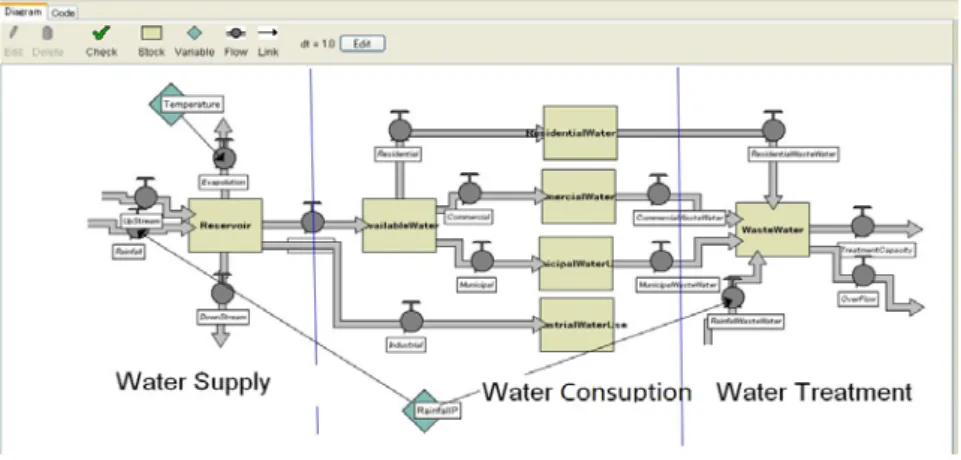
The urban water system can be divided into three parts: supply, consumption, and waste water treatment. Figure 3 shows the dynamic process of urban water supply and waste water treatment in ODMM. This module is developed using the “System Dynamics Model Builder” function in NetLogo.
For water supply, the water resource in a real situation can be from surface flow, lake, ground water, etc. However, to simplify the simulation process, we assume the water resource is taken from a reservoir. The impact factors for domestic water supply are precipitation, temperature, upstream flow and downstream flow.
Water consumption in the virtual urban space is composed of by industrial water consumption, commercial water consumption, residential water consumption and municipal water consumption. The amount of urban water consumption is related to the agents’ behaviour explained in subsection 2.2.2. Industrial water consumers should have their own water supply and wastewater treatment facilities, and other types of water consumption are supported by municipal water supply and wastewater treatment facilities.
The amount of wastewater from commercial, residential, and municipal water consumption are supposed to be treated by municipal waste water treatment facilities, and the treated water will be released to surface flow, such as rivers or lakes.
Figure 3. Dynamic process of urban water supply and waste water treatment.
2.3 Participatory Decision-Making on Teamview Platform
In ODMM, the object of water management related policies is affected by many factors and these factors usually relate to different departments.
For example, the Meteorological Department is in charge of the factors of rainfall potential and temperature, while the Environmental Protection Department is responsible for ecological water requirements, etc. However, the work locations of these departments are different. In order to make collaborative decision-making possible, ODMM provide a Server-Client decision support environment to let decision-makers from different government departments adjust the related parameters for updating scenario simulations based on their professional knowledge backgrounds. Figure 4 shows an example of the departments involved in a decision making process of water management. The client is only authorized to adjust parameters of his responsible department by selection of identity when he logs into the system. During the online meeting process, all the legal adjustments to parameters of the ODMM from clients will be broadcast to others.
Figure 4. Example of server- client parameter setting
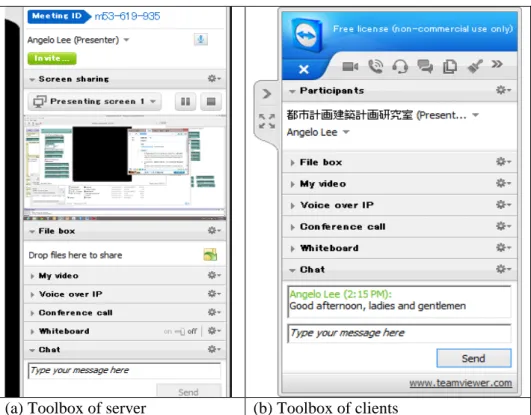
ODMM also provides an online meeting environment, which includes the functions of Screen sharing, Remote control, Video chatting, Voice chatting, Type chatting, File transfer and White board. Through these functions, planners can easily propose their arguments and communicate with others. The adjusted parameters will be sent to servers for background
urban simulation. The simulation results for urban development can be observed and refereed by all participants participating in the decision meeting. The example of functions for a web-meeting are as shown in Figure 5.
(a) Toolbox of server (b) Toolbox of clients
Figure 5. Online meeting environment
3. CONCLUSIONS AND DISCUSSIONS
In this research we introduced a conceptual framework of a planning support system for integrated urban water management, termed ODMM. By integrating a cellular and agent-based simulation system with an online meeting function, a virtual communication meeting environment was achieved. By using the ODMM, online communication and policy simulation can be conducted between participants of the meeting. Its friendly interface for operation and participation makes it an innovative planning support model for government decision making and it is helpful for improving public understanding and awareness of the decision process.
For future work, a validation of ODMM by importing real data is needed. We also need to apply the ODMM to a real decision making process in order to assess the effectiveness of the model and how it can be used to improve stakeholders’ participation in their decision making process.
REFERENCES
The United Nations Water Development Report 3, 2010, Water in a Changing World, http://www.unesco.org/new/fileadmin/MULTIMEDIA/HQ/SC/pdf/WWDR3_Facts_and_F igures.pdf .
Yan Ma, Zhenjiang Shen, Ying Long, Mitsuhiko Kawakami, Ke Wang, Katsunori Suzuki,
“Urban Growth Simulation for Spatial Strategic Plan of Chuangdong Area, China”, published by the 18th International Conference on GeoInformatics, 2010, Doi:
10.1109/GEOINFORMATICS.2010.5567666 .
Vairavamoorthy, K., Gorantiwar, S.D., Pathirana, A. (2008). “Managing urban water supplies in developing countries – Climate change and water scarcity scenarios”, Physics and Chemistry of the Earth, 33, 330–339.
Zhang, Y.X., Chen, M., Zhou, W.H., Zhuang, C.W., Ouyang, Z.Y. (2010). “Evaluating Beijing’s human carrying capacity from the perspective of water resource constraints”, Journal of environmental sciences, 22(8), 1297-1304.
Batty, M., Couclelis, H., Eichen, M., “Urban systems as cellular automata,” Environ. Plan. B, vol. 24, 1997, pp. 159–164.
Paul M. Torrens, Itzhak Benenson, “Geographic Automata Systems,” Int. J. Geogr. Inform.
Sci, vol. 19 (04), 2005, pp. 385–412.
Paul M. Torrens, 2007, “A Geographic automata model of residential mobility,” Environment and Planning B: Planning and Design, Vol. 34, pp. 200–222.
N. R. Jennings and M. Wooldridge, 1995, “Applying Agent Technology”, Journal of Applied Artificial Intelligence special issue on Intelligent Agents and Multi-Agent Systems. (PDF) D. Ettema. A multi-agent model of urban processes: Modelling relocation processes and price
setting in housing markets. Computers, Environment and Urban Systems, 2011, vol. 35, pp. 1-11.
C. P. Dawn and T. Filatova. A conceptual design for a bilateral agent-based land market with heterogeneous economic agents. Computers, Environment and Urban Systems, 2008, vol.
32, pp. 454–463.
D. C. Parker, S. M. Manson, M. A. Janssen, M. J. Hoffmann, P. Deadman. Multi- agent systems for the simulation of land use and land cover change: a review. Annals of the Association of American Geographers, 2003, vol. 93(2), pp. 314-337.
C.M. Fontaine, M.D.A. Rounsevell. An agent-based approach to model future residential pressure on a regional landscape. Landscape Ecological, 2009, vol. 24, pp.1237-1254.
NOTH, M., Borning, A., Waddell, P. (2003). An extensible, modular architecture for simulating urban development, transportation, and environmental impacts. Computers, Environment and Urban Systems, 27(2), 181-203.
Diappi L. and Bolchi P. (2006), “Gentrification Waves in the Inner-City of Milan - A multi agent / cellular automata model based on Smith's Rent Gap theory”, in: Van Leeuwen, J.P.
and H.J.P. Timmermans (eds.). Innovations in Design & Decision Support Systems in Architecture and Urban Planning, Dordrecht: Springer, p. 187-201.