
8
Non-fossil-resources-based Hydrogen Production Technology
— Key to Sustainable Hydrogen Energy Systems —
R
YOTAO
MORIEnvironment and Energy Unit
8.1 Introduction
In the face of global energy and environmental concer ns, there is a growing need to simultaneously deal with the issues represented by
“3E,” namely, energ y supply, environmental conservation, and economic growth.
With this situation as a backdrop, hydrogen- energy-based systems such as fuel cells are receiving widespread attention. Hydrogen along with electricity is expected to play a major role as a source of secondary energy in the future.
In promoting hydrogen energy, however, it is indispensa ble that a var iety of element technologies are developed and the infrastructure improved with respect to fuel cells and the production, transportation, storage and utilization of hydrogen. While global competition in this par ticular area heats up, both industr y and academia in Japan have been pouring significant resources into research and development of fuel cells and hydrogen energ y systems, the
achievements of which are being published in succession through scientific journals and mass media.
The government is also active in developing promotional strategies and budgetary measures.
The Council for Science and Technology Policy (CSTP), for instance, set the “2003 Guidelines for the Distribution of Budgets and Human Resources in Science and Technology”
[1]in June, specifying fuel cells and the use of hydrogen as “priority areas and issues to be promoted” in the energy field.
Likewise, the Strategic Research Council on the Commercialization of Fuel Cell Technology under the Ministr y of Economy, Trade and Industr y specified five advantages in introducing fuel cells - i.e., energy saving, reductions in the environmen- tal burden, diver sified energ y supply and substitution of oil, mer its associated with decentralized power sources, and improved industrial competitiveness and development of new industries.The council positioned fuel cells as a key technology in the fields of energy and the environment in the 21st century.
[2]Figure 1:Two phenomena occurring on the surface of titanium oxide photocatalyst
Fuel cells are, so to speak, power generators using hydrogen as fuel; they generate electricity through the chemical reaction between hydrogen and oxygen, which produces water. Fuel cells, themselves, discharge water only. Hydrogen gas, however, does not exist naturally in any significant quantity on Ear th, and hence it should be produced from fossil resources, biomass, water, etc.
At the moment, the widely held view is that hydrogen production will be heavily dependent on natural gas and other fossil resources.
Underlying this view are scores of problems associated with the non-fossil-resources-based hydrogen production technolog y, the commercialization and spread of which are likely to take considerable time.
However, in view of conserving fossil resources and reducing greenhouse gas emissions, transition to the non-fossil-resources-based hydrogen production technology is required in the long run.
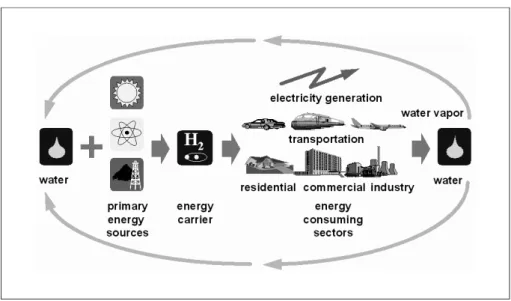
Widespread applications of technolog y for producing hydrogen from resources such as water and biomass through the use of renewable and nuclear energy will dramatically conserve fossil resources and reduce greenhouse gas emissions (Section 8.3.3 addresses a quantitative study on these issues). Expectations for the commercializa- tion of such sustainable hydrogen energy systems constitute the backbone of today’s research on fuel cells and hydrogen energy. Figure 1 shows the hydrogen energy cycle using hydrogen derived from water.
Prospects for when and how these sorts of
“ideal system” will be commercialized have a substantial inf luence on the significance and contents of policies for the introduction, commercialization and R&D strategies concerning fuel cells and hydrogen energy in the future.
Determining the potential of the non-fossil- resources-based hydrogen production technology is thus critical for Japan in developing not only long-term but also short-to-medium term energy policies and R&D strategies.
For these reasons, this article will focus on the non-fossil-resources-based hydrogen production technology. Specifically, Chapter 8.2 provides an introduction to hydrogen energy and fuel cells;
Chapter 8.3 reviews in a quantitative manner its
significance in solving the 3E problem, based on the achievements of previous studies; Chapter 8.4 outlines trends in the research and development of mainstay technologies; and Chapter 8.5 rounds up findings and provides suggestions.
8.2 Hydrogen energy and fuel cells
Hydrogen along with electricity is expected to play a major role as a source of secondary energy in the energ y system of the 21st centur y.
Electricity can be converted into hydrogen, and vice versa; they are complementary to each other as follows:
[4]• Hydrogen can be stored in bulk, which is not the case with electricity;
• Electr icity can transmit energy without moving substances, which is not the case with hydrogen;
• Hydrogen can be used as chemical fuel and industrial materials, which is not the case with electricity;
• Electricity can be used for processing and storing information, which is not the case with hydrogen; and
• Hydrogen is suita ble for long-distance transportation, while electricity is an ideal medium for short-distance transportation.
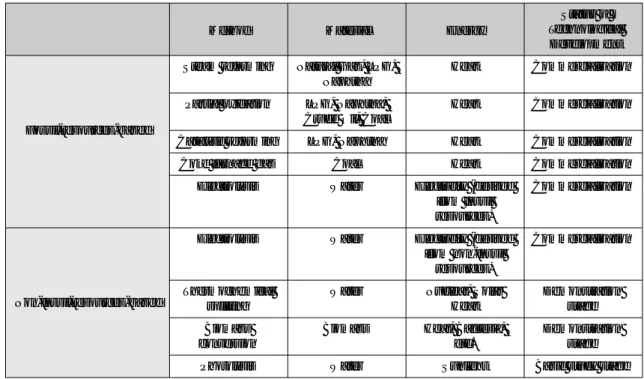
Fuel cells are the most promising system for making use of hydrogen energy. The principle of fuel cells is the opposite of water electrolysis; they produce electricity through the chemical reaction between hydrogen and oxygen, which produces water. As shown in Table 1, fuel cells can be categor ized into four types in ter ms of the electrolytes they use — i.e., the solid oxide type (SOFC), the molten carbonate type (MCFC), the phosphoric acid type (PAFC), and the polymer electrolyte type (PEFC). Fuel cells are used primarily for fuel cell vehicles (FCV), stationary power sources for domestic and business use (including cogeneration systems) and power sources for portable equipment.
Table 2 shows the “prospective targets for
introduction” specified in the Strategic Research
Council Report on the Commercialization of Fuel
Cell Technology (for the polymer electrolyte fuel cells).
[2]8.3 The significance of the non-fossil-resources-based hydrogen production
technology
— from the viewpoint of solving the “3E” problem
As mentioned earlier, molecular hydrogen does not exist naturally in any significant quantity on Earth, and, hence, hydrogen for fuel cells should be produced on- or off-site. In the case of fuel cell vehicles, hydrogen can be produced off-site and transported for use for fuel cell vehicles (pure hydrogen fuel cell vehicles), or it can be produced from methanol or gasoline by in-vehicle reformers (reformer fuel cell vehicles) (see Footnote 1). The
advanta ge in introducing fuel cells (e.g., substitution of oil, energy saving and reductions in the environmental burden) depends largely on fuel types and their production methods.
This chapter outlines supply and demand trends of hydrogen and its production methods, provides the results of existing analyses regarding the effects of saving energy and reducing greenhouse gas emissions by fuel and production method, and sheds light on the significance of the non-fossil-
Electrolyte
Fuel (Reactant)
Operational Temp.
Power Generation Efficiency (HHV)
Characteristics
Development Status
Applications
Stabilized zirconia
Hydrogen, carbon monoxide 900-1,000℃
45-55%
High power generation efficiency
Accommodates internal reforming
Demonstration stage
Centralized large-scale power generation, decentralized power sources, cogeneration systems
Carbonate
Hydrogen, carbon monoxide 650-700℃
45-50%
High power generation efficiency
Accommodates internal reforming
Demonstration stage
Centralized large-scale power generation, decentralized power sources, cogeneration systems
Phosphate
Hydrogen
200℃
40-45%
Soon to be commercialized Difficult to start and stop operations
Commercialization stage
Decentralized power sources, cogeneration systems
Ion exchange membrane
Hydrogen
70-90℃
35-40%
Can be operated at low temperatures
High energy density Relatively easy to start and stop operations
Soon to be put into practical use Vehicles, domestic cogeneration systems, portable power sources Solid Oxide Type
(SOFC)
Molten Carbonate Type (MCFC)
Phosphoric Acid Type (PAFC)
Polymer Electrolyte Type
(PEFC) Table 1:Four types of fuel cells [5], [6]
2002 - 2004
2005 - 2010 2010 - 2020
Targets for Introduction by the End of the Period
Period for improving infrastructure and demonstrating technology
Period for introduction Period for applications
-
50,000 units 5 million units
-
2.1 million kW 10 million kW Description of the Period
Period
Fuel Cell Vehicles Stationary Fuel Cell
Table 2:Prospective targets for the introduction of fuel cells commercialization conference (cumulative amount) [3]
Footnote 1:
Fuel cells based on molten carbonates or solid oxides accommodate internal reforming, and can use natural gas and coal gas as fuel.
However, their applications for vehicles and
small-scale stationary power sources have yet
to be examined.
resources-based hydrogen production technology.
8.3.1 Supply and demand trends of hydrogen
The world’s hydrogen production currently stands at some 500 billion Nm
3a year (Nm
3: volume at 0ºC and 1 atm), most of which is produced by steam reforming of fossil fuel such as natural gas; about 40% of which is consumed by ammonium synthesis, and some 20% b y oil refining. The world’s largest steam-reforming plant can produce 100,000Nm
3of hydrogen per hour.
[7]Domestic demand for hydrogen is estimated at 15-20 billion Nm
3a year, about half of which is consumed by oil refining. As for applications for energy, 3-5 million Nm
3of liquid hydrogen is used annually for launching space rockets.
[5]On the other hand, more than 10 billion Nm
3of hydrogen is produced annually as the by-product of steel- making, oil refining and ethylene production, most of which is consumed b y the producer s themselves as energy sources or materials for chemicals (a mere one percent, more or less, is sold on the market).
As shown in Table 2, the Strategic Research Council on the Commercialization of Fuel Cell Technology set the target for introducing fuel cell vehicles at 5 million units by 2020 (cumulative amount). About 5 million fuel cell vehicles on the road require some 14 billion m
3of hydrogen per year.
[8]If fuel cell vehicles become widespread in
the future, commanding a 50% share of the total number of passenger vehicles (which currently stands at 53 million units
[9]), five times this volume will be required to meet the expected demand.
Taking into account hydrogen to be consumed by stationary fuel cells, much more hydrogen will be needed.
The widespread use of hydrogen energ y systems will ine vita bly boost demand for hydrogen. How to produce hydrogen is thus a major challenge to be addressed, which in turn determines the entire framework of the systems.
8.3.2 Hydrogen production methods
Table 3 shows typical methods for producing hydrogen, which are broadly categorized into those using fossil resources and those using non- fossil resources, as materials or energy sources.The methods using fossil resources have been industrialized, but they emit large amounts of CO
2(see Footnote 2).Take the steam-reforming process for instance: this mainstay method for producing hydrogen emits 0.9kg of CO
2in producing 1m
3of hydrogen even when using natural gas — a material that involves the least amount of CO
2emissions.
[7]The methods using non-fossil resources can be categorized into; (1) water electrolysis using electr icity der ived from non-fossil fuel, (2) thermochemical water splitting, (3) biomass
Fossil-resources-based
Non-fossil-resources-based
Status of Technological Development Steam reforming
Partial oxidation
Catalytic reforming Coke furnace gas
Electrolysis
Electrolysis
Thermochemical splitting Biomass conversion Photolysis
Natural Gas, LPG, Naphtha LPG, Naphtha, Crude Oil, Coal
LPG, Naphtha Coal Water
Water
Water
Biomass
Water
Heat
Heat
Heat Heat Electricity (derived
from fossil resources) Electricity (derived
from non-fossil resources) Nuclear, Solar
Heat Heat, Bacteria,
etc.
Sunlight
Commercialization
Commercialization
Commercialization Commercialization Commercialization
Commercialization
Demonstration stage Demonstration
stage Basic study stage Energy
Material Method
Table 3:Hydrogen production methods
conversion, and (4) water photolysis, all of which vir tually eliminate CO
2emissions and the consumption of fossil resources. Of these, however, only the method based on “(1) water electrolysis” has been established so far.
8.3.3 Life cycle assessment of fuel-cell-based systems
Section 8.3.1 demonstrated that hydrogen production should be expanded dramatically in response to the widespread applications of hydrogen energy systems. Even if fossil resources are used for hydrogen production in this scenario, fossil resources can still be conserved and global warming gas emissions can be reduced on the condition that the energy efficiencies of fuel-cell- based systems (vehicles, stationary power sources, etc.) are higher than those of their conventional counterparts. Then, to what extent are they
effective in these respects?
To answer this question, there is a need to assess the life cycle of fuel-cell-based systems — i.e., energ y required for the extraction of raw materials, transportation, fuel production and the actual fuel consumption. This kind of assessment with respect to vehicles is called a “well-to-wheel”
analysis.
Take CO
2emissions for instance: in the case of conventional gasoline-powered vehicles, a large part of their lifecycle CO
2emissions is attributable to their operations, while the extraction of crude oil and the production/transportation of gasoline involve less CO
2emissions. By contrast, fuel cell vehicles loaded with hydrogen derived from fossil resources emit no CO
2when they are being driven, while hydrogen production itself is a major source of their lifecycle CO
2emissions.
Refer r ing to the results of the life cycle assessment conducted by Thomas et al.,
[11]and Wang,
[12]the third IPCC report
[10]addresses the effects of fuel cell vehicles in conserving energy and reducing greenhouse gas emissions. The New Energy and Industrial Technology Development Organization (NEDO) of Japan conducted a similar analysis through the project for developing hydrogen energy use technology (WE-NET) (see Footnote 3).
[13]Based on these findings, this Chapter examines the effects of fuel cell systems in conser ving fossil resources and reducing greenhouse gas emissions.
With regard to the effects of conserving fossil resources, the fuel economy figures of pure-
Figure 2:Assessment of the life cycle of greenhouse gas emissions [12]
Footnote 2:
Even when reforming fossil resources, zero
emissions can be achieved at large-scale
hydrogen production facilities through the
applications of CO
2recovery and sequestration
technologies. There has been a growing
interest in CO
2underground storage; for
details, refer to “Trends in the Development of
Measures Against Global Warming Centered on
CO
2Underground Storage” (Kazuaki Miyamoto,
the Jan. 2003 issue of Science & Technology
Trends – Quarterly Review).
hydrogen fuel cell vehicles and methanol reformer fuel cell vehicles (see Footnote 4) improve by 75- 250% and 25-125%, respectively, compared with those of conventional gasoline-powered vehicles, according to Thomas et al. Likewise,Wang’s results show 180-215% and 110-150% improvements in fuel consumption, respectively. WE-NET concludes that the fuel consumption of gasoline reformer fuel cell vehicles is about three times lower than those of conventional gasoline-powered vehicles.
Moreover, 40-60% improvement in ener g y consumption can be expected in using by-product hydrogen from coke furnaces, and for fuel cell vehicles using liquid fuel derived from natural gas.
It is also noted here that gasoline hybrid vehicles and electric vehicles are likewise effective in conserving energy.
On the other hand, the total energ y
consumption of fuel cell vehicles using hydrogen derived from non-fossil resources depends largely on the energy sources to be used for hydrogen production, the place of its production and the transportation methods. Meanwhile, there have been discussions as to whether renewable energy should be included when calculating energy consumption. Whatever the case may be, the consumption of fossil resources will be reduced dramatically.
Figure 2 shows part of the results of Wang’s life cycle assessment regarding the effects in reducing greenhouse gas emissions in the case of passenger vehicles in the U.S. In general, the amount of greenhouse gas emissions shows a trend similar to that of the results of fuel consumption. The amount of greenhouse gases emitted by gasoline or methanol reformer fuel cell vehicles and fuel cell vehicles using hydrogen derived from natural gas is lower than that emitted by conventional gasoline-powered vehicles by 50% and 60%, respectively. Likewise, electric vehicles reduce emissions by 50%, though depending on the makeup of power sources. Gasoline hybr id vehicles are similarly effective. Emissions can be reduced dramatically in the case of producing Footnote 3:
The project was launched in fiscal 1993 with an eye toward the global use of renewable energy derived from hydrogen. Phase 1 of the R&D program (a six-year program, budgeted at
¥10 billion) of the project was completed in fiscal 1998, and Phase 2 of the R&D program was subsequently launched in fiscal 1999.
Phase 2 will be completed in fiscal 2002, a year ahead of schedule, which will be consolidated into the “project for developing basic technology for the safe use of hydrogen” to be launched in fiscal 2003.
Footnote 4:
Fuel consumption, in this chapter, refers to the total amount of energy consumed by the whole process ranging from the extraction of materials to the driving of vehicles.
Figure 3:Transition to Non-fossil-resources-based hydrogen production technology
hydrogen from solar energy.
Up to this point, we have considered the assessment of fuel cell vehicles. According to the assessment conducted by WE-NET for decentra- lized stationary fuel cell power sources,
[13]their energ y ef ficiency and the amount of CO
2emissions are almost the same as those of existing large-scale power generation systems, while lagging behind those of highly efficient LNG combined cycle power generation systems, as far as the “power generation” part is concerned. The performance of fuel cells as a cogeneration system is similar to or lower than that of cogeneration systems directly using city gas or light oil.
To sum up, even when using fossil resources to produce hydrogen, fuel cell vehicles are quite effective in conser ving fossil resources and reducing greenhouse gas emissions. Fuel cell vehicles, however, compete directly with gasoline or natural gas powered hybrid vehicles and electric vehicles, and so do stationary fuel cells with cogeneration systems directly using city gas or light oil. Fuel-cell-based systems do not necessar ily outperfor m these competing technologies.
Meanwhile, fossil-resources consumption and CO
2emissions can be virtually eliminated if hydrogen is produced from such resources as water and biomass through the use of renewable or nuclear energy. From the viewpoint of solving the “3E” problem, therefore, it is preferable that the non-fossil-resources-based hydrogen production technology becomes widespread in the near future. Figure 3 shows a scenario for the transition to the non-fossil-resources-based hydrogen production technology.
8.4 Trends in the R&D of the non-fossil-resources-based hydrogen production
technology
This chapter addresses hydrogen production methods that use no fossil resources as materials and energy sources, and divides these methods into four categories — (1) water electrolysis, (2) thermochemical water splitting, (3) biomass conversion, and (4) water photolysis - for outlining trends in the R&D of each method.
8.4.1 Water electrolysis
Water electrolysis is the simplest method for producing hydrogen. However, it involves a large amount of CO
2emissions in the case of using electricity generated by such facilities as thermal power plants burning fossil resources. On the other hand, fossil-resources consumption and CO
2emissions can be virtually eliminated if water is electrolyzed by the electricity derived from nuclear or renewable energ y (including hydropower).
Since electricity is a valuable form of energy, there is a need to consider a balance with other electrical needs and minimize the total cost of energy supply when using electricity for large- scale hydrogen production. Pr imar ily, this hydrogen production method should be promoted in relation to the utilization of nighttime electricity for improving plant availabilities and to output-leveling measures for connecting wind- power plants to the grid.
The electrolytic process of water can be broadly categorized into electrolysis using alkaline water and that using polymer electrolyte. The alkaline
Figure 4:Principle of water electrolysis based on the polymer electrolyte method[5]
water electrolysis method is already in commercial use; it is a simple method but low in energy conver sion ef ficiency and susceptible to corrosion. Figure 4 shows the principle of the polymer electrolyte method:
[5]a polymer electrolyte membrane (made of fluoropolymers) is sandwiched by platinum catalytic electrodes, porous electrodes and current-carrying plates.The porous electrodes function as a medium that conveys both electricity and gas/liquid — water is supplied to the positive electrode and hydrogen is generated b y the negative electrode. This par ticular method, which has yet to be commercialized, is high in energy conversion efficiency, free from corrosion because of the absence of alkaline solution, and contributes to making equipment compact.
WE-NET has been conducting a project since 1993 for the technological development of water electrolysis based on the polymer electrolyte method. As part of this project, a hydrogen supply station (on-site hydrogen production type) was set up in February 2002 in the precinct of Shikoku Research Institute in Takamatsu.The station is one- tenth the size of commercial facilities and can produce 30Nm
3of hydrogen per hour (see Figure 5).
8.4.2. Thermochemical water splitting
In theory, direct splitting of water requires a large amount of heat with temperatures exceeding 2,500ºC. A number of thermochemical processes have been proposed, each of which incorporates ther mochemical reactions to split water at temperatures lower than 1,000ºC. In relation to this, nuclear energ y and solar ener g y are
considered their possible heat sources that emit no CO
2. In particular, the use of nuclear reactors is receiving attention as promising heat sources that can accommodate lar ge-scale hydrogen production.
[15]Of the variety of thermochemical water splitting cycles, the “IS Process” is the most promising technique, which is being studied by the group led by the Japan Atomic Energy Research Institute.
[16]This particular process, originally invented by General Atomics (U.S.), is designed to recycle iodine (which reacts with material water) and compounds der ived from sulfur within the process in order to eliminate the release of hazardous substances. It involves the following three chemical reactions:
At the moment, high temperature gas reactors (HTGRs) are assumed to be the prospective heat sources for the IS Process. High temperature gas reactors can provide a large amount of heat with temperatures exceeding 900ºC and are relatively safe in the fir st place. Light water reactor s, meanwhile, cannot accommodate the process because of their limited capacity for heat supply (300ºC or below).
The Japan Atomic Energy Research Institute developed continuous hydrogen production equipment (capacity: 50 liters per hour) in 2001 based on the IS Process, and subsequently launched relevant research programs. The equipment will be connected to a high- temperature engineering test reactor (HTTR) that
Figure 5:Hydrogen supply station (on-site hydrogenproduction type) based on the water electro- lysis method [14]
Figure 6:Continuous hydrogen production equipment based on the thermochemical water splitting method (IS process) (The Japan Atomic Energy Research Institute)[16]
(Left front: equipment for the Bunsen reaction process; left back: equipment for the sulfuric-acid decomposition process;
and right back: equipment for the distillation of hydrogen iodide.)
is being tested by the Institute. Figure 6 shows the external view of the equipment.
A one-million-kWe high temperature gas reactor that operates 7,000 hours a year can produce 3.4 billion Nm
3of hydrogen per year (the heat efficiency of hydrogen production = 50%). A light water reactor with the same capacity can produce 1.7 billion Nm
3of hydrogen per year through water electrolysis.
[4]The thermochemical method, which needs no conver sion of heat into electricity, outperforms the electrolysis method in total energy efficiency. Incidentally, it is estimated that the combination of a high temperature gas reactor and the IS Process produces hydrogen at a cost 1.5 times higher than that of the commercial steam reforming method using fossil resources.
Because of their large energy output with high density, nuclear power plants can accommodate large-scale hydrogen production; the y are expected to be an option that can meet the expanding demand for hydrogen in the future, respond to environmental constraints and conserve fossil resources. However, thermoche- mical cycles that can make use of the heat generated by today’s dominant light water reactors have yet to be developed.
8.4.3. Biomass conversion
Biomass refers to organic resources of plant origin such as agricultural waste, forestry waste, fishery waste, garbage and energy crops. Energy derived from these resources is called bioenergy, which is inexhaustible in its nature and thus receiving attention as a promising option for curbing global warming since, as a whole, it emits no CO
2. Hydrogen production processes using bioenergy, such as combustion heat, electricity, liquid fuel, etc., or biomass as materials generate CO
2, but the amount is equal to that produced by the original plants in the course of their growth. In a total sense, therefore, the use of biomass does not increase the CO
2concentration in the atmosphere (carbon neutral).
Biomass takes a variety of forms, and so does
hydrogen production using biomass. With the use of dr y biomass, hydrogen can be produced primarily through the thermochemical gasification process. In this case, the combustion heat of biomass itself is generally used for increasing reaction temperatures. However, there is a need to reform or eliminate by-products such as carbon monoxide and hydrocarbon gases.
With respect to wet biomass, the methane fermentation process is already operational;
hydrogen can be produced from methane, but the whole process takes several weeks. Other processes such as catalytic aqueous-phase reforming,
[17]supercritical water gasification
[18]and bacteria-based hydrogen fermentation
[19]have been invented.
One of the advantages of biomass is that it can be readily converted into liquid fuel (ethanol, methanol, biodiesel, etc.). Methanol and hydrogen derived from biomass can be used for fuel cell vehicles, or they can be used directly as internal combustion fuel (see Footnote 5).
8.4.4. Water photolysis
Water photolysis is the technology where hydrogen is produced by splitting water through the use of solar light ener g y. This chapter addresses the direct photolysis of water using photocatalysts and the like — the area in which Japan has been taking the lead ever since the
“Honda-Fujishima Effect”,
[20]water photolysis by an electrochemical cell made up of a titanium- dioxide electrode and a platinum electrode, was reported in 1972.
Scores of photocatalytic materials responding to Bunsen Reaction 2H
2O + xI
2+ SO
2= 2HIx + H
2SO
4Ambient Temp. to 100ºC Decomposition of Hydrogen Iodide 2HI = H
2+ I
2400ºC
+ Decomposition of Sulfuric Acid H
2SO
4= H
2O + SO
2+ 1/2O
2800ºC H
2O = H
2+ 1/2O
2Footnote 5:
Comparison between these options goes
beyond the scope of this article. In some states
in Brazil and the U.S., ethanol produced from
sugarcane and corn or a mixture of ethanol
and gasoline are becoming popular as
automotive fuel.
ultraviolet rays have been discovered so far, but the energy of these rays represents a mere 4% of solar light energy. In order to produce hydrogen efficiently, therefore, there is a need to develop photocatalysts that respond to a broad range of visible light (wavelength: 400-700nm), the energy of which represents some 43% of solar light energy.
Such photocatalysts with satisfactory stability and function have been considered difficult to develop. However, as some new findings have been reported recently, research in this particular area is gaining momentum.
The group led by Hironori Arakawa, director of the Photoreaction Control Research Center under the National Institute of Advanced Industrial Science and Technolog y, came up with a breakthrough: using a metal-oxide semiconductor (In
l-XNi
XTaO
4, X=0-0.2), doping indium/tantalum oxides with nickel, for the first time in the world the group succeeded in fully photolyzing water (hydrogen:oxygen = 2:1) through the single-step photoexcitation of visible light, the results of which were published in Nature last year.
[21]By doping nickel, the activity of photocatalysts for short-wavelength visible light improves dramatica- lly, while it disappears for visible light with a wavelength longer than 550nm. The quantum ef ficiency stands at 0.66% for light with a wavelength of 402nm (see Footnote 6).The group also succeeded in fully photolyzing water with the use of visible light, imitating a two-step photoexci- tation reaction, namely the photosynthesis mechanisms of plants.
[22]Even though under UV irradiation, Associate Professor Akihiko Kudo at the Science University of Tokyo succeeded in fully photolyzing water using NiO/NaTaO
3doped with lanthanum, and produced hydrogen from a reaction tube (with a capacity of a bout 400ml) at a high rate of 20mmol/h (500ml/h).
[23]Compared to water electrolysis, this performance corresponds to an
electrolytic cur rent of 1A or more, with its quantum efficiency reaching 50% at a wavelength of 270nm. As for photocatalysts responding to visible light, SrTiO
3doped with Cr
3+and Ta
5+or Sb
5+, NaInS
2and AgInZn
7S
9are reported to exhibit high activity in hydrogen production, though under the existence of sacrificial agents (see Footnote 7).
[24]The group led by Professor Kazunari Domen at the Tokyo Institute of Technology is conducting another research in this area: aiming at developing photocatalysts capable of splitting water, the group focused on oxynitride/oxisulfide-based photocatalytic materials, and has been testing their response to visible light. The results show that LaTiO
2N, Ta
3N
5, TaON and Sm
2Ti
2S
2O
5sufficiently absorb visible light with a wavelength up to 600nm.
[25, 26]The research on photocatalysts responding to visible light is becoming active not only for producing hydrogen but also for developing antifoulants, disinfectants and deodorants for building exteriors, car interiors, etc.This particular area is attractive to researchers in terms of the basic study relevant to materials science and catalyst science.
As far as hydrogen production is concerned, however, water photolysis is low in energy efficiency, and, hence, it is a long way from being commercialized. In fact, the energy efficiency of the process is lower than those of other hydrogen production systems using solar light systems combining photovoltaic generation and water electrolysis, systems converting biomass into hydrogen, etc., by a factor of ten to several hundr- ed. With this situation as a backdrop, there is a need to develop innovative photocatalysts that respond to long-wavelength visible light with sufficiently high quantum efficiency.
In addition to the a bove processes using semiconductor-type photocatalysts, the feasibility Footnote 6:
Quantum ef ficiency refer s to the ratio between the number of incident photons and the number of electrons involved in the reaction.
Footnote 7:
Sacr ificial a gents refer to additives
(methanol, etc.) to be added in order to
prevent generated hydrogen from being re-
oxidized - a reverse reaction that produces
water.
of photobiological hydrogen production — a system where hydrogen is produced by photo- synthesis bacteria - is being examined,
[19]with genetic engineering techniques being applied in developing photosynthesis bacteria.This hydrogen production system, however, requires a large amount of energy input — a factor that reduces the possibility of commercialization.The hydrogen production capacity of bacteria must be enhanced dramatically.
8.5 Conclusion
In this report, we have focused on the non-fossil- resources-based hydrogen production technology as the key to creating sustainable hydrogen energy systems, and discussed its significance from the viewpoint of future demand for hydrogen and its effects in conserving fossil resources and reducing greenhouse gas emissions. Moreover, we have divided the technology into the four categories of (1) water electrolysis, (2) thermochemical water splitting, (3) biomass conversion, and (4) water photolysis, analyzing trends in technological developments and issues to be addressed for each of these categories.
Fuel cells are energy-efficient in their nature.
Take fuel cell vehicles for instance: they both significantly conserve fossil resources and reduce greenhouse gas emissions, even if the y use hydrogen derived from fossil resources. As far as the results of our analysis are concerned, however, fuel cells do not outperform other competing technologies, such as hybrid vehicles, electric vehicles, combined cycle power generation, city gas cogeneration systems, etc.
When using hydrogen derived from non-fossil resources, meanwhile, fuel cells virtually eliminate fossil-resource consumption and greenhouse gas emissions. In this context, the non-fossil-resources- based hydrogen production technology is the key to creating sustainable hydrogen energy systems; it is particularly significant for Japan, whose self- sufficiency rates in energy remain at low levels.
Thus, Japan needs to pursue this technology on a long-term basis, placing emphasis on its research and development. Determining the potential of such ideal technology for producing hydrogen will provide fundamental information in developing
not only long-term but also short-to-medium term energy policies and R&D strategies.
As we have discussed, all the methods excluding water electrolysis are still in their basic-study or demonstration stages; it is important that potential methods be explored widely and the feasibility of each method be assessed.
It is also important to grasp the role of hydrogen in the whole energy system, keeping track of advances in relevant technologies and changes in the global energy map. For instance, role sharing between electricity and hydrogen has yet to be determined.
Hydrogen is secondar y energy along with electricity, functioning as a common currency among various energy systems. In this context, it involves all the aspects of energy such as its production, conver sion, transpor tation and consumption. In designing ener g y systems including hydrogen energy, it is indispensable to bring up specialists well versed in energy-related technologies and policies. Moreover, exchanges of human resources in the ener g y field and cooperation among academia should be promoted.
It seems that hydrogen production using renewable energy holds great potential especially for developing countries where available land and renewable energy sources are abundant and many areas have no access to the electricity grid. It requires neither a lar ge amount of initial investment nor advanced technology in plant maintenance.
From the viewpoint of technological develop- ment and international cooperation, therefore, it should be of benefit to Japan to actively develop technologies to be transferred to developing countries, while promoting local joint projects.
As is the case with technologies related to
hydrogen production, each of which has been
discussed in this article, there are also many
challenges posed to the technologies related to
the storage, transportation and utilization of
hydrogen. For this reason, the hydrogen
production technology of the future should be
developed based on a broad perspective that
includes advances in related technologies,
improvements in related infrastructures and the
usage of hydrogen energy.
References
[1] The Council for Science and Technology Policy, 2003 Guidelines for the Distribution of Budgets and Human Resources in Science and Technology, June 2002 (in Japanese).
[2] Strategic Research Council Report on the Commercialization of Fuel Cell Technology, the Ministry of Economy, Trade and Industry, January 2001 (in Japanese).
[3] The Website of the International Association for Hydrogen Energy (http://www.iahe.org/).
[4] The Japan Atomic Industrial Forum, Hydrogen Energ y Based on Nuclear Energ y, NSA/
Commentaries No. 10, 2002 (in Japanese).
[5] Y. Osumi, Hydrogen Energy Technology, Agne Gijutsu Center, 2002 (in Japanese).
[6] T. Hayashi, All About Fuel Cells, Gas Energy News, 2001 (in Japanese).
[7] A. Igarashi, Petrotech, 25, 125, 2002 (in Japanese).
[8] T. Takematsu, J. Hydrogen Energy Syst. Soc.
Jpn., 26 (2), 2, 2001 (in Japanese).
[9] The Japan Automobile Manufacturer s Association, Inc., Monthly Motor Vehicle Statistics,ugust 2002 (in Japanese).
[10] The Intergovernmental Panel on Climate Change (IPCC), Working Group III, Climate Change 2001: Mitigation, Section 3.4.4.4, 2001.
[11] C.Thomas et al., SAE Technical Paper 982496, 1998.
[12] M. Wang, Argonne National Laboratory, ANL/
ESD-39, vol. 2, 1999.
[13] WE-NET, The Outline of the 2000 Report (in Japanese).
[14] The Website of WE-NET (http://www.enaa.or.
jp/WE-NET/).
[15] Spencer Abraham, secretar y of the U.S.
Department of Energy, The Speech at the World Nuclear Association Luncheon, August 15, 2002. Excerpts: As many of you know, our Administration has identified hydrogen as being a potential source of unlimited and clean energy....But this is a vision that will take several decades to implement. And one of the challenges will be to cleanly and efficiently produce hydrogen.What is exciting about nuclear energy is that it promises to do exactly that (http://www.energy.gov/HQD ocs/speeches/2002/augss/WorldNuclearAssoc iationLuncheon.html).
[16] The Japan Atomic Energy Research Institute, Press Release, May 15, 2001 (http://www .jaeri.go.jp/open/press/2001/010515/index.
html) (in Japanese).
[17] R. Cortright et al., Nature, 6901, 964, 2002.
[18] Y. Matsumura, Kinzoku, 72, 419, 2002 (in Japanese).
[19] M. Matsumoto,T. Matsunaga, Kinzoku, 72, 405, 2002 (in Japanese).
[20] K. Honda, K. Fujishima, Nature, 238, 37, 1972.
[21] Z. Zou et al., Nature, 414, 625, 2001.
[22] K. Sayama, K. Mukasa, R. Abe, Y. Abe, H.
Arakawa, Chem. Commun., 2416, 2001.
[23] A. Kudo and H. Kato, Chem. Phys. Lett., 331, 373, 2000.
[24] A. Kudo, Kinzoku, 72, 401, 2002 (in Japanese).
[25] M. Hara, K. Domen, Materials Integration, 14 (2), 7, 2001 (in Japanese).
[26] K. Domen, The Japan Institute of Energy, The Seminar of the New Energy Session: The Forefront of the R&D of Direct Water Splitting with Photocatalysts for Hydrogen Production, Kogakuin Univer sity, June 25, 2002 (in Japanese).
(Original Japanese version: published in October 2002)
![Table 2: Prospective targets for the introduction of fuel cells commercialization conference (cumulative amount) [3]](https://thumb-ap.123doks.com/thumbv2/123deta/6926148.2265727/3.892.87.810.110.533/table-prospective-targets-introduction-cells-commercialization-conference-cumulative.webp)
![Figure 2: Assessment of the life cycle of greenhouse gas emissions [12]](https://thumb-ap.123doks.com/thumbv2/123deta/6926148.2265727/5.892.123.770.862.1163/figure-assessment-life-cycle-greenhouse-gas-emissions.webp)

![Figure 4: Principle of water electrolysis based on the polymer electrolyte method [5]](https://thumb-ap.123doks.com/thumbv2/123deta/6926148.2265727/7.892.465.808.671.1163/figure-principle-water-electrolysis-based-polymer-electrolyte-method.webp)
![Figure 6: Continuous hydrogen production equipment based on the thermochemical water splitting method (IS process) (The Japan Atomic Energy Research Institute) [16]](https://thumb-ap.123doks.com/thumbv2/123deta/6926148.2265727/8.892.83.427.127.356/continuous-hydrogen-production-equipment-thermochemical-splitting-research-institute.webp)
