Guanshen Fang
*1Massoud Amini
*2Hao Chen
*3 福田信幸*4 細矢治夫*5 河合雅弘*6Joseph E. LeBlanc
*7Paul G. Mezey
*8 成木勇夫*9 岡田 正*10Eric Rambo
*11Mark Spivakovsky
*12 竹内 茂*13Keith F. Taylor
*14Hongyi Wong
*15山中 聡*16 横谷正明*17
Peter Zizler
*18 有本 茂*19Mathematics and chemistry
interdisciplinary joint research and the Fukui Project XXVIII
Guanshen FANG, Massoud AMINI, Hao CHEN, Nobuyuki FUKUDA, Haruo HOSOYA Masahiro KAWAI, Joseph E. LEBLANC, Paul G. MEZEY, Isao NARUKI, Tadashi OKADA Eric RAMBO, Mark SPIVAKOVSKY, Shigeru TAKEUCHI, Keith F. TAYLOR, Hongyi WONG
Satoshi YAMANAKA, Masaaki YOKOTANI, Peter ZIZLER and Shigeru ARIMOTO†
This is the 28th part of the series of articles that records and further develops essentials of the Mathematics and Chemistry Interdisciplinary Symposium 2013 Tsuyama, whose main themes were symmetry, periodicity, and repetition. The symposium was held on April 5th and 6th in Tsuyama city, Okayama, Japan, in conjunction with the Fukui Project and was devoted to the memory of the late Professor Kenichi Fukui (1981 Nobel Prize) who initiated the project. The present series also provides challenging cross-disciplinary problems which are directly related to the Fukui conjecture, the Global Pattern Identification (GPI) in the Repeat Space Theory (RST), and Artificial Intelligence (AI). Some of these problems are formulated using mathematical language not well known among chemists despite the importance of these notions in elucidating additivity and high-speed asymptotic phenomena in molecules having many repeating identical moieties. The cross-disciplinary interaction between the Repeat Space Theory and the Spatial Anthropology has been discussed in connection with the Science-Art Multi-angle Network (SAM Network) Project, which seeks to bridge Science and Art (visual, audial, and conceptual) for a creative collaboration, and is an important part of the Fukui Project.
Key Words: the Fukui conjecture, Memoir of Prof. K. Fukui, Unique factorization domain (UFD), Global Pattern Identification in the Repeat Space Theory (RST), Spatial Anthropology, Artificial Intelligence (AI)
原稿受付 平成30年9月20日
*1, *6, *10 *11, *16 *17総合理工学科
*4 総合理工学科非常勤講師
*2 Dept. of Math.Tarbiat Modares University, Iran
*3 Dept. of Fund.Ed., Dalian Neusoft University of Information, China
*5 お茶の水女子大学 理学部・元教授
*7 School of Sciences, Humanities, and Visual Communications, Pennsylvania College of Technology, USA
*8 Institute of Chemistry, Eotvos University of Budapest, Hungary
*9 立命館大学 理工学部・数学物理学系・数理科学科・元教授
*12 CNRS and Institute de Mathématiques de Toulouse, France
*13 岐阜大学 教育学部・数学科・元教授
*14 Dept. of Math. and Stat., Dalhousie University, Canada
*15 School of Communication, Arts and Social Sciences, Singapore Polytechnic, Singapore
*18 Dept. of Math., Phys., and Eng., Mount Royal University, Canada
*19 Former Professor of NIT, Tsuyama College, Japan †Director of the Fukui Project (New Frontier Project) For correspondence, visit:
https://www.researchgate.net/profile/Shigeru_Arimoto (Links to other co-authors also available at the above website.)
10. The Red String of Fate Connecting Fukui and Hosoya
Haruo Hosoya
§1 Trans-addition of XY to ethylene
It was in the end of March of 1982 at the annual meeting of the Chemical Society of Japan (CSJ) held at Saint Paul University (Rikkyou). At that time Professor Kenichi Fukui (later called Fuku) was invited to give a special lecture in honor of the Chemistry Nobel Prize awarded to him in the preceding year. Before that lecture we happened to encounter each other in the campus. In return to my congratulations he said to me smiling “I’ve mentioned your work in my Nobel lecture.”
Before introducing his Nobel lecture [1] I have to explain the close relationship between Fuku and myself.
As a graduate student in the laboratory of Professor Saburo Nagakura (Naga) in the Institute for Solid State Physics of the University of Tokyo I started my research career in theoretical chemistry in 1959, and my battlefield was the Annual Meeting of Electronic States of Molecules, where the young soldiers from East and West severely fought freely. The heads of the both troops were supposed to be Naga and Fuku, respectively. However, I hadn’t met Fuku until 1962, when the International Symposium on Molecular Structure and Spectra was held in Tokyo, because Fuku himself didn’t attend domestic meetings but sent three able senior assistants, Teijiro Yonezawa (Yone), Chikayoshi Nagata, and Hiroshi Kato to lead younger students of Fuku’s laboratory of Kyoto University, such as (the late) Keiji Morokuma (Kuma), Akira Imamura, Tokio Yamabe (Toki), Hiroshi Fujimoto (Fuji), etc.
In the same year I presented a paper [2] on “Trans addition to ethylene” in the annual meeting held in Tohoku University, to the north-east of Tokyo. The essence of my idea is as follows: When an ionic fragment X+ of XY attacks at a carbon atom of a planar ethylene molecule from above, some orbital mixing of and should occur. Then irrespective of the s orbital in , i.e., 2s or 3s, the lobe of the anti-bonding 2p* (or LUMO in Fuku’s later terminology) would be unsymmetrically distorted especially at the rear side of another carbon atom. Namely at the trans position relative to the attack of X+ the LUMO would be swelled up leading to the Y– addition to yield CH2X–CH2Y, in which X and Y are situated at the trans positions with each other.
All the organic chemists at that time were simply
believing that this trans-addition of XY occurs due to steric hindrance. However, there was no explanation for the cis-(1,4)-addition of XY to butadiene.
According to my theory by the attack of X+ at the top surface of the edge carbon (position 1) of butadiene the lobe of LUMO on another edge (position 4) would be swelled up above the surface of the molecule leading to the cis-addition of Y–. Again, trans-addition would occur for hexatriene, and so on alternately. The important point in my theory is the alternate appearance of the symmetry of the 2p MO’s of linear polyene. In this mechanism the perturbing orbital can be chosen either from 2s or 3s of carbon atoms.
However, there were two big problems to be overcome in my theory. It was very difficult for me to collect as many results of organic chemistry experiments as possible for supporting the plausibility of this mechanism. Actually, in the first series of the frontier electron orbital theory the Fukui group dug out so many experimental results of organic chemistry for supporting their theory [3,4]. Another problem for me was that we didn’t know the detailed energetics of orbitals. Then in order to develop formal discussion some parametric problem needed to be clarified. At that time almost all the theorists in chemical physics were treating only 2p
electrons semi-empirically. Irrespective of these problems to be clarified, my point is that some orbital mixing of and should occur in the reaction mechanism involving hydrocarbons.
The senior researchers surrounding me were unfavorable to my theory. My boss Naga, who was the coauthor with me in that paper, even did not want me to continue this work.
After the conference I wanted to discuss with several organic chemists on this matter and asked Naga to present my work in the coming conference on organic reaction mechanisms to be held in Nagoya, in between Tokyo and Kyoto. As I could not get a good answer from him, I attended that conference by my own purse only to hear the presentations of organic chemists.
In any case my idea in clarifying the reaction mechanism in organic chemistry was slowly fading out.
However, many years after that I was informed by Kuma that Fuku was excited by reading the abstract of that paper by Hoso and Naga [2]. Further, this fact was later evidenced in the paper by Fuku and Fuji in 1966 after the Woodward-Hoffmann chaos. They cited our abstract as a rather long footnote in their paper [5]. I believe that the red string of fate was connected between Fuku and Hoso through “trans addition”. It was gradually strengthened by
-56-
and by through several academic events that followed. I dare say that Fuku is the only pioneer of mathematical chemistry in Japan, while Naga cannot understand my theory even until today.
Friendly relations between Kuma and Hoso had also been established even before Kuma’s expedition to the US, when we attended the summer school of structural chemistry held in Kiyosato at the foot of the Japan Alps in as early as 1961. So, I remember the
“Beardless Bear (or Kuma).”
As mentioned above I had to abandon this research project for my doctoral thesis which was submitted and approved in 1964. In return for this academic trouble I began to study the Rydberg orbitals of atoms and molecules, including 3s orbital of carbon atom. As a result, in 1967 and 68 two of my single-authored JCP papers were published [6,7]. Alas, just at that time I was playing with the eye balls of rats as a post-doctoral fellow of biophysics in the laboratory of John Platt of University of Michigan in Ann Arbor.
In those days I had difficulty in choosing a research topic. No exciting future could be expected beyond Rydberg orbitals. When Platt came to Japan in 1962 to attend the International Symposium in Tokyo, I was attracted both by his research attitude and personal character. According to his wish we climbed up to the summit of Mt. Fuji with two of my research friends in Naga’s laboratory. However, Platt’s interest had already been turned to the problem of the molecular mechanism of vision in mammals. Nevertheless, I decided to go to the US to see the world outside of Japan.
During this detour in my research life, I happened to make a big near-miss in Ann Arbor. At that time, I knew nothing about the graph theory, on which I studied later by reading the best introductory book on the topic by Frank Harary of U. of Michigan published in 1969, but I might have encountered him somewhere in the same campus or streets of Ann Arbor during my one year of stay there. However, this miss was well compensated by my next visit to Ann Arbor in 1976. Moreover, he became my academic uncle yielding “Erdös number 2” to me later [8].
Another near miss in Ann Arbor might have been the relation between Platt and myself, because during one year of stay there I didn’t know that Platt was the only physico-chemical researcher who realized the importance of the proposal [9] of the index by young Harry Wiener for correlating the structure and property of hydrocarbons.
Moreover, during my one year of stay in the US as a biophysicist I was staying away from chemistry,
intentionally or resultantly, I don’t know.
§2 Encounter with graph theory and Fuku
In the autumn of 1968 I came back to Japan and also to chemistry. In April of 1969 I became associate professor of chemistry in Ochanomizu University, one of the two national universities in Japan only for women students, but I was wondering about what to do again in chemistry. As already mentioned, starting from chemical reaction mechanism I was wandering in the domains of Rydberg orbitals in chemical physics and then of molecular vision mechanisms in biophysics. At least I decided not to do any research work related to my former boss, Naga.
Although I didn’t know anything about the graph theory nor QSAR (quantitative structure-activity relationship) study at that time, incidentally I was hit by the idea of “topological index (later called Z-index),”
which is defined for a non-directed graph (representing the carbon atom skeleton of a hydrocarbon molecule) and this turned out to be well-correlated with the boiling point of hydrocarbons.
Luckily, Ochanomizu University, irrespective of its high status in Japan, is small enough for a scientist to explore in the libraries of several foreign departments including mathematics, where I found the books by Harary and useful information on the graph theory.
Further, in chemistry I found the interesting QSAR papers by Wiener and also learned the active reaction by Platt to them. However, I could not find any chemist nor mathematician in Japan to discuss this exciting field with me.
In the autumn of 1970, at the Symposium of Structural Chemistry in Tokyo I presented a paper of my topological index. Although it was warmly accepted by the audience in the symposium, again I got into trouble for its publication. My short note to Chemical Physics Letters was severely rejected by Heilbronner, who himself confessed this to me later. Then I wrote a full paper and submitted to Bulletin of the Chemical Society of Japan (BCSJ), but had to wait for a long time. Later I was told that a few nominated referees skipped away from my curious paper. Finally, it was published in the autumn of 1971.
I was informed that the next International Symposium on Quantum Chemistry was to be held in the summer of 1973 in Menton, France, where I had spent a week just before coming back from the US for attending a summer school of quantum chemistry organized by Daudel and Pullman. As I loved Menton which is located to the east
end of the French coast of the Mediterranean Sea and also I wanted to disseminate my theory to western chemists, I decided to participate that symposium again by my own purse and I did by bringing my Z-index.
What a lucky chance I had. Fuku was there, and Kuma came from Rochester, his new home town. I don’t remember other participants from Japan, but only one or two if any. It was my first opportunity of talking directly to Fuku, and I was honored with being acquainted with him.
I remember such a smile-provoking scene that Kuma was helping his former boss who was in trouble with answering a question from the floor. Anyway, the red string was reinforced strongly in Menton and thereafter accelerated rapidly.
In Menton I met two chemists who got interested in the application of graph theory to chemistry. They are Roger Mallion from England and Dennis Rouvray who was thinking to escape from Johanesburg, South Africa, to the US. After Menton I made a round trip in Europe to meet several theorists, E. Heilbronner in Basel, Nenad Trinajstic in Zagreb, and Alexandru Balaban in Bucharest.
Several years later, with many of them we could succeed in establishing the international society of mathematical chemistry by fighting with the majority of (number-crunching) theoretical chemists all over the world. Fuku himself didn’t declare that he was a mathematical chemist, but as already mentioned, he was one of the most important pioneers of mathematical chemistry. In this sense my trip to Europe in 1973 was surely epoch-making in my life not only for research but also in every other respect.
Soon after in 1976 I was invited to attend a small seminar on electron correlation at Research Institute of Fundamental Physics of Kyoto Univ. It was organized by the Fukui group and two famous physicists, Fukutome and Yomosa in Kyoto. I was asked to give a talk on something related to frontier orbital theory and/or Woodward-Hoffmann rule. Then I managed to prepare a kind of answer to an exercise given to graduate students in a seminar.
In my turn I was a little strained, because Fuku was sitting just in front of me, at the center of the first row of the room. The essence of my talk was also on the phase of 2p molecular orbitals of hydrocarbon molecules.
When butadiene attacks naphthalene from above, phenanthrene would preferably be produced rather than anthracene due to the phase-matching of the nodal character of HOMO and LUMO’s of naphthalene and butadiene as evidenced from the Figure below. I thought
this was just a naïve exercise of the HOMO-LUMO theory.
Fuku was so much delighted by my talk. He must have been convinced of his frontier orbital theory, or HOMO-LUMO interaction strongly by this reaction mechanism. Within a year or two after this symposium Fuku asked me in a letter how to refer to my talk in his lectures and papers, because again I didn’t write any paper on this subject. But what an honorable treatment it was! Five years later in 1981 he introduced my idea very precisely in his Nobel lecture [1], and let me know at the campus of Rikkyou.
§3 After the Nobel prize to Fuku
Tight-binding of our red string was further strengthened by this Nobel prize. From 1973 CSJ began to publish a series of review books the “Kagaku-Sousetsu”
quarterly. Then the pertinent committee decided to publish a special issue of Fukui’s accomplishment and six editorial staff were nominated, among whom Yone and Kuma were selected from Fuku’s school. I was the only associate professor in that group and youngest. Although the committee asked Yone to become the representative editor, he strongly denied to accept this offer. He had strictly been bidden by Fuku to shield him from all the troublesome requests coming either from the academic or non-academic worlds. After all I was nominated to do this big job, and the special issue “Fukui Kenichi and Frontier Orbital Theory” was published in the spring of 1983 [10].
The Nobel lecture translated by Fuji is fully given in the first chapter [1] followed by the original papers and review articles by Fuku, and relevant introductory discussions by the several members of Fukui school. The original Woodward-Hoffmann papers were also included for referential purpose.
The committee wanted to interview Fuku, but Yone again was not willing to ask this to his boss. Then I had to make a direct telephone call to him. He immediately accepted my offer, and later it ended successfully, of course, accompanied by Yone.
While we were preparing to publish this issue, I was asked by Kyoudou-Tsushin-Sha (Kyodo news) to help to edit a book introducing a series of dialogues between Fuku and Leona Esaki, the famous physics
naphthalene HOMO
butadiene HOMO butadiene LUMO
naphthalene LUMO phenanthrene anthracene
-58-
Nobel laureate in 1973. Based on the dialogues, which were performed in the autumn of 1971 and partly published in several local newspapers, the publishers asked Fuku to write a short introduction of his work for layman readers. Then he nominated me instead of some of his students, and the publisher asked me if I would accept this offer or not. I didn’t want to miss this big chance and instantly accepted this offer. However, I wanted to know what kind of review and how long I should write. The answer of Fuku to the publisher was that “please, ask Hoso to write as freely as he wishes.”
The person in charge of this project said frankly to me over the telephone, “I don’t know the reason, but, please, do so.” Then I wrote a rather long but easy(?) chapter [11].
After this there was no special contact with him for about five years, but in 1990 a good chance came to me.
Fuku was keeping a good relation with Chinese theoretical chemists headed by Tang Auching in Beijing, and a group of theorists surrounding Fuku were invited to visit Beijing and other cities for discussion. Other than the academic events we could enjoy to visit many historic and interesting places in China. We could also enjoy a variety of Chinese foods and culture, whose memories do not fade out until today. The only bad memory was to see the spot in Tiananmen (Ten-An-Mon) where a severe protest by the students was crushed by tanks only a year before. I remember that Fuku was also enjoying excitedly this visit to China. He proudly said to us that his ancestor must have come from the Fujian area (Fukuken-Shou) and that’s why his last name carries the Chinese character of Fuku.
I think this was my last chance of making intimate contact with Fuku, and several years have passed.
Suddenly in January of 1998 I was told that he had died. I attended the formal funeral event in the Fukui Institute for Fundamental Chemistry and could talk with many of my friends about memories related to Fuku. Just before this Kyoto visit I asked Toki if I could deliver a memorial address. He said that things were getting out of control in selecting the persons for doing this business among the government and Imperial Household Agency (Kunaichou). My Fuku was flying far above from me now.
However, he came back to me from heaven in November of 2003 in Tokyo. For many years the Symposium on Structural Chemistry sponsored by the CSJ and the Structure-Activity Relationship Symposium sponsored by the Pharmaceutical Society of Japan were jointly held in the same venue annually by selecting the
place somewhere in this country. In this year the joint symposium was held in Hoshi (Pharmaceutical) University.
One evening the joint get-together party of the two different societies was held in the big cafeteria in the campus. In this party a gentleman came to me smiling and said, “I am very pleased to be able to meet Professor Hosoya. I often heard your name from my father. Please, shake my hand.” He was Professor Tetsuya Fukui of that university. We didn’t talk so much, but I was surprised and impressed to know that Fuku must have talked about me and my work to his family. This is an unusual family talk in general, isn’t it?
§4 Red string from Mathematical Reviews
Although I have never belonged to the Mathematical Society of Japan, I am supposed to be a mathematician according to the American Mathematical Society (AMS). For more than thirty years I have been working as an abstractor of Mathematical Reviews (MR), the most important international database of mathematics research monthly published by AMS. According to their policy of MR, instead of the abstract written by the author they use what is prepared by the designated reviewer in the respective field. It may be due to such a general inclination that a mathematician is ill-fitted to write an objective report on his or her own paper.
I think that because I have been publishing such graph-theoretical papers that are recorded in MR with reasonable frequency, AMS appointed me to be a reviewer in some regions of graph theory. The reason why I am not yet fired may be that they still recognize me as a slow but steady reviewer. So, every year they send me about five mathematics papers, and I am continuing this non-profit duty half unwillingly and half proudly.
Sometimes AMS sends me a very difficult paper which at a first glance cannot be understood by this layman in mathematics at all. However, just by browsing it repeatedly several keywords that appear frequently are picked out and recorded in a computer. If the paper has tables and/or figures, this process can be efficiently performed. Of course, the beginning and ending parts of the paper are important. The next step is to construct several clauses or phrases by using these keywords. Then by connecting and modifying these clauses and phrases a few sentences appear that the author seems to want to convey to the readers. Gradually one can build up some concrete object, or abstract-like something which, however, should not collapse easily. I am enjoying this process as a kid plays with a Lego toy. Of course, we
need to brush it up mathematically. This is a rough sketch of my method for preparing the abstract of a difficult paper of mathematics practically. I think that this tactic was gradually gained by struggling in mathematical chemistry and information sciences. I believe that Fuku would agree with me in our common stance to experimental and inductive mathematics.
The reason why I stepped out from the main theme of this essay is to introduce the role of MR, which reinforced our string connecting Fuku and Hoso.
Until January of 2017 I had never been asked by AMS to review a paper in Nihongo nor a paper of Fukui group. That is “The Fukui conjecture and the new frontier project interdisciplinary research” written by Shigeru Arimoto to Sugaku, the official journal for the members of the Mathematical Society of Japan. As I had never heard of “Fukui conjecture” and I only remembered the name of Arimoto belonging to the Fukui group, I immediately made contact with him through a letter and e-mail. Then over the telephone we could talk with each other. Although I don’t exactly know why AMS asked me to write the abstract of the paper introducing the Fukui conjecture, I am thinking that it is Fuku’s wish to use our red string.
I am confessing that this is my first and last experience to have submitted the very abstract written by a mathematician to MR. Here I will introduce my report to MR, which has been documented by the code MR3558487 in 2017.
The present paper is a mathematical continuation of the paper by S. Arimoto, “The Fukui conjecture (FC) and the new frontier project”, Kagaku (Chemistry in Japanese), 68 (2013), no.11, 24-27, and is composed of the following five chapters. i) Introductory characterization of FC, whose proof is considered as a prototype of the so-called “globally-pertaining-type problems”. ii) Historical root of FC. iii) Detailed characterization of FC, whose proof is crucial to
determine whether or not the
Fukui-Hoffmann-Woodward type pattern analysis in reaction-oriented chemistry can be extended to the new
“repeat-space” pattern analysis in property-oriented chemistry, iv) The structure of the “repeat-space”, which is considered as the mother of FC. v) New Frontier Project, which was initiated by Fukui in 1992 but is currently expanding together with new conjectures and with its sub-program called Science-Art Multi-angle Network (http://bit.ly/1Mrbd2R).
Although FC was originated in experimental
chemistry and can be formulated as a pure mathematical proposition by using the standard linear algebra, for its proof a variety of mathematics is needed, such as Banach space and fractal theories.
References
[1] The role of frontier orbitals in chemical reactions, Kenichi Fukui (translated into Nihongo by H. Fujimoto), Kagaku-Sousetsu (CSJ Review), No. 38 (1983) 1-16.
[2] Trans-addition to ethylene, H. Hosoya, S. Nagakura, Preprint of Symposium on Molecular Structure, Tohoku University, (1962) p. 48.
[3] A molecular orbital theory of reactivity in aromatic hydrocarbons, K.
Fukui, T. Yonezawa, H. Shingu, J. Chem. Phys., 20 (1952) 722-725.
[4] Molecular orbital theory of orientation in aromatic, heteroaromatic, and other conjugated molecules, K. Fukui, T. Yonezawa, C. Nagata, H.
Shingu, J. Chem. Phys., 22 (1954) 1433-1442.
[5] Sigma-pi interaction accompanied by stereoselection, K. Fukui, H.
Fujimoto, Bull. Chem. Soc. Jpn., 39 (1966) 2116-2126.
[6] Studies of Rydberg Orbitals. I. Slater-Condon parameters and valence-state energies for Rydberg excitations determined from atomic spectra of Be-F, H. Hosoya, J. Chem. Phys., 47 (1967) 4190-4198.
[7] Studies of Rydberg Orbitals. II. Calculation of the Rydberg orbitals of Li(I)-F(I) and their isoelectronic series, H. Hosoya, J. Chem. Phys., 48 (1968) 1380-1392.
[8] On the matching properties of three fence graphs, H. Hosoya, F.
Harary, J. Math. Chem., 12 (1993) 211-218.
[9] Structural determination of paraffin boiling points, H. Wiener, J. Am.
Chem. Soc., 69 (1947) 17-20.
[10] Fukui Kenichi and Frontier Orbital Theory, Kagaku-Sousetsu (CSJ Review), No. 38 (1983).
[11] Kagaku to Ningen wo Kataru (in Nihongo) (Let’s talk about science and mankind), K. Fukui, L. Esaki, Kyodonews (1982).
11. Alpha-Riemann-Extension Conjecture (ARE Conjecture)
Shigeru Arimoto
In the Repeat Space Theory (RST), the Alpha Existence Theorem and its Integral Representation Theorem are of fundamental importance. Especially, these two theorems are fundamental and indispensable to prove the Fukui conjecture (cf. [1] and references therein).
In what follows, we consider their combined form. (Cf.
the Appendix to Part XXIV of this series for the definition of notions and symbols appearing in Theorems 1 and 2 below.)
-60-
Let C(I) denote the set of all continuous functions defined on a closed interval I.
Theorem 1 (the Alpha Existence and Representation Theorem, C(I) version). Let q +, let {MN} X qr( ), and let I be a closed interval which contains all the eigenvalues of MN for all N +. Then, for any C(I), there exists an () such that
Tr[((MN))] = ()N + o(N) (1) as N → . Moreover, () is represented by the integral:
() = 2
0
1 Tr ( ( ))
2 F d
,where F is the FS map associated with the sequence {MN}.
Proof. The existence part was proved in [2], and the integral representation part was proved in [3]. //
Let R(I) denote the set of all Riemann integrable functions defined on a closed interval I.
We formulate here the following conjecture.
Alpha-Riemann-Extension Conjecture (ARE Conjecture):
Part I. The Alpha Existence and Representation Theorem, C(I) version can be extended from C(I) to R(I).
Part II. Moreover, the above extension can be done in a way that unifies the Alpha Existence and Representation Theorem C(I) version and the Alpha Existence and Representation Theorem R(I) version by using general topology.
Part I of the above conjecture has been positively solved by the author of this section (S.A.). Namely, the following Theorem 2 has been proved by the present author [4].
Theorem 2 (the Alpha Existence and Representation Theorem, R(I) version). Let q +, let {MN} X qr( ), and let I be a closed interval which contains all the eigenvalues of MN for all N +. Then, for any R(I), there exists an () such that
Tr[((MN))] = ()N + o(N) (2) as N → . Moreover, () is represented by the integral:
() = 2
0
1 Tr ( ( ))
2 F d
,where F is the FS map associated with the sequence {MN}.
However, Part II of the above ARE Conjecture has not yet been positively solved. The proof of Theorem 2 by S.
Arimoto is not based on the usual approach via the aspect of general topology, which is a fundamental unifying approach undertaken prevalently in the Repeat Space Theory. The reader is invited to attack Part II of the ARE Conjecture.
References
[1] S. Arimoto, New proof of the Fukui conjecture by the Functional Asymptotic Linearity Theorem, J. Math. Chem. 34 (2003) 259-285.
[2] S. Arimoto, Fundamental Existence Theorem for the Additivity Problems of the Zero Point Vibrational Energy of Hydrocarbons and the Total Pi Electron Energy of Alternant Hydrocarbons, Phys. Lett. 124A (1987) 131-137.
[3] S. Arimoto and G.G. Hall, Integral Representation of a Fundamental Functional for the Study of the Zero-Point Vibrational Energy of Hydrocarbons and the Total Pi-Electron Energy of Alternant Hydrocarbons, Int. J. Quantum Chem. 46 (1992) 612-635.
[4] S. Arimoto, tentative title, ‘Alpha Existence and Representation Theorem, R(I) version for the Repeat Space Theory,’ unpublished work to be submitted to the J. Math. Chem.
12. Frontier Castle Function and Concluding Remarks
Shigeru Arimoto
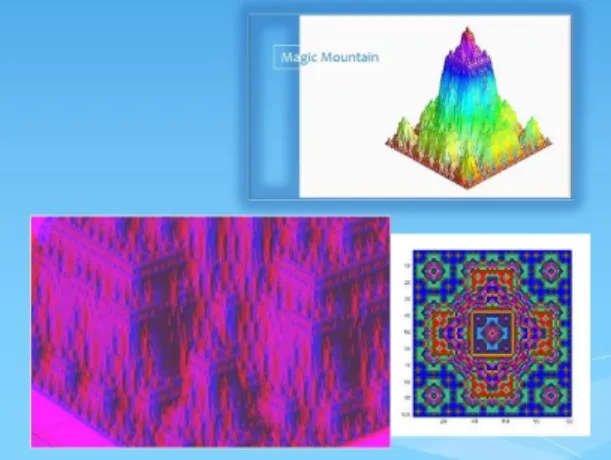
To prove the Asymptotic Linearity Extension Conjectures (ALTEC) [1-4] was a fundamental problem in the Repeat Space Theory. In Refs. [1,4], the Asymptotic Linearity Extension Conjectures, C(I) and CBV(I) versions, were proved by the author of this section (S.A.) for the first time by using two types of continuous fractal functions T and K and by using the Cantor function. Since the graph of the function K is obtainable by considering the diagonal cross-section of the function Magic Mountain nicknamed ‘Tsuyama Castle Function’ [5], one can prove the ALTEC, C(I) version, by using the ‘Tsuyama Castle Function’. To share this castle-like pretty fractal function with people world-wide, we have created another nickname: ‘Frontier Castle Function.’
This ‘Frontier Castle Function’ is a research symbol for our ongoing New Frontier Project; let it also be an iconic symbol for tackling the Challenging Problems B1 and B2 formulated in Section 5 of Part XXVI of this series of articles:
Challenging Problem B1: How can we raise globally capable and creative talents in the field of science, technology, engineering, and mathematics?
Challenging Problem B2: How can we raise globally capable talents in the field of science, technology, engineering, and mathematics who cannot be easily replaced by AI?
On behalf of my co-authors and myself, I would like to express sincere gratitude to all who helped in enhancing the Fukui Project. Special thanks are due to Professor Kyoji Saito, who provided the initial idea of using UFDs in the applications of resolution of singularities and related methods for establishing the Asymptotic Linearity Theorems (ALTs). We remark here that the Piecewise Monotone Lemmas (PMLs) which were indispensable for proving every version of the ALTs were provided by M. Spivakovsky, I. Naruki, and K.
Saito.
References
[1] S. Arimoto, Proof of the Asymptotic Linearity Theorem Extension Conjecture (ALTEC), J. Math. Chem. 54 (2016) 72-84.
[2] S. Arimoto, M. Amini, N. Fukuda, I. Morishima, T. Murakami, I.
Naruki, K. Saito, M. Spivakovsky, S. Takeuchi, K.F. Taylor, S. Yamanaka, M. Yokotani, and P. Zizler, "Mathematics and Chemistry Interdisciplinary Joint Research and the Fukui Project XI", Bulletin of National Institute of Technology, Tsuyama College 57 (2015) 59-66.
[3] S. Arimoto, M. Amini, N. Fukuda, I. Morishima, T. Murakami, I.
Naruki, K. Saito, M. Spivakovsky, S. Takeuchi, K.F. Taylor, S. Yamanaka, M. Yokotani, and P. Zizler, "Mathematics and Chemistry Interdisciplinary Joint Research and the Fukui Project XII", Bulletin of National Institute of Technology, Tsuyama College 57 (2015) 67-72.
[4] S. Arimoto, M. Amini, N. Fukuda, I. Morishima, T. Murakami, I.
Naruki, K. Saito, M. Spivakovsky, S. Takeuchi, K.F. Taylor, S. Yamanaka, M. Yokotani, and P. Zizler, "Mathematics and Chemistry Interdisciplinary Joint Research and the Fukui Project XIII", Bulletin of National Institute of Technology, Tsuyama College 57 (2015) 73-78.
[5] S. Arimoto, M. Amini, N. Fukuda, J.E. LeBlanc, T. Murakami, I.
Naruki, M. Spivakovsky, S. Takeuchi, K.F. Taylor, S. Yamanaka, M.
Yokotani, and P. Zizler, "Mathematics and Chemistry Interdisciplinary Joint Research and the Fukui Project XVI", Bulletin of National Institute of Technology, Tsuyama College 58 (2016) 47-51.
Acknowledgements
On behalf of the authors of this series of papers, the last author (S.A.) would like to express sincere gratitude to Dr.
T. Noritsugu, former President of Tsuyama College, National Institute of Technology, his predecessor Dr. H.
Inaba, and members of the Fukui Project Association for their help in holding our Symposium 2013 Tsuyama and promoting our interdisciplinary and international collaborations. The Symposium was also supported by the Tsuyama City and the Tsuyama City Educational Board, which we would like to thank cordially.
Fig. 1. Matrix Art of the graph of the function Magic Mountain
(which has theold nickname ‘Tsuyama Castle Function’ and the new nickname ‘Frontier Castle Function’) , anaglyph picture of part of
the graph, and Matrix Art of the contour map of the graph (Cf. Part XVI of this series of articles [5] and references therein.)
-62-