in Lamalera, Indonesia : An Analysis of the Catch Record of Whaling
著者(英) Tomoko Egami, Kotaro Kojima journal or
publication title
Senri Ethnological Studies
volume 84
page range 155‑176
year 2013‑08‑30
URL http://doi.org/10.15021/00002442
155
Traditional Whaling Culture and Social Change in Lamalera, Indonesia: An Analysis of the Catch Record of Whaling
1994–2010
Tomoko Egami
Okinawa International University, Japan
Kotaro Kojima
Independent photographer and writer, Japan
1. Introduction
2. Lamalera Whaling Culture 2.1 Lamalera Village
2.2 Traditional Whaling in Lamalera: Harpoon Whaling and the Processing and Distribution of Whale Products
2.3 Interdependent Relationships Based on the Barter System
3. Social Change in Lamalera and its Influence on Whaling and Fisheries 3.1 Social Changes and Development of Infrastructure
3.2 Changes in Whaling and Fisheries 4. The Sperm Whale Harvest Records
4.1 The Sperm Whale Harvest Records for the past 50 Years 4.2 Sperm Whales Harvest Records for the past 17 Years 4.2.1 Yearly Harvest Statistics
4.2.2 Seasonal Harvest Statistics 4.2.3 Monthly Harvest Statistics 4.3 Change Observable in the Harvest 5. Conclusion
Abstract
Lamalera is a village of whalers located on the southern coast of Lembata Island, in East Indonesia. The villagers hunt sperm whales, devil rays, and other fishery products from Peledang, a wooden sail boat, using hand-thrown harpoons. They maintain an economic system of barter by exchanging those fishery products for agricultural products from the
Edited by Nobuhiro Kishigami, Hisashi Hamaguchi and James M. Savelle
Figure 1 Conceptual diagram of Lamalera whaling culture
interior regions of Lembata.
The whaling culture of Lamalera is thus based on an interdependence between inland agriculturalists and whalers living on the coast. This paper describes changes observed using data on sperm whale hunting recorded during the seventeen years from 1994 to 2010. It shows that modernization in Indonesian society has led to changes in whale hunting methods in Lamalera.
The increasing use of small boats powered by outboard engines led to a decrease in fishing activities by Peledang, and promoted a change from “harpoon hunting and fishing on Peledang” to “harpoon hunting and fishing on motorboats”. The style of hunting also shifted toward Baleo whaling, where whalers begin hunting when the “Baleo” call is shouted after a whale spout has been spotted from on land. The method of fishing by drift net at night using motorboats was introduced in April 2009, and initiated a shift from “harpoon hunting and fishing using motorboats” to “net fishing using motorboats.”
Both daytime harpoon hunting and fishing during the Lefa season on Peledang are recognized as being in decline.
1. Introduction
Lamalera is a whaling village located on the south coast of the island of Lembata, in Eastern Indonesia. In Lamalera, sperm whales and manta rays are caught using harpoons from wooden whale boats called as Peledang, which are powered by the wind and oars.
Lamalera villagers barter whale meat and blubber for crops cultivated by mountain dwelling peoples, thereby creating a self-contained economic system. According to folklore, the interdependent relationship between the whalers and mountain dwellers
Traditional knowledge of natural ecology
Belief and ritual
Management of the peledang organization
Shipbuilding
Fishing equipment manufacture Salt
manufacture Processing methods Cooking methods Slaughtering methods Distribution methods
Whaling methods
Agricultural products at traditional markets
Favorite items for ritual
Kinship
Water resources Raw materials
for fishing equipment Shipbuilding
timber Foods obtained from
peddlers
Regional Society
Whale䊶 Products
Traditional exchange based on mutual interdependence Agricultural products
Whaling
Mountain
dwelling people
based on whale meat has a history of 400 years.
The traditional Lamalera methods of whaling, bartering systems, and other aspects of interdependence can be conceptualized as the “Lamalera whaling culture” (Figure 1).
The authors carried out a preliminary investigation on Lembata in 1993, making their first visit to Lamalera village on 27 July. On the following day they visited the traditional market (pasar) of, Lebala village, and were impressed by Lamalera women bartering whale meat. On 29 July, they boarded a Peledang to participate in a whale hunt with some Lamalera hunters. The appearance of sperm whales on this first hunt solidified their resolve to study the Lamalera whaling culture. The authors began full-scale fieldwork in January, 1994. Previous publications on Lamalera whaling culture presented the results of fieldwork to 1999 (Kojima and Egami 1999; Egami 2000; Egami and Kojima 2000).
Since the beginning of this century Lamalera and its fisheries have undergone rapid change concomitant with the modernization of Indonesian society. The principal innovation in fisheries was the introduction of motorized boats, such that there are now 20 traditional Peledang compared with 29 motorboats in Lamalera.
1)Peledang harpoon whaling has been transformed rapidly by the addition of motorboat harpoon hunting and fishing. Traditionally, every Peledang hunted sperm whales every day during the hunting and fishing season (Lefa), from May through September. We term this hunting method
“Lefa whaling”, Nowadays it is rare for all Peledang boats to sail every day. We termed another whaling method “Baleo whaling”, of which there are two types. One can occur at any time during the year when whales are spotted from the shore. Shouts of “Baleo!
Baleo! Baleo!” can be heard throughout the village, and whaling boats quickly put to sea.
A second type of Baleo whaling takes place when crews on a motorboat, within sight of shore, spot sperm whales while harpoon-fishing, and a crew member signals “Baleo” by raising a flag. Once this call is recognized, fishermen will rush to the beach to get their Peledang boats out to sea as rapidly as possible to join in pursuit of the whale. We term these two related hunting methods “Baleo whaling”. For the past several years, “Baleo whaling” has become more popular than “Lefa whaling”.
In this paper we examine the dynamics of Lamalera whaling culture and change in the Lamalera community using the ethnographic record from 1994 to 2010. First, we present a general view of the Lamalera economic system based on traditional whaling methods and bartering with surrounding communities. Second, we examine change in whaling and fisheries, primarily influenced by the modernization of Indonesian society in the 21st century. Third, by recording and analyzing the harvesting of sperm whales, we elucidate changes in Lamalera whaling culture. Finally, after having clarified changes and continuity in Lamalera whaling culture, we conclude by considering the future of Lamalera whaling culture.
2. Lamalera Whaling Culture 2.1 Lamalera Village
Lamalera village is located on Lembata Island, in East Nusa Tenggara Province. Lembata
Regency was separated from East Flores Regency in 1999. Lembata is located at 8° S and 121° E. It has a total area of 1,226 km
2and a population of 100,000 (BPS 2009a).
The livelihood of the indigenous people of Lembata is based on the shifting cultivation of maize and upland rice. Whaling is an economic activity specific to the villages of Lamalera and Lamakera, the latter located on the neighboring island of Solor.
Lamalera village is administratively part of Wulandoni District, of Lembata Regency.
Lamalera is divided into upland and lowland villages. At the time of this writing, about 1,800 people lived there. The ancestors of those villagers engaged in whaling were not indigenous to this region. According to folklore, in the 16th century they migrated from eastern Indonesia to Lamalera. Originally they were fishermen who hunted sharks, sea turtles and manta rays, using harpoons. As they settled in the Lamalera village, they entered into contractual relationships with the indigenous people, offering them fish in exchange for land use rights. Because the location they acquired was favorable for whaling, it can be surmised that this provided the impetus for the immigrants to expand their repertory to include whaling. After that, more people from some western Indonesian islands and from a mountainous region of Lembata Island moved to Lamalera in several stages. Now 18 clans, live in Lamalera. Indigenous people still live in the mountains adjacent to the village, where they engage in shifting cultivation.
There is a traditional division of labor by gender in Lamalera. Men engage in the hunting of sperm whales and fishing for manta rays, as well as net fishing, primarily for flying fish. Men also work as carpenters and boat builders. Women, on the other hand, barter whale meat and fish for maize in the traditional markets and by peddling, going daily into the mountains to do so. They also make salt and lime, and weave ikat, a textile famous around the world (Kojima and Egami, 1999).
2.2 Traditional Whaling in Lamalera: Harpoon Whaling and the Processing and Distribution of Whale Products
Lamalera is one of the few places in the tropics with a whaling tradition. Traditional whaling in Lamalera is carried out using 10m long Peledang boats powered by a sail and oars and crewed by 10–13 fishermen using hand-thrown harpoons. Lamalera whalers can catch sperm whales longer than 10m. When approaching a sperm whale, the “Lamafã ”
2)jumps onto the whale to and stabs it with his harpoon. The authors term this method
‘Peledang whaling’ (Photo 1).
On average, the hunters harvest about 20 sperm whales per year, in addition to other large fish and sea animals. Owing to the potentially fatal risks involved in sperm whaling, it differs from ordinary hunting and fishing. Accordingly, there are various taboos and customary laws that strictly regulate both the whaling methods and the distribution of whale products (Kojima and Egami, 1999: 69–71).
Although sperm whales are the ultimate prize for local whalers, and account for the
greatest share in the local distribution system, Lamalera whalers also harpoon pilot
whales, orcas, dolphins, manta rays, whale sharks, sun fish, sword fish, and turtles. In
short, almost all creatures that can be seen from the boat are targets of the hunt, except
baleen whales. Nowadays, the targets of motorboat harpoon hunting are almost the same
as those of the Peledang hunting, with sperm whales being the notable exception.
The distribution of whale products is regulated strictly by customary law, and everyone who takes part in whaling is entitled to a specific share of the meat. No part of a whale is wasted, and whale products are distributed extensively throughout the local community. Only small amounts of whale meat are consumed by the hunters and their households. Rather, being a basic item of barter, it is an indispensable item in the local economy, often being used as a form of currency. Customary laws regulating the distribution of manta rays, the second most important marine product, are broadly similar.
The distributed whale meat is washed in the sea at the beach by women and children of the hunters before it is taken home. Once the whale meat has been cut up and distributed by village men, women hang it on poles for a week to dry. This yields jerked meat, an important barter item. The oil which drips from the drying meat is collected and sold as lamp oil. Processed blubber is also bartered as a foodstuff. The processed whale meat is transported and sold to people living in the mountains by village women (Kojima and Egami 1999: 188–212; Egami and Kojima 2000: 107–119; Kojima and Egami 2001).
2.3 Interdependent Relationships Based on the Barter System
The two primary bartering methods used by women are peddling, and selling on traditional market days. Mountain dwellers and inhabitants of the lowlands gather at the weekly traditional markets, held on a set day in places like Wulandoni and Lebala. To go on peddling excursions beyond the local village is called `penetan’. Women loaded with
Photo 1 Peledang whaling: crew on a sail powered peledang trying to harpoon a sperm
whale which is spouting water (photo by Kotaro Kojima)
whale meat can be seen leaving Lamalera village around three in the morning, and returning to their villages the following afternoon carrying 50 kg loads of bartered items.
A wide variety of products is obtained by peddling and at the markets, but the most important are corn, the staple food, and bananas. Agricultural produce is often sold in lots of six items, this called a monga and which is the basic unit of barter. A monga is equivalent to six pieces of any item. One cut of whale meat valued at two monga is traded for twelve corn cobs or a bunch of twelve bananas (Kojima and Egami 1999;
Kojima and Egami 2002).
Although Lamalera villagers have bartered whale meat and whale oil since the 17th century, they have never traded with people from other islands (Barnes 1996) . We surmise that the hunting and fishing immigrants to Lamalera intentionally limited external economic relationships in order to give full priority to their interdependent relationship with the indigenous people. In Lamalera, whale meat is use as a form of currency within the island, and by maintaining its value sustains the barter system, which in turn constructs and maintains an interdependent relationship. We surmise that these are survival strategies employed by Lamalera fisher folk who do not produce their own grain. By these means they obtain important products like whale, salt, lime, and pottery that are put into circulation within the island. After their conversion to Christianity, the influence of the Lamalera fisherfolk in the southern part of island increased, and they now play a dominant role in the local economy.
Despite numerous social and economic changes, the value of whale products has remained stable in relation to corn and other local agricultural products, affirming the longstanding interdependent relationship between the mountain dwellers and Lamalera villagers. Although the Lamalera fishery is being modernized and the economic system in the village is also being transformed into a cash economy, the acquisition of the corn staple is still based on barter with mountain dwellers (Egami 2000).
3. Social Change in Lamalera and its Influence on Whaling and Fisheries 3.1 Social Changes and Development of Infrastructure
The winds of change started to blow in Lamalera village in 1999. The authors have published a general summary of the decade of infrastructural improvement and concomitant social change in Lamalera up to 2010, these changes being closely related to change and modernization in fisheries (Table 1 ) (Egami 2004: 15, Egami and Kojima 2010: 8).
The Soeharto Administration, in power for more than thirty years, was overthrown in 1998. In October, 1999 the Wahid Administration came to power and adopted a policy of decentralization, which became a driving force of social change. The new administration promoted a policy of transferring numerous central government functions to local governments, and in the process many new local governments were also created.
On October 15, 1999, the island of Lembata was separated from East Flores Regency,
becoming the new Regency of Lembata. Petrus Boiona Keraf, a native of an upland
Lamalera village, became the Acting Governor of the new regency, serving until 2001.
After his term expired, Petrus became Chairman of the Provincial Assembly, where he served until 2009. Then came the sensational news that Sony Keraf, the younger brother of Petrus, had been selected as the Minister of Environment in the Wahid Administration.
One of the pressing issues for the new Lembata Regency was the improvement of roads. In 2000, local governments acted promptly to improve local infrastructure. This proceeded rapidly, resulting in roads suitable by for cars for the first time in Lamalera village. The village enjoyed a newfound prosperity because of the public works. On May 6, 2000, the traditional stairway, called “gripe”, was torn down in the process of road construction. This came to symbolize modernization change in Lamalera society. As many aspects of the traditional culture came crashing down, the sound of the collapsing stairway came to symbolize the collapse of traditional culture amid the dramatic social and cultural changes brought about by modernization in Lamalera (Egami 2007: 15).
In 2001, the construction of six new motorboats heralded the beginning of a new era in whaling as the motorboats began harpoon hunting and fishing for the first time in a major way it signaled a shift away from Peledang whaling. In this epoch-making year,
“Peledang whaling with the assistance of motorboats” also received official sanction. In August 2002, a provincial government project to construct a new cross island road was completed. It made possible the establishment of regular cross island truck-bus services, spelling the demise in 2003 of the long-standing popular passenger boat service to Lewoleba.
On August 20, 2003, the upland and lowland villages of Lamalera became part of the new District of Wulandoni, which was formerly part of Nagawutung District. The capital of the new district was located in Wulandoni, where the traditional market is held (BPS 2009b).
In 2004 four additional truck-buses were pressed into passenger service, dramatically affecting the traditional peddling activities of women, who began to use the regular truck-bus service to go to the mountain villages to peddle whale meat. Whereas formerly it took several hours to reach villages on foot, it now only takes thirty minutes by bus.
Scenes of women with bundles of corn and bananas on their heads trudging down steep mountain paths are rapidly becoming a thing of the past. Although modern transportation has made their lives easier, money has become necessary to continue their traditional peddling activities. Also, 2004 marked a major expansion of motorboat harpoon hunting and fishing, making this year a turning point in the lifestyles of both men and women in Lamalera.
On June 3, 2005, when the State-owned power company started electrical service
from 6:00 p.m. to 6:00 a.m., the whale oil lamps were extinguished for the last time. In
December 2006 cell phone service began, marking the completion of the last major
modern infrastructure project in the government’s master plan to provide modern roads,
public transportation, electrical power, and communication services, all of which
necessitate a transition to a money economy. In 2007 a new fishery high school opened,
joining Lamalera village’s kindergarten, two elementary schools, and junior high school,
thus forming for the first time an integrated K-12 education system. The first high school
graduating class matriculated in 2010.
Table 1Chronology of Lamalera related events: 1999–2010 YrNo. of whales harvestedMajor Events in the Lamalera Fishing IndustryLembata Legency and Lamalera Village EventsIndonesian National Events 19996Nov.–Dec.: 21pilot whales taken with motorboats “Motorboat hunting and fishing” helps to popularize motorboats Oct. 15: Lembata Regency established Upland Lamalera villager Piter Keraf becomes provisional regency governor
Oct.: President Wahid inagurated Laws enacted in line with new decentralization policies Upland Lamalera villager Sony Keraf appointed State Minister of Environment 200010Jan.–Mar.: 26pilot whales taken by three motorboat crewsRegency government infrastructure projects initiated “Road to Upland Lamalera village constructed” May 6: Stairway connecting Upper and Lower Lamalera villages torn down during road construction 200135Biggest catch since 1995 Apr.: 10new motorboats acquired (transition to motorized fleet gets underway) Apr.28: Use of motorboats for whaling officially approved “Motorboat-peledang team whaling” introduced
Aug. 4: Andreas becomes Regency Governor Piter Keraf defeatedAug.:Megawati administration begins 200228May 8: Engine moounted on the peledang Jawa Tenã, a historic moment in Lamalera Introduction of the “Motorboat-peledang”
Aug. 25: Truck-Bus passenger service from the seat of Regency Government in Lewoleba to Upland Lamalera village inagurated
Oct. 12:Bali Island terrorist bombing incident 200318Poor whale harvest problem becomes serious “Motorboat-peledang team whaling” becomes dominantPassenger ferry service shut down. Transition to overland transportation 2 more truck-buses go into service Aug. 20:Wulandoni District established 200414May: 21 motorboats now in use Expansion of “motorboat whaling and fishing” May: Huge drop in peledang expeditions May: Permanent engine mounts attached to peledang for the first time May: After a catch of 3 whales, no more whales caught for the remainder of the season
Mar. 30: Lewoleba Central Market burns down Truck-buses in service in Lamalera increase to 4
Oct. 21: New Yudhoyono administration takes power *Federal-District revenue sharing budget laws revised Dec.26: 2004 Indian Ocean earthquake and tsunami 20055May: Dramatic decrease in peledang expeditions Jul. 12: Humpback whale taken by four motorboats for the first time in Lamalera history Aug.11: Sperm whale taken for the first time in 15 months
Jan.: Prices spike owing to rising gasoline prices Cell phone service inagurated in the regency capital Mar.:Disatrous harvest in Lembata owing to drought Jun.3: Electricity made available by the national electric power company Electric service comes to Lamalera State direct elections held for the first time in June Oct. 21:Oil prices jump 126%
Table 1Chronology of Lamalera related events: 1999–2010 (cont.) 20064“Motorized peledang” fleet increases to 4 No whales taken in whaling season Worst whaling season since 1989 Jun. 2: Gov. Andreas reelected to a 5 year term in direct elections Aug.26: Regency government approves gold and copper exploration Dec.:Cell phone service inagurated in Lamalera
May 27: 6,000 people die in Java earthquake 200743Jan. 28: Sunday whaling permitted for the first time May 2: 18 meter long “white” sperm whale harvested, the biggest in Lamalera history Biggest catch in 36 years “Peledang whaling with the assistance of mororboats” becomes prevalent
The American environmental group “Photovoices” distributes 50 digital cameras in the village on a 6 month loan Lamalera Village photo archivomg program begins “Joint sponsorship by the WWF, the Ford Foundation, and National Geographical Society” Apr. 30: Launching ceremony for new Indonesian WWF environmental conservation ship Koteklema in the Solor Sea Jul.: Lamalera Fishery High School construction completed Nov. 20: Photovoices holds photo exhibit in Lamalera Mar. 6: More than 73 people die in West Sumatra earthquake 200834Motorboat fleet increases to 26, motorized peledang fleet to 8 Whaling transitions to “Baleo whaling”
Truck-buses in service in Lamalera increase to 6Jan. 27:100 people die of bird flu in Indonesia May 24:Price of gasoline rises 28.7% 20095Mar.: District government donates 2 net fishing boats to Lamalera Apr.: “Nighttime drift net fishing” introduced Aug.: “Motorboat drift net fishing” takes hold Peledang use becoming limited to “Baleo Whaling)”
May 14: Establishment of the Savu Sea Marine Conservation Area announced at the Manado World Ocean Conference, but the Lembata area is excluded from the protected area Jul.: Dynamite fishing by 'visiting' fishing boats becomes more common along the Lamalera coast Oct. 29–30: First Annual Baleo Festival held May 11: World Ocean Conference held in Manado, Indonesia Jul. 8:Regency presidential election held Oct. 20:2nd Yudhoyono administration begins 201022Aug.: Huge harvest of 13 sperm whales in one weekNov. 29: 106 Lamalera men and women make a direct appeal to the Regency Assembly to preserve traditional whaling
Oct. 26: Eruption of Mt. Merapi in Java kills more than 200 people
3.2 Changes in Whaling and Fisheries
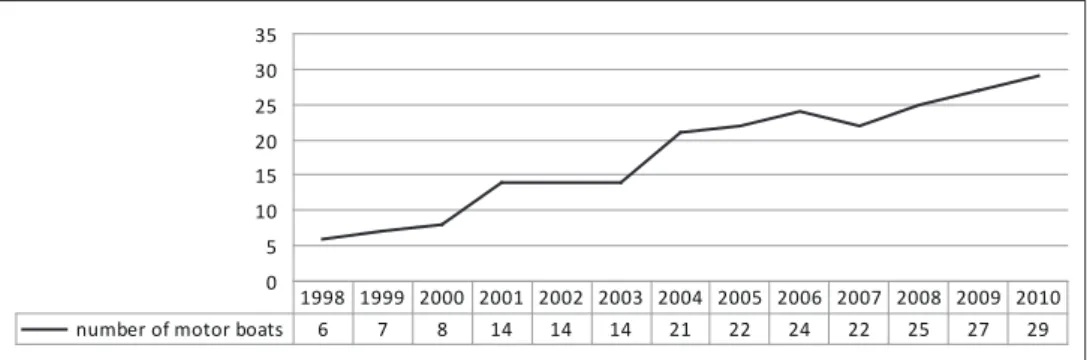
During the off-season for fishing from the end of 1999 to the beginning 2000, motorboat harpoon hunting and fishing crews harvested a record 47 pilot whales, energizing the local industry. Following this success in whaling with motorboats, the construction of a new motorboat began in 1999. Eight new motorboats were added to the fleet from 1999 to 2001, for a total of 14. Thus, 2001 became a major turning point in the Lamalera fishing industry. Still more motorboats have been built since 2001. At the time of the writing (2010), there were 29 motorboats in service (Figure 2).
The Year 2001: Introduction of a Cooperative Whaling System “Peledang Whaling with the Assistance of Motorboats”
The increase in the number of motorboats brought about significant changes in Lamalera whaling laws. On April 29, 2001, at the Lamalera traditional village assembly (tobu nama fata) it was determined that “in a case in which a motorboat tows a Peledang boat that catches a sperm whale, the owner and crew of the motorboat is entitled to a portion
Figure 2 Shift toward increasing number of motor boats 0
5 10 15 20 25 30 35
number of motor boats 6 7 8 14 14 14 21 22 24 22 25 27 29
1998 1999 2000 2001 2002 2003 2004 2005 2006 2007 2008 2009 2010
Figure 3 Diagram of sperm whale parts for distribution updated version of Kojima and Egami, 1999
of whale meat, called the kile”. This assembly also granted official sanction for the use of motorboats in whaling (Figure 3– 13 ).
When sperm whales are spotted, motorboats are used to tow Peledangs quickly toward the whales, and after the whales have been caught the motorboats are used to tow the Peledangs back to shore, playing an indirect but important role in the whale hunt. We have termed this type of whaling “Peledang whaling with the assistance of motorboats.”
It is impossible to catch sperm whales using motorboats alone because the motorboats are too small and they lack the buoyancy necessary to withstand the torque of the harpoon lines. This makes them more than usually susceptible to sinking. And should they sink, the economic losses would be much greater. However, the most important reason for the restriction of whaling with motorboats is that it violates Lamalera common law.
The year 2001 was epoch-making for Lamalera whaling. In this year, the motorized fleet had been expanded and Peledang whaling with the assistance of motorboats was officially sanctioned, marking the beginning of the era of motorboat assisted whaling.
The purchase of almost all motorboats is financed by relatives who are successful businessmen in Jakarta, or relatives in neighboring cities who work in high income occupations, such as public servants or teachers. Although according to local custom some clans, such as the Ebaona and Tanakrofa, not permitted to own a Peledang, they can own motorboats, enabling them to participate in whaling.
The whale harvest increased when motorboats began to tow the Peledang. For example, 16 whales were caught on nine expeditions from January to June in 2001.
However, only four were caught on three expeditions in July and August of that year, and all four whales put up tremendous fights during the hunt, seriously damaging most of the Peledang boats. Lamalera villagers were reminded of an old maxim passed down from their ancestors that states “whales will always put up a fight when people commit sins,” so while people welcome the advances in modern fishing technology, at the same time they fear that something is wrong. Since the introduction of the new methods of whaling made possible multiple whale harvests on a single expedition, the catch for 2001 increased to a total of 35 whales.
The Year 2002: Introduction of Motorized Peledang
The following year, on May 8, 2002, a major innovative in Lamalera whaling history was unveiled. Removable wooden motor mounts were attached to the stern of a Peledang, marking the first appearance of the “motorized Peledang”. A 15 hp outboard motor was attached to a Peledang named the Java Tenã. That day, the crew on the Java Tenã Peledang was able to approach very quickly to a surfacing whale. They then detached the motor and put it on another motorboat. After the success with this technique, Peledang boats and motorboats began to work in pairs. The Java Tenã Peledang and MukoTenã Peledang each formed two boat teams paired with motorboats.
Whalers working in these teams began to achieve a clear record of success compared to
other whaling methods. The superiority of this new whaling method soon became
obvious to all whalers.
The Year of 2003: The Superiority of Motorized Peledangs
In 2003, the crews of three Peledangs, the Java Tenã, MukoTenã and the newly motorized Manula Belolo, harvested 10 whales, more than half the total catch of 18 for that year. Conversely, whaling expeditions in hand-rowed Peledang went into a rapid decline. At the same time, motorboats were constructed in increasing numbers.
The Year of 2004: Spread of Motorboat Harpoon Fishing
In 2004, a Peledang with a built-in permanent wooden motor mount (sepi) was introduced for the first time in Lamalera whaling history. In this year seven motorboats were constructed, bringing the total number to 21, surpassing that of the 20 Peledangs for the first time. Since then, most whalers have switched to working in two boat teams – one Peledang and one motorboat.
The year 2004 also witnessed an increasing use of motorboats, but harpoon whaling expeditions using Peledang decreased dramatically. Traditionally, Peledang left shore every day for whaling during the Lefa season. The Lefa whaling season, which ordinarily begins in May and continues through September, this time lasted for only several weeks in May. The primary reason was that fewer whales migrated during this Lefa season, with only three being caught in May. However, another factor was also significant. With the advent of motorized craft, so many of the young men in Lamalera preferred to join motorboat crews for motorboat harpoon hunting and fishing that, when there were no active whale sightings, Peledang owners were unable to recruit sufficient crew members to row their non-motorized boats. Peledang require eight crew members for rowing, but the young men prefer the motorboats which do not need to be rowed. The tendency for fewer migrating whales to be spotted became an even more serious problem, causing the cancellation of the Lefa season in May, and only five sperm whales to be harvested in the Lefa season. Thus, 2004 became the second most important turning point in the local fishing industry because the paucity of whale sightings resulted in Peledangs being abandoned in favor of motorboats.
2005–2006: Historically Poor Catch
In all of 2005 only five sperm whales were caught. In addition, three killer whales were
caught in motorboat harpoon hunting, and for the first in Lamalera history, one humpback
whale was caught by four motorboat harpoon hunting crews on July 12. Then, in 2006,
the Lamalera whale hunters endured one of the worst Lefa seasons since 1989. In the
off-season, from January to March, only four sperm whales were caught, and no more
were caught for the rest of the year, although one beaked whale was caught by a
motorboat crew in May.
2007: The Spread of “Peledang Whaling with the Assistance of Motorboats” and a Historically Successful Catch
In an attempt remedy this situation, with the blessing of a Catholic priest, Baleo whaling was carried out on a Sunday, for the first time in memory
3). On May 2, the second day of the Lefa season, the hunters caught an 18m long white male sperm whale. It was the biggest whale ever caught in Lamalera whaling history. Subsequently, a total of 43 sperm whales were taken that year, the biggest catch since 1970 (Photo 2).
In addition, environmental groups became very active in Lamalera during this year.
The American environmental group “Photo Voices” loaned 50 digital cameras to the villagers for six months, and later held an exhibition of the photographs taken by the villagers, together with seminars. At the same time, the World Wide Fund for Nature Indonesia branch sent an observation vessel named Koteklema (lit. “sperm whale” in the Lamalera dialect) to the Solor Islands.
The Year of 2008: Transition to Baleo Whaling
In 2008, a total of 34 whales were caught in multiple harvesting expeditions, making for one of the most bountiful harvests in years. The trend toward motorboat harpoon hunting and fishing displacing the Peledang continued during this year. Sperm whale hunting has shifted to become primarily a Baleo whaling venture, with a corresponding decline in Lefa whaling. Further, it became possible to mount outboard motors on eight Peledangs,
Photo 2 An 18 meter long whale: the largest in the history of Lamalera whaling.
(Photo by Kotaro Kojima)
more than 33% of those in operation.
The Year of 2009: Introduction of Nighttime Motorboat Drift Net Fishing
In 2009 environmental protection policies received increased attention by the Indonesian government. At the World Ocean Conference, held in Manado, Indonesia, in 2009, the
“Kawasan Konservasi Perairan Laut Sawu” (Savu Sea Marine Conservation Area), was established. Owing to strong local opposition and various political maneuverings, the Lamalera villagers managed to get the marine area around the Lembata islands excluded from the sanctuary.
Just before the fishing season, nighttime motorboat fishing with drift nets was introduced, and as a result the catch dramatically increased. Thanks to these technological advances in drift net fishing, the exploitation of new types of marine resources became possible. At this point, drift net fishing has achieved an economic importance rivaling harpoon whaling and harpoon fishing. The authors surmise that, for the foreseeable future, a typical pattern of fishery operations will be drift net fishing at night, net and equipment maintenance during the day, and Baleo whaling in the daytime as opportunities permit.
It is also a noteworthy that during this year four veteran harpooners retired from whaling, symbolizing the changing times in the fishing industry. Lefa whaling operations with Peledang this year ended after only three weeks, with only five sperm whales taken in two expeditions.
The Year of 2010: Multiple Whales Harvests Through Baleo Whaling
In 2010, although only eight Peledang were engaged in Lefa whaling and 16 were used for Baleo whaling, and whalers caught 22 sperm whales in eight whaling expeditions.
However, that 13 of them were harvested in just three expeditions all within a single week demonstrates the unpredictability and unreliability of sperm whale hunting.
Baleo whaling conducted by teams of motorboats and Peledangs had become the main method of whaling by this time, and a tendency toward multiple whale harvests in limited numbers of whaling expeditions became apparent. Twenty-one motorboats were now in operation, contributing to an invigorated harpoon hunting and fishing and drift net fishing industry (Egami and Kojima 2011: 89–92). It seems likely that the drift net fishing will accelerate change in the local whaling culture.
4. The Sperm Whale Harvest Records
4.1 The Sperm Whale Harvest Records for the Past 50 Years
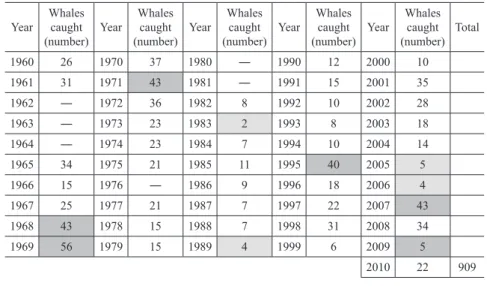
Harvest records of sperm whales in Lamalera have been kept only since 1960. Annual
data for 50 years of sperm whale harvests from 1960 to 2010 is shown in Table 2
4). This
data is incomplete because of the lack of records for six of the years. However, the
available data shows that, 909 whales were caught. Were those missing six years taken
into account, we estimate that only about 1,000 whales were harvested in 50 years. The importance of the whale is remarkable because those 1,000 whales sustained the life of 2,000 villagers for half a century. Even when taking into account harvests of manta rays and other marine life, according to our calculations one whale sustains about 100 villagers for a year, testifying to the vital importance of whaling in Lamalera.
Only seven years of data are available for the 1960s, but it can extrapolate that an average of 32.9 whales were harvested annually during this decade. The nine years of available data from the 1970s reveals an annual average harvest of 26.0. Data for the eight years in the 1980s shows an average annual harvest of 6.9 whales. In the 1990s, the average increased to 17.2, and in the first decade of the 21st century, the annual average was 19.6.
The greatest annual harvest ever recorded occurred in 1969 with 56 whales, followed by somewhat smaller harvest records in 1968, 1971, and 2007. During this half century of whaling, only five years produced harvests of greater than 40 whales, and also there have been only five years of disastrous harvests of five whales or less, three of which have been in the very recent years of 2005, 2006, and 2009, and that caused widespread concern (Egami and Kojima 2010: 15–16).
4.2 Sperm Whales Harvest Records for the Past 17 Years
During the 17-year period from 1994 to 2010, 345 sperm whales were harvested in 158 expeditions (Egami and Kojima 2010: 18–30). Since the details of harvest data have been published elsewhere only a general overview of recent changes in Lamalera whaling is presented here, based on the harvest data.
Table 2 Catch record of sperm whales for the period 1960–2010
Year
Whales caught (number)
Year
Whales caught (number)
Year
Whales caught (number)
Year
Whales caught (number)
Year
Whales caught (number)
Total
1960 26 1970 37 1980
―1990 12 2000 10
1961 31 1971 43 1981
―1991 15 2001 35
1962
―1972 36 1982 8 1992 10 2002 28
1963
―1973 23 1983 2 1993 8 2003 18
1964
―1974 23 1984 7 1994 10 2004 14
1965 34 1975 21 1985 11 1995 40 2005 5
1966 15 1976
―1986 9 1996 18 2006 4
1967 25 1977 21 1987 7 1997 22 2007 43
1968 43 1978 15 1988 7 1998 31 2008 34
1969 56 1979 15 1989 4 1999 6 2009 5
2010 22 909
【
Remarks
】― : No record ■■:5 or fewer whales
■■:40 or more whales
4.2.1 Yearly Harvest Statistics
Figure 4 shows the total number annual whaling expeditions and whales harvested. The figures show evidence of considerable fluctuation in the number of sperm whales harvested. A 6-year cycle appears to be operating. A typical pattern seems to be a poor catch for two years followed by a large catch for one year, and an average catch for three years, after which the catch becomes poor again. For example, there was a poor catch in 1993 to 1994, followed by a large catch in 1995. The same pattern was evident in the 1999 to 2000 poor catch–2001 large catch, and the 2005 to 2006 poor catch–2007 large catch. The poor catch of 2009 was an exception.
It is possible that this cycle may be related to the migration patterns of sperm whales. As sperm whales tend to give birth every five years (Kato 1995: 193), the migration-harvest cycle may be related to the gestation cycle. After the introduction of motorized boats in 2001, the catch decreased for five years, after which came the large harvest of 2007, which was then followed several years of decreasing harvests. If the harvest cycle is related to the reproduction cycle of sperm whales, it would seem to indicate a large catch in 2013. The average annual catch over these 17 years has been 20.3 whales from an average of 9.3 expeditions per year, giving an average of 2.2 whales per expedition.
4.2.2 Seasonal Harvest Statistics
In Figures 5 and 6, each year is divided into the hunting and fishing season (Lefa) and the off-season. The former called ranges from May to September when the weather is suitable. Until 2003, the Peledang went hunting and fishing every day during the Lefa season. During the off season, from October to April, when the weather is not suitable for hunting and fishing, ‘Baleo’ whaling is still possible. Although the Peledang do not venture out for hunting and fishing during the off-season, if a whale is spotted from the coast, and if the weather and wave conditions permit, the Baleo call goes out, and the Peledang quickly put to sea. Since the probability of a successful catch is high once a whale has been spotted, a high percentage of Peledang crews is likely to answer the Baleo call, even those that may have been inactive during the Lefa season. Even crews who have returned to shore after an unsuccessful day at sea will go back to sea if Baleo is called. Although technically Baleo whaling refers to expeditions launched only after a whale is spotted from shore, sometimes the off-season itself is referred to as the Baleo Season, because most whalers are not at sea then, and go out only if Baleo is called.
The harvest data of sperm whales for the past 17 years shows that during the
hunting and fishing season from May to September a total of 202 whales were caught on
84 expeditions. The average annual catch was 11.88 whales from 4.94 expeditions in the
Lefa season, with an average of 2.41 whales caught per expedition. During the
off-season, from October to April, 143 whales were caught on 74 expeditions. The
average off-season catch was 8.41 a year from an average of 4.35 expeditions, for an
average of 1.93 whales per expedition. Not only are more whales caught in the hunting
and fishing season than in the off-season, but the number harvested per expedition is also
higher (Figure 7).
㪊 㪉
1994 1995 1996 1997 1998 1999 2000 2001 2002 2003 2004 2005 2006 2007 2008 2009 2010
whales 10 40 18 22 31 6 10 35 28 18 14 5 4 43 34 5 22
number of expediƟons 7 18 7 8 13 6 5 22 14 10 8 2 4 14 10 2 8
0 5 10 15 20 25 30 35 40 45 50
Figure 5 Whales caught and number of expeditions during the Lefa season from 1994 to 2010
1994 1995 1996 1997 1998 1999 2000 2001 2002 2003 2004 2005 2006 2007 2008 2009 2010
whales 4 17 10 10 21 4 10 18 13 4 3 2 0 37 27 3 19
number of expediƟons 3 10 3 3 8 4 5 12 6 2 2 1 0 11 7 1 6
0 5 10 15 20 25 30 35 40
Figure 4 Whales caught and number of expeditions from 1994 to 2010
Figure 6 Whales caught and number of expeditions during the off season from 1994 to 2010
whales 6 23 8 12 10 2 0 17 15 14 11 3 4 6 7 2 3
number of expediƟons 4 8 4 5 5 2 0 10 8 8 6 1 4 3 3 1 2
0 5 10 15 20 25
1994 1995 1996 1997 1998 1999 2000 2001 2002 2003 2004 2005 2006 2007 2008 2009 2010
Figure 8 Month whale harvests from 1994 to 2010
0 10 20 30 40 50 60 70Jan.
Feb.
Mar.
Apr.
May
Jun.
Jul.
Aug.
Sep.
Oct.
Nov.
Dec.
numbers
number of expediƟons
Figure 7 Comparison
of
Lefa season and off season whale catches0 5 10 15 20 25 30 35 40
1994 1995 1996 1997 1998 1999 2000 2001 2002 2003 2004 2005 2006 2007 2008 2009 2010
Lefa season whale catches Baleo season whale catches