45
ORIGINALEarly expression of serum CCL8 closely correlates to non-relapse mortality after allogeneic hematopoietic stem
cell transplantation
Masaki Y
AMAMOTO1),2), Tsukasa H
ORI1),2), Naoki H
ATAKEYAMA3), Keita I
GARASHI1),2), Natsuko I
NAZAWA2), Nobuhiro S
UZUKI4), Norio T
AKEI1), Yoichi M. I
TO5), Kimikazu M
ATSUMOTO6), Koji K
ATO7), Hiroyuki T
SUTSUMI2), and Yasuo K
OKAI1)1) Department of Biomedical Engineering, Sapporo Medical University School of Medicine
2) Department of Pediatrics, Sapporo Medical University School of Medicine
3) Department of Pediatrics, Asahikawa Medical University
4) Hokkaido Medical Center for Child Health and Rehabilitation
5) Department of Biostatistics, Hokkaido University Graduate School of Medicine
6) Children's Cancer Center, National Center for Child Health and Development
7) Department of Hematology and Oncology, Children's Medical Center, Japanese Red Cross Nagoya First Hospital
ABSTRACT
To explore the role of Chemokine (C-C motif) ligand 8 (CCL8) as a potential biomarker for acute graft-versus- host disease (aGVHD), we retrospectively analyzed the sera and clinical course of 31 patients with grade II–IV aGVHD. No deaths occurred in the ten patients with serum CCL8 concentrations less than 213 pg/mL, whereas 11 of the 21 patients with more than 213 pg/mL died within 180 days post-transplantation. This landmark analysis revealed a significantly lower survival rate of patients with a CCL8 serum concentration greater than 213 pg/mL.
Thus, elevated serum CCL8 concentration before day 100 post-transplantation may predict aGVHD prognosis.
(Received October
13
,2017
and Accepted November22
,2017
) Key words: GVHD, chemokine, CCL8, biomarker1 . Introduction
Allogeneic hematopoietic stem cell transplantation (HSCT) is widely used as a treatment for hematological and malignant diseases. However, despite the development of potent immunosuppressive agents, acute graft-versus-host disease (aGVHD) continues to be a major contributor to non-relapse mortality (NRM), such as infection, veno-occlusive disease and thrombotic microangiopathy (TAM), of patients treated with allogeneic HSCT for malignant diseases.
1, 2)Employing proteomic techniques, we have shown that CC chemokine-ligand motif 8 (CCL 8 ) is a potential biomarker for the diagnosis of aGVHD.
3, 4)We now report that elevated serum CCL 8 concentration after HSCT closely correlates with NRM in humans. Thus, serum CCL 8 levels might be a potential prognostic biomarker for the clinical outcome of grade II–IV aGVHD.
2 . Patients and Methods
Thirty-one patients with grade II to IV aGVHD who underwent HSCT between May 1993 and February 2005 in the Department of Pediatrics at Sapporo Medical University Hospital or Department of Hematology and Oncology at the Children ' s Medical Center of Japanese Red Cross Nagoya First Hospital were retrospectively analyzed. Grading of GVHD was based on the report from the 1994 Consensus Conference.
5)Blood samples were obtained from patients undergoing allogeneic HSCT in the two hospitals after obtaining informed consent from the patients or their parents. The Ethics Committee of both hospitals approved the human sera studies. Sera had been collected on at least two occasions, aliquoted, and stored at
-80 ºC until use in assays.
Human CCL 8 enzyme-linked immunosorbent assay
(ELISA) kits were obtained from Immuno-Biological Laboratories (Gunma, Japan) and used according to the manufacturer ' s protocol.
6)We retrospectively analyzed patient deaths that occurred within 180 days after HSCT. To examine any possible correlation between serum CCL 8 level and the NRM of these patients, we chose the largest value of serum CCL 8 acquired in the early phase of aGVHD as a representative CCL 8 concentration for an individual case. Thus, serum CCL 8 hereafter corresponds to the largest value of serum CCL 8 amongst each patient ' s samples.
Statistical analysis was performed using JMP®
9 (SAS Institute, Cary, NC). The cut-off value of serum CCL 8 correlating with NRM was determined b y g e n e r a t i o n o f a R e c e i v e r O p e r a t i n g Characteristic (ROC) curve. The Kaplan-Meier method was used to estimate survival rate, while log-rank and generalized Wilcoxon tests were used to assess differences in survival among patients groups. A landmark analysis method was used to assess the impact of CCL 8 levels on survival by correcting for inherent bias in the analysis of time- to-event outcome between groups.
7)For landmark analysis, we set the landmark time to day 100 after HSCT because aGVHD is defined to develop within 100 days after HSCT. Values for significant difference were set at p < 0 . 05 .
3 . Results
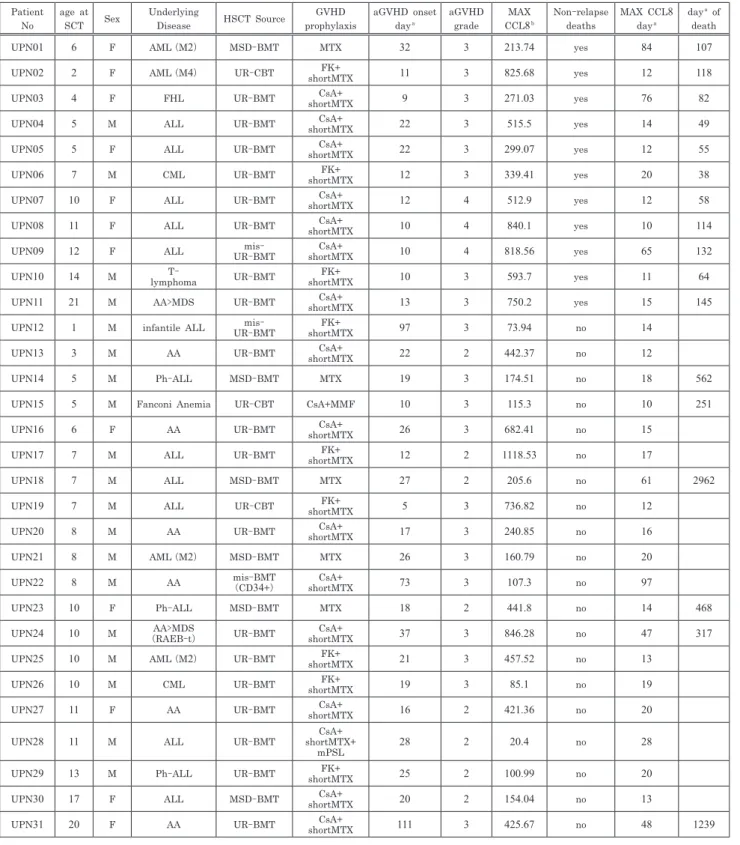
Patient characteristics are shown in Table I.
The median age was 8 years (range 1 – 21 years).
Eleven patients died of infection, hemorrhage, TAM or other complications within 180 days after HSCT.
The remaining 20 patients included six patients who died after day 180 with causes of death including pneumonia (n = 1 ), TAM (n = 1 ), secondary brain tumor (n = 1 ), and recurrence of initial disease (n = 3 ). Only one patient (UPN 24 ) suffered a relapse within 180 days after HSCT. The performance of CCL 8 for prediction of NRM was assessed by quantifying the area under the ROC curve (area under the curve is 0 . 741 , Figure 1 A).
The cutoff value for serum CCL 8 concentration was 213 pg/mL, corresponding to a specificity of 50 % and sensitivity of 100 %, and the likelihood ratio of a positive test was 2 . 0 . According to serum CCL 8 level, patients were divided into two groups: Group
1 (n = 21 ) included patients with a serum CCL 8 concentration > 213 pg/mL, while Group 2 (n = 10 ) included patients with a serum CCL 8 concentration
< 213 pg/mL. Median day of aGVHD onset was 15 days after HSCT in Group 1 and 20 days in Group 2 (p = 0 . 08 ). Median serum CCL 8 concentration was 512 . 9 pg/mL in Group 1 and 111 . 3 pg/mL in Group 2 , and average CCL 8 was 561 . 6 pg/mL in Group 1 and 119 . 8 pg/mL in Group 2 (p < 0 . 01 ).
Figure 1 B depicts days of post-HSCT (x-axis) and highest value of serum CCL 8 concentration (y-axis) up to 180 days post-HSCT. The vertical solid line indicates day 100 post-HSCT. The horizontal dotted line corresponds to 213 pg/mL of CCL 8 . All cases ( 100 %) exhibited the highest serum CCL 8 value before day 100 post-HSCT during the observation period. Open circles correspond to individuals who were still alive at day 180 , while closed circles indicate individuals who died within 180 days post-HSCT. The deaths of the eleven individuals who died within 180 days post-HSCT were all non-relapse associated.
Figure 1 C shows the survival rate at 180 days post-HSCT in all the patients with grade II–IV aGVHD (n = 31 ). Group 1 (solid line, serum CCL 8 >
213 pg/mL) showed a significantly lower survival rate at 180 days after HSCT compared with Group 2 (dashed line, serum CCL 8 < 213 pg/mL) (P < 0 . 01 , log-rank and Wilcoxon tests). This result suggests that serum CCL 8 concentration can predict NRM before day 180 .
Figure 1 D shows the results of landmark analysis. The landmark point was set at day 100 after HSCT because aGVHD is defined as developing within 100 days after HSCT.
4 . Discussion
We previously reported that serum CCL 8
concentration closely correlates with the survival of
GVHD model mice, suggesting that chemotactic
activity of this C-C chemokine may play a role in
tissue injury associated with GVHD.
4)Our findings
here indicate that the largest serum CCL 8 value
obtained during the early phase of grade II–IV
aGVHD could predict NRM within 180 days after
HSCT. Indeed, serum CCL 8 values were relatively
high in the early phase of aGVHD and slowly
decreased with immunosuppressive treatment (data
not shown). These results suggest that the
Table I. Patients’ Characteristics Patient
No
age at
SCT Sex Underlying
Disease HSCT Source GVHD prophylaxis
aGVHD onset daya
aGVHD grade
MAX
CCL8b Non-relapse deaths
MAX CCL8 daya
daya of death
UPN01 6 F AML(M2) MSD-BMT MTX 32 3 213.74 yes 84 107
UPN02 2 F AML(M4) UR-CBT FK+
shortMTX 11 3 825.68 yes 12 118
UPN03 4 F FHL UR-BMT CsA+
shortMTX 9 3 271.03 yes 76 82
UPN04 5 M ALL UR-BMT CsA+
shortMTX 22 3 515.5 yes 14 49
UPN05 5 F ALL UR-BMT CsA+
shortMTX 22 3 299.07 yes 12 55
UPN06 7 M CML UR-BMT FK+
shortMTX 12 3 339.41 yes 20 38
UPN07 10 F ALL UR-BMT CsA+
shortMTX 12 4 512.9 yes 12 58
UPN08 11 F ALL UR-BMT CsA+
shortMTX 10 4 840.1 yes 10 114
UPN09 12 F ALL mis-
UR-BMT CsA+
shortMTX 10 4 818.56 yes 65 132
UPN10 14 M T-
lymphoma UR-BMT FK+
shortMTX 10 3 593.7 yes 11 64
UPN11 21 M AA>MDS UR-BMT CsA+
shortMTX 13 3 750.2 yes 15 145
UPN12 1 M infantile ALL mis-
UR-BMT FK+
shortMTX 97 3 73.94 no 14
UPN13 3 M AA UR-BMT CsA+
shortMTX 22 2 442.37 no 12
UPN14 5 M Ph-ALL MSD-BMT MTX 19 3 174.51 no 18 562
UPN15 5 M Fanconi Anemia UR-CBT CsA+MMF 10 3 115.3 no 10 251
UPN16 6 F AA UR-BMT CsA+
shortMTX 26 3 682.41 no 15
UPN17 7 M ALL UR-BMT FK+
shortMTX 12 2 1118.53 no 17
UPN18 7 M ALL MSD-BMT MTX 27 2 205.6 no 61 2962
UPN19 7 M ALL UR-CBT FK+
shortMTX 5 3 736.82 no 12
UPN20 8 M AA UR-BMT CsA+
shortMTX 17 3 240.85 no 16
UPN21 8 M AML(M2) MSD-BMT MTX 26 3 160.79 no 20
UPN22 8 M AA mis-BMT
(CD34+) CsA+
shortMTX 73 3 107.3 no 97
UPN23 10 F Ph-ALL MSD-BMT MTX 18 2 441.8 no 14 468
UPN24 10 M AA>MDS
(RAEB-t) UR-BMT CsA+
shortMTX 37 3 846.28 no 47 317
UPN25 10 M AML(M2) UR-BMT FK+
shortMTX 21 3 457.52 no 13
UPN26 10 M CML UR-BMT FK+
shortMTX 19 3 85.1 no 19
UPN27 11 F AA UR-BMT CsA+
shortMTX 16 2 421.36 no 20
UPN28 11 M ALL UR-BMT CsA+
shortMTX+
mPSL 28 2 20.4 no 28
UPN29 13 M Ph-ALL UR-BMT FK+
shortMTX 25 2 100.99 no 20
UPN30 17 F ALL MSD-BMT CsA+
shortMTX 20 2 154.04 no 13
UPN31 20 F AA UR-BMT CsA+
shortMTX 111 3 425.67 no 48 1239
a) the day of HSCT is day0. The blanks mean that the patient lives, b) MAX CCL8 corresponds to the maximum level of serum CCL8 after the HSCT.
AbbreviationsintheTableI
aGVHD: acute graft-versus-host disease HSCT: hematopoietic stem cell transplantation BMT: bone marrow transplantation
UR-BMT: unrelated BMT
MSD-BMT: matched sibling donor BMT
UR-CBT: unrelated cord blood stem cell transplantation ALL: acute lymphoblastic leukemia
AML: acute myeloblastic leukemia AA: aplastic amemia
MDS: myelodysplastic syndrome CML: chronicmyelocyticleukemia
FHL: familialhemophagocyticlymphohistiocytosis
Figure 1.
A) Receiver operator characteristic (ROC) curve of Chemokine (C-C motif) ligand
8
(CCL8
) versus non-relapse deaths areas.Area under the curve is
0
.741
. The cutoff value of serum CCL8
concentration is213
pg/mL, corresponding to a specificity of50
% and sensitivity of100
%, and the likelihood ratio of a positive test is2
.0
.B) Distribution of maximum serum CCL
8
concentration of each patient during the course of post-transplantation up to180
days. Vertical solid line indicates day100
post-transplantation. Horizontal dotted line indicates serum concentration of213
pg/ml of CCL8
. One circle corresponds to one patient. Open circles correspond to individuals alive at day180
, whereas closed circles indicate individuals who died within180
days. All cases (100
%) exhibited a maximum level of CCL8
before day100
post-transplantation.C) Evaluation of survival by Kaplan-Meier curve and log rank test. Patients with a maximum serum CCL
8
concentration over213
pg/mL (Group1
, solid line, CCL8
>213
pg/ml, n =21
) showed a significantly lower survival rate at day180
post- transplantation compared with individuals whose levels were lower than213
pg /mL (Group2
, dashed line, CCL8
<213
pg/ml, n =10
). Values of significance were similar in log rank (p =0
.0076
) and Wilcoxon (p =0
.0087
) tests.D) Evaluation of the survival of
31
patients with grade II-IV aGVHD and recorded maximum serum CCL8
levels before day100
post-transplantation by the landmark method at day100
. Patients with a maximum serum CCL8
concentration over213
pg/mL (Group1
, solid line, CCL8
>213
pg/ml, n =21
) showed a significantly lower survival rate at day180
post- transplantation compared with individuals whose levels were less than213
pg /mL (Group2
, dashed line, CCL8
<213
pg/ml, n =10
). Values of significance were similar in log rank (p =0
.0076
) and Wilcoxon (p =0
.0087
) tests.chemotactic activity and/or other functions of CCL 8 could contribute quantitatively to aGVHD pathology, and are associated with prognosis.
However, the precise mechanism by which CCL 8 contributes to aGVHD has not been determined.
Glucksberg grading has been used to assess the clinical severity of aGVHD, with its maximum grade correlating with aGVHD prognosis.
8)However, the grade at onset is not helpful for prognostication.
While several biomarkers for aGVHD have been proposed.
9-12), the absolute value of any single biomarker has not been found useful for evaluating aGVHD prognosis. Levine et al. reported a biomarker panel consisting of six biomarkers for predicting the treatment outcome and prognosis of aGVHD patients.
13)However, using a formula to assess the values of several biomarkers risks over- fitting. Nonetheless, there need to be more accurate studies regarding biomarkers and their potential usefulness for GVHD in clinical settings. In our results, the absolute value of CCL 8 could predict the prognosis of aGVHD.
Although elevated serum CCL 8 concentration within 100 days post-HSCT may predict NRM in patients with grade II–IV aGVHD, there are a few drawbacks of this cohort study. First, the sample size is too small to draw a definitive conclusion.
Second, there might be a sampling bias, as this study was retrospective and the sampling times (days post-transplantation) varied. However, although there are some controversial points, our results are encouraging to launch a prospective observational study.
Acknowledgments
This study was supported by grants from the Ministry of Health, Labour and Welfare of Japan, and from the Ministry of Education, Culture, Sports, Science and Technology of Japan. We would like to thank Dr. Peter M. Olley, Professor Emeritus, University of Alberta, for helpful discussion and English revision of our manuscript.
We also thank Edanz Group (www.edanzediting.
com/ac) for editing a draft of this manuscript.
Authorship Contributions
MY, and TH performed research.
MY, TH, NH, KI, NI, NS, KM and KK contributed vital new reagents.
MY, Y-M and YK performed statistical analysis.
MY, TH and YK designed research.
MY, TH and YK wrote the paper.
Conflicts of Interest Statement
All authors declare that they have no conflicts of interests.
References
1. Shlomchik WD. Graft-versus-host disease. Nat Rev Immunol. 2007: 7: 340-352.
2. Ferrara JL, Levine JE, Reddy P, Holler E. Graft-versus- host disease. Lancet. 2009: 373: 1550-1561.
3. Hori T, Naishiro Y, Sohma H, Suzuki N, Hatakeyama N, Yamamoto M, Sonoda T, Mizue Y, Imai K, Tsutsumi H, Kokai Y. CCL8 is a potential molecular candidate for the diagnosis of graft versus host disease. Blood. 2008: 111: 4403-4412.
4. Yamamoto M, Ota A, Hori T, Imai S, Sohma H, Suzuki N, Hatakeyama N, Inazawa N, Ito YM, Kimura H, Tsutsumi H, Kokai Y. Early expression of plasma CCL8 closely correlates with survival rate of acute graft-vs.-host disease in mice. Exp Hematol. 2011: 39: 1101-1112.
5. Przepiorka D, Weisdorf D, Martin P, Klingemann HG, Beatty P, Hows J, Thomas ED. 1994 Consensus Conference on Acute GVHD Grading. Bone Marrow Transplant. 1995: 15: 825-828.
6. Ota A, Yamamoto M, Hori T, Miyai S, Naishiro Y, Sohma H, Maeda M, Kokai Y. Upregulation of plasma CCL8 in mouse model of graft-vs-host disease. Exp Hematol. 2009: 37: 525-531.
7. Dafni U. Landmark analysis at the 25-year landmark point. Circ Cardiovasc Qual Outcomes. 2011: 4: 363-371. 8. Corey Cutler and Joseph H. Antin. Manifestations and
Treatment of Acute Graft-Versus-Host Disease. In: edited by Frederick R. Appelbaum, Stephen J. Forman, Robert S.
Negrin, Karl G. Blume. Thomas' Hematopoietic Cell Transplantation: Stem Cell Transplantation, 4th ed.
Oxford : Wiley-Blackwell, 2008. p.1287-1303.
9. Choi SW, Kitko CL, Braun T, Paczesny S, Yanik G, Mineishi S, Krijanovski O, Jones D, Whitfield J, Cooke K, Hutchinson RJ, Ferrara JL, Levine JE. Change in plasma tumor necrosis factor receptor 1 levels in the first week after myeloablative allogeneic transplantation correlates with severity and incidence of GVHD and survival. Blood.
2008: 112: 1539-1542.
10. Kitko CL, Paczesny S, Yanik G, Braun T, Jones D, Whitfield J, Choi SW, Hutchinson RJ, Ferrara JL, Levine JE. Plasma elevations of tumor necrosis factor-receptor-1 at day 7 postallogeneic transplant correlate with graft-versus-host disease severity and overall survival in pediatric patients.
Biol Blood Marrow Transplant. 2008: 14: 759-765.
11. Paczesny S, Braun TM, Levine JE, Hogan J, Crawford J, Coffing B, Olsen S, Choi SW, Wang H, Faca V, Pitteri S,
Zhang Q, Chin A, Kitko C, Mineishi S, Yanik G, Peres E, Hanauer D, Wang Y, Reddy P, Hanash S, Ferrara JL.
Elafin is a biomarker of graft-versus-host disease of the skin. Sci Transl Med. 2010: 2: 13ra2.
12. Ferrara JL, Harris AC, Greenson JK, Braun TM, Holler E, Teshima T, Levine JE, Choi SW, Huber E, Landfried K, Akashi K, Vander Lugt M, Reddy P, Chin A, Zhang Q, Hanash S, Paczesny S. Regenerating islet-derived 3-alpha is a biomarker of gastrointestinal graft-versus-host disease.
Blood. 2011: 118: 6702-6708.
13. Levine JE, Logan BR, Wu J, Alousi AM, Bolanos-Meade J, Ferrara JL, Ho VT, Weisdorf DJ, Paczesny S. Acute graft-
versus-host disease biomarkers measured during therapy can predict treatment outcomes: a Blood and Marrow Transplant Clinical Trials Network study. Blood. 2012: 119: 3854-3860.
別刷請求先:山本 雅樹
〒
060
-8543
札幌市中央区南1
条西16
丁目 札幌医科大学医学部小児科学講座TEL:
011
-611
-2111
(内線34130
) FAX:011
-611
-0352
E-mail:[email protected]
非血縁者間同種造血細胞移植後早期の血清中
CCL8 発現は
移植後非再発死亡率と相関する山 本 雅 樹1, 2),堀 司1, 2),畠 山 直 樹3),五 十 嵐 敬 太1, 2),稲 澤 奈 津 子2), 鈴 木 信 寛4),武 井 則 雄1),伊 藤 陽 一5),松 本 公 一6),加 藤 剛 二7),
堤 裕 幸2),小 海 康 夫1)
1) 札幌医科大学フロンティア医学研究所病態情報学部門
2) 札幌医科大学小児科学講座
3) 旭川医科大学小児科学講座
4) 北海道立子ども総合医療・療育センター
5) 北海道大学大学院医学研究科先端医学講座臨床統計学分野
6) 国立成育医療研究センター小児がんセンター
7) 名古屋第一赤十字病院小児医療センター血液腫瘍科
急性移植片対宿主病(GVHD)におけるバイオマー カーとしてケモカイン
CCL 8
の役割を明らかにする た め,grade II
-IV
の 急 性GVHD
患 者31
名 の 血 清 と臨床経過を後方視的に解析した.血清CCL 8
濃度が,213 pg/mL
以上であった21
名中11
名が移植後180
日 以内に死亡していたが,血清CCL 8
濃度が213 pg/mL
以下であった