15
Jeff Wastila
Introduction
Many researchers (e.g. Saito & Ebsworth, 2004; Cutrone, 2009;
Hashimoto & Fukuda, 2011) have focused their inquiry on the reasons behind the ‘silence in the Japanese EFL classroom’ paradox. Cutrone (2009) focuses on the students’ fear of speaking, while Saito and Ebsworth (2004) spotlight the various sociocultural differences that exist as being the cause of the reti- cence. Hashimoto and Fukuda (2011) demonstrated that it is the differences in learning styles (student-centred versus teacher-centred) that played the most significant role. Although the reasons behind the silence are debatable, it is widely accepted that the silence in the Japanese EFL classroom exists (e.g.
Greer, 2000; King, 2013; Harumi, 2011). With the overwhelming amount of research supporting the notion of the silent classroom in Japan, methods of instruction that promote discussion should now be more actively researched and shared.
The research below is based on thirteen active EFL university teachers
in Japan who shared their thoughts and experiences on the concept of team-
based, team-assessed classes. More specifically, the research examined whether
or not Japanese students who work in teams and who are assessed in teams are
more willing to speak in English with their partners. Ultimately, the research
seeks to determine whether or not the team-based learning model could abate
any of the silence that currently dominates the EFL classrooms in Japan.
Research design
This study used a qualitative approach to gather EFL teachers’ perspec- tives on the use of team-based, team-assessed classes in Japanese universities.
Hatch (2002) characterizes qualitative research as research that is gathered from the actual experiences of people in real settings. Moreover, Hatch (2002) defines a qualitative researcher as someone who is attempting to see the world through the perspectives of their participants. Creswell (2014) adds that qual- itative research is usually conducted at the place where the participants expe- rience the problem or phenomenon. The use of a phenomenological research approach allowed the researcher to gather information from a group of people who all share the same experience in the same setting (Creswell, 2014).
Participants
Purposeful sampling was used to select the participants as their experi- ences and perspectives would best help the researcher understand the research question (Creswell, 2014). The criteria was that each participant should be a university EFL teacher in Japan with at least one year at the university level in Japan. Thirteen experienced teachers from two universities in Tokyo, Japan participated in the research. The participants were from Canada, the U.S., New Zealand, Australia, and England.
Methods
In qualitative research, researchers tend to collect several forms of data
which allows the researcher to obtain more accurate information (Creswell,
2014). With that in mind, two types of data collection tools were used in this
study: a survey with both open-ended and Likert-type questions, and individ-
ual face-to-face interviews.
Survey
A survey was used as it allows a researcher to identify the characteristics of a large group of people by surveying a small group of people (Fowler, 2009).
Lankshear and Knobel (2004) add that surveys allow the researcher to gather a variety of responses to specific questions from a variety of people. In this small- scale study, a vast variety of information was collected from a small group of people that may accurately identify the viewpoints from a larger community of university instructors in Japan. The survey questions were designed to gather feedback in three areas: 1) The type of learning environment the participant provides; 2) The value of working in pairs/groups/teams; 3) The value of being assessed in pairs/groups/teams. For the sake of this survey, a pair represented two students working together, whereas a group or a team represented three or four students working together.
Table 1: Survey Table 1. What’s the biggest challenge you face in your classroom?
2. Oral production is the most effective way of learning to speak a second language.
3. What oral communication activities work best in your classroom?
4. Through your observations in class, the students tend to speak English more willingly when they are working in pairs/groups/teams.
5. Through your observations in class, the students tend to speak to the teacher more will- ingly when they are working in pairs/groups/teams.
6. How much class time do you dedicate to student group work in a typical class?
7. Do you assess students in pairs or groups (giving each member the same grade)?
8. (If you answered Yes above) The students seem more willing to speak in English when they are preparing for and participating in the group-assessed activity.
9. (If you answered No above) The students would be more willing to speak in class if they were assessed in pairs/groups/teams (not individually).
10. In your opinion, what is the biggest potential challenge in assessing students in pairs/
groups/teams (each member receiving the same grade)?
11. Given the freedom, would you incorporate more oral activities where the students are in pairs/groups/teams?
12. Given the freedom, would you incorporate more oral activities in class where the stu- dents are assessed in pairs/groups/teams (each member receiving the same grade).
Interviews
In addition to the survey, face-to-face follow-up interviews were con- ducted with the goal of collecting the teachers’ perspectives more fully and accurately than the survey alone might provide.
Data analysis
After the qualitative data has been collected, Creswell’s (2014) method for analyzing the data involves coding the information, then constructing themes or categories from the codes, and then interpreting the data through tables or graphs. Adopting Creswell’s (2014) data analyzing formula, the infor- mation collected from the open-ended questions on the surveys was coded.
From there, several major themes emerged which are summarized in Table 2.
Results, Analysis and Evaluation of Findings
After analyzing the codes and categories and their interconnectedness, four major themes surfaced. All four themes directly address the research ques- tion: do EFL teachers in Japan believe that students working in teams and being assessed in teams is an effective approach in creating a meaningful learning environment where the students can actively participate in their learning?
Table 2: Themes, categories and codes Themes Theme 1:
The students’ unwillingness to speak is the biggest challenge for teachers
- Silence in the classroom - Low motivation - Shyness - Social pressure - Refusal to speak - Class size
Theme 2:
Team-based learning is the most
effective classroom approach - Student-centred activities - Student-generated
communication
- Group/pair work - Mingling exercises - Games
- Competitions Theme 3:
Team-assessment increases will-
ingness to speak - Speaking opportunities
increased - Ask each other/teacher questions
Theme 4:
Team-assessment is unfair - Speaking time inequality - Grading inequality
A discussion of the codes, categories, and themes found in Table 2 will be pre- sented below in an attempt to explain the data findings and the relationships that exist between them. The discussion for each theme will adhere to the fol- lowing order: (1) an overview of the theme, categories, and codes derived from the data. (2) A graph or chart of the survey question from where the data was sourced. (3) A discussion to determine the lessons learned by comparing the results with the findings of other research (Creswell, 2014). In this way, the data collected can be directly compared with the research of others in an attempt to confirm past results or to refute it (Creswell, 2014).
Table 3: Flowchart of themes
The biggest challenge for teachers is the students’ unwillingness to speak
↓
Team-based classes are the most productive approach in getting the students to speak more
↓
Team-assessed classes are effective Team-assessed classes are unfair
↓ Final Analysis
↓
Conclusion and recommendations
Theme 1: The students’ unwillingness to speak is the biggest challenge for teachers
Question #1: What’s the biggest challenge you face in your classroom?
Of the thirteen participants in this study, nine stated that the students’
unwillingness to speak in class was the biggest challenge in the classroom.
During the face-to-face interviews, the participants offered several different opinions as to the reasons behind the unwillingness to speak, such as shyness or lack of motivation; however, the silence that exists in the classroom was indeed the predominant obstacle the teachers faced. Participants typically said that “student shyness” was the biggest factor, while others stated that there is
“too much silence” or the students “lack motivation.” One participant replied with the students simply “refused to speak” and offered no speculation as to the reason behind this inaction.
Question #2: Oral production is the most effective way of learning to speak a second language (Izumi, 2003; Swain, 2005).
Ninety two percent of the participants agreed or strongly agreed to this notion and it is a generally accepted concept in the EFL teaching community.
This particular question, and the responses, are vital in the discussion that fol- lows because the question and the answers provided serve as the foundation to
Figure 1
the pedagogical decisions that the participants make in the classroom. For this question, one participant stated in the follow-up interview that “the students would improve if they would just speak more.” Another participant stated that while “there are many factors involved, listening, reading… but you have to speak as much as possible in order to learn to speak.”
Theme 2: Team-based learning is the most effective classroom approach
Question #3: What oral communication activities work best in your classroom?
The participants seemed to favour a student-centred classroom to a teacher-based classroom. When asked Question #3 on the survey, sixty three percent of the participants answered that a group, team, or pair activity was most effective. Interestingly, ‘student-generated’ communication was men- tioned by twenty two percent of the participants meaning that eighty five per- cent of the participants reported that they favor communication activities that were student-generated. One participant stated that “the conversation must be relevant to their personal lives and not from a textbook.” Another participant agreed, saying that conversation should be “outside of the textbook.” Another claimed that conversation must be about “something personal rather than conceptual.”
Figure 2
Question #4: Through your observations in class, the students tend to speak English more willingly when they are working in pairs/groups/teams.
All of the participants either agreed (23%) or strongly agreed (77%) that the students seemed more willing to speak more English when they worked together in pairs, groups, or teams. During the face-to-face interviews, the typ- ical response from the participants was that the students “were more comfort- able” in teams, and “not as shy.” Several participants stated that the students
“take more risks” when they are in teams.
Question #5: Through your observations in class, the students tend to speak to the teacher more willingly when they are working in pairs/groups/teams.
The results to the question showed that sixty two percent of the partici- pants agreed while fifteen percent strongly agreed. Twenty three percent of the participants answered that they neither agree nor disagree, meaning that none of the participants disagreed that the students were more willing to speak to the teacher while working in teams. In the follow-up interviews, the participants said that (while working in pairs or groups) “they ask me personal questions…
like what’s your favorite music? Or, what’s your favorite food? Things they never
Figure 3ask when they are working alone.” Another participant claimed that “they are terrified of being singled out to answer a question, but when they are in a group, they are less fearful—and sometimes even invite questions from me.”
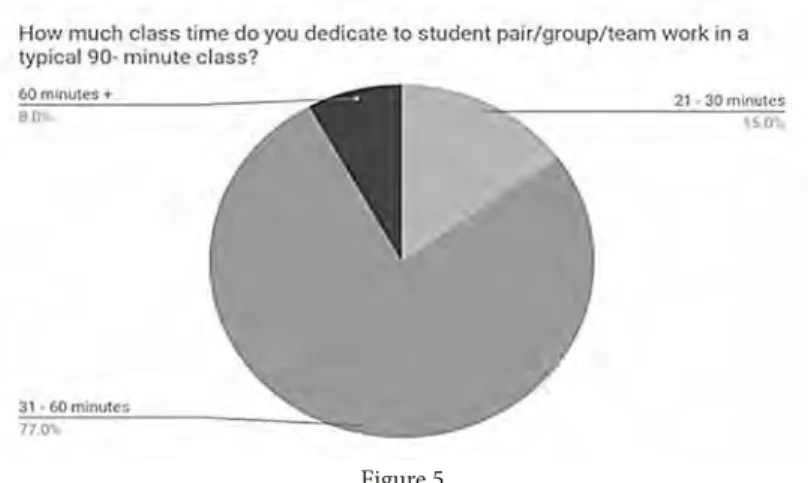
Question #6: How much class time do you dedicate to student pair work/
group work/team work in an average ninety-minute class?
All of the participants answered that they dedicated at least twenty one minutes of the class to group work. However, eighty five percent of the partici- pants allotted over thirty one minutes of class time to working in pairs, groups, or teams. One of the participants stated that “I have to work on other skills as well, such as listening.” Another teacher said, “it is impossible to hear everyone when they are in groups, so I don’t know if they are really speaking English or not.”
Figure 4
Question #7: Do you ever assess your students in pairs, groups, or teams (not individually, but giving each member the same grade)?
Sixty two percent of the participants do not assess their students in teams, whereas thirty eight percent of the participants do. The data shows that although all the participants utilize team-based activities, the majority of these teachers (62%) do not assess the students in teams. In short, the students are working in teams, but they are not being assessed in teams.
Figure 6 Figure 5
Theme 3: Team-assessment increases willingness to speak
Question #8: (If you answered Yes above) The students seem more willing to speak in English when they are preparing for and participating in the group-assessed activity.
Question #8 was answered only by the participants who assess their stu- dents in teams. In response to this question, one hundred percent of the partic- ipants said they agree that the students are more willing to speak when involved in a team-assessed activity. In the follow-up interview, the participants stated that they experienced times when the students “helped each other more” when they knew that they were being assessed in teams. Furthermore, one partici- pant said that the students “encouraged one another” when preparing for and participating in team-assessed activities.
Theme 4: Team-assessment is unfair
Question #9: (If you answered No above) The students would be more willing to speak in class if they were assessed in pairs/groups/teams (not individually).
Question #9 was answered only by the participants who do not assess
their students in teams. Sixty two percent of the participants answered either
agreed, strongly agreed, or neither. However, thirty two percent of the partici-
pants said that they disagree with this statement. The typical responses to this
question in the interview portion of the research gathering often incited reac-
tions such as “it might bring the stronger students’ grades down” or “the grades
will be negatively affected.” One participant stated that “it’s impossible to grade
the students accurately.”
Presumably, the participants who disagreed with the concept of team-as- sessment place a higher value on the formal grades of the students than the participants who utilize team-assessment in their classrooms. The participants who disagree with the concept of giving the same grade to each team member imply that they feel they must adhere to the global decree that some sort of measurement of learning must be given to an individual’s performance (e.g.
such as a test or exam score) in order to obtain educational success (Allwright, 2016).
Question #10: What is the biggest potential challenge in assessing students in pairs/groups/teams (each member receiving the same grade)?
Question #10 was answered by all thirteen participants. The major theme that emerged from this question was the unfairness of team-assess- ment. Many participants expressed that the grading was unfair when using the team-assessed model; however, the unfairness in student speaking time was also mentioned. One participant claimed that grading in teams was “inher- ently unfair” and the participant claimed that he or she “has to be able to grade individually.” Others said that when being assessed in teams, some stronger students tend to “monopolize” the speaking time in a given student-assessed
Figure 7
activity, such as a group presentation. This statement was mirrored by another participant who claimed that it is very difficult to “ensure that each student works and contributes equally” in a team-assessed activity. Overall, however, the unfairness of grading was the most often mentioned challenge the teachers faced when assessing in teams.
Question #11: Given the freedom, would you incorporate more oral activi- ties in class where the students are in pairs/groups/teams?
All of the participants maintain that a student-centred classroom is the most effective approach in their classrooms. This belief is in accordance with Armstrong’s (2012) belief that the traditional teacher-centred classroom is not a suitable approach in universities as the students cannot learn naturally. One participant said that “the students can’t speak when they’re listening to a lec- ture.” Another participant claimed that “speaking in teams maximizes their speaking time.”
Question #12: Given the freedom, would you incorporate more oral activi- ties in class where the students are assessed in pairs/groups/teams?
Surprisingly, one hundred percent of the participants replied that they would, if given the freedom, incorporate more student-assessed activities in
Figure 8
their classrooms. Additionally, during the follow-up interviews, several of the participants expressed an interest in exploring the idea of a team-assessed class- room. Additionally, during the follow-up interviews, several of the participants expressed an interest in exploring the idea of a team-assessed classroom. In the follow-up interview, one participant claimed “I’m going to try team-assessment in my class and I’ll tell you how it goes.” Although several participants resisted the thought of changing their viewpoints, maintaining that student-assessed activities are “unfair,” the responses to this question suggest that many teachers are open-minded and are eager to experiment with new concepts with the goal of improving the performances of their students.
Conclusion and Recommendations
The aim of this study was to examine the perspectives of EFL teachers in Japan regarding team-based, team-assessed classes in universities in Japan.
Team-based classes were defined as classes where two or more students worked together in order to finish a project, task, or assignment. Team-assessed classes were defined as classes where each member of a team or group receives the same grade or score, regardless of their contribution to the project, task, or assign- ment. From the study, there was a consensus amongst the teachers when it came to the classroom approach of team-based learning, however; a clear divi- sion emerged when it came to the pedagogical approach of team-assessment.
All of the participants make use of team-based classes in order to facilitate a
class where the students can better reach their learning goals; however, most
of the participants (8 of the 13) do not assess their students in teams (where
each student receives the same grade). Of the twelve survey questions, three
materialized as being significant. Moreover, these three questions were related
to the idea of team-assessment. From these three questions, one revealed that
most of the teachers who refrained from assessing their students in teams do
so primarily because of the perceived unfairness involved in the grading, or
the perceived unfairness in the amount of speaking time team-assessment
allows. However, two questions revealed that three of the teachers who do not currently assess in teams feel that their students would be more active if they were assessed in teams. Moreover, all thirteen teachers expressed some desire to employ team-assessment if given the freedom to do so.
Looking at the research, it can be concluded that while team-based learning seems to be the norm in Japanese university EFL classes, team-based assessment seems to be a topic of debate. According to the research, teachers who assess their language learners in teams seem to focus their efforts on get- ting their students to speak more in class. However, the participants who avoid assessing their students in teams seem more concerned with fairness in the classroom. This fairness wasn’t limited to the scores or grades assigned, but it also extended into the potential unfairness of speaking time in class. It is important to note, however, that all thirteen teachers expressed at least some interest in assessing their students in teams, given the freedom. Ironically, the freedom seems to be having the freedom from their own mindsets; their own set of standards regarding student assessment. It is fascinating to note that nobody (0/13) mentioned that the university administration was a deterrent behind their decision to neglect the team-assessment approach in their classes.
With that in mind, it must be concluded that the decision to use a traditional form of assessment stems from the participants’ own predispositions of assess- ment in the classroom. It must be concluded that the teachers who do not assess their students in teams make that pedagogical decision because “that’s the way it always been” and they haven’t fully explored alternative methods of assessment.
From the perspective of a teacher, we are left asking whether we should
be assessing the students in the traditional way, or should we be assessing the
students in a way the teacher feels helps the students best achieve their learning
goals. In the case of language learning, if it assumed that actual speaking prac-
tice is the best way to learn how to speak a second language (e.g. Izumi, 2003;
References
Allwright, D. (2016) Foreword. Team teaching, team learning and the development of collegiality. In: Tajino, A., Stewart, T. & Dalsky, D. (eds.) Team Teaching and Team Learning in the Language Classroom: Collaboration for Innovation in ELT. New York: Routledge. pp. xiv-xx.
Armstrong, J. S. (2012) Natural Learning in Higher Education. Encyclopedia of the Sciences
Swain, 2005), and if it is assumed that Japanese language learners speak more when they are working in teams and being assessed in teams, team-assessment must be considered a plausible method of assessment for EFL instructors to utilize in their classrooms, regardless of the perceived fairness or unfairness it may bring to the classroom. Moreover, a very significant phenomenon emerged from this research—that the teachers were willing to change their perceptions and predispositions in education. This is vital and corroborates with the ideas of many educational visionaries (e.g. Robinson, 2010; Allwright, 2016; Tajino, 2016) who plead for a new educational paradigm as they see the current form of education is failing us.
The value of the research is that it has shone some light on the idea of
team-assessment in the EFL classrooms in Japanese universities. This research
has shown that while most teachers do not use team-assessment, they are open
to exploring the concept. This openness is vital because it proves that the teach-
ers genuinely want to improve their skills and their knowledge in order to help
their students reach their learning goals. While more research must be done in
the area of team-assessment, this research also suggests that more professional
development must be provided in the university system in Japan, not only in
the area of team-assessment, but in all areas of education where new research is
leading to advancements in learning and teaching. This cannot be overlooked
because when it comes to improving the education of Japan’s next generation,
the teachers need access to all of the knowledge, support, and tools currently
available.
of Learning. Heidelberg: Springer.
Creswell, J. W. (2014) Research design. Qualitative, quantitative and mixed methods approaches (4th ed.). Thousand Oaks: Sage.
Cutrone, P. (2009) Overcoming Japanese EFL learners’ Fear of Speaking. Language Studies Working Papers. 1(1) pp. 55-63.
Fowler, F. J. (2009) Survey research methods (4th ed.). Thousand Oaks, CA: Sage.
Greer, D.L. (2000) The eyes of hito: A Japanese cultural monitor of behavior in the commu- nicative language classroom. JALT Journal. 22(1) pp. 183-195.
Harumi, S. (2011) Classroom silence: voices from Japanese EFL learners. ELT Journal:
English Language Teaching Journal. 65(3) pp. 260-269.
Hashimoto, N. & Fukuda, S. (2011) Reaching for their own goals: A more democratic class- room. The Language Teacher. 3(1) pp. 17-22.
Hatch, J. A. (2002). Doing qualitative research in educational settings. Albany: State University of New York Press.
Izumi, S. (2003) Comprehension and Production Processes in Second Language Learning:
In Search of the Psycholinguistic Rationale of the Output Hypothesis. Applied Linguistics. 24(2) pp. 168-196.
King, J. (2013) Silence in the Second Language Classrooms of Japanese Universities. Applied Linguistics. 34(3) pp. 325-343.
Lankshear, C., & Knobel, M. (2004) A handbook for teacher research from design to imple- mentation. Berkshire, UK: Open University Press.
Saito, H. & Ebsworth, M. (2004) Seeing English Language Teaching and Learning through the Eyes of Japanese EFL and ESL Students. Foreign Language Annals. 37(1) pp.
111-124.
Swain, M. (2005) The output hypothesis: Theory and research` in E. Hinkel (ed.): Handbook of Research in Second Language Teaching and Learning. Mahwah: Lawrence Erlbaum.
Tajino, A. (2016) Preface: Team teaching, team learning and the development of collegiality.
In: Tajino, A., Stewart, T. & Dalsky, D. (eds.) Team Teaching and Team Learning in the Language Classroom: Collaboration for Innovation in ELT. New York: Routledge.
pp. xiii.
TED (2010) Sir Ken Robinson: Changing education paradigms. [TED]. Available at: https://
www.ted.com/talks/ken_robinson_changing_education_paradigms (Accessed:
01/08/18).