• 検索結果がありません。

Analysis of Chlorothalonil by Liquid Chromatography/Mass Spectrometry Using Negative-ion Atmospheric Pressure Photoionization

N/A
N/A
Protected

Academic year: 2021

シェア "Analysis of Chlorothalonil by Liquid Chromatography/Mass Spectrometry Using Negative-ion Atmospheric Pressure Photoionization"

Copied!
5
0
0

読み込み中.... (全文を見る)

全文

(1)

2009 © The Japan Society for Analytical Chemistry

Introduction

Chlorothalonil is a foliar fungicide commonly used on turf grass, fruits, and vegetables. Because of its high consumption, chlorothalonil has been frequently detected in food

1,2

and the environment.

3

The primary degradation product of chlorothalonil, 4-hydroxy-2,5,6-trichloroisonaphthonitrile (4OH-TPN), has been reported to have greater stability and persistency than does that of the precursor compound.

4

Chlorothalonil has been analyzed by a gas chromatograph/electron capture detector or a gas chromatograph/mass spectrometer (GC/MS).

5

Trace analysis of chlorothalonil and its metabolites using gas chromatography requires complex analytical methods that include not only separate extractions under acidic and basic conditions but derivatization of polar metabolites. Therefore, novel analytical methods for chlorothalonil to complement methods based on GC are anticipated. Recently, a liquid chromatograph/mass spectrometer (LC/MS) has been applied to the trace analysis of polar compounds. Although there are some studies of chlorothalonil using LC/MS equipped with an atmospheric pressure chemical ionization (APCI) source,

4,6–8

the sensitivity of APCI was, for the most part, insufficient for detection in an aqueous environment. Furthermore, the analyses

of chlorothalonil and its degradation products required two separate runs on LC/MS.

8

The atmospheric pressure photoionization (APPI) technique has recently been introduced to mass spectrometry.

9,10

An APPI source is now commercially available for various mass spectrometers. The use of a dopant that has low ionization energy often provides enhanced sensitivity. The technique enables LC/MS to quantify apolar compounds,

11

as well as polar ones.

12

In addition, negative-ion APPI was also examined in detail,

13,14

so that its application range of APPI has been extended. Indirect ionization considered as photo-induced chemical ionization seems to be an important pathway in APPI. Consequently, the LC/APPI-MS technique ought to have a potential to improve the detection limit of chlorothalonil and simplify the analytical pretreatment. In this report, we studied an analytical method for food and aqueous samples of chlorothalonil and 4OH-TPN by LC/MS using dopant-assisted APPI.

Experimental

Reagents and chemicals

Chlorothalonil was purchased from Wako Pure Chemical Industries, Ltd. (Osaka, Japan). Its degradation product, 4OH- TPN, was purchased from Dr. Ehrenstorfer GmbH (Augsburg, Germany). Dacthal-d

6

(dimethyl-d

6

-tetrachloroterephthalate) was used as an internal standard, and purchased from C/D/N

Analysis of Chlorothalonil by Liquid Chromatography/Mass Spectrometry Using Negative-ion Atmospheric Pressure

Photoionization

Atsushi Y AMAMOTO ,*

1†

Iori M IYAMOTO ,*

1

Mikiya K ITAGAWA ,*

2

Hiroshi M ORIWAKI ,*

3

Hidekazu M IYAKODA ,*

4

Hideya K AWASAKI ,*

5

and Ryuichi A RAKAWA *

5

*1 Osaka City Institute of Public Health and Environmental Sciences, 8-34 Tojocho, Tennoji, Osaka 543–0026, Japan

*2 Osaka Prefectural Institute of Public Health, 1-3-69 Nakamichi, Higashinari, Osaka 537–0025, Japan

*3 Division of Applied Biology, Faculty of Textile Science and Technology, Shinshu University, 3-15-1 Tokita, Ueda, Nagano 386–0567, Japan

*4 Applied Biosystems Japan Ltd., 4-5-4 Hacchobori, Chuo, Tokyo 104–0032, Japan

*5 Department of Applied Chemistry, Faculty of Chemistry, Materials and Bioengineering, Kansai University, 3-3-35 Yamatecho, Suita, Osaka 564–8680, Japan

A highly sensitive and simple method for the analysis of chlorothalonil was presented using a liquid chromatograph/mass spectrometer equipped with an atmospheric pressure photoionization (APPI) source. Chlorothalonil is one of the most extensively used fungicides. The major degraded product of chlorothalonil, 4-hydroxy-2,5,6-trichloroisonaphthonitrile (4OH-TPN), was also quantified with sensitivity similar to that of chlorothalonil. The method was applied to the determination of chlorothalonil in aqueous environment and food samples. The method detection limits (MDLs) of chlorothalonil for aqueous samples and cucumber were determined to be 0.18 and 3.2 ng g

–1

, respectively. At several estuarial locations, chlorothalonil was detected with a maximum of 1.1 ng L

–1

. On the other hand, 4OH-TPN was detected not from estuaries but from rivers with a maximum of 14 ng L

–1

.

(Received February 17, 2009; Accepted April 13, 2009; Published May 10, 2009)

To whom correspondence should be addressed.

E-mail: [email protected]

(2)

Isotopes Inc. (Pointe-Claire, Quebec, Canada). All other chemicals were of residue analysis grade. A stock solution with a concentration of 1 mg mL

–1

was prepared by dissolution of the analyte in acetone. The solution was stored at –18˚C in the dark. Working standards were prepared by serial dilution of the stock solution with methanol for the acquisition of mass spectra and with methanol/water (20:80, v/v) for the LC/MS quantification.

Working standards for the quantification were prepared so that they would also contain 1 m g mL

–1

of the internal standard.

Apparatus

The APPI-MS observation was performed using an MDS- Sciex API2000 triple-quadrupole system (Applied Biosystems Japan, Tokyo, Japan). A PhotoSpray

®

source for the API2000 was used as an ionization module. The photoionization lamp was a 10-eV Model PKS 100 krypton discharge lamp (Cathodeon Ltd., Cambridge, UK). A micro-syringe pump (Harvard Apparatus, Holliston, MA, USA) or an Agilent 1200 isocratic pump (Agilent Technologies, Palo Alto, CA, USA) was used for dopant delivery. Toluene was used as the dopant in the APPI experiments. The full-scan mass spectrum was obtained in the range of m/z 100 – 500 at a scan rate of 1 scan s

–1

. Selective ion monitoring (SIM) and multiple reaction monitoring (MRM) modes were examined. Two each of the SIMs and MRMs that provided the best sensitivity were selected and applied to identification and quantitation. The APPI conditions were as follows: nitrogen curtain gas, 20 psi; ion transfer voltage, –1200 V; heater temperature, 450˚C; lamp gas flow, 1.5 L min

–1

; and declustering voltage, –41 V. The flow rates of the LC solvent and dopant were optimized by flow injection analysis (FIA) in which H

2

O/MeOH (1:1) was used as the solvent. An Agilent 1100 series HPLC system was applied to the FIA and chromatography. The analytes were chromatographed on a 15 cm ¥ 2 mm i.d. ODS-100S column packed with 5 mm C18 reversed-phase packing (Tosoh Corp., Tokyo, Japan). The effluent from the column was brought directly to the LC/MS interface without any postcolumn split.

For fractionation, a gradient that was composed of mobile phase A (water) and mobile phase B (methanol) was applied. Both mobile phases A and B contained 2 mM NH

4

HCO

3

for chromatographic retention. The gradient, expressed as changes in mobile phase B, was as follows: 0 – 5 min, a linear increase from 20 to 100% B; 5 – 10 min, hold at 100% B; 10 – 15 min, equilibration at 20% B. The flow rate of the mobile phase was optimized, and then determined to be 200 m L min

–1

. The injected volume was 5 mL.

Aqueous sample preparation

Aqueous samples were collected from rivers of Osaka City and their estuaries for the examination of a recovery study and the environmental occurrence of chlorothalonil. Twentyseven samples were collected on 6 – 7 February, 2008. The analytes were extracted from 0.5 L of an aqueous sample by solid-phase extraction (SPE). A Presep-C Agri cartridge (Wako Pure Chemical Industries, Ltd., Osaka, Japan) was sequentially conditioned by acetonitrile and water. Aqueous samples were forced through the cartridges using a Sep-Pak Concentrator (Waters, Milford, MA, USA) with the flow rate adjusted to 20 mL min

–1

. The analytes were eluted from the cartridges with 5 mL of acetonitrile. The eluates were spiked with 1 m g dacthal- d

6

and concentrated in 1 mL by evaporation in a water bath at 40˚C under a gentle stream of nitrogen.

Food sample preparation

Because cucumber is one of the vegetables in which

chlorothalonil has frequently been detected,

2

we examined food sample preparation with cucumber. The extraction procedure from food samples was based on the method described by Hernández et al.

15

with some modification. A 20-g portion of chopped cucumber was weighed and homogenized with 60 mL of H

2

O/MeOH (20:80) containing 0.1% formic acid for 2 min.

After filtration of the homogenate through a glass fiber filter (GA-100, Advantec, Tokyo, Japan) on a Buchner funnel under vacuum, the residue was washed. The filtrate was mixed with washing solvent and diluted to 100 mL. A mixed solution of H

2

O/MeOH (20:80) containing 0.1% formic acid was used for washing and dilution. Subsequently, an aliquot of 2.5 mL was taken from the extract and diluted eightfold with 0.1% formic acid solution. As with the environmental samples, Presep-C Agri was used as a SPE cartridge. Following loading the sample, a wash step was examined in order to elute any interference without premature elution of the analytes.

Appropriate washing solvents were examined with various organic solvent contents. After washing the cartridges, the cartridges were dried by passing air for 5 min. The analytes were eluted with 5 mL of acetonitrile. The eluates were spiked with 1 m g dacthal-d

6

and concentrated in 1 mL by evaporation in a water bath at 40˚C under a gentle stream of nitrogen.

Results and Discussion

APPI characteristics

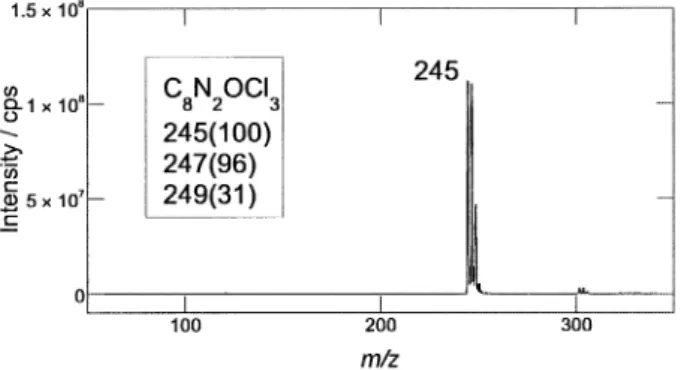
The mass spectrum of chlorothalonil is shown in Fig. 1. Since the intensity ratio of the emphatic ions corresponded to that of the ions that had three chlorine atoms, it was considered that chlorothalonil generated [M–Cl+O]

during negative-ion APPI.

In the absence of a dopant, the intensity of the peaks assigned to [M–Cl+O]

declined thoroughly. Although O

2–·

was not directly observed in this experiment, the existence of O

2–·

has been revealed during negative-ion APPI.

14

As does the rearrangement of polychlorinated aromatic hydrocarbons with O

2

generate characteristic phenoxides in a process of negative chemical ionization,

16,17

it is inferred that chlorothalonil was also transformed to [M–Cl+O]

by negative-ion APPI. A similar phenoxide was generated for dacthal-d

6

. On the other hand, 4OH-TPN generated deprotonated molecules as a main signal.

The effects of LC solvent and dopant flow rates on the ionization efficiency in APPI were examined by FIA. The LC flow rate and the dopant flow rate were adjusted to 50 – 1000 and 50 – 500 mL min

–1

, respectively. The results from the FIA with various flow rates are presented in Fig. 2. The intensity decreased as the LC flow rate increased in all dopant flow rates.

Fig. 1 Mass spectrum of chlorothalonil by negative APPI.

Predicted formula and its mass are also shown.

(3)

Ionization efficiency in positive-ion APPI has been described in detail.

18–20

Although the effects of the solvent and dopant flow rates on the formation of [M–Cl+O]

resemble the proton transfer that occurs in positive APPI, the optimum proportion of dopant flow rate to solvent flow rate was greater than was that in positive APPI. It is inferred that the optimum proportion markedly depends on a reaction pathway. In order to maintain favorable chromatographic retention, the LC flow rate and dopant flow rate were set at 200 and 100 mL min

–1

, respectively.

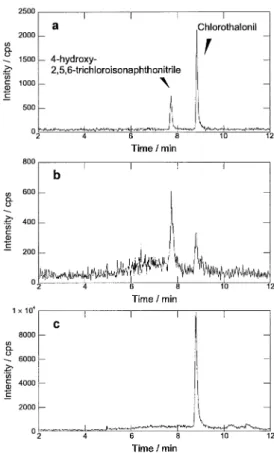
LC/MS acquisition was performed in SIM mode with m/z 245 and 247. A typical chromatogram running in SIM mode for a chlorothalonil standard solution of 1 ng mL

–1

is shown in Fig. 3.

The peak of chlorothalonil was sufficiently separated from that of 4OH-TPN, quantified by the same m/z value. Although use of acids was examined, acids seriously depleted the ionization efficiency. An excess use of base also showed an adverse effect.

A calibration curve obtained for chlorothalonil using a series of working standard solutions over a concentration range from 0.3 to 300 ng mL

–1

showed excellent linearity (r

2

> 0.99). Although moderate hydrolysis of chlorothalonil under a basic condition was previously reported,

21

obvious degradation was not observed during the LC/MS operation. The instrumental detection limit (IDL) was determined by multiplying the standard deviation of the quantified values of standard solutions for seven replicate measurements.

22

The IDLs of chlorothalonil and 4OH-TPN were 0.15 and 0.16 ng mL

–1

, respectively. The value was lower than that of chlorothalonil by GC/MS (100 ng mL

–1

).

5

LC/MS/MS

The product-ion mass spectrum of the generated ion (m/z 245) for chlorothalonil was acquired in the range m/z 20 – 300 at a scan rate of 1 scan s

–1

. The major product ion was m/z 35. The optimum collision energy was –48 V. A series of Cl eliminated ions [M–Cl

n

+O]

was also observed with subtle intensity.

LC/MS/MS acquisition was performed in MRM mode with the following MRM transitions: m/z 245 Æ 35 and 247 Æ 35. A calibration curve ranging from 1 to 1000 ng mL

–1

was constructed and showed good linearity (r

2

> 0.99). The IDL of chlorothalonil by MRM estimated in the same manner as SIM was 1.8 ng mL

–1

. The IDL by MRM was not better than that by SIM. It appeared that the absence of a dominant product ion with a large m/z value caused this result. For 4OH-TPN, the product-ion mass spectrum of the deprotonated molecule (m/z 245) was substantially the same as that of the ion (m/z 245) generated from chlorothalonil. The IDL of 4OH-TPN by MRM

was determined to 2.2 ng mL

–1

. Consequently, SIM mode was used to determine TPN and 4OH-TPN.

APPI vs. APCI

The generation of [M–Cl+O]

from chlorothalonil by LC/

APCI-MS has also been reported.

6,7

Martínez et al. quantified chlorothalonil by a calibration curve whose minimum concentration was 25 ng mL

–1

.

6

As the IDL of chlorothalonil by the APPI method was 0.15 ng mL

–1

, it can be said that APPI is outstanding with respect to instrumental sensitivity. As to the generated ions other than [M–Cl+O]

, it was reported that APCI generated solvent adducts and a fragment ion corresponding to the loss of Cl,

7

whereas APPI generated some solvent adducts and [M–Cl+O

2

]

with a relative abundance of 5% or less.

Although the analysis of 4OH-TPN by APCI was also examined,

7,8

Scribner et al. used only ESI for the determination of 4OH-TPN because of the sensitivity.

8

The APPI method could provide simultaneous determination of chlorothalonil and its polar degraded product with sub-ppb level sensitivity differing from other ionization methods.

Elution from SPE cartridge

The sorbent of Presep-C Agri is a copolymer composed of styrene, divinylbenzene, and methacrylate. Presep-C Agri has a capability to adsorb both polar and nonpolar compounds, as well as Oasis HLB (styrene, divinylbenzene, and N-vinyl- pyrrolidone; Waters), which was used in other studies.

6–8,15

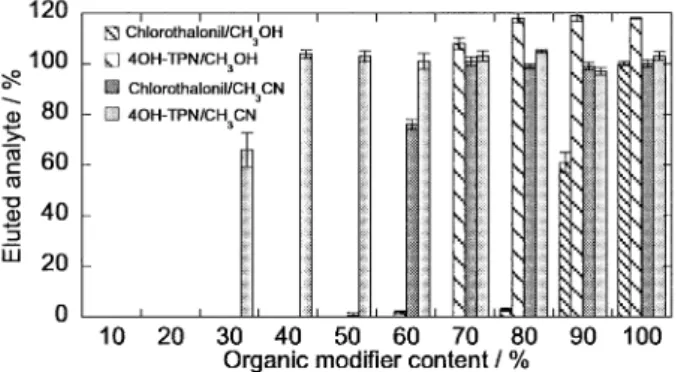
The elution profiles from Presep-C Agri cartridges with 5 mL of various solvents are shown in Fig. 4. Acetonitrile was stronger Fig. 2 Plots of [M–Cl+O]

signal intensity versus LC flow rate,

where the symbols denote dopant flow rate as follows: open circle, 50 m L min

–1

; solid circle, 100 m L min

–1

; open triangle, 200 m L min

–1

; filled triangle, 500 m L min

–1

. The standard deviation from five replicates is drawn as error bar.

Fig. 3 SIM chromatograms at m/z 245 of a) a standard solution

containing both chlorothalonil and 4-hydroxy-2,5,6-trichloro-

isonaphthonitrile (4OH-TPN) of 1 ng mL

–1

, b) an extract from river

water collected from Osaka City, and c) an extract from cucumber

containing chlorothalonil as a pesticide residue of 17 ng g

–1

.

(4)

than methanol in the elution of chlorothalonil and 4OH-TPN.

Since the use of methanol brought excess recovery of 4OH- TPN, 15% acetonitrile solution was selected as a washing solvent.

Oasis HLB was also examined. Since it strongly adsorbed 4OH- TPN, the eluent required additives such as NH

4

OH in order to elute 4OH-TPN from Oasis HLB. Presep-C Agri was selected to avoid degradation of chlorothalonil under a basic condition.

Method validation

For the recovery study, 0.5 L of river water and 20 g of cucumber samples were spiked with 5 ng and 0.2 m g of both chlorothalonil and 4OH-TPN, respectively. The recovery was satisfactory for extracting chlorothalonil from both the river water and cucumber samples, as listed in Table 1. Presep-C could be used for the extraction of 4OH-TPN as well as chlorothalonil. LC/APPI-MS chromatograms for the extracts from actual river water and cucumber are also shown in Fig. 3.

The cucumber contained chlorothalonil as a pesticide residue at 17 ng g

–1

. The method detection limit (MDL) calculated from seven replicate extractions is also listed in Table 1. The MDL for the aqueous sample enabled to quantify the concentration, which was potent for aquatic organisms.

23

Inter-day variation was evaluated by analyses of spiked water and cucumber samples over a period of three days. The reproducibility of the method was expressed in terms of relative standard deviation ranged from 3.8 to 7.5%.

Environmental level

At several estuarial locations, chlorothalonil was detected with a maximum of 1.1 ng L

–1

. Although some pesticides are currently also used as antifouling agents in boat paint, the concentration was still lower than that of other pesticides.

6

As for 4OH-TPN, it was principally detected not from estuaries but from river water with a maximum of 14 ng L

–1

. The difference of biota between rivers and estuaries might be one of the factors. The locations where 4OH-TPN was detected have received much effluent from sewage treatment plants and some agricultural water. In order to elucidate environmental occurrence of chlorothalonil, further investigation will be required especially in the peak season when chlorothalonil is frequently used.

Conclusions

This research demonstrated the applicability of liquid chromatography/mass spectrometry using an APPI source to the determination of chlorothalonil and its polar degraded product, 4OH-TPN, in environmental and food samples. Dopant-assisted

negative-ion APPI brought a rearrangement reaction of chlorothalonil with O

2

and generated [M–Cl+O]

with great sensitivity. The flow rates of dopant and solvent were essential for high sensitivity. Extraction and purification methods using solid phase cartridges were applied to actual samples.

Chlorothalonil was detected in the estuarial location with a maximum of 1.1 ng L

–1

. The location where 4OH-TPN was detected did not coincide with that of chlorothalonil. This is the first example of detecting chlorothalonil by LC/APPI-MS. This method provided superb sensitivity compared with other techniques

4,5,7,8

and simultaneous quantification with 4OH-TPN.

Acknowledgements

We thank Dr. Rie Kakehashi for fruitful discussions. This work was partially supported by a Grant-in-Aid for Scientific Research (B).

References

1. W. H. Newsome, J. Doucet, D. Davies, and W. F. Sun, Food Addit. Contam., 2000, 17, 847.

2. Pharmaceutical and Food Safety Bureau, Ministry of Health, Labour and Welfare of Japan, Test Results of Agricultural Chemical Residues on Farm Products in 2004, http://www.mhlw.go.jp/topics/bukyoku/iyaku/syoku-anzen/

zanryu2/081224-1.html (in Japanese).

3. M. Sakai, J. Environ. Sci. Health B, 2002, 37, 247.

4. T. L. Potter, R. D. Wauchope, and A. K. Culbreath, Environ.

Sci. Technol., 2001, 35, 2634.

5. L. Alder, K. Greulich, G. Kempe, and B. Vieth, Mass Spectrom. Rev., 2006, 25, 838.

6. K. Martínez, I. Ferrer, and D. Barceló, J. Chromatogr., A, 2000, 879, 27.

7. A. Chaves, D. Shea, and D. Danehower, Chemosphere, 2008, 71, 629.

8. E. A. Scribner, J. L. Orlando, W. A. Battaglin, M. W.

Sandstrom, K. M. Kuivila, and M. T. Meyer, “Results of Analyses of the Fungicide Chlorothalonil, Its Degradation Products, and Other Selected Pesticides at 22 Surface- water,” 2006, U.S. Geological Survey Open-File Report 2006-1207.

9. D. Robb, T. Covey, and A. Bruins, Anal. Chem., 2000, 72, 3653.

10. J. A. Syage, M. D. Evans, and K. A. Hanold, Am. Lab., 2000, 32, 24.

11. H. Moriwaki, M. Ishitake, S. Yoshikawa, H. Miyakoda, and Fig. 4 Elution profiles of chlorothalonil and 4OH-TPN from SPE

cartridges using eluents with different organic solvent contents.

Table 1 Recoveries from 0.5 L of river water and 20 g of cucumber spiked with chlorothalonil and 4OH-TPN so as to respectively adjust the concentration to 1 ng L

–1

and 10 ng g

–1

Mean recovery ± SD

a

,

% (n = 7) MDL

b

River water TPN 89 ± 3 0.18 ng L

–1

4OH-TPN 93 ± 8 0.71 ng L

–1

Cucumber TPN 93 ± 8 3.2 ng g

–1

4OH-TPN 105 ± 7 2.4 ng g

–1

a. Standard deviation.

b. Method detection limit (MDL) calculated from the standard deviation

of seven replicated analyses.

(5)

J. F. Alary, Anal. Sci., 2004, 20, 375.

12. H. Moriwaki, H. Harino, T. Yoshikura, T. Ohe, H. Nukaya, Y. Terao, H. Sawanishi, K. Wakabayashi, H. Miyakoda, and J. F. Alary, J. Environ. Monit., 2004, 6, 897.

13. T. J. Kauppila, T. Kotiaho, R. Kostiainen, and A. P. Bruins, J. Am. Soc. Mass Spectrom., 2004, 15, 203.

14. L. Song, A. D. Wellman, H. Yao, and J. E. Bartmess, J. Am.

Soc. Mass Spectrom., 2007, 18, 1789.

15. F. Hernández, O. J. Pozo, J. V. Sancho, L. Bijlsma, M.

Barreda, and E. Pitarch, J. Chromatogr., A, 2006, 1109, 242.

16. R. C. Dougherty, Anal. Chem., 1981, 53, 625A.

17. L. Luosujärvi, M. M. Karikko, M. Haapala, V. Saarela, S.

Huhtala, S. Franssila, R. Kostiainen, T. Kotiaho, and T. J.

Kauppila, Rapid Commun. Mass Spectrom., 2008, 22, 425.

18. T. J. Kauppila, A. P. Bruins, and R. Kostiainen, J. Am. Soc.

Mass Spectrom., 2005, 16, 1399.

19. D. B. Robb and M. W. Blades, J. Am. Soc. Mass Spectrom., 2005, 16, 1275.

20. S. S. Cai and J. A. Syage, J. Chromatogr., A, 2006, 1110, 15.

21. M. B. Szalkowski and D. E. Stallard, J. Agric. Food Chem., 1977, 25, 208.

22. Code of Federal Regulations of United States, Title 40 Protection of Environment, 2008, Vol. 22, Part 136, http://

edocket.access.gpo.gov/cfr_2008/julqtr/pdf/40cfr136AppB.

pdf.

23. USEPA Reregistration Eligibility Decision (RED):

Chlorothalonil, 1999, http://www.epa.gov/oppsrrd1/REDs/

0097red.pdf.

Fig. 1 Mass  spectrum  of  chlorothalonil  by  negative  APPI.
Fig. 3 SIM  chromatograms  at  m/z  245  of  a)  a  standard  solution  containing  both  chlorothalonil  and   4-hydroxy-2,5,6-trichloro-isonaphthonitrile (4OH-TPN) of 1 ng mL –1 , b) an extract from river  water  collected  from  Osaka  City,  and  c)  a
Table 1 Recoveries  from  0.5  L  of  river  water  and  20  g  of  cucumber  spiked  with  chlorothalonil  and  4OH-TPN  so  as  to  respectively adjust the concentration to 1 ng L –1  and 10 ng g –1

参照

関連したドキュメント

まず,PREG 及び PROG の重水素標識体をアルカリ条 件下での交換反応により合成し,それぞれを IS として Fig.. 7) .コント

Keywords: homology representation, permutation module, Andre permutations, simsun permutation, tangent and Genocchi

Standard domino tableaux have already been considered by many authors [33], [6], [34], [8], [1], but, to the best of our knowledge, the expression of the

Various attempts have been made to give an upper bound for the solutions of the delayed version of the Gronwall–Bellman integral inequality, but the obtained estimations are not

The edges terminating in a correspond to the generators, i.e., the south-west cor- ners of the respective Ferrers diagram, whereas the edges originating in a correspond to the

pole placement, condition number, perturbation theory, Jordan form, explicit formulas, Cauchy matrix, Vandermonde matrix, stabilization, feedback gain, distance to

[11] ISO 23830 Surface chemical analysis -- Secondary- ion mass spectrometry -- Repeatability and constancy of the relative-intensity scale in static secondary-ion

The carbon dioxide resulting from partial combustion process takes place simulta- neously with biomass gasification.. The prototype worked properly producing good