Author(s)
サベット・メヘランCitation
聖学院大学論叢, 21(2): 107-123URL
http://serve.seigakuin-univ.ac.jp/reps/modules/xoonips/detail.php?item_i d=943Rights
聖学院学術情報発信システム : SERVE
SEigakuin Repository for academic archiVE
執筆者の所属:人文学部・欧米文化学科 論文受理日2008年10月10日
A Closer Look at International Students at Seigakuin University
Mehran SABET
聖学院大学外国人留学生の現状調査 サベット・メヘラン
日本で勉強をする留学生数は,増加している。留学生数は,10年前の2倍に達しており,日本政 府は数年後には3倍に増やす計画である。少子化と高齢化に伴い,多くの日本の大学は学生数の減 少に直面している。留学生の受入れは,一時的な定員補充にはなるが,留学生が関心を寄せる大学 とし,健全な留学生を維持するためには,大学は留学生のニーズに細心の注意を払う必要がある。
この論文は,留学生の聖学院大学に対する満足度,そして彼らが,どのような問題を抱えているか を,授業,教員,友達,そして将来の計画などのトピックについてアンケート調査したものである。
Key words: 留学生,ニーズ,満足度,将来の計画
In 1996, Japan’s Ministry of Education, Science, and Culture announced that it plans to take measures that by the turn of the century would increase the total number of international students in the country to 100,000. Although the targeted number seemed rather high and some people doubted the possibility of reaching the goal, today Japan has not only reached its target, it has surpassed it comfortably. Now a new and ambitious target has been set by announcing that Japan plans to have 300,000 foreign students at its educational institutions by the year 2020 (Obst, D. 2008).
Some may wonder why the government would promote such a policy and what the benefits of such a program are. Supporters of such a policy argue that it is the responsibility of any government to create opportunities and provide support for foreign students to study at its institutions in order to maintain a competitive and global-minded workforce, both domestically and internationally (Japan Today, 2008). It is common understanding that societies that produce new technologies, products, and ideas, essentially provide the world with the tools that ensure a brighter future. Educational institutions in developed countries carry the responsibility of transferring knowledge and knowhow to their own people as well as to others who can benefit from them in the present and future.
There is no question that Japan plays a key role in the global market. The second largest economy
in the world can do a lot to improve the quality of life in developing countries through education and skills needed to succeed. One way to do that is to open the doors of the country and its schools to young people from these countries. The open door policy in Japan becomes much more critical when we consider that the gap between the wealthy and poor in developing nations, many of them in Asia, is getting wider. The Japanese government seems to be aware of this problem and is doing its share to resolve it by providing opportunities for foreign students-especially the ones from neighboring countries-to come to Japan to study.
International Students in Japan
The increase in the number of international students in Japan in the past two decades has been enormous. In 1991, there were just 45,000 international students studying in Japanese institutions of higher education (White Paper, 1991). However, as of May 1, 2007, this number stood at 118,498. The breakdown of these students by institutional type, country, and region can be seen in tables 1 to 3 respectively (Jasso, 2007).
Table 1 Number of International Students by Institutional Type (compared with last year)
Graduate school 31,592 2.2% up
Undergraduate schools 62,159 2.0% down
Professional training college 22,399 3.9% up University preparatory course 2,348 16.4% up
Table 2 Major Countries
China 71,277 4.1% down
Republic of Korea 17,274 8.1% up
Taiwan 4,686 11.3% up
Vietnam 2,582 21.8% up
Malaysia 2,146 0.5% down
Table 3 Number of International Students by Region of Origin
Asia 109,495 92.4 %
Europe 3,547 3.0 %
North America 2,112 1.8 %
Central and South America 1,024 0.9 %
Africa 989 0.8 %
Middle and Near East 797 0.7 %
Oceania 534 0.5 %
Total 118,498 100.00%
As it can be seen, more than 90% of the students come from Asia and this is an indication of the relationship that the Japanese government is trying to establish with neighboring nations in order to build a stronger bond in terms of trust and mutual understanding. There is no question that presence of foreign students in Japan promotes internationalization, cultural awareness, and increases the human resources available to both the host and home countries. Therefore, it is essential for all parties involved to ensure that these students receive quality education as well as assistance in dealing with their daily life such as accommodation, comfort, and safety. Everyone knows that Japan has a high cost of living, even when compared with some European and North American standards.
However, when prices in Japan are compared with countries such as China, India, Sri Lanka and the rest of Asia, the gap is so enormous that a student must come from a wealthy family or receive financial support from an organization in order to be able to study in Japan. That is perhaps the main reason why the Japanese government gives scholarships and financial aid to many foreign students.
In addition to the government’s aid, some students receive reduction in their tuition when entering a university, but money is only one of many issues that international students face. Settling in a new environment, feeling safe and welcomed in the new surroundings, making friends, and receiving quality education are some of the other issues that responsible students must be concerned about.
Although educational institutions may not feel obliged to pay close attention to the needs of these students, they should be aware of problems that these people face and provide assistance whenever possible. This requires a lot of time and coordination, but it is worth the effort to establish long term progress and stability. If universities and other educational institutions plan to have international students as a permanent part of their student population, then understanding their needs and responding to them accordingly is highly critical.
There are various ways in which schools can learn more about these needs. Personal interviews might produce the best results, but this process is time-consuming and may not be practical in schools with a large population of international students. Administering a questionnaire might be the next best solution. However, once the results are analyzed, appropriate action must be taken. This requires calculated and coordinated efforts from the various administrative bodies concerned. According to Wood (2006), universities must create a team of dedicated, internationally focused faculty, give them responsibility for initiatives, and then get out of their way and reward them for superior effort and results. He also states that institutions with outstanding international programs were those that cultivated an underlying philosophy of providing an international environment and experience for all their students.
However, the main issue that educators must pay close attention to is the satisfaction level shown
by students in regards to their classes, teachers, administration, and the overall atmosphere of the school. In order to attract more students from overseas and maintain their interest in Japan, schools must ensure that these students’ needs are met and that they are equipped with the knowledge and skills to enter the job market.
International Students Worldwide
Traditionally, English-speaking countries have attracted the largest number of international students. Although this has been the trend thus far, things may change if Japan continues its surge of attracting more foreign students. The United States has the largest number of international students on its university campuses. This number was about 623,000 for the 2007-2008 academic year. The net contribution of these students to the U.S. economy in the same year was about $15,000,000,000 (IIENetwork, 2008). This included their tuition fees and living expenses, minus financial support they received from the U.S. government. According to The Independent (2008), in the same time period, there were about 385,000 international students in England and approximately more than 200,000 were studying in Australia. The economic benefits of having a large number of foreign students are huge. Tuition, rent, daily living costs, and other expenses paid by these students naturally generate jobs and income for the host nations. But some countries can make long term gains if foreign students decide to stay and work in their host countries permanently. Among the steps that countries have taken to attract international students are: UK-India Education and Research Initiatives in 2006 that provides 12,000,000 pounds of government funding to 40 UK award programs for Indian students and support for 70 UK-India collaborative research projects; changes to the visa system in 2006 in the UK that allows international students who complete an undergraduate or graduate degree in certain areas such as mathematics to work in the country for up to 12 months (Atlas of Student Mobility, 2006), and the Australian government’s policy that makes it easier to become a naturalized citizen if a person has graduated from one of its universities (Australia Education, 2008). It will be discussed later how Japan can also gain from bringing in more international students and utilizing their skills.
The Questionnaire
At Seigakuin University, a questionnaire was voluntarily administered to students from countries such as China, Korea, Sri Lanka, Nepal, and India who attend the school (See Appendix One). It must be noted that the majority of the students come from China. There were approximately 220 foreign
students at this university at the time this questionnaire was administered and data was gathered on 94 participants. The questions were written both in English and Japanese and were administered to students in the classrooms. Since it was possible that some students may come in contact with the questionnaire in more than one classroom, teachers were asked to remind them that if they had already done the questionnaire, they did not need to do it a second time. Furthermore, when going through the answer sheets, attempts were made to eliminate duplicates.
Results
The questionnaire results were tabulated (See Appendix One) and the following observations can be made. From the data gathered, we can see that although the majority of students have lived in Japan between 4-6 years, a significant number of them (39%) have been in this country for only 1-3 years. According to the data, 52% said that they are enjoying their school life and another 46% said that “It’s alright.” Only 2% seem to be unhappy and this low percentage seems to indicate that the majority are content. The next question of interest was to find out what students like about Seigakuin University. The data tells us that 45% of the respondents like their teachers while “classes”,
“students”, and “other” have almost equal results. Students were allowed to choose more than one answer for this question. One point of concern here might be the level of students’ satisfaction with courses. Only 17% said that they like the school because of content of the courses and in another question only 50% said that they are satisfied with their classes. The remaining 50% have stated that they either think their classes are “alright” (46%) or not good (4%). It would be interesting to find out what kind of response we would receive from the Japanese students when asked the same question.
It could be possible that the reason learners are not happy with their classes is a lack of language proficiency. According to the data, more than 40% said that they understand less than 70% of the lectures. Lack of language proficiency may have more to do with the ability to read kanji as many students from countries such as Nepal, India, and Sri Lanka have indicated so.
There were a lot of different answers to the question “Why did you choose Seigakuin University”
and there is no clear “winner” as to why these students decided to enter this school. However, more than a few said that they were referred to this university by friends, relatives, or Japanese language teachers. Being a Christian school also seems to have attracted a few applicants (See Appendix Two).
These responses might be of much interest to people in the Admission Center.
The next question that should interest schools as well as government officials is to see what percentage of students plan to stay and work in Japan once they graduate. After all, it is one of the
main goals of the Japanese government to produce skilled individuals, who upon returning to their home country, can enter the job market and contribute immediately. Students at Seigakuin University do not seem to fit the ideal candidates. When asked “Are you planning to stay in Japan after you graduate?” 58% answered yes, and another 32% stated “Don’t know yet.” It is safe to say that a good portion of the respondents plan to stay in Japan for at least a few years and this assumption is supported by the fact that 54% said they want to work in Japan permanently, while the remaining 46% said that they want to work here between 2-3 years. As to what kind of jobs these students are interested in, general office work was their first choice (51%), with travel-related industry (24%) coming next.
Finally, regarding financial matters, 57% of the participants have stated that they have financial difficulties paying for their school and daily expenses. The majority of them receive money from their parents (39%) and/or support themselves through part-time jobs (32%). Foreign students are allowed to work up to 28 hours a week and almost all of them seem to do so. Other concerns for the respondents in this questionnaire are finding a good job, Japanese language, and paying school tuition.
Analysis by Department
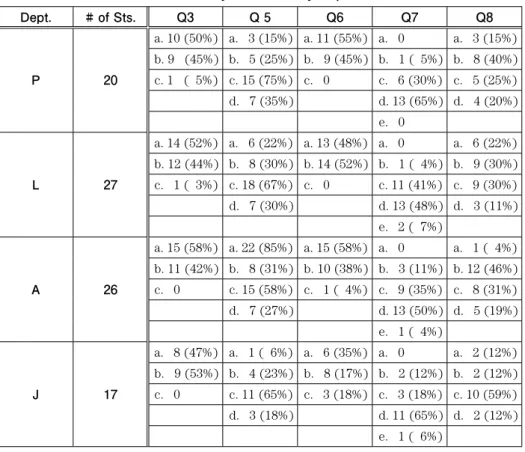
Although the number of respondents for each department was rather small, an analysis of their answers can give some indication as to how satisfied the students are with their classes, teachers, and school in general. Answers for the following four departments were analyzed: Political Science and Economics (P), Local Community Policies (L), Euro-American Culture (A), and Japanese Literature (J).
When asked “Are you enjoying your school life?” about 50% of students for each department answered “yes” (See Table 4), although the percentage for A (58%) is slightly higher than the rest. As to what the students like about their school, classes offered by the A department seem to have an edge over the remaining three departments since 85% of respondents in this department have stated their satisfaction. Also, teachers in P have received a better rating than their peers in other departments. For Question 6 “Are you satisfied with your classes?” A and P have the highest markings, but J received a rating considerably lower than the other three.
Another important piece of information from this data tells us to what level foreign students communicate with their advisors and the data states that in P, L, and A, almost the same percentage of the students see their advisor or seminar teacher when they have problems. However, the number is alarmingly low for J since only 4% have said so. Furthermore, 19% of students in A and 20% from P
do not see their advisor or seek help from their teachers at all when they need it. And, finally, in terms of Japanese language ability, students in P and J seem to have the least problem with understanding the lectures, while on the other hand, learners in L and A must have a hard time coping with lectures and assignments given to them by their teachers. Only about half of students in L and A understand 70%-90% of lectures. This should be an area of concern for the school.
Q3. Are you enjoying your school life? 大学生活を楽しんでいますか?
A. はい B. まあまあ C. いいえ
Q5. What do you like about Seigakuin University?
聖学院大学のどのようなところが好きですか?
A. クラス B. 学生 C. 教員 D. その他
Table 4 Analysis of Data by Department
Dept. # of Sts. Q3 Q 5 Q6 Q7 Q8
P 20
a. 10 (50%) a. 3 (15%) a. 11 (55%) a. 0 a. 3 (15%) b. 9 (45%) b. 5 (25%) b. 9 (45%) b. 1 ( 5%) b. 8 (40%) c. 1 ( 5%) c. 15 (75%) c. 0 c. 6 (30%) c. 5 (25%) d. 7 (35%) d. 13 (65%) d. 4 (20%)
e. 0
L 27
a. 14 (52%) a. 6 (22%) a. 13 (48%) a. 0 a. 6 (22%) b. 12 (44%) b. 8 (30%) b. 14 (52%) b. 1 ( 4%) b. 9 (30%) c. 1 ( 3%) c. 18 (67%) c. 0 c. 11 (41%) c. 9 (30%) d. 7 (30%) d. 13 (48%) d. 3 (11%)
e. 2 ( 7%)
A 26
a. 15 (58%) a. 22 (85%) a. 15 (58%) a. 0 a. 1 ( 4%) b. 11 (42%) b. 8 (31%) b. 10 (38%) b. 3 (11%) b. 12 (46%) c. 0 c. 15 (58%) c. 1 ( 4%) c. 9 (35%) c. 8 (31%) d. 7 (27%) d. 13 (50%) d. 5 (19%)
e. 1 ( 4%)
J 17
a. 8 (47%) a. 1 ( 6%) a. 6 (35%) a. 0 a. 2 (12%) b. 9 (53%) b. 4 (23%) b. 8 (17%) b. 2 (12%) b. 2 (12%) c. 0 c. 11 (65%) c. 3 (18%) c. 3 (18%) c. 10 (59%) d. 3 (18%) d. 11 (65%) d. 2 (12%)
e. 1 ( 6%)
Q6. Are you satisfied with your classes? 履修している科目に満足していますか?
A. はい B. まあまあ C. いいえ
Q7. What percentage of lectures given in Japanese do you understand?
日本語での授業は,どのくらい理解できていますか?
A. 0%~30% B. 30%~50% C. 50%~70% D. 70%~90% E. 100%
Q8. Do you see your advisor or seminar teacher when you have a problem?
勉強や大学生活で困った事がある時,アドバイザーやゼミの先生に相談に行きますか?
A. よく行く B. ときどき行く C. あまり行かない D. 全然行かない
Conclusion
Although only 94 students participated in this survey, their answers provide the administration of Seigakuin University with information that can be beneficial for future planning. In general, it can be said that the international students are content with their life at this school. Their satisfaction comes from areas that are positive and encouraging. For example, teachers received high marks, but when broken down into departments, we come across some areas of concern. Careful analysis of why some students do not seek the help of their advisors should be fully explored. Lack of Japanese language ability for some learners is another area that needs attention and the school must ensure that students graduate with a good command of the language. Otherwise, the prospect of finding a good job in Japan becomes lower. Suggestions have been made that foreign students who want to renew their visa or work in Japan might have to meet a certain level of language proficiency in order to be eligible to apply (The Asahi Newspaper, 2008). The quality level of some classes should be looked into as only 50% of learners are satisfied with lectures and the content of the courses. If some students enter this school through the recommendation by friends, relatives, or outside teachers, then having a solid curriculum should be the base for future recruitment.
The fact that many students are interested in working in Japan is encouraging. With Japan’s low birth rate and aging population, the need for a young workforce is increasing. Furthermore, the country can benefit from the presence of educated individuals who can offer their knowledge and skills to Japanese companies. Although eventually some or many of these potential workers will return to their homeland, their short term stay in Japan can provide them with the training and skills needed for a long and successful career. Additionally, their input and presence here can bring diversity, originality, and
innovation to all layers of the society. Having a large population of young and educated people in any society is a big plus, but we should not be content with the present number of foreign students in Japan.
Instead, we ought to strive to reach higher goals and at the same time, improve on areas that can slow or hinder the flow of international students into this country. It seems that attempting to meet the needs of these students creates a healthy dynamic to improve the education provided at universities, which in turn becomes a win-win situation for international and Japanese students alike.
References
Atlas of Student Mobility (2006). United Kingdom’s policies for promoting international higher education. Retrieved data from the Internet http://www.atlas.iienetwork.org
Australia Education (2008). Studying in Australia. Retrieved data from the Internet http://www.
internationaleducationmedia.com/australia
IIENetwork (2008). Economic impact of international students. Retrieved data from the Internet http://www.opendoors.iienetwork.org
Japan Student Services Organization (JASSO)(2007). Retrieved data from the Internet http://www.
jasson.org
Japan Today (2008). Panel calls for improving level of education. Japan News and Discussions.
Retrieved data from the Internet http://www.japantoday.com
Obst, D. (2007). National policies for international education. Retrieved data from the Internet http://
www.iienetwork.org
The Asahi Newspaper (2008). Language skills eyed for visa process. (1/16/2008)
The Independent (2008). Foreign students can stay in UK for extra year. Retrieved data from the Internet http://www.independent.co.uk/news/education/higher (2/22/2008)
Wood. V. R. (2006). Globalization and higher education: Eight common perceptions from university
leaders. Retrieved from the Internet http://www.iienetwork.org
Appendix One 聖学院大学留学生アンケート 1. How long have you lived in Japan? 日本での滞在期間
2. Why did you choose Seigakuin University? 聖学院大学を選んだ理由
(See Appendix Two)
3. Are you enjoying your school life? 大学生活を楽しんでいますか?
4. How many Japanese friends do you have? 日本人の友達は何人くらいいますか?
5. What do you like about Seigakuin University? 【※複数回答可】
聖学院大学のどのようなところが好きですか?
年~3年 37 39%
4年~6年 53 56%
7年以上 4 4%
はい 49 52%
まあまあ 43 46%
いいえ 2 2%
0人 4 4%
1人~5人 33 35%
6人~10人 15 16%
たくさん 42 45%
クラス 23 17%
学生 27 20%
教員 61 45%
その他 24 18%
6. Are you satisfied with your classes? 履修している科目に満足していますか?
7. What percentage of lectures given in Japanese do you understand?
日本語での授業は,どのくらい理解できていますか? ※パーセント(%)で答えてください。
8. Do you go to see your advisor or seminar teacher when you have some problems?
勉強や大学生活で困った事がある時,アドバイザーやゼミの先生に相談に行きますか?
9. Do you live alone or with somebody else? 1人暮らしですか,誰かと一緒に住んでいますか?
10. What kind of job are you interested in? どのような職業に就きたいですか?
はい 47 50%
まあまあ 43 46%
いいえ 4 4%
0%~30% 0 0%
30%~50% 8 8%
50%~70% 31 33%
70%~90% 51 54%
100% 4 4%
よく行く 12 13%
ときどき行く 33 35%
あまり行かない 34 36%
全然行かない 14 15%
1人 31 33%
友達と一緒 41 44%
親戚の人と一緒 18 19%
その他 3 3%
一般企業 49 51%
教育関係 11 11%
旅行関係 23 24%
その他 12 13%
11. Are you planning to stay in Japan after you graduate? 卒業後,日本に滞在するつもりですか?
12. If you want to work in Japan, will it be permanently or for a few years?
日本で就職をしたら,日本に永住したいですか,それとも数年間勤務を希望しますか?
13. Do you have any financial difficulties paying for school and the cost of living in general?
学費と生活費の支払いなど,経済的な問題はありますか?
14. Are you getting any financial support? 学費・生活費のサポートを受けていますか?
15. Please describe if you are currently facing any problem in your everyday life.
あなたが現在,かかえている問題などがあれば書いてください。
(See Appendix Two)
Appendix Two Q2. Why did you choose Seigakuin University?
・日本語学校に紹介してもらった。【6名】
・紹介【3名】
・友達がいるから
・友人の紹介と家に近いから
・友人の紹介
2年~3年勤務 40 46%
永住したい 47 54%
ある 45 57%
少しある 11 14%
ない 23 29%
国の家族 36 39%
奨学金 21 23%
アルバイトのみ 30 32%
その他 6 6%
はい 53 58%
いいえ 9 10%
まだわからない 30 32%
・友達のおかげで
・先生のすすめ【2名】
・文を書くのがあまり上手ではないので,先輩から学校のよいところを教えてもらった。
・先輩の紹介【2名】
・兄がいるから。
・親戚がいるから
・先輩がいたから【2名】
・学費が安い【2名】
・わからない【2名】
・たまたま
・面倒見がよいから。【5名】
・面倒見がよいから。経済を勉強したい。
・通学が便利で,面倒見のよい大学だから。
・学びたい科目がある。面倒見がいいから。
・①留学生の面倒見がよい。②キリスト教関係
・留学生の面倒見がよい
・近いから【5名】
・通学便利,教員いい。
・キリスト教も勉強することができる。
・家に近い。キリスト教の大学だから。
・クリスチャンだから,先生達も優しくて,生活充実できるから
・3年から編入できるから【2名】
・ほかの大学に落ちた。
・高校の時,英文が好きでした。また,西洋美術の油絵の歴史に関して興味があった。
・コンピューターを勉強したいから。
・勉強したい科目がある。
・政治経済にかかわる知識を身につけたいから。
・日本語教師になりたい。家から近い。
・日本語を学ぶ為に
・学校の先生たちが,優しそうだから。
・聖学院大学が大好きです。
・雰囲気が好きだから。
・自分に合うと思う。
・就職率が高そうだから
・聖学院大学の人間福祉学科は,私立大学のなかで有名だから
・自分のレベルにあっていた。
・神の存在を信じるから
・学びたいことが,この大学にある。学費が安い。友達も一緒にいるから。
・しっかり勉強できると思う。
Recommended by a teacher.
My sister is in this University.
I like Christian Universities.
No way to choose another University.
I’m interested in other cultures.
One of my teachers advised me to come here.
Introduced by my Japanese language school principal.
I applied for this university only. There is no special reason.
I don’t know the reason. I just chose this school.
It has many good features for foreign students.
Close, cheap, good courses, AO, was introduced
I want to learn more about America and Europe.【2名】
The school is best school for studying Euro-American culture in a good environment.
Iwant to improve my English language and also Japanese.
I wanted to learn about western culture and I thought欧米文化学科is the most proper.”
I want to read the history of European American culture deeply.
I want to study both Japanese and English because I am not fluent in Japanese.
The classes are small. I can study better in smaller groups.
In October I graduated from my Japanese school. I’m glad I entered Seigakuin University.
I thought Seigakuin University is a good University.
It is a popular university among the overseas students.
Q5. What do you like about Seigakuin University?
・図書館【2名】
・すべて【2名】
・少人数教育【2名】
・環境
・特に好きなところがありません。
・卒業証書がほしい
・専門的な知識を勉強する場合
・留学生の面倒見がよい
・ある先生が大好き
・常駐スタッフの友達
・授業
・キャリアサポートセンター,奨学金制度
・Nothing special.
・I don’t know.
It’s a nice place.
The campus and its green environment.
The view The Environment
We can learn about a lot of things (There are many courses).
Contents of lectures
Q15. Please describe if you are currently facing any problem in your everyday life.
・就職が心配【5名】
・これから就職するので,道がわからない。
・26歳だけど まだ1年生。就職する時,難しくなるかな。
・就職,進学など
・就職が,なかなか決まらないので,ちょっとあせっている。
・日本で就職できるかどうか心配
・学費の不足のため,アルバイトをがんばらなければならないので,勉強する時間が少なくなりま した。
・学費が,払えない恐れがある。
・お金
・来年の学費のこと。奨学金をいただきたい。
・学費の支払い,よい成績をとるとか大学生活が厳しいために日々つらいです。
・学費 もうちょっと安くなって欲しいです。日本語のスピーチと英語のスピーチの賞金は同じに してほしい。ビジネス日本語の授業がほしい。学校にロッカーがほしい。学校のバスに百円払う
のは,おかしい。他の大学はお金をとらない。
・I hope to improve my Japanese. 日本語で授業するとき,少しゆっくり話してもらいたい。
And write note on the blackboard. そうすると聞きやすいし,また難しいところは黒板に書いて ください。”
・成績の評価は不公平である。例えば,毎日遅刻したり授業中に寝ている学生も奨学金がもらえる 事。
・卒業論文がうまく書けるかどうか心配している。
・聖学院の授業料は,高い。留学生に対して大変なことだと思う。
・“この大学の減免制度は厳しいと思う。しかも学費が高い。留学生は,学校に通いながらアルバ イトをするので,生活が辛いと思う。”
・クラスで使う 先生の漢字
・さらに大勢友達を作りたい!情報を増やすため。Information is very important for me.
So that I want to make more friends.”
・生活のいろいろな問題があります。
・引越したいが,保証人がみつからない。就職や学校で忙しくてバイトができない。
・年をとったら,悩みごとが増えた。なぜ?
・“日本語で説明する時,先生達は早く進む。黒板に書いた字もよくわからないから授業がわかり にくいです。授業を進める時,プリントを配らないでやるから,もっと大変です。”
Only money problem.【2名】
No particular problem.
I can’t write as well as I can talk.
I think Japanese lifestyle is very busy, but now I’m slowly adjusting to it (about 70%).Japan is a very expensive country! That is the main problem.
I have problem reading and writing kanji. I know some kanji, but some teachers’ kanji written on the blackboard is a bit difficult to understand.”
I can’t find a good job in Japan. I am worried about it.
I want to work in Japan but, I must do SHUKATU. If I do SHUKATU, I can’t work. It is my financial problem.
I don’t have enough money for my living expenses.
There is no problem in my everyday life. But my home is far away from school. Everyday it takes 1 hour and 30 min. to come to school. It’s hard.
Right now, I don’t have any. I don’t know about the future.
Everyone faces problems. I have faced many! But nothing I can’t handle.
feel some difficulty when the lecture is given in Japanese, when the teacher does not write “Kanji”
clearly and uses very difficult words that we can’t understand. Then it becomes difficult for me.
Teachers should try to use simple words.