Introduction
Orthognathic surgery is routine and worldwide for oral and maxillofacial deformities. Most pa- tients with jaw deformities have serious com- plaints regarding oral dysfunction as well as their appearance;on the other hand, mentally retarded patients do not usually have any cosmetic dissatis- faction regarding their facial appearance.
Recently for the children with mental retarda- tion, the ethical indications for oral and maxillofa- cial corrective surgery have been extensively discussed in the literature.1)2) For adults, we con- sider that the adequate patient selection for sur- gery according to the age and the mental state is a very important factor for obtaining successful re- sults because the nature of this surgery is elective.
The following adult patient with mental retarda- tion is herein reported and discussed in this article.
Report of a case
Presurgical course
In January 1995, a 24yearold male with com- plaint of a masticatory dysfunction was referred to our clinic, and we observed no apparent physical problems in this patient. He complained of diffi- culty in incising and chewing fried chicken with bones, and he was also distressed by the ridicule from others regarding his facial appearance while eating. He himself had no dissatisfaction with his facial appearance in spite of his upper lip scar after undergoing cheiloplasty for the treatment of a cleft lip. His malocclusion had appeared since his childhood because he had never received solid food nor required the necessity of biting and chewing.
In his medical history, he suffered from frequent cramps from two months to five years of age and had been treated by his pediatrician, and he also
Orthognathic Surgery for Mentally Retarded Patient with an Open Bite
Toshihiro K
IKUTA1), Haruhiko F
URUTA1), Hiromasa T
AKAHASHI1), Naoki I
KEYAMA1), George U
MEMOTO1), Iwao H
ARA1) 2), Masahiko I
TO3)Yoko S
ARADA4)and Ryoji N
ISHIMURA5)1)Department of Oral and Maxillofacial Surgery, Faculty of Medicine, Fukuoka University, Fukuoka, Japan
2)Department of Maxillofacial Surgery, Hara Hospital, Fukuoka, Japan
3)Private Practice of Orthodontics, Fukuoka, Japan
4)Department of Education and Clinical Psychology, Faculty of Humanities, Fukuoka University, Fukuoka, Japan
5)Department of Psychiatry, Faculty of Medicine, Fukuoka University, Fukuoka, Japan
Abstract:There have been many discussions regarding surgical treatments for the esthetic rea- sons in mentally retarded children. However, in retarded adults, especially those showing mod- erate retardation with an awareness of the norms and with motivation to undergo surgery, orthognathic surgery offers an opportunity to improve their oral dysfunction along with the appearance. The patient selection as well as the appropriate procedures for orthognathic sur- gery are together considered to play a significant role in obtaining sufficient results. We herein report the case of 24yearold mentally retarded male with an open bite.
Key words:Orthognathic surgery, Mental retardation, Open bite
Correspondence to:Toshihiro KIKUTA, DDS, PhD
Department of Oral and Maxillofacial Surgery, Faculty of Medicine, Fukuoka University 7451, Nanakuma, Johnan ku, Fukuoka 8140180 Japan
Tel:(092) 801 1011 ext.3530 Fax:(092) 801 1044 Email:kikuta@fukuoka u.ac.jp
had undergone a couple of surgeries at other hospitals. He graduated from high school with difficulty supported by his parents and the teachers. He worked as a cleaning man in a build- ing at the time that he visited our clinic.
His physical examination was as follows;175.0 cm tall and he weighted 73 kg. His facial profile was flat because of his previous cheiloplasty and
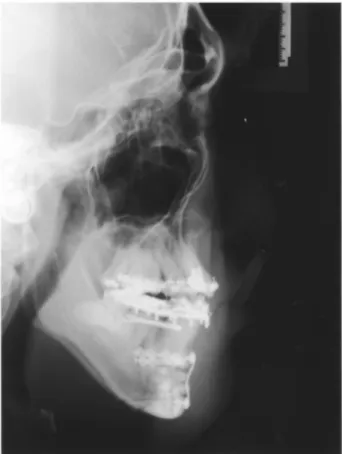
palatoplasty. He had a Class Ⅲ(mandibular ex- cess)anterior openbite malocclusion, an overbite of − 8 mm(8 mm opening between the upper and lower front teeth) , and an overjet of − 2 mm(2 mm anterior position of the lower front teeth to the up- per teeth)(Fig. 1). His lateral cephalogram show- ed maxillary hypoplasia(Fig. 2).
He was suspected to have mental retardation and
Fig. 1. Initial occlusion;Class Ⅲ anterior openbite
Fig. 2. presurgical lateral cephalogram
was referred to the clinic of Neuropsychological De- partment in our hospital before performing ortho- dontic treatments. The psychiatrist diagnosed him to have a moderate level of mental retardation based on the results of psychiatric examinations by a clinical psychologist, in which his state of in- tellectual functioning level(IQ)was 47, namely the same level as a 7 and 1/2yearoldboy. Psy- chiatrically the understanding and the develop- ment of language with this mental level is re- garded as usually slow and limited toward the end of growth so that he is able to do only simple work in an environment with a good leader and/or a superintendent.
We received the appropriate response from both the patient and the mother for the patient to un- dergo orthodontic treatment and orthognathic sur- gery after providing detailed explanations. As the psychiatrist informed us that all treatments in- cluding orthognathic surgery were feasible when sufficient informed consent was obtained, we there- fore planned Le Fore I and bilateral sagittal split mandibular osteotomies with concomitant ortho-
dontic treatment.
For 2 years and 9 months long during the pre surgical orthodontic therapy, he complained to be impatient due to difficulty of chewing and extreme discomfort which was caused by the oral appli- ance. As a result, we determined that it would not be possible to perform the bimaxillary surgery and elastic traction, and therefore the surgery was changed to a simple Koele mandibular osteotomy with the following procedures:autologous bone graft, the extraction of bilateral lower first premo- lars and genioplasty (Fig. 3). There were no event- ful findings during the surgery.
Postsurgical course
He complained about the inability to completely open his mouth and a swollen cheek from the third day. He was confused after surgery so that an antianxiety drug was used to calm him down. He needed a nurse to assist him with brushing his teeth. From the eighth day, he was able to brush his teeth and rinse his mouth by himself. He calmly read car magazines on his bed. Although
Figure 3. postsurgical lateral cephalogram
he complained that water leaked from his lips while drinking, this problem disappeared by 3 months after surgery.
At almost 10 years after surgery, he now has great pleasure in his ability to incise and chew eve- rything well. He is no longer laughed at when eat- ing and he speaks clearly. His parents are also satisfied with his facial appearance and his occlu- sion(Fig. 4).
Discussion
The surgical treatment of facial deformities in children with Down’s syndrome has been discussed for many years.1) Tongue reduction with the aim to improve the oral function is routinely per- formed in some countries.2)3) Some authors claim positive effects of corrective surgery on social be- havior and mental development4);this kind of treat- ment is also criticized in regard to whether it is ethical to change the facial appearance of mentally retarded children who are not aware of their facial deformity.
In mentally retarded adults, however, a jaw de- formity increases the risks of oral functional problem. We consider that orthognathic surgery is a rational and effective procedure to reduce these above risks depending upon the patient’s mental state.5) Our patient had a moderate intellectual functioning level(IQ:47)for an individual with mental retardation. By 18 years of age, he could
manage his personal care, education and job training.
Corrective surgery in mentally retarded adults is less controversial. Sometimes the patients with a moderate intellectual functioning level may re- quest changes to correct their occlusion and facial appearance. Stigmatizing facial features and lip movements may emphasize or exaggerate an indi- vidual mental state. Psychological changes after the orthognathic surgery can be better predicted in adults than in children. Our patient had been al- ready aware of his oral disturbances. After sur- gery he now has great pleasure in eating and biting all kinds of food, moreover, he is no longer laughed at during lunch and is able to speak more clearly after the surgery. Therefore, functional disturbances, such as mastication and speech, are also sufficient reasons for such individuals to un- dergo corrective surgery.
In our opinion, orthognathic surgery offers an opportunity for the mentally retarded young adult patients to improve their functional and es- thetical problems if they fulfill certain conditions to undergo surgery including a full understanding of social norms and sufficient motivation for ob- taining a surgical correction.
References
1)Lemperle G. and Radu D. Facial plastic surgery in children with Down’s syndrome. Plast Reconstr Fig. 4. Final occlusion
Surg 1980;66:337 342.
2)Donaldson J. D. and Redmond W. M. Surgical man- agement of obstructive sleep apnea in children with Down syndrome. J Otolaryngol 1988;17:398 403.
3)Olbrisch R. R. Plastic surgical management of chil- dren with Down’s syndrome;indication and result.
Br J Plast Surg 1982;35:195 200.
4)Wexler M. R., Peled I. J., Rand Y., Mintzker Y,
Feuerstein R. Rehabilitation of the face in patients with Down’s syndrome. Plast Reconstr Surg 1986;
77:383 393.
5)Becking A. G., Tuinzing D. B. Orthognathic sur- gery for mentally retarded patients. Oral Surg Oral Path Oral Med 1991;72:162 164.
(Received on October 7, 2008, Accepted on December 11, 2008)