
• 検索結果がありません。

篠 原 和 也

N/A
N/A
Protected

Academic year: 2021

シェア "篠 原 和 也"

Copied!
56
0
0

読み込み中.... (全文を見る)

全文

(1)

博 士 論 文

TheModelofHumanOccupation‑Based InterventionforPatientswithStroke:

ARandomisedTria1

(脳 卒 中 患 者 に 対 す る人 間 作 業 モ デ ル に基 づ く介 入:

ラ ン ダ ム 化 臨 床 試 験)

指 導 教 員 名 小 林 法 一 教授

首都 大 学東 京 大 学 院 人 間健 康 科 学研 究 科 博 士 後 期課 程 人 間健 康 科 学 専攻 作 業 療 法 科 学 域

篠 原 和 也

2013年3月

(2)

目 次

1学 …0・ …e・ …1

TheModeiofHumGnOccupa† ・iOsedIn†erven†ionfor PatientswithStroke:ARandomisedTrial

KazuyaShinOhor(】,TakashiYomαdQ,NOrikQzu・ ・a、

KirstyForsyth

HOngKOngJOurndofOccupα †ion(コ1‑..,2012

II副 論 文1・ ・ ・ ・ ・ ・ ・ ・ ・ ・ ・ ・ ・ ・ ・ ・ ・ ・ ・ ・ ・ …55 人 間 作 業 モ デ ル と そ の 他 の 理 論 を 用 い た 群 問 の 効 果 研 究 の 内 容

〜 脳 血 管 障 害 維 持 期 の 利 用 者 に 対 す る ラ ン ダ ム 化 臨 床 試 験 〜 篠 原 和 也,山 田 孝

作 業 行 動 研 究 第16巻 第1号

副 論 文2・ ・ ・ ・ ・ ・ ・ ・ ・ ・ ・ ・ ・ …a9・ ・ ・ …83 脳 卒 中 維 持 期 の 対 象 者 に 人 間 作 業 モ デ ル を 用 い た 作 業 療 法 実 践 の

3事 例 の 報 告

篠 原 和 也,山 田 孝

作 業 行 動 研 究 第14巻 第1号
(3)

IN5(

The Model of Human Occupation-Based Intervention for Patients with Stroke: A Randomised Trial

Kazuya Shinohara d,b,

Takashi Yamada C, Norikazu Kobayashi C, Kirsty Forsyth d

a Graduate School of Human Health Sciences , Tokyo Metropolitan University, Tokyo, Japan

b Health Care Facility for the Elderly , Kaise-no-Sato, Chiba, Japan c Graduate School of Human Health Sciences , Tokyo Metropolitan

University, Tokyo, Japan

d Department of Occupational Therapy , School of Health Sciences, Queen Margaret University, Edinburgh EH21 6UU,United

Kingdom

Hong Kong Journal-of Occupational Therapy, 2012 (In Press)

Accepted 4 September 2012 (Available online 12 October 2012).

(4)

Summary

Objective/Background: This study examined a group of people with cerebrovascular accidents who were in a chronic phase in a Health Care Facility for the Elderly in Japan. The model of human occupation (MOHO)-driven occupational therapy (OT) intervention was compared with interventions that were based on other theories,

for example, biomechanical and neurodevelopmental frames of reference.

Methods: A total of 36 service users were randomly assigned to either an experimental group (who received MOHO-based OT) or a control group (who received "usual OT"). All the service users were assessed using the Activities of Daily Living (ADL), WHO Quality of Life 26 (QOL-26), MOS-36-Item Short Form Health (SF-36) before and after a 12-week OT intervention.

Results: Based on the results of our study, we found that the experimental group significantly improved in ADL and QOL scores following the MOHO-based OT intervention; in fact, these scores were higher (p < .05) than before the practice. The control group, however, only improved on ADL scores following OT intervention.

In addition, when compared with the control group after the interventions, the experimental group had significantly improved (p < .05) scores in the following: ADL, all five domains of QOL-26, and physical functioning, role physical, bodily pain, general health perception, social functioning of SF-36.

Conclusion: The MOHO-based intervention was more effective in the improvement of ADL and QOL than non-MOHO-based intervention.

Keywords:

Cerebrovascular accident; model of human occupation;

occupational therapy; older adults

(5)

Introduction

Cerebrovascular accident (CVA) is a noncommunicable disease of increasing socioeconomic importance in ageing populations (Feigin, Lawes, Bennett, & Anderson, 2006). It is the second leading cause of mortality worldwide (WHO, 2003) with three million women and two-and-a-half million men dying from stroke every year (WHO, 2011). It has recently been reported as the number one cause of disability in developed countries (Fisher &

Norrving, 2011).

Survivors of stroke may experience a wide spectrum of symptoms including impairment of motor, perceptual, sensory, cognitive, and psychological functioning (Haslam & Beaulieu, 2007; WHO, 2011a).

Therefore, this diagnosis is responsible for changes in lifestyle for the majority of those affected (Morgans & Gething, 2002).

Considering the impact that stroke may have on a person's body functioning, and its high international incidence and prevalence, the disease has potentially emotional and socioeconomic results for people, their families, and health services (WHO, 2011). By 2020,

disability-adjusted life years (DALYs) lost due to stroke are predicted to rise globally from 38 million DALYs (as estimated in 1990) to 61 million DALYs (WHO, 2011).

Most survivors of stroke report decreased levels of activity,

socialisation, and overall quality of life (QOL), with only an

estimated 25% returning to the level of everyday participation of

community-matched people who have not had a stroke (Lai,

Studenski, Duncan, & Perera, 2002). A profession that is well

placed to support patients cope with the consequences of functional

(6)

deficits resulting from stroke is occupational therapy (OT). The World Federation of Occupational Therapists defines the profession

as concerned with promoting health and well-being through occupation and identifies the profession's primary goal as enabling people to participate in activities of daily life (WFOT, 2004).

In Japan, cerebrovascular disorder accounts for 26% of diseases that require care (Suzuki, 2010) and OT service is a priority within older adult practice (Japanese Association of Occupational Therapists, 2006). Functional recovery is possible, following an acute CVA, for up to 6 months (Moriyama, 2008). People are, therefore, referred to OT within 6 months of onset of their CVA (Aida & Matsufisa,2004). OT intervention is focused on improving engagement in occupational participation, that is, activities of daily living (ADL), work and play/leisure. In addition, supporting an improvement in people's QOL has been highlighted as pivotal (Saeki, Okazaki, & Hachisuga, 2005; Yamamoto & Yamada, 1997).

The Model of Human Occupation (MOHO) (Kielhofner, 2008a) provides a theoretical approach which examines occupational participation and QOL for people with cerebrovascular disorder

(Mentrup, Niehaus, & Kielhofner, 1999; Morgan & Jongbloed, 1990;

Wide'n- Holmqvist et al., 1993).

The MOHO

The MOHO (Kielhofner, 2008a) is an occupation-focused

(Pedretti & Early, 2001), client-centred (Law, 1998), evidence-based

(Lae et al., 1997) approach to OT practice. Available evidence

indicates that MOHO is now the most widely used occupation-based

model in practice worldwide (Ashby & Chandler, 2010; Haglund,

(7)

Ekbladh, Thorell, & Hallberg, 2000; Law & McColl, 1989; National Board for Certification in Occupational Therapy, 2004; Wikeby, Pierre, & Archenholtz, 2006). The model has also been advocated as the preferred occupation-focused conceptual model of practice in Japan (Japanese Association of Occupational Therapists, 2006;

Suzuki, 2010). The MOHO concepts address the following: (a) the motivation for occupation, (b) the routine patterning of occupations,

(c) the nature of skilled performance, and (d) the influence of environment on occupation (Kielhofner, 2008a). These concepts offer explanations for these factors, provide a framework for

gathering data about a client's situation, generating an understanding of the client's occupational strengths and limitations, and selecting and implementing a course of OT (Japanese Association of Occupational Therapists, 2006; Law &

McColl, 1989).

Cerebrovascular OT research

A literature review identified 141 studies that focused on CVA

(Shinohara & Yamada, 2008) and OT theoretical frameworks in

Japan. A total of 19 studies (13.5%) were nonrandomised

clinical-controlled trials and 122 (87%) were descriptive case

studies. The theoretical framework used within the studies were

rehabilitation frame of reference (37.9%), biomechanical frame of

reference (24.3%), behaviourism (17.9%), neurodevelopmental

frame of reference (10.7%), MOHO (7.9%), and sensory integration

(1.4%) (Shinohara & Yamada, 2008). Two case studies examined

MOHO-driven intervention for residents of a Health Care Facility

for the Elderly with a CVA (Miura & Yamada, 2002; Yamada & Ishii,

2003). These case studies illustrated that the MOHO-driven OT

(8)

intervention was effective in the maintenance and improvement of ADL and QOL for older adults. No studies were found which

quantitatively examine the effectiveness of MOHO against other non-MOHO interventions.

The purpose of this study, therefore, was to test the effect of MOHO-based intervention against non-MOHO-based intervention with respect to changes in capable ADL (C-ADL) and performing ADL (P-ADL), QOL, and health.

Methods

Selection of services

An invitation to participate in the study was sent to 398 occupational therapists (43 were registered with Welfare and Medical Service on Incorporated Administrative Agency; 54

attended a MOHO case-study meeting of the Japanese Society of Occupational Behavior; 266 were working around the Greater Tokyo area of the Japanese Association of Occupational Therapists, and 35 were referred by faculty members of the Tokyo Metropolitan University Graduate School). A total of 13 occupational therapists participated in this study.

Selection of participants

A pilot study was completed (Shinohara & Yamada, 2010a, b)

which identified the parameters needed for power calculation

(Cohen, 1988). In order to detect an improvement in the QOL

(QOL-26: psychological health) score of d = 1.0, with a two-sided 5%

(9)

significance level and a power of 80%, a sample size of 17 people (16.7) per group was necessary. The participating occupational therapists received study participant inclusion criteria, consent

forms, and protocol of the required evaluation procedure. The occupational therapists were asked to approach the participants who met the inclusion criteria. This included residents of a Health

Care Facility for the Elderly, who had a CVA without dementia within the past 6-36 months (Japanese Association of Rehabilitation Medicine, 2006; Ochi, 2004; Oshima, 2006). There was equity across sites as the Health Care Facility for the Elderly in Japan has prescribed standards inclusive of employee numbers, having a rehabilitation room, and appropriate equipment. These standards are enforced through government legislation.

Randomisation to groups

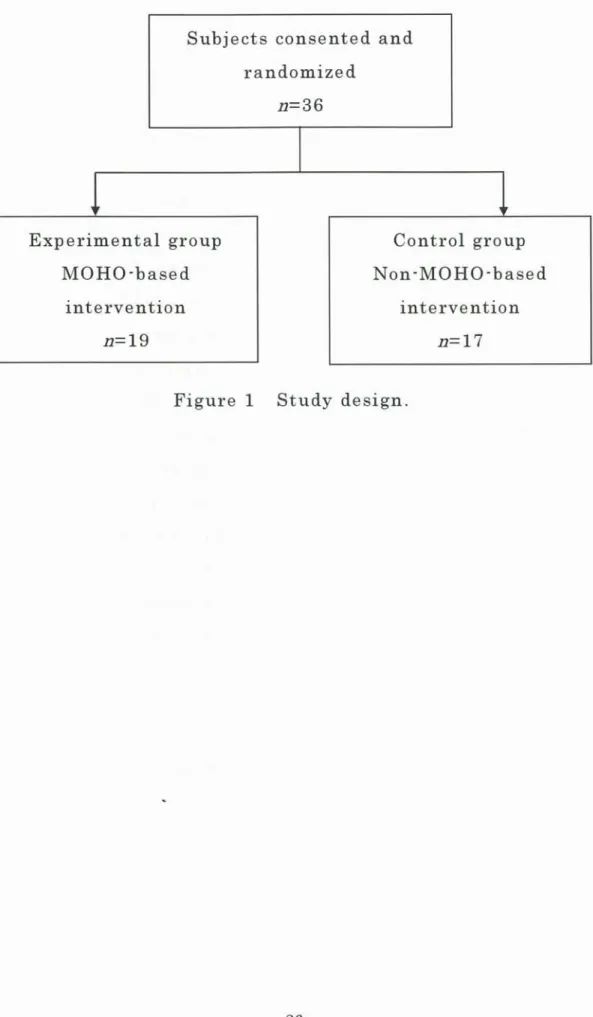
The participants were randomly assigned to an experimental group or a control group (Fig. 1). Both experimental and control groups provided OT intervention adhering to the following

guidelines: (a) the aim of intervention was

maintenance/improvement of ADL and QOL, (b) intervention was provided two times a week, for more than a minimum 20-30 minutes, for 3 months, (c) if a resident was discharged from the Health Care

Facility they would exit the study following completion of study

assessments the day before discharge. The intervention procedures

were in compliance with the established guidelines of the Japanese

Ministry of Health, Labour and Welfare as well as with the

Evaluation/Rehabilitation Synthesis Practice Plan. In the event of

a participant becoming medically unwell, refused OT intervention,

or both, the participant would not receive OT intervention.

(10)

Compliance to intervention was provided in a written report at the end of the intervention for each participant. The occupational therapists in the control group completed assessments appropriate to the biomechanical or neurodevelopmental frames of reference

(e.g., physical function or PF test). The intervention was, therefore, selected by formulating these assessment results using the underpinning frame of reference (i.e., biomechanical,

neurodevelopmental). As a result, the control group experienced physically focused interventions which included transferring between surfaces (i.e., bed/wheelchair), exercises of muscle

strengthening, advice about self-exercises, stretching in sitting position, and walking with a frame (Table 1). The occupational therapists in the experimental group completed MOHO training in order to be able to complete MOHO-based intervention inclusive of administering MOHO assessments effectively, which includes the Japanese Occupational Self-Assessment version 2 (OSA 2) (Yamada

& Ishii, 2004), the Japanese Interest Checklist (Yamada, 1982), and the Japanese Role Checklist (Yamada, Takehara, Ishii, & Ishikawa, 2002). Intervention was individually selected based on formulating the findings of these MOHO assessments using MOHO theory. As a result, the experimental group experienced interventions focused on volition (values, interests, confidence), role performance (meaningful daily responsibilities), and changes to physical environment (Table 2). The occupational therapists in both groups explained the contents of OT intervention and consent was obtained from the participants.

Ethics

This study obtained approval from the Tokyo Metropolitan

(11)

University Arakawa Campus Study Security Ethical Review Board (Acceptance No. 08073).

Data gathering

Data were gathered on participant's gender, age, the day of onset of CVA, the number of years of education of the participant, the number of years of clinical experience of each occupational therapist. The degree of care, having a five-point scale (1 = least care to 5 = maximum carenecessary), was also reported (Ministry of Health, Labour and Welfare of the Japanese Government, 1997).

Outcome measures

Both the experimental group and the control group completed the following assessments at baseline and at 3 months.

1. C-ADL and P-ADL (Division of the Health to the Elderly,

Health and Welfare Bureau for the Elderly, Ministry of Health, Labour and Welfare, 2006 & 2009). It rates 19 ADL items using a

five-point scale of independence, monitoring, partially assistance,

totally assistance, and not seen, and the total score is identified.

2. The Japanese version of QOL-26 (Nakano, Tazaki, & Miyaoka,

1999) rates 26 items related to body, psychology, environment,

social relations, and two questions about the overall QOL.

3. The Japanese version of the Short-Form Health Survey (SF-36)

(Fukuhara, Bito, Green, Hsiao, & Kurokawa, 1998) has

demonstrated Japanese national norms for eight items: a PF, a

(12)

role function of PFs (role physical or RP), body pain (bodily pain), a feeling of health of the whole (general health perception or Gil perception), vitality, a social-life function (social functioning or

SF), a role function of emotional function (role emotional or RE), and mental health (MH) (Matsushita & Matsushima, 2004).

4. The Hasegawa Intelligence Evaluation Scale (revised version of Hasegawa Dementia Scale) (Higashiura, Asaka, Kikuchi, &

Sasaki, 2002) score were used to exclude participants who had dementia.

Methods of analysis

Data were entered and cleaned using standard protocols. We used SPSS15.0J for analysis, which involved the following: (a) baseline demographics of participants, occupational therapists, and

differences of ADL/QOL between the two groups; (b) within-group comparison of the difference of ADL and QOL following the intervention; and (c) difference between groups following the intervention (Nagatani, 2005). The statistical tests included chi-square test, Mann-Whitney ranked score, and t test for Wilcoxon-signed rank test and Mann-Whitney ranked score test.

The statistics assumed a significance of 5% (Coolican, 2009).

Results

The study involved 13 occupational therapists and 36 participants from eight sites. The experimental group contained 19 participants and there were 17 participants in the control group.

None of the participants became unwell or refused OT intervention

(13)

during the period of this study. The participant characteristics are presented in Table 3.

Comparison at baseline

There were no significant differences between the groups based on age, gender, degree of care, or years of education (Table 3). The

"period after onset of CVA" was significantly shorter (p < .05) in the experimental group. Also, years of clinical experience of the occupational therapist was significantly longer in the control group (p < .05). However, there were no significant differences before the intervention on C-ADL and P-ADL and the QOL-26 score (Table 3).

Comparison from baseline to 3 months within group

The experimental group (which received MOHO-based OT) significantly improved on all ADL and QOL indicators (p < .05) following the intervention. The control group (which received non-MOHO-based OT) indicated that there was a significant improvement in ADL (C-ADL and P-ADL) following the intervention (Table 4).

Comparison between experimental and control groups at 3

months

There was no difference between the groups in the number of

intervention episodes received (Table 4). The scores for C-ADL,

P-ADL, all the five domains (a body, psychology, environment,

society, the QOL whole) of QOL-26, and RP, SF, PF, GH perception,

and BP of SF-36 following OT practice were significantly improved

(14)

(p < .05) for the experimental group (Table 4).

Discussion

Use of MOHO in Japan

The use of MOHO within Eastern cultures has been criticized (Iwama, 2003, 2004). This study, however, demonstrates the efficacious use of this conceptual model of practice within a Japanese culture. Indeed, MOHO has received much attention, including criticism, elaboration, application, and empirical testing by occupational therapists throughout the world (Ashby & Chandler, 2010; Haglund, Ekbladh, Thorell, & Hallberg, 2000; Law & McColl, 1989; National Board for Certification in Occupational Therapy, 2004; Wikeby, Pierre, & Archenholtz, 2006). Attempts to apply and test MOHO in different cultures and under different national conditions have provided clinical feedback about how its theoretical arguments and technology for application can best be developed to transcend cultural differences and national boundaries (Auzmendia, de las Heras, Kielhofner, & Miranda, 2008; Kielhofner, Andersen, et al., 2008, Kielhofner, Levin et al., 2008; Kielhofner, Mentrup, Miranda, Schulte, & Shepherd, 2008). MOHO incorporates a respect for each client's individuality and cultural background, and many MOHO assessments capture a client's unique cultural perspective

(Kramer, Bowyer, & Kielhofner, 2008). This view has been supported by the Japanese Association of Occupational Therapists (2006) and though multiple applications of MOHO within this culture (Kawamata & Yamada, 2008; Liu & Ng, 2008; Miura &

Yamada, 2002; Yamada & Ishii, 2003; Yamada & Kobayashi, 2008;

Yamada, Kawamata, Kobayashi, Kielhofner, & Taylor, 2010).

(15)

Moreover, there have been Japanese translations of MOHO assessment tools, including, Assessment of Communication and Interaction Skills (Yamada, 2000a), Pediatric Volitional Questionnaire (Yamada, 2000b), Volitional Questionnaire (Yamada, 2009), MOHO Screening Tool (Yamada, Notoh, & Kobayashi, 2008), Occupational Circumstances Assessment Interview and Rating Scale (Yamada & Ishii, 2011), Child Occupational Self Assessment (Yamada & Arikawa, 2007), Assessment of Occupational Functioning (Yamada & Ishii, 2008), Occupational Performance History Interview (Yamada, Nagatani, & Ishii, 2003), and the Worker Role Interview (Yamada & Nakamura-Thomas, 2007).

Added value of MOHO

The MOHO-based intervention was more effective in the improvement of ADL and QOL scores than non-MOHO-based OT.

The MOHO, therefore, added value as both interventions took the same intervention time; however, MOHO had additional important QOL benefits.

In recent years, the concept of QOL has become more readily

recognised and appreciated within health professions (Wolf & Baum,

2011). It has been embraced within the International Classification

of Functioning, Disability and Health (WHO, 2001), which defines

health as the outcome of the interaction of body function, activity,

and participation as influenced by environmental factors and

personal choice. It is hoped that the link between health and

participation will influence all health professionals working with

stroke survivors to support participation (Wolf & Baum, 2011).

(16)

The experimental group was focused on delivering MOHO interventions which effected changes in the QOL and ADL scores.

This intervention is client centred (Law, 1998) and occupation focused (Kielhofner, 2008a) which included attention to the service users volition (Reilly, 1962). Volition refers to the motivation for occupation. Volition is constructed from personal causation, one's sense of capacity and effectiveness (DeCharms, 1968); interests, what one finds enjoyable and satisfying (Matsutsuyu, 1969); and value, what one thinks is important (Bruner, 1990). Habituation is the process by which occupations are organised into patterns or routines. This includes roles, socially defined set of responsibilities

(Fein, 1990), and habits which are automatic responses (Kielhofner, 2008b). Performance capacity refers to the physical and mental capacities that underlie occupational participation (Kielhofner, Tham, Baz, & Hutson, 2008), and environment (physical and societal) within which the occupations are completed (Kielhofner, 2008a). Occupational therapists specifically identify these unique characteristics for each person in order to develop intervention based on their life experiences.

As a result, all participants in the experimental group

focused on both ADL and activities which were inclusive of being

interesting, made the service user feel competent, were highly

valued, provided them with a role and a meaningful routine. Nine

participants practiced housework (a productive life role) and 13

participants engage-d in a family role and/or a friendship role

through a hobby. In addition, specific service users focused on

specifically improving values (Kielhofner, 2008c) and interests

(Kielhofner, 2008c) through hobbies such as craftwork or woodwork,

housework, and practicing ADL. From this, it can be seen that the

(17)

experimental group were inclusive of all occupational domains (self-care, productivity, and leisure). Reilly emphasised this occupational principal by arguing that therapy should be focused on maintaining the occupational role that has been affected by the service user's diagnosis (Reilly, 1962). Because the experimental

group was specifically focused on meaningful occupation (in comparison with the control group), it could be argued that the influence of occupational roles was effective at improving performance in ADL and QOL. MOHO is a conceptual model of practice which provides specific assessments and intervention

focused on occupational meaning/roles and as such is, therefore, a valuable body of work to support effective OT intervention.

Relationship between role and QOL measures

Routine action is influenced by the fact that each of us belongs to and acts in social systems. Much of what we do is done as a spouse, parent, worker, student, and so on. Having internalised such roles, we act in ways that reflect our role status (Fein, 1990).

Internalising the role means taking on an identity, an outlook, and actions that belong to the role. Consequently, an internalised role is the incorporation of a socially and/or personally defined status and a related cluster of attitudes and actions that underpin occupational participation and QOL (Grossack & Gardner, 1970;

Katz & Kahn, 1966; Turner, 1962). First, they influence the manner

and content of our actions. Moving from one role to another is often

demarcated by such changes as how we dress, our manner of speech,

and our way of relating to others. Second, each role carries with it a

range of actions that makes up that role. Consequently, roles shape

the kinds of things we do. Third, roles partition our daily and

(18)

weekly cycles into times when we inhabit certain roles. The course of each day ordinarily involves a succession of roles and overlapping roles.

In one of the studies, researchers performed QOL-26 and SF-36 on 84 institution elderly residents and reviewed therapy goals (Yamashita et al., 2001). The group which indicated that they had strong therapy goals (e.g., engaging in roles of family member, friend role and/or hobby role) achieved high scores for psychological domain of QOL-26 and MH of SF-36 (Yamashita et al., 2001). Mayo, Wood-Dauphinee, Cote, Durcan, & Carlton (2002) reported that they evaluated QOL of 434 service users with CVAs and the QOL of the service user related to instrumental ADL such as housework (Mayo et al., 2002). Because the experimental group was engaged with hobbies and interactions with families and friends (Yamashita et al., 2001), and practice of instrumental ADL (Mayo et al., 2002), it was thought to have an effect on the QOL.

Study limitations

This study excluded patients who had dementia. The Japanese Ministry of Health, Labour and Welfare has reported 14%

of older adults have dementia and it is the second highest diagnosis (next to CVA) as a causative disease of care required. Moreover, 15%

of dementia conditions are caused by CVA (Ministry of Health, Labour and Welfare-of Japanese Government, 1997). It, therefore, seems important to replicate the study with people who have dementia and had a CVA.

While both groups were more than 12 months from CVA, the

(19)

experimental group had a significantly shorter time from CVA (p

< .01) which was 9 months. While Shimao (2005) reported that ADL gradually decreases over time, Kondo and Ota (1995) reported that a 2-year period is required for psychological and emotional recovery of a person with cerebrovascular disorder. In this study, however, there was no difference between ADL and QOL scores before the intervention.

The number of the participants who were able to perform SF-36 was 56%. However, the QOL-26 was also used which captures the five domains of QOL (physical, psychological, social, environmental, and QOL whole). There was an improvement in the QOL-26 score in the experimental group.

Conclusion

There was an improvement in ADL score in the non-MOHO group following intervention; however, the group receiving MOHO-based intervention had improved ADL scores plus improved QOL outcomes. It could, therefore, be argued that occupational therapists should use an MOHO-based intervention for improving performance in ADL and QOL of service users.

Acknowledgements

We thank occupational therapists and the participants who

had cooperated in this study and the Doctorial students of Yamada's

laboratory of the Graduate Student of the Tokyo Metropolitan

University Graduate School of Human Health Scientific that had

guidance and research workers.

(20)

References

Aida, M., & Matsufusa, T. (2004). Health care facilities for the elderly. In T. Matsufusa & K. Ogawa (Eds.). Standard

occupational therapy. Special field: Occupational therapy in Elderly. Tokyo: Igaku-Shoin (in Japanese).

Ashby, S., & Chandler, B. (2010). An exploratory study of the occupation-focused models included in occupational therapy

professional education programmes. The British Journal of Occupational Therapy, 73(12), 616-624.

Auzmendia, A. L., de las Heras, C. G., Kielhofner, G., & Miranda, C.

(2008). Recrafting occupational narratives. In G. Kielhofner (Ed.), Model of human occupation. Theory and application (4th

ed.). (pp. 313-336) Baltimore: Lippincott Williams & Wilkins.

Bruner, J. (1990). Acts of meaning. Cambridge: Harvard University.

Cohen, J. (1988). Statistical power analysis for the behavioral

sciences (2nd ed.). New York: Academic Press.

Coolican, H. (2009). Significance testing-was it a real effect? In H.

Coolican (Ed.), Research methods and statistics in psychology

(5th ed.). (pp. 322-349) London: Hodder Education.

DeCharms, R. E. (1968). Personal causation: The internal affective

determinants of behaviours. New York: Academic Press.

Division of the Health to the Elderly, Health and Welfare Bureau

for the Elderly, Ministry of Health, Labour and Welfare. (2006) . Question and answer about revision of nursing care insurance

system in April 2006, Vol. 3. Ministry of Health, Labour and Welfare, Retrieved November 27, 2009, from. http://www2.

roken.or.jp.

Division of the Health to the Elderly, Health and Welfare Bureau for the Elderly, Ministry of Health, Labour and Welfare. (2009).

The presentation of basic view, process businesslike conduct

about fee and examples of style on rehabilitation management.

Ministry of Health, Labour and Welfare, Retrieved November 27, 2009, from. http://www2.roken.or.jp.

Feigin, V. L., Lawes, C. M. M., Bennett, D. A., & Anderson, C. S.

(2006). Stroke epidemiology: a review of population-based

studies of incidence, prevalence, and case-fatality in the late

(21)

20th century. Lancet Neurology, 2(1), 43-53.

Fein, M. L. (1990). Role change: A resocialization perspective. New York: Praeger.

Fisher, M., & Norrving, B. (2011). The international agenda for stroke. 1st Global Conference on Healthy Lifestyles and

Noncommunicable Diseases Control Moscow, April 28-29, 2011.

Retrieved July 25, 2011, from: http://www.who.int/nmh/

events/moscow_ncds_2011/conference_documents/second_plenar y_norrving_fisher_stroke.p df.

Fukuhara, S., Bito, S., Green, J., Hsiao, A., & Kurokawa, K. (1998).

Translation, adaptation, and validation of the SF-36 health

survey for use in Japan. Journal of Clinical Epidemiology, 51(11), 1037-1044.

Grossack, M., & Gardner, H. (1970). Man and men: Social psychology as social science. Scranton: International Textbook.

Haglund, L., Ekbladh, E., Thorell, L.-H., & Hallberg, I. (2000).

Practice models in Swedish psychiatric occupational therapy.

Scandinavian Journal of Occupational Therapy, 7(3), 107-113.

Haslam, T., & Beaulieu, K. (2007). A comparison of the evidence of two interventions for self-care with stroke patients.

International Journal of Therapy and Rehabilitation, 14(3), 118-128.

Higashiura, H., Asaka, T., Kikuchi, S., & Sasaki, M. (2002). The influence of aging according to the item of the revised version of

Hasegawa's dementia scale. Journal of Hokkaido Physical

Therapy, 19, 61-64, (in Japanese).

Iwama, M. (2003). Toward culturally relevant epistemologies in occupational therapy. The American Journal of Occupational

Therapy, 57(5), 582-588.

Iwama, M. (2004). Meaning and inclusion: revising culture in occupational therapy. The Australian Occupational Therapy

Journal, 51(1), 1-2.

Japanese Association of Occupational Therapists. (2006). White paper occupational therapy 2005. The Journal of Japanese

Association of Occupational Therapists, 9, 25-36, (in Japanese).

Japanese Association of Rehabilitation Medicine. (2006). Revision

of social insurance medical fee concerned with rehabilitation

medicine in 2006. The Japanese Journal of Rehabilitation

Medicine, 43(5), 268-276, (in Japanese).

(22)

Katz, D., & Kahn, R. L. (1966). The social psychology of organizations. New York: Wiley.

Kawamata, H., & Yamada, T. (2008). A pilot study concerning of the effectiveness of grogram based on the model of human

occupation for preventive health promotion for the independently living elderly people in Retirement Housing.

Japanese Journal of Occupational Behavior, 11(2), 73-79, (in Japanese).

Kielhofner, G. (2008a). Introduction to the model of human occupation. In G. Kielhofner (Ed.), Model of human occupation:

Theory and application (4th ed.). (pp. 1-7) Baltimore: Lippincott

Williams & Wilkins.

Kielhofner, G. (2008b). Habituation: Patterns of daily occupation.

In G. Kielhofner (Ed.), Model of human occupation. Theory and application (4th ed.). (pp. 51-67) Baltimore: Lippincott Williams

& Wilkins.

Kielhofner, G. (2008c). Volition. In G. Kielhofner (Ed.), Model of human occupation. Theory and application (4th ed.). (pp. 32-50)

Baltimore: Lippincott Williams & Wilkins.

Kielhofner, G., Andersen, S., Last, D., Roitman, D., Brettschneider,

J., Vercruysse, L., et al. (2008). Applying MOHO to clients who are cognitively impaired. In G. Kielhofner (Ed.), Model of human occupation. Theory and application (4th ed.). (pp. 337e354)

Baltimore: Lippincott Williams & Wilkins.

Kielhofner, G., Levin, M., Egan, B., Moody, A., Skubik-Peplaski, C.,

& Rockwell-Dylla, L. (2008). Facilitating participation through

community-based interventions. In G. Kielhofner (Ed.), Model of human occupation. Theory and application (4th ed.). (pp.

355-378) Baltimore: Lippincott Williams & Wilkins.

Kielhofner, G., Mentrup, C., Miranda, C., Schulte, D., & Shepherd,

J. (2008). Enabling clients to reconstruct their occupational

lives in long-term settings. In G. Kielhofner (Ed.), Model of human occupation. Theory and application (4th ed.). (pp.

379-404) Baltimore= Lippincott Williams & Wilkins.

Kielhofner, G., Tham, K., Baz, T., & Hutson, J. (2008). Performance

capacity and the lived body. In G. Kielhofner (Ed.), Model of human occupation. Theory and application (4th ed.). (pp. 68-84)

Baltimore: Lippincott Williams & Wilkins.

Kondo, K., & Ota, T. (1995). Changes with time in Barthel index of

(23)

early stroke rehabilitation patients. Journal of Clinical

Rehabilitation, 4(10), 986-989, (in Japanese).

Kramer, J., Bowyer, P., & Kielhofner, G. (2008). Evidence for practice from the model of human occupation. In G. Kielhofner

(Ed.), Model of human occupation. Theory and application (4th ed.). (pp. 466-505) Baltimore: Lippincott Williams & Wilkins.

Lae, M., Cooper, B. A., Strong, S., Stewart, D., Rigby, P., & Letts, L.

(1997). Theoretical contexts for the practice of occupational

therapy. In C. Christiansen, & C. Baum (Eds.), Occupational therapy= Enabling function and well -being (2nd ed.). (pp. 73-102)

Thorofare: Slack.

Lai, S. M., Studenski, S., Duncan, P. W., & Perera, S. (2002).

Persisting consequences of stroke measured by the stroke impact

scale. Stroke, 33(7), 1840-1844.

Law, M. (1998). Client centered occupational therapy. Thorofare:

Slack. Law, M., & McColl, M. A. (1989). Knowledge and use of theory among occupational therapists: A Canadian survey.

Canadian Journal of Occupational Therapy, 56(4), 198-204.

Liu, K. P. Y., & Ng, B. F. L. (2008). Usefulness of the model of human occupation in the Hong Kong Chinese context.

Occupational Therapy in Health Care, 22(2-3), 25-36.

Matsushita, T., & Matsushima, E. (2004). The relationship between

QOL and lifestyle in the middle-aged and elderly. The Journal of Japan Academy of Health Sciences, 7(3), 156-163, (in Japanese).

Matsutsuyu, J. (1969). The interest check list. The American

Journal of Occupational Therapy, 23(6), 323-328.

Mayo, N. E., Wood-Dauphinee, S., Cote, R., Durcan, L., & Carlton, J.

(2002). Activity, participation, and quality of life 6 months poststroke. Archives of Physical Medicine and Rehabilitation, 83(8), 1035-1042.

Mentrup, C., Niehaus, A., & Kielhofner, G. (1999). Applying the model of human occupation in work-focused rehabilitation: a

case illustration. Work, 12(1), 61-70.

Ministry of Health, `Labour and Welfare of Japanese Government.

(1997). Comprehensive survey of living conditions of the people on health and welfare for 1997. Ministry of Health, Labour and

Welfare, Retrieved September 1, 2010, from. http://www.

mhlw.go.jp.

Miura, S., & Yamada, T. (2002). A trial of reevaluation applying the

(24)

model of human occupation for the client who could not return to his own home. Japanese Journal of Occupational Behavior, 6(1),

18-24, (in Japanese).

Morgan, D., & Jongbloed, L. (1990). Factors influencing leisure activities following a stroke: an exploratory study. Canadian

Journal of Occupational Therapy, 57(4), 223-229.

Morgans, L., & Gething, S. (2002). Cerebrovascular incident. In A.

Turner, M. Foster, & S. Johnson (Eds.), Occupational therapy

and physical dysfunction. Principles, skills and practice (pp.

477-488). Edinburgh: Churchill Livingstone.

Moriyama, S. (2008). Functional prognosis. In Y. Sugawara (Ed.), Textbook of occupational therapy. Occupational therapeutics (4),

physical disability (3rd ed.). (pp. 53) Tokyo: Kyodo Isho Shuppan,

(in Japanese).

Nagatani, R. (2005). Qualitative and quantitative research. In T.

Yamada (Ed.), Standard occupational therapy. Special field

methods of studying about occupational therapy. Tokyo: Igaku-

Shoin, (in Japanese) .

Nakane, Y., Tazaki, M., & Miyaoka, E. (1999). WHOQOL-BREF

survey of general population. The Health Care Science Institute,

9(1), 123-131, (in Japanese).

National Board for Certification in Occupational Therapy. (2004). A practice analysis study of entry-level occupational therapist

registered and certified occupational therapy assistant practice.

OTJR, Occupation, Participation and Health, 24(Suppl. 1), Sl-S31.

Ochi, H. (2004). How to practice the rehabilitation in

cerebrovascular accident. The Japanese Journal of

Rehabilitation Medicine, 41(2), 91-93, (in Japanese).

Oshima, S. (2006). What is acute and recovery rehabilitation. Japan Association of Rehabilitation Hospital and Institution.

Retrieved July 25, 2006, from. http://www.rehakyoh.jp.

Pedretti, L. W., & Early, M. B. (2001). Occupational therapy: Skills for practice for physical dysfunction. Maryland Heights: Mosby.

Reilly, M. (1962). The Eleanor Clarke Slagle Lecture. Occupational

therapy can be one of the great ideas of 20th century medicine.

American Journal of Occupational Therapy, 16, 1-9.

Saeki, G., Okazaki, T., & Hachisuga, K. (2005). Quality of life

concerned with health rehabilitation and cerebrovascular

(25)

accident. Sogo Rehabilitation, 33(11), 1003-1007, (in Japanese).

Shimao, H. (2005). When and how judge a prognosis of activities of daily living in cerebrovascular disorder patients. In H.

Hurukawa (Ed.), Understanding occupational therapy (pp.

71-85). Tokyo: KOBUNDO, (in Japanese).

Shinohara, K., & Yamada, T. (2008). Historical analysis of studies

related to evidence-based occupational therapy and frames of reference in occupational therapy for cerebrovascular Accidents

within the past 20 years in Japan: Reviewing literatures

between 1986 and 2006. Japanese Journal of Occupational

Behavior, 11(2), 80-88, (in Japanese).

Shinohara, K., & Yamada, T. (2010a). Three cases report concerning

with the intervention of model of human occupation based occupational therapy for the clients in amaintenance termof

cerebrovascular accidents inhealth carefacilities for theelderly.

Japanese Journal of Occupational Behavior, 14(1), 41-50, (in Japanese).

Shinohara, K., & Yamada, T. (2010b). Effectiveness of MOHO-based

Intervention for participants with CVA in the maintenance

phase: Comparing MOHO-based interventions with other theorybased intervention. The Journal of Japanese Association

of Occupational Therapists, 29(4), 422434, (in Japanese).

Suzuki, H. (2010). Cerebrovascular accident. In T. Yamada (Ed.), Occupational therapy in the disabled elderly (pp. 12-15). Tokyo:

Chuo-Houki Publishing, (in Japanese).

Turner, R. (1962). Role-taking, process versus conformity. In M.

Rose (Ed.), Human behavior and social processes (pp. 20-40).

Boston: Houghton Mifflin.

Wide'n-Holmqvist, L., de Pedro-Cuesta, J., Holm, M., Sandstro"m,

B., Hellblom, A., Stawiarz, L., et al. (1993). Stroke rehabilitation in Stockholm. Basis for late intervention in

patients living at home. Scandinavian Journal of

RehabilitationMedicine, 25(4), 173-181.

WFOT. (2004). What is occupational therapy?. Retrieved April 15, 2011, from. http://www.wfot.org/information.asp.

WHO. (2001). The International Classification of Function,

Disability and Health. Geneva: WHO (ICF).

WHO. (2003). Stroke. Retrieved July 25, 2011, from. http://www.

who.int/ncd surveillance/ncds/strokerationale/en/.

(26)

WHO. (2011). The atlas of heart disease and stroke. Retrieved July 25, 2011, from. http://www.who.int/cardiovascular_diseases/

resources/atlas/en!.

WHO. (2011a). Stroke, cerebrovascular accident. Retrieved July 25, 2011, from. http://www.who.int/topics/cerebrovascular_

accident/en/.

Wikeby, M., Pierre, B. L., & Archenholtz, B. (2006). Occupational

therapists' reflection on practice within psychiatric care: a Delphi study. Scandinavian Journal of Occupational Therapy, 13(3), 151-159.

Wolf, T. J., & Baum, C. M. (2011). Improving participation and quality of life through occupation. In G. Gillen (Ed.) (pp. 66-79).

St. Louis: Elsevier Mosby.

Yamada, T. (1982). The NPI interest checklist. Physical and occupational therapy, 16(6), 391-397.

Yamada, T. (2000a). The Japanese version of a user's manual for the assessment of communication and interaction skills (ACIS)

version 4.0. Tokyo: The Japanese Society of Occupational

Behavior (in Japanese).

Yamada, T. (2000b). The Japanese version of a user's guide to the pediatric volitional questionnaire version 1.0. Tokyo: The

Japanese Society of Occupational Behavior (in Japanese).

Yamada, T. (2009). The Japanese version of the manual of volitional

questionnaire, version 4.0. Tokyo: The Japanese Society of Occupational Behavior (in Japanese).

Yamada, T., & Arikawa, M. (2007). The Japanese version of a user's guide to the child occupational self assessment (COSA). Tokyo:

The Japanese Society of Occupational Behavior (in Japanese).

Yamada, T., & Ishii, Y. (2003). Occupational therapy for supporting

an elderly woman who had experience of deaths of her friends which make her conditions worse through using occupationalself

assessment. Japanese Journal of Occupational Behavior, 7(2), 54-59, (in Japanese).

Yamada, T., & Ishii; Y. (2004). A user's manual for the Japanese

version of the occupatipnal self assessment (version 2.1). Tokyo:

The Japanese Society of Occupational Behavior (in Japanese).

Yamada, T., & Ishii, Y. (2008). A manual for the assessment of occupational functioning, collaborative version (AOF-CV).

Tokyo: The Japanese Society of Occupational Behavior (in

(27)

Japanese).

Yamada, T., & Ishii, Y. (2011). The Japanese version of a user's manual for the occupational circumstances assessment

interview and rating scale (OCAIRS). Tokyo: The Japanese

Society of Occupational Behavior (in Japanese).

Yamada, T., Kawamata, H., Kobayashi, N., Kielhofner, G., & Taylor, R. R. (2010). A randomised clinical trial of a wellness

programme for healthy older people. The British Journal of Occupational Therapy, 73(11), 540-548.

Yamada, T., & Kobayashi, N. (2008). A prevention occupational

therapy program for the community-dwelling elderly.

Proceedings of the 67th Annual Meeting of Japanese Society of Public Health, Fukuoka, Japan, October 2008, 380 (in

Japanese).

Yamada, T., Nagatani, R., & Ishii, Y. (2003). The Japanese version of the user's manual for the occupational performance history

interview (OPHI-II) (version 2.0). Tokyo: The Japanese Society

of Occupational Behavior (Japanese).

Yamada, T., & Nakamura-Thomas, H. (2007). The Japanese version of the user's guide to the worker's role interview (WRI) (version

10.0). Tokyo: The Japanese Society of Occupational Behavior (in Japanese).

Yamada, T., Notoh, H., & Kobayashi, R. (2008). The Japanese

version of a user's manual for the model of human occupation

screening tool (MOHOST). Tokyo: The Japanese Society of Occupational Behavior (in Japanese).

Yamada, T., Takehara, S., Ishii, Y., & Ishikawa, T. (2002). Some empirical evidence of the Japanese version of role checklist.

Japanese Journal of Occupational Behaviour, 6(2), 55-61.

Yamamoto, M., & Yamada, T. (1997). A study on the relationships

among role performance, role value and life satisfaction of the persons with cerebrovascular accidents. Japanese Journal of

Occupational Behavior, 4(1), 1-5, (in Japanese).

Yamashita, A., Korrdo, K., Tanaka, T., Monna, T., Iba, K., &

Kinoshita, M. (2001). Concerning with feeling something one

lives for related quality of life of an old person in a nursing home

for the aged. Journal of Health and Welfare Statistics, 48(4),

12-19, (in Japanese).

(28)

Subjects consented and randomized

n=36

.

Experimental group MOHO -based

intervention n=19

Control group Non-MOHO-based

intervention n= 17

Figure 1 Study design.

(29)

Tablel Control Group Intervention.

The below points indicate the range of interventions

provided to the control group. Each person had a uniquely identified set of interventions based on his/her needs.

ADL

Each of the below interventions was designed to promote physical performance in ADL/ physically based QOL.

o Dressing

o Toileting

o Walking in parallel bars o Walking with a cane

o Walking outdoors

o Wheelchair advice

o Transferring between bed and wheelchair

o Muscle strengthening exercises for legs o Exercise of stretching in a sitting position

o Exercise of muscle strengthening for unaffected

arm and range of motion

o Exercise of muscle strengthening for the trunk in supine position

o Exercise of recovery of the voluntary movement

of affected arm, leg, and trunk o Thermal therapy

o Massage therapy

= activities of daily living; QOL = quality of life.

(30)

Table 2 Experimental Group Intervention.

The points below indicates the range of interventions provided to the experimental group. Each person had a uniquely identified set of interventions based on his/her needs.

People received appropriate ADL interventions described above with additional elements of intervention described below.

Each of the below interventions were designed to promote the person's volition, habituation, performance capacity,

engagement with social and physical environments on the basis of MOHO-based assessments.

o Walking outdoors, picking flowers, pressing flowers,

making wall hangings as present for son and grandchild

and for display in cultural festival

o Washing dishes and doing housework (e.g., hanging washed clothes to dry, quilting and handicraft)

o Sewing with friends

o Walking outdoors with family members as part of routine o Writing letter to a family member

o Using a computer

o Doing laundry with family

o Writing dairy with a writing brush and sharing diary with family

o Coloring the image of Buddha

o Sharing narrative writings with others o Knitting

o Making some crafts with friends at day care

o Gardening with a friend and followed a record of floral growth

o Woodworking (previous job before CVA) o Weaving basket as a gift for grandchild

o Engaging in karaoke to practice vocalization

o Playing golf

o Making coffee and miso soup

ADL = activities of daily living; CVA model of human occupation.

= cerebrovascular acci dent; MOHO =

(31)

Table 3 Demographic Participants, and Year therapists.

Characteristics for Both of Clinical Experience of

Group occupational

Experimental group

(n= 19)

Control group (n= 17)

Comparison of

two groups P Characteristics

for participations

Gender

Age

From onset month after stroke

Degree of Care

Years of education

Year(s) of clinical

experience of ` occupational

therapists

Male 9 Female

72.

13.

4±8 10

.7

8±8.9

3.0,3.0

12. 0±2.3

3.8±1.0

Male 6, Female

11 75.1±11.

4

21.7±7.8

3.0,2.0

10. 9±3.0

5.8±3.6

.347

.415

.004**

271 195

.046*

Data are presented as standard deviation; *

(median, p< .05; **

quartile) p< .01.

or mean± SD. SD =

Figure 1  Study  design.
Table  3  Demographic  Participants,  and  Year  therapists.

参照

関連したドキュメント

Concisely, the purpose of our work is to assess the impact of the reservoir on the trans- mission dynamics of EVD by coupling a bat-to-bat model with a human-to-human model through

The calibration problem for the Black-Scholes model was solved based on the S&amp;P500 data, and the S&amp;P 500 call and put option price data were interpreted in the framework

This paper deals with the a design of an LPV controller with one scheduling parameter based on a simple nonlinear MR damper model, b design of a free-model controller based on

On the other hand, for the Weisskopf-Wigner (WW) model (i.e., the Dicke model in the rotating wave approximation), we know that a non-perturbative ground state appears in the case

This approach is not limited to classical solutions of the characteristic system of ordinary differential equations, but can be extended to more general solution concepts in ODE

It is suggested by our method that most of the quadratic algebras for all St¨ ackel equivalence classes of 3D second order quantum superintegrable systems on conformally flat

We formalize and extend this remark in Theorem 7.4 below which shows that the spectral flow of the odd signature operator coupled to a path of flat connections on a manifold

The main technical result of the paper is the proof of Theorem 3.3, which asserts that the embeddability of certain countable configurations of elements into some model of the