• 検索結果がありません。

サイバーセキュリティ投資評価手法に関する研究

N/A
N/A
Protected

Academic year: 2021

シェア "サイバーセキュリティ投資評価手法に関する研究"

Copied!
160
0
0

読み込み中.... (全文を見る)

全文

(1)

九州大学学術情報リポジトリ

Kyushu University Institutional Repository

サイバーセキュリティ投資評価手法に関する研究

石川, 朝久

https://doi.org/10.15017/1928635

出版情報:Kyushu University, 2017, 博士(工学), 課程博士 バージョン:

権利関係:

(2)

Doctoral Dissertation

A Study on Evaluation Methodology of Cybersecurity Investment

Tomohisa Ishikawa

Department of Informatics

Graduate School of Information Science and Electrical Engineering

Kyushu University

October 2017

(3)
(4)

Contents

Contents i

List of Figures v

List of Tables vii

Abstract viii

Abstract (Japanese) xii

Acknowledgments xv

1 Introduction 1

1.1 Backgrounds . . . . 1

1.2 Motivation . . . . 2

1.3 Related Works . . . . 3

1.4 Challange and Contribution . . . . 4

1.4.1 Price of Personally Identifiable Information . . . . 5

1.4.2 Corporate Value Evaluation as an Intangible Costs . . . . . 6

1.4.3 Effectiveness of Cyber Risk Insurance . . . . 7

2 Overview of Security Strategy and Security Investment 9 2.1 Introduction . . . . 9

2.2 Building Security Strategy . . . . 9

2.2.1 Step 1 : Building Security Standards . . . . 9

2.2.2 Step 2 : Analysis of the Status Quo . . . . 10

2.2.3 Step 3 : Risk Visualization . . . . 10

2.2.4 Step 4 : Building Roadmap . . . . 11

2.3 Security Investment Effectiveness Evaluation . . . . 11

2.3.1 ROSI (Return On Security Investment) . . . . 12

2.3.2 TCO Minimization . . . . 13

2.3.3 Mathematical Approach . . . . 14

2.4 Expected Damage Estimation . . . . 14

2.4.1 Tangible Cost Estimation . . . . 14

2.4.2 Intangible Cost Estimation . . . . 17

2.5 Case Study . . . . 20

2.5.1 Case Study 1 : Target . . . . 20

(5)

2.5.2 Case Study 2 : Home Depot . . . . 22

3 The Price of Personally Identifiable Information in Data Breach 24 3.1 Introduction . . . . 24

3.1.1 Attack Vector . . . . 24

3.1.2 Challange . . . . 25

3.1.3 Contribution . . . . 26

3.2 Compensation After PII Breach . . . . 27

3.2.1 The United States of America . . . . 27

3.2.2 Global Trends in Legislation and Regulations . . . . 28

3.2.3 Japan . . . . 29

3.3 JO Model . . . . 29

3.3.1 Value of Information Leaked . . . . 30

3.3.2 Degree of Social Responsibility of the Organization . . . . . 31

3.3.3 Appraisal of Post-Incident Response . . . . 32

3.3.4 The Application of JO Model . . . . 32

3.4 Survey Research . . . . 34

3.4.1 Actual Trends in Compensation of PII Leakage . . . . 34

3.4.2 Gap Analysis between JO Model and Reality . . . . 37

3.4.3 Japanese Lawsuit Trends . . . . 39

3.4.4 The Comparison Between U.S. and Japan . . . . 40

3.5 The Challenge in PII Value and Concept . . . . 41

3.5.1 Searchability . . . . 41

3.5.2 Cancellability . . . . 42

3.5.3 Retrievability . . . . 42

3.6 Conclusion . . . . 43

4 Intangible Cost Estimation by Twitter Sentiment Event Study 44 4.1 Introduction . . . . 44

4.1.1 Motivation . . . . 44

4.1.2 Challange . . . . 45

4.1.3 Contribution . . . . 45

4.2 General Dataset Analysis . . . . 46

4.2.1 Stock Price Data Overview . . . . 46

4.2.2 Tweet Reputation Index Overview . . . . 46

4.2.3 Data Simlirality . . . . 47

4.2.4 Data Difference . . . . 48

4.2.5 Dataset Sumamry . . . . 50

4.3 Event Study Methodology . . . . 50

4.3.1 Terminology . . . . 50

4.3.2 Step 1: The Estimation of Theoretical Stock Price . . . . 51

4.3.3 Step 2: The Calculation of AR . . . . 52

4.3.4 Step 3: The Calculation of CAR . . . . 53

4.3.5 Step 4: The Statistical Test . . . . 53

4.4 Sentimental Analysis . . . . 54

4.4.1 Technology . . . . 54

(6)

4.4.2 Research Trends . . . . 55

4.5 Proposed Model . . . . 55

4.5.1 Terminology . . . . 55

4.5.2 Module 1 : Tweet Gathering Module . . . . 56

4.5.3 Module 2 : Sentimental Analysis Module . . . . 57

4.5.4 Module 3 : TRI Calculation Module . . . . 57

4.5.5 Event Study Analysis Module . . . . 58

4.6 Experiment . . . . 60

4.6.1 Case 1 : GMO Payment Gateway . . . . 60

4.6.2 Case 2 : Correlation Analysis with Stock Price . . . . 64

4.6.3 Case 3:Applicability . . . . 66

4.7 Conclusion . . . . 68

5 The Effectiveness of Cyber Risk Insurance 70 5.1 Introduction . . . . 70

5.1.1 Cyber Risk Insurance Market . . . . 70

5.1.2 Challange . . . . 72

5.1.3 Contribution . . . . 72

5.2 Basics and Challenge of Insurance . . . . 73

5.2.1 Insurance Mechanism . . . . 73

5.2.2 The Challenge of Cyber Risk Insurance . . . . 74

5.3 The Status Quo of Cyber Risk Insurance . . . . 77

5.3.1 Coverage . . . . 78

5.3.2 Premium . . . . 80

5.3.3 Payment Claims . . . . 80

5.4 Cyber Risk Insurance vs. Outsourcing . . . . 81

5.5 Theoritical Assumption of Insurance Design . . . . 83

5.6 Qualitative Analysis . . . . 84

5.7 Quantitative Analysis . . . . 85

5.7.1 Simulation Overview . . . . 85

5.7.2 Model Building . . . . 87

5.7.3 Simulation . . . . 91

5.8 Results and Analysis . . . . 91

5.8.1 Investment Constraint . . . . 93

5.8.2 Average Relative Cost . . . . 93

5.8.3 ROSI : Return On Security Investment . . . . 93

5.8.4 Effectiveness Evaluation of Cyber Risk Insurance . . . . 94

5.8.5 The Comparison with Actual Example . . . . 95

5.8.6 Analysis from Insurance Company Sides . . . . 96

5.9 Conclusion . . . . 96

6 Conclusions 98 6.1 Concluding Remarks . . . . 98

6.2 Future Issues . . . . 99

Appendix 100

(7)

A Experimental Data of Proposed Event Study Methodology 101

A.1 Introduction . . . 101

A.2 Public Sectors Example . . . 101

A.3 Side Effect Elimination . . . 102

A.4 Standardized Cumulative Abnormal Return . . . 104

Publications 106

References 108

Index 142

(8)

List of Figures

2.1 Target Stock Price (from Yahoo Finance) . . . . 20

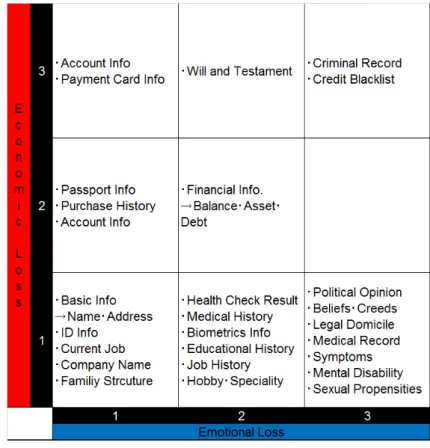
3.1 Economic Privacy Map . . . . 31

3.2 Simple EP Map . . . . 32

3.3 Compensation Cost Mapping . . . . 36

3.4 Total Compensation Cost Map . . . . 38

3.5 Gap Analysis Between Reality and JO Model Results . . . . 38

4.1 Timeline in Event Study . . . . 51

4.2 Abnormal Return / Cumulative Abnormal Return . . . . 61

4.3 The Comparison between Stock Price Data and Twitter Data . . . 62

4.4 The Comparison of Apache Struts2 Vulnerability Impact . . . . 64

4.5 The Comparison of Stock Price and Tweet Reputation Index . . . . 65

4.6 The Application of Non-Public Organizations (JTB) . . . . 67

5.1 Simulation Algorithm . . . . 92

A.1 Example : TRI-CAR of Saga Prefecture . . . 102

A.2 Example : Side Effect Elimination . . . 103

A.3 Standardized Cumulative Abnormal Return . . . 105

(9)

List of Tables

2.1 Security Framework, Maturity Model, Best Practice, and Regulation 10

2.2 TCO Minimization Example - Security Investment Options . . . . . 13

2.3 TCO Minimization Example - Approach . . . . 13

2.4 Security Damage Estimation Framework . . . . 15

2.5 Event Study Research Papers of Security Incident . . . . 18

2.6 Target Settlement in Class Action . . . . 21

3.1 Degree of Ease in Identifying the Individual . . . . 31

3.2 Degree of Social Responsibility of the Organization . . . . 32

3.3 Appraisal of Post-Incident Response . . . . 33

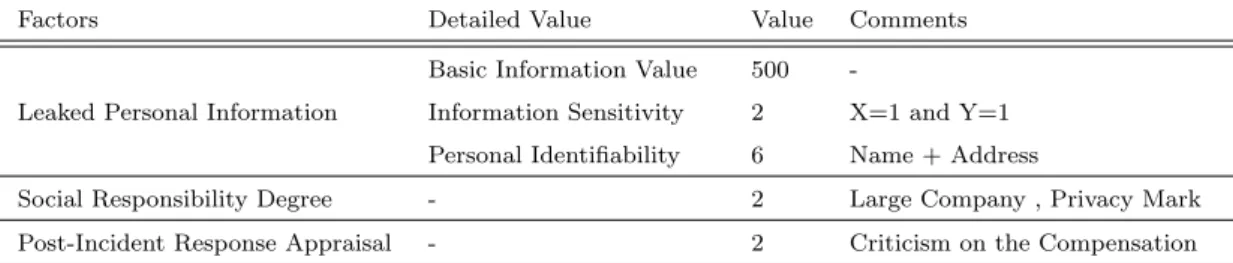
3.4 Configured Parameter in Benesse Corporation Incident . . . . 33

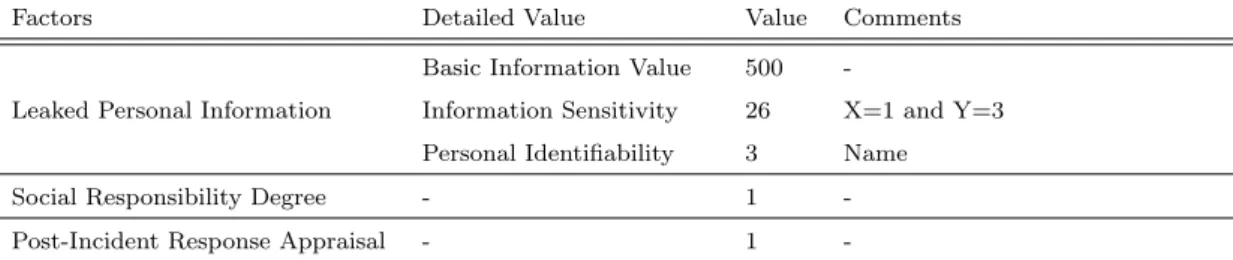
3.5 Configured Parameter in JINS Corporation Incident . . . . 34

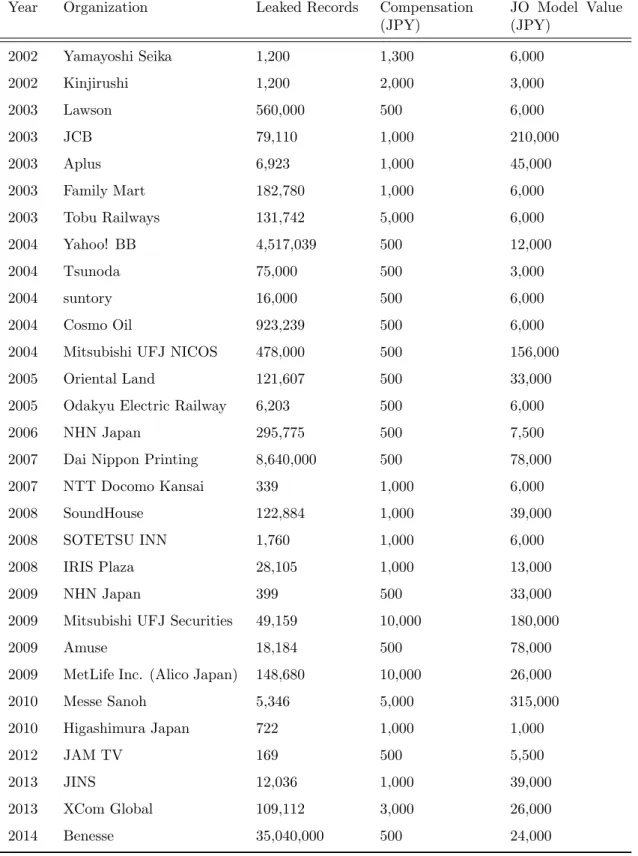
3.6 Spontaneous Compensation . . . . 35

3.7 Average Price of Compensation (N=45) . . . . 37

3.8 Compensation Decided by Lawsuit . . . . 39

3.9 Average Price of Compensation (N=6) . . . . 39

4.1 Experimental Condition (GMO Payment Gateway) . . . . 61

4.2 The Comparison between Stock Price and Twitter Data . . . . 62

4.3 Correlation Analysis 1 : GMO (same as Table 4.2) . . . . 66

4.4 Correlation Analysis 2 : Nippon TV . . . . 66

4.5 Correlation Analysis 3 : Piped Bits . . . . 66

4.6 Correlation Analysis 4 : JINS . . . . 66

4.7 Experimental Condition (JTB) . . . . 67

5.1 Disclosed Damage Cost . . . . 86

5.2 Initial Parameter : Model Company . . . . 87

5.3 Initial Parameter : The existence probability of the vulnerability . . 88

5.4 Initial Parameter : Data Breach Decision Algorithm . . . . 88

5.5 Security Investment 1 : Security Assessment . . . . 89

5.6 Security Investment 2 : Cyber Risk Insurance . . . . 89

5.7 Breach Cost : Total Costs . . . . 90

5.8 Breach Cost : Incident Response Cost . . . . 90

5.9 Initial Parameter : Customer Liability (Compensation) . . . . 91

5.10 Initial Parameter : Customer Liability (Q&A) . . . . 91

5.11 Simulation Scenarios . . . . 92

5.12 Experiment Results (Unit : cases, 1 million JPY) . . . . 93

(10)

5.13 Experiment Results (Unit : cases, 1 million JPY) . . . . 94

5.14 Insurance Coverage Ratio & Insurance ROSI . . . . 95

A.1 Experiment Condition . . . 103

A.2 Experiment Target . . . 104

(11)

Abstract

Since cybersecurity incidents happened every day, the senior management team has recognized that cybersecurity issue is not IT issue, but a management issue.

Also, they have recognized that the implementation of countermeasures is critical.

As long as each organization implements appropriate security controls by following the guidelines or regulations, many security incidents are preventable. However, we do not have any reasonable standards to decide the amount of security investment, and it is one of the challenges in cybersecurity strategy.

To validate the appropriateness of cybersecurity countermeasures, we need to estimate expected damage cost by using the model or past examples. We need to consider not only “Tangible Cost” such as an investigation or customer follow-up cost, but also “Intangible Cost” such as the decline of corporate value, customer loyalty, and corporate branding. From research fields of the evaluation methodol- ogy in cybersecurity investment, we pick up three critical challenges as follows.

The first challenge is the gap between real compensation value and theoretical value. In 2003, “JO model” was formulated, and it has been a benchmark for cal- culating the compensation cost of the personally identifiable information breach.

The background of this model had three reasons. Firstly, the Supreme Court de- cided the compensation price in a lawsuit case in 2002. Secondly, “Act on the Protection of Personal Information” was published in 2003. Thirdly, many victim- ized companies hesitated to disclose detailed information about security incidents.

On the contrary, a security breach in 2003 became the defacto-standard to pay

500 JPY coupons for the data breach, and this has led to making the disparity

between model and the reality.

(12)

The second challenge is that we do not have an approach to evaluate corpo- rate value impact in security incidents for the companies not having stock price data, although event study methodology by using stock price data is a well-known approach. This known method assumes that stock price means corporate value, and calculates Cumulative Abnormal Return (CAR) for understanding short-term impact by the security incident. It is powerful, but we need a new method since we cannot apply the traditional method to the organizations not having stock price data such as private companies, government agencies, and non-profit organizations.

The third challenge is that we do not have enough analysis about the effec- tiveness of cyber risk insurance. Cyber risk insurance is a typical risk transfer approach, but the mechanism, risk assessment, and deployment of cyber risk in- surance are in dawning age. Also, we cannot use traditional actuarial science approach. Because of this situation, the effectiveness of cyber risk insurance is controversial. However, cyber risk insurance is powerful since it makes volatile incident cost to fixed cost, and it will become a more valuable solution. Therefore, we need to analyze the effectiveness of cyber risk insurance by using simulative approach.

This doctoral dissertation is organized as follows.

Chapter 1 shows the background and motivation of evaluation methodology of cybersecurity incidents. In addition to this, we discuss the academic challenges and our contributions to this area.

Chapter 2 presents the background knowledge and related works about in- vestment evaluation methodology in cybersecurity and cost estimation methods.

By analyzing the previous works, we identify the academic challenge and their backgrounds.

In Chapter 3, by case study analysis about the compensation of personally

identifiable information, we have three major contributions in this area. Firstly,

we analyze 45 cases of Japanese personally identifiable information leakage, and

we find that the value of average spontaneous compensation is 543 JPY, and

(13)

the theoretical value by JO model is 60 times higher than this average price.

Secondly, we did case study analysis about lawsuits in Japan and U.S. In Japan, the compensation is more than 5,000 JPY in Japan, although one in U.S. is averagely less than one dollar. We think Japanese compensation value is averagely higher than U.S., and we find that it is caused by the difference of compensation style.

Thirdly, we analyze how to handle personally identifiable information in the current situation, and we point out three data characteristics model should include.

In Chapter 4, we propose new corporate valuation method by defining the value named Tweet Reputation Index (TRI), to evaluate targeted organizations instead of stock price in security incidents. Tweet Reputation Index is a cumu- lative emotion value against the targeted entities by unit time after performing sentiment analysis against Tweets related to them. As same as stock price data, we calculate Cumulative Abnormal Return(TRI-CAR: Tweet Reputation Index Cumulative Abnormal Return) from this Tweet Reputation Index, and we can estimate the event impact on corporate value. As case studies by applying this method, we have two contributions. Firstly, with the analysis of public enterprises, we demonstrate our approach, and we confirm high correlations (Correlation Coef- ficient: +0.8) between stock price data and Tweet Reputation Index in short-term (3 days before and after the Event Day) by analyzing both data. Secondly, we apply this method to the non-public organization not having stock price data, in order to prove the applicability of our proposed approach.

In Chapter 5, firstly, we analyze the mechanism, current service, and challenge

of cyber risk insurance from the technical and economic perspective. Secondly,

we have cost-benefit analysis from the quantitative perspective. Since the result

of simulation will be changed based on the risk scenario such as the occurrence

of information leakage or the number of leaked data, we performed analysis by

using Monte-Carlo simulation. In the case study by using virtual companies, we

acquire the result that ROSI ( Return on Security Investment ) is approximately

200 times, and the coverage of cyber risk insurance is approximately 65%. We

(14)

conclude that cyber risk insurance is beneficial for security management and risk management perspective.

Chapter 6 shows our conclusion and further research issues.

(15)

Abstract (Japanese)

サイバーセキュリティ事故は毎日のように発生しており、サイバーセキュリティは IT の問題ではなく、経営マネジメントの問題と認識され、対策の推進が重要とさ れる。セキュリティ対策は、ガイドライン・規制を参考に適切に実装すれば、そ の多くを予防可能である。しかし、セキュリティ対策をどこまで実施すればよい か投資基準は明らかでなく、セキュリティ戦略上の課題である。

セキュリティ投資の妥当性を検証するため、モデル・過去事例を通して妥当 な想定被害額の算出が重要となる。調査費用や顧客対応費用など「有形コスト」

(Tangible Cost)のみならず、企業価値・ブランディング低下など「無形コスト」

( Intangible Cost )についても検討が必要である。本論文では、セキュリティ投資

評価手法に関して次の重要な3つの課題を研究した。

第一に、個人情報漏洩時の賠償価格について、理論モデルの算出価格と実際に 訴訟・自主的な「お詫び」を通じて支払われる金額に乖離がある。 2003 年に「 JO モデル」が定式化され、個人情報漏洩時の賠償価格を算出するベンチマークが提 案された。この背景には、2002 年に関する個人情報漏洩の賠償金の判例が出たこ と、 2003 年に個人情報保護法が制定されたこと、事故情報の開示件数が非常に少 ないことが挙げられ、現在でも利用されている。一方、 2003 年の情報セキュリティ 事故を前例に、事故発生時には 500 円の金券を送付することが慣習化された。

第二に、セキュリティ事故発生時における企業価値への影響を評価する手法と して、株価の時系列情報を利用したイベント・スタディ手法が知られているが、株 価を持たない企業には応用ができないという課題が存在する。この既存手法は、

「株価が企業価値を示す指標である」という前提の下、イベント前後の株価の変動

に注目して「累積異常変化率」を算出し、イベントが株価にもたらす短期的影響

を分析する方法である。しかし、非上場企業などに応用できないため、既存手法

(16)

の応用範囲の観点から改善が必要となる。

第三に、「サイバー保険」について、投資の有効性分析が十分に行われていな い。保険は代表的なリスク転移手法であるが、サイバー保険の制度設計・導入の 黎明期であるため、伝統的な保険数理手法が使えず、有効性・費用対効果につい て様々な意見・議論がある。しかし、変動性の高い費用を固定化する「サイバー 保険」は、今後より重要になると推測される。様々な条件を入力して評価を実施 できる手法を採用し、現時点での有効性を示す必要がある。

本学位論文は以下のように構成される。

第1章では、本研究の背景と目的を述べる。また、本研究の主要な課題と貢献 についても論じる。

第2章では、セキュリティ投資評価手法と被害額推定手法に関する背景知識と 既存手法について説明する。既存研究を体系的に整理することで、上記で挙げた 研究課題を抽出した。

第3章では、第一に日本における個人情報漏洩事件 45 件の事例分析を行い、企 業が金券・商品券を送付した平均金額が 543 円であり、 JO モデルの理論値と 60 倍 以上の差異があることを示した。第二に、米国と日本における訴訟について事例 分析を行った。日本では賠償金額が1名当たり平均 5,000 円以上である一方、米国 では平均 1 ドル以下であることを突き止め、日本の賠償金額が平均的に高いこと、

および賠償に対する考え方の違いを論じた。第三に、個人情報の取り扱われ方の 変化について検討を行い、モデルが改善すべき点について「検索容易性」、「変更 容易性」、「回収容易性」という3つの特徴を指摘した。

第4章では、株価の代替として、 「ツイート感情指数」を定義し、インシデント による企業価値への影響を測定する手法を提案した。「ツイート感情指数」とは、

調査対象企業のツイートに対して感情分析を行い、数値化されたデータを単位時

間毎に累積した値である。この「ツイート感情指数」の時系列情報に対して、イ

ベント・スタディ手法を適用し「累積異常変化率」を算出することにより、イン

シデントの影響を分析する。事例分析では以下の結果を得た。第一に、上場企業

の株価・ 「ツイート感情指数」の両時系列情報に対してイベント・スタディを実施

し、短期間(イベント日前後1日を含む計3日間)の範囲で、両時系列情報に相

(17)

関係数 0.8 以上の強い相関性があり、「ツイート感情指数」が株価の代替として利 用可能であることを示した。第二に、非上場企業の事例について考察を行い、企 業価値の影響を測定できることを示した。

第5章では、第一にサイバー保険の仕組み・現状・課題について、技術的・経 済学的の観点から分析を実施した。その後、具体的な想定事例を元に、定量的な 費用便益分析を実施した。情報漏洩の発生確率や漏洩件数など想定シナリオによ り結果が変化するため、モンテカルロ・シミュレーションを利用して考察を行っ た。被害コストの公開事例に基づく仮想企業の事例では、投資対効果は約 200 倍、

保険の被害額カバー率は約 65% という結果となり、サイバー保険が被害額を抑え、

有効性があるという結論を得た。

第6章では本研究の結論を述べ、今後の研究課題について論じる。

(18)

Acknowledgement

I would like to thank all the researchers and colleagues who helped me in this thesis. Especially, I would like to thank my supervisor, Professor Kouichi Sakurai, who has supervised me for years and provided me valuable discussions, critics, and advice at any time. Also, I would like to express my gratitude to Associate Professor Daisuke Ikeda and Associate Professor Shingo Saito because they pro- vide valuable comments and advice to my doctoral dissertation. In addition to this, I thank my external advisor Dr. Naohiko Uramoto and Professor Masakatsu Nishigaki, who gave me helpful suggestions to my research paper, and Professor Reiko Aoki had insightful comments. Lastly, I would like to thank Dr. Mike David and Mr. Kurt Sauer for helping my doctoral dissertation in English perspective.

I would like to thank my all supervisors and colleagues in my workplace, who provided tremendous knowledge and skills of cybersecurity, much valuable sup- port, and a lot of challenges. In addition to this, I would like to offer my special thanks to all friends in infosec community since I have always acquired cutting-edge knowledge from practical and academic perspective.

Lastly and most importantly, I wish to thank my loving and supportive my

wife, Nagisa, and my wonderful daughter, Rin, who provide tremendous support

and unending inspiration.

(19)

Chapter 1 Introduction 1

Chapter 1 Introduction

1.1 Backgrounds

Information breach and unauthorized attack are continuously happened, such as the serial security attack to SONY group by Anonymous and LulzSec in 2011 [1], serial APT attack to Blue Cross in 2014 [2–5], breach from governmental office [6–8], private company [9], SNS [10], and cybersecurity is one of the serious risks for each organization. In Keynote of RSA Conference USA 2015 [11], RSA President, Mr. Amit Yoran named these situations as “Dark Age”.

Because of these situations, security management has been considered to be important. In order to response these requests, there are many documents, frame- work and maturity model, describing the best practice of security management, have been released by authorized organizations. On top of that, industry group or public administration office tends to provide standards and regulations, such as PCI-DSS [12], NYDFS Cybersecurity Regulation [13], or MAS Technology Risk Management [14], to maintain appropriate security maturity. According to re- search by National Policy Agency (hereinafter NPA) [15], 98.5% of organizations answered “implementation of security control is necessary”, and 61.7% of organi- zations responded “Our organization should have an investment actively to infor- mation security”.

Originally, cybersecurity was an IT problems, but currently, cybersecurity is

acknowledged as one of management risks. According to “Global Risk Report

(20)

Chapter 1 Introduction 2

2015” of World Economic Forum [16], cyber attack, and data leakage is a high-risk issue from possibility and impact. Also, leading credit rating agency, Standard

& Poor’s, announced that the companies that do not have appropriate security countermeasure might be downgraded although they do not have security inciden- nts [17]. In addition to this, METI (Ministry of Economy, Trade, and Industry) and IPA (Information Processing Agency) released the security guideline, “Cy- bersecurity Management Guidelines” [18] for senior management, and it clearly mentioned the necessity of security investment as a management strategy and the responsibility of senior management team. From this tendency, security manage- ment has been one of the business challenges offered by markets.

1.2 Motivation

The majority of security incidents can be avoidable when each organization im- plements necessary security controls in best practice and appropriate operation process, that will be mention in Table 2.1. However, from business process and cost perspectives, it is difficult to implement and manage all security control, and also, it requires huge budgets. In addition to this, the effective security investment concept has not been released or authorized yet. According to NPA survey [19], 51.3% answered “it is difficult to identify minimum standards of security control”, 47.3% answered that “it is difficult to know cost-effectiveness of each security con- trol”, and 42.5% answered that “security control takes too many costs”. Also, 35.4% of companies answered “not using security services” and 43.7% of them answered “only limited budget for IT security”, 32.9% answered “security control cost is inappropriate”.

It is a common problem around the world. For example, PwC report [20]

mentioned that many organizations struggled to understand how much cost each

organization needs to spend on security and how to determine the return on in-

vestments of their security outlay. Also, British Government research report [21]

(21)

Chapter 1 Introduction 3

revealed that 24% of small and midium-sized enterprise (hereinafter SME) men- tioned that security was too expensive and 22% answered that they “don’t know where to start”. Therefore, we think it is a challenging topic to propose the methodology to judge and evaluate security investment from a realistic and prac- tical perspective as the security strategy.

On top of that, in the white paper “The Second National Strategy on Infor- mation Security” [22] published in 2009 by NISC (National Information Security Policy Council), this document proposed a keyword “Accident Assumed Society”, and the direction of security control measure has been changed. According to NIST security framework [23], security countermeasures are categorized into five cate- gories including, Identification, Prevention, Detection, Response, and Recovery.

Before 2009, typical Japanese companies focused on identification and prevention, but recently, from a security perspective, these companies tended to shift the focus of security investment to post-countermeasure including detection, response, and recovery. Based on this, these companies started to calculate the cost of security incidents seriously and the framework about security investments as if security incidents is necessary.

1.3 Related Works

Security investment is a critical phase for building security strategy. In chapter 2, we will show three critical issues to understand the current view of this area.

Risk Visualization and Quantification Methodology

Building corporate security strategy is a critical part of security improvement,

but risk visualization and quantification is the pre-requisite to consider security

investment. In Chapter 2, we will show general steps of creating security strategy

in business fields and risk visualization and quantification methodology.

(22)

Chapter 1 Introduction 4

Security Investment Effectiveness Evaluation

CISO and security team need to show the effectiveness of security investment against visualized risks and gain the approval by senior management team. Es- pecially, the research related to IT security investment evaluation methodology is theorized based on the knowledge of other areas such as IT investment evaluation theory and corporate valuation methodology. In Chapter 2, we can show the cur- rent research methodology. The basic idea is the comparison of expected damage between having security investment and not having security investment, and verify the effectiveness of investments.

Expected Damage Estimation

In the effectiveness evaluation process of security investment, the most important issue is how to estimate the expected loss. Since effectiveness evaluation is entirely dependent on this assessed value, we need to pursue the accuracy as soon as practical. In Chapter 2, we will show current research and challenge.

1.4 Challange and Contribution

One of the general challenges of this area is how to estimate expected damage cost and the possibility of occurrence. Generally speaking, the companies having the experience of security incident do not tend to disclose the detailed costs of security incidents, and this tendency prevents the researchers from improving the algorithm of expected damage cost. From public information, the only way to know the cost is seeing an extraordinary loss in a financial report. Therefore, since we have only limited data, it is difficult to have analytical and mathematical decision-making from these data.

Based on this situation, we can see following specific issues for considering

security investment.

(23)

Chapter 1 Introduction 5

1.4.1 Price of Personally Identifiable Information

The first challenge is the gap between real compensation value and theoretical value. In 2003, NPO Japan Network Security Association (hereinafter JNSA) for- mulated JO model (JNSA Damage Operation Model for Individual Information Leak), and it has been a benchmark for calculating the compensation cost of per- sonally identifiable information. The background of formulating this model was three reasons. Firstly, on July 11, 2002, the Supreme Court judged that Uji City had to pay 15,000 JPY as compensation [24] (Technically, 10,000 JPY is for so- latium, and 5,000 JPY is for the compensation coverage of legal cost.) Secondly, in 2003, “Act on the Protection of Personal Information” [25] was published, and it was likely to increase the awareness of protecting personally identifiable infor- mation. Thirdly, the detailed information related to cybersecurity incidents had not released during this period. From these reasons, JNSA tried to create calcula- tion model of personally identifiable information, and it has been a great resource to consider the leakage. On the contrary, in 2003, Lawson, leading retail chain, leaked 560,000 records of personally identifiable information, and they proactively decided to send 500 JPY gift certificate to all 1.15 million exclusive customers including the customers who were not victims of this breach. Based on this ex- ample, many companies those leaked customer information referred this case, and 500 JPY coupons became a defacto-standard price of data breach cases in Japan.

We think this current situation has the difference from theoretical JO model.

In Chapter 3, by case study analysis about the compensation of personally identifiable information, we have three major contributions in this area. Firstly, we analyze 45 cases of Japanese personally identifiable information leakage, and we find that the value of average spontaneous compensation is 543 JPY, and theoretical value by JO model has more than 60 times gap from this average price.

Secondly, we have case study analysis about lawsuit case in Japan and U.S. In

Japan, the compensation is more than 5,000 JPY in Japan, although one in U.S. is

(24)

Chapter 1 Introduction 6

averagely less than one dollar. We think Japanese compensation value is averagely higher than U.S., and we find that it is caused by the difference of compensation style. Thirdly, we analyze how to handle personally identifiable information in the current situation, and we point out three data characteristics that model should include. The first factor is “Searchability”. Many people recently tend to open the primitive personally identifiable information to SNS platform and attackers can gain them without any security breach. The problem is, by the information leakage, attackers or the meddling third party can link the breached data (the data users do not want to disclose such as porn history data or purchase history) to disclosed data in SNS. We think this undesirable linkage is one of the keywords for improving the model. The second factor is “cancellability”, and it means that some data such as password can be changeable after information breach although some information such as date of birth can not be. We consider the lifecycle of data is one of the important factors. The last element is “Retrievability, ” and it means the possibility of the prevention of leaked information proliferation. In the case of internal fraud, it is easy to prevent the spread of leaked data because police or investigation organization can take over the data. However, it is difficult to remove the information online as we learned in Winny case.

1.4.2 Corporate Value Evaluation as an Intangible Costs

The second challenge is that we have the limited approaches to evaluate the im-

pact of corporate value in security incidents for the companies that do not have

stock price data. As the evaluation method of corporate value impact by security

incidents, the application of event study methodology by using stock price data

is a modern approach. Event study methodology is analyzing the short-term im-

pact to corporate value by an event, such as M&A announcement or new product

release, by examining the volatility of stock price before and after the event and

calculating the Cumulative Abnormal Return (hereinafter CAR). CAR allows us

to have the quantitative analysis of corporate value impact. The assumption of

(25)

Chapter 1 Introduction 7

this approach is that market capitalization calculated by stock price means the corporate value. In related works, many researchers apply this methodology to analyze information security incidents and to examine the short-term impact on corporate value. However, this method is entirely dependent on the stock price data, and we think it is a challenge that we cannot analyze the various cases. For example, we can not examine the organizations, which do not have stock price data such as private companies and governmental agency.

In Chapter 4, we propose new corporate valuation method by defining the value named Tweet Reputation Index (hereinafter TRI), to evaluate targeted organiza- tions instead of stock price in security incidents. Tweet Reputation Index is a cumulative emotion value against the targeted entities by unit time after perform- ing sentiment analysis against Tweets related to them. As same as stock price data, we calculate Cumulative Abnormal Return (hereinafter TRI-CAR: Tweet Reputation Index Cumulative Abnormal Return) from this Tweet Reputation In- dex, and we can estimate the event impact on corporate value. As a case study by applying this method, we have two contributions. Firstly, with the analysis of public enterprises, we demonstrate our approach, and we confirm high correlations (Correlation Coefficient: +0.8) between stock price data and Tweet sentiment data in short-term (3 days before and after the Event Day) by analyzing both data. Sec- ondly, we apply this method to the non-public organization not having stock price data, in order to prove the applicability of our proposed approach.

1.4.3 Effectiveness of Cyber Risk Insurance

The third challenge is that we do not have enough quantitative analysis about the

effectiveness of cyber risk insurance that is a new risk finance method. Cyber risk

insurance is a typical risk transfer approach, but the mechanism and deployment

of cyber risk insurance are in dawning age. In addition to this, the occurrence

of cyber risk is different from other hazards. We can not use traditional actual

science approach, and insurance companies are now considering the cyber risk

(26)

Chapter 1 Introduction 8

assessment method. However, since the awareness of cyber attack is increasing, the cost for incident response will be large in the future. Therefore, the cyber risk insurance will be a more valuable solution since cyber risk insurance makes the volatile incident cost to fixed cost. Therefore, we think we need to analyze the effectiveness of cyber risk insurance by using simulative approach.

In Chapter 5, we evaluate the effectiveness of cyber risk insurance from the quantitative perspective. Firstly, we analyze the mechanism, current service, and challenge of cyber risk insurance from the technical and economic perspective.

Secondly, we have cost-benefit analysis from the quantitative perspective. Since the results of simulation will be changed based on the risk scenario such as the occurrence of information leakage or the number of leaked data, we have the anal- ysis by using Monte-Carlo simulation. The benefit of this model is we can add and modify the initial parameters based on the risk preference and risk scenario.

In the case study by using a virtual company, we acquire the result that ROSI

( Return on Security Investment ) is approximately 200 times, and the coverage of

cyber risk insurance is approximately 65%. We conclude that cyber risk insurance

is beneficial for security management and risk management perspective.

(27)

Chapter 2 Overview of Security Strategy and Security Investment 9

Chapter 2

Overview of Security Strategy and Security Investment

2.1 Introduction

As we mentioned in Chapter 1, security investment is a very critical phase of building cybersecurity strategy, and it is not an IT issue but a corporate manage- ment problem. Since security countermeasure cannot contribute the profitability of organizations, CISO and security team have to prepare a comprehensive secu- rity strategy in order to justify the investment. In this chapter, we show current methodology and research of building security strategy, security investment effec- tiveness evaluation, and expected cost estimation.

2.2 Building Security Strategy

According to the research paper by NRI [26], a leading IT consulting firm in Japan, when we consider the security strategy in the business field, we have following steps.

2.2.1 Step 1 : Building Security Standards

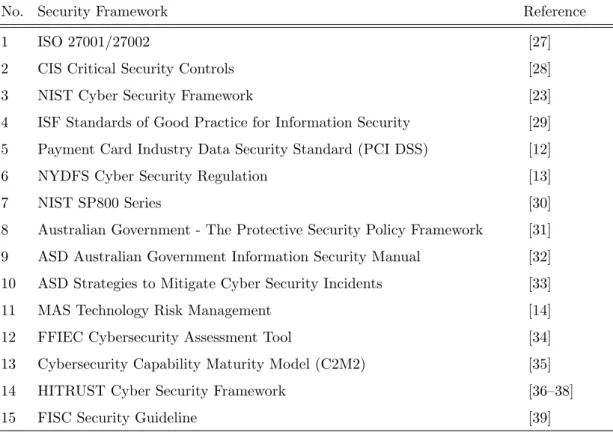
As Step 1, we prepare the goal and security standards by using various documents

as we show in Table 2.1. It is a critical phase because we need to define the

goal and objectives. One of the important things at this stage is understanding

the characteristics of each best practice document because each document has

different scope, granularity, and depth of descriptions.

(28)

Chapter 2 Overview of Security Strategy and Security Investment 10

Table 2.1: Security Framework, Maturity Model, Best Practice, and Regulation

No. Security Framework Reference

1 ISO 27001/27002 [27]

2 CIS Critical Security Controls [28]

3 NIST Cyber Security Framework [23]

4 ISF Standards of Good Practice for Information Security [29]

5 Payment Card Industry Data Security Standard (PCI DSS) [12]

6 NYDFS Cyber Security Regulation [13]

7 NIST SP800 Series [30]

8 Australian Government - The Protective Security Policy Framework [31]

9 ASD Australian Government Information Security Manual [32]

10 ASD Strategies to Mitigate Cyber Security Incidents [33]

11 MAS Technology Risk Management [14]

12 FFIEC Cybersecurity Assessment Tool [34]

13 Cybersecurity Capability Maturity Model (C2M2) [35]

14 HITRUST Cyber Security Framework [36–38]

15 FISC Security Guideline [39]

2.2.2 Step 2 : Analysis of the Status Quo

Secondly, we analyze the status quo from various perspectives such as 4P (Pol- icy, Product, Process, People) or management resource (Human Resource, Goods, Budgets, Time, Information). Regarding analysis technique, there is a different method such as questionnaire, documents evaluation, interview, onsite review, and cyber fire drill, but we need to have a balance between cost and analysis accuracy.

2.2.3 Step 3 : Risk Visualization

After collecting the various information of current environment, we can visualize

risk. One of the usual approaches is known as baseline approach. It is the gap

analysis by comparing between defined standards (baseline) and current status. In

many cases, we typically use metrics technique (risk quantification) approach or

risk scenario approach. Especially, risk scenario approach is very powerful since

it visualizes how current security control mechanism can stop the threat from

(29)

Chapter 2 Overview of Security Strategy and Security Investment 11

Defense-In-Depth perspective.

2.2.4 Step 4 : Building Roadmap

Finally, we build a roadmap and the plan of security investment. Based on visu- alized risks, we consider the options for security investment and the effectiveness.

In building roadmap phase, one of the critical concepts is risk treatment strategy.

Risk treatment strategy is how to treat the risk based on the risk impact and risk preference. There are four strategies including Risk Avoidance, Risk Mitiga- tion, Risk Transfer, and Risk Acceptance. We need to classify the identified risks based on these categories.

In addition to this, from a financial perspective, Risk Finance is also impor- tant and ISO 31000 [40] defines this keyword and shows two options named Risk Acceptance and Risk Transfer. Risk Acceptance means accepting the risks and preparing the retained earnings for the future security incidents. On the contrary, Risk Transfer implies transferring the risk to the third party by using insurance.

Cyber risk insurance, which is recently notable, is one of the practical options in risk finance context.

2.3 Security Investment Effectiveness Evaluation

The methodology of security investment effectiveness evaluation is one of the crit-

ical activity since CISO and security team need to explain the effectiveness and

gain the approval of security investment. The basic idea is the comparison of

expected damage between having security investment and not having security in-

vestment, and verify the effectiveness of investments. Many research papers apply

the knowledge of other areas such as IT investment evaluation theory and corpo-

rate valuation methodology. In following parts, we show various methods proposed

by related research papers.

(30)

Chapter 2 Overview of Security Strategy and Security Investment 12

2.3.1 ROSI (Return On Security Investment)

One of the popular frameworks is ROSI (Return On Security Investment). Origi- nally, this ROSI idea is from CBA (Cost-Benefit Analysis) approach in accounting domain. This idea is a simple, but a very powerful concept. According to ENISA reports [41], ROSI is defined as follows.

ROSI = Loss Reduction Security Investment

Security Investment (2.1)

“Loss Reduction” means that expected loss reduction by security investment.

“Security Investment” means the monetary cost of security investment including initial cost, operation cost, learning cost, and process reforming cost. According to this definition, as long as ROSI is larger than 1, we can determine that these options are cost-effective.

On top of that, “Loss Reduction” is defined as follows when we apply ALE (Annual Loss Expectancy) theory. ALE approach is estimating risks based on an annual basis. It was proposed in 1975 by the National Bureau of Standards in Federal Information Processing Standard 65, “Automatic Data Process Risk Analysis” [42].

Loss Reduction = ALE mALE (2.2) Annual Loss Expectancy (ALE) is a monetary loss that can be expected from a particular risk on a specific asset in one year. mALE means “modified ALE” by security investment. The definition is as follows.

ALE = ARO SLE (2.3)

Annual Rate of Occurrence (ARO) is a measure of the probability that a

risk occurs in a year. Single Loss Expectancy (SLE) means the total cost of an

incident assuming its single occurrence.

(31)

Chapter 2 Overview of Security Strategy and Security Investment 13

2.3.2 TCO Minimization

Lawrence Gordon and Martin Loeb, who are economists at the University of Mary- land, proposed TCO (Total Cost of Ownership) minimization theory in a famous book named “Managing Cybersecurity Resource: A Cost-Benefit Analysis” [43].

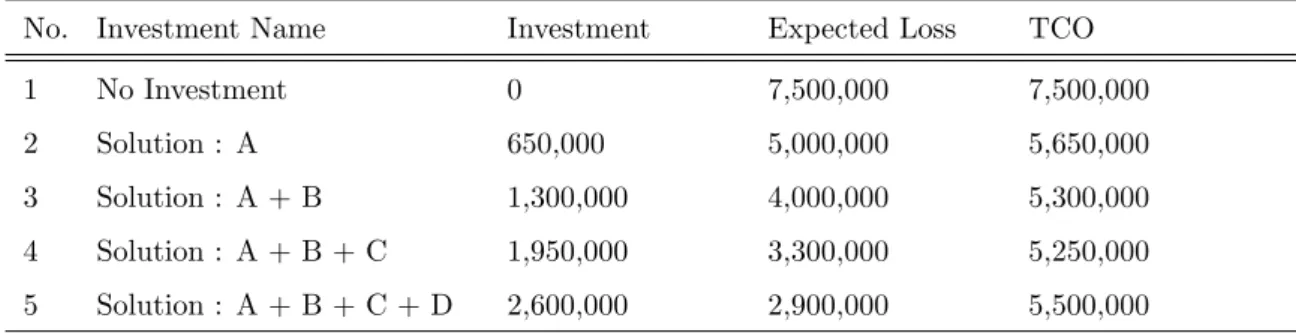
It is also a simple but powerful concept to evaluate the security investment since this idea can answer a question like “what is the necessary baseline of security investment?”. For example, when we have following security investment as Table 2.2, TCO theory can be helpful to decide optimal security investment.

Table 2.2: TCO Minimization Example - Security Investment Options

No. Investment Name Poential Loss Investment Probability of Loss

1 No Investment 10,000,000 0 0.75

2 Solution : A 10,000,000 650,000 0.50

3 Solution : A + B 10,000,000 1,300,000 0.40

4 Solution : A + B + C 10,000,000 1,950,000 0.33

5 Solution : A + B + C + D 10,000,000 2,600,000 0.29

After calculating expected loss and TCO (Expected Loss + Investment), we can understand that No.4 minimizes TCO as Table 2.3 shows, and we can assume this is the optimal investment.

Table 2.3: TCO Minimization Example - Approach

No. Investment Name Investment Expected Loss TCO

1 No Investment 0 7,500,000 7,500,000

2 Solution : A 650,000 5,000,000 5,650,000

3 Solution : A + B 1,300,000 4,000,000 5,300,000

4 Solution : A + B + C 1,950,000 3,300,000 5,250,000

5 Solution : A + B + C + D 2,600,000 2,900,000 5,500,000

This approach is similar to introductory economics such as maximizing profit by

considering marginal costs. Gordon and Loeb generalized this concept by applying

economic approach and modeling. They constructed optimal investment theory

[44] named “Gorden & Loeb Model” (GLEIS Model). This study provided that

(32)

Chapter 2 Overview of Security Strategy and Security Investment 14

security investment should not exceed 1/e( 36.79%) of the expected loss of a security breach. Many researchers improved and verified this study [45–48].

2.3.3 Mathematical Approach

Another approach is applying combinational optimization theory in mathematics for security investment evaluation. For example, Sasaki et al. proposed to use combinational optimization method to Fault Tree describing the causal relation- ship between threat and countermeasure [49, 50]. Also, Nakamura et al. proposed generalized modeling methods [51, 52]. In addition to this, as a similar approach, some research applied game theory to risk assessment. For example, Carin et al.

proposed the QuERIES model (Quantitative Evaluation of Risk for Investment Efficient Strategies) as risk assessment approach by using game theory [53, 54] and other researchers proposed similar approach [55–60].

2.4 Expected Damage Estimation

One of the most difficult things in security investment effectiveness evaluation is estimating expected damage and cost. It is because effective evaluation is totally dependent on this estimation. Before consideration of damage estimation, we describe the type of costs.

Tangible Cost

It is the cost of direct losses, including website downtime, forensic investiga- tion cost, customer follow-up cost, and legal cost.

Intangible Cost

It is the indirect losses, including the loss of customer loyalty, reputation damage, and corporate branding damage.

2.4.1 Tangible Cost Estimation

For the tangible cost estimation, there are several approaches to estimate the costs.

(33)

Chapter 2 Overview of Security Strategy and Security Investment 15

Approach 1 : Analytical Framework Approach

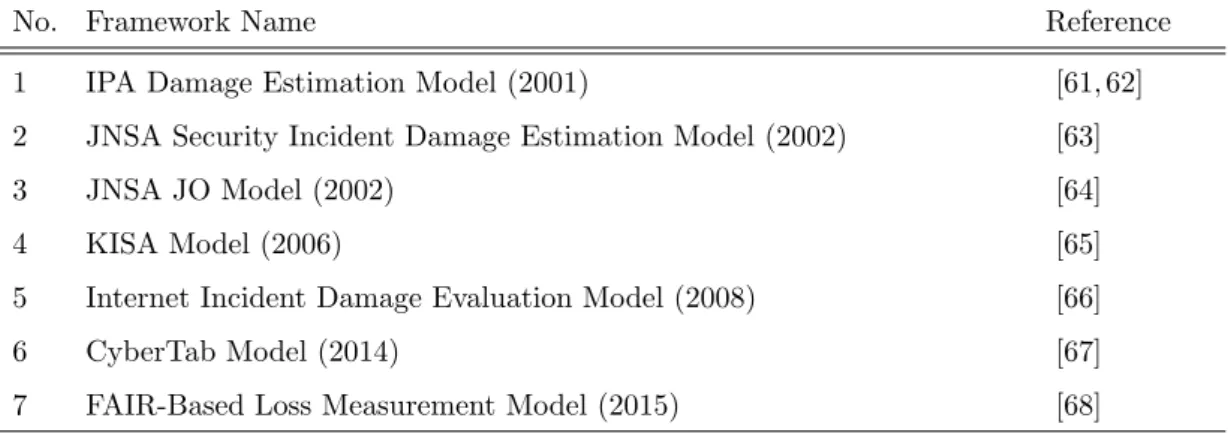
The first approach is analytical framework approach. This approach provides the items and perspectives affecting the amount of damage and estimating the damage cost based on the framework. Table 2.4 shows the related works.

Table 2.4: Security Damage Estimation Framework

No. Framework Name Reference

1 IPA Damage Estimation Model (2001) [61, 62]

2 JNSA Security Incident Damage Estimation Model (2002) [63]

3 JNSA JO Model (2002) [64]

4 KISA Model (2006) [65]

5 Internet Incident Damage Evaluation Model (2008) [66]

6 CyberTab Model (2014) [67]

7 FAIR-Based Loss Measurement Model (2015) [68]

For example, CyberTab proposed by The Economist Intelligence Unit is re- markable calculation framework to consider the incident cost of specific incidents because it includes many perspectives including legal expenses and corporate com- munication costs that are easily missed.

Also, In South Korea, research on loss estimation has been done actively. In 2013, several Korean organization got the cyber attacks (known as 3.20 cyber attack), and research group in KAIST (Korean Advanced Institute of Science and Technology) estimated damage with Internet Incident Damage Evaluation Model, and it concluded 867.2 billion won [69].

Approach 2 : Statistical Data Approach

The second approach is called as statistical data approach. Many security service vendors and security consulting firms publish the statistical data based on the sur- vey and the log data generated by their services. As a cost evaluation perspective, we can utilize these data to estimate the impact of the security incident.

For example, Incapsula Inc., that is a leading DDoS solution vendor, revealed

that the average per-hour costs by DDoS attacks were 40,000 USD [70]. Also,

(34)

Chapter 2 Overview of Security Strategy and Security Investment 16

Ponemon Institutes report [71] taught us that information leakage cost per records was 158 USD in 2016. As another example, PwC [20] mentioned that large com- panies had a more significant financial loss than SME(small and medium-sized enterprise), and the average financial loss of large companies having more than 1 billion USD revenue was 5.9 million USD, although companies having less than 100 million USD was 0.41 million USD. In addition to this, British Government report [72] had a similar conclusion that the breach cost of the large organization was between 600,000 GBP and 1.15 million GBP although the one of SME was between 65,000 GBP and 115,000 GBP.

In different perspective, indirect data is also helpful. For example, “Cisco 2017 Annual Cybersecurity Report” [73] revealed that following facts.

24% of breached organizations lost customers, and 40% of them lost more than 20 percent of their customer)

29% of breached organizations lost revenue, and 38% of them lost more than 20% of revenue.

23% of breached organizations lost business opportunities, and 42% of them lost more than 20% of them.

Another example is “Flipping the Economics of Attacks” [74] by Ponemon Institute. They concluded interesting data.

An increase of approximately two days (40 hours) in the time required to conduct successful cyber attacks can eliminate as much as 60 percent of all attacks.

On average, a technically proficient attacker will quit an attack and move on

to another target after spending approximately a week (209 hours) without

success.

(35)

Chapter 2 Overview of Security Strategy and Security Investment 17

Approach 3 : Simulation Approach

The third approach is simulation approach. This method estimated a reasonable cost with Monte-Carlo Simulation. Conrad [75] applied Monte-Carlo Simulation to security incident cost estimation based on ALE modeling and he concluded that Monte-Carlo Simulation was an effective method. After this report, Burtescu [76]

created a model with ALE model and risk level analysis, and he found that these methods was efficient for risk management by considering risk level classification.

Lyon [77] analyzed the effectiveness of SANS Critical Security Control by using Monte-Carlo Simulation.

2.4.2 Intangible Cost Estimation

For intangible cost estimation, it is wise to search for alternative indicators instead of calculating direct costs because it is tough to estimate the actual intangible cost of security breaches. Many researchers tried to evaluate corporate value loss as

“intangible cost” by security incidents because we assumed that the decrease of corporate value was one of the typical examples of indirect losses. They applied corporate valuation methodology in corporate finance theory because the evalu- ation of corporate value loss was typical research area in the corporate finance field. We introduce two standard approaches, that is also applied to information security.

Accounting Approach with “Matched Sample Comparison”

“Matched Sample Comparison” is a scientific approach to reveal the impact of one condition difference by preparing two groups called “Control Group” and “Treat- ment Group”. This scientific technique is applicable for the evaluation of corpo- rate valuation impact by security incident from an accounting perspective. This accounting approach revealed that long term impact of security incidents since it analyzes the annual report of victimized companies.

For example, Gorden, Loeb, and Sohail [78] had an accounting analysis of

(36)

Chapter 2 Overview of Security Strategy and Security Investment 18

the market value impact by using Ohlson Model. Ohlson model was one of the corporate valuation methods by using net asset value on the balance sheet and net income in profit and loss sheet. This study added the other elements of voluntary disclosure of security incident.

Ko and Dorantes [79] applied this technique for the analysis of security breach.

They picked up the samples called “Treatment Group” that have experienced information security breaches, and “Control Group” samples that represent the firms that were selected to match the treatment samples by size and industry.

Then, they have deeper accounting analysis to evaluate the impact of corporate valuation by security breaches.

Event Study Methodology

Another approach for calculating corporate value is the using “Event Study Method- ology”. It analyzes the change of stock price before and after the event from the statistical perspective, and evaluate the impact of corporate value by calculating CAR (Cumulative Abnormal Return). The assumption of this methodology is stock price means the corporate value. This method was developed in 1969 by a study [80], and a study [81] formulated this methodology. After this paper, many researchers started the empirical research and applied this method to many cases such as the analysis of M&A or new product announcement. Since this approach allows to analyze the direct impact of corporate value after the incident, it is ap- propriate to security breach analysis, and many remarkable research papers have been available. Table 2.5 shows the empirical research against security breach cases by event study.

Table 2.5: Event Study Research Papers of Security Incident

No. Researh Group Ref. Keywords

1 Campbell et al. (2003) [82] data breach (sensitive, non-sensitive) 2 Hovav et al. (2003) [83] attack vector (DoS attack)

3 Ettredge et al. (2003) [84] attack vector (DoS attack)

Continued on next page

(37)

Chapter 2 Overview of Security Strategy and Security Investment 19

No. Researh Group Ref. Keywords

4 Garg et al. (2003) [85] attack vector (DoS, data breach, web tamparing) 5 Hovav et al. (2004) [86] attack vector (malware infection)

6 Cavusoglu et al. (2004) [87] corporate profile (size, industry), attack vector 7 Acquisti et al. (2006) [88] damage size, media type

8 Kawaji (2006) [89] Japanese company, attack vector 9 Ishiguro et al. (2006) [90] comparison (Japan, U.S., Europe) 10 Telang et al. (2007) [91] vulnerability disclosure

11 Kanna et al. (2007) [92] analysis window (short, long) 12 Andoh-Baidoo et al. (2007) [93] decision tree analysis

13 Goel et al. (2009) [94] impact on stock price 14 Muntermann et al. (2009) [95] notification of PII breach 15 Roztocki et al. (2009) [96] survey paper

16 Gatzlaff et al. (2010) [97] data breach impacting stakeholders’ asset 17 Takayabu et al. (2011) [98] data breach (payment card)

18 Chai et al. (2011) [99] security investment

19 Gordon et al. (2011) [100] damage type (Information CIA) 20 Bose et al. (2011) [101] RFID impementation

21 Malhotra et al. (2011) [102] analysis window (short, long) 22 Morse et al. (2011) [103] long term impact

23 Konchitchki et al. (2011) [104] survey paper 24 Yayla et al. (2011) [105] integrated analysis

25 Hiromatsu (2011) [106] corporate profile (size, industry) 26 Hiromatsu (2012) [107] PII protection law

27 Parameswaran, et al. (2012) [108] cloud Service Use

28 Das et al. (2012) [109] comparison (India, U.S.) , attack vector 29 Andoh-Baidoo et al. (2013) [110] decision tree analysis

30 Brock et al. (2013) [111] security investment on onlin banking

31 Tanaka (2013) [112] corporate profile (indsutry, ISMS, disclosure) 32 Bose et al. (2013) [113] security investment

33 Oxford Economics (2014) [114] British company

34 Yoshimi (2015) [115] SNS flaming

35 Tanaka et al. (2015) [116] Japanese comapny 36 Spanos et al. (2016) [117] survey paper 37 Miyayuchi et al. (2016) [118] integrated paper

38 Nakamura (2016) [119] Impact difference by risk disclosure

(38)

Chapter 2 Overview of Security Strategy and Security Investment 20

2.5 Case Study

In order to discuss and verify the effectiveness of new proposed methodology of cy- bersecurity investment and cost estimation, we need to know real security incident examples. We picked up two famous example to know the reality.

2.5.1 Case Study 1 : Target

Target, which is a famous retailer, had significant security information breach in November and December of 2013, and they leaked 40 million records of credit card information and 70 million records of PII data by POS malware. It was very famous security incidents because of three reasons. Firstly, primary cause of this security incidents was POS malware. Secondly, they leaked approximately 110 million records, and it was the catastrophic breach [120] in cybersecurity history. Thirdly, this incident had huge negative impact on profit and stock price. According to Forbes [121], profit fell 46% in its fourth fiscal quarter of 2013 and declined by more than a third for all of 2013. In addition to this, Figure 2.1 revealed that more than 5 USD was declined in stock price perspective [122].

Figure 2.1: Target Stock Price (from Yahoo Finance)

Total Expenses and Insurance Coverage

According to 2016 annual report and Form 10-K of Target [123], it stated that

they spent 292 million USD as cumulative expenses of countermeasures including

(39)

Chapter 2 Overview of Security Strategy and Security Investment 21

settlements through the end of 2016. However, insurance covered 90 million USD and net cumulative expenses of 202 million USD. In another word, we assumed insurance covered approximately 30.82% of total countermeasure cost. In addition to this, according to DXC Technology [124], new branding company of leading IT consulting firm CSC (Computer Sciences Corporation) and HPE (Hewlett Packard Enterprise Services), they assumed that the cost of annual premiums of Target was probably between 200,000 USD and 400,000 USD in the case of the coverage beyond 100 million USD. Also, they mentioned that this comprehensive coverage could be realized by combining multiple underwriters. When we assume the annual premium of Target is between 200,000 USD and 400,000 USD, ROSI of this cyber risk insurance is approximately between 224 times to 449 times.

Class Action

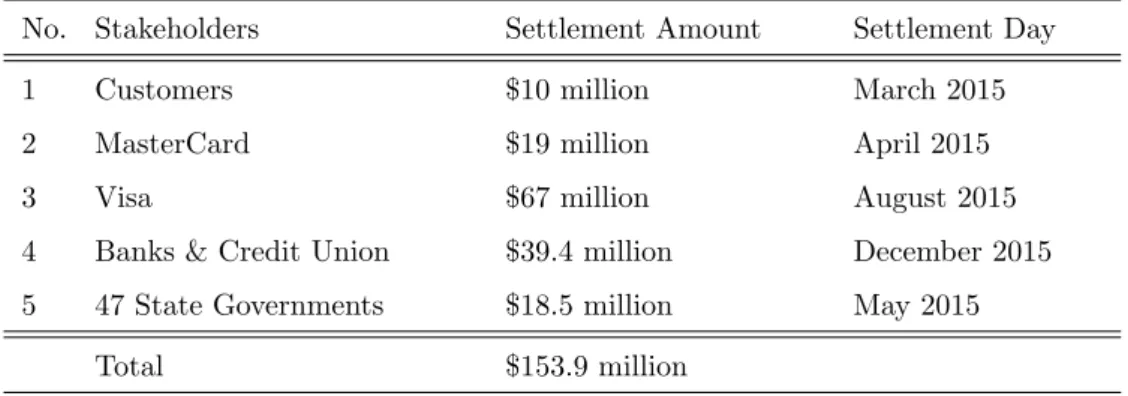
From class action perspective, according to this news [125, 126], They had over 100 lawsuits, but they were consolidated into three groups including victimized customers, financial institutions, and Target stakeholder. After several years later, Target agreed to pay tremendous money to several stakeholders as Table 2.6 shows.

Especially, Target decided to pay 10 million USD as the maximum to victimized people, and each victimized individual, whose information records has been leaked, can acquire compensation up to 10,000 USD.

Table 2.6: Target Settlement in Class Action

No. Stakeholders Settlement Amount Settlement Day

1 Customers $10 million March 2015

2 MasterCard $19 million April 2015

3 Visa $67 million August 2015

4 Banks & Credit Union $39.4 million December 2015 5 47 State Governments $18.5 million May 2015

Total $153.9 million

(40)

Chapter 2 Overview of Security Strategy and Security Investment 22

Compensation of Personally Identifiable Information

One of the arguments about this settlement to clients is 10 million USD is too small for 40 million victimized people. However, this settlement works correctly.

As news articles [127, 128] quoted the comments by Sasha Romanosky, who is a researcher of the economics of information security at Carnegie Mellon University,

“Many customers will likely not be able to prove that they lost money due to hacker activities”. From this perspective, technically, people can only gain 25 cents averagely as compensation.

2.5.2 Case Study 2 : Home Depot

Home Depot, which is famous home improvement retailer, also had significant security information leakage in 40 million records of payment card and 56 million records of personally identifiable information in September 2014.

Total Expenses and Insurance Coverage

According to 2016 annual report [129], it stated that they spent 298 million USD as accumulated countermeasures cost including settlement. However, insurance covered 100 million USD, and cumulative net expenses are 198 million dollars.

In another word, we assumed insurance covered approximately 34.56% of total countermeasure cost.

Class Action

From the class action perspective, Home Depots decided to pay 179 million USD for

settlement. According to the news article [130], Home Depots had 57 class actions

in U.S. and Canada with victimized individual and agreed to pay 19.5 million

USD to them. 13 million USD is for reimbursing impacted customers for out-of-

pocket losses, and 6.5 million USD is for covering 18 months of cardholder identity

protection services. Also, for the financial institutions, Fortune [131] mentioned

that Home Depot paid 134.5 million USD to Visa, MasterCard, and various banks,

(41)

Chapter 2 Overview of Security Strategy and Security Investment 23

and they agreed to pay 25 million USD in March 2017 to dozens of banks.

PII Compensation

From PII compensation perspective, 56 million people struggled with the 13 million

USD budgets as the compensation. In another word, averagely, people can only

gain 23.2 cents as compensation.

(42)

Chapter 3 The Price of Personally Identifiable Information in Data Breach 24

Chapter 3

The Price of Personally

Identifiable Information in Data Breach

3.1 Introduction

Personally identifiable information (hereinafter PII) is a critical competitive re- source for the service providers, and it is necessary for service development, con- tinuous improvement of service, and marketing. On the contrary, the security incidents of PII breach is increasing, and it will be catastrophic damage to corpo- rate branding and business continuity. Especially for B2C companies, PII breach is influential and senior management team also seriously considers the prevention of PII breach.

3.1.1 Attack Vector

Generally speaking, the attack vector of PII breach has two types.

Traditional Hacking

The first vector is abusing the vulnerability of web application or infrastructure

for leaking the information. According to an article [132], The attacks against

e-commerce sites and CMS (Contents Management System) have been notable,

and there are many cases, such as the information breach of Nippon Television

Network Corporation by abusing the vulnerability of OS command injection [133],

Table 2.1: Security Framework, Maturity Model, Best Practice, and Regulation
Table 2.3: TCO Minimization Example - Approach
Table 2.4: Security Damage Estimation Framework
Table 2.5: Event Study Research Papers of Security Incident
+7

参照

関連したドキュメント

The SLE-revised (SLE-R) questionnaire despite simplicity is a high-performance screening tool for investigating the stress level of life events and its management in both community

The answer, I think, must be, the principle or law, called usually the Law of Least Action; suggested by questionable views, but established on the widest induction, and embracing

The input specification of the process of generating db schema of one appli- cation system, supported by IIS*Case, is the union of sets of form types of a chosen application system

In this, the first ever in-depth study of the econometric practice of nonaca- demic economists, I analyse the way economists in business and government currently approach

We show that a discrete fixed point theorem of Eilenberg is equivalent to the restriction of the contraction principle to the class of non-Archimedean bounded metric spaces.. We

By applying the Schauder fixed point theorem, we show existence of the solutions to the suitable approximate problem and then obtain the solutions of the considered periodic

In this paper, we extend this method to the homogenization in domains with holes, introducing the unfolding operator for functions defined on periodically perforated do- mains as

This problem becomes more interesting in the case of a fractional differential equation where it closely resembles a boundary value problem, in the sense that the initial value