Master Thesis
Web Browsing by Surrounding-space Visualization and Parallel Link
Navigation
Supervisor Professor Katsumi TANAKA
Department of Social Informatics Graduate School of Informatics
Kyoto University
Shimpei IKEDA
Feburary 6, 2004
i
Web Browsing by Surrounding-space Visualization and Parallel Link Navigation
Shimpei IKEDA Abstract
Web space became one of the important sources in information gathering with the spread of the Internet in recent years.However, ”there is no confidence of the user in Web browsing” is mentioned as a problem of Web browsing. It is the uneasiness referred to as whether to be the really sufficient Web page which the user is looking at now and, whether there is the Web page more corresponding to the information that he needs else, when the user is looking for some information needed. And it is the uneasiness referred to as whether the navigation which the user performed now is really good, whether there is another navigation which can approach the information that he is more needed.
In other words, this problem can also be called limit of a classic hypermedia model which performs one text presentation at once and successive navigation.
Web browsing in Web space is considered to be also movement between Web pages. When a user moves in the real world, he can acquire the information on surrounding of his present location by looking around the surrounding of his present location. It can be said to be recognizing the surrounding space of his present location. However, in Web space, although a user can recognize the visiting Web page, he cannot know the other information. We think that the problem mentioned previously is solvable by getting to know multiple Web pages other than the visiting Web page called the Surrounding-space of the visiting Web page.
In order to solve these problems, up to now, we have proposed the Web navigation system that visualizes ”Surrounding-space”. The Surrounding-space of a Web page is a set of Web contents that have a certain relevance to a certain Web page. For example, they are the Web page that links from a certain Web page, and the Web page to which contents are similar, etc. This Web navigation is performing navigation using two or more Web pages, and is the method of discovering an interesting page.
Among the researches relevant to the Web navigation by visualization of Web
ii space, there are many researches on Web navigation that displays Web space with a global viewpoint as shown in a map, and which is jumped to the Web page that had visited in the past using the visited history. The main purposes of these researches are solving the disorientation problem of hypermedia as the user discovers the present location and the destination in Web space. And those are not researches for solving the problem that there is no confidence of the user in Web browsing. In this paper, for solving such a problem, we visualize Web space seen from the local viewpoint called as Surrounding-space.
However, in the Web navigation which visualizes Surrounding-space, a user can only recognizes the Surrounding-space of a certain Web page one by one.
On the other hand, not only using two or more Web pages, but performing Web navigation using two or more navigation, we think we can further solve the problem that there is no confidence of the user in Web browsing. For example, when a user progresses to the following Web page from the visited Web page following a link, the need that he wants to know what is in the link place when he follows the link of the Surrounding-space reflecting contents of the previously visited Web page, previously should also exist. Such demands cannot befilled with the navigation system that visualizes Surrounding-space.
Then, in this paper, we propose extension of WebDriving as a Web nav- igation system to present Surrounding-space. The Web navigation system which presents Surrounding-space has two functions. One is visualization of Surrounding-space and another is parallel link navigation. The parallel link navigation said here is visiting two or more Web pages with link navigation simultaneously, synchronizing not a content synchronization but a link anchor.
By parallel link navigaiton, a user can multiple navigation simultaneously. The purpose of this Web navigation is that the system discovers an interesting page using multiple Web pages (Surrounding-space) and multiple navigations.
By the system that we proposes, a user can grasp the present location in Web space, and perform browsing which the user is conscious of relevance with Surrounding-space, with the navigation that presented the Surrounding-space by using the local viewpoint, with using these system.
iii
周辺情報の視覚化とパラレルリンクナビゲーションによる Web ブラウジング
池田 新平 内容梗概
近年のインターネットの普及にともない,Web空間は情報収集における重要 な情報源の一つとなった.しかし,Webブラウジングの問題点として「Webブ ラウジングに対するユーザの確信の無さ」といったものが挙げられる.これは ユーザが何か欲しい情報を探している際(Web探索)に,今見ているWebペー ジで本当にいいのか,もっと自分の欲しい情報に合致するWebページが他にあ るのではないか,といった不安や,今行ったナビゲーションで本当にいいのか,
もっと自分の欲しい情報に近づける別のナビゲーションがあったのではないの か,という不安のことである.この問題は,言い換えれば,一度に1つの文章呈 示を行ったり,逐次的なナビゲーションを行ったりするような古典的ハイパー メディアモデルの限界とも言うことが出来る.
一方,Web空間におけるブラウジングは,Webページ間の移動とも考えられ る.実世界において移動を行う際,現在地の周辺を見回すことによって現在地 の周辺の情報を得ることが出来る.それは、現在地の周辺空間を認知すること であるとも言える.しかし,Web空間においては,閲覧中のWebページを認知 することは出来ても,それ以外の情報を知ることは出来ない.先に挙げた問題 は,ユーザが閲覧中のWebページの周辺空間という閲覧中のWebページ以外 の複数のWebページを知ることで解決できると考える.
この問題を解決するために,我々は,“ 周辺空間 ”を視覚化するWebブラウ ジングのナビゲーションとして“Web標識 ”と“WebDriving”を提案してきた.
ここで言うWebページの周辺空間とは,あるWebページと何らかの関連性を 持つWebコンテンツの集合のことを指す.例えば,あるWebページのリンク 先のWebページや,あるWebページと内容が類似しているWebページなどで ある.このWebナビゲーションは,複数のWebページを用いてナビゲーショ ンを行うことで,興味あるページを発見する手法である.
従来Web空間の視覚化によるナビゲーションに関連した研究は数多く行わ れている.しかしそれらの研究多くは,閲覧履歴から過去に訪れたことのある Webページへナビゲーションや,Web空間を地図のようにグローバルな視点捉
iv えて表示するようなナビゲーションについての研究である.これらの研究の主 な目的は,Web空間における自分の現在地を発見したり,目的地を見つけ出し たり,といったハイパーメディアの失方位性問題を解決するための研究であり,
Webブラウジングに対するユーザの確信の無さ,といった問題を解決するため の研究ではない.このような問題を解決するため,本研究では周辺空間という,
Web空間をローカルな視点から見たWeb空間の視覚化を行っている.
しかし,周辺空間を視覚化するWebナビゲーションでは,ユーザはあるWeb ページの周辺空間を一つ一つ認知することしかできない.
一方,複数のWebページを用いるだけでなく複数のナビゲーションを用いて Webナビゲーションを行うことで,Webブラウジングに対するユーザの確信の 無さ,という問題をさらに解決することが出来ると考える.例えば,閲覧中の Webページからリンクを辿って次のWebページに進んだ時に,先ほど閲覧し ていたWebページの内容的周辺空間のリンクを辿っていった先に何があるのか を知りたい,といった要求や,二つのページを内容同期ではなく,リンクアン カー同期で同時に閲覧したい,といった要求も存在するはずである.周辺空間 を視覚化するナビゲーションシステムでは,そういった要求を満たすことはで きない.
そこで,本研究ではWebDrivingの拡張をすることで,周辺空間を呈示する Webブラウジングのナビゲーションを提案する.周辺空間を呈示するWebナ ビゲーションは2つの機能を持つ.一つは周辺空間の視覚化,もう一つはパラ レルリンクナビゲーションである.パラレルリンクナビゲーションとは,二つ 以上のWebページを内容同期ではなくリンクアンカーを同期させながら同時に リンクナビゲーションして閲覧することである.パラレルリンクナビゲーショ ンにより,周辺空間を同時にナビゲーションすることが出来る.このWebナビ ゲーションの目的は,複数のWebページ(周辺空間)と複数のナビゲーション を用いて興味あるページを発見することである.
本研究で提案するシステムにより,局所的な視点による周辺空間をユーザに 呈示してナビゲーションを行うことで,ユーザはWeb空間における現在地の把 握や,周辺との関連性を意識したブラウジングを行うことも可能となる.
Web Browsing by Surrounding-space Visualization and Parallel Link Navigation
Contents
Chapter 1 Introduction 1
Chapter 2 Motivation and Basic Concepts 5
2.1 Web Navigation By Surrounding-space Information . . . 5
2.2 Web Strolling . . . 6
2.3 Parallel Link Navigation . . . 7
Chapter 3 Surrounding-space Visualization 9 3.1 Acquirement of Surrounding-space Information . . . 9
3.1.1 Feature Extraction . . . 10
3.1.2 Acquirement of Surrounding-space reflecting link struc- ture Information . . . 11
3.1.3 Acquirement of Surrounding-space reflecting contents Information . . . 11
3.2 Visualizing Surrounding-space Information . . . 12
3.2.1 WebSign . . . 12
3.2.2 WebDriving . . . 14
Chapter 4 Parallel Link Navigation 24 4.1 Matching of the Link Anchors . . . 25
Chapter 5 Prototype System 29 5.1 WebSign Prototype System . . . 29
5.2 WebDriving Prototype System . . . 30
Chapter 6 Experiments and Evaluation 37
Chapter 7 Related Works 40
Chapter 8 Conclusions 44
Acknowledgments 46
References 47
Chapter 1 Introduction
By the spread of the Internet in recent years, Web contents became a so- cial infrastructure. The Internet population of Japan is actually increasing to 56,450,000 people (the end of February, 2003). And, although Web contents became a social infrastructure, as access technology to it, the web browser tech- nology and contents reference will also be generaly popularized. By this, Web browsing became a general information gathering means, and Web space was set to one of the important sources of information in information gathering.
However, ”there is no confidence of the user in Web browsing” is mentioned as a problem of Web browsing. It is the uneasiness referred to as whether to be the really sufficient Web page which the user is looking at now and, whether there is the Web page more corresponding to the information that he needs else, when the user is looking for some information needed. And it is the uneasiness referred to as whether the navigation which the user performed now is really good, whether there is another navigation which can approach the information that he is more needed. In other words, this problem can also be called limit of a classic hypermedia model which performs one text presentation at once and successive navigation.
Web browsing in Web space is considered to be also movement between Web pages. When a user moves in the real world, he can acquire the information on surrounding of his present location by looking around the surrounding of his present location. It can be said to be recognizing the surrounding space of his present location. However, in Web space, although a user can recognize the visiting Web page, he cannot know the other information. We think that the problem mentioned previously is solvable by getting to know two or more Web pages other than the visiting Web page called the Surrounding-space of the visiting Web page.
In order to solve these problems, up to now, we have proposed the Web navigation system that visualizes ”Surrounding-space”[1]. The Surrounding- space of a Web page is a set of Web contents that have a certain relevance to a certain Web page. For example, they are the Web page that links from a
certain Web page, and the Web page to which contents are similar, etc. This Web navigation is performing navigation using two or more Web pages, and is the method of discovering an interesting page.
Among the researches relevant to the Web navigation by visualization of Web space, there are many researches on Web navigation that displays Web space with a global viewpoint as shown in a map, and which is jumped to the Web page that had visited in the past using the visited history[2]. The main purposes of these researches are solving the disorientation problem of hypermedia[3] as the user discovers the present location and the destination in Web space. And those are not researches for solving the problem that there is no confidence of the user in Web browsing.
And, also about the method of visualization of Web space, although we can see the whole Web space with a global viewpoint, it may not be not much effective for the user who has actually entered the inside of Web space. For example, also in the real world, many people have lost their way, even if they have a map. As the reason, it is mentioned that a user who is in the inside of space does not understand his present location and relevance of his present location and the it’s surrounding by the method using a global viewpoint. In this paper, for solving such a problem, we visualize Web space seen from the local viewpoint called as Surrounding-space.
However, in the Web navigation which visualizes Surrounding-space, a user can only recognizes the Surrounding-space of a certain Web page one by one.
A user only recognizes another Surrounding-space one by one whenever he per- forms navigation.
On the other hand, not only using two or more Web pages, but performing Web navigation using two or more navigation, we think we can further solve the problem that there is no confidence of the user in Web browsing. For example, when a user progresses to the following Web page from the visited Web page following a link, the need that he wants to know what is in the link place when he follows the link of the Surrounding-space reflecting contents of the previously visited Web page, previously should also exist. Such demands cannot befilled with the navigation system that visualizes Surrounding-space.
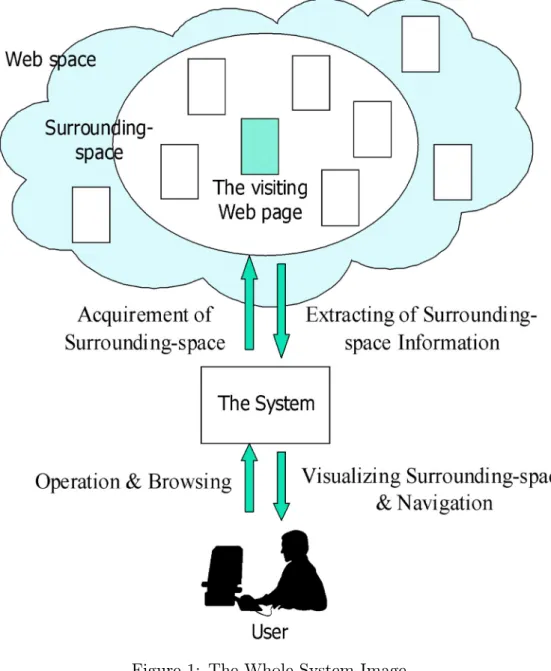
Figure 1: The Whole System Image
Then, in this paper, we propose extension of WebDriving as a Web nav- igation system to present Surrounding-space. The Web navigation system which presents Surrounding-space has two functions. One is visualization of Surrounding-space and another is parallel link navigation. The parallel link navigation said here is visiting two or more Web pages with link navigation simultaneously, synchronizing not a content synchronization but a link anchor.
By parallel link navigaiton, a user can multiple navigation simultaneously. The purpose of this Web navigation is that the system discovers an interesting page
using multiple Web pages (Surrounding-space) and multiple navigations.
Fig. 1 is the whole system image. As indicated by Fig. 1, these system consist of
• Acquirement the Surrounding-space of the visiting Web page.
• Extracting Surrounding-space Information of the visiting Web page.
• Presenting a user the Surrounding-space.
• Navigation along a user’s browsing.
A user can grasp the present location in Web space, and perform browsing which the user is conscious of relevance with Surrounding-space, with the navi- gation that presented the Surrounding-space by using the local viewpoint, with using these systems.
It is considered as one of the application of the navigation system presenting Surrounding-space that browsing action called ”Web Strolling”. A user can grasp his present location in Web space by Web browsing which presented the Surrounding-space that is local information, and progress to the following page, he being conscious of relevance with the Surrounding-space. Since it is similar with the strolling action in man’s city-action, we are calling the form of such browsing ”Web Strolling”.
The remainder of this paper is organized as follows: Section 2 explains our motivation and basic concepts, Section 3 discusses Surrounding-space visual- ization, Section 4 discusses parallel link navigation, Section 5 explains the pro- totype system, Section 6 discusses our experiments, Section 7 discusses related work, and we conclude in Section 8.
Chapter 2 Motivation and Basic Concepts
Motivation and basic concepts are described below.
2.1 Web Navigation By Surrounding-space Information
Although various researches have been conventionally done about the Web nav- igation, many of those researches are researches about Web navigation that look at Web space by using the global viewpoint and navigate to the Web page, and which navigate to the Web page that had visited in the past using the visited history. For example, Web map, retrieval by keyword, bookmark, etc. are men- tioned. By the Web navigation by using these methods, a user has to determine what information that a user is searching for, or can navigate only to the page that had visited in the past.
However, many users have demands that they want to the acquire Surrounding- space information about the visiting Web page currently, and determine which web page is visited by themselves next, based on it, when doing Web browsing.
For example, while visiting the Web page about news, a user wants to see the Web page that tells the same news on other news sites, and while looking for the place to travel, a user wants to be taught the place of recommendation re- cently, etc. There may be an occasion that if there are some which induce some interest, he wants to visit the Web page, although even a user does not only determine the information that he search for but also have the purpose which browse the Web page. Thus, by the conventional Web navigation, it cannot respond enough to Web browsing which determines the Web page to visit next using the Surrounding-space information of the visiting Web page.
Then, as approach of this research, we propose the method of visualizing Surrounding-space to the user when he is browsing. The Surrounding-space of a certain Web page consists of two, Surrounding-space reflecting link structure and Surrounding-space reflecting contents. Surrounding-space reflecting link structure is the a set of the Web page that links from a certain Web page, or the Web page that links to a certain Web page. Surrounding-space reflecting contents is a set of the Web page that has certain relevance in contents to a
certain Web page. For example, they are the Web page that the contents are similar to a certain Web page, and the Web page treated about the same matter, etc. These Surrounding-space reflecting link structure and Surrounding-space reflecting contents are collectively called Surrounding-space of this Web page.
This Surrounding-space is a set of the Web page that is in near structurally and in contents from a certain Web page. User can acquire the local information about a certain Web page by Web navigation that visualizes Surrounding-space, and he can determine the Web page to visit next, based on it. Moreover, even if a user has not determined the contents of the Web page for which he searches, by the visualized Surrounding-space, he can visit to the Web page that is likely to suit his purpose. Furthermore, this method can also be adapted to a strange Web page.
2.2 Web Strolling
A user can perform browsing called Web Strolling by Web navigation that presents Surrounding-space. Web Strolling is browsing action which progresses to more interested information gradually, after investigating the Surrounding- space that is the local information of the Web page whenever a user visits a new Web page in Web browsing. Any Web Strolling action repeats the steps as follows:
(1) Acquire Surrounding-space information of the visiting Web page
(2) Investigate Surrounding-space information and confirm the relation be- tween present location and Surrounding-space
(3) According to Surrounding-space information, select the Web page to visit next
(4) Navigate to the selected Web page
It is mentioned an advantage of this browsing that a user investigates the Surrounding-space of his present location, and can determine the following movement place among abundant choices by recognizing the following move- ment place. A user’s interest may be also induced by presenting abundant choices when he does not having the purpose for which a user performs brows- ing.
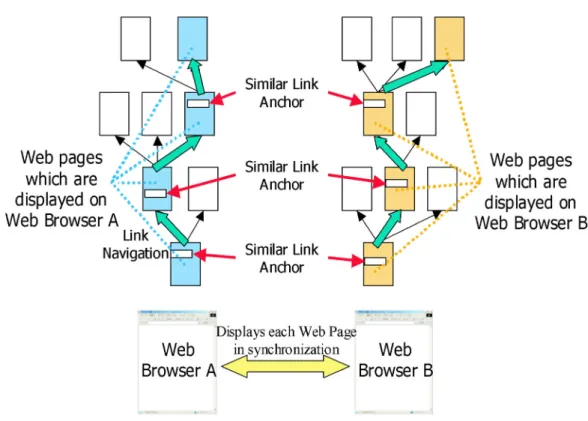
Figure 2: Parallel Link Navigation
2.3 Parallel Link Navigation
When a user is going to carry out comparative browsing of two or more websites that have a similar structure and an item, a user has to open these Web pages on another Web browser respectively, and he has to operate each window and read contents.
On the other hand, the Web navigation system that presents Surrounding- space cannot meet the demand enough that a user wants to know what there are in the link place of Web pages that are similar to the visiting Web page in contents, if the user follows the link of these Web pages and he progresses to the following Web page respectively. For example, although it is the same link anchor ”Paper” in the site of two laboratories, the contents of these Web pages that the link presents is completely different, since the contents of the Web page is dependent on each laboratory, there will be the demand of wanting to see these Web pages.
Then, we use the approach called parallel link navigation, as shown in Fig.
2. Parallel link navigation is Web navigation that performs link navigation in synchronization about the link that an anchor text is similar to each other in two or more Web pages. In other words, it is the method of performing link navigation automatically, when a user chooses the link anchor expressed in an anchor text in a certain Web page and performs link navigation, the system chooses the link anchor expressed in the anchor text in other Web pages that are considered to be most similar to the anchor text in that Web page, comparing the anchor texts of two or more Web pages. In the conventional Web browsing, although the operation performed on two or more windows have been independent mutually, in parallel link navigation, when a user only operates one window without operating other windows, he can perform link navigation on other windows in synchronization.
In this method, comparison of the websites that have similar structures and items is also attained. And, a user can also follows the link place of the Surrounding-space reflecting contents of a certain Web page simultaneously.
Chapter 3 Surrounding-space Visualization
In this chapter, we describe the Web navigation system by presenting Surrounding- space. When a user performs the usual Web browsing, it is only the visiting Web page that the user can browse, and he cannot recognize Surrounding-space.
Since a user can recognize Surrounding-space by using the system that we pro- pose in this paper, he can grasp the present location in Web space, and he can be conscious of Surrounding-space, and he can move to the following Web page in which is interested from the visiting Web page. Moreover, a user can also perform Web Strolling by this system.
The method of Surrounding-space visualization is as follows.
(1) Extract the features from the visiting Web page
(2) According to the extracted the features, acquire the Surrounding-space of the visiting Web page
(3) Acquire Surrounding-space information from the acquired Surrounding- space
(4) Visualize Surrounding-space using Surrounding-space information
3.1 Acquirement of Surrounding-space Information
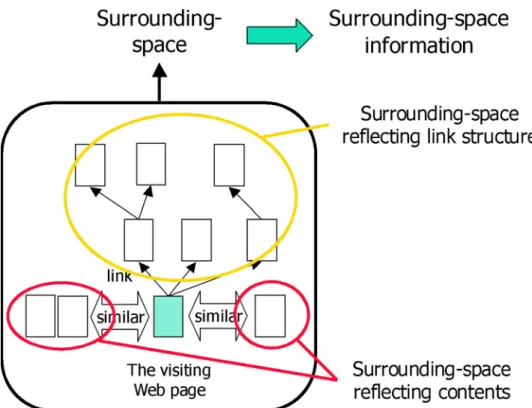
This section describes the acquirement method of Surrounding-space informa- tion. The Surrounding-space in this paper consists of two Surrounding-space, Surrounding-space reflecting link structure and Surrounding-space reflecting contents, as shown in Fig. 3.
Surrounding-space reflecting link structure of a certain Web page is the Web page group that link from the Web page. Surrounding-space reflecting contents of a certain Web page is the Web page group similar to the Web page in contents. The acquisition method of Surrounding-space reflecting link structure and Surrounding-space reflecting contents is described in detail in the following chapters.
And, in acquirement of Surrounding-space, we use the degree of similarity between Web pages. Although various methods as the calculation method of the degree of similarity between Web pages can be considered, in this paper,
Figure 3: Surrounding-space
we calculate the degree of similarity with the number cosine function based on the feature vector of each Web page. The feature vector of Web pages are respectively set to ~x, ~y, and the degree of similarity of ~x, ~y is set to sim(~x, ~y), then
sim(~x, ~y) = ~x·~y
|~x||~y| 3.1.1 Feature Extraction
System extracts features of each Web pages based on the word that appears in each Web page, respectively. And Chasen[4] was used for extraction of the word from each Web page.
Feature Vector Extraction
The keyword vector generated based ontf value of the word which appears in each Web page is defined as the feature vector of each Web page.
Feature Keyword Extraction
In the Web page, the word with high frequency of appearance among the words that appear in a Web page can be considered as a feature by which the Web
page is characterized.
In this paper, in order to acquire the Surrounding-space of the visiting Web page, the feature keyword of each Web page is extracted. Some words are defined as the feature keyword of each Web page among words with high fre- quency of appearance in the Web page, among each word extracted from each Web page.
3.1.2 Acquirement of Surrounding-space reflecting link structure In- formation
This section describes acquirement of Surrounding-space reflecting link struc- ture information. First, the system acquires the Web page that followed the link of the visiting Web page. Next, the system grades the Web page that links from the visiting Web page on the method which the rank of the Web page that feature vector has the high degree of similarity to the feature vector of the visiting Web page is high, among the acquired Web page. It considers a set of the Web page of these ranking higher ranks as Surrounding-space reflecting link structure of the visiting Web page.
3.1.3 Acquirement of Surrounding-space reflecting contents Infor- mation
This section describes acquirement of Surrounding-space reflecting contents in- formation. We use the existing search engine for Web page retrieval on the following sentence.
In this paper, we define a set of the Web page that extracted only the Web page that ranking is higher from a result of similar Web page retrieval as the Surrounding-space reflecting contents of the visiting Web page.
However, by the similar Web page retrieval by using the existing search engine, there are many cases where a similar page is not found as a result. In this case, in this paper, we retrieve a similar Web page using the AND retrieval based on the feature keyword of the Web page.
First, System extracts two or more feature keywords of the visiting Web page, and performs AND retrieval that combined these feature keywords. We define a set of the Web page that extracted only the Web page that ranking is high as a result of these AND retrieval as the Surrounding-space reflecting
contents of the visiting Web page.
3.2 Visualizing Surrounding-space Information
In this paper, visualization of Surrounding-space is performed using two meth- ods, WebSign and WebDriving. The each method of visualization of Surrounding- space is described in detail below.
3.2.1 WebSign
WebSign proposed in this paper is a system that carries out Web navigation by the Surrounding-space using a traffic-control sign metaphor.
WebSign image is shown at Fig. 4. It is thought that moving between Web pages in Web space is similar to moving to other points from a certain point in real world. Then, we think that we can propose what is useful for a user also in Web space, by introducing into Web space the traffic-control sign that is useful in the real world. And, there is a strong possibility that a user has got a traffic-control sign used to seeing usually, we consider to be easier for a user to understand the concept only at a glance that the Web sign generated introducing a traffic-control sign metaphor into Web space. With the Web sign proposed in this paper, a user can recognize the relevance of his present location and Surrounding-space in Web space.
System Architecture of WebSign
When a user notifies the demand of WebSign to the system, or when the user visited thefixed number of Web pages, the system creates and displays WebSign.
At this time, various method as a method of composing WebSign using Surrounding-space information can be considered. In this paper, we use the method of projecting the keyword vector of the Web page that composes Surrounding- space reflecting link structure and the keyword vector of the Web page contained in visited history to 2-dimensional space, and the keyword vector of the Web page that composes Surrounding-space reflecting contents and the feature vec- tor of the visiting Web page to 1-dimensional space, using FastMap[5]. Then, these two-projection spaces are unified and WebSign is composed using the uni- fied projection space. The Web page of Surrounding-space reflecting structure is displayed in the vertical advance direction in WebSign, and the Web page of
Figure 4: WebSign Image
Surrounding-space reflecting contents is displayed in the horizontal direction.
At this time, each Web page is displayed on a WebSign as a node with the title. When a user chooses the node in WebSign, he will jump to the Web page corresponding to the node. User can also perform the usual link navigation, without using WebSign.
User can change the number of the node displayed in WebSign, and the range of the scale of WebSign.
WebSign and Bookmark
WebSign and a bookmark have a close relation. Bookmark is the guidance to the visited Web page that presents the information as URL. As contrasted with bookmark, WebSign is the Web navigation system that presents the Surrounding- space of the visiting Web page, so, WebSign can navigate to the visited Web page and the non-visited Web page. If Bookmark and WebSign is also regarded as the Web navigation system that navigate to a certain Web page by presenting a certain information about a Web page, since information that are presented
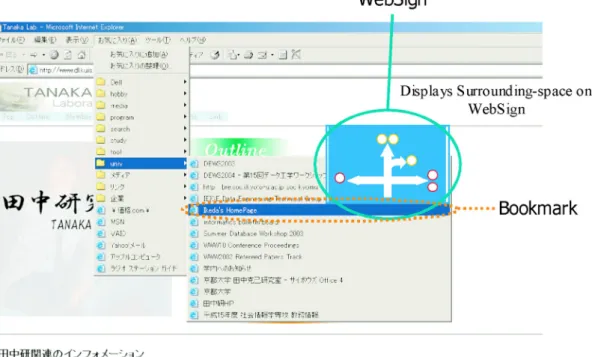
Figure 5: WebSign and Bookmark
by these two system have complementary relationship, we think it possible to use bookmark and Web sign together.
For example, as shown in Fig. 5, if WebSign is generated to each bookmark page, respectively, WebSign can present the Surrounding-space of a bookmark Web page. Also we consider displaying a bookmark on a Web sign. Thereby, we also consider that a user can perform more efficient information.
3.2.2 WebDriving
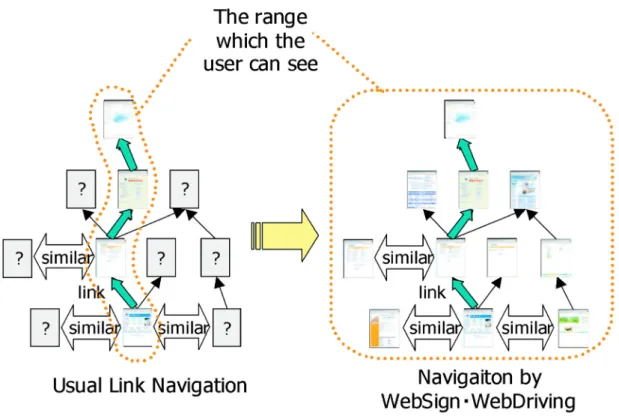
WebDriving proposed in this paper is the Web navigation system that aims to perform browsing in the Web space with Driving feeling, presenting Surrounding- space to a user, it is the Web navigation system built on the concept that devel- oped through the concept of WebSign. Although a user can see only the visiting Web page in the usual browsing as shown in Fig. 6, a user can see the Web page that links from the visiting Web page and the Web page that is similar to the visiting Web page in contents although not directly connected by the link,
Figure 6: WebDriving Image with the visiting Web page.
By using WebDriving, a user can move in Web space, recognizing Surrounding- space. Since a user can move by Web Driving, recognizing the relation between his present location and Surrounding-space in Web space, a user can always grasp his present location.
In WebDriving, the Surrounding-space presented to the user can be con- sidered as the ”scene” in Web space. Since, the scene in the real world is
”things which is in sight from a present location (not a point but domain)”, the Surrounding-space in the real world changes from space to a scene, when an observer observes. Similarly, the Surrounding-space changes to the scene in Web space by being observed by the user in WebDriving.
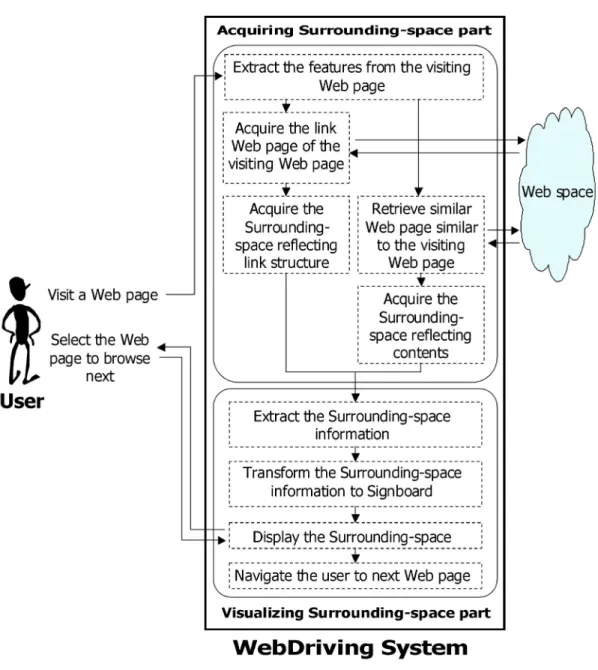
System Architecture of WebDriving WebDriving system consists of two functions.
• Acquiring Surrounding-space part
• Visualizing Surrounding-space part
Figure 7: System Architecture
Acquiring Surrounding-space part is the function that searches and acquires the Surrounding-space of the visiting Web page, and Visualizing Surrounding- space part is the function that visualizes and displays the Surrounding-space for a user.
The WebDriving system overview is as follows:
(1) A user visits a Web page on a main browser.
(2) The system acquires the Surrounding-space reflecting link structure and Surrounding-space reflecting contents of the visiting Web page.
Figure 8: WebDriving Interface
(3) The system extracts Surrounding-space information from each Surrounding- space.
(4) The system displays Surrounding-space pages on a Surrounding-space browser using Surrounding-space information.
(5) The user chooses the following Web page to visit by choosing a link anchor or the Surrounding-space page displayed on a Surrounding-space browser.
(6) The system navigates the user to that Web page.
(7) Repeat steps (1) to (6).
The system architecture of WebDriving system is as shown in Fig. 7.
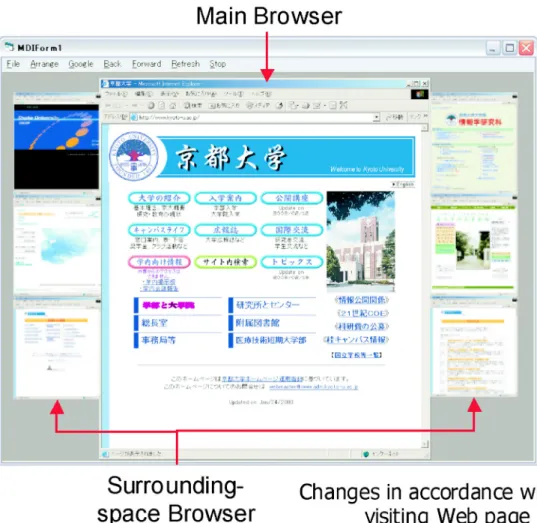
As shown in Fig. 8, two browsers, a main browser and a Surrounding- space browser, realize WebDriving, in order to divide and display the visiting
Web page and the Surrounding-space. In this paper, the browser who displays the visiting Web page called the main browser and, the browser who displays the Surrounding-space of the visiting Web page called the Surrounding-space browser.
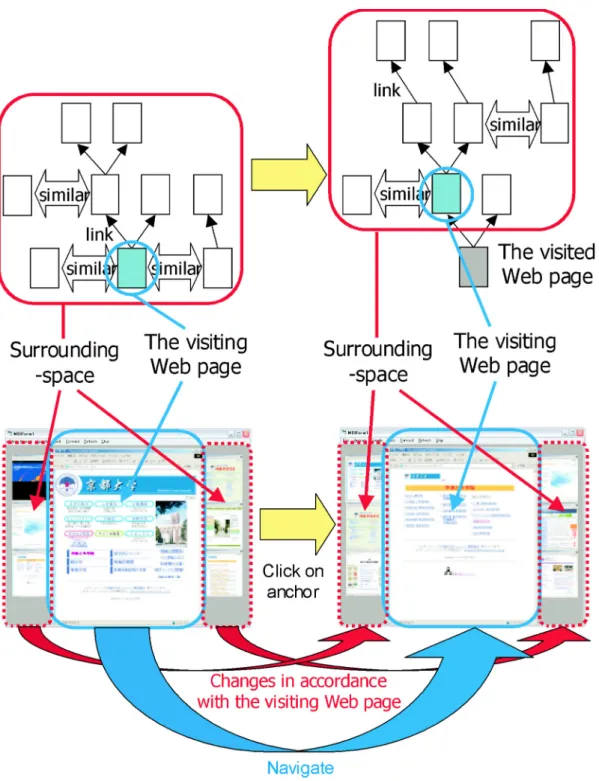
When performing WebDriving, first, the system acquires the Surrounding- space of the visiting Web page, and displays the acquired Surrounding-space on a Surrounding-space browser. While a user is looking at the Web page displayed on a main browser, the Surrounding-space displayed on a Surrounding-space browser does not change. Next, when a user chooses a certain anchor in the visiting Web page and performs link navigation, as shown in Fig. 9, a main browser displays the Web page that links from the visiting Web page, and the Surrounding-space displayed on a Surrounding-space browser changes from the Surrounding-space of the visiting Web page to the Surrounding-space of the Web page that links from the visiting Web page.
And when a user chooses the Surrounding-space on a Surrounding-space browser, a main browser displays the Web page that he chooses. At this time, When a user selects the Surrounding-space, a main browser displays the Web page that chosen by him, and the Surrounding-space displayed on a Surrounding-space browser changes from the Surrounding-space of the visit- ing Web page to the Surrounding-space of the Web page that was chosen by a user.
Signboard Metaphor
In this paper, when Surrounding-space pages are displayed on a Surrounding- space browser, in order to display Surrounding-space pages metaphorically, a system summarizes Web pages in WebDriving.
Also in the conventional research, the various method summarizations are studied as a method of displaying Web pages. For example, although there are a method of displaying the thumbnail of a Web page, a method of displaying properties such as a title, an author, a language of a Web page, and a method of displaying the summary of the text of a Web page, they are not enough to summarize present a Web page to a user. Although the user can hold atmo- sphere of a Web page, such as overall use of color of the Web page, and a size
Figure 9: Navigation by WebDriving
of a character, by the method of displaying the thumbnail of the Web page, it is difficult for a user to grasp the pictures and understand the contents of the Web page. Although a user can understand a title, an author, etc. by the
method of displaying the property of a Web page, the user cannot recognize the information about the contents of the Web page other than that. Although user can understand about the contents of the text of a Web page by the method of displaying the summary of the text of a Web page, since the object to display becomes large, there is a possibility of barring browsing of the visiting Web page for the user.
Then, in this paper, a ”signboard metaphor” is used as the display method of Surrounding-space pages. A signboard metaphor is the method that creates the pseudo signboard about a Surrounding-space page combining the title of the Surrounding-space page and the picture corresponding to the Surrounding-space page, and expresses the information about a Surrounding-space page metaphor- ically. Since a signboard is easily spotted and stands out in someone’s memory unconsciously, although a signboard is a method used well when someone sends a information also in the real world, the effect of a signboard come to everyone’s attention. By using a signboard metaphor, summarization of a Surrounding- space page can be performed and Surrounding-space can be presented for a user in an understandable way.
In this paragraph, we explain the creation method of the signboard about a Surrounding-space page, as shown in Fig. 10.
First, after acquiring the Surrounding-space of the visiting Web page, the system collects the titles of each Surrounding-space page.
Next, in order to collect the pictures corresponding to each Surrounding- space page, the system queries on ””each title” + logo” from empirical rule is using an image retrieval which used the existing search engine, and the pic- tures which is the top in a result of the retrieval is collected as the picture corresponding to the Surrounding-space page.
And, when the number of a result of the retrieval is zero in this image retrieval, the picture that is wedged between the ¡img¿ tags that appearsfirst in a Surrounding-space page with the title is collected as the picture corresponding to the Surrounding-space page.
Furthermore, when the number of the result of the retrieval is zero in this image retrieval, and the picture that is wedged between the ¡img¿ tags in a
Figure 10: Making Signboard
Surrounding-space page with the title was not found, either, the picture corre- sponding to the Surrounding-space page is regarded as nothing.
At the last, the signboard about each Surrounding-space page is created combining the title of the Surrounding-space page and the picture corresponding to the title.
Use of WebDriving
The following can be considered as a scenario that performs browsing using WebDriving.
• Browsing in Web space
Browsing is looking for the information that is likely to be helpful to attain a user’s purpose, without a clear plan. And, it is an action that looks for information, while it does not extract only the information corresponding to the user’s purpose but the user repeats trial and error.
When using WebDriving for browsing of Web space, the user can find the information that is hard to find at the usual browsing by presenting Surrounding-space. For example, a user can select the link anchor which links to the Web page that contents is near his demand by presenting simul- taneously two or more Web pages as the candidate of user’s link navigation.
And, the candidate of a different Web page about the same information can also be presented by presenting the Web page that contents are similar to the visiting Web page.
• Web Strolling
Since a user can perform browsing presenting Surrounding-space, the user can perform Web Strolling by using WebDriving. The user investigates the relation of the Surrounding-space and his present location, and navigates to the following Web page based on it.
• Application to the retrieval result of a search engine
When a user searches using a search engine, he can recognize simultaneously two or more contents of the Web page of the retrieval result by using WebDriving for it. And, the system can also present other Web pages as a candidate of the Web page that may agree with the user’s demand, presenting the Web page that is similar to the Web page of a retrieval result in contents.
• Application to the visited history
When applying WebDriving to a user’s visited history, the user can again follow the Web page of the visited history with Surrounding-space presen- tation. Thereby, it enables a user find the Web page that has not been
found in former browsing, and know whether he has been visited the Web page that has what relation to other Web pages in Web space. And, in this case, since the order and address of the Web page that the user will visit were decided beforehand, automatic navigation can also be carried out.
WebDriving and WebSign
The WebSign proposed in this paper is a system that makes a user recognize Surrounding-space, presenting the relevance of Surrounding-space and the vis- iting Web page in two dimensions. On the other hand, WebDriving is a system that performs navigation of Web browsing, presenting Surrounding-space simul- taneously to a user.
Both of the systems perform navigation of Web browsing presenting Surrounding- space to a user, and since WebDriving is the system that is developed the con- cept of WebSign, WebSign and WebDriving can be used simultaneously. We think that, by using WebSign and WebDriving together, a user can browse the Web page and the Surrounding-space simultaneously by WebDriving, recogniz- ing the relation between the visiting Web page and the Surrounding-space by WebSign. We plan to implement the system that uses WebSign and WebDriving simultaneously for testing in the near future.
Chapter 4 Parallel Link Navigation
In this chapter, we describe the parallel link navigation system. With the par- allel link navigation system, a user performs link navigation in synchronization about the link that an anchor text is similar to each other in two or more Web pages, as shown in Fig. 11. In this system, we define the Web page to which the user operates as the basic Web page, and the Web page to which the system performs link navigation automatically by operation that the user gives to the basic Web page as the compared Web page.
The user can perform browsing two or more Web pages with the interactions only to the basic Web page, without the interactions to the compared Web page.
In this method, the user can accomplish comparison of the websites that have similar structure and items to each other. And, the user can also follows the link place of the Surrounding-space reflecting contents of a certain Web page simultaneously.
The Parallel link navigation system overview is as follows:
(1) The user specifies the URLs of the basic Web page and the compared Web page.
(2) The system displays the basic Web page and the compared Web page.
(3) The user browses the basic Web page.
(4) The user selects a link anchor in the basic Web page.
(5) The system finds the link anchor in the compared Web page just like the selected link anchor in the basic Web page.
(6) The user performs link navigation both in the basic Web page using the link anchor that selected by the user, and in the compared Web page using the link anchor that selected by the system.
(7) Repeat steps (2) to (6).
The system architecture of Parallel Link Navigation system is as shown in Fig. 12.
Figure 11: The Basic Web Page and The Compared Web Page
4.1 Matching of the Link Anchors
In this paper, in order that the system finds the link anchor in the compared Web page just like the link anchor selected in the basic Web page by the user, the system compares anchor character sequences and matches link anchors. The system uses the degree of similarity of words and the degree of cooccurrence of words that are contained in anchor character sequences for comparison of these anchor character sequences. The systemfinds the link anchor in the compared
Figure 12: System Architecture
Web page that is the most similar to the link anchor that the user selected in the basic Web page, by the following methods.
• The system finds the link anchor with the highest degree of similarity in the compared Web page to the link anchor that the user selected in the basic Web page, as the most similar link anchor.
• The link anchor which the user selected in the basic Web page is defined as B,the words which are contained in the anchor character sequence in B are defined as Bi, i= 1,2,· · ·, n.
• The jth link anchor which is in a certain compared Web page are defined as Cj, the words which are contained in the anchor character sequence in Cj are defined asCji, j = 1,2,· · ·, m, i= 1,2,· · ·, n.
• The function which judges whether the certain wordx and certain word y are the completely same word is defined as F(x, y).
F(x, y) =
1 (x=y) 0 (x6=y)
• The function which judges whether the certain wordx and certain word y are synonyms is defined as G(x, y).
G(x, y) =
1 (x and y are synonyms) 0 (x and y are not synonyms)
• The function which judges whether the certain wordx and certain word y are synonyms is defined as H(x, y).
H(x, y) =
1 (x and y are cooccurrence words) 0 (x and y are not cooccurrence words)
• The thesaurus is used in functionG(x, y).
• The degree of cooccurrence is used in function H(x, y), the system judges the words that the degree of cooccurrece is more then a threshold as cooc- currence words.
• The degree of cooccurrence ofxandyare defined asCo(x, y), and, although some calculation methods of the degree of cooccurrence of x and y are considered, in this paper, it presumes using the retrieval result of an existing search engine as follows.
Co(x, y) =/x∩y/÷/x∪y/
(/X/ is the number of Web pages including the word set X)
• The degree of similarity of link anchor B and Cj is defined as sim(B, Cj), then
sim(B, Cj) = α
Xn
i=1
F(Bi, Cji) +β
Xn
i=1
G(Bi, Cji) +γ
Xn
i=1
H(Bi, Cji) (0<α<1, 0<β <1, 0<γ <1, α+β+γ = 1)
• The system determines Cj which value of sim(B, Cj) is the highest as the most similar link anchor in the compared Web page to the link anchor which the user selects in the basic Web page.
Chapter 5 Prototype System
The prototype system was implemented according to the above-mentioned method.
In this chapter, we describe the prototype system of WebSign and WebDriving.
WebSign The system that presents the relevance of a user’s present location and Surrounding-space in Web space.
WebDriving The system that navigates a user presenting the relevance of the user’s present location and Surrounding-space in Web space, and performs Parallel Link Navigation.
And, the implementing environment is as follows:
• OS : Windows 2000
• CPU : Pentium4 2.00GHz
• Memory : 2GB
• Development Environment : Microsoft Visual Basic 6.0
5.1 WebSign Prototype System
WebSign is displayed in another window, from a web browser. Fig.13 is the example image that actually displayed Surrounding-space using the prototype of WebSign. In Fig. 13, the present visiting Web page is displayed the center of WebSign, and the Web page of Surrounding-space reflecting link structure is displayed in the vertical advance direction, and the Web page of Surrounding- space reflecting contents is displayed in the horizontal direction as a node (round mark) to which the Web page title was attached, respectively.
Intuitively, the Surrounding Web page near the center of WebSign will be similar to the visiting Web page. Since, the keyword vector of the Web page that composes Surrounding-space reflecting link structure is added weighting by the keyword vector of the Web page contained in the visited history, intuitively, the nearer Web page of Surrounding-space reflecting link structure from the center of WebSign will be similar to the visited history in contents.
Fig. 13 is the WebSign that displayed while visiting the Web page about the professional baseball of asahi.com[6]. The visiting Web page is displayed on the
center of the WebSign, the Web page treated about the history of professional baseball is displayed as Surrounding-space reflecting contents, and the Web page of other item about professional baseball is displayed as Surrounding-space reflecting link structure.
Figure 13: Prototype System of WebSign
5.2 WebDriving Prototype System
According to the above-mentioned realization method of visualization of the Surrounding-space and parallel link navigation, we implemented the prototype of WebDriving system. The WebDriving system is a system that can perform visualization of the Surrounding-space and parallel link navigation simultane- ously.
In order to perform these two navigation simultaneously, two main browsers are prepared, a basic Web page is displayed on one and a compared Web page is displayed on one more. Furthermore, the visiting Web pages are displayed on the each main browser, and the Surrounding-space of the each visiting Web page is displayed on the each Surrounding-space browser corresponding to the each main browser. The system architecture of the prototype system of WebDriving
Figure 14: The System Architecture of the Prototype System of WebDriving is shown in Fig. 14.
Prototype system of WebDriving system consists of four parts.
Interface part Interface part is a part that perform interaction with a user, receiving the operation from a user, displaying Web pages to the user. The part also perform interaction by data communication with Web space.
Acquiring Surrounding-space part Acquiring Surrounding-space part is a part that acquires the Surrounding-space of the visiting Web page. The part extracts the features from the visiting Web page, and acquires the Surrounding-space from Web space according to it.
Visualizing Surrounding-space part Visualizing Surrounding-space part is a part that visualizes the Surrounding-space of the visiting Web page.
The part visualizes the Surrounding-space acquired at Acquiring Surrounding- space part and displays it to a user.
Searching the next Web page part Searching the next Web page part is a part that determines which Web page is displayed next as a compared Web page when a user operates the basic Web page that displayed on a main browser and moves the next Web page. The part determines the Web page displayed next as a compared Web page according to the link anchor and signboard that the user selects.
Data Base There are the thesaurus which is used in Searching the next Web page part when that part determine which Web page is displayed next as a compared Web page, and the coincidence word dictionary in Data Base.
The Prototype System of WebDriving system overview is as follows:
(1) The system acquires the basic Web page and compared Web page that is specified by the user from Web space, and displays each Web page on another main browser.
(2) The system acquires the each Surrounding-space of the basic Web page and compared Web page that are displayed on the main browsers.
(3) The system displays the acquired Surrounding-space on the Surrounding- space browser in the upper part of each main browser.
At this time, the Web page of Surrounding-space reflecting link structure is displayed on the each Surrounding-space browser which is located on top of each main browser as a rectangular signboard, and the Web page of Surrounding-space reflecting contents of the basic Web page is displayed on the Surrounding-space browser which is located on the left side of the basic Web page as a circular signboard, and the Web page of Surrounding- space reflecting contents of the compared Web page is displayed on the Surrounding-space browser which is located on the right side of the com- pared Web page as a circular signboard.
It follows that it seems that the Web page of Surrounding-space reflecting link structure is displayed just above the each main browser as a rectangular signboard, and for the Web page of structural circumference space, and the
Web page of Surrounding-space reflecting contents is displayed on the upper left and the upper right of each main browser as a circular signboard.
(4) When the user selects the Web page to visit next by selecting which a link anchor or a signboard on Surrounding-space browser of the basic Web page, the system looks for the Web page that correspond to the selected link anchor and signboard, and displays the Web page as the compared Web page.
At this time, when the user selected a link anchor, the system looks for the link anchor which considered to be the most similar to the link anchor which is selected by the user in the compared Web page, and make the compared Web page perform link navigation to the Web page that the link presents automatically. And, when the user selected a signboard, the system looks for a signboard which title is the most similar to the title of the signboard which is selected by the user among signboards currently displayed on a Surrounding-space browser of the compared Web page, and also automatically make the compared Web page navigate to the Web page to which the signboard correspond.
At this time, using the same method used for comparison of link anchors as how to select the most similar title, the system compare the character sequences of the title of a signboard, and give a score to each title, and judge the title which score is the most highest to be the most similar title.
a score is attached to each title, and a title with the most expensive score is judged to be a most similar title.
(5) The system displays the basic Web page that is selected by the user and the compared Web page that is selected by the system on another main browser, respectively.
(6) Repeat steps (2) to (5).
Moreover, if a user specifies a basic Web page and the system displays the Web page of Surrounding-space reflecting contents on a compared Web page, the user can perform WebDriving applying to a certain Web page and the Web page of the Surrounding-space reflecting contents.
The interface of the prototype system of WebDriving system is shown in
Figure 15: Interface of the Prototype System
Fig. 15. In Fig. 15, the basic Web page is displayed on one of two main browsers, and the compared Web page is displayed on another main browser, the Surrounding-space of the Web page displayed on each main browser now is displayed on each Surrounding-space browser.
The example of under running prototype system of WebDriving system is shown in Fig. 16. On this occasion, it is specified Kyoto Shimbun Internet News[7] as a basic Web page, and asahi.com[6] as a compared Web page.
First, a user specifies URL of Kyoto Shimbun Internet News as a basic Web page and URL of asahi.com as a compared Web page. Next, The system acquires
Figure 16: The example of under running prototype system
and displays the Surrounding-space of the basic Web page and the compared Web page. Next the user browses the basic Web page and the compared Web page, and the user selects a link anchor that has ”Sports” as the anchor text in the basic Web page. Next the system finds the most similar link anchor to the selected link anchor in the compared Web page, it is a link anchor that has ”Sports” as the anchor text. Then the system makes the basic Web page perform link navigation to the Web page that the link selected by the user presents and the compared Web page perform link navigation to the Web page that the most similar link anchor to the link anchor selected by the user presents
automatically. Hereafter, the system repeats such navigation.
With parallel link navigation in this navigation, there are two kinds of cases about the Web pages. One of these is that the link anchor selected by a user and the link anchor selected by the system are similar to each other, and the basic Web page that the link anchor selected by the user presents and the compared Web page that the link anchor selected by the system presents are also similar to each other. Another is that the link anchor selected by a user and the link anchor selected by the system are similar to each other, but the basic Web page that the link anchor selected by the user presents and the compared Web page that the link anchor selected by the system presents are not similar to each other. For example, The example of under running prototype system of WebDriving system above-mentioned in Fig. 16 was actually the latter example.
In either case, it is useful for a user to perform parallel link navigation.
Chapter 6 Experiments and Evaluation
We did three types of experiments,first considering the precision when the sys- tem displays Surrounding-space as signboards, second considering the precision when the system displays the compared Web page in parallel link navigation, third considering the user questionnaire about the ease of using of the system.
The result of each experiment is shown as follows.
The precision of Signboard
This is an experiment that evaluates the precision of signboard that suggests the Surrounding-space. It turns out correctly by this experiment how precise the signboard that expresses the Web page that base the signboard.
In this experiment, we used 30 pages from asahi.com[6]. In this experiment, the system displays four signboards for each Surrounding-space per one Web page. The results of the experiment are shown in Table 1.
The kind of Surrounding-space precision ratio not exist image in signboard
reflecting link structure 68/120 32
reflecting contents 76/120 29
Table 1: The precision of Signboard
The precision of Signboard is 68/120 in Surrounding-space reflecting link structure and 76/120 in Surrounding-space reflecting contents. But there is a problem that many signboards does not have image. It depends on the method
of finding an image for a signboard. It’s necessary that we consider the new
method forfinding images.
The precision of Parallel Link Navigation
This is an experiment that evaluates the precision of parallel link navigation. It turns out correctly by this experiment how precise link navigation synchronizing link anchors that the system perform.
In this experiment, we used 30 pages from asahi.com[6] as a compared Web page and Kyoto Shimbun Internet News[7] as a basic Web page. The results of
the experiment are shown in Table 2.
precision ratio not exist image in signboard not exist similar link anchor
19/30 5 3
Table 2: The precision of Parallel Link Navigation
The precision of Parallel Link Navigation is 19/30. But not including the case that there not exist similar link anchor in the compared Web page by nature, The precision of Parallel Link Navigation is 70%.
The User Questionnaire about the Ease of Using of the System This experiment is that experimental subjects visit two news sites simultane- ously and select three most interest news and answer the questionnaire about the ease of using of the system. The subjects of this experiment are eight students of this university.
The item of a questionnaire and the result are shown in Table 3, 4, 5, and 6.
Useful 0
Useful if it is improved 7
Neutral 1
Useless 0
Table 3: Do you think that it is easy to use this system?
Helpful 4
Helpful if display method is good 4
Neutral 0
Helpless 0
Table 4: Do you think it helpful to see Surrounding-space apart from display method?
Good 2 Good if it is improved 5
Neutral 1
Bad 0
Table 5: Do you think that the display method of a signboard is good as the display method of Surrounding-space?
Helpful 0
Helpful if display method is good 2
Neutral 4
Helpless 2
Table 6: Do you think that parallel link navigation is helpful?
In this experiment, we got good results about Web navigation by presenting Surrounding-space, but not a very good result about parallel link navigation.
And it is considered that the prototype system has to be improved.
Chapter 7 Related Works
Kawauchi et al.[8] have proposed ” The platform offering the network space ”In- foLead””, and the application service ”service offering the network space” by using it. It visualizes the conceptual information space ”network space” which consists of the huge Web page on WWW and various related information that surrounds them as 3D space on a terminal display. When InfoLead shows users a lot of Web page groups, it makes conspectus-browsing possible by specifying freely the position to display, an angle, size, transparency, and so on ,and ar- ranging on 3D space. Research of Kawauchi et al. resembles this research in that they use related information and propose the browser that displays them, but differ in that local information is used.
Figure 17: Infolead
Hascoet[9] has proposed BookMap as a user interface for Web navigation.
The contents and relations of user’s bookmarks and Web pages of visited history, are made into graph, and are shown visually. It resembles this research in that a relation about contents of Web pages is shown , but differs in that Surrounding- space is shown.
Elmer.S et al.[10] have proposed ”A Metro Map Metaphor”. It is a system for visualizing of ”Guided Tour” in Web space. This system visualizes ”Guided Tour” by comparing to a subway route map. By this system, it can be possible for a user to understand the structure of ”Guided Tour” intuitively. However, this system is the way to visualize like a map in the Web space where the visited range and route decided beforehand, which are called Guided Tour. The system that we propose differs from research of Elmer.S et al. in that can also guide
to the Web page that exists neither in the range nor route decided beforehand.
H. Weinreich et al.[11] have proposed the system that displays various infor- mation on a link Web page, when a mouse cursor is put on the link anchor on a Web page. The information to display is the title, language, the last visit day, the response speed of a server, size, and so on, of a link Web page. Compared to it, the system that we propose differs in that not the information on such a link Web page, but the information about the contents of the link page and the information about the contents of Web pages other than a link Web page are shown.
Figure 18: Improved Visualization of Web Link Attributes
Kopetzky et al.[12] have proposed the system called as ”Visual link preview”
which presents a thumbnail image of a Web page that the link presents when a mouse cursor is put on the link anchor on the Web page. By this system, local overview of Web space is shown for Web browsing. It resembles this research in that presents a information about contents on the Web page that the link presents, but differs in that the system that we propose can present a information about contents not only the Web page that the link presents.
Figure 19: Visual Preview for Link Traversal on the WWW
Koyama et al.[13] have proposed the system that supports Web browsing
activity by presenting the contents on link Web pages as thumbnails on either side of Web Browser for improving browsability of link Web pages of the visiting Web page. It resembles this research in that presents a information about contents on the link Web page and in GUI, but differs in that the system that we propose can present a information about contents not only the link Web page.
Figure 20: Presenting the contents on link Web pages as thumbnails And, although atmosphere such as overall use of color and a size of a char- acter when seeing a Web page, can be held by the method of displaying the thumbnail of these Web pages, it is difficult for a user to grasp pictures and understand contents.
Arai et al.[14] have proposed the system that a user can judge which link Web page is important to him before click on a link anchor by presenting the short summary of the text on a link Web page by using automatic summary technology in Web browsing. It resembles this research in that presents a in- formation about contents on the link Web page and in GUI, but differs in that the system that we propose can present a information about contents not only the link Web page. And, in that research, although the system presents the short summary of the text on a link Web page as a ToolTip,since the object to present is large by this method, there is a possibility of barring a user’s browsing. In this paper, we attach importance to not barring a user’s browsing.
Nadamoto et al.[15] have proposed a new type of Web browser, called the Comparative Web Browser (CWB), which concurrently presents multiple Web pages in a way that enables the content of the Web pages to be automatically
synchronized. They call a Web site with which the user actually interacts the basic Web site, and a Web site which the interaction with the Web page is auto- matically simulated by CWB the compared Web site, and CWBfinds the most similar page from the comparison Web site and each user interaction (scrolling, clicking, navigation, moving forward or backward, etc.) is done on the basic Web site, and is automatically transformed into an interaction (or a series of interactions) on the compared Web site such that the content-base synchroniza- tion is achieved. The CWB searches a similar page from the compared Web site by using the passage-level feature vectors consisting of the subject keywords and content keywords. Users can compare similar Web sites easily, automatically, and concurrently by using the CWB, and can perform content-synchronized- navigation of the other Web site. It resembles this research in that the purpose of the concurrently presenting multiple Web pages, differs in that the system that we propose navigates a user in synchronization based on link anchor.
Figure 21: Comparative Web Browser
Takahashi et al.[16] have proposed the method that if a user visits one website, also in other sites, a Web page with the similar contents to the visited Web page will be shown to the user automatically. It resembles this research in that Web page will be shown to the user automatically, but differs in that the system that we propose does not have necessary to visit a Web page beforehand and navigates a user in synchronization based on link anchor.
Chapter 8 Conclusions
In this paper, we propose the Web navigation system that presents ”Surrounding- space”. The Surrounding-space consists of two Surrounding-space, Surrounding- space reflecting link structure and Surrounding-space reflecting contents. Surrounding- space reflecting link structure of a certain Web page is the Web page group that link from the Web page. Surrounding-space reflecting contents of a certain Web page is the Web page group similar to the Web page in contents.
There are two visualizing methods Surrounding-space that are WebSign and WebDriving. WebSign is the Web navigation system that carries out Web navigation by the Surrounding-space using a traffic-control sign metaphor. And WebDriving is the Web navigation system that aims to perform browsing in the Web space with Driving feeling, presenting Surrounding-space to a user, it is the Web navigation system built on the concept that developed through the concept of WebSign.
And we propose the method of Parallel Link Navigation that a user visiting two or more Web pages with link navigation simultaneously, synchronizing not a content synchronization but a link anchor. In other words, it is the method of performing link navigation automatically, when a user selects the link anchor expressed in an anchor text in a certain Web page and performs link navigation, the system selects the link anchor expressed in the anchor text in other Web pages that are considered to be most similar to the anchor text in that Web page, comparing the anchor texts of two or more Web pages.
And the two prototype systems were implemented according to the above- mentioned method.
WebSign The system that presents the relevance of a user’s present location and Surrounding-space in Web space.
WebDriving The system that navigates a user presenting the relevance of the user’s present location and Surrounding-space in Web space, and performs Parallel Link Navigation.
The features of WebSign are as follows.