【Original】 原 著
Sequential Organ Failure Assessment (SOFA) score as a prognostic factor for disseminated intravascular coagulation patients with infectious disease treated with recombinant human soluble thrombomodulin (rhTM) in clinical practice
Noriaki Kawano1), Akira Tasaki2), Sayaka Kawano1), Shuro Yoshida3), Yoshihiro Tahara1), Takuro Kuriyama1), Kiyoshi Yamashita1), Hidenobu Ochiai4), Kazuya Shimoda5)
and Ikuo Kikuchi1)
Background:Although recombinant human soluble thrombomodulin (rhTM) is reportedly effective for treating dis- seminated intravascular coagulation (DIC), the prognosis for DIC patients remains still poor.
Patients and Methods:We retrospectively analyzed 136 DIC patients (infectious group: 103, hematological group: 33) treated with rhTM at a single institution between May 2012 and November 2014.
Results:The resolution rate of DIC was in 57.3% (59/103) and 54.5% (18/33) of patients in the infectious and hematologi- cal groups, respectively. The overall survival (OS) rate at 28 days was 73.8% (76/103) and 87.9% (29/33) in the infectious and hematological groups, respectively. Unexpectedly, the DIC scores were resolved in 22.2% (6/27) and 25% (1/4) and the DIC scores were reduced in 63.0% (17/27) and 50.0% (2/4) of non-surviving DIC patients, in the infectious and he- matological groups, respectively. Multivariate analysis identified the Sequential Organ Failure Assessment (SOFA) score as a prognostic factor for DIC patients with infectious disease (cut-off point: 10). Moreover, high DIC and SOFA scores at diagnosis were significantly associated with poor OS of DIC patients with infectious disease.
Conclusion:Our study clearly revealed that high SOFA scores (>10) are correlated with poor outcomes for DIC pa- tients with infectious disease. Furthermore, rhTM treatment may improve the abnormal coagulopathy in survivors and in even some populations of non-surviving DIC patients in clinical practice.
Keywords:DIC, rhTM, SOFA score, prognostic factor
Background
Disseminated intravascular coagulation (DIC) is a se- vere and life-threatening clinical condition secondary to underlying diseases such as sepsis, hematological malignancy, and solid tumors. It is characterized by systemic activation of coagulation pathways that re- sult in multiple organ failure1)〜3). Although the mecha- nism of DIC differs depending on the underlying dis- ease, there is a common process across all cases, charac- terized by excessive production of thrombi that cause
systemic organ damage due to systemic microvascular fibrin generation and deposition1)〜3). Furthermore, fibri- nolytic activation and over-consumtion of anti- coagulation factors can lead to systemic hemor- rhage1)〜3).
Recently, inflammation and coagulation have been closely linked to high mobility group box 1 (HMGB-1), lipopolysaccharide (LPS), neutrophil extracellular traps (NETs), and other inflammatory cytokines3)〜7). Regard- ing the control of inflammation and coagulopathy, re-
1)Department of Internal Medicine, Miyazaki Prefectural Miyazaki Hospital, Miyazaki, Japan 2)Department of Intensive Care Unit, Miyazaki Prefectural Miyazaki Hospital, Miyazaki, Japan 3)Department of Internal Medicine, Hamanomachi Hospital, Fukuoka, Japan
4)Trauma and Critical Care Center, Faculty of Medicine, University of Miyazaki, Miyazaki, Japan
5)Division of Gastroenterology and Hematology, Department of Internal Medicine, Faculty of Medicine, University of Miya- zaki, Miyazaki, Japan
〔Received: 2017/04/18, Accepted: 2017/09/07〕
combinant human soluble thrombomodulin ( rhTM ) may be an appropriate anti-coagulant and anti- inflammatory agent because of its two major effective sites of lectin-like domain and epidermal growth factor (EGF)-like domains3)〜7). These sites 1) control inflamma- tion, and 2) bind to thrombin to inactivate coagulation, creating a complex that activates protein C to create activated protein C (APC) for the control of abnormal coagulopathy3)〜7). Several retrospective studies, two systemic review/meta-analysis, and major guidelines have reported the efficacy and safety of rhTM for DIC in patients with underlying infectious or hematological diseases in clinical practice8)〜21).
Previously, we reported that the early administra- tion of rhTM resulted in an increased resolution of DIC among 92 DIC patients (infection: 62 cases, hematology:
30 cases) treated with rhTM at a single institution over 4 years (August 2008 to April 2012)13). However, the rate of resolution of DIC at 28 days was approximately 30%
and was still poor prognosis8)〜21).
To improve the poor outcome of DIC, it is essential to identify the prognostic factors of DIC in clinical prac- tice.
Herein, we analyzed the additional 136 DIC patients treated with rhTM at Miyazaki Prefectural Miyazaki Hospital between May 2012 and November 2014. Fur- thermore, we focused on the analysis of characteristics between survivors and non-survivors, and the identifi- cation of prognostic factors for DIC treatment out- comes in clinical practice.
Patients and Methods
We retrospectively analyzed data from 136 DIC pa- tients (103 with infectious and 33 with hematological diseases) who fulfilled the DIC diagnostic criteria of the Japanese Association for Acute Medicine (JAAM) for infectious diseases (over 4 points) or the DIC diagnostic criteria of the Japanese Ministry of Health and Welfare ( JMHW ) for hematological diseases ( over 3 points ) treated between May 2012 and November 2014 at our institution22)23).
In 1983, the JMHW criteria were proposed for the di- agnosis of DIC with infectious disease including sepsis and hematological disease23). In 2001, the ISTH criteria were proposed for the diagnosis of DIC with infectious disease, including cases of sepsis that had a high speci- ficity of DIC diagnosis24). In 2006, the JAAM criteria were proposed for the diagnosis of DIC with infectious
disease, including sepsis harboring a high sensitivity of a DIC diagnosis, to enable further early diagnosis of DIC23). Takemitsu et al. evaluated the prospective evaluation of three different diagnostic criteria for DIC and showed that all three diagnostic criteria were re- lated to poor outcomes25). At present, in Japan, many cli- nicians have made a diagnosis of DIC with associated infectious disease including sepsis by using the JAAM DIC criteria and have diagnosed DIC with hematologi- cal disease by JMHW DIC criteria. In our study be- tween May 2012 and November 2014 before the revi- sion of sepsis by Sepsis-3 in 201626), we made a diagnosis of DIC with infectious disease including sepsis by the JAAM criteria and DIC with hematological disease by the JMHW criteria.
In the DIC patients with infectious disease, DIC was evaluated using the diagnostic criteria of the JAAM21). In the DIC patients with infectious disease, DIC was di- agnosed when the DIC score exceeded 4 points. Resolu- tion of DIC was defined as a score of!3 points. In the DIC patients with hematological diseases, DIC was evaluated using the diagnostic criteria of the JMHW23). In the DIC patients with hematological disease, DIC was diagnosed when the DIC score exceeded 3 points in the presence of severe thrombocytopenia due to bone marrow failure. Resolution of DIC was defined as a score of!2 points.
In DIC with hematological disease, Wada et al.
showed that the outcome was poorer with increasing DIC score, suggesting that early diagnosis and early treatment are important27). Although the effectiveness of early treatment for DIC is controversial, according to Wadaʼs report27)and our previous report13), we imme- diately administer rhTM for DIC with hematological disease at 3 points of JMHW for DIC with hematologi- cal disease because of the aggressive clinical course of DIC with hematological disease. However, all patients with suspected DIC fulfilled the 4 points of JMHW DIC score during the clinical course of rhTM treatment.
The following cases were excluded from the analysis of the DIC resolution rate and the change in the DIC score: cases in which the DIC score did not apply to the diagnosis according to the JAAM and JMHW DIC di- agnostic criteria at baseline; and cases in which the DIC score could not be calculated due to missing data, such as laboratory test results at baseline and/or following the day after final treatment. The Japanese pharma- ceutical reference about rhTM strongly warned that
patients with active life-threatening bleeding resulting in shock should be contraindicated and excluded. Ac- cording to the Japanese pharmaceutical reference about rhTM and previous reports8)13), the exclusion cri- teria were as follows: fatal or life-threatening bleeding (intracranial, gastrointestinal, or pulmonary bleeding).
We administered rhTM at a dose of 380 U/kg/day for 6 consecutive days8)〜10). For renal insufficiency DIC pa- tients, we administered an adjusted dose of 130 U/kg/
day8)〜10). For DIC patients with low antithrombin (AT) activity (<70%), we administered AT 1,500 U/day for 3 consecutive days.
We retrospectively examined the coagulation mark- ers, DIC score, and Sequential Organ Failure Assess- ment (SOFA) score, before and after rhTM treatment.
Furthermore, we examined the differences in DIC score and SOFA score between survivors and non- survivors. Moreover, we examined overall survival (OS) and adverse effects after rhTM treatment. Subse- quently, we analyzed the transfusion rate and dose in 103 DIC patients with infectious disease and 33 DIC pa- tients with hematological disease. In addition, in order to study the relationship between transfusion rate / dose and DIC resolution/DIC treatment outcome, we analyzed the relationship between the transfusion rate/dose and DIC resolution or treatment outcome.
We administered red blood cells (RBC), platelet concen- trate (PC), and fresh frozen plasma (FFP) for thrombo- cytopenia, anemia, and hypofibrinogen according to the guidelines of transfusion medicine28)29). In Japan, major points such as proper indications for the use of blood products associated with patient conditions or trigger levels were discussed and were proposed for perform- ing transfusion medicine in clinical practice28). Accord- ing to Japanese transfusion guidelines and Makinoʼs re- port27)28), an hemogulobin (Hb) concentration <7.0 g/dl triggered a RBC transfusion in principle. A platelet concentration <2.0 1010/l is a trigger level for PC transfusion in principle. Fibrinogen level <100 mg/dlis also a trigger level for FFP transfusion in principle. Ad- verse effects were evaluated on the basis of Common Terminology Criteria for Adverse Events, version 3.0 (CTCAE)30).
The changes in DIC score and SOFA score were ex- amined using the Wilcoxon signed-rank test. The cor- relations among parameters such as fibrin/fibrinogen degradation products (FDP), prothrombin time (PT) ra- tio, platelets, DIC score, and SOFA score in Table 2
were examined by using Spearmanʼs rank correlation coefficient. Thus, there were no statistically significant correlations among variables in Table 2 by using Spearmanʼs rank correlation coefficient. As shown in Table 2, a univariate and a multivariate analysis was performed to identify risk factors associated with the prognosis. To identify the optimal cut-off point of the prognostic factors, we utilized the Youden index, i.e., J
= max (sensitivity + sensitivity 1). As shown in Table 3, a comparison of the rate of transfusion was per- formed between DIC resolution patients and DIC non- resolution patients by using the Fischerʼs exact test.
The comparison of the rate of transfusion between sur- viving DIC patients and non-surviving DIC patients was performed by using the Fischerʼs exact test. The comparison of the dose of transfusion between DIC resolution patients and DIC non-resolution patients was performed by using the Mann-Whitney U test. In Fig. 5A, 5B, and 5C, a Cochran-Armitage test was per- formed to analyze the statistical differences. Statistical significance was determined with a 2-sided P value (<0.05).
This retrospective study was conducted in compli- ance with good clinical practices and the ethical princi- ples of the Declaration of Helsinki. We received ap- proval for this study from the appropriate ethics com- mittees and institutional review boards.
Results
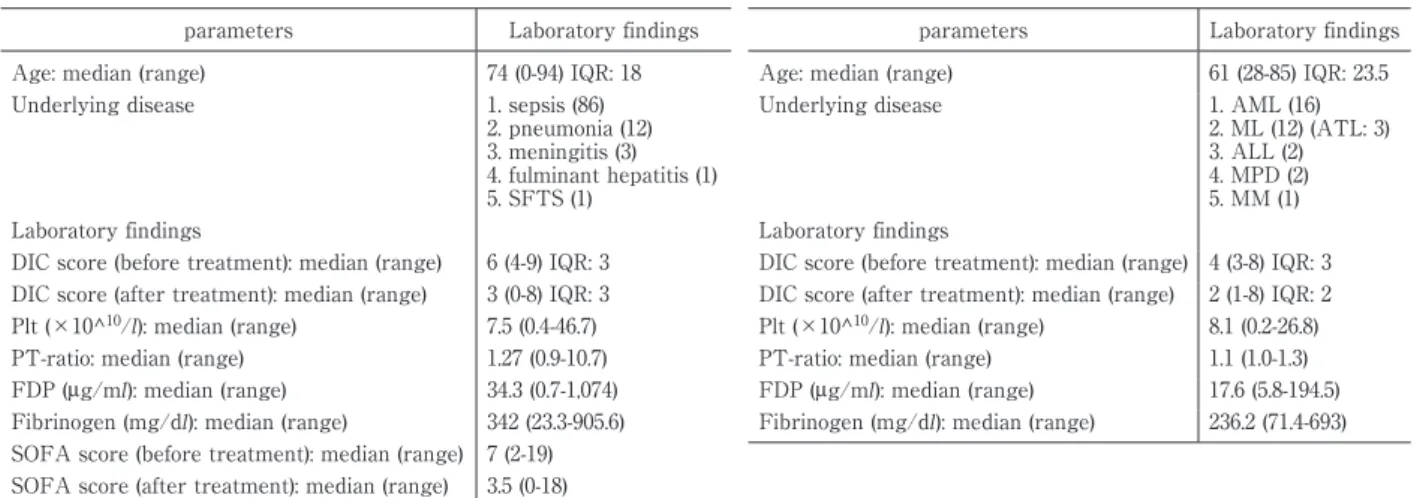
The patient characteristics of DIC patients with in- fectious disease (n=103) are shown in Table 1A. The median age of the infectious disease group was 74 years (range 0-94 years). The etiologies of the underly- ing disease were sepsis (86), pneumonia (12), meningitis (3), fulminant hepatitis (1), and severe fever with throm- bocytopenia syndrome (SFTS) virus (1).
Therefore, our study was performed between May 2012 and November 2014, and the Sepsis-3 definition (2016) was not applied for a diagnosis of sepsis. Instead, sepsis was diagnosed with the Japanese guideline for management of sepsis in 2012 and 201420).
The laboratory data were as follows: median DIC score before rhTM treatment: 6, mean platelet count:
7.5 1010/l, median prothrombin time-ratio (PT-ratio):
1.27, median fibrin / fibrinogen degradation products (FDP): 34.3μg/ml, and median fibrinogen: 342 mg/dl. We compared DIC scores before and after rhTM treat- ment (Fig. 1A).
Table 1 Clinical characteristics of DIC patients with infectious (1A) and hematological disease (1B) Table 1A
parameters Laboratory findings
Age: median (range) 74 (0-94) IQR: 18
Underlying disease 1. sepsis (86)
2. pneumonia (12) 3. meningitis (3) 4. fulminant hepatitis (1) 5. SFTS (1)
Laboratory findings
DIC score (before treatment): median (range) 6 (4-9) IQR: 3 DIC score (after treatment): median (range) 3 (0-8) IQR: 3 Plt (×10^10/l): median (range) 7.5 (0.4-46.7) PT-ratio: median (range) 1.27 (0.9-10.7) FDP (μg/ml): median (range) 34.3 (0.7-1,074) Fibrinogen (mg/dl): median (range) 342 (23.3-905.6) SOFA score (before treatment): median (range) 7 (2-19) SOFA score (after treatment): median (range) 3.5 (0-18)
Table 1B
parameters Laboratory findings
Age: median (range) 61 (28-85) IQR: 23.5
Underlying disease 1. AML (16)
2. ML (12) (ATL: 3) 3. ALL (2) 4. MPD (2) 5. MM (1) Laboratory findings
DIC score (before treatment): median (range) 4 (3-8) IQR: 3 DIC score (after treatment): median (range) 2 (1-8) IQR: 2 Plt (×10^10/l): median (range) 8.1 (0.2-26.8) PT-ratio: median (range) 1.1 (1.0-1.3) FDP (μg/ml): median (range) 17.6 (5.8-194.5) Fibrinogen (mg/dl): median (range) 236.2 (71.4-693)
Fig. 1
A and B: DIC resolution among patients with infectious and hematological diseases C: Changes of SOFA score in DIC patients with infectious disease
0 2 4 6 8 10
⒪๓(n=33) ⒪ᚋ(n=33)
0 2 4 6 8 10
⒪๓䠄n=103䠅 ⒪ᚋ䠄n=100䠅
6
3 p<0.0001
Wilcoxon signed-rank test 1A. Infectious disease
(n=103)
Resolution of DIC䠖57.3% (=59/103) After treatment
(n=103) Before treatment
(n=103)
p<0.0001
4 2
Resolution of DIC䠖54.5% (=18/33)
1B. Hematological disease (n=33)
Before treatment (n=33)
After treatment (n=33)
0 2 4 6 8 10 12 14 16 18 20
⒪๓
(n=103) ⒪ᚋ
(n=100)
1C. The changes of SOFA score in infectious disease
7
3.5
After treatment (n=103) Before treatment
(n=103)
SOFAscore 7 (before rhTM treatment) ĺ3.5 (after rhTM treatment).
DIC score DIC score SOFA score
Overall, among patients with underlying infectious disease, the median DIC score declined from 6 before rhTM treatment to 3 after rhTM treatment (Fig. 1A).
The resolution rate of DIC was 57.3% (59/103) (Fig. 1A).
Next, we compared the SOFA score before and after rhTM treatment (Fig. 1C). The median SOFA score de- clined from 7 before rhTM treatment to 3.5 after rhTM treatment (Fig. 1C). The OS rate of DIC patients with in- fectious disease at 28 days was 73.8% (76/103) (Fig. 2A).
The characteristics of DIC patients with hematologi- cal disease (n=33) are shown in Table 1B. The median age of the hematological group was 61 years (range 28-
85 years). The etiologies of the underlying disease were acute myelogenous leukemia ( AML ) ( 16 ) , including acute promyelocytic leukemia (APL) (3); malignant lym- phoma (12), including adult T-cell leukemia/lymphoma ( ATL ) ( 3 ) ; acute lymphocytic leukemia ( ALL ) ( 2 ) ; myeloproliferative disorder (MPD) (2) ; and multiple myeloma (MM) (1). The laboratory findings were as fol- lows: median DIC score before rhTM treatment: 4, me- dian platelet count: 8.1 1010/l, median PT-ratio: 1.1, me- dian FDP: 17.6μg/ml, and median fibrinogen: 236.2 mg/
dl.
Among patients with underlying hematological dis-
Fig. 2 Survival rate of DIC patients with infectious (2A) and hematological diseases (2B) 0.00
0.20 0.40 0.60 0.80 1.00
0 5 10 15 20 25 30
0.00 0.20 0.40 0.60 0.80 1.00
0 5 10 15 20 25 30
2A. Survival rate of DIC patients with infectious disease 2B. Survival rate of DIC patients with hematological disease
73.8% (76/103): 28days Survival rate (%)
Overall survival (days)
Survival rate (%)
Overall survival (days) 87.9% (29/33): 28days 100
80 60 40 20 0
100 80 60 40 20 0
ease, the median DIC score of 4 before rhTM treatment declined to a DIC score 2 after rhTM treatment (Fig.
1B). The resolution rate of DIC was 54.5% (18/33) (Fig.
1B). The OS rate of DIC patients with hematological dis- ease at 28 days was 87.9% (29/33) (Fig. 2B). In summary, of all 136 DIC patients, the resolution rate of DIC was 56.6% (77/136). The OS rate of the 136 DIC patients at 28 days was 77.2% (105/136).
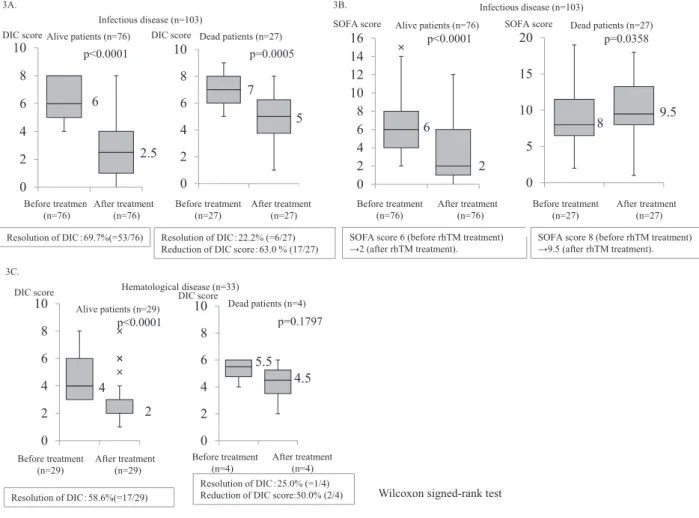
Next, we compared DIC scores before and after rhTM treatment between survivors (n=76) and non- survivors (n=27) in DIC patients with infectious disease (Fig. 3A). In survivors, the median DIC score of 6 before rhTM treatment declined to a median DIC score of 2.5 after rhTM treatment. The resolution rate of DIC was 69.7% (53/76) (Fig. 3A). In non-survivors, the median DIC score of 7 before rhTM treatment declined to a median DIC score of 5 after rhTM treatment. The resolution rate of DIC among non-survivors was 22.2% (6/27). Un- expectedly, 63.0% of patients experienced a reduction in DIC score among non-survivors (17/27) (Fig. 3A).
Similarly, we compared the SOFA score before and after rhTM treatment between survivors (n=76) and non-survivors (n=27) in DIC patients with infectious dis- ease (Fig. 3B). In survivors, a SOFA score of 6 before rhTM treatment declined to a SOFA score of 2 after rhTM treatment. However, in non-survivors, a SOFA score of 8 before rhTM treatment increased to a SOFA score of 9.5 after rhTM treatment (Fig. 3B).
We also compared DIC scores before and after rhTM treatment between survivors (n=29) and non- survivors (n=4) among DIC patients with hematological disease (Fig. 3C). In survivors, the median DIC score of 4 before rhTM treatment declined to a median DIC
score of 2 after rhTM treatment (Fig. 3C). The resolu- tion rate of DIC was 58.6% (17/29) (Fig. 3C). In non- survivors, the median DIC score of 5.5 before rhTM treatment declined to a median DIC score of 4.5 after rhTM treatment. The resolution of DIC was 25.0% (1/
4). Unexpectedly, 50.0% of patients experienced a re- duction in DIC score among non-survivors (=2/4) (Fig.
3C).
In DIC patients with low AT activity (<70%) (n=35), we administered AT 1,500 U/day for 3 consecutive days (infectious disease, n=29; hematological disease, n
=6). We examined the effect of AT administration on DIC resolution and OS. In DIC patients with infectious disease who were administered AT (n=29), the rate of DIC resolution was not superior (45%) compared to the rate of DIC resolution in patients who were not admin- istered AT (62%, 46/74) (Fig. 4A). Regarding the OS of DIC patients, the OS of DIC patients with infectious dis- ease who were administered AT tended to be superior to the OS of DIC patients who were not administered AT (Fig. 4B).
In DIC patients with infectious disease who did not survive (n=27), the cumulative mortality rate was 50%
at day 11 and 75% at day 17. Mortality tended to occur within 2 weeks of DIC onset. In DIC patients with he- matological disease who did not survive (n=4), the cu- mulative mortality rate was 50% at day 4 and 75% at day 17. Mortality tended to occur within a week of DIC onset.
The causes of mortality among non-surviving DIC patients with infectious disease were sepsis (19), pneu- monia (6), fulminant hepatitis (1), and SFTS (1). The causes of mortality among non-surviving DIC patients
Fig. 3
A: DIC resolution and DIC score reduction in surviving and non-surviving DIC patients with infectious disease B: The changes of SOFA score in surviving and non-surviving DIC patients with infectious disease
C: DIC resolution and DIC score reduction of hematological disease in surviving and non-surviving DIC patients 0
2 4 6 8 10
⒪๓ 䠄n=27䠅
⒪ᚋ 䠄n=24䠅 0
2 4 6 8 10
⒪๓ 䠄n=76䠅
⒪ᚋ 䠄n=76䠅 p<0.0001
6
2.5
7 5 p=0.0005
Wilcoxon signed-rank test Alive patients (n=76) Dead patients (n=27)
Infectious disease (n=103) 3A.
Before treatment (n=76)
After treatment (n=76)
Before treatment (n=27)
After treatment (n=27)
0 2 4 6 8 10 12 14 16
⒪๓
(n=76) ⒪ᚋ (n=76) p<0.0001
6
2
3B. Infectious disease (n=103)
Alive patients (n=76)
Before treatment (n=76)
After treatment (n=76) SOFA score 6 (before rhTM treatment) ĺ2 (after rhTM treatment).
0 5 10 15 20
⒪๓
(n=27) ⒪ᚋ (n=24)
Dead patients (n=27)
Before treatment (n=27)
After treatment (n=27) SOFA score 8 (before rhTM treatment) ĺ9.5 (after rhTM treatment).
p=0.0358
8 9.5
3C.
0 2 4 6 8 10
p<0.0001
4 2
Hematological disease (n=33)
Before treatment (n=29)
After treatment (n=29)
0 2 4 6 8
10 Dead patients (n=4)
Before treatment (n=4)
After treatment (n=4) Alive patients (n=29)
5.5 4.5
Resolution of DIC䠖25.0% (=1/4) Reduction of DIC score:50.0% (2/4) Resolution of DIC䠖22.2% (=6/27) Reduction of DIC score䠖63.0 % (17/27) Resolution of DIC䠖69.7%(=53/76)
Resolution of DIC䠖58.6%(=17/29)
p=0.1797
DIC score DIC score
SOFA score SOFA score
DIC score DIC score
with hematological disease were AML (2), ATL (1), and MM (1).
Next, to evaluate prognostic factors associated with outcomes of DIC patients with infectious disease, we performed univariate analysis of the laboratory find- ings at diagnosis (Table 2A). The univariate analysis re- vealed that PT-ratio, DIC score, and SOFA score were significantly associated with poor treatment outcomes (HR=1.217, 95% confidence interval [CI] 1.021-1.449, P=
0.028; HR= 1.389, 95% CI 1.045-1.846, P=0.024; HR=1.213, 95% CI 1.107-1.329), P<0.001, respectively (Table 2A).
The multivariate analysis revealed that SOFA score was the only statistically significant factor associated with poor treatment outcomes of DIC among patients with infectious disease (HR=1.167, 95% CI 1.022-1.333, P=0.023) (Table 2A).
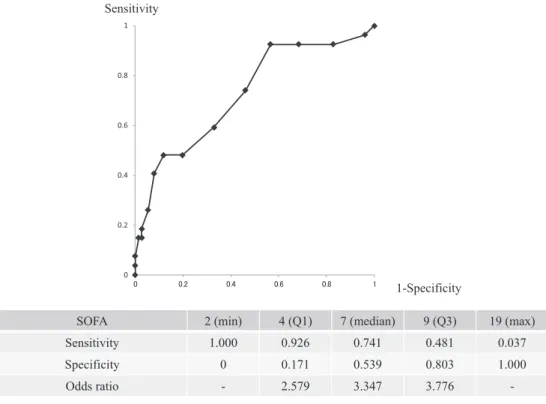
Furthermore, we analyzed the cut-off values of the SOFA score to predict the treatment outcomes of DIC with infectious disease. The ROC curve for the logistic
regression model for SOFA is shown in Fig. 5. The model including SOFA achieved an AUC of 0.72. The optimal cut-off was 10, and the sensitivity and specific- ity were 0.481 and 0.88, respectively, by the Youden in- dex method. Thus, we clearly showed that the optimal cut-off point was 10 as determined by the Youden in- dex.
Similarly, in DIC patients with hematological disease, we performed univariate analysis of the laboratory findings at diagnosis (Table 2B). The univariate and multivariate analysis did not reveal any factors signifi- cantly associated with the outcomes (Table 2B). How- ever, in univariate analysis, platelet count tended to be near the statistical significance threshold (HR=0.639, 95% CI 0.376-1.086, P=0.098). Additional research with a larger population of DIC patients is needed to clarify the prognostic factors associated with outcomes in DIC patients with hematological disease.
Based on our findings of the prognostic factors asso-
Table 2 Prognostic factors associated with poor treatment outcomes in DIC patients with in- fectious (2A) and hematological disease (2B)
Table 2A
Univariate analysis Multivariate analysis Hazard ratio (95%CI) P value Hazard ratio (95%CI) P value FDP μg/ml 1.002 (1.000-1.003) 0.076 1.007 (0.995-1.019) 0.285 PT-ratio 1.217 (1.021-1.449) 0.028 1.155 (0.781-1.706) 0.471 Fibrinogen mg/dl 1.000 (0.997-1.002) 0.638 1.000 (0.997-1.002) 0.866 PLT ×1010/l 0.968 (0.902-1.039) 0.370 0.981 (0.906-1.063) 0.644 SIRS score 1.596 (0.747-3.409) 0.228 2.251 (0.924-5.481) 0.074 DIC score 1.389 (1.045-1.846) 0.024 0.948 (0.627-1.433) 0.798 SOFA score 1.213 (1.107-1.329) <0.001 1.167 (1.022-1.333) 0.023 Cox proportional hazards model
Table 2B
Univariate analysis Multivariate analysis Hazard ration (95%CI) P value Hazard ration (95%CI) P value
FDP μg/ml 1.003 (0.987-1.020) 0.700 1.033 (0.959-1.113) 0.387
PT-ratio 2.307 (<0.001->1,000) 0.866 788.095 (<0.001->1,000) 0.659 Fibrinogen mg/dl 0.999 (0.994-1.005) 0.818 0.974 (0.929-1.021) 0.268 PLT ×1010/l 0.639 (0.376-1.086) 0.098 0.370 (0.100-1.381) 0.139 SIRS score 3.530 (0.402-30.986) 0.255 1,158.693 (0.010->1,000) 0.239
DIC score 1.347 (0.861-2.109) 0.192 0.018 (0.0001-5.52) 0.169
Cox proportional hazards model
Fig. 4
A: Effect of AT administration on DIC resolution in infectious disease B: Effect of AT administration on treatment outcomes in infectious disease
Infectious disease
45% 62%
0%
20%
40%
60%
80%
100%
AtϪ䛒䜚 AtϪ䛺䛧
p=0.110
4A.
AT+ AT-
n=29 n=74
0.00 0.20 0.40 0.60 0.80 1.00
0 7 14 21 28
AtϪ䛒䜚 AtϪ䛺䛧 Log rank test p=0.436
Infectious disease
n=103
Days after treatment with rhTM (days)
4B.
AT+:n=29 AT-:n=74
Survival rate (%) DIC resolution rate
100
80
60
40
20
0
ciated with DIC outcomes, including higher DIC score (univariate analysis), and higher SOFA score (multivari- ate analysis) (cut-off point: 10) at diagnosis in DIC pa- tients with infectious disease, and the lower platelet count in DIC patients with hematological diseases, we examined the relationship between OS, DIC, and SOFA
score in patients with infectious disease, and OS and platelet count in patients with hematological disease.
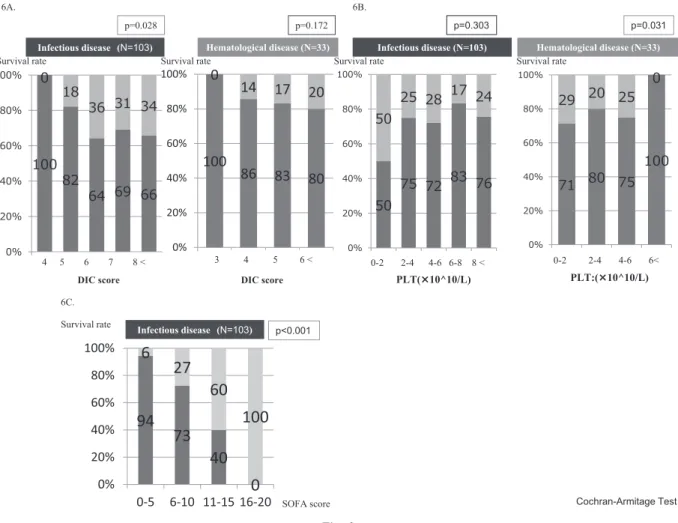
Higher DIC score at diagnosis was significantly asso- ciated with poorer OS in DIC patients with infectious disease (P=0.028) (Fig. 6A), lower platelet count at diag- nosis was significantly associated with poorer OS in
Fig. 5 ROC curve of SOFA score in DIC patients with infectious disease. The ROC curve for the logistic regression model for SOFA is shown. The model including SOFA achieved an AUC of 0.72. The optimal cut-off was 10, and the sensitivity and specificity were 0.481 and 0.88 respec- tively, by the Youden index method.
0 0.2 0.4 0.6 0.8 1
㻜 㻜㻚㻞 㻜㻚㻠 㻜㻚㻢 㻜㻚㻤 㻝
SOFA 2 (min) 4 (Q1) 7 (median) 9 (Q3) 19 (max)
Sensitivity 1.000 0.926 0.741 0.481 0.037
Specificity 0 0.171 0.539 0.803 1.000
Odds ratio - 2.579 3.347 3.776 -
Sensitivity
1-Specificity
DIC patients with hematological diseases (P=0.031) (Fig.
6B), and higher SOFA score at diagnosis was signifi- cantly related to worse OS in DIC patients with infec- tious disease (P<0.001) (Fig. 6C).
Finally, we analyzed the transfusion rate and dose in 103 DIC patients with infectious disease and 33 DIC pa- tients with hematological disease (Table 3). In 103 DIC patients with infectious disease, we analyzed the trans- fusion rate and dose between DIC resolution patients and DIC non-resolution patients (Table 3A). The trans- fusion rate (RBC, PC, and FFP) in DIC resolution pa- tients was statistically lower than that in DIC non- resolution patients. The transfusion dose (RBC, PC, and FFP) in DIC resolution patients was statistically lower than that in DIC non-resolution patients. These results clearly showed that rhTM treatment may affect the transfusion rate and dose in DIC resolution patients with infectious disease.
Furthermore, we analyzed the transfusion rate and dose between surviving DIC patients and non- surviving DIC patients (Table 3B). The transfusion rate (RBC, PC, and FFP) in surviving DIC patients was sta- tistically lower than that in non-surviving DIC patients.
The transfusion dose (RBC, PC, and FFP) in surviving
DIC patients was statistically lower than that in non- surviving DIC patients. These results clearly showed that rhTM treatment may affect the transfusion rate and dose in surviving DIC patients with infectious dis- ease.
In 33 DIC patients with hematological disease, we analyzed the transfusion rate and dose between DIC resolution patients and DIC non-resolution patients (Table 4A). Only the FFP transfusion rate in DIC reso- lution patients was statistically inferior to that in DIC non-resolution patients. Only the FFP transfusion dose in DIC resolution patients was also statistically inferior to that in DIC non-resolution patients. Moreover, we analyzed the transfusion rate and dose between sur- viving DIC patients and non-surviving DIC patients (Table 4B). Only the PC transfusion dose in surviving DIC patients was statistically inferior to that in non- surviving DIC patients. These results clearly revealed that rhTM treatment may affect the FFP transfusion rate and dose in surviving DIC patients with hemato- logical disease.
The adverse effects of treatment with rhTM were tolerable except for two occurrences of grade 2 bleed- ing, cerebral hemorrhage (1), and bleeding at the opera-
Table 3A The comparison between transfusion rate and dose in DIC resolution patients and DIC non-resolution patients with infectious disease
Transfusion rate Transfusion dose (median)
total RBC PC FFP RBC PC FFP
Transfusion (+)/DIC resolution patients 40.6%
(=24/59)
32.2%
(=19/59)
22.0%
(=13/59)
6.8%
(=4/59) 4 (0-38)
10 (0-460)
0 (0-24) Transfusion (+)/DIC non-resolution patients 72.7%
(=32/44) 52.3%
(=23/44) 52.3%
(=23/44) 40.9%
(=18/44) 6
(0-62) 25
(0-240) 6
(0-302)
p=0.001 p=0.018 p=0.000 p=0.045 p=0.049 p=0.002 p=0.002
Fischerʼs exact test Mann-Whitney U test
Transfusion rate Transfusion dose (median)
Total RBC PC FFP RBC PC FFP
Transfusion (+)/surviving DIC patients 48.7%
(=37/76)
34.2%
(=26/76)
28.9%
(=22/76)
14.5%
(=11/76) 0 (0-38)
0 (0-460)
0 (0-24) Transfusion (+)/non-surviving DIC patients 70.3%
(=19/27)
59.3%
(=16/27)
51.9%
(=14/27)
40.7%
(=11/27) 4 (0-62)
10 (0-240)
4 (0-302)
p=0.0071 p=0.039 p=0.037 p=0.006 p=0.014 p=0.036 p=0.004
Fischerʼs exact test Mann-Whitney U test
Table 3B The comparison between transfusion rate and dose of surviving DIC patients and non-surviving DIC patients with infectious disease
Fig. 6
A: Survival rate according to DIC score in patients with infectious and hematological diseases B: Survival rate according to platelet count in patients with infectious and hematological diseases C: Survival rate according to SOFA score among DIC patients with infectious disease
Infectious disease (N=103) Hematological disease (N=33)
Cochran-Armitage Test
ਰ
p=0.028 p=0.172
6A.
100 86 83 80 0 14 17 20
0%
20%
40%
60%
80%
100%
3 4 5 6௨ୖ
4 5 6 7 8 < 3 4 5 6 <
6B.
Infectious disease (N=103) p=0.303
0-2 2-4 4-6 6-8 8 <
Hematological disease (N=33) p=0.031
0-2 2-4 4-6 6<
PLT:(¼10^10/L) PLT(¼10^10/L)
DIC score DIC score
6C.
94 73 40
0 6 27
60 100
0%
20%
40%
60%
80%
100%
0-5 6-10 11-15 16-20
p<0.001 Survival rate Infectious disease (N=103)
SOFA score
Survival rate Survival rate Survival rate Survival rate
Table 4A The comparison between transfusion rate and dose of DIC resolution patients and DIC non-resolution patients with hematological disease
Transfusion rate (median) Transfusion dose (median)
total RBC PC FFP RBC PC FFP
Transfusion (+)/DIC resolution patients 73.7%
(=14/19) 57.9%
(=11/19) 68.4%
(=13/19) 26.3%
(=5/19) 7
(0-20) 75
(0-190) 2
(0-44) Transfusion (+)/DIC non-resolution patients 100%
(=14/14) p=0.057
78.6%
(=11/14) p=0.278
92.9%
(=13/14) p=0.195
78.6%
(=11/14) p=0.004
9 (0-26) p=0.101
95 (0-410) p=0.115
12 (0-60) p=0.003
Fischerʼs exact test Mann-Whitney U test
Transfusion rate (median) Transfusion dose (median)
total RBC PC FFP RCC PC FFP
Transfusion (+)/surviving DIC patients 82.8%
(=24/29)
70.0%
(=20/29)
79.3%
(=23/29)
48.3%
(=14/29) 7 (0-20)
75 (0-190)
2 (0-44) Transfusion (+)/non-surviving DIC patients 100%
(=4/4) 50%
(=2/4) 75%
(=3/4) 50%
(=2/4) 9
(0-26) 95
(0-410) 12 (0-60)
p=1.00 p=0.586 p=1.000 p=1.000 p=0.357 p=0.036 p=0.102
Fischerʼs exact test Mann-Whitney U test
Table 4B The comparison between transfusion rate and dose of surviving DIC patients and non-surviving DIC patients with hematological disease
tion site (1). The overall incidence of adverse effects was 8.8% (12/136). The incidence of bleeding adverse effects was 5.9% (8/136) and included subcutaneous hemor- rhage (6), cerebral hemorrhage (1), and bleeding at the operative site (1). Grade 2 bleeding adverse effects in- cluded cerebral hemorrhage (1) and bleeding at the op- erative site (1). Our case with cerebral hemorrhage af- ter rhTM treatment gradually recovered with conser- vative therapy without requiring surgery.
Discussion
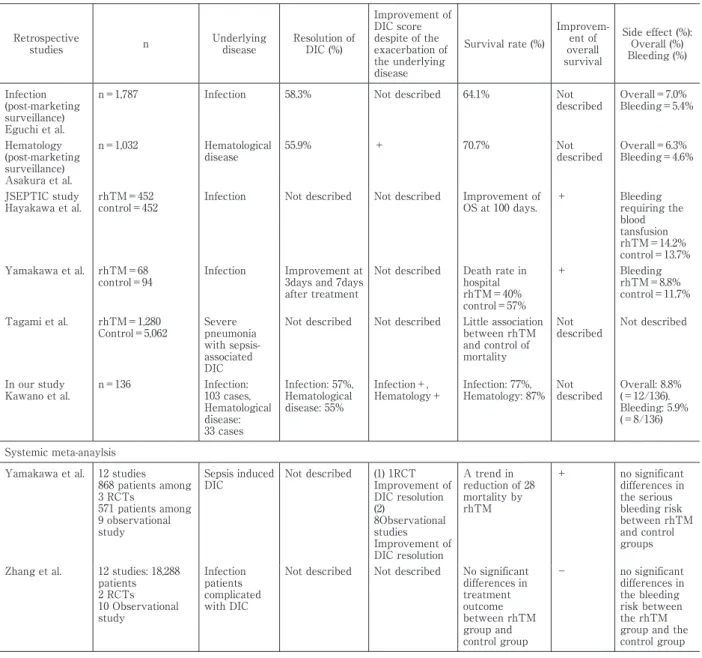
Recently, several retrospective clinical reports, two systemic reviews/meta-analyses, and major guidelines revealed the efficacy and safety of rhTM for DIC pa- tients with infectious or hematological diseases in clini- cal practice (Table 5)3)9)〜13). Yamakawaʼs systemic re- view/meta-analysis including 12 studies (838 patients included in 3 randomized controlled trials [RCTs]; 571 patients in 9 observational studies) revealed a statisti- cally significant effect on OS at 28 days after rhTM treatment for DIC patients14). In contrast, Zhangʼs sys- temic review/meta-analysis including 10 observational studies and 2 RCTs involving 18,288 patients did not re- veal a statistically significant effect on OS at 28 days fol- lowing rhTM treatment for DIC patients15). Thus, the effect of rhTM on DIC treatment outcome is still con- troversial. Consequently, the predicted survival rate of DIC after 28 days treated with rhTM was approxi- mately 30% and was still poor prognosis8)〜21). Thus, to
improve the poor outcome of DIC, it is essential to iden- tify the prognostic factors of DIC. Furthermore, we analyzed the clinical effect of DIC resolution, the OS of DIC patients, the adverse effects on DIC patients, the transfusion rate, and transfusion dose for DIC patients during rhTM treatment in clinical practice.
In our retrospective study,
(i) We identified a prognostic factor, SOFA ( > 10 points) for DIC patients with infectious disease.
(ii) rhTM treatment may have an effect on reduction of the abnormal coagulopathy (DIC score) in DIC pa- tients with infectious disease and hematological dis- ease.
(iii) rhTM treatment may reduce the transfusion rate and dose (RBC, PC, and FFP) in DIC resolution patients and surviving DIC patients with infectious disease.
Moreover, rhTM treatment may reduce the transfu- sion rate and dose (FFP) in DIC resolution patients and the transfusion dose (PC) in surviving DIC patients with hematological disease.
(iv) Our analysis also found that the reduction of DIC, OS, and adverse effects of DIC patients with infectious disease and hematological disease were consistent with previous reports8)〜21).
Our study clearly revealed that higher SOFA score (>10) was associated with a poor outcome in DIC pa- tients with infectious disease. Furthermore, rhTM treatment demonstrated an improvement in abnormal coagulopathy in survivors and even some populations
Table 5 Previous reports regarding DIC patients treated with rhTM and our study
Retrospective
studies n Underlying
disease
Resolution of DIC (%)
Improvement of DIC score despite of the exacerbation of the underlying disease
Survival rate (%)
Improvem- ent of overall survival
Side effect (%):
Overall (%) Bleeding (%)
Infection (post-marketing surveillance) Eguchi et al.
n=1,787 Infection 58.3% Not described 64.1% Not
described Overall=7.0%
Bleeding=5.4%
Hematology (post-marketing surveillance) Asakura et al.
n=1,032 Hematological
disease 55.9% + 70.7% Not
described Overall=6.3%
Bleeding=4.6%
JSEPTIC study
Hayakawa et al. rhTM=452
control=452 Infection Not described Not described Improvement of
OS at 100 days. + Bleeding requiring the blood tansfusion rhTM=14.2%
control=13.7%
Yamakawa et al. rhTM=68 control=94
Infection Improvement at 3days and 7days after treatment
Not described Death rate in hospital rhTM=40%
control=57%
+ Bleeding
rhTM=8.8%
control=11.7%
Tagami et al. rhTM=1,280 Control=5,062
Severe pneumonia with sepsis- associated DIC
Not described Not described Little association between rhTM and control of mortality
Not described
Not described
In our study Kawano et al.
n=136 Infection:
103 cases, Hematological disease:
33 cases
Infection: 57%, Hematological disease: 55%
Infection+, Hematology+
Infection: 77%, Hematology: 87%
Not described
Overall: 8.8%
(=12/136).
Bleeding: 5.9%
(=8/136) Systemic meta-anaylsis
Yamakawa et al. 12 studies 868 patients among 3 RCTs
571 patients among 9 observational study
Sepsis induced DIC
Not described (1) 1RCT Improvement of DIC resolution (2)
8Observational studies Improvement of DIC resolution
A trend in reduction of 28 mortality by rhTM
+ no significant differences in the serious bleeding risk between rhTM and control groups Zhang et al. 12 studies: 18,288
patients 2 RCTs 10 Observational study
Infection patients complicated with DIC
Not described Not described No significant differences in treatment outcome between rhTM group and control group
− no significant differences in the bleeding risk between the rhTM group and the control group
of non-survivors in clinical practice.
We discussed (i) the SOFA score as a prognostic fac- tor for DIC patients, (ii) the improvement of abnormal coagulopathy in some populations of non-survivors of DIC by rhTM treatment, (iii) the reduction of transfu- sion rate and dose of DIC patients by rhTM treatment, and (iv) the clinical effect of DIC resolution, OS of DIC, and adverse effects due to rhTM treatment of DIC.
In our study, we focused on the identification of prog- nostic factors for DIC patients to improve the poor out- come of DIC. First, regarding prognostic factors associ- ated with treatment outcome, SOFA score (multivari- ate analysis) (cut-off point: 10) at diagnosis in DIC pa- tients with infectious disease was identified. In previ- ous DIC studies without rhTM treatment, various
markers such as AT, SF, high-mobility group box 1 (HMGB-1), TM, acute DIC score, or SOFA score were reported as prognostic factors for DIC patients31)〜36)
(Table 6). Among these markers, in a previous DIC study without rhTM treatment, Seki et al. reported that the outcomes of 77 septic patients with DIC pri- marily depended on the SOFA score and the resolution of DIC, which are related to organ failure36)(Table 6).
At present, in previous DIC studies with rhTM treat- ment, sex9), duration of DIC before rhTM9), fibrinogen9), SOFA9), and ADAMTS 13 activity37)were reported as prognostic factors for DIC treatment outcome9)37)(Ta- ble 6). Eguchi et al. reported that sex, the duration of DIC before rhTM, fibrinogen, and SOFA score were identified as significant independent factors affecting
Table 6 Previous reports regarding prognostic factors for DIC treatment outcomes and our study
(1) Previous DIC reports without rhTM treatment
AT (ref 31), SF (ref 32), HMGB-1 (ref 33), TM (ref 34), Acute DIC score (ref 35), SOFA score (ref 36).
(2) Previous DIC reports with rhTM treatment
Sex (ref 9), duration of DIC before rhTM (ref 9), Fibrinogen (ref 9), SOFA (ref 9), ADAMTS 13 activity (ref 36) (3) Our present study
SOFA score (optimal cut-off points: 10)
the survival rate among 1,787 sepsis-induced DIC pa- tients in post-marketing surveillance9). Ohshiro et al. re- ported that low ADAMTS 13 activity ( < 65% ) may worsen DIC and organ failure by promoting vascular endothelial damage in 30 DIC patients with hemato- logical malignancies37). Although various markers were reported, these markers are not easily measured or promptly available in clinical practice.
In our study with rhTM treatment for DIC, the SOFA score was identified as the most important pre- dictor of the treatment outcome of DIC with infectious disease (cut off point: 10). These results are consistent with the previous reports regarding SOFA9)36). How- ever, these previous reports9)36)did not examine and discuss the cut-off point of SOFA for the treatment out- come. In our study, the optimal cut-off of SOFA for af- fecting the treatment outcome was 10, and the sensitiv- ity and specificity were 0.481 and 0.88, respectively, by the Youden index method. As for the relationship be- tween SOFA score and mortality, Vincent et al. re- ported that a higher SOFA score was associated with an increased probability of mortality in 1,449 patients admitted to 40 ICUs in 16 countries38). In this report, for a total SOFA score of >10, the mortality rate was ap- proximately 40%38). Furthermore, for a total SOFA score of >15, the mortality rate was approximately 90%38). In survivors, the peak of maximum SOFA score was distributed in scores 3-438). In non-survivors, the peak of maximum SOFA score was distributed in scores 10-1138). Our results revealing the prognostic fac- tor as SOFA score (>10) were consistent with Vincentʼs report38)of a total score of >10 (approximate mortality rate 40%) and maximum SOFA score distribution (10- 11) in non-survivors. Thus, the evaluation of SOFA score at DIC diagnosis may be essential to improve the poor outcome of DIC patients with infectious disease.
As for the relationship between SOFA score and anti- coagulant therapy for DIC patients with sepsis, Yamakawa et al. reported that anti-coagulant therapy may be effective for sepsis-DIC patients with a higher
SOFA score (SOFA score: 13-17) in a nationwide study including 2,663 patients (anticoagulant group: 1,247 pa- tients consisting of 818 received AT, 717 received rhTM, 323 received synthetic protease inhibitor, 144 re- ceived heparin/danaparoid, versus the control, 1,416 patients)39). Moreover, in February 2016, Sepsis-3 em- phasized the evaluation of SOFA score at diagnosis and sequential SOFA score in sepsis to improve the poor outcome26). Consistent with the importance of the SOFA score in Yamakawaʼs report39)and Sepsis-326), an early diagnosis using the diagnostic criteria of DIC with early evaluation multi-organ status using the SOFA score led to the subsequent successful rhTM treatment for DIC patients with infectious disease in clinical practice. However, in non-surviving DIC pa- tients with infectious disease, the SOFA score in- creased after rhTM treatment (8→9.5). Thus, rhTM treatment did not have an ameliorative effect for re- duction of the SOFA score in non-surviving DIC pa- tients. Furthermore, our study revealed that a higher DIC score and higher SOFA score at diagnosis of DIC were significantly associated with lower OS for DIC in patients with infectious disease. Thus, before the pro- gression of systemic organ damage due to cross talk of inflammation and coagulation mechanisms, prompt rhTM treatment for DIC, based on early diagnosis of DIC patients with lower SOFA score, and subsequent rapid rhTM treatment, may improve the poor outcome of DIC patients with infectious disease in clinical prac- tice.
Second, rhTM, as a powerful anti-coagulant and anti- inflammatory agent, may improve abnormal coagulo- pathy in some populations of non-surviving DIC pa- tients with infectious and hematological diseases. In a previous DIC study without rhTM treatment, Seki et al. reported the importance of the resolution of DIC for treatment outcomes of DIC with infection36). Moreover, in post-marketing surveillance of DIC patients with he- matological diseases (n=1,032), Asakura et al. reported that abnormal coagulation tests were significantly im-
proved after rhTM treatment even in subjects whose clinical course of underlying disease was assessed as unchanged or exacerbated10). Thus, our clinical retro- spective study revealed that rhTM treatment may have an ameliorative effect for resolution or reduction of the DIC score in even some populations of non- surviving DIC patients. These results may be ex- plained by the mechanism of anti-coagulant effects by APC activation and anti-inflammatory effects by the lectin like-domain because of the inflammation- coagulopathy cross-talk mechanism3)〜8).
Third, rhTM treatment may reduce the transfusion rate and dose (RBC, PC, FFP) in DIC resolution patients and surviving DIC patients with infectious disease.
Moreover, rhTM treatment may reduce the transfu- sion dose of PC and FFP in DIC resolution and surviv- ing DIC patients with hematological disease. In a previ- ous report regarding the relationship between rhTM treatment and transfusion treatment, Murata et al. re- ported that a retrospective large nationwide DPC (Di- agnosis Procedure Combination ) -based study ( 7,535 DIC patients with infectious disease in 886 hospitals) re- vealed that the use of rhTM treatment group (n=3,934) significantly decreased the length of stay and medical costs during hospitalization of patients with DIC in con- trast to the AT treatment group (n=3,601)40). In this study, the transfusion rate of PC and FFP in the rhTM treatment group was significant lower than in the AT treatment group40). Consistent with Murataʼs report40), our results showed that in DIC patients with infectious diseases, the transfusion rate and dose (RBC, PC, and FFP) in DIC resolution patients and surviving DIC pa- tients was significantly lower than in DIC non- resolution patients and non-surviving DIC patients, re- spectively. Moreover, our results showed that in DIC patients with hematological diseases, the transfusion dose of PC and FFP in DIC resolution patients and sur- viving DIC patients were significantly lower than in DIC non-resolution patients and non-surviving DIC pa- tients, respectively. Thus, these findings of our study clearly showed that early administration of rhTM after immediate diagnosis of DIC may result in the reduction of the transfusion rate and dose in patients who are ex- pected to experience DIC resolution and survive. In 2017, the Japanese society of transfusion and cell ther- apy proposed a guideline for the use of RBC, PC, and FFP based on scientific evidence41)〜43). In these guide- lines41)〜43), the trigger levels of RBC, PC, and FFP in DIC
patients with infectious and hematological disease were not described because of the variation in the un- derlying diseases. Further analysis was essential to elu- cidate the appropriate trigger level of transfusion. Con- sequently, rhTM treatment may ameliorate the reduc- tion in the transfusion rate and dose (RBC, PC, and FFP) of DIC patients with infectious disease and the transfu- sion dose of PC and FFP in patients expected to experi- ence DIC resolution and survival with hematological diseases.
Finally, our analysis also revealed that the reduction of DIC, OS, and adverse effects of DIC patients with in- fectious disease and hematological disease were consis- tent with previous reports9)〜21). The adverse effects of rhTM treatment in DIC patients were tolerable; the in- cidence of adverse effects and the incidence and grade of bleeding were consistent with previous reports9)〜21). Our cerebral hemorrhage case after rhTM gradually recovered with conservative therapy and without sur- gery. In the prediction of hemorrhagic events during and following rhTM treatment, Chinen et al. reported that low ADAMTS-13 activity at diagnosis of DIC may predict a higher risk of hemorrhagic events44). In our case, ADAMTS-13 activity was not measured at diag- nosis of DIC. Thus, cerebral hemorrhage should be watched for during and after rhTM treatment for DIC patients in clinical practice.
Wada reviewed the differences among the recom- mendations provided by the five guidelines ( BSCH, JSTH, SISET, ISTH, and J-SSCG 2016)17)〜21)45)46). Among the five guidelines17)〜21)45)46), the Japanese expert con- sensus for the treatment of DIC recommends the use of rhTM for DIC patients in 2014 (recommendation: B1- C)18). The ISTH/SSC guideline suggested the use of rhTM for DIC patients in 201319). Furthermore, Japa- nese guidelines for the treatment of sepsis from the sepsis registry committee of the Japanese Society of In- tensive Care Medicine recommended rhTM for DIC patients with sepsis in 2014 (recommendation: 2C)20). However, in 2016, Japanese clinical practice guidelines for management sepsis and septic shock 2016, J-SSCG 2016, did not mention rhTM for DIC21). Thus, unifying the recommendations of these five guidelines may be required to perform appropriate treatment for DIC pa- tients in clinical practice worldwide17).
At present, a phase III clinical trial evaluating the ef- ficacy of rhTM in severely septic patients with abnor- mal coagulopathy is now enrolling patients and is being
conducted in the USA, South America, Asia, Australia, the European Union, and other countries3). This study is expected to clarify whether rhTM may be the stan- dard treatment for severe sepsis with abnormal coagu- lopathy worldwide.
In conclusion, our study clearly revealed that SOFA at diagnosis may be an independent prognostic factor for DIC patients with infectious disease treated with rhTM in clinical practice. Furthermore, rhTM treat- ment even for some populations of non-surviving DIC patients with infectious and hematological diseases demonstrated resolution and reduction of the DIC score. Thus, rhTM treatment may be a powerful anti- coagulant and anti-inflammatory agent that improves abnormal coagulopathy even in some populations of non-surviving DIC patients. A higher SOFA score (>10) was related to poor outcomes of DIC associated with in- fectious disease, and thus, early diagnosis of DIC with evaluation of SOFA, and subsequent rhTM treatment may improve the resolution and poor outcomes of DIC in clinical practice. In the future, a larger population of DIC patients treated with rhTM is needed to further research and clarify the clinical effect of rhTM on DIC patients in clinical practice.
Conflict of Interest Statement
All authors have no conflict of interest.
References
1)Levi M, Ten Cate H: Disseminated intravascular coagu- lation. N Engl J Med, 341: 586―592, 1999.
2)Bick RL: Disseminated intravascular coagulation cur- rent concepts of etiology, pathophysiology, diagnosis, and treatment. Hematol Oncol Clin North Am, 17: 149―
176, 2003.
3)Gando S, Levi M, Toh CH: Disseminated intravascular coagulation. Nat Rev Dis Primers, 2: 16037, 2016.
4)Maruyama I: Recombinant thrombomodulin and acti- vated protein C in the treatment of disseminated in- travascular coagulation. Thromb Haemost, 82: 718―721, 1999.
5)Esmon CT: The interactions between inflammation and coagulation. Br J Haematol, 131: 417―430, 2005.
6)Conway EM, Van de Wouwer M, Pollefeyt S, et al: The lectin-like domain of thrombomodulin confers protec- tion from neutrophil-mediated tissue damage by sup- pressing adhesion molecule expression via nuclear fac- tor kappaB and mitogen-activated protein kinase path- ways. J Exp Med, 196: 565―577, 2002.
7)Abeyama K, Stern DM, Ito Y, et al: The N-terminal do- main of thrombomodulin sequesters high-mobility group-B1 protein, a novel antiinflammatory mechanism.
J Clin Invest, 115: 1267―1274, 2005.
8)Saito H, Maruyama I, Shimazaki S, et al: Efficacy and safety of recombinant human soluble thrombomodulin (ART-123) in disseminated intravascular coagulation: re- sults of a phase III, randomized, double-blind clinical trial. J Thromb Haemost, 5: 31―41, 2007.
9)Eguchi Y, Gando S, Ishikura H, et al: Post-marketing sur- veillance data of thrombomodulin alfa: sub-analysis in patients with sepsis-induced disseminated intravascu- lar coagulation. J Intensive Care, 2: 30, 2014.
10)Asakura H, Takahashi H, Tsuji H, et al: Post-marketing surveillance of thrombomodulin alfa, a novel treatment of disseminated intravascular coagulation - safety and efficacy in 1,032 patients with hematologic malignancy.
Thromb Res, 133: 364―370, 2014.
11)Hayakawa M, Yamakawa K, Saito S, et al; Japan Septic Disseminated Intravascular Coagulation (JSEPTIC DIC) study group : Recombinant human soluble thrombo- modulin and mortality in sepsis-induced disseminated intravascular coagulation. A multicentre retrospective study. Thromb Haemost, 115: 1157―1166, 2016.
12)Yamakawa K, Ogura H, Fujimi S, et al: Recombinant hu- man soluble thrombomodulin in sepsis-induced dissemi- nated intravascular coagulation: a multicenter propen- sity score analysis. Intensive Care Med, 39: 644―652, 2013.
13)Kawano N, Tasaki A, Kuriyama T, et al: Effects of re- combinant human soluble thrombomodulin treatment for disseminated intravascular coagulation at a single institution--an analysis of 62 cases caused by infectious diseases and 30 cases caused by hematological diseases.
Intern Med, 53: 205―213, 2014.
14)Yamakawa K, Aihara M, Ogura H, et al: Recombinant human soluble thrombomodulin in severe sepsis: a sys- tematic review and meta-analysis. J Thromb Haemost, 13: 508―519, 2015.