3
(H27-化学—一般-006))厚生労働科学研究費補助金(化学リスク研究事業)
(総合)研究報告書
免疫毒性評価試験法Multi-ImmunoTox assayの国際validationへ向けての検討
研究代表者 相場 節也 東北大学病院皮膚科教授
4 研究要旨
1)modified Multi‑ImmunoTox assay (mMITA)の構築とそれを用いた 免疫毒性物質の clustering:
平成 27 年度は、Multi‑ImmunoTox assay (MITA)を用いて更に data set の拡充をはかり合計で 60 化学物質からなる data set を構築した。その なかで、皮膚感作性物質の多くが LPS で刺激した THP‑G8 細胞の IL‑8 転 写活性を抑制することを見いだし、従来の MITA では単球/樹状細胞に抑 制的に作用する免疫抑制物質と皮膚感作性物質を区別できない事が明 らかとなった。そこで従来法の MITA に、これまで我々が進めてきた皮 膚感作性物質試験法である IL‑8 Luc assay を加えた modified MITA (mMITA)を構築した。そこで平成 29 年度までに、免疫抑制剤、免疫毒性 が明らかな化学物質を含む 60 種類の化学物質を Multi‑ImmunoTox assay (MITA)を用いて評価し、MITA の data set を構築した。その中で、
PMA/Io 刺激存在下の IL‑2、IFN‑γ転写活性抑制と LPS 存在下の IL‑1β、
IL‑8 転写活性抑制のみを評価する従来の MITA に加えて、皮膚感作性試 験である IL‑8 Luc assay を組み合わせることで化学物質の免疫毒性が より正確に評価できることを見いだした。具体的には、化学物質の IL‑
2、IL‑8 転写活性を抑制する最低濃度 (Lowest observed effect level;
LOEL)および IL-8 Luc assayの結果を組み合わせることでMITA により 免疫毒性化学物質が 6 種類のクラスターに分類できることを明らかにし た。それらのClusterは以下の様な特徴を有していた。Cluster 1; IL-8転 写活性のみ抑制物質、Cluster 2: IL-2転写活性抑制、感作性物質、Cluster 3: 感作性物質、Cluster 4: 陰性物質、Cluster 5: IL-2、IL-8転写活性抑 制物質、Cluster 6: IL-2転写活性のみ抑制物質2)OECD テストガイド ライン化に向けての IL‑2 転写活性抑制評価試験の国際バリデーション Phase 1, Phase 2 を行った。
2) AOP の作成:
平成 27 年度から 28 年度にかけて、IL‑2 転写活性抑制と IL‑8 転写活性 増強の 2 つを key event とする adverse outcome pathway (AOP)を作成 した。前者では、dimethylthiocarbamate (DTC)の NF‑kB 抑制、AG‑018986 の p38 MAPK 抑制、メチル水銀(CH3HgCl)の ERK1/2 抑制、Propanil (3,4‑
dichloropropionanilide (DCPA)の STIM1、CRAC を介した NFAT 抑制、鉛 の calmodurin を介した NFAT 抑制を組み込んだ AOP が作成できた。また 後者では、diesel exhaust particle (DEP)、フォルマリン、PM2.5 さら には界面活性剤による IL‑8 転写活性亢進作用と adverse outcome とし ての気道刺激性を組み込んだ AOP を作成した。 IL‑2 転写活性抑制と IL‑8 転写活性抑制の 2 つを key event とする AOP を作成した。
3)IL‑2 レポーター活性抑制物質評価法の国際 validation
平成 28 年 9 月 13 日に国内外から免疫毒性の専門家を交えた免疫毒性評 価系国際化へ向けての kick‑off meeting を仙台にて開催し、MITA の科 学的意義、作成した AOP の改良、試験法プロトコルの妥当性などについ て議論した。その後、まず IL‑2 レポーター活性抑制物質評価にかかわ る技術移転性確認を目的とした 3 施設での施設間差比較試験(Phase 0) を実施した。平成 28 年度後半に行った国際バリデーション実行委員会 の承認を得た後に Phase 1 study(施設内、施設間再現性確認試験)を実
5
施した。平成 29 年 2 月 3‑5 日、京都にて開催された第2回国際バリデ ーション実行委員会会議にて Phase 1 の結果が了承され、Phase II 試 験を実施した。Phase II の結果は、平成 29 年 11 月 18‑19 日、大阪にて 開催された第3回国際バリデーション実行委員会会議および平成 30 年 3 月 29 日に Skype にて行われた国際バリデーション実行委員会会議に て検討された。その間、統計解析手法の改良も行われ、最終的にPhase I、IIのいずれの結果も施設間再現性、施設内再現性が study plan に記 載された基準 80%を上まわった。
4)皮膚感作性試験法 IL‑8 Luc assay が OECD テストガイドライン(442E) に承認された。
研究分担者氏名・所属研究機関名及び所属研究機関 における職名
小島 肇・国立医薬品食品衛生研究所・安全性予 測評価部・第二室長
近江谷 克裕・産業技術総合研究所・バイオメデ ィカル研究部門・研究部門長 山影 康次・食品薬品安全センター秦野研究所・
研究開発部・部長
中島 芳浩・産業技術総合研究所・健康工学研究 部門・研究グループ長
大森 崇・神戸大学医学部附属病院・臨床研究推 進センター・特命教授
木村 裕・東北大学病院・皮膚科・助教
A.研究目的
研究背景:環境汚染物質、食品添加物、薬剤などの化学 物質のなかには免疫系を標的とし、アレルギー、
自己免疫疾患、免疫抑制に基づく易感染性、発 癌などの健康被害を及ぼすものが少なくない。
したがって、外因性化学物質の生体免疫機能へ の毒性効果として定義される免疫毒性は、公衆 衛生行政にとっても重要な課題となっている。
しかし現在存在している化学物質の免疫毒性評 価法は、極めて多岐にわたる免疫反応に及ぼす 化学物質の影響を評価するには不十分であり、
さらにその多くが動物実験に依存している。い うまでもなく動物実験には、得られた結果から どこまでヒトに対する影響を類推できるかとい
う科学的問題に加えて費用面、倫理面など多く の問題が存在する。したがって、これらの問題 を解決するためには多岐にわたる免疫反応を動 物実験を用いずに評価する試験系の開発が不可 欠である。
我々は,平成18−22年NEDO「高機能簡易型有害性 評価手法の開発」プロジェクトにおいて、産業総 合研究所が開発した3色発光細胞の技術を応用 し,Jurkat細胞におけるINF‑γ、IL‑2、G3PDHプロ モーター活性、THP‑1細胞におけるIL‑8、IL‑1β、
G3PDHプロモーター活性をhigh throughputに評価 できる長期細胞株を樹立し、化学物質の免疫毒性 多項目評価システム(Multi‑ImmunoTox assay;
MITA)を構築し国内外の特許を取得している。
MITAを用いるとヒトT細胞におけるIL‑2とIFN‑γ、
マクロファージ/樹状細胞におけるIL‑1βとIL‑8 の転写に関与するシグナル伝達経路への化学物 質の影響を定量的に評価することができる。平成 24年度から平成26年度の3年間にわたる厚生労働 科学研究費補助金事業「多色発光細胞を用いた high‑throughput免疫毒性評価試験法の開発」に おいて、我々はまず作用機序の明らかな種々の免 疫抑制剤をMITAを用いて評価するなかで、化学物 質免疫毒性評価におけるMITAのプロトコールを 作成し、そのプロトコールを用いた薬剤の免疫毒 性評価を行った。その結果、代表的な免疫抑制剤 であるデキサメサゾン(Dex)、サイクロスポリン (CyA)、タクロリムス(Tac)のT細胞とマクロファ
6 ージ/樹状細胞に対する薬理効果をMITAが予測で きることを明らかにした
[1]
。さらに、40種類の化 学物質を評価したところ、鉛の免疫抑制作用、リ チウム、水銀によるによる免疫増強作用を検出で きることも明らかとなった。そこで平成27年度以降は、合計60化学物質から なるdata setを作成した。また、MITAによる化学 物質の免疫毒性を評価するなかで、MITAのみよる 分類では、免疫抑制物質中に感作性物質が含まれ てしまうことが明らかとなり皮膚感作性試験法 IL‑8 Luc assayとMITAを組み合わせたmodified MITAを構築し、IL‑8 Luc assayの評価結果もdata setに追加した。また、そのdata setを基に化学物 質のclusteringを行い、化学物質が免疫毒性の profileの違いにより6つのグループに分類でき ることを示した。さらに、研究期間中にIL‑8 Luc assayをOECDテストガイドライン化することがで きた。一方、MITAのIL‑2転写活性抑制物質評価系 に関しては、現在までに国際validation phase 1 and 2が終了している。
計画全体の目的:
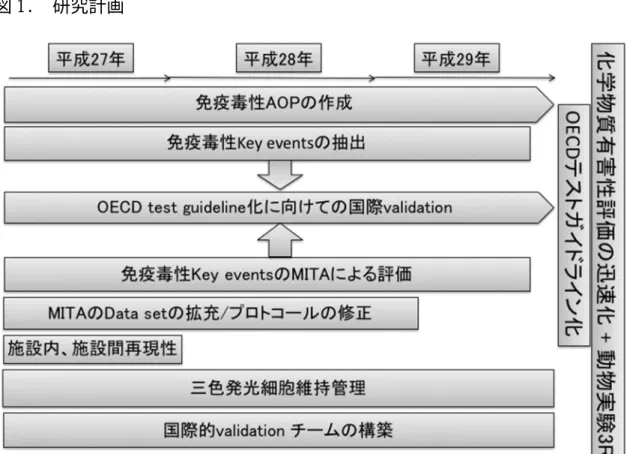
図1に示すように、本研究では以下の 4 項目を 目的として研究を計画した。
1) MITA の最適化と data set の構築 2) MITA のパラメーターを key event とす
る AOP の作成
3) IL‑2 転写活性障害を指標とした T 細胞 の分化異常誘導化学物質評価系の validation 試験
4)
MITA のテストガイドライン化
2015 年度の目的:
① MITA の最適化と data set の構築
MITA の問題点を明らかにして、MITA を免疫 毒性評価により適した評価系に修正する。
② MITA に適した免疫毒性評価系の探索
③ MITA のパラメーターを key event とする AOP の作成
④ AOPに基づく化学物質評価
⑤ IL‑2転写活性抑制試験に関する技術移転性 確認
⑥ MITA を用いた免疫毒性評価系国際化へ向け ての kick‑off meeting の開催
2016 年度の目的:
① 自己免疫、免疫抑制、アレルギーなどに 関するAOPの作成
② AOPに基づく評価方法の決定
③ Multi‑ImmunoTox assay (MITA) のdata setの拡充と施設内、施設間再現性を改善 し国際的validationを目指す。
④ 国際的validationチームの運営
⑤ IL‑8 Luc assayのOECDテストガイドライ ン化
2017年度の目的:
① AOP の改良と the Extended Advisory Group on Molecular Screening and Toxicogenomics (EAGMST)への承認に向け ての対応
② L‑2 転写活性抑制を key event とする T 細 胞分化異常誘導評価系およびのデーター ベース構築 (研究代表ならびに分担者
(木村)
③ IL‑2 転写活性抑制を key event とする T 細胞分化異常誘導評価系の Phase 2 試験
④ IL‑8 転写活性増強を指標とした気道刺激 性物質評価系のデーターベース構築
⑤ IL‑8 Luc assayのOECDテストガイドライ ン化
B.研究方法
試薬
Water-soluble Dexamethasone (Dex), Cyclosporin A (CyA), Tacrolimus (TAC), Rapamycin, Cyclophosphamide, Azathioprine, Mycophenolic acid, Mizoribine, Leflunomide, Methotrexate, 4- Aminophenyl sulfone (Dapsone), Sulfasalazine, Colchicine, Chloroquine, Minocycline, Nicotinamide, Acetaminophen, Digoxin, Warfarin, Cimetidine, Levamizol, Isoniazid, Phorbol 12-myristate 13- acetate (PMA), Ionomycin(Io), Lipopolysaccharides from E. coli 026:B6 (LPS), 2,4-Diaminotoluene, 2- Aminoanthracene, 2-Mercaptobenzothiazole, Amphoterycine B, Benzethonium chloride, Chlorpromazine, Cisplatin, Dibenzo[a,i]pyrene, Dibutyl phthalate, Diethanolamine, Lead acetate, Nitrofurazone, Pentamidine isethionate, p- Nitroaniline, Pyrimethamine, Ribavirin, Sodium
7 bromate, Triethanolamine, Actinomycin D, Cobalt chloride, Dimethyl sulfoxide, Histamine, Hydrocortisone, Isophorone diisocyanate, Mitomycin CはSigma-Aldrichか ら 購 入 し た 。 Aluminum chloride, Ethanol, Magnesium sulfate, Methanol, Nickel sulfate, Sodium lauryl sulfate, Lithium carbonate, Mercuric chlorideは和光純薬か ら購入した。Hydrogen peroxideは三徳化学工業 から購入した。Deoxyspergualinは医薬品卸業か ら購入した。
Jurkat T細胞由来#2H4細胞におけるIL‑2, IFN‑
, GAPDHプロモーターアッセイおよびTHP‑1 単 球細胞由来TGCHAC‑A4細胞、THP‑G8細胞における IL‑1, IL‑8, GAPDHプロモーターアッセイ(図 2)
IL-2およびIFN-プロモーター活性の測定には、
ヒトTリンパ芽球性白血病由来細胞株Jurkatに IL-2プロモーターに制御されたSLGルシフェラ ーゼ遺伝子(緑色に発色)、IFN-プロモーターに 制御されたSLOルシフェラーゼ遺伝子(橙色に 発色)、GAPDHプロモーターに制御されたSLR ルシフェラーゼ遺伝子(赤色に発色)を導入し た#2H4細胞を用いた[2]。またIL-1プロモータ ー活性の測定には、ヒト急性単球性白血病由来 細胞株THP-1にIL-1プロモーターに制御された
SLGルシフェラーゼ遺伝子、GAPDHプロモータ
ーに制御されたSLRルシフェラーゼ遺伝子を導 入したTGCHAC-A4細胞を、IL-8プロモーター活 性の測定には、THP-1にIL-8プロモーターに制御 さ れ たSLOル シ フ ェ ラ ー ゼ 遺 伝 子 お よ び GAPDHプロモーターに制御されたSLRルシフ ェラーゼ遺伝子を導入したTHP-G8細胞を用い た[3]。なおTGCHAC-A4細胞の樹立には人工染 色体技術[4]を用い細胞の安定性を確保した。1 ウェル当たり2×10⁵個の#2H4細胞または1ウェル 当たり5×10⁴個のTGCHAC-A4細胞またはTHP- G8細胞を黒色の96-well プレート(Greiner bio-
one)に播種し、薬剤を加え、37℃、5%CO2下で1
時間培養した。つづいて#2H4細胞については 25nM PMAと1M Io の 混 合 物(PMA/Io)、 TGCHAC-A4細胞、THP-G8細胞については100 ng/ml LPSで刺激し37℃、5%CO2下で6時間培養 した。その後、細胞溶解剤とルシフェラーゼ反 応の基質であるルシフェリンの混合剤である Tripluc luciferase assay reagent (TOYOBO)を混合 し、室温で10分振盪させたのちマルチプレート 対応型ルミノメーターにてルシフェラーゼ活性
を測定した。SLG、SLO、 SLRルシフェラーゼ は共通の基質の存在により同時に発光するが、
2枚の光学的フィルターにより分離し、各ルシフ ェラーゼの発光量 (SLG-luciferase activity (SLG- LA)、SLO-luciferase activity (SLO-LA)、SLR- luciferase activity (SLR-LA)) を検出した。また細 胞数の違いや各種刺激後の生存率の違いを勘案 しSLG-LA、SLO-LAをSLR-LAで除することによ り そ れ ぞ れ normalized SLG-luciferase activity(nSLG-LA), normalized SLO-luciferase activity(nSLO-LA)を算出した。さらに以下の式 に%suppression抑制率を計算した。
% suppression = (1-薬物存在下でのnSLG-LAまた はnSLO-LA/薬物非存在下でのnSLG-LAまたは nSLO-LA) X 100
MITAによる免疫毒性評価法
各実験において得られた結果は、一元配置分 散分析を行い、その後 Dunnett 検定により有意 な抑制効果,増強効果があるか否かを検討した。
しかし、この実験を 3回繰り返し検討すると、
3 回の実験結果が必ずしも一致していない薬剤 が存在した。そこで、一致が見られなかった薬 剤に関しては、3 回の繰り返し実験の結果のな かから%suppression の絶対値(免疫抑制物質に 関しては正の値、増強物質に関しては負の値と なる)が最も大きい値を選びStudent’s t-testを行 い、そこで統計的有意差の得られた場合、その 結果を薬剤の最終的判定結果とした (図3)。
Phase 0 study
国際バリデーション実行委員会にて選定した 2‑Aminoantracene, Citral, Chloroquine, Dexamethasone, Methyl mercuric chlorideにつ いて参加3施設、産総研つくば、食薬センター、
産 総 研 高 松 に お い て Multi‑ImmunoTox Assay protocol Ver.008.1Eにのっとり各物質3回繰り 返し1セットの試験を1セット行った。
Phase 1 study
国際バリデーション実行委員会にて選定した 5化学物質をコード化し、参加3施設、産総研つ くば、食薬センター、産総研高松においてMulti‑
ImmunoTox Assay protocol Ver.008.5Eにのっと り各物質3回繰り返し1セットの試験を3セット
8 行った。
Phase 2 study
国際バリデーション実行委員会にて選定した20 化学物質をコード化し、参加3施設、産総研つく ば、食薬センター、産総研高松においてMulti‑
ImmunoTox Assay protocol Ver.009.1Eにのっと り各物質3回繰り返し1セットの試験を1セット 行った。
国際バリデーション実行委員会
平成28年度第1回:2016年9月13日23:30より 国際バリデーション実行委員会会議をスカイプ にて行った。(参加者:小島肇、相場節也、木村 裕、大森崇、Emanuela Corsini、Erwin L. Roggen、
Dori Germolec、Tomoaki Inoue)
平成28年度第2回:2017年2月3‑5日、京都に て第2回国際バリデーション実行委員会会議を 行った。(参加者:小島肇、S.Venti、相場節也、
木村裕、大森崇、小林眞弓、安野理恵、山影康 次、渡辺美香、小林美和子、中島芳浩、Emanuela Corsini、Erwin L. Roggen、Dori Germolec、
Tomoaki Inoue)
平成29年度第3回:2017年11月18‑19日、大阪 にて第3回国際バリデーション実行委員会会議 を行った。(参加者:小島肇、足利太可雄、S.Venti、
相場節也、木村裕、大森崇、小林眞弓、安野理 恵、山影康次、渡辺美香、小林美和子、中島芳 浩、Emanuela Corsini、Erwin L. Roggen、Dori Germolec、Tomoaki Inoue)
平成29年度第4回:2018年3月29日20:00より 国際バリデーション実行委員会会議をスカイプ にて行った。(参加者:小島肇、足利太可雄、相 場節也、木村裕、Emanuela Corsini、Erwin L.
Roggen、Dori Germolec、Tomoaki Inoue)
(倫理面への配慮)
健常人からの採血に際しては、研究内容、採 血における危険性、得られた検査結果により本 人の人権が損なわれることのないこと、得られ た検査結果は守秘され個人のプライバシーを侵 害する可能性がないこと、研究に協力すること に同意した後もいつでも自由に辞退できること、
この研究によって生じる知的財産権は被験者に は帰属しないことについて説明し、本人より同
意書を取得している。
C. 研究結果
①MITAの最適化とdata setの構築ならびに 免疫毒性化学物質のClustering
1)MITA data set の構築 (Table 1)
これまでに作成されていた MITA data set の 不確定な部分を補い、更に WHO から提出された Guidance for immunotoxicity risk assessment for chemicals の Case‑Studies にて検討されて いる化学物質、喘息などのアレルギー疾患との 関 与 が 想 定 さ れ て い る diesel exhaust particles (DEP)、ホルマリン (FA)、dibutyl phthalate を加えた 60 化学物質からなる data set を作成した。その際に、それぞれの化学物質 のIL-2、IFN-γ、IL-1β、IL-8の転写抑制活性に 作用を及ぼす最低濃度 (Lowest observed effect level;LOEL)を決定した。WHO Guidance の Case‑
Studies に含まれる化学物質に関しては、MITA は鉛の免疫抑制、水銀による IFN‑レポーター活 性増強作用を、また DEP、FA の Th1 サイトカイ ンである IL‑2 レポーター活性抑制作用を検出 できた。
2)MITA の問題点
MITA data set (Table 1)から明らかな様に、
MITA で は CoCl2 、 NiCl2 、 isophorone diisocyanate などの感作性物質が IL‑8 レポー ター活性抑制作用を示し、Dex、hydrocortisone あるいは FR167653 (p38 mitoten activated kinase (MAPK)阻害剤)などの免疫抑制剤との区 別できない。そこで MITA を有効に活用するため には、感作性物質評価系との組み合わせが不可 欠である。
3)Modified MITA の構築 (Table 2)
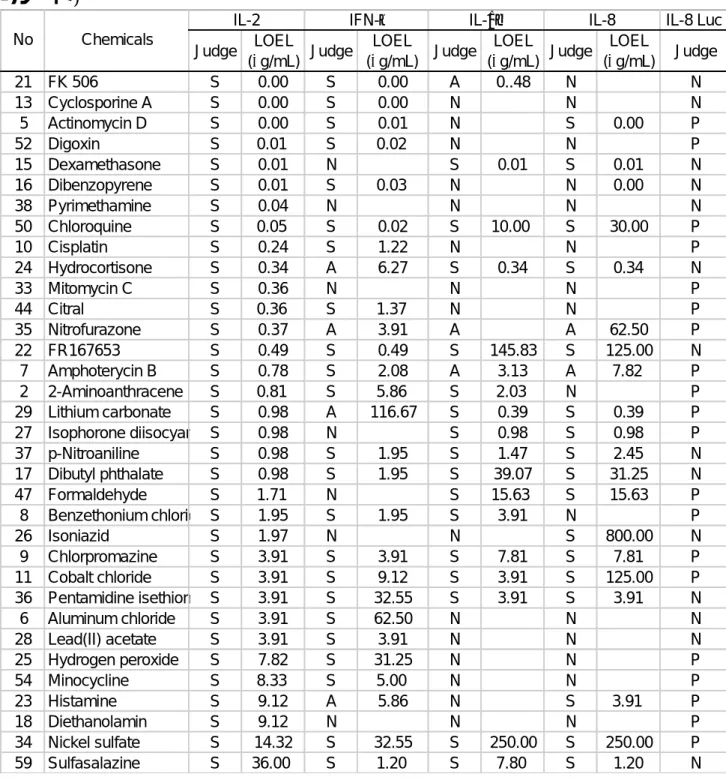
そこで従来の MITA に、すでに OECD テストガ イドライン(442E)に承認されている IL‑8 Luc assay を組み合わせることにした(Table 1)。さ らに、Table 1 を IL‑8 レポーター活性抑制 LOEL 順に並べ替えると (Table 2)、IL‑8 レポーター 活性抑制と IL‑8 Luc assay の結果とは相関が ないことが明らかとなった。しかし、IL‑ 8 Luc assay を加えることにより、IL‑8 レポーター活 性抑制を示す Dex、hydocortisone、FR167653 な どの免疫抑制物質と感作性物質との識別が可能 となった。
4) IL-1β、IL-8レポーター活性LOELの相関 次に、Table 2を基にして、化学物質のIL-1β、
IL-8 レポーター活性に対する LOEL 値の相関を
9 検討した。図4に示す様に、両者の間には統計的 に極めて有為な相関が認められた (R2=0.8481)。
しかし、いずれも IL-2のLOELとの相関は認め られなかった。
5) IL-2、IFN-γレポーター活性LOELの相関
次に、Table 1をIL‑2レポーター活性抑制LOEL 順に並べ替え(Table 3)、更にそれを基に化学 物 質のIL-2、IFN-γ レ ポ ー タ ー 活 性 に 対 す る LOEL値の相関を検討した。具体的には、IL-2、
IFN-γレポーター活性に対する判定が異なる化 学物質を除き相関を調べると、図4に示す様に、
両者の間には統計的に極めて有為な相関が認めら れた (R2=0.7363)。
6)MITAによる免疫毒性化学物質のclustering
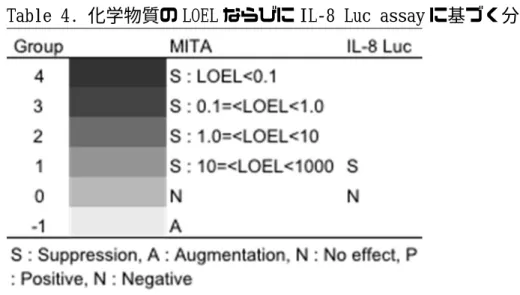
次に、化学物質をIL‑2とIL‑8の転写抑制活性に作 用を及ぼすLOELをもとに6つのグループ(4群 LOEL<0.1μg/ml、3群LOEL<1.0μg/ml、2群LOEL<10 μg/ml、 1群LOEL<1000μg/ml、0群LOWEL無し、‑
1群増強)に、またIL‑8 Luc assayによる判定結果 により2つのグループ(1群感作性あり、2群感作性 無し)に分類しheat mapを作成した(Table 4 と Table 5 )。それらをもとにまずhierarchical clusteringを施行したところ、化学物質が最大6 つのクラスターに分けられることが明らかにな った(図5)。次いで K‑means clusteringを行っ たところ(図6)、cubic clustering criterion 1.74、silhouette score 0.450で6つのクラスター に 分 類 で き た 。 興 味 深 い こ と に 、 い ず れ の clustering方法でも60種類の化学物質がほぼ同 様に含まれる6個のクラスターに分類され、それ ぞれのクラスターは以下の特徴を有していた:
Cluster 1; IL‑8転写活性のみ抑制物質、Cluster 2: IL‑2転写活性抑制、感作性物質、Cluster 3:
感作性物質、Cluster 4: 陰性物質、Cluster 5:
IL‑2、IL‑8転写活性抑制物質、Cluster 6: IL‑2転 写活性のみ抑制物質(図7)
。
②MITAのパラメーターをkey eventとする AOPの作成
1)IL‑2 転写活性抑制を key event とした T 細 胞分化異常誘導に関する AOP の作成
IL‑2 レポーター活性が、MITA で評価可能な T 細胞関連因子の中では最も多くの化学物質で抑 制されること、また多くの化学物質で IFN‑レポ ーター活性と相関が認められることより IL‑2 レポーター活性を KE とした AOP を構築するこ ととした。IL-2 はおもに Th1 細胞が分泌するサ イトカインであるが、T 細胞の増殖に必須なばか りでなく、IL-12Rβ2、IL-4Rα4、gp130などの発 現を介してTh1、Th2細胞、Treg細胞の分化に不 可欠なサイトカインである。また一方で、Th17細 胞の分化を抑制することにより不必要な自己免疫 反応や炎症反応の発症を制御する[5] [6]。そこで化 学物質の免疫毒性の指標として、IL-2の転写制御 を評価することは極めて重要な意味を有している。
本年度は、IL-2 の転写に影響を及ぼす化学物質 とその分子メカニズムが記載されている論文を 渉猟し、570 の化学物質に関して Appendix Table 1 を作成した。さらに Appendix Table 1 をもと に、IL‑2 転写活性抑制 (図8)ならびに増強(図 9)を key event とした T 細胞分化異常誘導の AOPを充実させた。
2)IL‑8 転写活性抑制を key event とした化学 物質気道刺激性の AOP 作成
IL‑8 Luc assay が、感作性物質のみではなく DEP、ホルマリン、PM2.5、界面活性剤さらには微 生物由来毒素などにも幅広く反応することを利 用し、IL‑8 転写活性亢進作用を中心とした気道 刺激性 AOP を作成した(図10)。特に、PM2.5 や 黄砂のように大気中の化学物質のみならず微生 物毒素などもその表面に吸着されている可能性 がある物質の評価には有用性が期待できる。し かしこの AOP もIL‑2 転写活性抑制を中心とした 免疫毒性 AOPと同様に個々の化学物質による IL‑
8 転写活性、分泌亢進がどのようにして気道過敏 に繋がるのかはまだ明らかになっていない。
③IL‑2転写活性抑制を指標としたT細胞分 化異常誘導化学物質評価系のvalidation試 験
作成したIL‑2転写活性障害をkey eventとしたT 細胞分化異常誘導に関するAOPに基づき、MITAを
10 構成する2H4細胞を用いたIL‑2転写活性障害を 指標としたT細胞分化異常誘導化学物質評価系 のvalidation試験を以下の方法で実施した。1)
Phase 0 study
国際バリデーション実行委員会にて選定した2‑
Aminoantracene, Citral, Chloroquine, Dexamethasone, Methyl mercuric chlorideにつ いて参加3施設、産総研つくば、食薬センター、
産 総 研 高 松 に お い て Multi‑ImmunoTox Assay protocol Ver.008.1Eにのっとり各物質につい て3回1セットからなる試験を1セット行い評価 した。リードラボを含む4施設のデータを解析し たところ5化学物質に対する反応は同様のパタ ー ン を 示 し た 。 し か し な が ら 賦 活 剤 で あ る PMA/Ioに対する反応性に違いがみられ、特に施 設間試験に初めて参加した施設で反応が低くな る傾向が認められたため以下のようにプロトコ ールを変更した。
・ PMA/Ioおよび選択抗生剤であるハイグロマ イシンの調製方法を変更した。
・ 細胞を調製する際の遠心速度を変更した。
このプロトコールの変更の結果前述の施設でも 反応性が認められるようになった。
その他、参加施設および神戸大学とプロトコー ルを検討し以下の変更を行った。
・ acceptance criterionをnSLO‑LA>3とし た。
・ 化学物質が揮発性を持つことを想定しイン キュベート中にプレート上面をシールで覆 うこととした。
・ 新しいクライテリア(クライテリア2、
3)
・ として、繰り返し実験から得られる測定値 を用いて実験間の違いを調整する新しい判 定方法が提案され従来のクライテリア(ク ライテリア1)と並存させることとした。
(図11,12)
2)Phase 1 study (Appendix 1)
国際バリデーション実行委員会にて選定した5 化学物質ついてコード化し、参加3施設、産総研 つくば、食薬センター、産総研高松において Multi‑ImmunoTox Assay protocol Ver.008.5Eに のっとり各物質3回1セットからなる試験を3セ
ット行い施設内、施設間再現性を評価した。
クライテリア1では施設内再現性が93%, 施設 間再現性が80%、クライテリア2では施設内再現 性が80%,施設間再現性が80%、クライテリア3で は施設内再現性が73%,施設間再現性が80%であ った。クライテリア1において各施設の施設内 再現性、施設間再現性ともに80%以上という study planの基準を満たしたことからクライテ リア1を採用しPhase II試験を行う方針とした。
しかし、判定において濃度依存性を考慮するべ きとの 意見を踏まえクライテリア3を下記の ように改訂しPhase II試験において使用するこ ととした。
「%suppressionを使用したDunnet試験で、2濃 度以上連続した正の統計的に有意な点が存在、
または3濃度以上で正での増加を伴う正の統計 的に有意な点が存在すればImmunosuppression, 2濃度以上連続した負の統計的に有意な点が存 在、または3濃度以上で負での減少を伴う負の統 計 的 に 有 意 な 点 が 存 在 す れ ば Immunoaugmentationと判定する。それ以外の結 果をNo effectとする。」(クライテリア3 )(図 13)
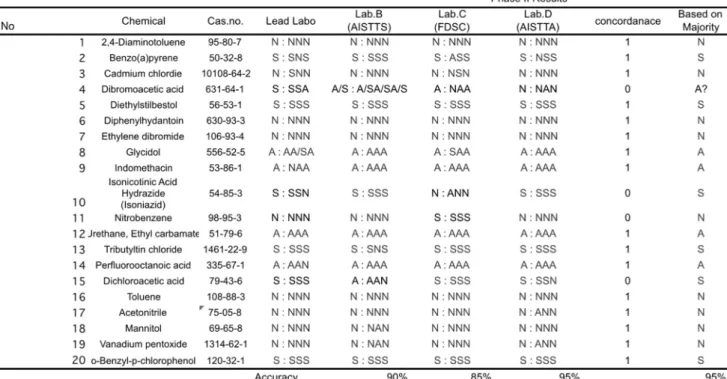
3)Phase 2 study (Appendix 2)
国際バリデーション実行委員会にて選定した20 化学物質をコード化し、参加3施設、産総研つく ば、食薬センター、産総研高松においてMulti‑
ImmunoTox Assay protocol Ver.009.1Eにのっと り各物質3回繰り返し1セットの試験を1セット 行い施設間再現性を評価した。
結 果 は ク ラ イ テ リ ア 3 で 施 設 間 再 現 性 が 65%(13/20)であり、再度クライテリアについて 再 検 討 し 、 各 々 の ア ッ セ イ に お い
て%suppressionをベースとし95%信頼区間を表
記したグラフを用い図14に示すようなクライテ リア(クライテリア4)を設定し再評価したとこ ろ施設間再現性が65%(13/20)であった。そこで 東北大学で作成されたMITA data setの各化学物 質における%suppressionの最大値、最小値を参考 とし%suppressionの閾値を±35%と設定したク ライテリア(クライテリア5、図15)を設定し再 評価したところ施設間再現性が80%(16/20)であ った。(Table 6)またクライテリア5を用いPhase
Iの結果を再評価したところ施設間再現性、施設
内再現性ともに80%(4/5)で(Table 7)Phase II
11 の結果とともにstudy planに記載された基準を 満たした。2018年3月29日に開催されたスカイプ 会議でクライテリア5は国際バリデーション実 行委員に承認された。
Phase I, IIの結果についてリードラボである 東北大学の結果との一致率を検討したところそ れぞれ80%、95%(Based on Majority)であった。
(Table 6, 7)
④IL‑8 Luc assayのOECDテストガイドライ ン化
MITAを構成するIL‑8 Luc assayに関しては、
2015年10月15、16日(パリOECD本部)、2016年11 月2,3日(パリOECD本部)、2016年12月12日(電話 会議)、2017年3月3日(電話会議)に開催された Meeting of the Expert Group on Skin Sensitisationに参加し、IL‑8 Luc assayの性能、
validation studyの結果等を説明し、2017年10 月にOECD テストガイドライン 442Eとして承認 された。
D. 考察
本年度、これまで継続して開発してきたMITA を構成する細胞であるTHP‑G8細胞を用いた皮膚 感作性試験法がOECD test guidelineに承認さ れた。細胞を用いる感作性試験は、IL‑8 Luc assay以外にもh‑CLATやU‑SENSが存在するが、
IL‑8 Luc assayのみがflow cytometryを用いず、
luciferase assayにより感作性の有無を判定す る。Luciferase assayはflow cytometryに比較 して測定を自動化することが容易で、実際にIL‑
8 Luc assayも細胞に化学物質を添加した後は、
完全に自動化されている。また、細胞と化学物 質との反応時間も短く、さらに本試験を開始す る前に必要となる細胞毒性濃度を決定するプロ セスも不要である。したがって、IL‑8 Luc assay はもっともhigh throughput assayに適した試 験法で、今後の活用が期待される。
また、今年度は、MITAとIL‑8 Luc assayを組 み合わせたmMITAを構築した。MITA、IL‑8 Luc assay い ず れ も 反 応 時 間 が 短 く 、 さ ら に luciferase assayを用いる評価系であり、mMITA もhigh throughput assayに適している。したが って、現在、社会に存在する数万ともよばれる 化学物質の免疫毒性を評価するのには最適の評 価系である。
一方、本年度、mMITAにより化学物質が6つ のクラスターに分類できることを明らかにし た。複雑な免疫反応を考えると、免疫毒性が幾 つのパラメータで正しく分類できるかは今後の 課題であるが、化学物質の免疫毒性評価の方向 性を示せた結果と考えている。
IL‑2レポーター活性抑制物質評価系の validationを行い、Phase 1、Phase 2を終了し た。まだ、評価委員から最終コメントを頂いて いないが、少なくとも施設内、施設間再現性に 関しては、不足のない結果であった。
AOPに関しては、IL‑2転写活性抑制、IL‑8 転 写活性亢進のそれぞれをkey eventとしたT細胞 分化異常誘導および気道刺激性に関するAOPを 作成したが、今後はmMITAをtest gideline化す る際に必要となる、多項目免疫毒性評価に対応 したAOPの作成が課題である。
E. 結論
①MITA により 60 種類の化学物質を評価し data set を構築した。また、それに基づき、化学物質 が 6 種類の異なった免疫毒性プロフィールを有 する cluster に分類できることを明らかにした。
②MITAのパラメーターであるIL‑2転写活性抑制、
IL‑8転写活性抑制をkey eventとするAOPを作成 した。
の作成
③IL‑2転写活性抑制を指標としたT細胞分化異 常誘導化学物質評価系のPhase 1およびPhase 2 validation試験を実施した。
④ 皮膚感作性試験法IL‑8 Luc assayをOECDテ ストガイドライン化した。
⑤ IL‑2転写活性抑制をkey eventとしたT細胞 分化異常誘導のAOPを作成した。
⑥ IL‑2 転写活性抑制、IL‑8 転写活性亢進の それぞれを key event とした T 細胞分化異 常誘導および気道刺激性に関する AOP を作 成した。
引用文献
[1] Kimura Y, Fujimura C, Ito Y, Takahashi
12 T, Aiba S: Evaluation of the Multi‑
ImmunoTox Assay composed of 3 human cytokine reporter cells by examining immunological effects of drugs. Toxicol In Vitro 28: 759‑768, 2014.
[2] Saito R, Hirakawa S, Ohara H, Yasuda M, Yamazaki T, Nishii S, et al.: Nickel differentially regulates NFAT and NF‑kappaB activation in T cell signaling. Toxicol Appl Pharmacol 254: 245‑255, 2011.
[3] Takahashi T, Kimura Y, Saito R, Nakajima Y, Ohmiya Y, Yamasaki K, et al.: An in vitro test to screen skin sensitizers using a stable THP‑1‑derived IL‑8 reporter cell line, THP‑G8. Toxicological sciences : an official journal of the Society of Toxicology 124: 359‑369, 2011.
[4] Katoh M, Ayabe F, Norikane S, Okada T, Masumoto H, Horike S, et al.: Construction of a novel human artificial chromosome vector for gene delivery. Biochem Biophys Res Commun 321: 280‑290, 2004.
[5] Letourneau S, Krieg C, Pantaleo G, Boyman O: IL‑2‑ and CD25‑dependent immunoregulatory mechanisms in the homeostasis of T‑cell subsets. J Allergy Clin Immunol 123: 758‑762, 2009.
[6] Liao W, Lin JX, Wang L, Li P, Leonard WJ: Modulation of cytokine receptors by IL‑
2 broadly regulates differentiation into helper T cell lineages. Nat Immunol 12: 551‑
559, 2011.
F.研究発表
1.論文発表
1. Kimura, Y., Fujimura, C., Ito, Y., Takahashi, T., Terui, H., Aiba, S.
Profiling the immunotoxicity of
chemicals based on in vitro evaluation by a combination of the Multi‑ImmunoTox assay and the IL‑8 Luc assay. Arch Toxicol in press.
2. Aiba, S., Kimura, Y. In vitro test methods to evaluate the effects of chemicals on innate and adaptive immune responses. Curr Opin Toxicol 2017 5:6‑
12
3. Hidaka, T., Ogawa, E., Kobayashi, E.H., Suzuki, T., Funayama, R., Nagashima, T., Fujimura, T., Aiba, S., Nakayama, K., Okuyama, R., Yamamoto, M., The aryl hydrocarbon receptor AhR links atopic dermatitis and air pollution via induction of the neurotrophic factor artemin. Nat Immunol 2017. 18, 64‑73.
4. Asano, M., Yamasaki, K., Yamauchi, T., Terui, T., Aiba, S., Epidermal iron metabolism for iron salvage. J Dermatol Sci 2017. 87, 101‑109.
5. Fujimura, T., Kambayashi, Y., Furudate, S., Kakizaki, A., Hidaka, T., Aiba, S.
Possible mechanisms of the crosstalk between Langerhans cells and regulatory T cells in extramammary Paget disease by receptor activator of nuclear factor kappa B (RANK) ligand/RANK pathways. Br J Dermatol 2017. 176, 387‑394.
6. Yamauchi, T., Yamasaki, K., Tsuchiyama, K., Koike, S., Aiba, S. A quantitative analysis of multilineage‑
differentiating stress‑enduring (Muse) cells in human adipose tissue and efficacy of melanocytes induction. J Dermatol Sci, 2017. 86, 198‑205.
7. Yamauchi, T., Yamasaki, K., Tsuchiyama, K., Koike, S., Aiba, S. The Potential
13 of Muse Cells for Regenerative Medicine of Skin: Procedures to Reconstitute Skin with Muse Cell‑Derived Keratinocytes, Fibroblasts, and Melanocytes. J Invest Dermatol 2017.
137, 2639‑2642.
8. Fujimura, T., Kakizaki, A., Furudate, S., Kambayashi, Y., Aiba, S. Tumor‑
associated macrophages in skin: How to treat their heterogeneity and plasticity. J Dermatol Sci 2016. 83, 167‑173.
9. Tsutsumi, M., Fukuda, M., Kumamoto, J., Goto, M., Denda, S., Yamasaki, K., Aiba, S., Nagayama, M., Denda, M. Abnormal Morphology of Blood Vessels in Erythematous Skin From Atopic Dermatitis Patients. Am J Dermatopathol , 2016. 38, 363‑364.
10. Tsutsumi, M., Kitahata, H., Fukuda, M., Kumamoto, J., Goto, M., Denda, S., Yamasaki, K., Aiba, S., Nagayama, M., Denda, M. Numerical and comparative three‑dimensional structural analysis of peripheral nerve fibres in epidermis of patients with atopic dermatitis. Br J Dermatol, 2016. 174, 191‑194.
11. Fujimura, T., Kambayashi, Y., Furudate, S., Kakizaki, A., Hidaka, T., Asano, M., Aiba, S. Receptor activator of nuclear factor kappa‑B ligand (RANKL)/RANK signaling promotes cancer‑related inflammation through M2 macrophages.
Exp Dermatol 2016. 25, 397‑399.
12. Fujimura, T., Kambayashi, Y., Kakizaki, A., Furudate, S., Aiba, S. RANKL expression is a useful marker for differentiation of pagetoid squamous
cell carcinoma in situ from extramammary Paget disease. J Cutan Pathol, 2016. 43, 772‑775.
13. Kimura, Y., Shimada‑Omori, R., Takahashi, T., Tsuchiyama, K., Kusakari, Y., Yamasaki, K., Nishikawa, R., Nishigori, C., Aiba, S. Therapeutic drug monitoring of patients with psoriasis during tumour necrosis factor (TNF)‑alpha antagonist treatment using a novel interleukin‑8 reporter cell line. Br J Dermatol 2016. 175, 979‑987.
14. Oeda, S., Hirota, M., Nishida, H., Ashikaga, T., Sasa, H., Aiba, S., Tokura, Y., Kouzuki, H. Development of an in vitro photosensitization test based on changes of cell‑surface thiols and amines as biomarkers: the photo‑
SH/NH(2) test. J Toxicol Sci 2016. 41, 129‑142.
15. Kimura, Y., Fujimura, C., Ito, Y., Takahashi, T., Nakajima, Y., Ohmiya, Y., Aiba, S. Optimization of the IL‑8 Luc assay as an in vitro test for skin sensitization. Toxicol In Vitro 2015.
29, 1816‑1830.
16. Fujimura, T., Kambayashi, Y., Furudate, S., Asano, M., Kakizaki, A., Aiba, S.
Receptor Activator of NF‑kappaB Ligand Promotes the Production of CCL17 from RANK+ M2 Macrophages. J Invest Dermatol 2015.135, 2884‑2887.
17. Kambayashi, Y., Fujimura, T., Furudate, S., Asano, M., Kakizaki, A., Aiba, S.
The Possible Interaction between Receptor Activator of Nuclear Factor Kappa‑B Ligand Expressed by Extramammary Paget Cells and its Ligand
14 on Dermal Macrophages. J Invest Dermatol 2015.135, 2547‑2550.
18. Watanabe, M., Kurai, J., Minato, S., Noma, H., Sano, H., Saito, R., Aiba, S., Oshimura, M., Hatakeyama, K., Yamasaki, A., Shimizu, E. Difference in interleukin‑8 transcriptional activity induced in THP‑G8 cells by particulate matter collected in winter and summer in western Japan. J Med Invest 2015.
62, 145‑148.
19. Watanabe, M., Noma, H., Kurai, J., Sano, H., Kitano, H., Saito, R., Kimura, Y., Aiba, S., Oshimura, M., Shimizu, E.
Variation in the Effect of Particulate Matter on Pulmonary Function in Schoolchildren in Western Japan and Its Relation with Interleukin‑8. Int J Environ Res Public Health, 2015. 12, 14229‑14243.
20. Watanabe, M., Noma, H., Kurai, J., Sano, H., Saito, R., Abe, S., Kimura, Y., Aiba, S., Oshimura, M., Yamasaki, A., Shimizu, E. Decreased pulmonary function in school children in Western Japan after exposures to Asian desert dusts and its association with interleukin‑8. Biomed Res Int, 2015.
2015, 583293.
21. Yu, Z., Ono, C., Aiba, S., Kikuchi, Y., Sora, I., Matsuoka, H., Tomita, H.
Therapeutic concentration of lithium stimulates complement C3 production in dendritic cells and microglia via GSK‑
3 inhibition. Glia, 2015. 63, 257‑270.
2.学会発表
1) Kimura Y. et al. Multi‑ImmunoTox Assay (MITA): the creation of its data set and
the results of validation studies. 10th World Congress Alternatives and Animal Use in the Life Science. Seattle, Washington, USA August 20‑24, 2017
2) Aiba S. et al. A novel in vitro assay for sensitisers in purely aqueous system:
the modified IL‑8 Luc assay using X‑VIVOTM 15 as a solvent. 10th World Congress Alternatives and Animal Use in the Life Science. Seattle, Washington, USA August 20‑24, 2017
3)木村裕他:Multi‑ImmunoTox Assay (MITA) デ ータセットの作成およびバリデーション研究の 結果 日本動物実験代替法学会 第30回大会
(東京)2017年11月
4)相場節也他:DMSOを用いないin vitro感作性 試験 日本動物実験代替法学会 第30回大会
(東京)2017年11月
5)相場節也:学会賞受賞講演 IL‑8 Luc assay (OECD TG 442E)の開発 日本動物実験代替法学 会 第30回大会(東京)2017年11月
6)相場節也:細胞表面SH基修飾を指標とした免 疫感作性評価. 日本薬物動態学会第31回年会
(松本)2016年10月13日
7)木村裕、相場節也:試験法ワークショップ「IL‑
2転写活性抑制をkey eventとするT細胞分化異常 誘導に関するAOP」第23回日本免疫毒性学会学術 年会(北九州)2016年9月
8) Kimura, Y., Shimada‑Omori, R., Takahash i, T., Tsuchiyama, K., Kusakari, Y., Yamas aki, K., Aiba, S. An interleukin‑8 reporte r cell line, THP‑G8, can evaluate anti‑TNF
‑a neutralizing activity of patients sera and predict drug effectiveness during ant i‑TNF‑a antibody therapy. 23rd World Congr ess of Dermatology. Vancouver, Canada June 2015,
9) 相 場 節 也 : 皮 膚 感 作 性 お よ び 免 疫 毒 性 の adverse outcome pathway (AOP). 日本動物実
15 験代替法学会 第28回大会(横浜)2015年12月
H.知的財産権の出願・登録状況 (予定を含む。 )
1. 特許取得
特願2010‑151362; PCT/JP2011/65090
3. その他
2017年10月9日IL‑8 Luc assayがOECD テストガ イドラインに承認された。(442E)
2017 年 10 月 12 日に動物実験代替法学会賞を 受賞 (IL‑8 Luc assay (OECD TG442E)の開発)
16
図 1. 研究計画
図2.Multi‑ImmunoTox assay (MITA)
17
図3.MITA の判定基準 (Criteria 1)
図 4. MITA パラメータの LOEL 値の相関
3回の繰り返し実験
3回の実験結果に基づく判定
Criteria 1
significant
suppression (-)
significant
augmentation (+)
no
significance (0)
a one-way ANOVA test followed by Dunnett’s post hoc test compared with the value for stimulation without drugs
Student’s t-test using
% suppression, which shows the most remarkable change in each experiment
compared with that of the vehicle control (0%) 各実験:
-/-/- Immunosuppression (S)
+/+/+ Immunoaugmentation (A)
-/-/0 -/-/+
+/+/0 +/+/-
others No effect (N)
18
図 5. 60化学物質の hierarchical clustering
19
図 6. 60化学物質の K‑means clustering
20
図 7.各 cluster の免疫毒性 profile
21
図 8.IL‑2 転写活性抑制を key event とした T 細胞分化異常誘導に関する AOP
図 9.IL‑2 転写活性増強を key event とした T 細胞分化異常誘導に関する AOP
22
図 10. IL‑8 転写活性増強を key event とした気道刺激性 AOP
図 11.MITA の判定基準 (Criteria 2)
23
図 12.MITA の判定基準 (Criteria 3)
図 13.MITA の判定基準 (Criteria 3 )
24
図 14.MITA の判定基準 (Criteria 4)
図 15.MITA の判定基準 (Criteria 5)
11-1 Acceptance criteria
The following acceptance criteria should be satisfied when using the Multi-ImmunoTox Assay method.
If Fold induction of nSLO-LA of PMA/Ionomycin wells without chemicals (=(nSLO-LA of #2H4 cells treated with PMA/Ionomycin) / (nSLO-LA of non-treated #2H4 cells)) demonstrate less than 3.0, the results obtained from the plate containing the control wells should be rejected.
11-2 Criterion
Conduct three independent experiments for each chemical.
Identification of immunotoxicants is evaluated by the mean of %suppression and its 95%
simultaneous confidence interval.
In each experiment, when the chemicals clear the following 2 criteria, they are judged as suppressive or stimulatory. Otherwise, they are judged as no effect chemicals.
1. The result shows two or more consecutive statistically significant positive (negative) data or one statistically significant positive (negative) data with a trend in which at least 3 consecutive data increase (decrease) in a dose dependent manner. In the latter case, the trend can cross 0, as long as the data comprising the trend are not statistically significant in the opposite effect.
2. The results are judged using only data obtained in the concentration at which I.I.-SLR-LA is >
0.05
The experiments are repeated until two consistent results are obtained. Then, the chemicals are classified by the consistent results.
Criteria 4
11-1 Acceptance criteria
The following acceptance criteria should be satisfied when using the Multi-ImmunoTox Assay method.
If Fold induction of nSLO-LA of PMA/Ionomycin wells without chemicals (=(nSLO-LA of #2H4 cells treated with PMA/Ionomycin) / (nSLO-LA of non-treated #2H4 cells)) demonstrate less than 3.0, the results obtained from the plate containing the control wells should be rejected.
11-2 Criterion
The experiments are repeated until two consistent positive (negative) results or two consistent “no effect results” are obtained. When two consistent results are obtained, the chemicals are judged as the obtained consistent results.
Identification of immunotoxicant is evaluated by the mean of %suppression and its 95%
simultaneous confidence interval.
In each experiment, when the chemicals clear the following 3 criteria, they are judged as suppressive or stimulatory. Otherwise, they are judged as no effect chemicals.
1. The mean of %suppression is > 35 (suppressive) or < -35 (stimulatory) with statistical significance. The statistical significance is judged by its 95% confidence interval.
2. The result shows two or more consecutive statistically significant positive (negative) data or one statistically significant positive (negative) data with a trend in which at least 3 consecutive data increase (decrease) in a dose dependent manner. In the latter case, the trend can cross 0, as long as only one data point shows the opposite effect without statistical significance.
3. The results are judged using only data obtained in the concentration at which I.I.-SLR-LA is >
0.05
Criteria 5
25
Table 1. 60化学物質の MITA による免疫毒性評価
IL-8 Luc Judge LOEL Judge LOEL Judge LOEL Judge LOEL Judge
1 2,4-Diaminotoluene N A 62.50 N S 0.98 N
2 2-Aminoanthracene S 0.81 S 5.86 S 2.03 N S
3 2-Mercaptobenzothiazole N N N S 125.00 S
4 Acetaminophen A 33.33 A 33.33 A 166.67 A 100.00 N
5 Actinomycin D S 0.00 S 0.01 N S 0.00 S
6 Aluminum chloride S 3.91 S 62.50 N N N
7 Amphoterycin B S 0.78 S 2.08 A 3.13 A 7.82 S
8 Benzethonium chloride S 1.95 S 1.95 S 3.91 N S
9 Chlorpromazine S 3.91 S 3.91 S 7.81 S 7.81 S
10 Cisplatin S 0.24 S 1.22 N N S
11 Cobalt chloride S 3.91 S 9.12 S 3.91 S 125.00 S
12 Cyclophosphamide N A 168.00 N N S
13 Cyclosporine A S 0.00 S 0.00 N N N
14 Dapsone S 45.01 S 55.14 S 46.88 S 134.75 N
15 Dexamethasone S 0.01 N S 0.01 S 0.01 N
16 Dibenzopyrene S 0.01 S 0.03 N N 0.00 N
17 Dibutyl phthalate S 0.98 S 1.95 S 39.07 S 31.25 N
18 Diethanolamin S 9.12 N N N S
19 Dimethyl sulfoxide A 3.91 A 625.00 S 66.41 S 3.91 N
20 Ethanol N N N N N
21 FK 506 S 0.00 S 0.00 A N N
22 FR167653 S 0.49 S 0.49 S 145.83 S 125.00 N
23 Histamine S 9.12 A 5.86 N S 3.91 S
24 Hydrocortisone S 0.34 A 6.27 S 0.34 S 0.34 N
25 Hydrogen peroxide S 7.82 S 31.25 N N S
26 Isoniazid S 1.97 N N S 800.00 N
27 Isophorone diisocyanate S 0.98 N S 0.98 S 0.98 S
28 Lead(II) acetate S 3.91 S 3.91 N N N
29 Lithium carbonate S 0.98 A 116.67 S 0.39 S 0.39 S
30 Magnesium sulfate N N S 15.63 N S
31 Mercuric chloride N A 3.91 S 1.95 S 1.95 S
32 Methanol N N N N N
33 Mitomycin C S 0.36 N N N S
34 Nickel sulfate S 14.32 S 32.55 S 250.00 S 250.00 S
No Chemicals IL-2 IFN-γ IL-1β IL-8
26
35 Nitrofurazone S 0.37 A 3.91 A A 62.50 S
36 Pentamidine isethionate S 3.91 S 32.55 S 3.91 S 3.91 N
37 p-Nitroaniline S 0.98 S 1.95 S 1.47 S 2.45 N
38 Pyrimethamine S 0.04 N N N N
39 Ribavirin A 15.63 A 187.50 A 5.86 N N
40 Sodium bromate S 125.00 N N N S
41 Sodium dodecyl sulfate N N N N S
42 Triethanolamine S 187.50 S 1416.67 N N S
43 Hexachlorobenzene N N N N N
44 Citral S 0.36 S 1.37 N N S
45 Trichloroethylene N N N N N
46 Chloroplatinic acid N N N S 15.63 S
47 Formaldehyde S 1.71 N S 15.63 S 15.63 S
48 Diesel exhaust particles S 39.07 A 47.53 N S 62.50 S
49 Azathioprine N A 40.01 A 9.23 N N
50 Chloroquine S 0.05 S 0.02 S 10.00 S 30.00 S
51 Colchicine A 0.29 A 0.06 A 0.02 A 20.00 S
52 Digoxin S 0.01 S 0.02 N N S
53 Methotrexate A 0.45 A 0.09 N N N
54 Minocycline S 8.33 S 5.00 N N S
55 Mizoribine N N A 5.20 A 7.45 N
56 Mycophenolic acid A 0.38 A 6.24 N N S
57 Nicotinamide A 0.10 A 110.03 S 3.00 S 10.00 N
58 Rapamycin A 0.00 N A 0.91 N S
59 Sulfasalazine S 36.00 S 1.20 S 7.80 S 1.20 N
60 Warfarin A 23.33 N S 30.00 S 0.00 N
AFC, antibody forming cell; CSM, cell surface marer; NK, natural killer cell activity.
27
Table 2. 60化学物質の MITA による免疫毒性評価 (IL‑8 転写抑制 LOEL によ りソート)
IL-8 Luc Judge LOEL
(µg/mL) Judge LOEL
(µg/mL) Judge LOEL
(µg/mL) Judge LOEL
(µg/mL) Judge
60 Warfarin A 23.33 N S 30.00 S 0.00 N
5 Actinomycin D S 0.00 S 0.01 N S 0.00 P
15 Dexamethasone S 0.01 N S 0.01 S 0.01 N
24 Hydrocortisone S 0.34 A 6.27 S 0.34 S 0.34 N
29 Lithium carbonate S 0.98 A 116.67 S 0.39 S 0.39 P
1 2,4-Diaminotoluene N A 62.50 N S 0.98 N
27 Isophorone diisocyan S 0.98 N S 0.98 S 0.98 P
59 Sulfasalazine S 36.00 S 1.20 S 7.80 S 1.20 N
31 Mercuric chloride N A 3.91 S 1.95 S 1.95 P
37 p-Nitroaniline S 0.98 S 1.95 S 1.47 S 2.45 N
19 Dimethyl sulfoxide A 3.91 A 625.00 S 66.41 S 3.91 N
23 Histamine S 9.12 A 5.86 N S 3.91 P
36 Pentamidine isethion S 3.91 S 32.55 S 3.91 S 3.91 N
9 Chlorpromazine S 3.91 S 3.91 S 7.81 S 7.81 P
57 Nicotinamide A 0.10 A 110.03 S 3.00 S 10.00 N
46 Chloroplatinic acid N N N S 15.63 P
47 Formaldehyde S 1.71 N S 15.63 S 15.63 P
50 Chloroquine S 0.05 S 0.02 S 10.00 S 30.00 P
17 Dibutyl phthalate S 0.98 S 1.95 S 39.07 S 31.25 N
48 Diesel exhaust partic S 39.07 A 47.53 N S 62.50 P
3 2-Mercaptobenzothia N N N S 125.00 P
11 Cobalt chloride S 3.91 S 9.12 S 3.91 S 125.00 P
22 FR167653 S 0.49 S 0.49 S 145.83 S 125.00 N
14 Dapsone S 45.01 S 55.14 S 46.88 S 134.75 N
34 Nickel sulfate S 14.32 S 32.55 S 250.00 S 250.00 P
26 Isoniazid S 1.97 N N S 800.00 N
16 Dibenzopyrene S 0.01 S 0.03 N N N
2 2-Aminoanthracene S 0.81 S 5.86 S 2.03 N P
6 Aluminum chloride S 3.91 S 62.50 N N N
8 Benzethonium chlorid S 1.95 S 1.95 S 3.91 N P
10 Cisplatin S 0.24 S 1.22 N N P
12 Cyclophosphamide N A 168.00 N N P
13 Cyclosporine A S 0.00 S 0.00 N N N
18 Diethanolamin S 9.12 N N N P
No Chemicals
IL-2 IFN-γ IL-1β IL-8
28
20 Ethanol N N N N N
21 FK 506 S 0.00 S 0.00 A 0.48 N N
25 Hydrogen peroxide S 7.82 S 31.25 N N P
28 Lead(II) acetate S 3.91 S 3.91 N N N
30 Magnesium sulfate N N S 15.63 N P
32 Methanol N N N N N
33 Mitomycin C S 0.36 N N N P
38 Pyrimethamine S 0.04 N N N N
39 Ribavirin A 15.63 A 187.50 A 5.86 N N
40 Sodium bromate S 125.00 N N N P
41 Sodium dodecyl sulfa N N N N P
42 Triethanolamine S 187.50 S 1416.67 N N P
43 Hexachlorobenzene N N N N N
44 Citral S 0.36 S 1.37 N N P
45 Trichloroethylene N N N N N
49 Azathioprine N A 40.01 A 9.23 N N
52 Digoxin S 0.01 S 0.02 N N P
53 Methotrexate A 0.45 A 0.09 N N N
54 Minocycline S 8.33 S 5.00 N N P
56 Mycophenolic acid A 0.38 A 6.24 N N P
58 Rapamycin A 0.00 N A 0.91 N P
55 Mizoribine N N A 5.20 A 7.45 N
7 Amphoterycin B S 0.78 S 2.08 A 3.13 A 7.82 P
51 Colchicine A 0.29 A 0.06 A 0.02 A 20.00 P
35 Nitrofurazone S 0.37 A 3.91 A 62.50 A 62.50 P
4 Acetaminophen A 33.33 A 33.33 A 166.67 A 100.00 N
AFC, antibody forming cell; CSM, cell surface marer; NK, natural killer cell activity, LOEL : Lowest Observed Effect Level
29
Table 3. 60化学物質の MITA による免疫毒性評価 (IL‑2 転写抑制 LOEL によ りソート)
IL-8 Luc Judge LOEL
(µg/mL) Judge LOEL
(µg/mL) Judge LOEL
(µg/mL) Judge LOEL
(µg/mL) Judge
21 FK 506 S 0.00 S 0.00 A 0..48 N N
13 Cyclosporine A S 0.00 S 0.00 N N N
5 Actinomycin D S 0.00 S 0.01 N S 0.00 P
52 Digoxin S 0.01 S 0.02 N N P
15 Dexamethasone S 0.01 N S 0.01 S 0.01 N
16 Dibenzopyrene S 0.01 S 0.03 N N 0.00 N
38 Pyrimethamine S 0.04 N N N N
50 Chloroquine S 0.05 S 0.02 S 10.00 S 30.00 P
10 Cisplatin S 0.24 S 1.22 N N P
24 Hydrocortisone S 0.34 A 6.27 S 0.34 S 0.34 N
33 Mitomycin C S 0.36 N N N P
44 Citral S 0.36 S 1.37 N N P
35 Nitrofurazone S 0.37 A 3.91 A A 62.50 P
22 FR167653 S 0.49 S 0.49 S 145.83 S 125.00 N
7 Amphoterycin B S 0.78 S 2.08 A 3.13 A 7.82 P
2 2-Aminoanthracene S 0.81 S 5.86 S 2.03 N P
29 Lithium carbonate S 0.98 A 116.67 S 0.39 S 0.39 P
27 Isophorone diisocyan S 0.98 N S 0.98 S 0.98 P
37 p-Nitroaniline S 0.98 S 1.95 S 1.47 S 2.45 N
17 Dibutyl phthalate S 0.98 S 1.95 S 39.07 S 31.25 N
47 Formaldehyde S 1.71 N S 15.63 S 15.63 P
8 Benzethonium chlorid S 1.95 S 1.95 S 3.91 N P
26 Isoniazid S 1.97 N N S 800.00 N
9 Chlorpromazine S 3.91 S 3.91 S 7.81 S 7.81 P
11 Cobalt chloride S 3.91 S 9.12 S 3.91 S 125.00 P
36 Pentamidine isethion S 3.91 S 32.55 S 3.91 S 3.91 N
6 Aluminum chloride S 3.91 S 62.50 N N N
28 Lead(II) acetate S 3.91 S 3.91 N N N
25 Hydrogen peroxide S 7.82 S 31.25 N N P
54 Minocycline S 8.33 S 5.00 N N P
23 Histamine S 9.12 A 5.86 N S 3.91 P
18 Diethanolamin S 9.12 N N N P
34 Nickel sulfate S 14.32 S 32.55 S 250.00 S 250.00 P
59 Sulfasalazine S 36.00 S 1.20 S 7.80 S 1.20 N
No Chemicals
IL-2 IFN-γ IL-1β IL-8
30
48 Diesel exhaust partic S 39.07 A 47.53 N S 62.50 P
14 Dapsone S 45.01 S 55.14 S 46.88 S 134.75 N
40 Sodium bromate S 125.00 N N N P
42 Triethanolamine S 187.50 S 1416.67 N N P
31 Mercuric chloride N A 3.91 S 1.95 S 1.95 P
46 Chloroplatinic acid N N N S 15.63 P
3 2-Mercaptobenzothia N N N S 125.00 P
12 Cyclophosphamide N A 168.00 N N P
30 Magnesium sulfate N N S 15.63 N P
41 Sodium dodecyl sulfa N N N N P
1 2,4-Diaminotoluene N A 62.50 N S 0.98 N
20 Ethanol N N N N N
32 Methanol N N N N N
43 Hexachlorobenzene N N N N N
45 Trichloroethylene N N N N N
49 Azathioprine N A 40.01 A 9.23 N N
55 Mizoribine N N A 5.20 A 7.45 N
58 Rapamycin A 0.00 N A 0.91 N P
57 Nicotinamide A 0.10 A 110.03 S 3.00 S 10.00 N
51 Colchicine A 0.29 A 0.06 A 0.02 A 20.00 P
56 Mycophenolic acid A 0.38 A 6.24 N N P
53 Methotrexate A 0.45 A 0.09 N N N
19 Dimethyl sulfoxide A 3.91 A 625.00 S 66.41 S 3.91 N
39 Ribavirin A 15.63 A 187.50 A 5.86 N N
60 Warfarin A 23.33 N S 30.00 S 0.00 N
4 Acetaminophen A 33.33 A 33.33 A 166.67 A 100.00 N
AFC, antibody forming cell; CSM, cell surface marer; NK, natural killer cell activity, LOEL : Lowest Observed Effect Level
31
Table 4. 化学物質の LOEL ならびに IL‑8 Luc assay に基づく分類
32
Table 5. 化学物質の IL‑2、IL‑8転写抑制 LOEL ならびに IL‑8 Luc assay に基 づく分類と heat map.
33
34