R E S E A R C H Open Access
Resuscitative endovascular balloon
occlusion of the aorta versus aortic cross clamping among patients with critical
trauma: a nationwide cohort study in Japan
Toshikazu Abe
1,2*, Masatoshi Uchida
1, Isao Nagata
1, Daizoh Saitoh
3and Nanako Tamiya
1Abstract
Background: Measures of aortic occlusion (AO) for resuscitation in patients with severe torso trauma remain controversial. Our aim was to characterize the current use of resuscitative endovascular balloon occlusion of the aorta (REBOA) and resuscitative open aortic cross-clamping (ACC), and to evaluate whether REBOA should be an alternative method to resuscitative open ACC.
Methods: This study was a retrospective cohort study between 2004 and 2013 from a nationwide trauma registry in Japan. Participants were selected who underwent either REBOA or ACC. Their characteristics, interventions, and outcomes were analyzed to compare REBOA and ACC directly. The primary outcome was in-hospital mortality and the secondary outcome was mortality in the emergency department. Logistic regression analysis was performed to compare the outcomes between REBOA and ACC with adjustment for severity; 1:1 propensity score matching was also performed.
Results: Of the 159,157 trauma patients, 903 were eligible based on the selection criteria. Overall, 405/607 patients (67%) who had REBOA died compared to 210/233 patients (90%) who had ACC. Patients with REBOA had higher revised trauma score (RTS) (mean ± SD, 5.2 ± 2.0 vs. 4.2 ± 2.2; P < 0.001) but higher Injury Severity Score (ISS) (median (interquartile); 34 (25) vs. 34 (20); P < 0.001), and higher probability of survival (0.43 ± 0.36 vs. 0.27 ± 0.30; P < 0.001) compared to those with ACC. REBOA had an odds ratio (OR) for in-hospital mortality of 0.309 (95% confidence interval (CI) = 0.190 – 0.502) adjusting for trauma and injury severity score using a logistic regression model ( n = 903).
Similar associations were observed adjusting for RTS (OR = 0.224; 95% CI = 0.129 – 0.700) or adjusting for ISS (OR, 0.188; 95% CI, 0.116 to 0.303). In the propensity score-matched cohort ( n = 304), REBOA was associated with lower mortality compared to ACC (OR, 0.261; 95% CI, 0.130 to 0.523). Patients with REBOA had less severe chest complications than those with ACC (Abbreviated Injury Scale thorax, 3.8 ± 0.8 vs. 4.2 ± 0.8; P < 0.001), although physiological severity and backgrounds were similar in this population.
Conclusions: Patients who underwent AO had a high mortality. REBOA might be a favorable alternative method to resuscitative ACC for severe torso trauma although some indication bias could still remain. Further studies are needed to elucidate optimal indications.
* Correspondence:[email protected]
1Department of Health Services Research, Faculty of Medicine, University of Tsukuba, 1-1-1, Tennodai, Tsukuba 305-8577, Japan
2Department of Emergency Medicine, Tsukuba Medical Center Hospital, 1-3-1, Amakubo, Tsukuba 305-8558, Japan
Full list of author information is available at the end of the article
© The Author(s). 2016Open AccessThis article is distributed under the terms of the Creative Commons Attribution 4.0 International License (http://creativecommons.org/licenses/by/4.0/), which permits unrestricted use, distribution, and reproduction in any medium, provided you give appropriate credit to the original author(s) and the source, provide a link to the Creative Commons license, and indicate if changes were made. The Creative Commons Public Domain Dedication waiver (http://creativecommons.org/publicdomain/zero/1.0/) applies to the data made available in this article, unless otherwise stated.
Abeet al. Critical Care (2016) 20:400 DOI 10.1186/s13054-016-1577-x
Background
Bleeding control is a critical strategy in the management of severe trauma patients. Aortic occlusion (AO) is a standard initial procedure to control blood loss in severe torso trauma patients which buys time for a more defini- tive treatment. Open aortic cross-clamping (ACC), estab- lished as just such a definitive approach, has been traditionally accomplished via emergent thoracotomy or as an initial step during laparotomy [1]. However, ACC for resuscitation in critical trauma patients remains controversial because of a very high mortality rate. In ac- tuality, open ACC might suffer from a negative perception because it might be used in patients already beyond saving, thereby driving up the mortality rate. Recently, resuscitative endovascular balloon occlusion of the aorta (REBOA) has been used as an alternative method of ACC.
REBOA has been previously described as useful for hemorrhagic shock in cases of ruptured abdominal aortic aneurysm [2], gastrointestinal bleeding [3], and in postpar- tum hemorrhage [4]. As they are useful in solving multiple problems, endovascular approaches such as trans-catheter arterial embolization (TAE) should become more widely used in trauma settings. However, there is a dearth of clin- ical reports with adequate sample size and situations on which to base recommendations [5, 6]. There are a few re- ports to show favorable outcomes of REBOA compared with ACC [1] but no concrete indications of REBOA or ACC efficacy exist at the time of this report. To this end, our aim was to analyze the present situation of REBOA and ACC usage with nationwide trauma registry data and to then evaluate as to whether or not REBOA should be deemed a preferential alternative to resuscitative ACC.
Methods
Study designsWe conducted a retrospective cohort study using registered data from the Japan Trauma Data Bank (JTDB) to com- pared characteristics and outcomes between REBOA and ACC.
Data collection
Data were obtained from the JTDB, a nationwide trauma registry established in 2003 and authorized and main- tained by the Japanese Association for the Surgery of Trauma and the Japanese Association for Acute Medicine to improve and assure the quality of trauma care in Japan [7]. During the study period, a total of 234 hospitals including 95% of tertiary emergency medical centers in Japan participated in the JTDB [7]. The JTDB collected variables about patients and hospitals such as patient demographics, comorbidities, injury type, mechanism, vital signs, Abbreviated Injury Scale (AIS) score, Injury Severity Score (ISS), pre-hospital treatment, in-hospital
procedures, and in-hospital and emergency department (ED) mortality [7].
REBOA has recently found use as a general technique across major emergency centers in Japan. Due to the limitations of the JTDB as being a general, total trauma registry and not a REBOA-specific database, we were un- able to glean information on imaging, access, and balloon zone placement specifics. Although details of REBOA in those three areas depend mainly on local facilities and expertise, in our specific cases REBOA access is typically accomplished through a common femoral artery and the balloon insertion follows a blind approach.
Patient selection
The study inclusion criteria were the presence of critical trauma and reception of either REBOA or ACC. We ex- cluded patients who had received both REBOA and ACC. Also, we excluded subjects younger than 14 years old or those with age data missing. Patients with car- diopulmonary arrest on arrival at the ED (systolic blood pressure of 0 mm Hg or data missing on arrival) or with an AIS score of 6 (i.e., non-survivable injury) for any region were also excluded. Figure 1 shows partici- pant selection data from this study.
Study endpoints
The primary intervention was either REBOA or ACC.
Intervention strategies were solely dependent on the indi- vidual decisions of ED physicians. The primary outcome of this study was in-hospital mortality and the secondary outcome was mortality in the ED.
Statistical analysis
To report the characteristics of participants, firstly we used the Shapiro-Wilk test to identify normality of each variable. However, there was some skew in almost all the variables. We then decided whether to use the mean ± standard deviation (SD) or median (interquartile range (IQR)) for plot figures of each variable, depending on the previous reporting style. To assess the independent effects of REBOA compared with those of ACC, outcomes were evaluated by analytical models—standard logistic regression and a logistic regression incorporating the results of propensity score matching. Since the number of survivors was very small in this study population, we chose a few covariates for the standard logistic regression analyses. Within the standard logistic regression ana- lyses, we conducted three adjustment models: a revised trauma score (RTS)-adjusted model, an ISS-adjusted model, and a trauma and injury severity score (TRISS)- adjusted model. Together, these three standard logistic regression models, coupled with a propensity score- matched model, provide a robust method for statistically reliable analysis.
Abeet al. Critical Care (2016) 20:400 Page 2 of 10
Propensity score
Because the use of REBOA or ACC was not randomly assigned, a formal causal inference is not possible. There- fore, a logistic regression analysis was used to estimate propensity scores (PSs) to predict usage of REBOA or ACC from the available predictors. These variables were age, gender, mechanism of injury, cause of injury, trans- port type, pre-hospital treatment, vital signs at ED, and ISS, which would reflect patient wound severity. Treat- ments after ED arrival (e.g., blood transfusion, cardio- pulmonary resuscitation (CPR), operations) were not included in the PS derivation process because they were performed after usage of REBOA or ACC. Severity scoring systems without ISS (e.g., RTS, TRISS) were not included in the PS because in them were many of the same compo- nents that had already been included in the PS, such as vital signs. Propensity score matching extracted 1:1 matched pairs of subjects who received REBOA or ACC based on an averaged PS. The absolute standardized difference of variables for the PS estimation was used to assess the match balance. An absolute standardized difference of less than 0.2 was generally considered as an acceptable match balance between the groups.
The two-sided significance level for all tests was P <
0.05. All analyses were performed using SPSS software, version 21.0 (IBM, Armonk, NY, USA).
Results
A total of 159,157 trauma patients were registered in the JTDB from 1 January 2004 to 31 December 2013. Of these, 2032 patients with trauma were included in this study because they received REBOA or ACC. Cases were excluded if they received both REBOA and ACC (n = 90), were below the cutoff age (n = 28), had age data missing (n = 11), if they had already died (n = 922), had SBP data missing (n = 58), or if they did not have a chance to
survive (i.e., AIS = 6) (n = 20). Thus, 903 patients were included in the first round of calculations. After PS matching, 304 patients were included in a second round of analysis (Fig. 1).
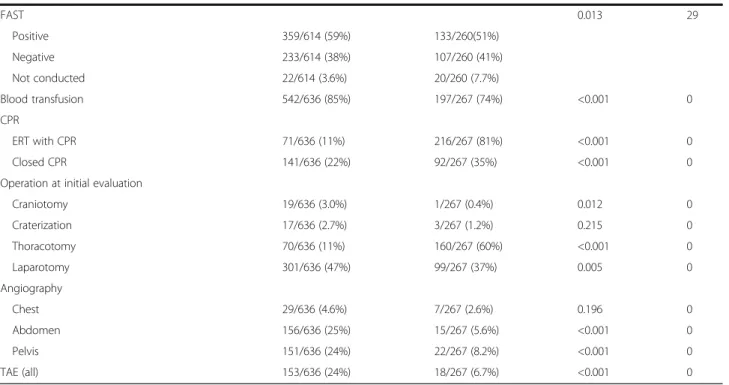
Table 1 shows the characteristics of critical patients with trauma who received either REBOA or ACC. The mean age was 53.7 ± 21.2 years; 611/903 (67.7%) were male. Blunt trauma was common (838/895; 93.6%). Mean RTS was 4.94 ± 2.08. The RTS in REBOA cases was signifi- cantly higher than in ACC cases. Median (interquartile) ISS was 34 (20). ISS in REBOA cases were also more severe than that in ACC cases. However, TRISS was higher in REBOA cases than in ACC cases. Also, 153/636 (24%) patients who were REBOA cases received TAE compared to 18/267 (6.7%) who were ACC cases. Table 2 demon- strates outcome comparisons between REBOA and ACC.
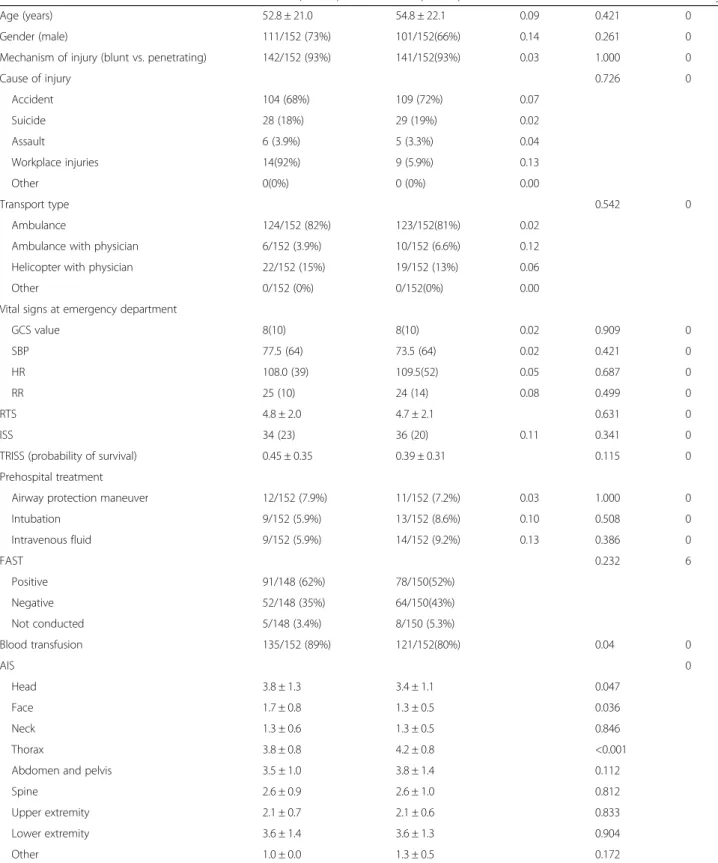
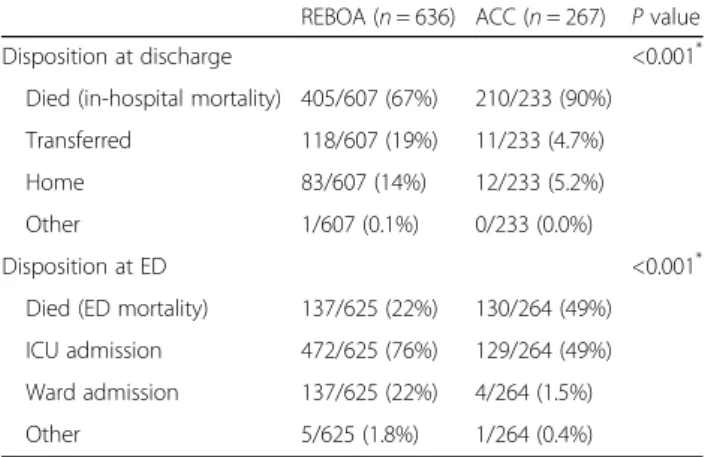
In-hospital mortality was 405/607 (67%) in REBOA and 210 /233 (90%) in ACC. ED mortality was 137/625 (22%) in REBOA and 130/264 (49%) in ACC. Figure 2 shows a comparison of the mortality between REBOA and ACC ( n = 903). Patients who underwent REBOA had a signifi- cantly lower in-hospital mortality than those who under- went ACC as shown by adjusted RTS (odds ratio (OR) = 0.224; 95% confidence interval (CI) = 0.129 – 0.700), ISS (OR = 0.188; 95% CI = 0.116 – 0.303), or TRISS (OR = 0.309; 95% CI = 0.190 – 0.502), respectively. After PS matching ( n = 304), in-hospital mortality was 106/146 (73%) in REBOA and 122/134 (91%) in ACC, and ED mortality was 24/149 (16%) in REBOA and 77/150 (51%) in ACC. Thus, mortality in the REBOA patients was lower than that of ACC (OR = 0.261; 95% CI = 0.130 – 0.523 at discharge; OR = 0.182; 95% CI = 0.106 – 0.313 at ED). Table 3 lists the baseline characteristics of PS-matched patients ( n = 304). There was no significant difference between REBOA and ACC in RTS (mean ± SD;
4.8 ± 2.0 vs 4.7 ± 2.1; P = 0.631), ISS (median (interquartile);
Fig. 1Flow chart of patients included in this study.AISAbbreviated Injury Scale,ACCaortic cross-clamping,REBOAResuscitative endovascular balloon occlusion of the aorta,SBPsystolic blood pressure
Abeet al. Critical Care (2016) 20:400 Page 3 of 10
Table 1Characteristic of critical patients with trauma who had either REBOA or ACC
REBOA (n= 636) ACC (n= 267) Pvalue Missing
Age (years) 52.5 ± 21.2 56.7 ± 21.1 0.007 0
Gender (male) 417/636 (66%) 194/267 (73%) 0.043 0
Onset year 0
2004–2008 218/636 (34%) 70/267 (26%)
2009–2013 418/636 (66%) 197/267 (74%)
Mechanism of injury (blunt vs. penetrating) 591/630 (94%) 247/265 (93%) 0.765 8
Cause of injury 0.754 31
Accident 429/618 (69%) 187/254 (74%)
Suicide 127/618 (21%) 44/254 (17%)
Assault 20/618 (32%) 6/254 (2.4%)
Workplace injuries 39/618 (6.3%) 16/254 (6.3%)
Other 1/618 (0.2%) 1/254 (0.4%)
Transport type 0.008 27
Ambulance 514/617 (83%) 194/259(75%)
Ambulance with physician 26/617 (4.2%) 24/259 (9.3%)
Helicopter with physician 73/617 (12%) 40/259 (15%)
Other 4/617 (0.6%) 1/259 (0.4%)
Vital signs at prehospital
SBP 101 (42) 105 (40) 0.42 358
HR 97 (37) 100 (43) 0.76 163
RR 24 (10) 25 (10) 0.445 232
Vital signs at emergency department
GCS value 10(12) 5(8) <0.001 21
SBP 89 (46) 87 (45) <0.001 0
HR 102 (36) 106 (52) 0.181 14
RR 25 (10) 24 (15) <0.001 99
RTS 5.2 ± 2.0 4.2 ± 2.2 <0.001 107
AIS 0
Head (n= 382) 3.6 ± 1.2 3.3 ± 1.1 0.101
Face (n= 167) 1.6 ± 0.7 1.8 ± 1.3 0.274
Neck (n= 14) 2.4 ± 1.3 1.5 ± 0.8 0.178
Thorax (n= 593) 3.8 ± 0.9 4.3 ± 1.1 <0.001
Abdomen and pelvis (n= 580) 3.6 ± 1.1 3.8 ± 1.5 0.143
Spine (n= 187) 2.5 ± 1.1 2.6 ± 0.9 0.959
Upper extremity (n= 209) 2.0 ± 0.6 2.1 ± 0.6 0.284
Lower extremity (n= 558) 3.7 ± 1.3 3.7 ± 1.2 0.702
Others (n= 39) 1.1 ± 0.4 1.2 ± 0.4 0.701
ISS 34 (25) 34 (20) <0.001 0
TRISS (probability of survival) 0.43 ± 0.36 0.27 ± 0.30 <0.001 12
Prehospital treatment
Airway protection maneuver 53/636 (8.3%) 41/267 (15%) 0.003 0
Intubation 44/636 (6.9%) 35/267 (13%) 0.004 0
Intravenous fluid 55/636 (8.6%) 25/267 (9.3%) 0.703 0
Abeet al. Critical Care (2016) 20:400 Page 4 of 10
34 (23) vs 36 (20), P = 0.341), and TRISS (mean ± SD;
0.45 ± 0.35 vs 0.39 ± 0.31, P = 0.115). However, the AIS of the thorax was significantly lower in REBOA cases than in ACC cases (3.8 ± 0.8 vs 4.2 ± 0.8, P < 0.001).
Thoracotomy at initial evaluation was also less frequent in REBOA cases than in ACC cases. On the other hand, patients with REBOA underwent angiography of the ab- domen and pelvis, including TAE, more often than those with ACC.
Discussion
Brief summaryThis study investigated the current usage of REBOA and ACC using a large, nationwide trauma database in Japan.
Mortality rates in patients requiring AO was discovered to be very high but this is attributed to the usage of ACC on patients who cannot be saved, skewing mortality out of favor with ACC. We also analyzed outcomes for patients after receiving either REBOA or ACC after adjusting for patient trauma severity. Robust analyses of the adjusted data showed that REBOA was associated with significantly re- duced in-hospital mortality compared with ACC. However, due to differences in associated procedures between REBOA (e.g., increased need for angiography) and ACC (e.g., thora- cotomy), there should be some consideration given to choosing either intervention.
Comparison with previous studies
To our knowledge, our current study is one of the largest cohort studies describing the use of REBOA [8]. REBOA has recently found use as a general technique across major emergency centers in Japan. The highest density of potential REBOA patients is also seen at major trauma centers in England and Wales, although the number of patients in whom REBOA was utilized is small [9]. In fact, a review of the potential use of REBOA in exsanguinating hemorrhage cases in the US suggested that this new technique should
Table 1Characteristic of critical patients with trauma who had either REBOA or ACC(Continued)FAST 0.013 29
Positive 359/614 (59%) 133/260(51%)
Negative 233/614 (38%) 107/260 (41%)
Not conducted 22/614 (3.6%) 20/260 (7.7%)
Blood transfusion 542/636 (85%) 197/267 (74%) <0.001 0
CPR
ERT with CPR 71/636 (11%) 216/267 (81%) <0.001 0
Closed CPR 141/636 (22%) 92/267 (35%) <0.001 0
Operation at initial evaluation
Craniotomy 19/636 (3.0%) 1/267 (0.4%) 0.012 0
Craterization 17/636 (2.7%) 3/267 (1.2%) 0.215 0
Thoracotomy 70/636 (11%) 160/267 (60%) <0.001 0
Laparotomy 301/636 (47%) 99/267 (37%) 0.005 0
Angiography
Chest 29/636 (4.6%) 7/267 (2.6%) 0.196 0
Abdomen 156/636 (25%) 15/267 (5.6%) <0.001 0
Pelvis 151/636 (24%) 22/267 (8.2%) <0.001 0
TAE (all) 153/636 (24%) 18/267 (6.7%) <0.001 0
All categorical variables are shown asn(%); continuous variables are shown as mean ± standard deviation or median (interquartile)
ACCaortic cross-clamping,AISAbbreviated Injury Score,CPRcardiopulmonary resuscitation,ERTEmergency resuscitative thoracotomy,FASTFocused assessment with sonography for trauma,GCSGlasgow Coma Scale,HRheart rate,ISSInjury Severity Score,REBOAresuscitative endovascular balloon occlusion of the aorta,RR Respiratory rate,RTSrevised trauma score,SBPsystolic blood pressure,TAEtrans-catheter arterial embolization,TRISStrauma and injury severity score
Table 2Outcome comparisons between REBOA and ACC REBOA (n= 636) ACC (n= 267) Pvalue
Disposition at discharge <0.001*
Died (in-hospital mortality) 405/607 (67%) 210/233 (90%) Transferred 118/607 (19%) 11/233 (1.8%)
Home 83/607 (14%) 12/233 (2.0%)
Other 1/607 (0.1%) 0/233 (0.0%)
Disposition at ED <0.001*
Died (ED mortality) 137/625 (22%) 130/264 (49%) CU admission 472/625 (76%) 129/264 (49%) Ward admission 137/625 (22%) 4/264 (1.5%)
Other 5/625 (1.8%) 1/264 (0.4%)
The variables are shown asn(%)
ACCaortic cross clamping,EDemergency department,ICUintensive care unit, REBOAresuscitative endovascular balloon occlusion of the aorta
*Chi-square test
Abeet al. Critical Care (2016) 20:400 Page 5 of 10
be thoroughly evaluated for broad use, but the literature currently suffers from a dearth of human studies on REBOA [10]. Although our observational study admittedly had some selection bias, we feel that our results will nonetheless become an important part of the foundation of literature supporting the evaluation of global REBOA use.
Previous studies regarding REBOA usage have been limited in size and scope, and have shown ambiguous results. For example, although previous single-center co- hort studies mentioned the utility of REBOA for massive pelvic bleeding cases that could still be imaged by angiog- raphy [5, 6], another large, retrospective cohort study cautioned against REBOA usage for patients who had emergency surgery or transcatheter embolization [7, 11].
Yet another single-center cohort study also reported on the feasibility and safety of REBOA for a non-compressive torso injury (pelvic fracture or hemoperitoneum) [12], but contrasting studies also reported that REBOA usage was associated with a higher mortality compared with non- REBOA usage in JTDB [7, 11]. However, to objectively evaluate these reports, a thorough knowledge of the Japanese trauma care system is required. For example, most Japanese emergency departments see few in-house
trauma surgeries, see fewer trauma cases overall, and mostly deal with older patients and age-related maladies [13].
REBOA usage, in this context, may signal “ last ditch ” efforts [11]. However, our results from the same database show an incongruent outcome even though our study population and comparisons are different. Previous reports have indi- cated REBOA usage as a last resort in the most severe trauma cases, but only one multicenter, prospective observa- tional study (Aortic Occlusion for Resuscitation in Trauma and Acute Care Surgery (AORTA) registry) [1] has looked at direct comparisons with ACC, which is also used in the most severe cases, and found REBOA to be beneficial. As the severity criteria for both REBOA and ACC are similar, it is reasonable to compare those outcomes directly and our reports findings strengthen the conclusion of DuBose and colleagues [1], and show a promising consistency in results.
Possible explanations and implications
AO was used on 2032 patients in our database. However, 799 patients with ACC were excluded from analysis because of pre-hospital cardiopulmonary arrest. Although we controlled for this in our study, the differences between REBOA and ACC in general need more context
a
b
Fig. 2Comparison of the mortality of REBOA versus ACC at discharge (a) and in the emergency department (ED) (b). *The covariates used to estimate the propensity score were age, gender, mechanism of injury, cause of injury, transport type, prehospital treatment, vital signs at ED, and Injury Severity Score (ISS).CIconfidence interval,ORodds ratio,RTSrevised trauma score,TRISStrauma and injury severity score
Abeet al. Critical Care (2016) 20:400 Page 6 of 10
Table 3Baseline characteristic in propensity score-matched patients with severe trauma*
REBOA (n= 152) ACC (n= 152) SD Pvalue Missing
Age (years) 52.8 ± 21.0 54.8 ± 22.1 0.09 0.421 0
Gender (male) 111/152 (73%) 101/152(66%) 0.14 0.261 0
Mechanism of injury (blunt vs. penetrating) 142/152 (93%) 141/152(93%) 0.03 1.000 0
Cause of injury 0.726 0
Accident 104 (68%) 109 (72%) 0.07
Suicide 28 (18%) 29 (19%) 0.02
Assault 6 (3.9%) 5 (3.3%) 0.04
Workplace injuries 14(92%) 9 (5.9%) 0.13
Other 0(0%) 0 (0%) 0.00
Transport type 0.542 0
Ambulance 124/152 (82%) 123/152(81%) 0.02
Ambulance with physician 6/152 (3.9%) 10/152 (6.6%) 0.12
Helicopter with physician 22/152 (15%) 19/152 (13%) 0.06
Other 0/152 (0%) 0/152(0%) 0.00
Vital signs at emergency department
GCS value 8(10) 8(10) 0.02 0.909 0
SBP 77.5 (64) 73.5 (64) 0.02 0.421 0
HR 108.0 (39) 109.5(52) 0.05 0.687 0
RR 25 (10) 24 (14) 0.08 0.499 0
RTS 4.8 ± 2.0 4.7 ± 2.1 0.631 0
ISS 34 (23) 36 (20) 0.11 0.341 0
TRISS (probability of survival) 0.45 ± 0.35 0.39 ± 0.31 0.115 0
Prehospital treatment
Airway protection maneuver 12/152 (7.9%) 11/152 (7.2%) 0.03 1.000 0
Intubation 9/152 (5.9%) 13/152 (8.6%) 0.10 0.508 0
Intravenous fluid 9/152 (5.9%) 14/152 (9.2%) 0.13 0.386 0
FAST 0.232 6
Positive 91/148 (62%) 78/150(52%)
Negative 52/148 (35%) 64/150(43%)
Not conducted 5/148 (3.4%) 8/150 (5.3%)
Blood transfusion 135/152 (89%) 121/152(80%) 0.04 0
AIS 0
Head 3.8 ± 1.3 3.4 ± 1.1 0.047
Face 1.7 ± 0.8 1.3 ± 0.5 0.036
Neck 1.3 ± 0.6 1.3 ± 0.5 0.846
Thorax 3.8 ± 0.8 4.2 ± 0.8 <0.001
Abdomen and pelvis 3.5 ± 1.0 3.8 ± 1.4 0.112
Spine 2.6 ± 0.9 2.6 ± 1.0 0.812
Upper extremity 2.1 ± 0.7 2.1 ± 0.6 0.833
Lower extremity 3.6 ± 1.4 3.6 ± 1.3 0.904
Other 1.0 ± 0.0 1.3 ± 0.5 0.172
Abeet al. Critical Care (2016) 20:400 Page 7 of 10
for accurate interpretation. In Japan, ACC currently seems to be a preferred intervention tactic in non-survivable in- jury cases and this differs from other countries, possibly making Japanese ACC-related mortality rates non-indica- tive of actual outcomes [1, 9, 13]. In addition, other patient characteristics such as better Glasgow Coma Scale (GCS) scores in cases where REBOA was used versus ACC cases (with more severe GCS scores) may also skew results. This raises the issue of snap decisions by ED physicians to choose rapid thoracotomy over REBOA because ACC would be more frequently chosen in cases with worse GCS scores. A key point to keep in mind, however is that al- though the probability of survival (TRISS) for REBOA was better than that of ACC, it is still no guarantee of suc- cess in severe cases (0.43 ± 0.36). Furthermore, REBOA patients who die might count as preventable, but ACC deaths with TRISS scores indicating unsurvivable injur- ies (0.27 ± 0.30) would be counted as non-preventable.
This might not be seen as a negative even though the mortality of ACC patients was very high (90%) and might be related to more severe complications in the thorax. These issues highlight the nuances necessary to objectively interpret the data, as both REBOA and ACC have complicating factors. Survival rates at ED of 78%
and 51% in REBOA and ACC, respectively, indicate that both can serve a role in trauma treatment. However, it is important to keep in mind that these procedures are not panaceas; only 14% (83/607) of REBOA patients and 2.0% (12/233) of ACC patients could leave the hospital and go home. This emphasizes the difficulty of AO in clinical practice. This is especially evident in Japan as our mortality was slightly higher than other countries [1, 9, 13]. As Japan ’ s
prevalence of penetrating trauma is quite low (6.4%), survival probabilities may follow suit. However, taking into consideration the variability in study populations and insti- tutional skill, a general trend in the same direction can be seen with our results versus those of other countries.
Trauma severity in ACC cases versus REBOA cases were controlled for with sensitivity analyses as seen in Fig. 2, but REBOA usage showed a clear survival benefit. PS matching was also used to control for insufficiency of adjustment and the tendency of results was the same among PS-matched patients. We found that PS matching was one of the best methods to control confounders in this prevalence and mortality. Again, direct comparisons between REBOA and ACC were conducted after PS matching because of current interest in the possibility of shifting the ACC paradigm to REBOA [10]. Table 3 shows the precision of our PS match- ing methodology. However, covariate differences where we did not use PS (although we did properly control for physiological severity and backgrounds) unavoid- ably resulted in an inability to match anatomical sever- ity. This might be classified as an indication bias, but we feel that our analysis shows the real utility of AO.
Taken together, we feel that these results should be made part of the body of knowledge that physicians consult in the decision tree of AO. Accordingly, REBOA would conceiv- ably be used more often as a solo abdominal trauma option even though there are no formal criteria for AO treatment utility. Still, this does not necessarily mean that all AO cases would shift from ACC to REBOA. In reality, choosing ACC for severe abdominal trauma patients who present no chest trauma is a difficult choice for ED physicians who may not have enough thoracotomy experience. This is especially
Table 3Baseline characteristic in propensity score-matched patients with severe trauma*(Continued)Operation at initial evaluation
Craniotomy 3/152 (2.0%) 0/152(0%) 0.248 0
Craterization 4/152 (2.6%) 1/152 (0.7%) 0.371 0
Thoracotomy 20/152 (13%) 92/152(61%) <0.001 0
Laparotomy 79/152 (52%) 68/152(45%) 0.251 0
Angiography
Chest 2/152 (1.3%) 5/152 (3.3%) 0.448 0
Abdomen 27/152 (18%) 10/152 (6.6%) 0.004 0
Pelvis 33/152 (22%) 15/152 (9.9%) 0.007 0
TAE (all) 29/152 (19%) 11/152 (7.2%) 0.004 0
CPR
ERT with CPR 20/152 (13%) 125/152 (82%) <0.001 0
Closed CPR 33/152 (22%) 53/152(35%) 0.015 0
All categorical variables are shown asn(%); continuous variables are shown as mean ± standard deviation or median (interquartile)
ACCaortic cross-clamping,AISAbbreviated Injury Score,CPRcardiopulmonary resuscitation,ERTEmergency resuscitative thoracotomy,FASTFocused assessment with sonography for trauma,GCSGlasgow Coma Scale,HRheart rate,ISSInjury Severity Score,REBOAresuscitative endovascular balloon occlusion of the aorta,RRRespiratory rate, RTSrevised trauma score,SBPsystolic blood pressure,SDstandardized difference,TAEtrans-catheter arterial embolization,TRISStrauma and injury severity score
*The covariates used to estimate the propensity score were age, gender, mechanism of injury, cause of injury, transport type, prehospital treatment, vital signs at the emergency department, and ISS
Abeet al. Critical Care (2016) 20:400 Page 8 of 10
important because of recent reports on poor outcomes of emergency thoracotomies after abdominal exsanguination, adding to the reputation of ACC as a “last ditch” effort [13, 14]. However, to find the best position of an occlusion balloon with a blind approach is next to impossible when patients present with thoracic complications. This explains the higher incidence of abdominal and pelvic angiography in REBOA groups which we find to be an acceptable >trade- off for accuracy in occlusion balloon positioning. We do not doubt that REBOA will be applicable as a bridge to defini- tive treatment in the ED, but indications and contraindica- tions in the light of ACC must be further refined. Finally, the most critical point to remember is that any method in- ducing long-lasting ischemia to at least half or more of the body has serious potential to harm the patient. To this end, the decision to use REBOA or ACC should be part of a robust clinical governance framework in order to ensure high quality patient care and maximal survival chance [9].
Limitations
Potential limitations of this study should be acknowledged.
First, there remained some indication bias as previously discussed, indicating caution when interpreting results for clinical standpoints. However, we controlled for patient background using logistic regression and PS-matched ana- lysis, when possible, and found two key points in this study.
First, PS-matched analysis was one of the best methods for comparison because there was a relatively small sample size of survivors. Second, there was institutional bias although covariates were carefully selected on the basis of the as- sumption that none were affected directly by the interven- tion. This assumption could be a potential weakness and requires further study. With regard to mortality rates, a population-based study in England and Wales showed only major trauma centers had a high density of REBOA use and their rate was smaller than ours [9]. We, on the other hand, did not have institutional-level data, and therefore we could not control for it and this might account for our higher mortality rate. Although a potential weakness could be variability between physicians and institutions, AORTA registry data reveals that the general tendency of out- comes is the same [1]. Although selection bias may skew towards REBOA more than ACC in both AORTA and this study, we feel that our results are worth consideration to add to the scarce body of knowledge regarding this topic.
Moreover, we did not have detailed data on REBOA or ACC such as the clamping time, the ballooning time, and the tactics of that therapy. Since the patients had the issue of ischemia/reperfusion injury, their out- come may have been influenced by time. A general assumption, however, is that clamping and ballooning times were kept as short as possible by the physicians because of the common knowledge that occlusion times should be kept to a minimum.
Conclusions
Despite any residual indication bias, REBOA might be a favorable alternative method to ACC, especially for severe trauma below the diaphragm. Further study is needed to elucidate optimal indications.
Key messages
Patients who underwent AO had a high mortality.
REBOA might be a favorable alternative method to ACC.
Abbreviations
ACC:Aortic cross-clamping; AIS: Abbreviated Injury Scale; AO: Aortic occlusion;
AORTA: Aortic Occlusion for Resuscitation in Trauma and Acute Care Surgery;
CI: Confidence interval; ED: Emergency department; GCS: Glasgow Coma Scale;
IQR: Interquartile range; ISS: Injury Severity Score; JTDB: Japan Trauma Data Bank; OR: Odds ratio; PS: Propensity score; REBOA: Resuscitative endovascular balloon occlusion of the aorta; RTS: Revised trauma score; SD: Standard deviation; TAE: Trans-catheter arterial embolization; TRISS: Trauma and injury severity score
Acknowledgement
We thank assistant Prof. Bryan J. Mathis for English language revision.
Funding
This work was supported by JSPS KAKENHI JP 16 K15388. This study was also supported by the Ministry of Health, Labour and Welfare (H27-seisaku- senryaku-012).
Availability of data and materials Not applicable
Authors’contributions
TA conceived of and designed this study, conducted data cleaning, analyzed the data, interpreted the data, drafted the manuscript, and revised the manuscript for important intellectual content. MU jointly conceived of and designed this study and interpreted the data. IN jointly conceived of and designed this study and interpreted the data. DS contributed to the acquisition of data, interpreted the data, and revised the manuscript for important intellectual content. NT interpreted the data and revised the manuscript for important intellectual content. All of the authors reviewed, discussed, and approved the final manuscript.
Competing interests
TA received a research grant from Hitachi, Ltd. previously, but declares no competing interests in relation to this research. The other authors declare that they have no competing interests.
Consent for publication Not applicable
Ethics approval and consent to participate
We received permission to use the data from the JTDB. This study was approved by the ethics committee of Tsukuba Medical Center Hospital. The ethics committee at our institution does not require its informed consent for observational studies using anonymous data previously collected for routine operations. Also, informed consent from each patient is waived for using anonymous data according to the informed consent guidelines in Japan.
Presentation
We presented these results at the AHA Scientific Sessions Resuscitation Science Symposium on 12 November 2016. Our research was selected Best of the Best Oral Abstract Presentations and Presentation of the Best Abstract Awards for Cardiac and Trauma Resuscitation Science.
Abeet al. Critical Care (2016) 20:400 Page 9 of 10
Author details
1Department of Health Services Research, Faculty of Medicine, University of Tsukuba, 1-1-1, Tennodai, Tsukuba 305-8577, Japan.2Department of Emergency Medicine, Tsukuba Medical Center Hospital, 1-3-1, Amakubo, Tsukuba 305-8558, Japan.3Department of Traumatology and Emergency Medicine, National Defense Medical College, 3-2, Namiki, Tokorozawa, Saitama 359-8513, Japan.
Received: 14 July 2016 Accepted: 25 November 2016
Reference
1. DuBose JJ, Scalea TM, Brenner M, Skiada D, Inaba K, Cannon J, Moore L, Holcomb J, Turay D, Arbabi CN, et al. The AAST Prospective Aortic Occlusion for Resuscitation in Trauma and Acute Care Surgery (AORTA) registry: data on contemporary utilization and outcomes of aortic occlusion and resuscitative balloon occlusion of the aorta (REBOA). J Trauma Acute Care Surg. 2016;81(3):
409–19.
2. Assar AN, Zarins CK. Endovascular proximal control of ruptured abdominal aortic aneurysms: the internal aortic clamp. J Cardiovasc Surg (Torino).
2009;50(3):381–5.
3. Karkos CD, Bruce IA, Lambert ME. Use of the intra-aortic balloon pump to stop gastrointestinal bleeding. Ann Emerg Med. 2001;38(3):328–31.
4. Harma M, Harma M, Kunt AS, Andac MH, Demir N. Balloon occlusion of the descending aorta in the treatment of severe post-partum haemorrhage.
Aust N Z J Obstet Gynaecol. 2004;44(2):170–1.
5. Ogura T, Lefor AT, Nakano M, Izawa Y, Morita H. Nonoperative management of hemodynamically unstable abdominal trauma patients with angioembolization and resuscitative endovascular balloon occlusion of the aorta. J Trauma Acute Care Surg. 2015;78(1):132–5.
6. Martinelli T, Thony F, Declety P, Sengel C, Broux C, Tonetti J, Payen JF, Ferretti G. Intra-aortic balloon occlusion to salvage patients with life-threatening hemorrhagic shocks from pelvic fractures. J Trauma. 2010;68(4):942–8.
7. Inoue J, Shiraishi A, Yoshiyuki A, Haruta K, Matsui H, Otomo Y. Resuscitative endovascular balloon occlusion of the aorta might be dangerous in patients with severe torso trauma: a propensity score analysis. J Trauma Acute Care Surg. 2016;80(4):559–67.
8. Morrison JJ, Galgon RE, Jansen JO, Cannon JW, Rasmussen TE, Eliason JL.
A systematic review of the use of resuscitative endovascular balloon occlusion of the aorta in the management of hemorrhagic shock. J Trauma Acute Care Surg. 2016;80(2):324–34.
9. Barnard EB, Morrison JJ, Madureira RM, Lendrum R, Fragoso-Iniguez M, Edwards A, Lecky F, Bouamra O, Lawrence T, Jansen JO. Resuscitative endovascular balloon occlusion of the aorta (REBOA): a population based gap analysis of trauma patients in England and Wales. Emerg Med J.
2015;32(12):926–32.
10. Biffl WL, Fox CJ, Moore EE. The role of REBOA in the control of exsanguinating torso hemorrhage. J Trauma Acute Care Surg. 2015;78(5):1054–8.
11. Norii T, Crandall C, Terasaka Y. Survival of severe blunt trauma patients treated with resuscitative endovascular balloon occlusion of the aorta compared with propensity score-adjusted untreated patients. J Trauma Acute Care Surg. 2015;78(4):721–8.
12. Saito N, Matsumoto H, Yagi T, Hara Y, Hayashida K, Motomura T, Mashiko K, Iida H, Yokota H, Wagatsuma Y. Evaluation of the safety and feasibility of resuscitative endovascular balloon occlusion of the aorta. J Trauma Acute Care Surg. 2015;78(5):897–903. discussion 904.
13. Qasim Z, Brenner M, Menaker J, Scalea T. Resuscitative endovascular balloon occlusion of the aorta. Resuscitation. 2015;96:275–9.
14. Suzuki K, Inoue S, Morita S, Watanabe N, Shintani A, Inokuchi S, Ogura S.
Comparative effectiveness of emergency resuscitative thoracotomy versus closed chest compressions among patients with critical blunt trauma:
a nationwide cohort study in Japan. PLoS One. 2016;11(1):e0145963. • We accept pre-submission inquiries
• Our selector tool helps you to find the most relevant journal
• We provide round the clock customer support
• Convenient online submission
• Thorough peer review
• Inclusion in PubMed and all major indexing services
• Maximum visibility for your research Submit your manuscript at
www.biomedcentral.com/submit
Submit your next manuscript to BioMed Central and we will help you at every step:
Abeet al. Critical Care (2016) 20:400 Page 10 of 10
ERRATUM Open Access
Erratum to: Resuscitative endovascular
balloon occlusion of the aorta versus aortic cross clamping among patients with critical trauma: a nationwide cohort study in Japan
Toshikazu Abe
1,2*, Masatoshi Uchida
1, Isao Nagata
1, Daizoh Saitoh
3and Nanako Tamiya
1Erratum
Following publication of the original article [1], it was brought to our attention that there were a few errors in Table 2:
CU admission should read: ICU admission 11/233 (1.8%) should read: 11/233 (4.7%) 12/233 (2.0%) should read: 12/233 (5.2%)
The corrected table is presented in this erratum [Table 2].
Furthermore, the sentence “… only 14% (83/607) of REBOA patients and 2.0% (12/233) of ACC patients could leave the hospital and go home. ” in the Discus- sion section should as a consequence read: “… only 14% (83/607) of REBOA patients and 5.2% (12/233) of ACC patients could leave the hospital and go home. ”
This has now been corrected in this erratum.
Author details
1Department of Health Services Research, Faculty of Medicine, University of Tsukuba, 1-1-1, Tennodai, Tsukuba 305-8577, Japan.2Department of Emergency Medicine, Tsukuba Medical Center Hospital, 1-3-1, Amakubo, Tsukuba 305-8558, Japan.3Department of Traumatology and Emergency Medicine, National Defense Medical College, 3-2, Namiki, Tokorozawa, Saitama 359-8513, Japan.
Received: 8 February 2017 Accepted: 10 February 2017
Reference
1. Abe T, Uchida M, Nagata I, Saitoh D, Tamiya N. Resuscitative endovascular balloon occlusion of the aorta versus aortic cross clamping among patients with critical trauma: a nationwide cohort study in Japan. Crit Care. 2015;20:
400. doi:10.1186/s13054-016-1577-x.
* Correspondence:[email protected]
1Department of Health Services Research, Faculty of Medicine, University of Tsukuba, 1-1-1, Tennodai, Tsukuba 305-8577, Japan
2Department of Emergency Medicine, Tsukuba Medical Center Hospital, 1-3-1, Amakubo, Tsukuba 305-8558, Japan
Full list of author information is available at the end of the article
© The Author(s). 2017Open AccessThis article is distributed under the terms of the Creative Commons Attribution 4.0 International License (http://creativecommons.org/licenses/by/4.0/), which permits unrestricted use, distribution, and reproduction in any medium, provided you give appropriate credit to the original author(s) and the source, provide a link to the Creative Commons license, and indicate if changes were made. The Creative Commons Public Domain Dedication waiver (http://creativecommons.org/publicdomain/zero/1.0/) applies to the data made available in this article, unless otherwise stated.
Abeet al. Critical Care (2017) 21:41 DOI 10.1186/s13054-017-1627-z
Table 2Outcome comparisons between REBOA and ACC REBOA (n= 636) ACC (n= 267) Pvalue
Disposition at discharge <0.001*
Died (in-hospital mortality) 405/607 (67%) 210/233 (90%) Transferred 118/607 (19%) 11/233 (4.7%)
Home 83/607 (14%) 12/233 (5.2%)
Other 1/607 (0.1%) 0/233 (0.0%)
Disposition at ED <0.001*
Died (ED mortality) 137/625 (22%) 130/264 (49%) ICU admission 472/625 (76%) 129/264 (49%) Ward admission 137/625 (22%) 4/264 (1.5%)
Other 5/625 (1.8%) 1/264 (0.4%)
The variables are shown asn(%)
ACCaortic cross clamping,EDemergency department,ICUintensive care unit, REBOAresuscitative endovascular balloon occlusion of the aorta
*Chi-square test
Abeet al. Critical Care (2017) 21:41 Page 2 of 2
Article
The relationship between raising a child with a disability and the mental health of mothers compared to raising a child without disability in japan
Yui Yamaoka
a, Nanako Tamiya
a,n, Nobuyuki Izumida
b, Akira Kawamura
a, Hideto Takahashi
c, Haruko Noguchi
daDepartment of Health Service Research, Faculty of Medicine, University of Tsukuba, Tsukuba-shi, Ibaraki, Japan
bDepartment of Empirical Social Security Research, National Institute of Population and Social Security Research, Chiyoda-ku, Tokyo, Japan
cOffice of Information Management and Statistics, Radiation Medical Science Center for the Fukushima Health Management Survey, Faculty of Medicine, Fukushima Medical University, Fukushima, Japan
dFaculty of Political Science and Economics, Waseda University, Shinjuku-ku, Tokyo, Japan
a r t i c l e i n f o
Article history:
Received 19 April 2016 Received in revised form 2 August 2016 Accepted 3 August 2016
Keywords:
Children with disabilities Mothers
Psychological distress Family structure Japan
a b s t r a c t
Objective: Previous studies conducted in Japan targeted only mothers who cared for children with dis- abilities, and lacked reference subjects, such as mothers of children without disabilities. The aim of this study was to examine the association between raising one or two children with a disability and maternal psychological distress compared to mothers of children without a disability, and to assess differences among partnered mothers living with grandparent(s), partnered mothers without grandparent(s), and single mothers.
Methods:This study utilized data from the Comprehensive Survey of Living Conditions (CSLC) in 2010.
We merged the data of the children (aged six and over), mothers, and fathers. This study obtained 33,739 study subjects as a triad of a child (33,110 children without disabilities and 629 children with disabilities), mother, and father. The Japanese version of Kessler 6 (K6) was used to assess the psychological distress of mothers. Multivariate logistic regression was performed to assess the independent association of a child with a disability on maternal psychological distress after controlling for the basic characteristics of the children, mothers, and households.
Results:This study reported that raising one or two children with disabilities was significantly related to maternal psychological distress (odds ratio: 1.72 for one child, 2.85 for two children) compared to mo- thers of children without disability. After stratifying the analyses by family structure, significant asso- ciations remained among mothers in two-parent families but not for mothers in three-generation fa- milies and single mothers due to a small number of children with disabilities in these families.
Conclusions: This study reported the significant association between raising a child with a disability and maternal psychological distress in comparison to mothers of children without disabilities. Attention should be paid to not only single mothers, but also partnered mothers in two-parent families who have a child with a disability. It is important for health professionals to focus on the mental health of every mother of a child with a disability and to assess their needs for psychological support.
&2016 The Authors. Published by Elsevier Ltd. This is an open access article under the CC BY-NC-ND
license (http://creativecommons.org/licenses/by-nc-nd/4.0/).
1. Background
Raising a child with a disability is an unexpected experience for parents (Raina et al., 2005). Caring for a child with a disability, depending on the type of disability, can result in physical health problems, mental health problems, and time orfinancial burdens on mothers (Bourke et al., 2008;Brehaut et al., 2004;Estes et al.,
2013;Lee, 2013;Montes & Halterman, 2008a,2008b;Nes et al., 2014;Parish, Rose, Dababnah, Yoo & Cassiman, 2012;Raina et al., 2005). In particular, maternal mental health is important for both mothers and children because poor maternal mental health is related to unfavorable parenting practices (McLennan & Ko- telchuck, 2000; Minkovitz et al., 2005), child health problems (Ferro & Speechley, 2009;Schwebel & Brezausek, 2008), and poor school performance (Shen et al., 2016).
Mothers play a major role in childrearing, regardless of the presence or absence of a disability. Supporting mothers is a public issue because Japanese society faces a proliferation of nuclear and Contents lists available atScienceDirect
journal homepage:www.elsevier.com/locate/ssmph
SSM -Population Health
http://dx.doi.org/10.1016/j.ssmph.2016.08.001
2352-8273/&2016 The Authors. Published by Elsevier Ltd. This is an open access article under the CC BY-NC-ND license (http://creativecommons.org/licenses/by-nc-nd/4.0/).
nCorresponding author.
E-mail address:[email protected](N. Tamiya).
SSM -Population Health 2 (2016) 542–548
dual-income families. Paternal involvement in childrearing re- mains to a small extent in the present circumstances. For example, the parental leave obtainment rate was only 2.0% of full-time working fathers (The Ministry of Health Labour and Welfare, 2012), and fathers seldom commit to household chores and childrearing tasks (i.e., only 39 minutes per week in dual-income families) (Statistics Bureau, 2011). Therefore, mothers may ex- perience further negative influence on their mental health in ad- dition to ordinary childrearing tasks.
Previous studies conducted in Japan targeted only mothers who cared for children with disabilities and lacked reference subjects, such as mothers of chil- dren without disabilities (Toki et al., 2010;Yamaguchi, Takataya & Ogiwara, 2005;
Yamaoka et al., 2015;Yatsugi, Suzukamo & Izumi, 2013). Furthermore, these studies did not consider the possibility of having multiple children with disabilities in a household. Comparison with general childrearing situation is needed to understand the magnitude of mental problems related to raising one or more children with disabilities and to provide specific supporting measurements in addition to general parenting support. Therefore, this study aimed to assess the relationship between raising single or multiple children with disabilities and the mental health of mothers compared mothers of children without disabilities using population-based data in Japan.
2. Method 2.1. Data source
Data for this study, were drawn from the Comprehensive Sur- vey of Living Conditions (CSLC) (The Ministry of Health, 2011), which was conducted by the Ministry of Health, Labour and Welfare in 2010. The CSLC is a nationally representative survey of households that has been conducted every three years since 1986, with smaller annual surveys in the intervals. The CSLC employs a stratified random cluster sampling method based on the Census.
The Census in 2005 surveyed 982,000 enumeration districts (EDs) throughout Japan, of which each ED included approximately 50 households. The 2010 CSLC randomly selected 5530 EDs, and all household members in the selected EDs became study subjects, except for individuals who were hospitalized or institutionalized for long periods. The enumerator collected the self-administered questionnaire by visiting all households. The 2010 CSLC surveyed 289,363 households and collected questionnaires from 229,785 households (response rate: 79.4%), which comprised 609,019 household members.
2.2. Study sample
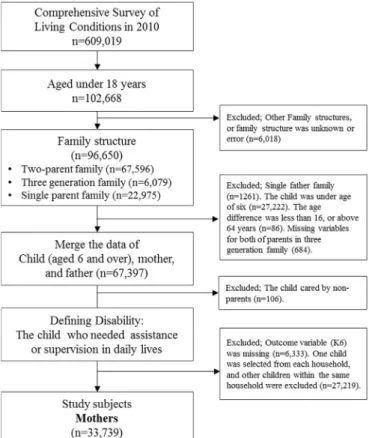
Theflow chart (Fig. 1) shows how samples were extracted to determine the study subjects. First, we extracted children who were under the age of 18 from the total CSLC sample (n¼102,668).
Second, the CSLC coded family structures as two-parent families, three-generation families, families with single mothers, and oth- ers. Other types of family structures or households without family structure data were excluded (n¼6018) because it was impossible to determine the parent-child relationships in families with sev- eral adult couples, single adults, and children living in the same household. There were 96,650 children with three types of family structures. Third, we excluded single-father families (n¼1261) because the outcome variable of the study was maternal psycho- logical distress. In addition, this study aimed to compare the households of children with disabilities and those without dis- abilities. We used the question that inquired about disability status for children aged six and over. The content of this question is ex- plained in the subsection “explanatory variable”. Because of the targeting age in this question, children under the age of six were excluded (n¼27,222). Before merging each set of data for the
children, mothers, and fathers, we excluded the outliers of age differences—over the age of 64 or under the age of 16 (n¼86)— and children without age data for both the mothers and fathers in three-generation families (n¼684). In this manner, we merged the data of the children, mothers, and fathers (n¼67,379). This study targeted the psychological distress level of mothers who were caring for children with or without disabilities. Therefore, we ex- cluded children with disabilities who were not being cared for by parents (n¼106) and mothers without outcome variables (n¼6333). Last, we selected one child per household to eliminate the possibility of repeated measures for the same mothers and fathers, and excluded other children from the same household (n¼27,219). In households where none of the children had dis- abilities, the youngest child was selected. In households where all the children had disabilities, the child with the most severe dis- ability was selected. In households where some children did have disabilities and other children did not have disabilities, the child who was the youngest and had a more severe disability was se- lected. The severity of a child's disability is explained in the sub- section “explanatory variable”. Finally, we obtained 33,739 mo- thers as a study subjects and triads of a child, mother, and father, including 33,110 children without disabilities and 629 children with disabilities.
2.3. Mental health measures
Maternal mental health was assessed by the Japanese version of the Kessler 6 (K6) scale (Furukawa et al., 2008). The K6 score, a simple screening tool with six items, ranges from 0 to 24 with a 5-point scale (0–4) for each item, and a higher total score indicates more severe mental health conditions. Non-specific psychological distress is the core dimension that people with a wide range of mental disorders have typically experienced (Kessler et al., 2002).
Kessler et al. originally developed the K6 to identify non-specific psychological distress among the general population (Kessler et al.,
Fig. 1.Flow chart of study samples.
Y. Yamaoka et al. / SSM -Population Health 2 (2016) 542–548 543
2002;Kessler et al., 2010). Sakurai et al. reported that the optimal cutoff point on K6 was 4/5 for screening mood and anxiety dis- orders in self-reported questionnaires (sensitivity 100%, specificity 68.7%) using community residents in Japan (Sakurai, Nishi, Kondo, Yanagida & Kawakami, 2011). The present study employed a cutoff point of 4 or 5 and higher in the K6 score to assess non-specific psychological distress because CSLC used a self-administered questionnaire. A K6 score of 5 and higher was coded‘1’to express the presence of psychological distress and‘0’otherwise.
2.4. Explanatory variables
The child's disability status was an explanatory variable in the current study. To define whether a child had a disability, we used responses to the question that inquired about disability status for children aged six and over:“Does he/she need assistance or su- pervision?”This question targeted children aged six and over to avoid general parenting assistance or supervision toward infants and preschoolers. Children aged six and over who received a re- sponse of“Yes”to this question were operationally categorized as a
“child with disability”. The number of children with a disability in the same household was used to assess the extent of association between raising them and maternal psychological distress.
In terms of the severity of disabilities, we utilized a subsequent question from the questionnaire to ask about four levels of the child's dependence in their daily life. The mildest level (Level 1) indicated that a child did have any type of disability but could go out by oneself. Level 2 indicated a child who was independent at home but needed assistance to go out. Level 3 represented a child that needed assistance in their daily life, mainly stayed in bed, and maintained a sitting position. The severest level (Level 4) indicated a child who was bedridden and needed help for all of their daily activities, such as egestion, meals, and changing clothes. The se- verity of disabilities was used to select one child if there were multiple children in the same household.
2.5. Covariates
Possible covariates were used from the questionnaire, such as the characteristics of a child (sex, age, outpatient visits, activity limitation), parents (age, educational attainment, and working status), and household (family structure, house ownership, number of children, population of city, and monthly household expenditure). The question for the outpatient visits was the fol- lowing: “Do you currently make regular outpatient visits to hospitals, clinics, Japanese traditional massage therapists, acu- puncturists, moxacautery practitioners, Judo orthopedists, or reg- ular home visits by a physician?”If the child visits regularly to any kind of health care facility, the outpatient visits was coded as‘1’, or otherwise‘0’. The question for activity limitation was the follow- ing:“Have you ever become bedridden or experienced the inability to perform usual activities due to health problems, such as being absent from work or school or not being able to perform house- keeping tasks at least one day during last month?”If the child had answered positively to these conditions at least one day in the last month, the activity limitation was coded as‘1’and‘0’otherwise.
The educational attainment of parents was divided into two ca- tegories: high educational attainment indicated graduation from vocational school, technical college, university, or postgraduate school, and low educational attainment indicated graduation from primary school, junior high school, or high school. The working status of parents was coded as‘1’for having any type of job and‘0’ for jobless. The status of having a job included a person who worked and attended school at the same time or worked for a self- owned business. Jobless status indicated a person who attended school or performed household chores without engaging in a job.
Family structure was categorized into four groups: family with two parents and child's grandparent(s), family with two parents, family with one parent and child's grandparent(s), and family with one parent (i.e., single mother family). The population of the city was also considered as one of the covariates because living in an urban city might influence maternal psychological distress, and it was divided into two categories with a threshold of 150,000. The total household monthly expenditure was categorized into either below the 25th percentile or the 25th percentile and above after dividing it by the square root of the number of family members to stan- dardize the effect of family size. Below the 25th percentile of total household monthly expenditure was coded as ‘1’ for lower household expenditure and‘0’otherwise.
2.6. Statistical analysis
Wefirstly conducted univariate analysis to describe the asso- ciations between covariates and maternal psychological distress.
We used Student's t-test for the continuous variables (age), the
χ
2test for dichotomous variables (sex, outpatient visits, activity limitation, maternal and paternal educational attainment, working status, family structure, homeownership, lower household ex- penditure, population of the city), and the Wilcoxon rank sum test for nonparametric variables (number of children without disability in the household).
Secondly, we conducted a multivariable logistic regression to assess the association between the presence and number of chil- dren with a disability and maternal psychological distress after controlling for the basic characteristics of the children (age, sex, number of children with a disability). Child's outpatient visits and activity limitation were not included into the multivariable logistic regression because it might mediate the dependent variable. In the next step, we entered confounding factors (maternal educational attainment and working status, house ownership, monthly ex- penditure, and family structure) into the model. Among family structure, partnered mothers living with the child's grandparent (s) was defined as the reference group. Because the coefficients of correlation between the age of the child and mother, child and father, and mother and father were relatively high (0.66, 0.61, and 0.82), we added only the age of the child as a confounder into the model. Paternal variables were not added to the model because there were single mothers.
Lastly, we stratified into three subgroups: partnered mothers living with grandparent(s), partnered mothers without grand- parent(s), and single mothers both of with and without grand- parent(s). Multivariable logistic regression was performed among partnered mothers with the confounding factors of the child, mother, household, and also father (i.e., educational attainment and working status). In the multivariable logistic regression for single mothers, we added the variable of co-residence with the child's grandparent(s) instead of paternal variables. The analyses were performed with complete cases for all variables in the models. We used STATA/MP, version 14 (Stata Corp LP, College Station, TX, USA) for all analyses.
3. Results
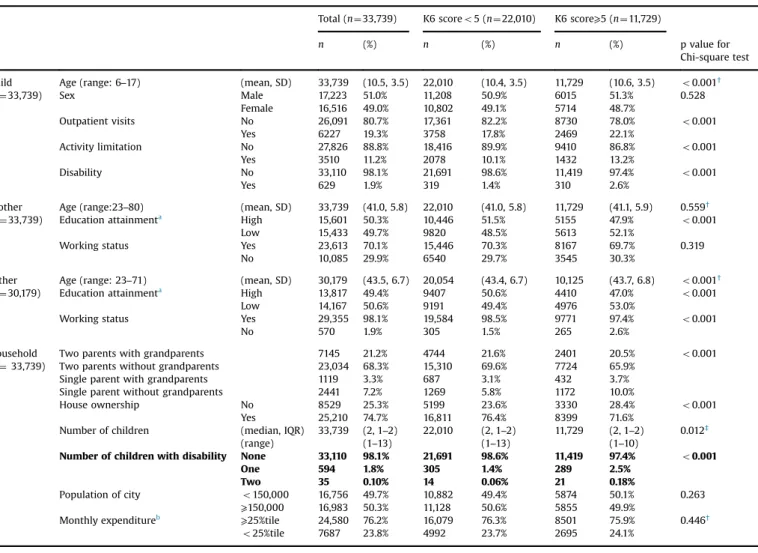
Table 1shows the characteristics of the children, households, mothers, and fathers and their associations with maternal psy- chological distress. One-third of mothers had experienced psy- chological distress during the last month (n¼11,729, 34.7%). Of the 33,739 subjects, 1.8% of mothers (n¼594) had one child with a disability, and 0.10% of mothers (n¼35) had two children with a disability in their household. The majority of mothers were part- nered mothers in two-parent families living without the child's Y. Yamaoka et al. / SSM -Population Health 2 (2016) 542–548
544
grandparent(s) (68.3%). The proportion of single mothers was 10.5%, including co-residence with grandparent(s) (3.3%) and without co-residence (7.2%). The proportion of mothers having a child with a disability was not significantly different among partnered mothers (1.87%) and single mothers (1.93%). However, the proportion of co-residence with grandparent(s) was sig- nificantly lower among families with one or two disabled children (16.2%) compared to families without (24.7%) (po0.001, these results are not presented inTable 1).
Table 2shows the multivariable logistic regression analysis for the psychological distress of mothers. Raising a child with a dis- ability was significantly associated with maternal psychological distress (crude odds ratio (OR) 1.78, 95% confidence interval (95%
CI) 1.51-2.09 for one child with a disability; OR 2.90, 95%CI 1.47- 5.70 for two children with a disability). After controlling for the characteristics of the mother and household, the adjusted OR (AOR) was still significantly associated (AOR 1.72, 95%CI 1.44-2.05 for one child with a disability; AOR 2.85, 95%CI 1.28-6.34 for two children with a disability).
Table 3 shows the stratified analyses among the three sub- groups of mothers. Among partnered mothers living with grand- parent(s), the proportions of having one child or two children with disability were 87 (1.4%) and 3 (0.048%). Raising a child with a disability was not significantly associated with psychological dis- tress (AOR, 95%CI: 1.34, 0.84-2.13). The odds ratio for having two children with a disability could not be obtained due to the small sample size of the explanatory variable. Among partnered mothers living without grandparent(s), 446 mothers had one child (2.2%) and 24 mothers had two children with a disability (0.12%). The AOR remained 1.80, with significance (95%CI: 1.47–2.21), for one child, and 2.84 for two children with a disability (95%CI: 1.14–7.07).
Among single mothers, 61 mothers had one child with a disability (2.0%), and eight mothers had two children with a disability (0.26%). Raising one or two children with a disability was not significantly associated with psychological distress (AOR, 95%CI:
1.42, 0.81–2.47 for one child; 4.43, 0.51–38.7 for two children with a disability).
Table 1
Association between maternal psychological distress (K6 score⩾5) and characteristics of child, mother, father, and household.
Total (n¼33,739) K6 scoreo5 (n¼22,010) K6 score⩾5 (n¼11,729)
n (%) n (%) n (%) p value for
Chi-square test Child Age (range: 6–17) (mean, SD) 33,739 (10.5, 3.5) 22,010 (10.4, 3.5) 11,729 (10.6, 3.5) o0.001†
(n¼33,739) Sex Male 17,223 51.0% 11,208 50.9% 6015 51.3% 0.528
Female 16,516 49.0% 10,802 49.1% 5714 48.7%
Outpatient visits No 26,091 80.7% 17,361 82.2% 8730 78.0% o0.001
Yes 6227 19.3% 3758 17.8% 2469 22.1%
Activity limitation No 27,826 88.8% 18,416 89.9% 9410 86.8% o0.001
Yes 3510 11.2% 2078 10.1% 1432 13.2%
Disability No 33,110 98.1% 21,691 98.6% 11,419 97.4% o0.001
Yes 629 1.9% 319 1.4% 310 2.6%
Mother Age (range:23–80) (mean, SD) 33,739 (41.0, 5.8) 22,010 (41.0, 5.8) 11,729 (41.1, 5.9) 0.559†
(n¼33,739) Education attainmenta High 15,601 50.3% 10,446 51.5% 5155 47.9% o0.001
Low 15,433 49.7% 9820 48.5% 5613 52.1%
Working status Yes 23,613 70.1% 15,446 70.3% 8167 69.7% 0.319
No 10,085 29.9% 6540 29.7% 3545 30.3%
Father Age (range: 23–71) (mean, SD) 30,179 (43.5, 6.7) 20,054 (43.4, 6.7) 10,125 (43.7, 6.8) o0.001†
(n¼30,179) Education attainmenta High 13,817 49.4% 9407 50.6% 4410 47.0% o0.001
Low 14,167 50.6% 9191 49.4% 4976 53.0%
Working status Yes 29,355 98.1% 19,584 98.5% 9771 97.4% o0.001
No 570 1.9% 305 1.5% 265 2.6%
Household Two parents with grandparents 7145 21.2% 4744 21.6% 2401 20.5% o0.001
(n¼33,739) Two parents without grandparents 23,034 68.3% 15,310 69.6% 7724 65.9%
Single parent with grandparents 1119 3.3% 687 3.1% 432 3.7%
Single parent without grandparents 2441 7.2% 1269 5.8% 1172 10.0%
House ownership No 8529 25.3% 5199 23.6% 3330 28.4% o0.001
Yes 25,210 74.7% 16,811 76.4% 8399 71.6%
Number of children (median, IQR) 33,739 (2, 1–2) 22,010 (2, 1–2) 11,729 (2, 1–2) 0.012‡
(range) (1–13) (1–13) (1–10)
Number of children with disability None 33,110 98.1% 21,691 98.6% 11,419 97.4% o0.001
One 594 1.8% 305 1.4% 289 2.5%
Two 35 0.10% 14 0.06% 21 0.18%
Population of city o150,000 16,756 49.7% 10,882 49.4% 5874 50.1% 0.263
⩾150,000 16,983 50.3% 11,128 50.6% 5855 49.9%
Monthly expenditureb ⩾25%tile 24,580 76.2% 16,079 76.3% 8501 75.9% 0.446†
o25%tile 7687 23.8% 4992 23.7% 2695 24.1%
χ^2 test.
t-test.
‡Wilcoxson rank sum test.
aHigh education attainment is for person graduated from university, college, or vocational school. Low educational attainment is for person graduated from junior high school or high school.
bMonthly expenditure was divided by the square root of number of persons in the household.Missing value: Outpatient visit (n¼1421), Activity limitation (n¼2403), Maternal educational attainment (n¼2705), Maternal working status (n¼41), Paternal educational attainment (n¼2195), Paternal working status (n¼254), and Monthly Expenditure (n¼1472).
Y. Yamaoka et al. / SSM -Population Health 2 (2016) 542–548 545