CUSPIDALIZATION OF HYPERBOLIC CURVES
Shinichi Mochizuki June 2008
In this paper, we continue our study of thepro-Σfundamental groups of configuration spacesassociated to a hyperbolic curve, where Σ is either the set of all prime numbers or a set consisting of a single prime number, begun in an earlier paper. Our main result may be regarded either as acombinatorial, partially bijective generalization of an injectivity theoremdue toMatsumotoor as ageneralization to arbitrary hyperbolic curves of injectivity and bijectivity results for genus zero curves due toNakamuraandHarbater-Schneps. More precisely, we show that if one restricts one’s attention to outer automorphisms of such a pro-Σ fundamental group of the configuration space associated to a(n) affine (respectively, proper) hyperbolic curve which are compatible with certain “fiber subgroups” [i.e., groups that arise as ker- nels of the various natural projections of a configuration space to lower-dimensional configuration spaces] as well as with certaincuspidal inertia subgroups, then, as one lowers the dimension of the configuration space under consideration from n+ 1 to n≥1 (respectively,n≥2), there is a natural injectionbetween the resulting groups of such outer automorphisms, which is abijectionifn≥4. The key tool in the proof is acombinatorial version of the Grothendieck Conjectureproven in an earlier paper by the author, which we apply to construct certaincanonical sections.
Contents:
Introduction
§0. Notations and Conventions
§1. Generalities and Injectivity for Tripods
§2. Injectivity for Degenerating Affine Curves
§3. Conditional Surjectivity for Affine Curves
§4. The General Profinite Case
§5. The Discrete Case
2000 Mathematical Subject Classification. Primary 14H30; Secondary 14H10.
Typeset byAMS-TEX
1
Introduction
Topological Motivation:
From a classical topological point of view, one way to understand the starting point of the theory of the present paper is via the Dehn-Nielsen-Baer theorem [cf., e.g., [Ivn], Theorem 2.9.B] to the effect that ifX is atopological surface of type(g, r) [i.e., the complement of r distinct points in a compact oriented topological surface of genusg], then every automorphismαof its [usual topological] fundamental group π1top(X) that stabilizes the conjugacy classes of the inertia groups arising from the r missing points arises from a homeomorphism αX :X → X∼ .
For n ≥ 1, let us write Xn for the complement of the diagonals in the direct product of n copies of X. Then one important consequence of the Dehn-Nielsen- Baer theorem, from the point of view of the present paper [cf., e.g., the proof of Corollary 5.1, (ii)], is that α extends to a compatible automorphism of π1top(Xn).
Indeed, this follows immediately from the fact that αX induces a homeomorphism αn :Xn → X∼ n. Note, moreover, that such an argument is not possible if one only knows that αX is a homotopy equivalence. That is to say, although a homotopy equivalence X → X∼ is, for instance, ifr = 0, necessarily surjective, it is not neces- sarily injective. This possible failure of injectivity means that it is not necessarily the case that such a homotopy equivalenceX → X induces a homotopy equivalence Xn → Xn.
Put another way, one group-theoretic approach to understanding the Dehn- Nielsen-Baer theorem is to think of this theorem as a solution to the existence portion of the following problem:
The Discrete Combinatorial Cuspidalization Problem (DCCP):
Does there exist a natural functorial way to reconstruct πtop1 (Xn) from π1top(X)? Is such a reconstruction unique?
At a more philosophical level, since the key property of interest ofαX is its injectiv- ity — i.e., the fact that itseparates points — one may think of this problem as the problem of “reconstructing the points of X, equipped with their natural topology, group-theoretically from the group π1top(X)”. Formulated in this way, this problem takes on a somewhat anabelian flavor. That is to say, one may think of it as a sort of problem in “discrete combinatorial anabelian geometry”.
Anabelian Motivation:
The author was also motivated in the development of the theory of the present paper by the following naive questionthat often occurs inanabelian geometry. Let X be a hyperbolic curve over a perfect field k; U ⊆X a nonempty open subscheme of X. Write “π1(−)” for the ´etale fundamental group of a scheme.
Naive Anabelian Cuspidalization Problem (NACP): Does there exista natural functorial “group-theoretic” way to reconstructπ1(U) from π1(X)? Is such a reconstructionunique?
For n ≥ 1, write Xn for the n-th configuration space associated to X [i.e., the open subscheme of the product of n copies of X over k obtained by removing the diagonals — cf. [MT], Definition 2.1, (i)]. Thus, one has a natural projection morphismXn+1 →Xn, obtained by “forgetting the factor labeledn+ 1”. One may think of this morphism Xn+1 → Xn as parametrizing a sort of “universal family of curves obtained by removing an effective divisor of degree n from X”. Thus, consideration of the above NACP ultimately leads one to consider the following problem.
Universal Anabelian Cuspidalization Problem (UACP): Does there exist a natural functorial “group-theoretic” way to reconstruct π1(Xn) from π1(X)? Is such a reconstruction unique?
The UACP was solved for proper X over finite fields in [Mzk7], when n = 2, and in [Hsh2], when n≥3. Moreover, when k is a finite extension of Qp [i.e., the field of p-adic numbers for some prime number p], it is shown in [Mzk8], Corollary 1.11, (iii), that the solution of the UACP for n = 3 when X is proper or for n = 2 when X is affine is precisely the obstacle to verifying the “absolute p-adic version of Grothendieck Conjecture” — i.e., roughly speaking, realizing the functorial re- construction ofX fromπ1(X). Here, we recall that for such ap-adick, the absolute Galois group Gk of k admits automorphisms that do not arise from scheme theory [cf. [NSW], the Closing Remark preceding Theorem 12.2.7]. Thus, the expecta- tion inherent in this “absolute p-adic version of Grothendieck Conjecture” is that somehow the property of beingcoupled [i.e., within π1(X)] with the geometric fun- damental group π1(X×kk) [wherek is an algebraic closure of k] has the property of rigidifying Gk. This sort of result is obtained, for instance, in [Mzk7], Corollary 2.3, for X “of Belyi type”. Put another way, if one thinks of the ring structure of k — which, by class field theory, may be thought of as a structure on the various abelianizations of the open subgroups of Gk — as acertain structure on Gk which isnot necessarily preserved by automorphisms of Gk [cf. the theory of [Mzk1]], then this expectation may be regarded as amounting to the idea that
this “ring structure on Gk” is somehow encoded in the “gap” that lies between π1(Xn) and π1(X).
This is precisely the idea that lay behind the development of theory of [Mzk8], §1.
By comparison to the NACP, the UACP is closer to the DCCP discussed above.
In particular, consideration of the UACP in this context ultimately leads one to the following question. Suppose further that Σ is a set of prime numbers which is either of cardinality one or equal to the set of all prime numbers, and that k is an algebraically closed field of characteristic zero. Write “π1Σ(−)” for the maximal pro- Σ quotient of “π1(−)”. Note that [unlike the case for more general k] in this case,
π1Σ(Xn),π1Σ(X) areindependent of the moduli ofX [cf., e.g., [MT], Proposition 2.2, (v)]. Thus, in this context, it is natural to write Πndef= π1Σ(Xn).
Profinite Combinatorial Cuspidalization Problem (PCCP): Does there exist a natural functorial “group-theoretic” way to reconstruct Πn
from Π1? Is such a reconstruction unique?
Here, it is important to note that although the PCCP is entirely independent of k [and hence, in particular, of any Galois group actions], an affirmative answer to PCCP implies an affirmative answer to UACP [and hence to NACP]. That is to say:
Despite the apparently purely combinatorial nature of the PCCP, our discussion above of “ring structures on Gk” suggests that there is quite substantial arithmetic content in the PCCP.
Thisanabelian approach to understanding the arithmetic content of the apparently combinatorial PCCP is interesting in light of the point of view of research on the Grothendieck-Teichm¨uller group [cf., e.g., [HS]] — which is also concerned with issues similar to the PCCP [cf. the OPCCP below] and their relationship to arith- metic, but from a somewhatdifferentpoint of view [cf. the discussion of “Canonical Splittings and Cuspidalization” below for more on this topic].
From a more concrete point of view — motivated by the goal of proving
“Grothendieck Conjecture-style results to the effect that π1(−) is fully faithful”
[cf. Remark 4.1.4] — one way to think of the PCCP is as follows.
Out-version of the PCCP (OPCCP): Does there exist a natural sub- group
Out∗(Πn)⊆Out(Πn)
of the group of outer automorphisms of the profinite group Πn such that there exists a natural homomorphism Out∗(Πn) → Out∗(Πn−1) [hence, by composition, a natural homomorphism Out∗(Πn) →Out∗(Π1)] which is bijective?
From the point of view of the DCCP, one natural approach to defining “Out∗” is to consider the condition of “quasi-speciality” as is done by many authors [cf.
Remarks 4.1.2, 4.2.1], i.e., a condition to the effect that the conjugacy classes of certain inertia subgroupsare preserved. In the theory of the present paper, we take a slightly different, but related approach. That is to say, we consider the condition of “FC-admissibility”, which, at first glance, appearsweaker than the condition of quasi-speciality, but is, in fact, almostequivalentto the condition of quasi-speciality [cf. Proposition 1.3, (vii), for more details]. The apparently weaker nature of FC- admissibility renders FC-admissibilityeasier to verifyand henceeasier to work with in the development of theory. By adopting this condition of FC-admissibility, we are able to show that a certain natural homomorphism Out∗(Πn) → Out∗(Πn−1)
as in the OPCCP is bijective if n≥ 5, injective if n ≥3 when X is arbitrary, and injective if n≥2 whenX is affine [cf. Theorem A below].
Main Result:
Our main result is the following [cf. Corollary 1.10, Theorem 4.1 for more details]. For more on the relation of this result to earlier work ([IK], [NTU], [Ts]) in thepro-l case, we refer to Remark 4.1.2; for more on the relation of this result to earlier work ([Mts], [Naka], [HS]) in the profinite case, we refer to Remarks 4.1.3, 4.2.1.
Theorem A. (Partial Profinite Combinatorial Cuspidalization) Let U →S
be a hyperbolic curve of type (g, r) [cf. §0] over S = Spec(k), where k is an algebraically closed field of characteristic zero. Fix a set of prime numbers Σ which is either of cardinality one or equal to the set of all prime numbers. For integers n≥1, write Un for the n-th configuration space associated to U [i.e., the open subscheme of the product ofn copies of U overk obtained by removing the diagonals — cf. [MT], Definition 2.1, (i)];
Πn def
= π1Σ(Un)
for the maximal pro-Σ quotient of the fundamental group of Un; OutFC(Πn)⊆Out(Πn)
for the subgroup of “FC-admissible” [cf. Definition 1.1, (ii), for a detailed def- inition; Proposition 1.3, (vii), for the relationship to “quasi-speciality”] outer automorphismsα— i.e., αthat satisfy certain conditions concerning thefiber sub- groups of Πn [cf. [MT], Definition 2.3, (iii)] and the cuspidal inertia groups of certain subquotients of these fiber subgroups. If U is affine, then set n0
def= 2; if U is proper over k, then set n0
def= 3. Then:
(i) The natural homomorphism
OutFC(Πn)→OutFC(Πn−1)
induced by the projection obtained by “forgetting the factor labeled n” is injective if n≥n0 and bijective if n≥5.
(ii) By permuting the various factors of Un, one obtains a natural inclusion Sn →Out(Πn)
of the symmetric group on n letters into Out(Πn) whose image commutes with OutFC(Πn) if n≥n0 and normalizes OutFC(Πn) if r= 0 and n= 2.
(iii) Write Πtripod for the maximal pro-Σ quotient of the fundamental group of a tripod [i.e., the projective line minus three points] over k; OutFC(Πn)cusp ⊆ OutFC(Πn) for the subgroup of outer automorphisms which determine outer auto- morphisms of the quotient Πn Π1 [obtained by “forgetting the factors of Un with labels >1”] that induce the identity permutation of the set of conjugacy classes of cuspidal inertia groupsofΠ1. Let n≥ n0; x a cusp of the geometric generic fiber of the morphismUn−1 →Un−2 [which we think of as the projection obtained by
“forgetting the factor labeled n−1”], where we take U0
def= Spec(k). Then x deter- mines, up to Πn-conjugacy, an isomorph ΠEx ⊆Πn of Πtripod. Furthermore, this Πn-conjugacy class is stabilizedby anyα∈OutFC(Πn)cusp; thecommensurator and centralizer of ΠEx in Πn satisfy the relation CΠn(ΠEx) = ZΠn(ΠEx)×ΠEx. In particular, one obtains a natural outer homomorphism
OutFC(Πn)cusp →OutFC(Πtripod) associated to the cusp x.
In §1, we discuss various generalities concerning ´etale fundamental groups of configuration spaces, including Theorem A, (iii) [cf. Corollary 1.10]. Also, we prove a certain special case of theinjectivityof Theorem A, (i), in the case of atripod[i.e., a projective line minus three points] — cf. Corollary 1.12, (ii). In §2, we generalize this injectivity result to the case of degenerating affine curves [cf. Corollary 2.3, (ii)]. In §3, we show that similar techniques allow one to obtain a corresponding surjectivityresult [cf. Corollary 3.3], under certain conditions, for affine curves with two moving cusps. In §4, we combine the results shown in §1, §2, §3 to prove the remaining portion of Theorem A [cf. Theorem 4.1] and discuss how the theory of the present paper is related to earlier work [cf. Corollary 4.2; Remarks 4.1.2, 4.1.3, 4.2.1]. Finally, in §5, we observe that a somewhat stronger analogue of Theorem 4.1 can be shown for the correspondingdiscrete[i.e., usual topological]fundamental groups [cf. Corollary 5.1].
Canonical Splittings and Cuspidalization:
We continue to use the notation of the discussion of the PCCP. In some sense, the fundamental issue involved in the PCCP is the issue of how to bridge the gap betweenΠ2 andΠ1×Π1. Here, we recall that there is a natural surjection Π2 Π1× Π1. If we considerfibersover Π1, then the fundamental issue may be regarded as the issue of bridging the gap between Π2/1 def= Ker(Π2 Π1) [where the surjection is the surjection obtained by projection to thefirst factor; thus, the projection to the secondfactor yields a surjection Π2/1 Π1] and Π1 [i.e., relative to the surjection Π2/1 Π1].
If one thinks of Π2/1 as π1Σ(X\{ξ}) for some closed pointξ ∈X(k), then there isno natural splittingof the surjection Π2/1 Π1. On the other hand, suppose that
X is anaffine hyperbolic curve, and one takes “X\{ξ}” to be thepointed stable log curve Zlog [over, say, a log scheme Slog obtained by equipping S def= Spec(k) with the pro-fs log structure determined by the monoid Q≥0 of nonnegative rational numbers together with the zero map Q≥0 → k — cf. §0] obtained as the “limit”
ξ → x, where x is a cusp of X. Thus, Z consists of two irreducible components, E and F, where F may be identified with the canonical compactification of X [so X ⊆ F is an open subscheme], E is a copy of the projective line joined to F at a single node ν, and the marked points of Z consist of the points = ν of F\X and two points = ν of E. Write UE ⊆ E, (X =) UF ⊆ F for the open subschemes obtained as the complement of the nodes and cusps;Ylog for the pointed stable log curve obtained from Zlog by forgetting the marked point of E ⊆Z determined by the “limit of ξ” [so we obtain a natural mapZlog →Ylog;X may be identified with the complement of the marked points of Y]. Thus, by working with logarithmic fundamental groups[cf. §0], one may identify the surjection “Π2/1 Π1” with the surjection πΣ1(Zlog)π1Σ(Ylog)∼=π1Σ(X). Then thetechnical starting point of the theory of the present paper may be seen in the following observation:
The natural outer homomorphism
Π1 =π1Σ(X)=∼π1Σ(UF)∼=π1Σ(UF ×Z Zlog)→πΣ1(Zlog) = Π2/1 determines a“canonical splitting”of the surjectionπ1Σ(Zlog) = Π2/1 π1Σ(Ylog) ∼=πΣ1(X) = Π1.
Put another way, from the point of view of“semi-graphs of anabelioids”determined by pointed stable curves [cf. the theory of [Mzk6]], this canonical splitting is the splitting determined by the“verticial subgroup”(πΣ1(UF)=) Π∼ F ⊆π1Σ(Zlog) = Π2/1 corresponding to the irreducible component F ⊆ Z. From this point of view, one sees immediately that Π2/1 is generated by ΠF and the verticial subgroup (π1Σ(UE)∼=) ΠE ⊆Π2/1 determined byE. Thus:
The study of automorphisms of Π2/1 that preserve ΠE, ΠF, are com- patible with the projection Π2/1 Π1 [which induces an isomorphism ΠF →∼ Π1], and induce theidentity on Π1 may be reduced to the study of automorphisms of ΠE.
Moreover, by the “combinatorial version of the Grothendieck Conjecture” — i.e.,
“combGC” — of [Mzk6], it follows that onesufficientcondition for the preservation of [the conjugacy classes of] ΠE, ΠF is the compatibility of the automorphisms of Π2/1 under consideration with the outer action of the inertia group that arises from the degeneration “ξ → x”. On the other hand, since this inertia group is none other than the inertia group of the cusp x in Π1, and the automorphisms of Π2/1 under consideration arise from automorphisms of Π2, hence are compatible with the outer action of Π1 on Π2/1 determined by the natural exact sequence 1→Π2/1 →Π2 →Π1 →1, it thus follows that the automorphisms of Π2/1 that we are interested in do indeed preserve [the conjugacy classes of] ΠE, ΠF, hence are relatively easy to analyze. Thus, in a word:
The theory of the present paper may be regarded as an interesting appli- cation of the combGC of [Mzk6].
This state of affairs is notable for a number of reasons — which we shall discuss below — but in particular since at the time of writing, the author is not aware of any other applications of “Grothendieck Conjecture-type” results.
ν
X canonical splitting ξ
x
E F
In light of the central importance of the “canonical splitting determined by the combGC” in the theory of the present paper, it is interesting to compare the approach of the present paper with the approaches of other authors. To this end, let us first observe that since the canonical splitting was originally constructed via scheme theory, it stands to reason that if, instead of working with “arbitrary automorphisms” as in the OPCCP, one restricts one’s attention to automorphisms that arise from scheme theory, then one does not need to apply the combGC. This, in effect, is the situation of [Mts]. That is to say:
The “canonical splitting determined by the combGC” takes the place of — i.e., may be thought of as a sort of “combinatorial substi- tute” for — the property of “arising from scheme theory”.
Here, it is important to note that it is precisely in situations motivated by problems in anabelian geometry that one must contend with “arbitrary automorphisms that do not necessarily arise from scheme theory”. As was discussed above, it was this
sort of situation — i.e., the issue of studying the extent to which thering structureof the base field is somehowgroup-theoretically encoded in the “gap”that lies between Πnand Π1 — that motivated the author to develop the theory of the present paper.
Next, we observe that the “canonical splitting determined by the combGC” is not necessary in the theory of [HS], precisely because the automorphisms studied in [HS] are assumed to satisfy a certain symmetry condition [cf. Remark 4.2.1, (iii)]. This symmetry condition is sufficiently strong to eliminate the need for reconstructing the canonical splitting via the combGC. Here, it is interesting to note that this symmetry condition that occurs in the theory of the Grothendieck- Teichm¨uller group is motivated by the goal of “approximating the absolute Galois group GQ of Q via group theory”. On the other hand, in situations motivated by anabelian geometry — for instance, involving hyperbolic curves of arbitrary genus
— such symmetry properties are typically unavailable. That is to say, although both the point of view of the theory of theGrothendieck-Teichm¨uller group, on the one hand, and the absolute anabelian point of view of the present paper, on the other, have the common goal of“unraveling deep arithmetic properties of arithmetic fields [such as Q, Qp] via their absolute Galois groups”, these two points of view may be regarded as going in opposite directions in the sense that:
Whereas the former point of view starts with the rational number field Q “as a given” and has as its goal the explicit construction and doc- umentation of group-theoretic conditions [on Out(Π1), when (g, r) = (0,3)] that approximate GQ, the latter point of view starts with the ring structure of Qp “as an unknown” and has as its goal the study of the extent to which the“ring structure onGQp may be recovered from an arbi- trary group-theoretic situation which is not subject to any restricting conditions”.
Finally, we conclude by observing that, in fact, the idea of“applying anabelian results to construct canonical splittings that are of use in solving various cuspidal- ization problems” — i.e.,
Grothendieck
Conjecture-type result canonical
splitting application to cuspidalization
— is not so surprising, in light of the following earlier developments [all of which relate to thefirst “”; the second and third [i.e., (A2), (A3)] of which relate to the second“”]:
(A1) Outer Actions on Center-free Groups: If 1→H →E → J → 1 is an exact sequence of groups, andHiscenter-free, thenEmay be recovered
from the induced outer action ofJ on H as “H out J” — i.e., as the pull- back via the resulting homomorphism J → Out(H) of the natural exact sequence 1 → H → Aut(H) → Out(H) → 1 [cf. §0]. That is to say, the center-freeness of H — which may be thought of as the most primitive example, i.e., as a sort of “degenerate version”, of the property of being
“anabelian”— gives rise to a sort of“anabelian semi-simplicity”in the form of the isomorphism E →∼ H out J. This “anabelian semi-simplicity”
contrasts sharply with the situation that occurs whenH fails to be center- free, in which case there are many possible isomorphism classes for the extensionE. Perhaps the simplest example of this phenomenon — namely, the extensions
1→p·Z →Z→Z/pZ→1 and 1→p·Z→(p·Z)×(Z/pZ)→Z/pZ→1
[where p is a prime number] — suggests strongly that this phenomenon of “anabelian semi-simplicity” hassubstantial arithmetic content [cf., e.g., the discussion of [Mzk5], Remark 1.5.1] — i.e., it is as if, by working with center-free groups [such as free or pro-Σ free groups], one is afforded with
“canonical splittings of the analogue of the extension 1 → p·Z → Z → Z/pZ→1”!
(A2) Elliptic and Belyi cuspidalizations [cf. [Mzk8], §3]: In this theory one constructs cuspidalizations of a hyperbolic curve X by interpreting either a“multiplication byn”endomorphism of an elliptic curve or aBelyi map to a projective line minus three points as, roughly speaking, anopen immersion Y →X of a finite ´etale covering Y →X of X. This diagram X ← Y → X may be thought of as a sort of “canonical section”;
moreover, this canonical section is constructed group-theoretically in loc.
cit. precisely by applying the main [anabelian] result of [Mzk2].
(A3) Cuspidalization over Finite Fields: Anabelian results such as the main result of [Mzk2] have often been referred to as “versions of the Tate Conjecture [concerning abelian varieties] for hyperbolic curves”. Over fi- nite fields, the “Tate Conjecture” is closely related to the “Riemann hy- pothesis” for abelian varieties over finite fields, which is, in turn, closely related to varioussemi-simplicityproperties of the Tate module [cf. the theory of [Mumf]]. Moreover, such semi-simplicity properties arising from the “Riemann hypothesis” for abelian varieties play a key role — i.e., in the form of canonical splittings via weights — in the construction of cuspidalizations over finite fieldsin [Mzk7], [Hsh2].
(A4) The Mono-anabelian Theory of [Mzk9]: If one thinks of “canonical splittings” as “canonical liftings”, then the idea of “applying anabelian geometry to construct canonical liftings” permeates the theory of [Mzk9]
[cf., especially, the discussion of the Introduction to [Mzk9]].
Acknowledgements:
The material presented in this paper was stimulated by the work of Makoto Matsumoto [i.e., [Mts]], as well as the work of Marco Boggi on the congruence subgroup problem for hyperbolic curves. Also, I would like to thank Akio Tama- gawa for helpful discussions concerning the material presented in this paper and for informing me of the references discussed in Remarks 4.1.2, 4.2.1.
Section 0: Notations and Conventions
Topological Groups:
If G is a center-freetopological group, then we have a natural exact sequence 1→G→Aut(G)→Out(G)→1
— where Aut(G) denotes the group of automorphisms of the topological group G;
the injective [since G is center-free!] homomorphism G → Aut(G) is obtained by letting G act on G by inner automorphisms; Out(G) is defined so as to render the sequence exact. If J →Out(G) is a homomorphism of groups, then we shall write
G out J def= Aut(G)×Out(G)J
for the “outer semi-direct product of J with G”. Thus, we have a natural exact sequence: 1→G→G out J →J →1.
If H ⊆ G is a closed subgroup of a topological group G, then we shall use the notation ZG(H), NG(H), CG(H) to denote, respectively, the centralizer, the normalizer, and commensurator of H in G [cf., e.g., [Mzk6], §0]. If H = NG(H) (respectively, H =CG(H)), then we shall say that H isnormally terminal (respec- tively, commensurably terminal) in G.
Log Schemes:
When a scheme appears in a diagram of log schemes, the scheme is to be understood as a log scheme equipped with thetrivial log structure. If Xlog is a log scheme, then we shall denote its interior — i.e., the largest open subscheme over which the log structure is trivial — by UX. Fiber products of (pro-)fs log schemes are to be understood as fiber products taken in the category of (pro-)fs log schemes.
The ´Etale Fundamental Group of a Log Scheme:
Throughout the present paper, we shall often consider the ´etale fundamental groupof a connected fs noetherian log scheme [cf. [Ill]; [Hsh1], Appendix B], which
we shall denote “π1(−)”; we shall denote the maximal pro-Σ quotient of “π1(−)”
by “π1Σ(−)”. The theory of the “π1(−)” of a connected fs noetherian log scheme extends immediately to pro-fs noetherian log schemes; thus, we shall apply this routine extension in the present paper without further mention.
Recall that if Xlog is a log regular, connected log scheme of characteristic zero [i.e., there exists a morphism X → Spec(Q)], then the log purity theorem of Fujiwara-Kato asserts that there is a natural isomorphism
π1(Xlog) →∼ π1(UX) [cf., e.g., [Ill]; [Mzk3], Theorem B].
Let S◦log be a log regular log scheme such that S◦ = Spec(R◦), where R◦ is a complete noetherian local ring of characteristic zero with algebraically closed residue field k◦. Write K◦ for the quotient field of R◦. Let K be a maximal algebraic extension of K◦ among those algebraic extensions that are unramified over R◦. Write R ⊆ K for the integral closure of R◦ in K; S def= Spec(R). Then by considering the integral closure of R◦ in the various finite extensions of K◦ in K, one obtains a log structure on S such that the resulting log scheme Slog may be thought of as a pro-fs log scheme corresponding to a projective system of log regular log schemes in which the transition morphisms are [by the log purity theorem] finite Kummer log ´etale. Write k for the residue field of R [so k ∼= k◦];
s◦log def= Spec(k◦)×S◦S◦log; slog def= Spec(k)×SSlog. Next, let
X◦log →S◦log be a proper,log smooth morphism; write
Xlog def= X◦log×Slog
◦ Slog →Slog X◦logs def
= X◦log×Slog
◦ slog◦ →slog◦ ; Xslog def= X◦log×Slog
◦ slog →slog
for the result of base-changing via the morphisms Slog → S◦log, slog◦ → S◦log, slog → S◦log. Then by [Vid], Th´eor`eme 2.2, (a) [in the case where S◦ is a trait];
[Hsh1], Corollary 1 [for the general case], we have a natural“specialization isomor- phism” π1(X◦logs ) →∼ π1(X◦log). We shall also refer to the composite isomorphism π1(X◦logs ) →∼ π1(X◦log) →∼ π1(UX◦) [where the second isomorphism arises from the log purity theorem] as the“specialization isomorphism”. By applying these special- ization isomorphisms to the result of base-changing X◦log →S◦log to the various log regular log schemes that appear in the projective system [discussed above] associ- ated to the pro-fs log scheme Slog, we thus obtain“specialization isomorphisms”
π1(Xslog) →∼ π1(Xlog) →∼ π1(UX)
for Xlog → Slog. Here, we note that if K is any algebraic closure of K, and the restriction of X◦log → S◦log to US◦ is a log configuration space associated to some
family of hyperbolic curves over US◦ [cf. [MT], Definition 2.1, (i)], then we have a natural isomorphism
π1(UX) →∼ π1(UX ×K K)
[cf. [MT], Proposition 2.2, (iii)]. We shall also refer to the composite isomorphism π1(Xslog) →∼ π1(UX ×K K) as the “specialization isomorphism”.
Curves:
We shall use the termshyperbolic curve, cusp, stable log curve, andsmooth log curve as they are defined in [Mzk6], §0. Thus, the interior of a smooth log curve over a scheme determines a family of hyperbolic curves over the scheme. A smooth log curve or family of hyperbolic curves of type (0,3) will be referred to as a tripod.
We shall use the terms n-th configuration space and n-th log configuration space as they are defined in [MT], Definition 2.1, (i). If g, r are positive integers such that 2g−2 +r >0, then we shall write Mlogg,r for the moduli stack Mg,r of pointed stable curves of type (g, r) over [the ring of rational integers] Z equipped with the log structure determined by the divisor at infinity. Here, we assume the marking sections of the pointed stable curves to be ordered. The interior of Mlogg,r will be denoted Mg,r.
Section 1: Generalities and Injectivity for Tripods
In the present §1, we begin by discussing various generalities concerning the various log configuration spaces associated to a hyperbolic curve. This discussion leads naturally to a proof of a certain special case [cf. Corollary 1.12, (ii)] of our main result [cf. Theorem 4.1 below] for tripods [cf. §0].
LetS def= Spec(k), where k is an algebraically closed field of characteristic zero, and
Xlog →S
a smooth log curve of type (g, r) [cf. §0]. Fix a set of prime numbers Σ which is either of cardinality one or equal to the set of all prime numbers.
Definition 1.1. Let n≥1 be an integer.
(i) Write Xnlog for the n-th log configuration space associated to [the family of hyperbolic curves determined by] Xlog [cf. §0]; X0log def= S. We shall think of the factors of Xnlog as labeled by the indices 1, . . . , n. Write
Xnlog →Xnlog−1 →. . .→Xmlog →. . .→X2log →X1log
for the projections obtained by forgetting, successively, the factors labeled by indices
> m [as mranges over the positive integers ≤n]. Write Πndef= π1Σ(Xnlog)
for themaximal pro-Σ quotient of the fundamental groupof the log schemeXnlog [cf.
§0; the discussion preceding [MT], Definition 2.1, (i)]. Thus, we obtain a sequence of surjections
Πn Πn−1 . . .Πm. . .Π2 Π1
— which we shall refer to as standard. If we write Km def
= Ker(Πn Πm), Π0 def= {1}, then we obtain a filtration of subgroups
{1}=Kn ⊆Kn−1 ⊆. . .⊆Km⊆. . .⊆K2 ⊆K1 ⊆K0 = Πn
— which we shall refer to as the standard fiber filtration on Πn. Also, for nonneg- ative integers a ≤b≤n, we shall write
Πb/a def= Ka/Kb
— so we obtain a natural injection Πb/a →Πn/Kb ∼= Πb. Thus, if m is a positive integer ≤ n, then we shall refer to Πm/m−1 as a standard-adjacent subquotient of Πn. The standard-adjacent subquotient Πm/m−1 may be naturally identified with the maximal pro-Σ quotient of the ´etale fundamental group of the geometric generic fiber of the morphism on interiorsUXm →UXm−1. Since this geometric generic fiber is a hyperbolic curve of type (g, r+m−1), it makes sense to speak of the cuspidal inertia groups — each of which is [noncanonically!] isomorphic to the maximal pro-Σ quotient ZΣ of Z — of a standard-adjacent subquotient.
(ii) Let
α : Πn →∼ Πn
be anautomorphismof the topological group Πn. Let us say thatα is C-admissible [i.e., “cusp-admissible”] if α(Ka) = Ka for every subgroup appearing in the stan- dard fiber filtration, and, moreover,αinduces abijectionof the collection ofcuspidal inertia groupscontained in each standard-adjacent subquotient of the standard fiber filtration. Let us say that α is F-admissible [i.e., “fiber-admissible”] if α(H) = H for every fiber subgroup H ⊆ Πn [cf. [MT], Definition 2.3, (iii), as well as Remark 1.1.2 below]. Let us say thatα isFC-admissible[i.e., “fiber-cusp-admissible”] ifα is F-admissible and C-admissible. Ifα : Πn →∼ Πn is an FC-admissible automorphism, then let us say thatα is a DFC-admissible[i.e., “diagonal-fiber-cusp-admissible”] if α induces the sameautomorphism of Π1 relative to the various quotients Πn Π1 by fiber subgroups of co-length 1 [cf. [MT], Definition 2.3, (iii)]. If α : Πn →∼ Πn
is a DFC-admissible automorphism, then let us say that α is an IFC-admissible automorphism [i.e., “identity-fiber-cusp-admissible”] if α induces the identity au- tomorphism of Π1 relative to the various quotients Πn Π1 by fiber subgroups of co-length 1. Write Aut(Πn) for the group of automorphisms of the topological group Πn;
AutIFC(Πn)⊆AutDFC(Πn)⊆AutFC(Πn)⊆AutF(Πn)⊆Aut(Πn)⊇Inn(Πn)
for the subgroups of F-admissible, FC-admissible, DFC-admissible, IFC-admissible, and inner automorphisms;
OutFC(Πn)def= AutFC(Πn)/Inn(Πn)⊆OutF(Πn)def= AutF(Πn)/Inn(Πn)⊆Out(Πn) for the corresponding outer automorphisms. Thus, we obtain a natural exact se- quence
1→AutIFC(Πn)→AutDFC(Πn)→Aut(Π1) induced by the standard surjection Πn Π1 of (i).
(iii) Write
Ξn ⊆Πn
for theintersectionof the variousfiber subgroups of co-length1. Thus, we we obtain a natural inclusion
Ξn →AutIFC(Π2)
induced by the inclusion Ξn ⊆Πn →∼ Inn(Πn)⊆Aut(Πn) [cf. Remark 1.1.1 below].
(iv) By permuting the various factors ofXnlog, one obtains a natural inclusion Sn →Out(Πn)
of the symmetric group on n letters into Out(Πn). We shall refer to the elements of the image of this inclusion as the permutation outer automorphismsof Πn, and to elements of Aut(Πn) that lift permutation outer automorphisms aspermutation automorphisms of Πn. Write
OutFCP(Πn)⊆OutFC(Πn)
for the subgroup of outer automorphisms thatcommutewith the permutation outer automorphisms.
(v) We shall append the superscript “cusp” to the various groups of FC- admissible [outer] automorphisms discussed in (ii), (iv) to denote the subgroup of FC-admissible [outer] automorphisms that determine an [outer] automorphism of Π1 that induces theidentity permutation of the set of conjugacy classes of cuspidal inertia groups of Π1.
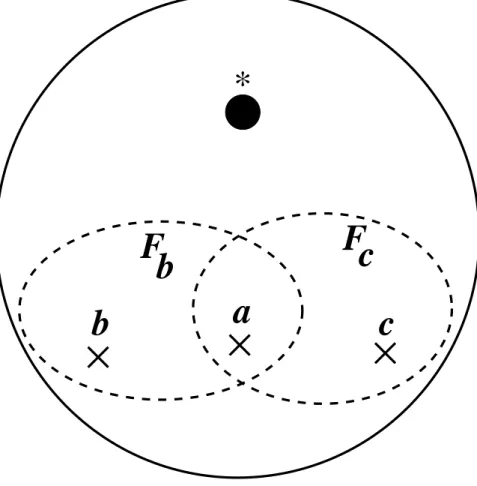
(vi) When (g, r) = (0,3), we shall write Πtripod def= Π1, Πtripodn def= Πn. Suppose that (g, r) = (0,3), and that the cusps of Xlog are labeled a, b, c. Here, we regard the symbols{a, b, c,1,2, . . . , n}as equipped with the orderinga < b < c <1<2<
. . . < n. Then, as is well-known, there is anatural isomorphism over k Xnlog →∼ (Mlog0,n+3)k
— where we write (Mlog0,n+3)k for the moduli scheme overk ofpointed stable curves of type (0, n+ 3), equipped with its natural log structure [cf. §0]. [Here, we assume
the marking sections of the pointed stable curves to beordered.] In particular, there is natural action of the symmetric group on n+ 3 letters on (Mlog0,n+3)k, hence also on Xnlog. We shall denote this symmetric group — regarded as a group acting on Xnlog — bySMn+3. In particular, we obtain a natural homomorphism
SMn+3 →Out(Πtripodn )
the elements of whose image we shall refer to asouter modular symmetries. [Thus, the permutation outer automorphisms are the outer modular symmetries that oc- cur as elements of the image of the inclusion Sn→SMn+3 obtained by considering permutations of the subset {1, . . . , n} ⊆ {a, b, c,1, . . . , n}.] We shall refer to ele- ments of Aut(Πtripodn ) that lift outer modular symmetries as modular symmetries of Πtripodn . Write
OutFCS(Πtripodn )⊆OutFC(Πtripodn )
for the subgroup of elements that commute with the outer modular symmetries;
OutFC(Πtripodn )S⊆OutFC(Πtripodn )
for the inverse image of the subgroup OutFCS(Πtripod1 )⊆OutFC(Πtripod1 ) via the ho- momorphism OutFC(Πtripodn )→OutFC(Πtripod1 ) induced by the standard surjection Πtripodn Πtripod1 of (i). Thus, we have inclusions
OutFCS(Πtripodn )⊆OutFC(Πntripod)S ⊆OutFC(Πtripodn )cusp
and an equality OutFCS(Πtripod1 ) = OutFC(Πtripod1 )S. Here, the second displayed inclusion follows by considering the induced permutations of the conjugacy classes of the cuspidal inertia groups of Πtripod1 , in light of the fact that S3 is center-free.
Remark 1.1.1. We recall in passing that, in the notation of Definition 1.1, Πn is slim [cf. [MT], Proposition 2.2, (ii)]. In particular, we have a natural isomorphism Πn →∼ Inn(Πn).
Remark 1.1.2. We recall in passing that, in the notation of Definition 1.1, when (g, r) ∈ {(0,3); (1,1)}, it holds that for any α ∈ Aut(Πn) and any fiber subgroup H ⊆Πn,α(H) is a fiber subgroup of Πn [though it is not necessarily the case that α(H) =H!]. Indeed, this follows from [MT], Corollary 6.3.
Remark 1.1.3. If α ∈Aut(Πn) satisfies the condition that α(Ka) =Ka for a = 1, . . . , n, then often — e.g., in situations where there is a “sufficiently nontrivial”
Galois actioninvolved — it is possible to verify theC-admissibilityofα by applying [Mzk6], Corollary 2.7, (i), which allows one to conclude“group-theoretic cuspidality”
from “l-cyclotomic full-ness”.
Remark 1.1.4. In the context of Definition 1.1, (vi), we observe that if, for instance, n = 2, then one verifies immediately that the outer modular symmetry
determined by the permutationσ def= (a b)(c 1) yields an example of a C-admissible element of Out(Πtripod2 ) [since conjugation by σ preserves the set of transpositions {(a2),(b2),(c2),(1 2)}] which is not F-admissible[since conjugation byσ switches the transpositions (c 2), (1 2) — cf. Remark 1.1.5 below]. On the other hand, whereasevery element of Out(Πtripod1 ) is F-admissible, it is easy to construct [since Πtripod1 is afree pro-Σ group] examples of elements of Out(Πtripod1 ) which are not C- admissible. Thus, in general, neither of the two properties of C- and F-admissibility implies the other.
Remark 1.1.5. Letα ∈OutFC(Πn)cusp. Then observe thatα necessarily induces theidentity permutationon the set ofconjugacy classes of cuspidal inertia groupsof every standard-adjacent subquotient of Πn [i.e., not just Π1]. Indeed, by applying theinterpretationof the various Πb/a as “Πb−a’s” for appropriate “Xlog” [cf. [MT], Proposition 2.4, (i)], we reduce immediately to the case n = 2. But then the cuspidal inertia group ⊆Π2/1 associated to theunique new cusp that appears may be characterized by the property that it is contained in Ξ2 [which, in light of the F-admissibility of α, is clearly preserved by α].
Proposition 1.2. (First Properties of Admissibility) In the notation of Definition 1.1, (ii), let α ∈Aut(Πn). Then:
(i) Suppose that α(Ξn) = Ξn. Then there exists a permutation automor- phism σ ∈ Aut(Πn) such that α ◦ σ is F-admissible. In particular, if α is C-admissible, then it follows that α is FC-admissible.
(ii) Suppose that α ∈ AutFC(Πn). Let ρ : Πn Πm be the quotient of Πn by a fiber subgroup of co-length m ≤ n [cf. [MT], Definition 2.3, (iii)].
Then α induces, relative to ρ, an element αρ ∈ AutFC(Πm). If, moreover, α ∈ AutDFC(Πn) (respectively, α∈AutIFC(Πn)), then αρ ∈AutDFC(Πm) (respectively, αρ ∈AutIFC(Πm)).
(iii) Suppose that α ∈ AutFC(Πn). Then there exist β ∈ AutDFC(Πn), ι ∈ Inn(Πn) such that α =β◦ι.
Proof. First, we consider assertion (i). Sinceα(Ξn) = Ξn, it follows thatα induces an automorphism of the quotient Πn Π1×. . .×Π1 [i.e., onto the direct product of ncopies of Π1] determined by the various fiber subgroups of co-length 1. Moreover, by [MT], Corollary 3.4, this automorphism of Π1×. . .×Π1 is necessarilycompatible with the direct product decomposition of this group, up to some permutation of the factors. Thus, by replacing α by α◦σ for some permutation automorphism σ, we may assume that the induced automorphism of Π1×. . .×Π1 stabilizes each of the direct factors. Now let us observe that this stabilization of the direct factors is sufficient to imply that α(H) = H for any fiber subgroup H ⊆ Πn. Indeed, without loss of generality, we may assume [by possibly re-ordering the indices] that H = Ka for some Ka as in Definition 1.1, (i). By applying the same argument to α−1, it suffices to verify that α(Ka)⊆Ka. Thus, let us suppose thatα(Ka)⊆Kb