Introduction
In 2007, all the students who chose to study English in the commerce department of Chiba University of Commerce (hereafter CUC) as their foreign language were divided into six levels according to their English proficiency. In our last research (Ohno et al. 2008), 357 students were examined. The research was focused on their awareness of autonomous learning toward English language learning. The authors investigated the subjects from the best performing classes and the worst performing classes of three faculties : commerce, economics, and management. Based upon the past literature, three hypotheses were created : 1) If a student has high self-efficacy, he or she is an autonomous learner. 2) If a student has high self-efficacy, he or she is a good performer in school subjects. 3) If a student is a good performer in school subjects, he or she is not teacher dependent. After analyzing the data they obtained, they stated that the results verify Hypotheses One and Two, but does not verify Hypothesis Three. The subjects were requested to answer the questionnaire and we obtained the results. The obtained data was analyzed carefully. As for Hypothesis Three, the result tells very interesting phenomenon about English education in CUC.
A college student is expected to be learner autonomous and not teacher dependent when he or she enters a university. Of course, we admit many students in CUC who are not autonomous learners when they enter CUC. However, after getting an education in the college, some high performers are still teacher dependent.
This means that English education in CUC may not always help good learners be autonomous learners but only have them do just as teachers say.
A year has passed since the research was conducted. Last time as for the scales, learner autonomy and self-efficacy were the focus. Recently, an interesting paper was published. Sakai and Takagi (2009) investigated 721 students' awareness toward English language learning from sixteen universities in Japan using a set of questionnaires and a vocabulary test. They claimed that it is meta-cognitive strategy use that separates better performing students from poorly performing ones. They describe the characters of the three levels : good performers, intermediate group stu- dents, poorly performing students. The best performers are described as; They
A Study on the Relation between Learners' Self-efficacy in English Learning and Improvement of their English Proficiency
SAKAI, Shien
NAKAMURA, Akira
SAGARA, Yoichiro
accepted their teachers' dominant teaching style, but realized the importance of setting their study goal. Their ability is good enough to use some meta-cognitive strategies and they have a wish to challenge authentic English." The characteristic of the intermediate group is interpreted as follows; They are poor at setting their individual study goal, checking their progress, and reflecting the result. They like to study through communication, but they prefer to study English by listening to radio and or watching TV English language learning programs rather than challenging authentic English." That of the poor performers is explained as follows : They want to be more involved in class management than the others but considering their English proficiency, it is doubtful that they can control their study such as setting their own study goal and reflecting on the results. In reality, they need much support of various fields from teachers. Their meta-cognitive abilities should be trained more." This research has a limit in that the scale was focused on only learner autonomy. Therefore, in the present research, the authors decided to use questionnaire items from psychological scales more.
Literature Review
Firstly, Self-efficacy" is put into the questionnaire because using the questionnaire items from Pintrich et al. (1990), Mori (2004) states that sense of self-efficacy influences English language learning. Therefore, some of the questionnaire items from Pintrich et al. (ibid.) were decided to be put into the questionnaire in the present study. The breakdown is as follows : eight items of Self-efficacy" and fourteen items of Cognitive strategy use." In addition, considering that awareness of grasping control of one's own study leads to his or her activeness or passiveness toward English language learning, eight questionnaire items about control of one's own study are put into the set of the questionnaire. They are drawn from Sakai et al.
(2008), who did research about learner autonomy among East Asian students.
All the questionnaire items except some items Mori used are written in English.
Then the authors put them into Japanese. However, some of the questionnaire items appeared to be no problem with good performers but not to be good enough for developmental education students. The authors discussed the questions and adapted some of the items to the developmental education in Japan and made a set of questionnaires (See appendix 1).
It seems to be impossible that both good performers and bad ones share the same awareness toward English language learning. The subjects should be divided according to their English proficiencies. Concerning measuring students' English proficiency, a test for measuring vocabulary size (henceforth referred to as a vocabulary test) was chosen because of limitations in budget and possible variances in marking. Some vocabulary tests can be used free of charge, however, standardized tests, such as TOEFL and TOEIC, will charge schools around fifty U.S. dollars per student. As for
reliability, some kinds of vocabulary tests adopt a multiple-choice method, which means the reliability of marking these tests should be high. Tohno et al. (1995, p. 14) claims, There is no objection to using a person's vocabulary size as a scale for measuring his or her English proficiency." Schmitt et al. (2001, p. 55) explains, their Vocabulary Levels Test is designed to give an estimate of vocabulary size for second language (L2) learners of general or academic English." The rationale for this stems from research, which has shown that vocabulary size is directly related to a person's ability to use English in various settings. Schmitt et al. (2001, p. 60) reports, To provide this evidence, vocabulary tests are often correlated with proficiency tests, particularly the TOEFL." Therefore the authors in this study decided to use the new Vocabulary Levels Test by Schmitt et al. (2001).
The students' English proficiency was examined by the Mochizuki Test developed by Mochizuki (1998). It is a very popular test to see students' English proficiency. The test adopts a receptive matching format. It presents two words and six definitions of words at a time. The students are directed to read the definitions and choose the right words, the most frequent 2,000 words, the most frequent 3,000 words, and the most frequent 4,000 words. Each section has thirty words. The highest possible score is 90.
The present study, therefore, investigates the relationship between learner autonomy and English language proficiency of Japanese students from one university.
Specifically, the following one objective was addressed : How does the level of autonomy influence the relationship between English proficiency, cognitive strategy use, and self-efficacy ?
METHOD Participants
The participants were 454 freshman aged between 18 and 20 years (363 male and 89 female), whose majors are commerce, economics, or management at CUC, which is a private university.
Measures
The set of questionnaires was composed of seven scales. However, in this present study the authors only used three scales : self-efficacy, cognitive strategy use, and learner autonomy. Question items of self-efficacy and cognitive strategy use were from Motivation Strategies for Learning Questionnaire [MSLQ] which was originally made by Pintrich and De Groot (1990) and Mori (2004) translated it into Japanese.
We used some items out of Mori's translation. As for learner autonomy, we used some of the revised version of Sakai et al.(2008). English proficiency was measured by the Mochizuki Test, which is frequently used in Japan to measure students' vocabulary size.
RESULTS
Analysis of each scale
The scale of cognitive strategy use seemed to contain some psychological domains.
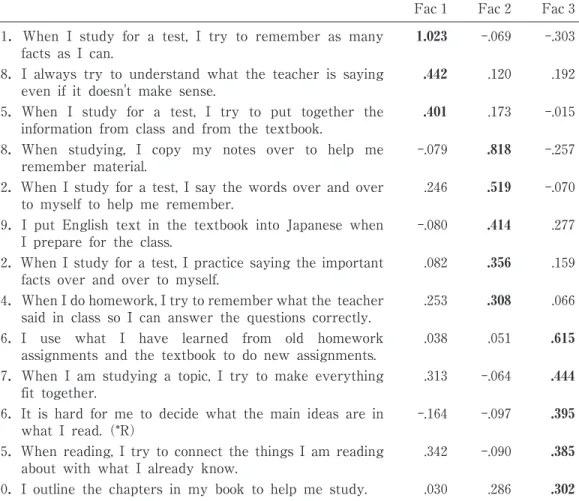
Therefore, in order to analyze the construction of this scale, factor analysis with the promax rotation was applied. Three factors were extracted with reference to scree plot in addition to Kaisere's criteria (eigenvalue > 1 ). The loading of Q44 for all the factors was less than 0.3, so another factor analysis was performed after eliminating Q44.
The three items loading on Factor 1 seem to involve the usage of the knowledge the students already had, hence this factor was labeled application of the knowledge".
Factor 2 consisted of five items which reflected repeated practice, and this factor was named rehearsal". Factor 3 revealed an underlying theme of meta-cognitive strategies, so this factor was labeled meta-cognitive strategy."
Table 1. Factor Loadings for each item on the scale of cognitive strategy use.
Fac 1 Fac 2 Fac 3 41. When I study for a test, I try to remember as many
facts as I can.
1.023 ‑.069 ‑.303 38. I always try to understand what the teacher is saying
even if it doesn't make sense.
.442 .120 .192
05. When I study for a test, I try to put together the information from class and from the textbook.
.401 .173 ‑.015 28. When studying, I copy my notes over to help me
remember material.
‑.079 .818 ‑.257 62. When I study for a test, I say the words over and over
to myself to help me remember.
.246 .519 ‑.070 29. I put English text in the textbook into Japanese when
I prepare for the class.
‑.080 .414 .277
52. When I study for a test, I practice saying the important facts over and over to myself.
.082 .356 .159
14. When I do homework, I try to remember what the teacher said in class so I can answer the questions correctly.
.253 .308 .066
56. I use what I have learned from old homework assignments and the textbook to do new assignments.
.038 .051 .615
57. When I am studying a topic, I try to make everything fit together.
.313 ‑.064 .444 26. It is hard for me to decide what the main ideas are in
what I read. (*R)
‑.164 ‑.097 .395 45. When reading, I try to connect the things I am reading
about with what I already know.
.342 ‑.090 .385 20. I outline the chapters in my book to help me study. .030 .286 .302 (*R) means a reverse item
Subscale scores were computed for each of the three factors by summing the items in the scale. Internal consistencies of each scale were assessed by Cronbach's coefficient alpha. The obtained coefficients were satisfactory, so the reliabilities of these scales were confirmed. Table 2 shows the mean, standard deviation, and Cronbach's alpha of each scale and subscale.
Relationship between self-efficacy, cognitive strategy use, learner autonomy, and scores on English vocabulary test
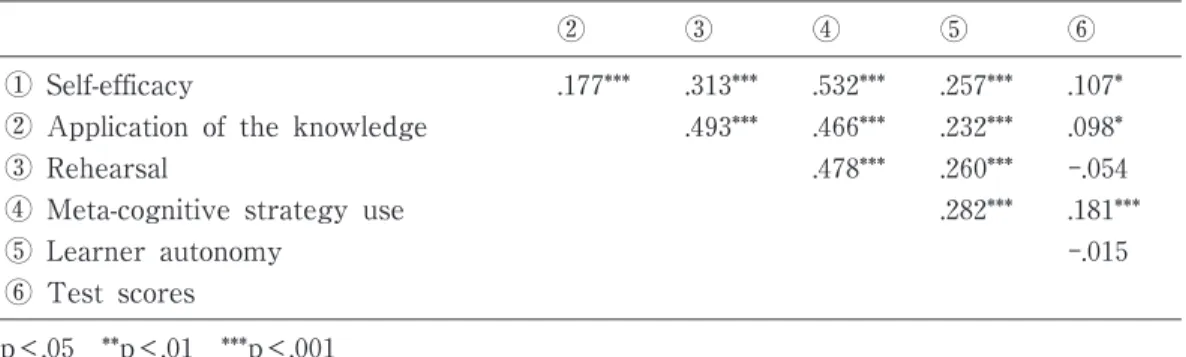
Table 3 shows the correlation among self-efficacy, cognitive strategy use, learner autonomy, and the test scores. Self-efficacy correlated positively with cognitive strategy use and learner autonomy. On the other hand, the correlation between the test scores and other scales were weak ( r(454)= ‑.054 〜 .181). These results indicated that use of cognitive strategy use was related with high self-efficacy, but was not with test performance.
Table 2. Mean, Standard deviation, Cronbach's coefficient alpha of each scale
Mean SD Alpha
Cognitive strategy use 45.90 8.42 .82
Application of the knowledge 15.62 3.98 .64
Rehearsal 11.10 2.42 .68
Meta-cognitive strategy use 15.77 3.29 .61
Self-efficacy 22.08 6.22 .86
Learner autonomy 25.37 5.64 .83
Score on English vocabulary test 41.87 15.74
Table 3. Correlation among self-efficacy, cognitive strategy use, learner autonomy, and the test scores
② ③ ④ ⑤ ⑥
① Self-efficacy .177*** .313*** .532*** .257*** .107*
② Application of the knowledge .493*** .466*** .232*** .098*
③ Rehearsal .478*** .260*** ‑.054
④ Meta-cognitive strategy use .282*** .181***
⑤ Learner autonomy ‑.015
⑥ Test scores
*p < .05 **p < .01 ***p < .001
Comparison between High autonomy group and Low autonomy group
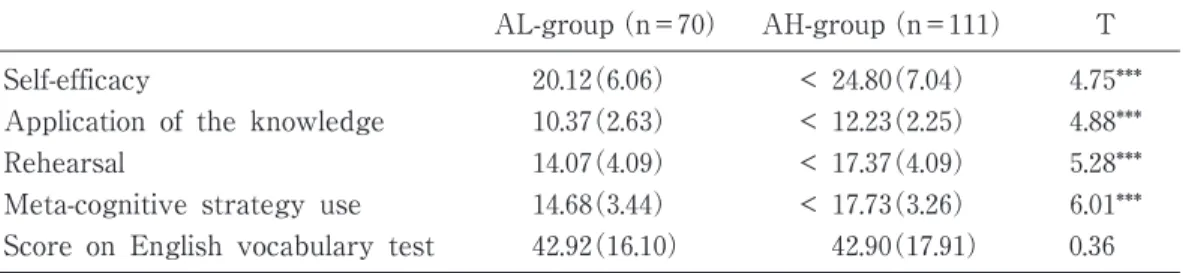
For the purpose of making categories, the subjects were ranked into five categories according to their degree in learner autonomy. Each group consisted of almost the same number of subjects. In order to investigate how the level of autonomy influenced the relationship between the test score, cognitive strategy use, and self-efficacy, subjects with the highest level of learner autonomy (AH-group, Autonomy score
>= 31, n = 70) were compared with those with the lowest (AL-group, learner autonomy score <= 21, n = 111). As shown in Table 4, AH-group had a higher score of self efficacy and cognitive strategy use than AL-group, significantly. However, in terms of the test scores, no significant difference was observed between AL-group and AH-group. These results supported the above correlational results that learner autonomy positively correlated with self-efficacy and cognitive strategy use, but not with the test scores.
Next, the relationships among the test scores, cognitive strategy use, and self-efficacy were analyzed in the AL-group and the AH-group respectively. In both groups, self- efficacy was not correlated with the score on the vocabulary test significantly. As for cognitive strategy use, application of the knowledge did not correlate with the test scores and self-efficacy. Rehearsal was correlated with self-efficacy, though not with the test scores. These results suggested that frequent use of rehearsal strategy was related with high self-efficacy, however it did not always lead to good high English performance. The difference between the AL-group and the AH-group was observed in the results of meta-cognition. In both groups, meta-cognition was positively correlated with self-efficacy. On the other hand, meta-cognition was positively correlated with the test scores in the AH-group, though not in the AL-group. This means that with the students with low learner autonomy, use of meta-cognition does not always link with high performance, and with the students with high autonomy, use of meta- cognition leads to good high English performance.
Table 4. Self-efficacy, cognitive strategy use and test scores of AL-group and AH-group AL-group (n = 70) AH-group (n = 111) T
Self-efficacy 20.12(6.06) < 24.80(7.04) 4.75***
Application of the knowledge 10.37(2.63) < 12.23(2.25) 4.88***
Rehearsal 14.07(4.09) < 17.37(4.09) 5.28***
Meta-cognitive strategy use 14.68(3.44) < 17.73(3.26) 6.01***
Score on English vocabulary test 42.92(16.10) 42.90(17.91) 0.36
***p < .001
Conclusion
The results obtained above are full of interesting suggestions. Many Japanese students try to repeat and do rehearsal when they study English subjects. Those trials have a strong relationship with self-efficacy, but unfortunately do not result in good test performance; in other words, English proficiency. Similar phenomena are seen as to meta-cognition, but only in the group with low learner autonomy. When students with high learner autonomy make efforts in using meta-cognitive strategy, they succeed. In conclusion, students with poor performance in English as a foreign language should improve learner autonomy as well as acquire meta-cognitive strategies.
PEDAGOGICAL IMPLICATIONS
One of the supreme goals for educators is probably to develop callow teenagers into autonomous learners. In Chiba University of Commerce, teachers are eager to assist the students to become autonomous learners. However, most of the English teachers have trouble in assisting low level students to have good English proficiency. The results of the study give us a beacon light to assist them. In real English classrooms, most English teachers have been working exceedingly devotedly to help the students become good English users. However, have their efforts been focused conveying only English skills and rules ? Usually, a learning process which includes getting knowledge and rules, practicing and or repeating them to internalize them, and reproduce them in different contexts should be thought as the right way in educational settings; at least for Japanese cases. However, this cognitive strategy is suitable for only students with learner autonomy but not for low level students.
Therefore, they should be taught how to be autonomous learners.
Table 5. Relationships among self-efficacy, cognitive strategy use and the test score in AL-group
Self-efficacy Application Rehearsal Meta-cognition
Score of English vocabulary test .13 .09 ‑.06 .15
Self-efficacy .18 .28** .51***
*p < .05 **p < .01 ***p < .001
Table 6. Relationships among self-efficacy, cognitive strategy use and the test score in AH-group
Self-efficacy Application Rehearsal Meta-cognition
Score of English vocabulary test .13 .09 ‑.01 .26*
Self-efficacy .16 .37** .59***
*p < .05 **p < .01 ***p < .001
What does an autonomous learner" mean Before going to the topic, what learning should be pondered. According to Vigotzky's Zone of Proximal Development (henceforth ZPD) theory (in Shibata 2001), it is defined as the zone where children /students can learn how to solve a task co-working with others. In the case of raising a child, the parents can co-work with the child to help the child do the task.
When it is happening in a classroom, the students can co-work with the teacher and or classmates. Some researchers claim that the learner can get scaffolding in their ZPD. However, considering the character of learning carefully, when we learn how to do the new task, there are often cases where we sometimes get some direct help from others. However, there are also cases where we can figure out how to do it by ourselves while we are co-working with others such as teachers, friends, parents, and others. As for considering the ZPD in more detail, in theory learners realize their ZPD by co-working with others. However, there must be something in our brain/
mind, a mental device producing a zone similar with ZPD learners so they can realize by themselves because any person who desires to develop intellectually more needs that zone. It can be raised by him/herself. If something is necessary for a learner to co-work in his/her zone, it can be probably his/her meta cognition, which controls his/her cognitive activities. Therefore, it is possible that an autonomous learner is defined as a learner who can co-work with his/her meta-cognition to do the task in his/her zone and boost up his/her zone.
Then, how we assist low-level students pick up the habit of using meta-cognition is an exceedingly tough question to be solved. It will take a long time to discover the right answer. Therefore, we should do it step by step. Sakai and Takagi (2009) state :
They could not set a proper goal, check their progress, or evaluate outcomes.
A possible way of teaching them could be to assist them in developing their meta-cognitive abilities. Students should be taught to set a proper goal, check their progress, evaluate the outcome, and reflect on what they could have done to improve their outcome. As for developing meta-cognitive strategies to enhance autonomy, it is suggested that : at the first lesson of a semester, teachers discuss the goal of the class with the students, display some textbooks possible for class use, allow students to select one, and nominate the reason for their selection.
After a few lessons when students have become accustomed to the pace of their teachers, students should be allowed to consider whether the pace of the class suits them. After halfway through the semester, teachers should instruct students to assess whether the textbook has helped them develop their English proficiency. At the end of the semester, students should be asked to evaluate whether the textbook has significantly improved their ability and reflect on their studies. In between, teachers should encourage students to reflect on their studies. Similar strategies can be used for developing homework tasks.
In addition, another tough task for teachers who teach low-leveled students is to have them show their ZPD to teachers. Poorly performing students are often reluctant to co-work with their teachers, especially showing their ZPD probably because they are defensive about showing their weakness. Their pride often prevents them from being honest. Therefore, teachers should be reliable people who can obtain students' trust enough to open their hearts. Adapting to Maslow's (1943) hierarchy of needs into educational theories, those students should feel belongingness and loveliness offered inside the classroom first because they have lost confidence and interest in their past English classrooms. They do have self-esteem. It is a key matter for teachers to co-work well with students' self-esteem.
ACKNOWLEDGEMENTS
We are extremely grateful to Emeritus Prof. Okuda, Prof. Matsumoto, Prof. Oguro, Prof. Wakayama, Prof. Sakuda, Prof. Hashimoto, Prof. Okadome, Prof. Sugawara, Prof.
Moritani, Prof. Nakagawa, Prof. Shimizu, Prof. Yamaguchi, Prof. Komuro, Prof.
Soyama, and Prof. Elliott for their tremendous help in collecting the data and proofreading this article.
REFERENCES
Holec, H. (1981). Autonomy in Foreign Language Learning. Pergamon, Oxford.
Holec, H. (1979). Autonomy and Foreign Language Learning. Strasbourg : Council of Europe.
Hyland, K. (1994). The learning styles of Japanese students." JALT Journal, 16(1), 55‑74.
Mainichi (2008) Teimeisuru Eigoryoku Daigakuga Tekoire [Universities Assist Low level English Proficiency of University Students]" the morning paper of February 18th.
Maslow, A. (1943). A Theory of Human Motivation."Psychological Review, 50, 370‑396.
Mori, Y.(2004) Relationship between Self-Efficacy and Learning Strategies of English in College Students." Japan Society for Educational Technology, vol.28, 45‑48.
Mochizuki(1998) Nihonjin gakushu-sha no tameno Goi size test [A vocabulary size test for Japanese learners]", Bulletin of The Institute for Research in Language Teaching, vol.12, pp.27‑53.
Ohno, M., Nakamura, A., Sagara, Y., & Sakai, S. (2008). A Study on the relationship between learner autonomy and academic grades", The Journal of Chiba University of Commerce, 45(4), 1‑23.
Ono, H. (2006). Kiso-eigo-ryoku Teikano Genjo [Situation of Declining English Proficiency]." The English Teachers' Magazine, 54(11), 63‑67.
Pintrich, P.R., and De Groot, E.V. (1990) Motivational and Self-Regulated Learning Components of Classroom Academic Performance." Journal of Educational Psychology, 82. 1, 33‑40
Sakai, S., Takagi, A. (2009) Relationship between learner autonomy and English lan- guage proficiency of Japanese learners" THE JOURNAL OF ASIA TEFL, 6(3), 297‑325.
Sakai, S., Chu, M., Takagi, A., & Lee, S. (2008) Teachers' Roles in Developing Learner Autonomy in the East Asian Region." THE JOURNAL OF ASIA TEFL, 5(1), 93‑117.
Schmitt, N., Schmitt, D., & Clapham, C. (2001). Developing and exploring the behaviour of two new versions of the Vocabulary Levels Test."Language Testing, 18, 55‑88.
Shibata (2001) Shikou to Gengo [Vigotzky (1934) Thinking and Speech]" Shindokusho- sha
STEP (2006) Eigo Gakushu & Eigo Siyou Joukyo Chousa [Investigating Japanese Learners' Study Habits and Use of English Outside the Classroom]," STEP Eigo Joho [STEP Information for English], 25‑29, vol. 9, no.4
Tohno, Y. (1995). Eigo Goi Shutoku Ron. [The Theory of English Vocabulary Acquisition.], Tokyo, Japan : Kagensha Press.
Appendix
Questionnaire for English Learning
This questionnaire is conducted for the benefit of the 2009 CUC Grant-Aided joint research A Study on the Relation between Learners' Self-efficacy in English Learning and Improvement of their English Proficiency" We observe the law to protect private information, therefore we will use the data of this questionnaire only for the research and not use it for other aims. Please cooperate. Please write your student number. It will be used mainly for arranging the data. Please write your gender code (1 male, 2 female).
Shien Sakai, Akira Nakamura, Yoichiro Sagara
Commerce Department of CUC
Please choose one of the choices which reflect your perception of English language learning.
5 Totally, 4 Sometimes 3 Neutral 2 Rarely 1 Not at all 01. I know that I will be able to learn the material for an English class.
02. I think that what we are learning in an English class is interesting.
03. Some people are born with a special ability which is useful for learning English.
04. I would like to reflect on our opinion in topics and activities we learn in class.
05. When I study for a test, I try to put together the information from class and from the book.
06. I would like to reflect on our opinion in deciding our class's goal of study in one semester.
07. I often find that I have been reading for class but don't know what it is all about. (*R)
08. I prefer class work that is challenging so I can learn new things.
09. I am satisfied with the English education I received.
10. I would like to reflect on our opinion in deciding the type of classroom activities, such as individual, pair and group work.
11. I'm certain I can understand the idea taught in this course.
12. I think I will be able to use what I learn in this English class in other classes.
13. I would like to reflect on our opinion in how to carry out lessons.
14. When I do homework, I try to remember what the teacher said in class so I can answer the questions correctly.
15. I would like to reflect on our opinion in deciding the textbook and materials we use in class.
16. I ask myself questions to make sure I know the material I have been studying.
17. Girls are better than boys at learning English.
18. I am so nervous during a test that I cannot remember facts I have learned.
19. Compared with others in this English class, I think I'm a good student.
20. I outline the chapters in my book to help me study.
21. Considering the amount of time I have studied English, I am satisfied with my progress.
22. Learning English interests me.
23. To say something in English, I think of how I would say it in Japanese and then translate it into English.
24. I think that what I am learning in this English class is useful for me to know.
25. I think I will receive a good grade in this English class.
26. It is hard for me to decide what the main ideas are in what I read. (*R) 27. I would like to reflect on our opinion in deciding the amount and type of
homework.
28. When studying, I copy my notes over to help me remember material.
29. I put English text in the textbook into Japanese when I prepare for the class.
30. Even when I do poorly on a test I try to learn from my mistakes.
31. My study skills are excellent compared with others in this English class.
32. I have an uneasy, upset feeling when I take a test.
33. It is important for me to learn what is being taught in this English class.
34. The more I study English the more enjoyable I find it.
35. In order to speak and understand English very well, English education at school is enough.
36. When I'm reading a textbook, I stop once in a while and go over what I have read.
37. Compared with other students in this English class, I think I know a great deal
about the subject.
38. I always try to understand what the teacher is saying even if it doesn't make sense.
39. I work hard to get a good grade even when I don't like the class.
40. I worry a great deal about tests.
41. When I study for a test, I try to remember as many facts as can.
42. I would like to reflect on our opinion in deciding ways of assessment, such as attendance, essay and self-evaluation.
43. To understand English, it must be translated into Japanese.
44. When I study, I put important ideas into my own words.
45. When reading, I try to connect the things I am reading about with what I already know.
46. I find that when the teacher is talking, I think of other things and don't really listen to what is being said. (*R)
47. I expect to do very well in this English class.
48. Even when study materials are dull and uninteresting, I keep working until I finish.
49. When work is hard, I either give up or study only the easy parts. (*R)
50. I am sure I can do an excellent job on the problems and tasks assigned for this English class.
51. When I take a test I think about how poorly I am doing.
52. When I study for a test, I practice saying the important facts over and over to myself.
53. People who are good at math and science are not good at learning foreign languages.
54. I would like to reflect on our opinion in deciding classroom management, such as seating and class rules.
55. I work on practice exercises and answer end of chapter questions even when I don't have to.
56. I use what I have learned from old homework assignments and the textbook to do new assignments.
57. When I am studying a topic, I try to make everything fit together.
58. Learning a word means learning the Japanese translation.
59. I study English because it is useful to communicate with English-speaking people.
60. I like what I am learning in this English class.
61. Listening to tapes and watching English programs on television are very important in learning English.
62. When I study for a test, I say the words over and over to myself to help me remember.
― Abstract ―
In this study, perception of English language learning among 454 freshmen was investigated by a set of questionnaires. The authors' focus was put on how the level of autonomy influences the relationship between English proficiency, cognitive strategy use, and self-efficacy. English proficiency was measured by the Mochizuki Test. Three results were obtained. The first result indicated that use of cognitive strategy use was related with high self-efficacy, but not with test performance.
The second result showed that learner autonomy positively correlated with self- efficacy and cognitive strategy use, but not with the test scores. The third result demonstrated that with the students with low learner autonomy, use of meta-cognition does not always link with high performance, and with the students with high autonomy, use of meta-cognition lead to good high English performance. It is concluded that in order to improve their English proficiency, students with poor performance in English as a foreign language should develop learner autonomy as well as acquire meta- cognitive strategies.
Keywords : meta-cognition, learner autonomy, self-efficacy, cognitive strategy use
本研究は, 平成21年度千葉商科大学学術研究助成金の交付を得て実施した研究の報告で ある。