An Exploratory Study on Correlations among
Vocabulary Size, Vocabulary Learning Strategy
Use,TOEIC Scores and Self-Efficacy
著者
TAGUCHI, Kaya
著者別名
Kaya Taguchi
journal or
publication title
The Economic Review of Toyo University
volume
41
number
1
page range
55-67
year
2015-12
An Exploratory Study on Correlations among Vocabulary Size,
Vocabulary Learning Strategy Use, TOEIC Scores and Self-Efficacy
TAGUCHI, Kaya
Abstract
This article outlines a small-scale exploratory study on correlations among vocabulary size, vocabulary learning strategy use and TOEIC scores of young adults learning English. Thirty-seven Japanese economics majors participated in taking a Vocabulary Size Test and responding to a vocabulary learning strategy questionnaire, and provided their TOEIC scores. Statistical analyses showed that the students' vocabulary size and TOEIC scores are correlated, and that the students' perceived level of self-efficacy, one of the subscales of the vocabulary learning strategy questionnaire, also correlates with their TOEIC scores. Followed by the details of the study design and results, this paper concludes with pedagogical implications that teaching learning strategies, not only for vocabulary but for other skills, can enhance both learners' self-efficacy, and their overall English proficiency.
Key words: vocabulary size, vocabulary learning strategy use, TOEIC scores, self-efficacy
INTRODUCTION
Given the TOEIC test's huge popularity1) in Japan, many college students in Japan study English to take
the test, although some learners do not seem quite ready to take it. The question then is what do TOEIC test-takers need to be ready? Among the many areas learners need to cover in English learning, which should we, as their teachers, target to help their learning2)? While answering those questions with a focus on
vocabulary size and learners' English vocabulary learning strategy use, this study attempts to present teaching suggestions to support students' learning.
1) In 2014, the number of college students (including junior college) who took Eiken, or Eiken IBA, or EIken Jr. was 62,837 in 2014, while that of TOEIC, TOEIC SW or TOEIC Bridge was 295,763.
2) Since pros and cons about test preparation as a goal of language learning is beyond the scope of this article, I am just indicating here that I am personally against studying for a test, but feel obliged to try to satisfy my students' needs.
Vocabulary size for successful reading
The TOEIC test consists of a listening section and a reading section, with 100 questions each. Due to the limited space for this article, I am narrowing my focus to reading here. When it comes to reading, preceding studies have shown that there is a threshold level of vocabulary, which is usually 95%, that is needed to successfully understand a written text (Laufer, 1997; Nation, 1990 and others). This means a reader would need to understand 19 of every 20 words to minimally comprehend the text. How many word families, then, would a TOEIC test-taker need? Based on three criterion vocabulary lists̶the British National Corpus High Frequency Word List, the Standard Vocabulary List 12000, and Nation's 14K̶Chujo and Oghigian (2009)3)
determined a TOEIC test-taker needs a minimum vocabulary size of 4,000 words, or 3,000 word families, which is above the 3,000 words high school graduates in Japan are expected to learn. This means there are very likely many students who are not ready to take the TOEIC test when they enter college.
Vocabulary learning strategy use
While a learner needs to learn a large number of words to understand a text successfully, it is impossible and impractical for teachers to try to teach all the words they need to know. Good language learner' studies have documented, usually qualitatively, that, just as Folse (2004) summarizes, a good language learner uses different kinds of learning strategies to advance his language skills (p.87). Folse (2004) also indicates that a good learner has his/her own inventory of strategies that are suitable for vocabulary acquisition. Language learning strategies have a prototypical core, which is a dynamic process with problem-solving as its central aim (Gu, 2012). It involves selective attention, analysis of task, choice of decisions, execution of plan, monitoring of progress and/or modification of plan, and evaluation of result (p.1).
Self-regulated learning
As we see in Gu's definition, a strategy is closely related to self-regulation. If a learner is not in control of his/her own learning, s/he would be passive, simply accepting the situation as it is. Such a learner would not pay selective attention, nor engage in an analysis of task, or make any conscious decision… all of which are actions that are prototypical strategies of self-regulation. In fact, an area of language learning strategies can be considered to fall under the concept of self-regulated learning (Mizumoto, 2013a), which involves learners who proactively direct their behavior or strategies to achieve self-set goals (Zimmerman, 1989).
3) They also analyzed EIKEN Pre-1st grade and TOEFL vocabulary to determine the vocabulary size test-takers would need, which was 5,500 word or 4,500 word families for the former and 4,500 word or 3,500 word families for the latter.
Self-efficacy
In self-regulated learning, self-efficacy is a key variable (Zimmerman, 1989). It is the belief in one's capabilities to organize and execute the courses of action required to manage prospective situations (Bandura, 1995, p. 330). In fact, as Mizumoto's (2013b) studies have shown, self-efficacy is related to motivation to learn, learning strategies, academic achievement or L2 proficiency, and learner autonomy (p.261).
Considering the studies on learning strategy use, self-regulated learning, and self-efficacy, vocabulary learning strategy use, especially self-efficacy, can impact vocabulary size and an English proficiency test result, such as the TOEIC. These correlations were researched for the current study as below.
METHOD
Research questions
This study explores the following questions:
1. Is Japanese college students' English vocabulary size correlated with their TOEIC scores?
2. Are there specific vocabulary learning strategies that high scorers used more frequently than low scorers?
Hypotheses
Hypothesis 1: The participants' vocabulary size correlates with their TOEIC scores, as preceding studies suggest.
Hypothesis 2: The participants' self-efficacy correlates to their English vocabulary size and TOEIC scores because those who are more confident in their ability (with high self-efficacy) to carry out a task successfully are more likely to work harder and advance.
Exploration of these hypotheses may have pedagogical implications for teaching vocabulary to Japanese college students who are learning English.
Participants
Fifty-three economics major students agreed to participate, but the sample size was reduced to 37 (19 freshmen, 6 sophomores, 9 juniors and 3 seniors) after deleting those with missing responses in the
questionnaire. The remaining participants' English proficiency level was lower than Japanese college students in general, according to their TOEIC Institutional Program scores they were required to take as a placement test for their required English courses. The detailed scores are shown in the next section.
Measures
The participants took a vocabulary test and responded to a vocabulary learning strategy questionnaire and agreed to submit their TOEIC scores after I explained the purpose of the study and anonymity of the participants. I also made clear that the participation was strictly voluntary. The vocabulary size test was adopted from the Vocab Size Test (VST), BNC Version (1-14k) created by Nation and Beglar (2007), which measures receptive vocabulary size (word families). As for the questionnaire, I employed one that was used in Mizumoto et al. (2014). The questionnaire used here is a combination of two categories. The first one, which looks into learners' strategic vocabulary learning, contains 6 subscales: self-management, input-seeking, imagery, writing rehearsal, oral rehearsal, and association. The other category, which is about self-regulated strategy use, has 5 subscales: self-efficacy, goal setting, volitional control, strategy use and satisfaction with strategy use. The participants responded on a six-point scale, from 1 (Not at all true of me) to 6 (Very true of me). The total number of question items was 46, which are listed in the Appendix.
Analysis
By using SPSS, I obtained descriptive statistics of VST results, TOEIC scores and the vocabulary learning strategy use questionnaire results of the participants. I also obtained Pearson's correlation coefficient between the vocabulary size and TOEIC score, between vocabulary learning strategy use and the vocabulary size, and between vocabulary learning strategy use and the TOEIC score.
RESULTS
Vocabulary size test and TOEIC scores
Table 1
Descriptive Statistics of VST Results and TOEIC Scores of the 37 Participants
Mean SD Max Min
TOEIC Listening 156.49 56.81 305 100
TOEIC Reading 112.03 50.23 250 50
TOEIC Total 268.51 96.26 555 175
Vocabulary Size 21.5 14.7 54 2
Note. SD=Standardized Deviation
Considering the average scores of Japanese college students' TOEIC IP (Institutional Program) in 2014, which was 248 for Listening Section, 192 for Reading Section and 440 for the total, the proficiency of the participants in this study was low. As for the vocabulary size of the participants, again, the VST results estimated it to be 2150 word families on average, which is lower than the 3,000 that a TOEIC test-taker needs. Like the aforrementioned study, a statisitacal test I ran also shows that there seems to be a rather strong correlation between a person's vocabulary size and his/her TOEIC test scores as below.
Table 2
The Correlation Coeffient (r) between the Vocabulary Size and TOEIC Scores (n=37)
TOEIC Reading TOEIC Listening TOEIC Total
.535** .497** .552**
Note. *p <.01, **p <.05
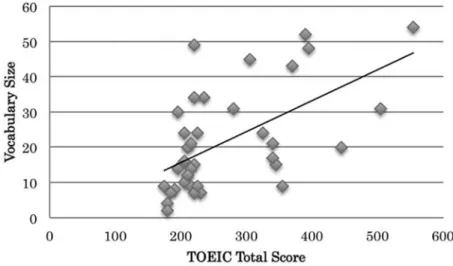
The table above shows that the correlation coefficients were close to or above .50 with an alpha level of .05. We can say there is a positive correlation between the vocabulary size and the TOEIC test score among the participants in this study. This means Hypothesis 1 is supported: The participants' vocabulary size correlates with their TOEIC scores. Those who scored higher on the TOEIC appear to have a larger vocabulary size, and/or those who have a larger vocabulary size earned a higher TOEIC score. This correlation can be seen in the scatter plot below as well.
How about their vocabulary learning strategy use? To see whether there might be a correlation between vocabulary learning strategy use, vocabulary size, and the TOEIC scores of the participants, let us move on to the next section for the vocabulary learning strategy use questionnaire results.
Figure 1. Scatter plot of TOEIC total score and vocabulary size.
Learners
'
use of vocabulary learning strategies
The following table shows the number of items in each subcategory and the participants' mean scores and standard deviations.
Table 3
Descriptive Statistics of Vocabulary Learning Strategy Use Questionnaire (n=37)
subcategory of strategy # of items Mean SD
self-management 7 2.26 0.92 input-seeking 4 2.73 1.21 imagery 5 3.46 1.05 writing rehearsal 3 4.03 1.33 oral rehearsal 3 3.18 1.34 association 3 2.99 1.09 self-efficacy 4 2.59 1.26 goal setting 4 2.72 1 volition control 5 2.97 1.27 strategy use 4 2.93 1.32
satisfaction with strategy use 4 3.22 1.28
Figure 2. Rader chart of vocabulary learning strategies.
As also seen in the radar chart, the most frequently used strategy by the participants, according to their own observation, was writing rehearsal: When I try to remember vocabulary, I write it repeatedly. For example, while the least used category was self-management̶ I regularly review the vocabulary I learned to check if I remember it. / I keep a vocabulary book or word list to check the vocabulary any time I wish. ̶it seems that when they feel they have to learn vocabulary, they write it, but they do it only occasionally. As for the overall strategy use, there was no statistically significant correlation of their TOEIC scores and vocabulary size. In other words, the results did not support that those who used vocabulary learning strategies more frequently overall tended to get a higher score on a TOEIC test or vocabulary size test, or vice versa.
Learners
'
use of vocabulary learning strategies and TOEIC scores
The next table shows statistically positive correlations between the two categories (input-seeking and self-efficacy) and the TOEIC test scores (there was no correlation found between any category and the vocabulary size test score). The other categories did not show any correlation with the TOEIC test scores. These findings partially support Hypothesis 2: The participants' self-efficacy correlates to their English vocabulary size and
TOEIC scores. This study only found a correlation between self-efficacy and TOEIC scores. Table 4
The Correlation Coeffient (r) between Input-Seeking and TOEIC Scores, and between Self-Efficacy and TOEIC Scores (n=37)
TOEIC Listening TOEIC Reading TOEIC Total
input-seeking .266 .406* .403*
self-efficacy .400* .621** .577**
Note. *p <.01, **p <.05
ANALYSES AND DISCUSSION
As past studies have already suggested, the participants' TOEIC scores and VST results showed that they were correlated to each other. As for vocabulary language strategy use questionnaire, self-efficacy was found to be correlated with a TOEIC score, which suggests improving the self-efficacy of learners may be key to their successful English learning, as other previous studies also indicate is the case.
Mizumoto (2013a, 2013b) completed an empirical study showing that teaching Japanese university students' self-regulated learning strategies help enhance vocabulary acquisition, probably because it improves learners' self-efficacy. Mizumoto (2013a) showed a group of Japanese learners of English who received 10-15 minute lessons once a week over two semesters (8 months) about how self-regulated learning increased their self-efficacy and vocabulary knowledge compared with the other two contrast groups. Mizumoto (2013b) also showed that self-regulated learning process can boost self-efficacy and increase vocabulary knowledge for Japanese learners of English.
In addition to vocabulary learning, instruction also can enhance self-efficacy in listening to English as a foreign language. As Graham (2011) summarizes, past studies have shown that explicit teaching of listening strategies that aim at increasing a learner's sense of control and expectations of success can lead to development. For instance, the study by Goh and Taib (2006) indicated that strategy instruction where learners reflected and discussed strategy use improved listening and strategic knowledge as well as their confidence in listening. They also indicated that strategy instruction helped less proficient learners the most.
The above studies that have increased learners' self-efficacy involved reflecting on one's own learning, especially through verbalization, both in writing (Mizumoto, 2013a) and in talking (Goh and Taib, 2006);
as suggested by Schunk and Rice (1983, 1984), the pairing' of strategy learning and verbalization would increase self-efficacy.
The current study, while the number of participants was small (37), and they were exclusively Japanese L1 learners, suggests that self-efficacy indeed can be related to overall English proficiency. As preceding empirical studies have indicated, strategy instruction that involves verbal reflection on whether a learner might succeed in modeling his/ her teachers' use of strategies, can enhance learners' self-efficacy, and hopefully lead to their overall English proficiency. I will aim to see through further empirical studies whether this might be effective for rather less- proficient learners of English, most of whom are not confident in their learning but, for the same reason, expect to gain from strategy learning to a larger extent.
References
Beglar, D., & Hunt, A. (
1999
). Revising and validating the word level and university word level vocabulary tests. Language Testing, 16(2
),131
-162
. doi:10
.1177
/026553229901600202
Benesse (
2015
). GTEC Conversion Table against TOEIC and TOEFL. Available from http://www.benesse. co.jp/gtec/contact/answer/toeic_toefl_conversion.pdfChujo, K. & Oghigian, K. (
2009
). How many words do you need to know to understand TOEIF, TOEFL & Eiken? An Examination of Text Coverage and High Frequency Vocabulary. The Journal of Asia TEFL,6(
2
),121
-148
.Educational Testing Service (
2015
). DATA & ANALYSIS 2014 Number of Examinees and Average Scores inFY2014. Available from
http://www.toeic.or.jp/library/toeic_data/toeic_en/pdf/data/TOEIC_Program_DAA.pdf Eiken (
2015
). The Number of Eiken Examinees. Available fromhttp://www.eiken.or.jp/eiken/merit/situation/
Folse.S. (
2004
). Vocabulary myths: applying second language research to class-room teaching. Ann Arbor, MI: University of Michigan Press.Goh, C. C. M., & Taib, Y. (
2006
). Metacognitive instruction in listening for young learners. ELT Journal, 60,222
–232
. doi:10
.1093
/elt/ccl002
Graham, S. (
2011
). Self-efficacy and academic listening. Journal of English for Academic Purposes 10,113
–117
. doi:10
.1016
/j.jeap.2011
.04
.001
Conference Proceedings. Tokyo:JALT.
Laufer, B. (
1997
). The lexical plight in second language reading: words you don't know, words you think you know and words you can't guess. In Second Language Vocabulary Acquisition: a Rationale for Pedagogy, eds. J. Coady and T. Huckin. Cambridge University Press. pp.20
-34
.Ministry of Education, Culture, Sports, Science and Technology (
2008
). New curriculum design and treatmentof the contents for each subject. Available from
http://www.mext.go.jp/a_menu/shotou/new-cs/news/
081223
/014
.pdfMizumoto, A. (
2013
a). Enhancing self-efficacy in vocabulary learning: A self-regulated learning approach.Vocabulary Learning and Instruction, 2(
1
),15
-24
. doi:10
.7820
/vli.v02
.1
.mizumotoMizumoto, A. (
2013
b). Effects of self-regulated vocabulary learning process on self-efficacy. Innovation inLanguage Learning and Teaching, 7(
3
),253
-265
doi:10
.1080
/17501229
.2013
.836206
Mizumoto, A., Someya, Y., & Yamanishi, H. (
2014
). Using Blended-learning for Fostering Vocabulary Learning: An Interim Report of the Newly Implemented Grammar & Vocabulary Development Course.Journal of Faculty of Foreign Language Studies, Kansai University. 11,
71
-92
. Nation, I.S.P. (1990
). Teaching and Learning Vocabulary New York: Newbury House. Nation, I.S.P. & Beglar, D. (2007
). Vocabulary Size Test. The Language Teacher, 31(7
),9
-13
.Qian, D.D. (
1999
). Assessing the roles of depth and breadth of vocabulary knowledge in reading comprehension. Canadian Modern language review, 56(2
),282
-307
. doi:http://dx.doi.org/
10
.3138
/cmlr.56
.2
.282
Schunk, D. H., & Rice, J. M. (
1983
). Strategy verbalization effects on self-efficacy and listeningcomprehension. Paper presented at the Annual Meeting of the American Psychological Association,
Annaheim, CA, August
26
–30
.Schunk, D. H., & Rice, J. M. (
1984
). Strategy self-verbalization during remedial listening comprehension instruction. The Journal of Experimental Education, 53,49
–54
.Zimmerman, B. J. (
1989
). A social cognitive view of self-regulated academic learning. Journal of EducationalPsychology, 81,
329
-339
.Appendix
Vocabulary learning strategy questionnaire (Originally in Japanese) Self-management
1. I regularly review the vocabulary I learned to check if I remember it.
3. I try to make it a rule to memorize a certain number of words in a specific time period (e.g., I will memorize 10 words a day ).
4. I try to learn extra vocabulary in addition to what I am taught in class. 5. I try to take time for vocabulary learning.
6. I consciously set aside time to study vocabulary in order to prepare for tests (e.g., TOEIC, TOEFL, Eiken: English Proficiency Test).
7. I use my own methods for remembering, checking, or reviewing vocabulary. Input-seeking
1. I try to expose myself to English vocabulary by reading or listening a lot.
2. I try to manage the learning environment so as to expose myself to English vocabulary.
3. I try to make use of the media (TV, radio, Internet, mobile phone, or movies) to learn vocabulary. 4. I study vocabulary with the intention of using it.
Imagery
1. When I try to remember vocabulary, I make a mental picture of what can be associated with a word's meaning.
2. When I try to remember vocabulary, I link my personal experiences to it.
3. When I try to remember vocabulary, I create an image of the spellings or ůorthographic forms. 4. When I try to remember vocabulary, I use the keyword method (keyword mnemonic technique). 5. When I try to remember vocabulary, I imagine whether the meaning of the word is negative or positive. Writing rehearsal
1. When I try to remember vocabulary, I write it repeatedly. 2. When I try to remember vocabulary, I write it on a note or a card.
3. When I try to remember vocabulary, I remember not only the meaning but šalso the spelling of the word by writing it.
Oral rehearsal
1. When I try to remember vocabulary, I say it aloud repeatedly.
2. When I try to remember vocabulary, I vocalize it to remember not only the meaning but also the pronunciation of the word.
3. When I try to remember vocabulary, I say the sample sentence aloud. Association
1. When I try to remember vocabulary, I associate it with the synonyms (e.g., begin and start) or antonyms (e.g., positive and negative) I already know.
2. When I try to remember vocabulary, I also memorize the synonyms or antonyms of the word.
3. When I try to remember vocabulary, I memorize words similar to it (in meaning, sound, or shape) or the related words in a group.
Self-efficacy
1. I am good at memorizing vocabulary. 2. I know more vocabulary than others. 3. I know basic vocabulary to some extent.
4. I believe that I can get a good score in the vocabulary test. Goal setting
1. I set a goal first when learning vocabulary.
2. I plan how and what to learn before I start learning vocabulary. 3. I set a standard for what is to be done when learning vocabulary. 4. I plan a schedule in order to keep learning vocabulary.
Volitional Control
1. When learning vocabulary, I have special techniques to keep my concentration focused. 2. I feel satisfied with the methods I use to reduce the stress of vocabulary learning.
3. When it comes to learning vocabulary, I have my special techniques to prevent procrastination. 4. When learning vocabulary, I know how to arrange the environment to make learning more efficient. 5. When feeling bored with learning vocabulary, I know how to regulate my mood in order to invigorate the
learning process. Strategy Use
1. I have my own way of learning and reviewing when learning vocabulary. 2. I devise various methods to memorize vocabulary.
3. I use mnemonic methods to help memorize vocabulary.
4. I try to improve the way to learn vocabulary when the current method fails. Satisfaction with Strategy Use
1. I have my own ways to learn vocabulary.
2. I am satisfied with the vocabulary learning tactics that I am using.
3. I feel that the methods I use for learning vocabulary are better suited to me than those methods used by others.