Cyclotron Damping of the Space Charge Wave of Beam in a Nonuniform Magnetic Field Region
journal or
publication title
福井大学工学部研究報告
volume 26
number 2
page range 175‑182
year 1978‑09
URL http://hdl.handle.net/10098/4450
FUKUI UNIVERSITY VOL.26 No.2 1978
Cyclotron Damping of the Space Charge Wave of Beam in a Nonuniform Magnetic Field Region
* * *
T. Idehara, M. Tanaka and Y. Ishida
The space charge wave of electron beam excited by the reactive medium instability in a uniform magnetic field region is observed to propagate into the increasing magnetic field region. When the wave passes through the cyclotron resonance region, it suffers a heavy cyclotron damping.
The instability of the space charge wave of beam due to the coupling with the Bernstein wave has been investigated by many authors in a beam- plasma system confined in a uniform magnetic field. The calculation of its growth rate shows that the instability occurs most strongly near the cyclotron sub-harmonics w/w ~n+2~ , where w/2n and w /2n are the wave and
c c
the electron cyclotron frequencies and n is an integer, because the cyclotron damping due to the plasma electrons supresses the instability near the
cyclotron harmonic frequencies w/w
~n.l)
c On the other hand, it has been verified by the experimental study that the emission spectrum ascribed to the instability has a series of sharp peaks near the cyclotron sub- harmonics2) and the amplification factor k
i of the obliquely propagating
*
Department of Applied Physics1~
test wave excited in a beam-plasma system has maximum values near the inter- section between the cyclotron sub-harmonics and the upper hybrid resonance, i.e., W
~ (n+~)wc ~ J w~
+w~
, where wp/2n is the electron plasmafrequency. 3) ,4) In this letter, we report the experimental result which supports the above consideration. That is, the space charge wave excited strongly by the reactive medium instability in a uniform field region where the cyclotron sub-harmonic condition w/wc ~n+~ is satisfied, suffers the heavy damping near the cyclotron resonance region, when it propagate in the region of increasing magnetic field.
The plasma is produced by the dc
dischar~
in the TP-D type device5 ) and diffused along the line of magnetic force into the pylex glass tube(9.5 cm in diameter and 65 cm in length), its parameters being as follows.
The density n =3.5~5.3xI09 cm-3 , the electron temperature kT =10 eV,
p e
4 -4 the plasma diameter D=30 mm and the pressure of the neutrals CAr) p=7. xlO Torr (the collision frequency of electrons with neutrals v
en=4 MHz is much smaller than the wave frequency w/2n). The electron beam is generated by an electron gun placed at the opposite side of the discharge region and injected parallel to the line of force into the diffused plasma, so that the electron beam-plasma system is formed and the density ~ and velocity Vb (or energy eV
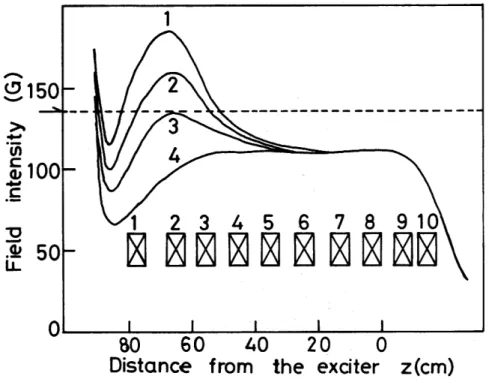
b) of the beam are controlled independently of the plasma parameters. This device has been used in the experimental study which was reported recently.3) The magnetic field is applied to the beam-plasma system by ten coils, which are arranged as shown in Fig. 1.
The current II of two coils denoted by I and 2 is varried independently on the current 12 of the other eight coils, so that the distributions of
1
:g
.~
50
I.L.
o----~----~---~----~---
SO 60 40 20 0
Distance from the exciter z(cm)
Fig. 1 The arrangement of coils and the distribution of
magnetic field intensity. The coil current 12=1.0 A.
The coil current II is varied independently on 1 2. 11= 1.0, 1.6, 2.0 and 2.4 A for the distributions shown by cueves 1, 2, 3 and 4, respectively. The dotted line shows the field intensity corresponding to w/2n=
380 MHz.
178
4
60 40 20 0
Distance from the exciter z(cm)
Fig. 2 The propagating wave patterns of the space chsrge wave of beam in nonuniform magnetic field. Patterns 1, 2 and 4 correspond to the distributions of field intensity 1, 2 and 4, respectively. The wave frequency w/2TI is fixed at 380 MHz. Arrows show the cyclotron resonance points.
magnetic field intensity shown in the figure are obtained. The dotted line shows the magnetic field intensity corresponding to w /2n=380 MHz.
c
The test wave is excited by the coaxial probe situated in the center of the beam-plasma. system (z=O) and detected by the other probe movable axially. By using the interferometer system, the propagating wave patterns along the field (along the axial direction z) are observed in the various distributions of the field intensity. The results are shown in Fig. 2. The curve 4 is the wave pattern corresponding to the uniform magnetic field shown by the curve 4 in Fig. 1, where the wave and the electron cyclotron frequencies are 380 MHz and 308 MHz, respectively.
As shown in the previous
paper~)
it is seen that the space charge wave of beam is amplified by the reactive medium instability (w=kl~b' kll is the wave number parallel to field) along the streaming of beam" and shows the stable propagation after it saturates at a sufficiently high level.From the value of kll obtained from this pattern and the value of the perpendicular wave number k" obtained from the radial propagation pattern, the propagation angle 8 with respect to the magnetic field (=tan ... l
k..L/k" ) is about 760• The patterns denoted by 2 and 1 correspond to the nonuniform magnetic fields shown by the curves 2 and· 1 in Fig. 1, where the wave frequency w/2n is fixed at 380 MHz. It is seen that the space charge waves amplified to high level in a uniform field region are damped strongly near the cyclotron resonance region denoted by arrows (that is, the points where the dotted line intersects the curves 2 and 1, in Fig. 1).
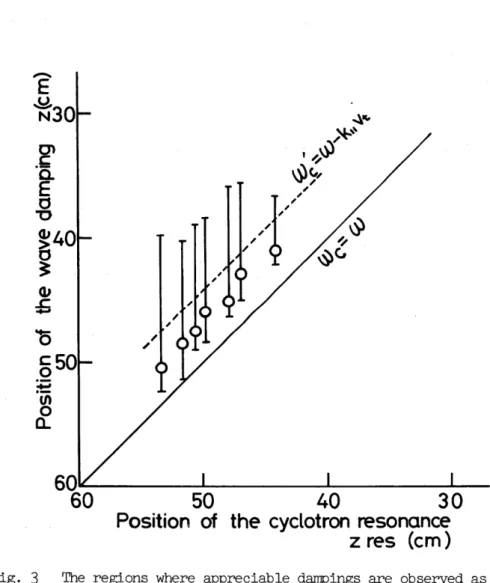
The similar experiments are done for the various distributions of field intenSity. The regions where appreciable dampings are observed are plotted in Fig. 3 as the function of the position z where the cyclotron
res
180
...
E
u'N30
.~ Cl Q.
E c
"'0
<1140
~
~Q) .£:.
+-'
15 e50
0 +=i·in
a.
0~ /
50 40 30
Position of the cyclotron resonance zres(cm)
Fig. 3 The regions where appreciable dampings are observed as the function of the cyclotron resonance points z for the
res corresponding distribution of the field intensity.
resonance occurs for the corresponding distribution.
shows the res,onance point . w=w c for each distribution.
damped away before it reaches the resonance region.
The solid line The waves are The dotted line shows the point where the relation of wc=w - kllv
t is satisfied, where v t is the thermal velocity of plasma electrons. It is reasonable that the points where the dampings of waves are most strong (denoted by hollow circles in Fig. 3) lie in the region surrounded by the solid and dotted lines.
In conclusion, the results mentioned above may support the previous experimental results,3),4) where the amplification of the space charge wave of beam due to the reactive medium instability occurs most strongly near the cyclotron sub-harmonic frequencies. Moreover, it may
suggest that the energy transfer from the beam electrons to the plasma electrons does occur effectively for the appropriate configuration of magnetic field intensity.
This work is partially supported by the Grant-in-Aid from the Ministry of Education in Japan.
References
1) M. Seidl, Phys. of Fluids 4 (1970) 966.
2) T. Idehara, K. Ohkubo and S. Tanaka, J. Phys. Soc. Japan 27 (1969) 187.
3) T. Idehara, M. Takeda and Y. Ishida, J. Phys. Soc. Japan 38 (1975) 1125.
4) T. Idehara, M. Takeda, N. Miyama and Y. Ishida, J. Phys. Soc . Japan 39 (1975) 213.
182
5) K. Takayama, M. Ohtsuka, Y. Tanaka, K. Ishii and Y. Kubota,
in Proc. 7th Intern. Conf. on Phenomena in Ionized Gases (Gradevinska, Knjiga, Beograde, Yugoslavia (1966) Vol. I, p. 420.