Fast Cyclotron Wave Excitation in a Spiral Electron Beam‑Plasma System
journal or
publication title
福井大学工学部研究報告
volume 27
number 1
page range 143‑159
year 1979‑03
URL http://hdl.handle.net/10098/4416
FUKUI UNIVERSITY VOL.27 No. 1 1979
Fast Cyclotron Wave Excitation in a Spiral
*
Electron Beam-Plasma System
Toshitaka IDEHARA, Mataharu TANAKA and Yoshio ISHIDA Department of Applied Physics, Fukui University
Fukui 910
Abstract
The fast cyclotron wave excitation resulting from the coupling with the electron Bernstein wave is observed in a magnetized plasma penetrated by a spiral electron beam.
For the excitation to occur, the beam energy component
perpendicular to the magnetic field is larger than a critical value. From measurements of the wave number and the
growth rate of the excited cyclotron wave, its dispersion relation is determined for various values of beam and plasma parameters. The experimental results are compared with the theoretical considerations.
*It has been reported partially in Phys. Letts. G8A (1978) 442.
1 Introduction
The instability of the wave in a beam-plasma system and its nonlinear development have been investigated with
1) ,2)
a great interest by many authors. For the weak beam interaction, the wave becomes unstable near the frequencies of beam waves, that is,
W
= kJj vOII + nWc' where kll and voll are the parallel components of wave vector and beam velocity andUJ
/2tr is the cyclotron frequency.c . In the
case where an electron beam is injected parallel to the external magnetic field into a plasma, the space charge wave
(n=O) and the slow cyclotron wave (n=-l) of beam have the negative energy and become unstable, as the result of the coupling with the plasma wave.3)-S) These are called the Cherenkov excitation and the slow cyclotron wave excitation which are the most dominant process in the system.
On the other hand, in the case where a beam is injected obliquely to the external field and has the energy component EJL perpendicular to the field, the fast cyclotron wave
(n=l) of beam may also have the negative energy and be
excited, which is called the fast cyclotron wave excitation.
In this paper, i t is reported that the latter excitation is observed when
El-
is larger than a critical value which is about 20 percent of the total beam energy Eb (= E-L
+ Ell) . Then, Cherenkov excitation can always occur together with fast or slow cyclotron wave excitation, but both fast and slow cyclotron wave excitations do not occur at the same time. For the larger value ofEJL,
higher modes of beamwaves (Inl
2
2) are excited. These results can be explained consistently by the theoretical considerations following Seidl's paper, 6) which is given in§
2.In
§
3, the experimental apparatus and procedures are explained. In§
4, the experimental results and discussions are given, and in§
5, the concluded remarks are descibed.2 Theoretical consideration
Following Seidl's paper, 6) we describe in brief the theoretical consideration for the instability of wave in the system where the magnetized Maxwellian plasma is penetrated by the monoenergetic spiral electron beam.
2.1 Dispersion relation
The dispersion relation of the wave in the system is given by using the susceptibilities
(E
p and£
b) of plasma and beam, as follows,(1) As well-known, tp is expressed for the Maxwellian plasma, as follows,
E
p(2)
where CUp is the plasma frequency, v
t is the thermal speed of plasma electrons,
A = +
(kJ.. v tl
CUc) 2, k1.
is the perpendicularcomponent of wave vector, I n (A) are modified Bessel functions of the first kind and Z(x) is the plasma dispersion function. 7)
If the velocity distribution of beam is assumed as follows,
(3)
then,
+
n T ()J
n c
where ~ is the perpendicular component of velocity,
(4)
UUb is the plasma frequency of electron beam, Sn
= J~(~),
2 I
Tn =
p
I n (]A) I n ( f ) ,f
= kl. v 01./ Wc and I n (f') are Bessel functions.2.2 Criterion for the wave excitation
Here, we consider only the weak beam interaction with Then, the dispersion equation (eq. (1»
can be expanded around the intersection point W= Wo of both dispersion relations of the nth mode of beam wave
( W - n Wc - k"v
Oll= 0 ) and the plasma wave ( I +
t
p = 0 ),and approximated by using the dimensionless small parameter
(w -
w ) /
att.' .,
c as follows,~
3_(W~ l
G n T )~
_(W~
(x _ n) 2W2 n W2
c c
(5)
This equation will yield two complex roots, one corresponding to instabili ty (1m
S)
0), if'(6)
Under the cold plasma assumption, i.e., k2
:.L - 2 - ,
k
G is calculated as follows,
x x 2 - 1 (x - n)2(x2
- 1) + g2 x2
G 2 (x2 _ l) (x - n) 2 + g2 x 4 (x _ n) 2 + g2
(7)
since G> 0 for all values of x
(:>
I), the sufficient condition for eq. (6) isn T ~ O.
n --
In Fig.l, -Tn are shown as functions of
JA .
(8)
From the wave excitation condition (eq. (8» and this figure., we can remark as follows, 1. Cherenkov excitation (n=O)
10 -3 ~1~~~~~~~~~~~.
,.u=~
We
Fig. 1 -Tn are plotted as functions of)A= kJ..vOJ!Wc ' The fast cyclotron modes are unstable in the regions ofjA where -Tn has positive value, while the slow modes are unstable if -Tn
<
o •...
...
. .......
...
. ... ...
{Wplwc>2=a (wt>/wpr=O.02 Vou/Vt=5 VQLIVt=1 kl.Vt /"'c=O.8
0.2 0.4 0.6
Normalized wave nt.mber kiM/laic
Fig. 2 The dispersion relation of the unstable fast cycl~tron_waye
in a spiral electron beam~plasma system (solid and Dr~ken lines.) and the stable electron Bernstein wave in a plasma. The maximum growth rates (kill) occur at the intersectien points of Doth dispersion curves.
occurs for all values of E~ . 2. Fast mode excitations
(n~ 1) occur when Tn becomes negative for sufficiently
large value of E 1.. • 3. Since T =T , slow mode excitations -n n
(n ~ -1) can occur even for EJ.. =0, that is, for the case of parallel beam injection. For the spiral beam, both fast and slow mode excitations of same mode number Inl do not occur simultanebusly.
2.3 Numerical solution for the dispersion relation
Under the condition where fast cyclotron wave excitation does occur, that is, Tl has negative value, the dispersion relation (eq. (1» is analyzed numerically, assuming that k \I is complex. The result is shown in Fig. 2.
The solid and broken lines show the real and imaginary parts of k II for unstable fast cyclotron wave, while dotted lines do the dispersion relation of the plasma wave
(the electron Bernstein wave) in the absence of the beam (1 +
£
p=
0). It is seen that the imaginary part (kJli) has the maximum values, near the intersection points
(GU=W O )
of both dispersion relation curves W- k11v 011 - Wc = 0 and 1 + [p =
o.
In conclusion, the instability results from the coupling of the fast cyclotron wave of beam with the electron Bernstein wave of plasma.3 Experimental apparatus and procedures
In order to investigate the propagation of waves and their instability due to the interaction of an electron beam with a plasma, i t is desired that a Maxwellian plasma is produced
and an electron beam is injected into this plasma, parameters of beam being varied independently on those of plasma.
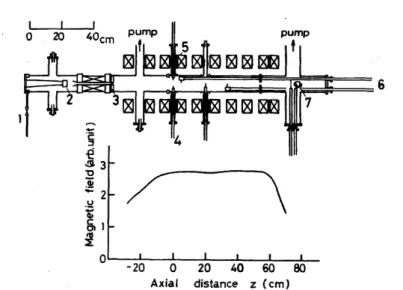
Considering such a requirement, we have set up the apparatus (Fig. 3), which is consisted of three regions, that is, the dc discharge region, the plasma diffused region (or the region of the beam-plasma system) and the beam-generated region. This apparatus has be shown in a previous paper. 3) The plasma produced by dc discharge in Ar gas (pressure Pl = 1 - 2 X 10 -2 Torr) is diffused into the second region (P2= 1 - 2 X 10⁻³
Torr) along the line of magnetic force. An electron beam is produced by the Pierce gun in the third region (P3= 0.8 - 1.0 X 10 -4 Torr), and injected into the second region. The ratio of the beam energy component to the total energy E..L/Eb can be varied continuously by varying the beam injection angle
e
with repect to the line of force. The parameters of the beam-plasma system are as follows, the plasma density n = 5)\ 108
- 8 X 10¹⁰
cm -3, the electron temperature p
kTe= 5 - 10 eV, the beam density nb= 1.5 - 4.5 )( 108 cm-3 the beam temperature kTb= 0.3 eV, the total beam energy Eb= 100 - 350 eV, the beam energy component E~= 0 - 80 eV, and the electron cyclotron freauency W /21C = 308 MHz.
c
The test wave is excited by the coaxial probe situated in the center of the beam-plasma system (z=O) and detected by the other probe movable axially. By using the
interferometer system, the propagating wave patterns along the field (along the axial direction z) are observed.
Axial distance z (em)
Fig. 3 The experimental apparatus and the distribution of external magnetic field. 1. gas inlet, 2. cathode, 3, anode, 4. r-probe, 5. coile, 6. z-probe and 7. electron gun.
E.L= OeV
21eV
from the exciter z
Fig. 4 The prGpagating· wave patterns. For.E~= 51 eV and' 62 eV, the excitati&n sf·the fast cyclotron. wave is seen.
The parallel component of beam velocity vall is determined from the pitch p of spiral motion, which is measured by the spatial variation of probe current.
(9)
4 Experimental results and discussions
4.1 Excitation of fast cyclotron wave (n=l)
The propagating wave patterns measured by the interfero- meter system are shown in Fig. 4, with the beam energy
component E~ as a parameter. In the case of E~ = 0 eV which is shown in the upper trace, only the Cherenkov
excitation (n=O) can occur and the space charge wave of beam grows along the direction of streaming of electron beam.
The wave number k
l\ 0 of growing wave satisfies the relation W= kliOvOII' This result is the same as that of the
. 3) . .
prevlous paper. On the other hand, for the sufflclent1y large value of E..L ' the other wave of smaller ">lave number kill (as shown by the dotted line) is seen, over1aping on the space charge wave of wave number kilo. The former wave may be considered to be the fast cyclotron wave of beam.
4.2 Dispersion relation of the wave
The similar wave patterns are ohserved for the fixed value of E..L (; 52 eV), with the exciting frequency W /2"rr as a parameter. The wave numbers (k
ll
a and kill) of both waves and the amplification factor klli for the wave of smaller wave number kill are estimated from the patterns, They are plotted as functions of W /2"(( in Fig. 5, which-
o
0.1 0.2 0.3 0.4 Amplification factor klli (cm-1) 600300
o
A ,.£A
Ai A
klli~
kL' /
IIIA A
A~
-Jv
A~~
1'1' ~
KilO
d o
.q fc= 308 MHz
~I' 0
E
II= 148 eV
~ I'
/ EJ. = 52eV
o
4 5
k
llr (cm-1)
Fig. 5 Observed wave numbers kilO and kill and growth rate klli corresponding to kill are plotted as functions of W /2Tf.
500
Ell E,L (eV) 189 51 152 48 109 51 1
Wave kll
Fig. 6 Observed wave numbers kilO and kill are p10tted as functions of W/21t' with v 011 as a parameter.
shows the dispersion relation of both waves. It is seen that kiil satisfies the excitation condition of the fast cyclotron wave W= kljvOl1 + Duc ' though k"o does the Cherenkov excitation condition
W
= kllv011 •Comparison of the results with the theoretical consideration shown in Fig. 2, suggests that the observed excitations result from the coupling of the space charge or the fast cyclotron waves of beam with the electron Bernstein wave.
The similar experiments are done for various values of the parallel beam velocity v011 and the electron
cyclotron frequency
c:.V
c/2rr .
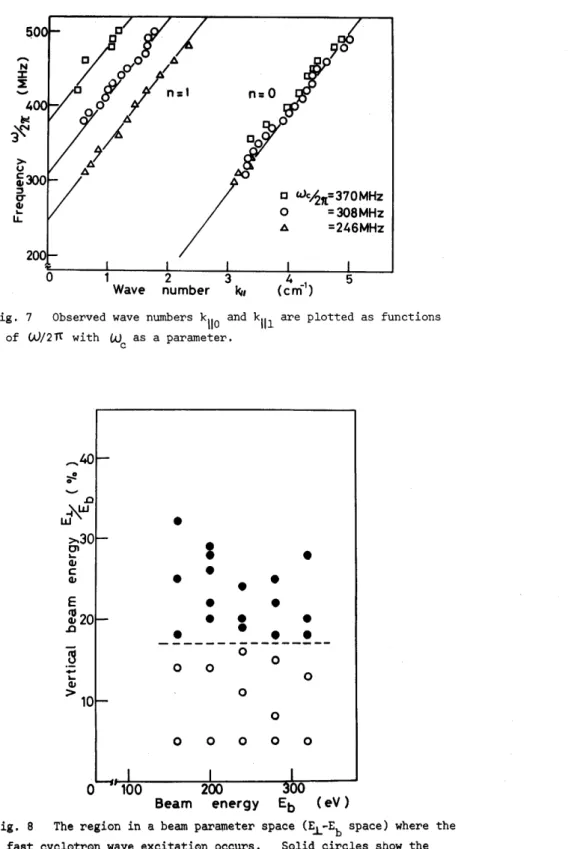
Observed wave number k\l 0 and kl\ 1 of both waves are plotted as functions ofW
/2rr ,
in Figs. 6 and 7. kll 0 and kill always satis fy the relations mentioned above, when vOIl and W c are varied.
These facts support the explanation that the observed wave of the wave number kill is the unstable fast cyclotron wave.
4.3 Criterion for the fast cyclotron wave excitation For the various values of beam parameters E~ and Eb, the excitation of the wave is tried, the results of which are shown in Fig. 8. Solid circles show the occurence of the excitation of fast cyclotron wave. lA1hen the
ratio El../Eb is larger than about 20 percent, the excitation does occur. This fact is consistent with the theoretical consideration given in
§
2, where an electron beam isassumed to be the. monoenergetic spiral one. It is shown that the wave (n=l mode) becomes unstable, if Tl~ O.
The bands of the wave excitation, that is, the regions
c WC~71=370MHz
o = 308 MHz
A =246MHz
1 5
Wave
Fig. 7 Observed wave numbers kilO and kill are plotted as functions of W/2Tt with Wc as a parameter.
, ... ,40 t--
~ 0
~ J:l
l.LJ
•
>-30 ~
Cl
I •
...
C1IC
• •
C1I
• •
E
• •
~20 l -
• • •
.0 - --- ---
• • • •
~
0 0 0 0- ...
C1I 0> 10 t-- 0
0
0 0 0 0 0
I I I
o
'"'00 200 300 Beam energy Eb (eV)Fig. 8 The region in a beam parameter space (El-Eb space) where the fast cyclotron wave excitation occurs. Solid circles show the eccurence Gf the exc~tatiQn.
where Tl has negative value, are expressed by the following equation.
(10)
, ,
where
V
1m and VIm are the mth zeros of J 1 (f{) and J 1 (jJ-) •On the other hand, under the experimental conditions, i.e., Eb= 240 eV,
Ei.
= 48 eV and Wc/2IT=
308 MHz ~ the wave patterns propagating radially are observed, with the wavefrequency L0/2K as a parameter and the perpendicular wave number
k~ of the unstable fast cyclotron wave is determined.
-1 -1
The value lies in the region of 10 cm
< ki<
20 cm , which corresponds to the region of 1. 72<
k 1.. vOl / ()Jc<
3.43.This region consists approximately with the first band
(m=l) for wave excitation condition, which is the reasonable result.
4.4 Observation of the slow cyclotron wave (n= -1) and the second mode (n= -2)
The slow cyclotron modes (n ~ -1) are unstable and
excited for the inverse regions of those denoted by ea. (10).
Therefore, they should be observed even for the parallel injection of beam (El = 0 eV) . However, the Cherenkov excitation is so intense that they cannot be observed for the first band ( kl.vo.l
/Wc<Vn1 ).
When E~ is increased and the second band of excitation condi tion for the slow cyclotron mode
(V ~l <
k.l. v o..L / W c< V
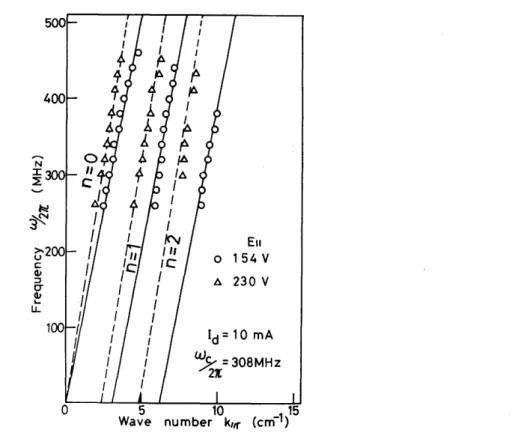
n2)is attained, the slow cyclotron wave (n= -1) and the second mode (n= -2) are observed to be excited, over1aping on the rather weak excitation of the space charge wave (n=O).
500
400
...
~300 N
Ell
o 154 V A. 230 V
Id
=
10 mA~ =308MHz
2X
Fig. 9 Observed dispersion relation of the slow cyclotron modes and the space charge wave, with vall as a parameter.
The measured wave numbers k
1\
are plotted as functions of W /2rr
with the parallel velocity component of beam in Fig. 9. The solid and broken lines show the dispersion relations of beam waves calculated by using the experimental conditions. The experimental results are in fairlygood agreement with the calculated curves.
5 Conclusion
It is concluded that the fast cyclotron wave (n=l) of beam has negative energy and becomes unstable as the result of coupling with the electron Bernstein wave,
when the spiral electron beam is injected into the plasma.
The experimentally obtained dispersion relation of the unstable wave is in agreement with the theoretical one.
The threshold value of beam energy component Elperpendicular to the external field for the instability, is studied
experimentally and compared with the theoretical result.
Both coinside with each other. For larger value of
E~ ,the excitation of higher modes of beam waves are excited.
Ac~&'wledgemen t
The authors thank to Mr. F. Yoshida for his help in experiment. This work was partially supported by a Grant-in-Aid from the Ministry of Education.
References
1) R. J. Briggs, Electron-Stream Interaction with
Plas~a, M.I.T. Press, Cambridge, Massachusetts (1964).
2) R.Z. Sagdeev and A.A. Galeev, Theory, Benjamin (1969).
Nonlinear Plasma
3) For example, T. Idehara, N. Miyama and Y. Ishida, J. Phys. Soc. Japan 42 (1977) 1730.
4) K. Mizuno, R. Sugaya and S. Tanaka, 36A ( 19 71 ) 441 .
5) T. Idehara, M. Takeda and Y. Ishida,
5 8A ( 19 76 ) 33 .
Phys. Letts.
Phys. Letts.
6) M. Seidl, Phys. of Fluids 4 (1970) 966.
7) B.D. Fried and S.D. Conte, The Plasma Dispersion Function, Academic Press, New York (1960).