PAPER
Multi-Hypothesis Prediction Scheme Based on the Joint Sparsity Model
Can CHEN†, Chao ZHOU†,Nonmembers, Jian LIU††,andDengyin ZHANG†††,††††a),Members
SUMMARY Distributed compressive video sensing (DCVS) has re- ceived considerable attention due to its potential in source-limited commu- nication, e.g., wireless video sensor networks (WVSNs). Multi-hypothesis (MH) prediction, which treats the target block as a linear combination of hypotheses, is a state-of-the-art technique in DCVS. The common approach is under the supposition that blocks that are dissimilar from the target block are given lower weights than blocks that are more similar. This assumption can yield acceptable reconstruction quality, but it is not suitable for sce- narios with more details. In this paper, based on the joint sparsity model (JSM), the authors present a Tikhonov-regularized MH prediction scheme in which the most similar block provides the similar common portion and the others blocks provide respective unique portions, differing from the common supposition. Specifically, a new scheme for generating hypothe- ses and a Euclidean distance-based metric for the regularized term are pro- posed. Compared with several state-of-the-art algorithms, the authors show the effectiveness of the proposed scheme when there are a limited number of hypotheses.
key words: distributed compressive video sensing (DCVS), multi- hypothesis (MH) reconstruction, joint sparsity model (JSM), wireless video sensor networks (WVSNs)
1. Introduction
Compressed sensing (CS)[1], [2], which involves signal sampling with far fewer measurements than required by Nyquist theory[3], is emerging as a desirable framework for signal acquisition. Under certain conditions[4], a sig- nal x ∈ Rn×1 can be reconstructed with a high probabil- ity from its measurement vector y ∈ Rm×1 (m < n) by solving an optimization problem. According to different sparse models, two categories of CS recovery exist: (1) sin- gle subspace models, in which there areknon-zero coeffi- cients in the representation vector corresponding toxwhich lies in ak-dimensional single subspace spanned bykbasis
Manuscript received May 16, 2019.
Manuscript revised July 3, 2019.
Manuscript publicized August 5, 2019.
†The authors are with the College of Telecommunications and Information Engineering, Nanjing University of Posts and Telecommunications, Nanjing, 210003 P.R. China.
††The author is with the College of Information Engineering, Nanjing University of Finance and Economics, Nanjing, 210023 P.R. China.
†††The author is with the College of Internet of Things, Nanjing University of Posts and Telecommunications, Nanjing, 210003 P.R. China.
††††The author is also with Jiangsu Key Laboratory of Broadband Wireless Communication and Internet of Things, Nanjing Uni- versity of Posts and Telecommunications, Nanjing, 210003 P.R.
China.
a) E-mail: [email protected] DOI: 10.1587/transinf.2019EDP7133
vectors[2],[5], and (2) union of subspace models, for which x lies in a union of subspaces[6]–[8] corresponding to a block-sparse structure[9]. Several convex or greedy algo- rithms can be employed to iteratively solve these optimiza- tion problems[36]–[39]. However, these algorithms suffer from high computational complexity issues. Thus, several works have introduced deep learning networks to recover signals from measurements[10]–[13]. Moreover, unrolling methods[14],[15]combine deep learning networks and iter- ative algorithms to learn more realistic signals from training data.
Recently, CS has been widely adopted in video acqui- sition and reconstruction because it can alleviate the bur- den on encoders. Combining CS and DVC[16], distributed compressive video sensing (DCVS)[27],[41]has received considerable attention from researchers. In DCVS, complex motion estimation (ME) and motion compensation (MC) processes are shifted from the encoder to the decoder, mak- ing the method suitable for resource-limited applications, e.g., wireless video sensor networks (WVSNs)[17]. To reduce the storage requirements of encoders, Lu[18] pre- sented a block-based scheme for DCVS instead of sampling signals in a global manner. Various signal models have been proposed to reconstruct video sequences, such as two- dimensional (2D) models[19],[20]and three-dimensional (3D) models[21]. However, 2D models do not exploit the correlations among frames; and 3D models suffer from high computational complexity issues. By incorporating ME/MC techniques, Mun[22] presented a residual reconstruction method for block-based DCVS that efficiently exploits tem- poral and spatial correlations. Several schemes[23], [24]
that mine sparsity in the residual domain have been pro- posed to enhance the reconstruction quality.
Multi-hypothesis (MH) prediction algorithms[27]–
[31], which utilize a linear combination of hypotheses to predict the target block, can yield state-of-the-art results for DCVS. Although extensive efforts have been made to im- prove these algorithms, there are still some challenges that must be addressed:
1).Generate the hypothesis set. Generally, blocks ex- tracted directly from side information (SI) within a search window centered on the target block are stacked to generate the hypothesis set. Several adaptive schemes have been pro- posed to optimize the hypothesis set[25], [26]. However, determining how to utilize these blocks and further improve the reconstruction quality remains a research question.
2).Regularize the optimization problem. Regularized Copyright c2019 The Institute of Electronics, Information and Communication Engineers
terms play important roles in MH prediction. By assum- ing that the weight vector of hypotheses is sparse, Do pro- posed the DISCOS approach[27]. Moreover, Fowler[28]
presented a Tikhonov-regularized MH scheme for sparsity that was irrelevant. Additionally, several derivatives of this method[29],[30]have been proposed. However, these reg- ularizations share the common assumption that blocks that are dissimilar from the target block should be given lower weights than blocks that are more similar to the target, lim- iting the reconstruction performance of MH prediction.
The joint sparsity model (JSM)[40], which assumes that two successive frames or blocks in the same scene are visually similar and have similar common and unique portions, can effectively exploit the relevant correlations in DCVS. Based on JSM, a Tikhonov-regularized MH predic- tion scheme is presented in this study. The main contribu- tions of this study are two-fold:
1). Based on JSM, the authors propose a new scheme for generating the hypothesis set and a Euclidean distance- based metric for the regularized term.
2). The proposed theory, that the most similar block provides the similar common portion and the others blocks provide respective unique portions, breaks with the common-sense supposition that blocks that are more similar to the target should be given higher weights than dissimilar blocks.
The remainder of this paper is organized as follows.
Section 2 provides the research background, and we review JSM and the frameworks of MH prediction. In Sect. 3, we describe the relationships between JSM and MH prediction and present the proposed Tikhonov-regularized MH predic- tion scheme in detail. The experimental results and conclu- sions are provided in Sect. 4 and Sect. 5, respectively.
2. Background
2.1 Joint Sparsity Model (JSM)
JSM[40]assumes that two successive frames or blocks in the same scene are visually similar and they should have similar common and unique portions. Conceptually, the two vectored frames or blocks,xi∈Rn×1andxi+1∈Rn×1, can be expressed as follows.
xi=xc+xu i (1)
xi+1 =xc+xu i+1 (2) where xc ∈ Rn×1is the similar common portion and xu i ∈ Rn×1andxu i+1 ∈Rn×1denote the respective unique portions ofxiandxi+1, respectively.
2.2 Multi-Hypothesis (MH) Prediction-Based Framework Based on ME/MC, scholars proposed the MH prediction technique for DCVS to enhance the reconstruction quality.
MH prediction uses a linear combination of blocks to esti- mate the target block. DCVS shifts complex ME/MC tasks
from the encoder to the decoder to alleviate the burden on the encoder. Thus, the vectored target block xi ∈ Rn×1 is unavailable and only the measurement vectoryi ∈ Rm×1 is available at the decoder. Based on the JL lemma[34], MH recasts the optimization problem from the pixel domain to the measurement domain:
ωi=arg min
ω yi−ΦHiω22 (3)
where Φ ∈ Rm×n represents the measurement matrix,Hi ∈ Rn×pdenotes the set ofphypotheses directly extracted from the SI within a search window centered on the target block, andωi ∈Rp×1is the weight vector. Several regularizations have been proposed to solve this optimization problem, e.g., sparse-based regularization[27],[30], Tikhonov regulariza- tion[28],[31], and elastic net-based regularization[29]. To implement DCVS in resource-limited WVSNs for real-time field environmental monitoring, the overriding objective is to not increase the computational complexity. Thus, we ex- pand the Tikhonov-regularized MH prediction method[28]
to obtain the proposed scheme due to its low computational complexity and acceptable performance. Using Tikhonov regularization, the calculation of the weight vector of thei- th block ¯ωi∈Rp×1can be described as follows.
ω¯i=arg min
ω yi−ΦHiω22+λΓω22 (4)
whereλis a non-negative real value parameter andΓ∈Rp×p is a Tikhonov regularization matrix. The closed form of (4) can be given as follows.
ω¯i=
(ΦHi)T(ΦHi)+λΓTΓ−1
(ΦHi)Tyi (5) Residual reconstruction[22]is performed after MH predic- tion to further enhance the reconstruction quality. Com- monly,Γis given as follows:
Γ =diag
yi−ΦHi,122, . . . ,yi−ΦHi,p22
(6) where Hi,j=1,2...p denotes each hypothesis of Hi. This ap- proach is based on the common-sense assumption that blocks that are dissimilar from the target block should be given lower weights than blocks that are more similar. This assumption can yield acceptable reconstruction quality, but it is not suitable for scenarios with more details. Thus, we propose a multi-hypothesis prediction scheme based on the joint sparsity model to enhance the details.
3. The Proposed Tikhonov-Regularized MH Predic- tion Scheme
In this section, based on JSM, we propose a Tikhonov- regularized MH prediction scheme. Unlike the existing MH prediction schemes, which assume that blocks dissimilar to the target block are given lower weights than those more similar to the target block, the proposed scheme assumes that the most similar block provides a similar common por- tion, whereas the other blocks provide respective unique
portions. Specifically, a new scheme for generating hy- potheses and a Euclidean distance-based metric for the reg- ularized term are proposed.
According to (1) and (2),xi+1can be predicted byxi: xi+1 =xc+xu i+1=xi+(xu i+1−xu i)
=xi+(xi+1−xi)
=xc+xu i+1 (7) where xc = xi and xu i +1 = xi+1 − xi. In other words, xc ∈ Rn×1 can be regarded as the similar common portion provided by the similar block xi, and xu i+1 ∈ Rn×1 as the respective unique portions provided by the residual block xi+1−xi. Based on JSM, the final MH prediction ¯xi∈Rn×1 can be expressed as follows.
¯
xi=xc+xu i (8)
Thus, we propose the assumption that the most similar block Hi ∈Rn×1 provides the similar common portionxcand the others blocksHi ∈ Rn×(p−1)provide respective unique por- tionsxu i:
¯
xi=xc+xu i=Hi+Hiωi (9) where ωi ∈ R(p−1)×1 represents the corresponding weight vector ofHi.
3.1 Hypothesis Set Generation Scheme
We first generate the initial hypothesis set ¯Hi ∈Rn×p by di- rectly extracting blocks from the SI within a search window centered on the target block. Then, we use the Euclidean distance between measurement vectors to select the most similar blockHi:
Hi=arg min
H¯i,j
yi−ΦH¯i,j22 (10) where ¯Hi,j=1...p denotes each hypothesis in ¯Hi. In (7), re- spective unique portions are provided by the residual block between the similar block and the other blocks. Thus, we generateHias follows.
Hi=
H¯i,1−Hi, . . . ,H¯i,p−1−Hi
(11)
Note that the dimension ofHiis p−1 because we remove Hifrom ¯Hiand each row ofHiis the residual between each hypothesis andHi.
3.2 Euclidean Distance-Based Metric
Unlike existing MH prediction schemes, the proposed scheme implements Tikhonov-regularized MH prediction for the measurement vector of respective unique portionsyi instead ofyi.
yi=yi−ΦHi (12) In the proposed scheme, a similar common portion is pro- vided byHi, and respective unique portions are provided by
Hi. To preserve the respective unique portions over the sim- ilar common portion, we assign higher weights to blocks in Hi that are dissimilar from those inHi. Thus, we propose a Euclidean distance-based metric ¯Γ ∈ R(p−1)×(p−1) for the Tikhonov-regularized MH prediction as follows.
Γ =¯ diag
1
Hi−Hi,122, . . . , 1 Hi−Hi,p−122
(13) Note that residual blocks in Hi have less energy because the blocks in ¯Hiare highly related. Thus, assigning higher weights to these dissimilar blocks will not affect the simi- lar common portion but will enhance the respective unique portions. Furthermore, the measurement vector of the orig- inal block which can be regarded as a low-dimensional fea- ture vector can be unreliable when used in similarity mea- surements. Thus, we use pixel-domain vectors instead of measurement-domain vectors to measure similarity. By sub- stitutingyi, Hi, and ¯Γ foryi,Hi, andΓin (5) and (9), we obtainωiand ¯xi.
4. Results
In this section, we denote the proposed scheme as MH-JSM.
We compare it with some other state-of-the-art MH algo- rithms experimentally and conceptually: (1). MH-TIK[28], which adopts a single Tikhonov regularization; (2). MH- wEnet[29], which associates a weighted l1 regularization and a Tikhonov regularization as the reweighted elastic net regularization; and (3). MH-ST[30], which combines a Tikhonov regularization and a sparsity regularization on the frame. We evaluate MH-JSM based on the following classi- cal CIF (352×288) sequences: Coastguard, Container, Fore- man and Hall. We use the average peak signal-to-noise ratio (PSNR) of all non-key frames as the comparative index. We adopt the bilateral MC[35]algorithm to generate the SI for each non-key frame. The number of hypotheses is highly correlated with the MH prediction performance. Thus, we conduct experiments with different numbers of hypotheses (e.g.p=10 andp=40). In all experiments, other parame- ters are set as in[28]to maintain equality. Specifically, the sampling rate of key frames is set to 0.7, the group of pic- tures (GOP) is set to 8, and the size of block is set to 16.
All experiments were conducted in MATLAB R2015b on a Dell laptop with an Intel (R) Core (TM) i7-4710HQ CPU (2.5 GHz).
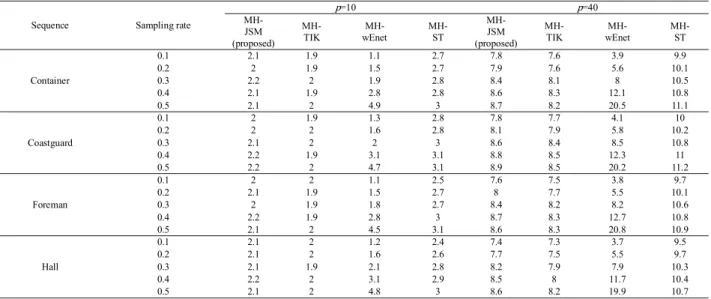
Table 1 shows the average PSNR for various video se- quences. In the region where p=40, compared with MH- TIK, MH-wEnet, and MH-ST, the performance of MH-JSM is unstable and poor at low sampling rates but satisfactory at high sampling rates. This performance variation occurs because the similar common portion has a greater impact on the performance than the respective unique portions in MH- JSM. However, adopting a larger search window to generate more blocks can introduce a large number of uncorrelated blocks, resulting in high-energy residual blocks inHi. These high-energy residual blocks can influence the similar com- mon portion. Furthermore, the Euclidean distance between
Table 1 Reconstruction performance (dB) comparisons
Table 2 Reconstruction time (s) comparisons
measurement vectors is used to select the most similar block Hi. The measurement vector of the original block which can be regarded as a low-dimensional feature vector can be un- reliable when used in similarity measurement applications, especially at low sampling rates, resulting in failure in se- lecting the most similar block. Table 1 shows that increasing in the number of hypotheses cannot guarantee a reconstruc- tion improvement for each algorithm because it enhances the representation ability and introduces inaccurate hypothe- ses. Moreover, the computational complexity exponentially increases, as shown in Table 2. Thus, the ideal scheme im- proves the reconstruction quality with as few hypotheses as possible.
In the region where p = 10, MH-JSM stably out- performs the other algorithms for the Container, Coast- guard, and Hall sequences because the blocks extracted from a small search window are highly correlated. We take
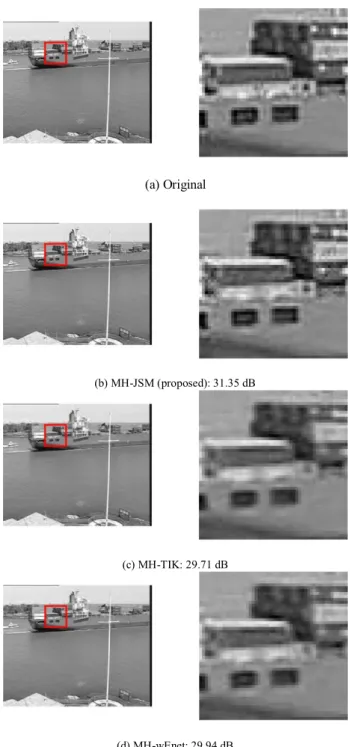
experiments with a sampling rate of 0.5 as examples. For the Container sequence, MH-JSM outperforms MH-TIK, MH- wEnet, and MH-ST by 1.76 dB, 1.95 dB, and 1.64 dB, re- spectively. Moreover, for the Coastguard sequence, MH- JSM outperforms these methods by 1.3 dB, 1.42 dB, and 1.07 dB. Additionally, for the Hall sequence, MH-JSM outperforms the other methods by 1.97 dB, 2.12 dB, and 1.34 dB. However, MH-JSM does not obviously improve the reconstruction quality for the Foreman sequence. These results differ because the Foreman sequence is a shot-shifted video sequence, and the others are shot-fixed video se- quences. In shot-shifted video sequences, the same portion of a frame in one shot can disappear in the next shot, mak- ing it difficult to select the most similar block and related blocks. However, this task is easy in shot-fixed video se- quences. Figure 1 shows visual reconstruction comparisons of the first non-key frame in the Container sequence at a
Fig. 1 Visual comparisons of the Container sequence. (a) Original;
(b) MH-JSM (proposed); (c) MH-TIK; (d) MH-wEnet; (e) MH-ST
sampling rate of 0.1.
To investigate the complexity of different algorithms, we present the reconstruction time of each algorithm in Table 2. Overall, the reconstruction time of MH-JSM is slightly greater than that of MH-TIK. This extra time is required to divide blocks into two hypothesis sets instead of generating one hypothesis set. To implement DCVS in resource-limited WVSNs for real-time field environmental monitoring, the overriding objective is to not increase the computational complexity. Compared to other methods, MH-JSM achieves a better balance between the reconstruc- tion quality and computational complexity.
5. Conclusion
To implement DCVS in resource-limited WVSNs for real-time field environmental monitoring, a Tikhonov- regularized MH prediction scheme in which the most similar block provides the similar common portion and the others blocks provide respective unique portions is proposed in this paper. The proposed scheme differs from the common-sense assumption. Moreover, a new scheme for selecting hypothe- ses and a Euclidean distance-based metric for the regular- ized term are proposed. Compared to several state-of-the- art algorithms, MH-JSM achieves a better balance between the reconstruction quality and computational complexity. In future work, strategies for selecting blocks in shot-shifted scenes should be further investigated to improve the appli- cability of MH-JSM.
Acknowledgments
This work was supported in part by National Natural Sci- ence Foundation of China (No.61571241 and 61872423), the Ministry of Education-China Mobile Research Founda- tion (No.MCM20170205), the Scientific Research Founda- tion of the Higher Education Institutions of Jiangsu Prov- ince (No.15KJA510002 and 17KJB510043), and Postgrad- uate Research & Practice Innovation Program of Jiangsu Province (No. KYCX18 0889), China.
References
[1] E.J. Cand`es, J. Romberg, and T. Tao, “Robust uncertainty principles:
Exact signal reconstruction from highly incomplete frequency infor- mation,” IEEE Trans. Inf. Theory, vol.52, no.2, pp.489–509, 2006, 10.1109/TIT.2005.862083.
[2] D.L. Donoho, “Compressed sensing,” IEEE Trans. Inf. Theory, vol.52, no.4, pp.1289–1306, 2006, 10.1109/TIT.2006.871582.
[3] H.J. Landau, “Sampling, data transmission, and the Nyquist rate,”
Proc. IEEE, vol.55, no.10, pp.1701–1706, 1967, 10.1109/PROC.
1967.5962.
[4] E.J. Candes, “The restricted isometry property and its implications for compressed sensing,” Comptes rendus mathematique, vol.346, no.9-10, pp.589–592, 2008, 10.1016/j.crma.2008.03.014.
[5] E.J. Cand`es and T. Tao, “Near-optimal signal recovery from random projections: Universal encoding strategies,” IEEE Trans. Inf. The- ory, vol.52, no.12, pp.5406–5425, 2006, 10.1109/TIT.2006.885507.
[6] Y.M. Lu and M.N. Do, “A theory for sampling signals from a union of subspaces,” IEEE Trans. Signal Process., vol.56, no.6,
pp.2334–2345, 2008, 10.1109/TSP.2007.914346.
[7] T. Blumensath, “Sampling and reconstructing signals from a union of linear subspaces,” IEEE Trans. Inf. Theory, vol.57, no.7, pp.4660–4671, 2011, 10.1109/TIT.2011.2146550.
[8] Y.C. Eldar and M. Mishali, “Robust recovery of signals from a struc- tured union of subspaces,” IEEE Trans. Inf. Theory, vol.55, no.11, pp.5302–5316, 2009, 10.1109/TIT.2009.2030471.
[9] Y.C. Eldar, P. Kuppinger, and H. Bolcskei, “Block-sparse signals:
uncertainty relations and efficient recovery,” IEEE Trans. Signal Process., vol.58, no.6, pp.3042–3054, 2010, 10.1109/TSP.2010.
2044837.
[10] A. Mousavi, A.B. Patel, and R.G. Baraniuk, “A deep learning ap- proach to structured signal recovery,” 2015 53rd Annual Allerton Conference on Communication, Control, and Computing (Allerton), IEEE, pp.1336–1343, 2015, 10.1109/
ALLERTON.2015.7447163.
[11] A. Mousavi and R.G. Baraniuk, “Learning to invert: Signal recovery via deep convolutional networks,” 2017 IEEE International Confer- ence on Acoustics, Speech and Signal Processing (ICASSP), IEEE, pp.2272–2276, 2017, 10.1109/ICASSP.2017.7952561.
[12] X. Lu, W. Dong, P. Wang, et al., “ConvCSNet: A convolutional com- pressive sensing framework based on deep learning,” arXiv preprint arXiv:1801.10342, 2018.
[13] H. Yao, F. Dai, D. Zhang, et al., “DR2-net: Deep residual recon- struction network for image compressive sensing,” arXiv preprint arXiv:1702.05743, 2017.
[14] U.S. Kamilov and H. Mansour, “Learning optimal nonlinearities for iterative thresholding algorithms,” IEEE Signal Process. Lett., vol.23, no.5, pp.747–751, 2016, 10.1109/LSP.2016.2548245.
[15] C.A. Metzler, A. Mousavi, and R.G. Baraniuk, “Learned D-AMP:
Principled neural network based compressive image recovery,”
arXiv preprint arXiv:1704.06625, 2017.
[16] B. Girod, A.M. Aaron, S. Rane, and D. Rebollo-Monedero, “Dis- tributed video coding,” Proc. IEEE, vol.93, no.1, pp.71–83, 2005, 10.1109/JPROC.2004.839619.
[17] F. Pereira, L. Torres, C. Guillemot, T. Ebrahimi, R. Leonardi, and S. Klomp, “Distributed video coding: selecting the most promising application scenarios,” Signal Processing: Image Communication, vol.23, no.5, pp.339–352, 2008, 10.1016/j.image.2008.04.002.
[18] L. Gan, “Block compressed sensing of natural images,” Proc. inter- national conference on digital signal processing, IEEE, pp.403–406, 2007, 10.1109/ICDSP.2007.4288604.
[19] J. Zhang, D. Zhao, and W. Gao, “Group-based sparse representation for image restoration,” IEEE Trans. Image Process., vol.23, no.8, pp.3336–3351, 2014, 10.1109/TIP.2014.2323127.
[20] J. Zhang, C. Zhao, D. Zhao, and W. Gao, “Image compressive sensing recovery using adaptively learned sparsifying basis via L0 minimization,” Signal Processing, vol.103, pp.114–126, 2014, 10.1016/j.sigpro.2013.09.025.
[21] P. Llull, X. Liao, X. Yuan, J. Yang, D. Kittle, L. Carin, G.
Sapiro, and D.J. Brady, “Coded aperture compressive temporal imaging,” Optics express, vol.21, no.9, pp.10526–10545, 2013, 10.1364/OE.21.010526.
[22] S. Mun and J.E. Fowler, “Residual reconstruction for block- based compressed sensing of video,” Data Compression Conference (DCC), IEEE, pp.183–192, 2011, 10.1109/DCC.2011.25.
[23] C. Zhao, S. Ma, J. Zhang, R. Xiong, and W. Gao, “Video compres- sive sensing reconstruction via reweighted residual sparsity,” IEEE Trans. Circuits Syst. Video Technol., vol.27, no.6, pp.1182–1195, 2017, 10.1109/TCSVT.2016.2527181.
[24] K. Chang, P.L.K. Ding, and B. Li, “Compressive sensing re- construction of correlated images using joint regularization,”
IEEE Signal Process. Lett., vol.23, no.4, pp.449–453, 2016, 10.1109/LSP.2016.2527680.
[25] J. Chen, N. Wang, F. Xue, and Y. Gao, “Distributed compressed video sensing based on the optimization of hypothesis set up- date technique,” Multimedia Tools and Applications, vol.76, no.14,
pp.15735–15754, 2017, 10.1007/s11042-016-3866-4.
[26] Y. Kuo, K. Wu, and J. Chen, “A scheme for distributed com- pressed video sensing based on hypothesis set optimization tech- niques,” Multidimensional Systems and Signal Processing, vol.28, no.1, pp.129–148, 2017, 10.1007/s11045-015-0337-4.
[27] T.T. Do, Y. Chen, D.T. Nguyen, N. Nguyen, L. Gan, and T.D. Tran,
“Distributed compressed video sensing,” 16th IEEE International Conference on Image Processing (ICIP), IEEE, pp.1393–1396, 2009, 10.1109/CISS.2009.5054678.
[28] E.W. Tramel and J.E. Fowler, “Video compressed sensing with multihypothesis,” 2011 Data Compression Conference, pp.193–202, 2011, 10.1109/DCC.2011.26.
[29] J. Chen, Y. Chen, D. Qin, and Y. Kuo, “An elastic net-based hy- brid hypothesis method for compressed video sensing,” Multime- dia Tools and Applications, vol.74, no.6, pp.2085–2108, 2015, 10.1007/s11042-013-1743-y.
[30] M. Azghani, M. Karimi, and F. Marvasti, “Multihypothesis com- pressed video sensing technique,” IEEE Trans. Circuits Syst. Video Technol., vol.26, no.4, pp.627–635, 2016, 10.1109/TCSVT.2015.
2418586.
[31] C. Chen, D. Zhang, and J. Liu, “Resample-based hybrid multi-hy- pothesis scheme for distributed compressive video sensing,” IEICE Trans. Inf. & Syst., vol.100, no.12, pp.3073–3076, 2017, 10.1587/ transinf.2017EDL8133.
[32] E. Elhamifar and R. Vidal, “Sparse subspace clustering: Algorithm, theory, and applications,” IEEE Trans. Pattern Anal. Mach. Intell., vol.35, no.11, pp.2765–2781, 2013, 10.1109/TPAMI.2013.57.
[33] Y. Li, W. Dai, J. Zou, H. Xiong, and Y.F. Zheng, “Struc- tured sparse representation with union of data-driven linear and multilinear subspaces model for compressive video sampling,”
IEEE Trans. Signal Process., vol.65, no.19, pp.5062–5077, 2017, 10.1109/TSP.2017.2721905.
[34] W.B. Johnson and J. Lindenstrauss, “Extensions of Lipschitz map- pings into a Hilbert space,” Contemporary mathematics, vol.26, no.1, pp.189–206, 1984, 10.1090/conm/026/737400.
[35] B.-T. Choi, S.-H. Lee, and S.-J. Ko, “New frame rate up-conversion using bi-directional motion estimation,” IEEE Trans. Consum. Elec- tron., vol.46, no.3, pp.603–609, 2000, 10.1109/30.883418.
[36] C.A. Metzler, A. Maleki, and R.G. Baraniuk, “From denoising to compressed sensing,” IEEE Trans. Inf. Theory, vol.62, no.9, pp.5117–5144, 2016, 10.1109/TIT.2016.2556683.
[37] D. Needell and J.A. Tropp, “CoSaMP: Iterative signal recov- ery from incomplete and inaccurate samples,” Applied and com- putational harmonic analysis, vol.26, no.3, pp.301–321, 2009, 10.1016/j.acha.2008.07.002.
[38] A. Beck and M. Teboulle, “A fast iterative shrinkage-thresholding algorithm for linear inverse problems,” SIAM journal on imaging sciences, vol.2, no.1, pp.183–202, 2009.
[39] Z. Wen, B. Hou, and L. Jiao, “Joint sparse recovery with semisupervised MUSIC,” IEEE Signal Process. Lett., vol.24, no.5, pp.629–633, 2017, 10.1109/LSP.2017.2680603.
[40] M.F. Duarte, M.B. Wakin, D. Baron, et al., “Universal distributed sensing via random projections,” Proc. 5th International Conference on Information Processing in Sensor Networks, pp.177–185, 2006.
[41] J. Prades-Nebot, Y. Ma, and T. Huang, “Distributed video coding using compressive sampling,” Picture Coding Symposium, pp.1–4, 2009.
Can Chen received the B.S. degree in Nanjing University of Posts and Telecommuni- cations, Nanjing, China, in 2015. He is currently pursuing the Ph.D. degree in signal and infor- mation processing in the College of Telecom- munications and Information Engineering of Nanjing University of Posts and Telecommu- nications, Nanjing, China. His research inter- est include image and video coding, image and video processing, machine learning, and com- pressive sensing.
Chao Zhou received the B.S. degree in Wuhan University of Technology, Wuhan, China in 2016. He is currently pursuing the Ph.D. degree signal and information processing in the College of Telecommunications and In- formation Engineering of Nanjing University of Posts and Telecommunications, Nanjing, China.
His research interest includes image and video coding, image and video processing, and com- pressive sensing.
Jian Liu was born in China in 1990.
He received the Ph. D. degree in signal and information processing at Nanjing University of Posts and Telecommunications (NJUPT), Nanjing, China, in 2018. Since 2018, he works in Nanjing University of Finance and Economics (NUFE), Nanjing, China, and is cur- rently a lecturer of College of Information En- gineering. His research interests are in the areas of nonlinear stochastic resonance (SR) and its applications, including signal detection, signal transmission, and digital communication system.
Dengyin Zhang received the B.S.
degree, M.S. degree and Ph.D. degree in Nanjing University of Posts and Telecommuni- cations, Nanjing, China, in 1986, 1989 and 2004 respectively. He is currently a Professor of the School of Internet of Things, Nanjing Univer- sity of Posts and Telecommunications, Nanjing, China. He was in Digital Media Lab at Umea University in Sweden as a visiting scholar from 2007 to 2008. His research interests include signal and information processing, networking technique, and information security.