SUMMARY The physics and applications of superconducting phase shifts and their control in superconducting systems are reviewed herein.
The operation principle of almost all superconducting devices is related to the superconducting phase, and an efficient control of the phase is crucial for improving the performance and scalability. Furthermore, employing new methods to shift or control the phase may lead to the development of novel superconducting device applications, such as cryogenic memory and quantum computing devices. Recently, as a result of the progress in nanofabrication techniques, superconducting phase shifts utilizingπstates have been realized. In this review, following a discussion of the basic physics of phase propagation and shifts in hybrid superconducting struc- tures, interesting phenomena and device applications in phase-shifted su- perconducting systems are presented. In addition, various possibilities for developing electrically and magnetically controllable 0 andπjunctions are presented; these possibilities are expected to be useful for future devices.
key words: superconductivity, superconducting spintronics,πjunction, phase shift, Josephson junction
1. Introduction
A macroscopic phase in superconductors is a key feature of superconductivity. In superconducting structures, various interesting phenomena related to superconducting phases appear, such as Andreev reflections[1] and the Josephson effect[2]. Superconducting phases play essential roles in both fundamental physics and device applications of su- perconductors and controlling the phase shifts is impor- tant for the operation of superconducting devices. Vari- ous superconducting devices have been developed over the years, such as superconducting quantum interference de- vices (SQUIDs)[3], rapid single flux quantum (RSFQ) logic circuits[4], and Josephson voltage standard systems[5]. Al- most all superconducting devices operate by utilizing the su- perconducting phase shift in Josephson junctions.
In recent years, superconductors have once again at- tracted a lot of attention because superconductor-based quantum bits (qubits) are promising candidates as basic el- ements of quantum computing systems[6]–[8]. Although there are several types of superconducting qubits, such as charge, flux, phase, and transmon qubits, the basic element in common is the Josephson junctions. Superconducting quantum annealers also comprise arrays of direct-current
Manuscript received October 13, 2017.
Manuscript revised December 26, 2017.
†The author is with NICT Advanced ICT Research Institute, Kobe-shi, 651–2492 Japan.
††The author is with PRESTO, Japan Science and Technology Agency, Kawaguchi-shi, 332–0012 Japan.
a) E-mail: [email protected]
DOI: 10.1587/transele.E101.C.378
SQUIDs with Josephson junctions[9]. To realize large- scale quantum computing systems, an efficient control of the superconducting phase in Josephson junctions needs to be achieved. In currently developed superconducting qubits, the phases of the Josephson junctions are primarily con- trolled by external magnetic fields. This approach is suitable when only a few qubits are used. However, a more efficient approach needs to be developed for large-scale systems be- cause it is difficult to precisely control many qubit phases owing to the variations in physical parameters in the qubits.
In this paper, we review various approaches for con- trolling the superconducting phases in superconducting hy- brid structures. In Sect. 2, the basic principles of Andreev reflection and the Josephson effect are described from the point of view of a superconducting phase; in addition, in- trinsicπ-phase shifts by ferromagnetic Josephson junctions and d-wave superconductors are introduced. In Sect. 3, in- teresting phenomena related to phase-shifted superconduct- ing systems are presented, along with their applications to novel devices. In Sect. 4, several methods to control the su- perconducting phase using the electric current, spin current, and magnetic configuration are described.
2. Physics of Superconducting Phase Shifts
2.1 Phase Propagation via Andreev Reflection
Andreev reflection is a phenomenon that occurs at nor- mal metal/superconductor (NM/SC) interfaces, as shown in Fig. 1 (a)[1]. When a voltage smaller than the supercon- ducting gap is applied to this system, an electron in the NM moves to the interface but cannot enter the SC as an electron because there is no energy state within the gap except a con- densed state of Cooper pairs. Therefore, the electron takes another electron with opposite spin from the NM and forms a Cooper pair. As a result, the injected electron is reflected to the NM as a hole, and a Cooper pair propagates to the SC; this is the Andreev reflection. In the Andreev reflection, the reflected hole obtains the superconducting phase (θin Fig. 1 (a)) in the SC; as a result, the information concerning the superconducting phase propagates into the NM via the hole.
At a ferromagnetic metal/superconductor (FM/SC) in- terface, the probability of an Andreev reflection is very sen- sitive to the exchange energy of the FM[10]. Let us consider the limiting case of a half-metallic FM in which only an up- spin state exists at the Fermi level (Fig. 1 (b)). In this case, Copyright c2018 The Institute of Electronics, Information and Communication Engineers
Fig. 1 Schematics of Andreev reflection and crossed Andreev reflec- tion in (a), (b) and (c), (d), respectively. (a) and (c) are for normal metal/superconductor (NM/SC) structures, and (b) and (d) are for ferro- magnet/superconductor (FM/SC) structures.
an injected electron with an up spin cannot obtain a down- spin electron from the FM; this means that the formation of a Cooper pair is prohibited. In general, the probability of the Andreev reflection becomes smaller for stronger FMs, and the spin polarization of FMs can be estimated by measuring the conductance via the Andreev reflection[10].
The phase propagation via the Andreev reflection also occurs innon-localstructures, as shown in Fig. 1 (c)[11]–
[13]. In this structure, when the distance between two NM electrodes is small enough[13]and an electron in one elec- trode is injected into the SC, the hole can be reflected onto the other electrode. This is called a “crossed” Andreev re- flection (CAR). In this process, the injected electron and the reflected hole propagate in different NM electrodes, but they are connected via the superconducting phase in the SC. This indicates that the phase is propagated non-locally. When the electrodes are in the FM, the probability of CAR depends on the relative orientation of the magnetizations in the FMs:
for example, in the case of half-metallic FMs, a Cooper pair cannot form when the magnetizations are parallel be- cause an up-spin electron in one electrode cannot obtain a down-spin electron in the other electrode. However, when the magnetizations are antiparallel, as shown in Fig. 1 (d), an up-spin electron in one electrode can obtain a down-spin electron in the other electrode; as a result, a Cooper pair can propagate to the SC via the CAR. In general, the con- ductance and resistance of CAR processes are higher and lower, respectively, for antiparallel alignments than for par- allel ones; this means that inverse magneto-resistance effects can occur in such systems[13].
2.2 Phase Shift in Josephson Junctions
It is well known that the Josephson effect appears in sys- tems separated by two SCs, such as SC/insulator/SC or SC/NM/SC junctions, and the Josephson current (J) de-
Fig. 2 Schematics of a superconducting loop with (a) a ferromagneticπ junction and (b) d-wave pairing symmetry.
pends on the phase difference (ϕ) in the SCs: J= JCsinϕ, where JC is the Josephson critical current[2]. The Joseph- son effect can be explained by the occurrence of multiple Andreev reflections in a barrier layer[14]. As described above, the superconducting phase propagates by electrons and holes via the Andreev reflection, which means that the superconducting phases in both SCs are coupled. As a re- sult, discrete Andreev bound states that depend on the phase difference between two SCs form in the junction, and the Josephson current flows via the Andreev bound states.
When the barrier between the SCs is ferromagnetic (SC/FM/SC junction), the Andreev bound states are modu- lated by the exchange energy in the FM and therefore be- come spin-dependent because the Fermi wavenumbers of the propagating electrons and holes are spin-dependent in a FM[15]. As a result, for specific conditions of the ex- change energy and thickness of the FM, the numbers of the Andreev bound states for positive and negative Josephson currents are reversed; thus, the sign of the Josephson criti- cal current changes, and the current–phase relationship for the SC/FM/SC junction is shifted by π; J = −JCsinϕ = JCsin(ϕ+π). This junction is called a “πjunction,” and the phase difference isπin the ground state (πstate)[16]. The physical mechanism of theπstate can be explained by os- cillation of the order parameter in the FM[17]. Because of the exchange energy in FMs, the momenta of the up-spin and down-spin electrons in Cooper pairs have finite centers of mass. As a result, a spatial oscillation term appears in the order parameter in the FM, and the phase difference ofπ becomes stable when the sign of the order parameter is dif- ferent for the two SCs. After the first experimental demon- stration of a πjunction, many studies on the πstate have been presented[18]–[24]. The ordinary state, in which the phase difference is zero (0 state), and the π state can be set by controlling the temperature and thickness of a FM layer[18],[19].
The simplest geometry, in which the phase shift by the πstate appears as a macroscopic phenomenon, is a super- conducting loop with a πjunction, as shown in Fig. 2 (a).
From the condition that the total phase shift in the loop needs to be an integral multiple of 2π, a spontaneous cir- culating current flows; this results in a magnetic flux corre- sponding to a half-integer flux quantum being generated in the loop. Another way in which an intrinsic phase shift can
netic flux is generated in the same manner as it is in a fer- romagneticπjunction loop. It is worth noting here that, for both ferromagnetic Josephson junctions and d-wave pairing symmetry, the 0 andπstates cannot be controlled externally, i.e., by the current or magnetic field, in simple structures generally. To control the 0 andπstates flexibly, therefore, some specific structures need to be prepared; these are pre- sented in Sect. 4.
3. Phase-shifted Superconducting Systems
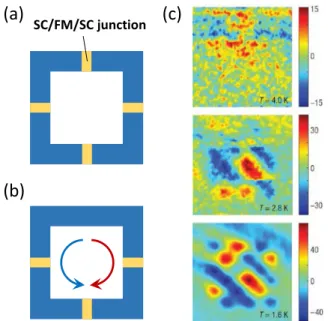
3.1 Spontaneous Currents in Superconducting Arrays An interesting experiment regarding phase-shifted super- conducting systems withπjunctions has been demonstrated by Frolovet al.[28]. The authors demonstrated spontaneous current imaging in frustrated superconducting loop array structures. They fabricated an array consisting of supercon- ducting loops with even and odd numbers of ferromagnetic Josephson junctions, as shown in Figs. 3 (a) and (b), respec- tively. The thickness of the ferromagnetic (CuNi) layer was set to 11 nm, for which the Josephson junction changes to theπ state from the 0 state at 2.8 K with decreasing tem- perature. When the junction was in theπstate, no current flowed in the loop containing even numbers ofπjunctions in the ground state; this occurred because the flux quantiza-
Fig. 3 Schematics of (a) an unfrustrated and (b) a frustrated supercon- ducting cell withπjunctions. (c) SSM image of a 6×6 checkerboard- frustrated array at temperatures of, from the top, 4.0, 2.8, and 1.6 K. The vertical magnetic field scale is approximately in units of mΦ0[28].
junctions) and “unfrustrated” (evenπjunctions) cells using a scanning SQUID microscope (SSM). Figure 3 (c) shows an SSM image of a 6×6 checkerboard-frustrated array at various temperatures. For temperatures above the 0–πtran- sition temperature of 2.8 K, all the ferromagnetic Josephson junctions were in the 0 state, so no spontaneous currents ap- peared. When the temperature decreased and became lower than 2.8 K, spontaneous currents started to flow in the cells, and a clear magnetic flux pattern appeared in the array be- cause of the spontaneous current at 1.6 K. This is a striking demonstration of the intrinsic phase shift of theπjunctions, and the experimental system with the magnetic flux array is attractive for studying the frustrated two-dimensional sys- tems[29].
3.2 Supercomputing Logic Devices
One important application of superconductors is in cryo- genic computing[4],[30]–[33]. Recently, various types of superconducting logic devices have been developed as can- didates for post-CMOS computers, such as RSFQ[4],[30], adiabatic quantum flux parametron (AQFP)[31],[32], and reciprocal quantum logic (RQL)[33]devices. The main ad- vantages of these superconducting logic devices are their high-speed operation and ultralow power consumption. For example, RSFQ circuits can operate on the order of 10–
100 GHz[30], and an AQFP has been demonstrated to have a power consumption of 10 zJ[32]. Not only do these de- vices have potential for use in high-performance computing systems, but the RSFQ and AQFP circuits are also expected to find use as cryogenic signal-processing circuits for su- perconducting nanowire single-photon detectors (SSPDs or SNSPDs)[34],[35].
Efficient phase shift and control are crucial for improv- ing the performance of superconducting logic devices. In a conventional RSFQ circuit, there is a problem associated with a large single-flux storage cell because high geomet-
Fig. 4 Schematic of aπ-junction flux qubit. The optimum point in the energy diagram of the ground and excited quantum states is located at zero external magnetic field.
rical inductance is required for storing magnetic flux quan- tum. Such large cells prevent the cell size of RSFQs from being reduced. To overcome this problem, a study has pro- posed replacing the inductance with aπjunction; the authors designed a toggle flip-flop (TFF) circuit that included aπ junction[36]. Utilizing a numerical simulation of aπ-TFF circuit, they confirmed that their proposed circuits operated correctly and possessed a sufficient margin for operation.
Experimentally, a first phase-shifted RSFQ circuit has been realized by the d-wave pairing symmetry of a high- TCsuperconductor, YBCO[37]. Theπ-TFF was developed by combining the YBCO and Nb, and the authors demon- strated that its operating stability was improved for a vari- ety of parameters in the phase-shifted RSFQ circuit. They also demonstrated that the bias current supply can be re- duced because the bias current required to realize the two- fold degenerate energy state was replaced by insertion of the πjunction. In 2010, the implementation of a SC/FM/SCπ junction into a RSFQ logic circuit was reported[38]. The authors fabricated a RSFQ-based frequency divider that in- cluded a π-TFF with an Nb/CuNi/Nb junction, and they demonstrated correct operation of the circuit.
3.3 Superconducting Quantum Computers
A quantum computing device is a recent vigorous applica- tion of superconductors[6]–[8]. Among the various candi- dates for a quantum computer, the superconducting qubit has many advantages; the qubit and the peripheral circuit to control and read out the quantum state can be designed, ac- cumulated techniques concerning device fabrication can be adopted, and so on. Actually, in the superconducting qubit, the circuit quantum electrodynamics (circuit QED) has al- ready been demonstrated, and the control and readout of the qubit state can be performed by using the microstrip cavity and line fabricated monolithically. An advantage of the su- perconducting qubit is that such a quantum system with de- sired circuit parameters can be designed and fabricated. As a result of many efforts to improve the decoherence time of the qubit, sub-ms decoherence time has now been achieved[39].
One recent trend regarding the superconducting qubit is to realize large-scale systems with many qubits; thus, improve- ment of the scalability is crucial, as is a longer decoherence time.
Phase shift techniques can be applied to superconduct- ing qubits to improve their performance. The first proposal for superconducting qubits with intrinsic phase shift ele- ments was proposed by Ioffeet al.[40]. The basic struc- ture is similar to that shown in Fig. 2 (b). By connecting the positive and negative parts of a d-wave order parameter with an ordinary (s-wave) superconductor, double degener- ate states can be intrinsically generated without a constant external magnetic field. This is called a “quiet” qubit be- cause a finite magnetic flux (or circulating current) is not generated in the coherent quantum state; thus, there is no undesired electric or magnetic coupling to the environment.
This feature is expected to improve the decoherence time
of qubits. However, developing quiet qubits with d-wave superconductors is challenging because fabricating devices with high-TCsuperconductors is relatively difficult, and the reproducibility and controllability of the physical parame- ters are fairly low[41].
As another phase-shifted qubit, a πflux qubit with a SC/FM/SC junction has been proposed[42],[43]. The de- vice structure is similar to conventional flux qubits with Josephson junctions; oneπjunction and one or two Joseph- son junctions (0 junctions) are placed in a superconducting loop. In aπflux qubit, the magnetic pre-bias correspond- ing to the half-integer flux quantum that is necessary in the conventional flux qubit is not required to generate the coher- ent two energy level and operate at the optimum point with long decoherence time. Thus, similar to the quiet qubit, the decoherence originating from coupling to the environment, such as the magnetic noises of the pre-bias coil, will be sup- pressed compared with the conventional flux qubit. Further- more, for the realization of multi qubits, theπflux qubits do not require a uniform magnetic field to pre-bias each qubit precisely, so this feature is an advantage for large-scale in- tegration. From the point of view of device fabrication, the π flux qubit is possible because Nb-based SC/FM/SC πjunctions have been developed by many groups[18]–[24].
In the field of superconducting logic devices, Nb is com- monly used, and the fabrication of large-scale circuits has already been established; therefore, the πjunction is com- patible with conventional fabrication processes. Actually, a phase qubit with an Nb/CuNi/Nb π junction has been demonstrated experimentally[38]. In this experiment, the obtained decoherence time was comparable to that of the conventional phase qubit (without aπjunction), and further improvement of the decoherence time is desired. Very re- cently, high-quality NbN-basedπjunctions have been pre- sented toward a realization ofπflux qubits with longer de- coherence time[24].
4. Ideas for Control of Phase Difference
4.1 Electron-Distribution Modulation
In the phase-shifted superconducting systems with ferro- magneticπjunctions or d-wave paring symmetry discussed in Sect. 3, the degree of the superconducting phase shift is basically fixed. However, if one can control the 0 and π states electrically or magnetically, the possibilities for new device applications will expand.
Baselmanset al. presented an electrically controllable 0–πJosephson junction[44]. The device geometry is shown in Fig. 5 (a). They fabricated SC/NM/SC junctions using su- perconducting Nb electrodes with an Au barrier, and a volt- age control line was connected to the Au barrier via reser- voirs. In the diffusive Au region, a supercurrent-carrying density of states, which is similar to the Andreev bound states in the ballistic regime, is formed. Positive and neg- ative Josephson currents flow via the positive and negative parts of the supercurrent-carrying density of states, respec-
Fig. 5 (a) (left) Geometry of a controllable 0–πjunction that utilizes electron-distribution modula- tion. (right) The control voltage dependence of the Josephson critical current. Inset: current–voltage characteristics for control voltages of 0.38 (curve 1), 0.44 (2), 0.52 (3), 0.64 (4), 0.84 (5), and 1.70 mV (6)[44]. (b) (left) Geometry of a controllable 0–πjunction utilizing non-local spin injection. (right) Schematic of spin accumulation caused by the shift of the chemical potentials of the up- and down-spin electrons in the NM region of a SC/NM/SC junction.
tively. Therefore, by modulating the electron distribution in the density of states, the direction of the Josephson current (IJ) can be reversed. In this geometry, the electron distribu- tion can be changed by applying a large control voltage. As shown in the right-hand side of Fig. 5 (a), the current voltage curves were measured as a function of the control voltage, and it was observed that the sign of the Josephson critical current,IC, reversed with increasing control voltage at ap- proximately 0.5 mV. Although the mechanism of the sign reversal of the Josephson current was different from that for a ferromagneticπjunction, this result indicates a phase shift in the current–phase relation and can be used as a control- lable 0–πjunction in future applications.
4.2 Non-Local Spin Injection
The 0 andπstates are also expected to be controlled by gen- erating a spin imbalance in the NM of an SC/NM/SC junc- tion electrically[45]. Figure 5 (b) shows the geometry of a non-local spin injection. In the left-hand side, the FM elec- trode contacts the NM bar, and the NM is sandwiched by two SC electrodes (SC/NM/SC junction) in the right-hand side of the geometry. When the currentIbis biased from the FM electrode to the NM bar, spin is injected into the NM because the number of up-spin electrons is greater than that of down-spin ones at the Fermi level in the FM[46],[47].
As a result, the chemical potential in the NM close to the FM/NM interface is spin-split in the range of the spin relax- ation length from the interface. Although the charge current flows only to the left-hand side of the NM bar, the spin split- ting of the chemical potential relaxes also in the direction of the right-hand side of the NM bar; thus, a spin accumula- tion is non-locally generated in the NM at the SC/NM/SC junction, as shown in Fig. 5 (b). This non-equilibrium spin accumulation works as the exchange energy in the ferromag- net and will therefore modulate the Andreev bound states formed in the SC/NM/SC junction. Because the degree of spin accumulation can be controlled by the injected current from the FM, the Andreev bound states can also be mod- ulated electrically. As a result, it is possible that the 0–π
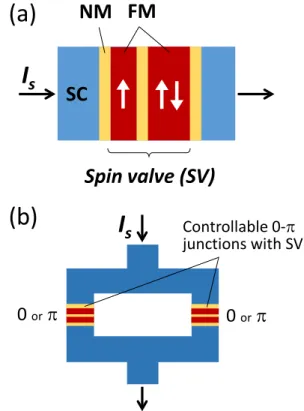
Fig. 6 (a) Schematic of a 0–πcontrollable Josephson junction with a spin-valve (SV) magnetic layer. The SV layer consists of two ferromagnets with different coercive fields separated by a normal metal layer. Parallel and anti-parallel alignments of the magnetization can be realized by apply- ing a magnetic field. (b) SQUID with two phase-controllable Josephson junctions with a SV layer.
transition can occur by changingIb.
4.3 Josephson Junction with Spin-Valve Structures Recently, another way to control the 0 andπstates has been presented in Josephson junctions with a spin-valve (SV) magnetic layer; SC/SV/SC junctions[48]–[50]. The SV layer consists of two FM layers separated by a non-magnetic metal. The two FM layers have fixed and free magneti-
zations, and the relative orientation of the magnetization can be set as parallel (P) or antiparallel (AP) by applying an external magnetic field. Because the effective magnetic layer thickness the order parameter experiences depends on the relative orientation of the magnetization, it is expected that the Josephson critical current will change depending on the magnetic state in the SV layer. This indicates that the strength of the Josephson coupling can be controlled by an external magnetic field. Furthermore, by optimally setting the thickness of a SV layer, it is also possible to control the 0 andπstates magnetically. In Ref.[48], SC/SV/SC junctions (Nb/Cu/Ni/Cu/NiFeNb/Cu/Nb) were fabricated, and the de- pendences of the critical current on the magnetic field and on the thickness of the Ni layer were measured systemat- ically. In the measurements of the characteristic voltage of the junction as a function of the Ni thickness, cusp behavior, indicating a 0–πtransition, was observed. Here it is strik- ing that the transition point (thickness) between the 0 andπ states is different for the P and AP alignments because the effective ferromagnetic layer thickness (i.e., the total phase shift) was larger for the P state than for the AP state. This result indicates that a 0–πmagnetically controllable junction can be realized utilizing the SV structure.
More recently, Gingrich et al. demonstrated a 0–π controllable SQUID[50]. This SQUID consists of two SC/SV/SC junctions in a superconducting loop, and the co- ercive fields of the free layers in the two SVs were designed to be different. The ground state of both of the junctions was the 0 state for the AP alignment and theπstate for the P alignment of the magnetizations of the layer. Therefore, by controlling the magnetic field, the state of the SQUID could be changed to the 0–0, 0–π,π–0, orπ–πstates. The authors clearly observed different critical current modulations for the four magnetic states. From an application point of view, 0–πcontrollable SC/SV/SC junctions and/or SQUIDs with phase-controllable junctions are promising candidates for cryogenic memory devices, which is a missing component in superconductor-based cryogenic computer systems[51].
5. Conclusion
In this review, we introduced the physics and device ap- plications regarding the phase shift and control in super- conducting hybrid structures using theπstate of ferromag- netic Josephson junctions and the d-wave order parameter.
By adopting the intrinsic phase shift in superconducting systems, various interesting phenomena and devices, such as efficient logic circuits, higher-coherence superconduct- ing qubits, and cryogenic memory devices, can be realized.
These novel techniques for efficient superconducting phase shift and control will facilitate the improvement of device performances and open up new possibilities for supercon- ducting device applications.
Acknowledgments
This work was supported by JST PRESTO Grant Number
JPMJPR1669, Japan.
References
[1] A.F. Andreev, “The thermal conductivity of the intermediate state in superconductors,” Sov. Phys. JETP, vol.19, no.5, pp.1228–1231, 1964.
[2] B.D. Josephson, “Supercurrents through barriers,” Adv. Phys., vol.14, no.56, pp.419–451, 1965.
[3] R.L. Fagaly, “Superconducting quantum interference device instru- ments and applications,” Review of Scientific Instruments, vol.77, no.10, p.101101, 2006.
[4] K.K. Likharev and V.K. Semenov, “RSFQ logic/memory family:
a new Josephson-junction technology for sub-terahertz-clock-fre- quency digital systems,” IEEE Trans. Appl. Supercond., vol.1, no.1, pp.3–28, 1991.
[5] C.A. Hamilton, “Josephson voltage standards,” Review of Scientific Instruments, vol.71, no.10, p.3611, 2000.
[6] J. Clarke and F.K. Wilhelm, “Superconducting quantum bits,” Na- ture, vol.453, no.7198, pp.1031–1042, 2008.
[7] T.D. Ladd, F. Jelezko, R. Laflamme, Y. Nakamura, C. Monroe, and J.L. O’Brien, “Quantum computers,” Nature, vol.464, no.7285, pp.45–53, 2010.
[8] M.H. Devoret and R.J. Schoelkopf, “Superconducting circuits for quantum information: an outlook,” Science, vol.339, no.6124, pp.1169–1174, 2013.
[9] M.W. Johnson, M.H.S. Amin, S. Gildert, T. Lanting, F. Hamze, N. Dickson, R. Harris, A.J. Berkley, J. Johansson, P. Bunyk, E.M.
Chapple, C. Enderud, J.P. Hilton, K. Karimi, E. Ladizinsky, N.
Ladizinsky, T. Oh, I. Perminov, C. Rich, M.C. Thom, E. Tolkacheva, C.J.S. Truncik, S. Uchaikin, J. Wang, B. Wilson, and G. Rose,
“Quantum annealing with manufactured spins,” Nature, vol.473, no.7346, pp.194–198, 2011.
[10] R.J. Soulen, Jr., J.M. Byers, M.S. Osofsky, B. Nadgorny, T.
Ambrose, S.F. Cheng, P.R. Broussard, C.T. Tanaka, J. Nowak, J.S.
Moodera, A. Barry, and J.M.D. Coey, “Measuring the Spin Polar- ization of a Metal with a Superconducting Point Contact,” Science, vol.282, no.5386, pp.85–88, 1998.
[11] G. Deutscher and D. Feinberg, “Coupling superconducting-ferro- magnetic point contacts by Andreev reflections,” Appl. Phys. Lett., vol.76, no.4, pp.487–489, 2000.
[12] G. Falci, D. Feinberg, and F.W.J. Hekking, “Correlated tunneling into a superconductor in a multiprobe hybrid structure,” Europhysics Lett., vol.54, no.2, pp.255–261, 2001.
[13] T. Yamashita, S. Takahashi, and S. Maekawa, “Crossed Andreev re- flection in structures consisting of a superconductor with ferromag- netic leads,” Phys. Rev. B, vol.68, no.17, p.174504, 2003.
[14] I.O. Kulik, “Macroscopic quantization and proximity effect in S-N-S junctions,” Sov. Phys. JETP, vol.30, no.5, pp.944–950, 1970.
[15] H. Sellier, C. Baraduc, F. Lefloch, and R. Calemczuk, “Tempera- ture-induced crossover between 0 andπstates in S/F/S junctions,”
Phys. Rev. B, vol.68, no.5, p.054531, 2003.
[16] A.I. Buzdin, L.N. Bulaevskii, and S.V. Panyukov, “Critical-current oscillations as a function of the exchange field and thickness of the ferromagnetic metal (F) in an S-F-S Josephson junction,” JETP Lett., vol.35, p.178, 1982.
[17] E.A. Demler, G.B. Arnold, and M.R. Beasley, “Superconducting proximity effects in magnetic metals,” Phys. Rev. B, vol.55, no.22, pp.15174–15182, 1997.
[18] V.V. Ryazanov, V.A. Oboznov, A. Yu. Rusanov, A.V. Veretennikov, A.A. Golubov, and J. Aarts, “Coupling of two superconductors through a ferromagnet: Evidence for aπjunction,” Phys. Rev. Lett., vol.86, no.11, pp.2427–2430, 2001.
[19] T. Kontos, M. Aprili, J. Lesueur, F. Genˆet, B. Stephanidis, and R.
Boursier, “Josephson junction through a thin ferromagnetic layer:
Negative coupling,” Phys. Rev. Lett., vol.89, no.13, p.137007, 2002.
[20] W. Guichard, M. Aprili, O. Bourgeois, T. Kontos, J. Lesueur,
of superconductor-ferromagnet-superconductor junctions,” Phys.
Rev. Lett., vol.96, no.19, p.197003, 2006.
[23] M. Weides, M. Kemmler, E. Goldobin, D. Koelle, R. Kleiner, H. Kohlstedt, and A. Buzdin, “High quality ferromagnetic 0 and pi Josephson tunnel junctions,” Appl. Phys. Lett., vol.89, no.12, p.122511, 2006.
[24] T. Yamashita, A. Kawakami, and H. Terai, “NbN-based 0 andπfer- romagnetic Josephson junctions,” Phys. Rev. Appl., vol.8, p.054028, 2017.
[25] D.A. Wollman, D.J. Van Harlingen, W.C. Lee, D.M. Ginsberg, and A.J. Leggett, “Experimental determination of the superconducting pairing state in YBCO from the phase coherence of YBCO-Pb dc SQUIDs,” Phys. Rev. Lett., vol.71, no.13, pp.2134–2137, 1993.
[26] J.R. Kirtley, C.C. Tsuei, J.Z. Sun, C.C. Chi, L.S. Yu-Jahnes, A.
Gupta, M. Rupp, and M.B. Ketchen, “Symmetry of the order param- eter in the high-Tc superconductor YBa2Cu3O7−δ,” Nature, vol.373, no.6511, pp.225–228, 1995.
[27] E. Il’ichev, V. Zakosarenko, R.P.J. IJsselsteijn, H.E. Hoenig, V.
Schultze, H.-G. Meyer, M. Grajcar, and R. Hlubina, “Anomalous pe- riodicity of the current-phase relationship of grain-boundary Joseph- son junctions in high-Tc superconductors,” Phys. Rev. B, vol.60, no.5, pp.3096–3099, 1999.
[28] S.M. Frolov, M.J.A. Stoutimore, T.A. Crane, D.J. Van Harlingen, V.A. Oboznov, V.V. Ryazanov, A. Ruosi, C. Granata, and M. Russo,
“Imaging spontaneous currents in superconducting arrays of π- junctions,” Nat. Phys., vol.4, no.1, pp.32–36, 2008.
[29] S.E. Korshunov, “Phase transitions in two-dimensional systems with continuous degeneracy,” Phys.-Uspekhi, vol.49, no.3, pp.225–262, 2006.
[30] M. Tanaka, K. Takata, R. Sato, A. Fujimaki, T. Kawaguchi, Y. Ando, K. Takagi, N. Takagi, and N. Yoshikawa, “Development of Bit-Se- rial RSFQ Microprocessors Integrated with Shift-Register-Based Random Access Memories,” Ext. Abst. 15th Int. Superconductive Electronics Conf., no.DS-001, pp.157–159, Nagoya, July 2015.
[31] N. Takeuchi, D. Ozawa, Y. Yamanashi, and N. Yoshikawa, “An adia- batic quantum flux parametron as an ultra-low-power logic device,”
Supercond. Sci. Technol., vol.26, no.3, p.035010, 2013.
[32] N. Takeuchi, Y. Yamanashi, and N. Yoshikwa, “Measurement of 10 zJ energy dissipation of adiabatic quantum-flux-parametron logic using a superconducting resonator,” Appl. Phys. Lett., vol.102, no.5, p.052602, 2013.
[33] Q.P. Herr, A.Y. Herr, O.T. Oberg, and A.G. Ioannidis, “Ultra- low-power superconductor logic,” J. Appl. Phys., vol.109, no.10, p.103903, 2011.
[34] T. Yamashita, S. Miki, H. Terai, K. Makise, and Z. Wang,
“Crosstalk-free operation of multi-element SSPD array integrated with SFQ circuit in a 0.1 W GM cryocooler,” Opt. Lett., vol.37, no.14, pp.2982–2984, 2012.
[35] N. Takeuchi, T. Yamashita, S. Miyajima, S. Miki, N. Yoshikawa, and H. Terai, “Low-power and low-current adiabatic interface for su- perconducting nanowire single-photon detectors,” Opt. Exp., vol.25, no.26, pp.32650–32658, 2017.
[36] A.V. Ustinov and V.K. Kaplunenko: “Rapid single-flux quantum logic usingπ-shifters,” J. Appl. Phys., vol.94, no.8, pp.5405–5407, 2003.
[37] T. Ortlepp, Ariando, O. Mielke, C.J.M. Verwijs, K.F.K. Foo, H.
Rogalla, F.H. Uhlmann, and H. Hilgenkamp, “Flip-flopping frac- tional flux quanta,” Science, vol.312, no.5779, pp.1495–1497, 2006.
and G. Blatter, “Environmentally decoupled sds-wave Josephson junctions for quantum computing,” Nature, vol.398, no.6729, pp.679–681, 1999.
[41] Y. Makhlin, G. Schon, and A. Shnirman, “Quantum-state engineer- ing with Josephson-junction devices,” Rev. Mod. Phys., vol.73, no.2, pp.357–400, 2001.
[42] T. Yamashita, K. Tanikawa, S. Takahashi, and S. Maekawa, “Super- conductingπqubit with a ferromagnetic Josephson junction,” Phys.
Rev. Lett., vol.95, no.9, p.097001, 2005.
[43] T. Yamashita, S. Takahashi, and S. Maekawa, “Superconductingπ qubit with three Josephson junctions,” Appl. Phys. Lett., vol.88, no.13, p.132501, 2006.
[44] J.J.A. Baselmans, A.F. Morpurgo, B.J. van Wees, and T.M.
Klapwijk, Nature, vol.397, no.7, pp.43–45, 1999.
[45] T. Yamashita, S. Takahashi, and S. Maekawa, “Controllableπjunc- tion with magnetic nanostructures,” Phys. Rev. B, vol.73, no.14, p.144517, 2006.
[46] M. Johnson and R.H. Silsbee, “Interfacial charge-spin coupling: In- jection and detection of spin magnetization in metals,” Phys. Rev.
Lett., vol.55, no.17, pp.1790–1793, 1985.
[47] F.J. Jedema, A.T. Filip, and B.J. van Wees, “Electrical spin injection and accumulation at room temperature in an all-metal mesoscopic spin valve,” Nature, vol.410, no.6826, pp.345–348, 2001.
[48] B. Baek, W.H. Rippard, S.P. Benz, S.E. Russek, and P.D.
Dresselhaus, “Hybrid superconducting-magnetic memory device us- ing competing order parameters,” Nat. Commun., vol.5, p.3888 doi:
10.1038/ncomms4888 (2014).
[49] B. Baek, W.H. Rippard, M.R. Pufall, S.P. Benz, S.E. Russek, H.
Rogalla, and P.D. Dresselhaus, “Spin-transfer torque switching in nanopillar superconducting-magnetic hybrid Josephson junctions,”
Phys. Rev. Applied, vol.3, no.1, p.011001, 2015.
[50] E.C. Gingrich, B.M. Niedzielski, J.A. Glick, Y. Wang, D.L. Miller, R. Loloee, W.P. Pratt Jr, and N.O. Birge, “Controllable 0-πJoseph- son junctions containing a ferromagnetic spin valve,” Nat. Phys., vol.12, no.6, pp.564–567, 2016.
[51] T. Yamashita and H. Terai, “Recent Progress in Ferromag- net/Superconductor Hybrid Structure and its Applications to Cryo- genic Computing,” IEEJ Transactions on Fundamentals and Materi- als, vol.136, no.12, pp.728–733, 2016.
Taro Yamashita received his Ph.D. de- gree in physics from Tohoku University, Japan, in 2005. He is currently a Senior Researcher at the National Institute of Information and Com- munications Technology (NICT), Japan. He is also a PRESTO Researcher, Japan Science and Technology Agency. His research interests in- clude superconducting devices and physics and superconducting spintronics. He is a member of the Japan Society of Applied Physics (JSAP), the Physical Society of Japan (JPS), and the In- stitute of Electronics, Information, and Communication Engineers of Japan (IEICE).