1 . Introduction
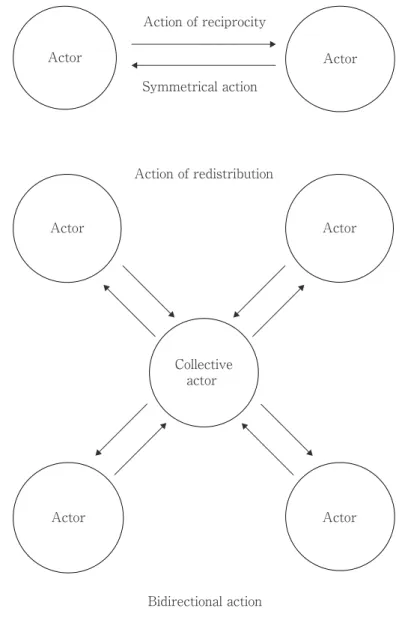
We cannot live alone. We have been living helping each other. Therefore mutual help is important factor for our lives. The action of mutual help in regional societies is divided into three types based on the direction of actions (Figure 1 Direction of mutual help). One is reciprocity in helping to plant rice and re-roof houses by exchanging labor. The second is redistribution. In exchange for the right to get goods from a common store, local people have the obligation to maintain common-pool resources.
Finally, unidirectional help refers to support in funeral and wedding ceremonies requiring no monetary exchange.
The hypothesis of this paper is that the Asian countries of Japan, South Korea and China have similar patterns of mutual help action and the study explores both the commonalities and differences among them. These traditional actions are have been and continue to be transformed through modernization in the three countries resulting in varying outcomes as they adapt to external influences.
The paper focuses on the ways that evolved and evolving traditional community help networks contribute to community sustainability in the face of modernity (Etzioni, 1996). Historically each society has been maintained through mutual help networks as a spontaneous social order. However, modernization has introduced challenges to these networks as it has taken hold.
In Japan, the largest challenges have been a rapidly aging population coupled with 論 文
Reconstructing Sustainable Communities through Mutual Help Networks in East Asia:
A Comparison of Japan, South Korea and China
Morio Onda
Action of redistribution Actor
Actor
Actor
Actor
Actor
Actor Collective
actor
Bidirectional action Action of reciprocity
Symmetrical action
Actor Actor
Action of support or assistance (non-reciprocal)
Unidirectional action
Figure 1 Direction of mutual help
a decrease in its size leading to a loss of vitality in more rural areas. South Korea has been confronting its continuing modernization under the strain of the military and cultural conflicts on its peninsula leading to challenges to its traditional dominant Confucianism. China has been confronting the contradiction of extreme socialism onto which modern capitalism has been grafted in many sectors of society. Although new communities are constantly evolving under such various pressures, the role that mutual help networks as a spontaneous social order have been playing remains significant.
2 . Survey method
The survey was conducted through interviewing local people living in regional society using questionnaires on the connections and bonds among people prepared based on previously developed semi-structured interviews conducted in Japan beginning in 2002 which bore fruit as a book in 2006 (Onda, 2006). Additional information for the study analysis was gathered through published earlier materials. The earlier study (Onda, 2006) shows that mutual help systems are three types based on the direction of participant actions. Surveys on the topic have continued in Japan.
The survey respondent population was expanded in 2007 to include residents of South Korea and China. The questionnaires used in these countries are based on the Japanese model, focused on the three types of mutual help identified in regional society there. Though the research in the two additional societies has been intermittent over the past 7 years, the semi-structured interview instrument began to systematically to find the equivalent of the Japanese reciprocal, distributional and unidirectional help in 2011.
In South Korea the field survey was conducted both on the peninsula and some of its adjacent islands which were included expressly to compare with the data gathered from the similar smaller islands of Japan. The hypothesis is that South Korea has the spirit of the peninsula which consists of both groupism of Japan and individualism of China. Therefore inlands in 2007 and islands in 2012, 2013 were researched⑴.
The hypothesis is that China has different from the Japanese island spirit and the South Korean peninsula spirit. This is the continent spirit. The paper compares efforts of communities in the three countries keeping alive mutual help networks as traditional customs in modernizing societies. In China the survey was begun in the north, including villages in Liaoning, Jilin and Heilongjiang Provinces in March, 2009. In
September, 2012, it was extended to villages in Fujian Province along with the eastern provinces of Jiangsu and Zhejiang in 2012. In March, 2013, additional interviews were conducted in villages in Shanghai suburbs⑵.
3 . Japan
⑴ Types of Mutual Help
①Yui: reciprocal action
The first type, yui, refers to the exchange of labor. Peasants helped in planting and cutting rice and re-roofing houses with pampas grass. Harvesting rice required intensive labor and farmers helped their neighbors on the condition of later receiving help themselves. When a peasant built or repaired the roof of a house, others helped through the exchange of labor. Women would contribute half as much labor as men.
The benefited peasant returned the favor at another time. Although there are few yui of this type remaining, we can still see it in action among extended family relatives in agricultural villages. The social action is symmetrical (Sugden, 1984).
Yui is reciprocity. The giver always gets the same volume and quality of labor in return (Gouldner, 1960). It is a rational exchange and the labor unit is the family.
Historically, there were two forms; a single family to single family exchange group and multi-family groups. In the second instance, the exchange group might have consisted of families ‘A,’ ‘B’ and ‘C.’‘A’ family got labor from families ‘B’ and ‘C.’
The next time, ‘B’ got it from ‘C’ and ‘A.’ Likewise ‘C’ was given labor from ‘A’
and ‘B.’
②Moyai: redistributive action
Moyai refers to the redistribution of common goods and services. Historically, those who had commons of mountain, forest or sea distributed these resources among themselves mainly based on the amount and quality of labor that local people provided to maintain the commons including such village-mandated public works (mura shigoto) as repairing and cleaning roads, canals and reservoirs. The vectors of the action are toward the center from the periphery and vice versa.
An entire participating village family could use the mountains, forest or sea commons, based on the effort undertaken by a single member. If a family did not participate in the public work, it was condemned as a destroyer of village order.
However, a family or an individual could be excused from this work by paying a
monetary penalty. Nowadays the traditional action of this form has been revived in the repairing of roads by local people.
In another form of moyai, rather than supplying labor, money was sometimes collected among local people to help the poorest. This ‘money moyai’ became popular after the spread of currency in villages. The rotating credit system (Geertz, 1962) has remained especially popular in Okinawa Prefecture. In addition, a money moyai would sometimes collect money simply to accumulate funds for some future unstated need⑶. In a further variation, such commodities as harvested crops, household goods and Japanese pampas grasses for roofing would be gathered to give to people who could not otherwise afford them. This might be called ‘goods moyai.’ Villagers further supported the life of the poor by providing them land of the commons preferentially so that every family could maintain its life independently.
③Tetsudai: unidirectional action
Tetsudai is the third form of village mutual help. This is ‘one-way’ or unidirectional aid, in which there is no expectation of reciprocity. Despite this, even the chronically poor or temporarily disadvantaged would often still try to give goods or labor in return eventually. Accordingly, many people who were helped through tetsudai would record the nature and amount of the aid. If the assistance was in the form of labor, they would often serve food to their helpers.
Tetsudai, could, and still can, also be seen in wedding or funeral ceremonies.
When one died in a regional society, villagers would gather to help by caving a tomb for burial and shouldering the coffin. Also, people brought the grieving family food ready to cook, entertained condolers and helped in other ways to provide vital encouragement to the family. All was noted in a ‘memorandum of unhappiness’ for each funeral ceremony in order to register the historical continuity of village tetsudai.
In the future the bereaved family might try to reciprocate these efforts, occasionally giving this form of tetsudai a reciprocal cast.
Tetsudai operated through two types of social relationships, equal and unequal.
Equal or horizontal relationships were maintained between families of the same social rank. Unequal, paternalistic, vertical social relationships, similar to patron-apprentice relationships, operated between landowners and peasants. Both types of tetsudai can still be seen nowadays in rural communities not only in partnerships, but also in semi- vertical power relationships.
The three forms of mutual help, then, operate through symmetrical action (yui),
bidirectional action (moyai) and principally unidirectional action (tetsudai). According to Polanyi, reciprocity, redistribution and exchange are economic actions operating as social actions and exhibit both market and non-market characteristics (Polanyi, 1977).
Mutual help as a social action is non-market oriented. When mutual help becomes fully market-oriented, the ‘spirit’ of mutual help has been lost. This article contends, however, that the spirit of mutual help does persist in modern, market-oriented Japan, but in a transformed manifestation.
⑵ Organizations of Mutual Help: Kumi and Kou
①Formal Standing Organizations: Kumi
Historically, mutual help was carried out through two organizations called kumi, standing formal institution and kou, an ad hoc organization focused on a specific purpose (Onda, 2005: 2006). A kumi was organized by family, age and sex and active participation was almost mandatory. This was the basic unit for all forms of yui, moyai and tetsudai. A yui gumi (‘g’ replaces ‘k’ in common verbal usage), for example, was a work unit for planting and harvesting rice and re-roofing houses. The wakamono gumi (a mail youth group) played an important role in public works as well as taught village rules, turning boys into men.
Another type of kumi was compelled by either the central or local government and had the purpose of helping to maintain control of local people who were already used to participating in voluntary mutual help structures. The gonin-gumi (the standard group of five households) and the tonari-gumi (the group of ten households) were examples. The former was the unit of mutual help with cooperative responsibility in the Edo era (1603-1867) for mutual protection among farmers and paying tribute. The latter was the unit with the same responsibility during the Pacific War (1941-1945) in the Showa era (1926-1989) for controlling individuals during emergencies. There are now relatively few such compulsory organizations. Spontaneous organizations for mutual help continue to be important to local people.
②Ad hoc (privately constituted) organizations: Kou
The second kind of mutual help organization, a kou, would be organized to a specific purpose. Villagers would help a troubled person by collecting money, or donating goods and labor. These organizations also realized the spirit of local and indigenous religions. Focuesd not only on social and religious activity, they were also vehicles for micro-finance. Kous originated in the religious activity of reading Buddhist scriptures.
A group of believers who gathered to study evolved into an organization for mutual help included fundraising for specific purposes beyond temporary charity.
Generally speaking, an organization tended to be called a kou if it had a religious or an economic purpose. Kous first raised money to establish their own economic foundation, and later to contribute to the relief of the poor materially as well as emotionally. The micro-finance mechanisms of a kou differed from a kumi. It was a rotating credit association. The tanomoshi version, for example, lent money to the poor without interest. Another kou organization (muzin) lent money with interest.
Nowadays there are still some kou religious organizations that support pilgrimages for believers in indigenous land gods such as Ise kou (funding trips to the most sacred shrine of Shintoism) or Fuji kou (funding trips to climb Mt. Fuji).
⑶ Reconstructing communities after the Great East Japan Disaster (The Fukushima earthquake, tsunami and nuclear meltdown)
①Community reconstruction as a phase of ‘community life cycles’
In considering community consciousness, we can construct a life cycle divided into 4 phases (Figure 2 Life cycle of a community) (Onda, 2013a). The first is a ‘period of introduction’ in which the consciousness of community starts to grow when new residents begin to live as neighbors. This is followed by a ‘period of growth.’
The third phase is a ‘period of maturity’ during which a community heads toward stasis and starts to scatter. The final phase is a ‘period of decline’ when growth is completely curtailed and population dwindles. If a community is in the fourth stage precipitated by disaster, the community should be considered how to be revitalized.
By what means could it be possible to revive a consciousness of community?
The first observation about the transformation of mutual help networks caused by the Great East Disaster is that the less intimate human relations in a regional society had become, the more intimately the victims responded to the help of volunteers (Onda, 2013a)⑷. We could draw the second observation drawn from the interviews is that the stronger the outside help, the more the victims come to rely on it in lieu of local help, weakening local bonds and fracturing local society. The third observation is that if the lack of mutual help networks in a separated society degrades the previous bonds of the original locale, then local people who were displaced by the atomic accident especially will look to recreate them elsewhere. They express deeper distress and anger than those who had ‘only’ the natural disasters to cope with. There might be no friction of feelings among victims who share the fear of radioactive contamination
in the ‘refugee community.’ However, the more closely they had previously interacted through traditional mutual help networks, the more they were disappointed with the loss of these relationships.
According to the first observation through the experience of the victims, reconstruction of a local disaster prevention or security organization should be done through the participation by neighbors whose normal ties were weak. Taking the roots of the word community literally, ‘com’ meaning to be communal and ‘munis’
means to have responsibility, we can infer that local people have to rebuild local society through recreating communal responsibility.
As the second observation shows, outside volunteers can gain the confidence among local people, acting as ‘catalysts’ that could lead to repairing the cracks in devastated community networks. This can be effective even though, in the end, the previous communal relationships are unlikely to be perfectly reconstituted. Outside help, then, should first play the role of supplementing mutual help networks in local societies.
The best abilities of networkers and of coordinators of volunteers are called into play to facilitate a codependence of healing leading to eventual independence of the local mutual help systems. Mutual help among local people is important because they know better the pain of their hearts.
It is more difficult for the victims of the additional atomic disaster to rebuild their communities. Many people were compelled to leave their home town and to flee
community consciousness
period introduction growth mature decline time Figure 2 Life cycle of a community
Fukushima Prefecture entirely. However, the third observation shows it important for them to rebuild their communities. In light of what we know about community life cycles, we should consider local peoples’ community consciousness in their new permanently resettled locations. The reality is they have no choice but to abandon the contaminated areas. The reality is that they have to resettle outside of the contaminated area. We should make new ‘nodule’ organizations where new and old inhabitants can interact through small group activities that can decrease the newcomers’ uncertainty and loneliness. It is preferable that the residential units of people who lived in the same town previously should be assembled to make new communities. Volunteers might play a role in connecting the victims who have become scattered as ‘weak ties’ or in connecting scattered communities as ‘structured whole’ (Granovetter, 1975; Burt, 1992). If local people in the same town can play these roles, the bonds of victims and the cohesiveness of the communities would be strong.
After all, it should be recommended that victims rebuild mutual trust and community empowerment again by themselves (Crow, 2004; Friedmann, 1992).
②Lessons of reconstructing communities through the big disaster
The forced depopulation of the stricken area has been masking the concurrent severe problem of lessened vitality due to depopulation that is occurring naturally in much of rural Japan. More intensive investment by local governments is especially necessary for the recovery of marginal communities. The less populated an area becomes, leaving fewer and fewer local successors, the less vital it will be. We should note that some local communities were disbanded after redistributing the funds (self-government fee) that local people had assembled. However, people who did not leave such societies would want to rebuild their communities by themselves (Putnam, 2000), if possible. We should not embrace the idea that the reconstruction of some areas is not necessary simply because some of victims do not come back. Though each community may be reduced in population, suitable steps should be taken to reconstruct them all.
The situation is very difficult to solve because it is not easy for the victims to come back to their home towns, as exemplified by the following interviewees. A man in his 50s in Namie Town said that the town was not united and the community was broken up because inhabitants had fled separately. A woman in her 70s in the same town said that she was not reconciled to the atomic meltdown in the plant that her father had opposed before it was built and was anxious about grave of ancestors. A woman in her 30s in Futaba Town said that although the town mayor would make a new
town outside their former town, it would never be the same town. A man in his 60s in Futaba Town said that their town would eventually simply disappear. Another man in his 60s said that elderly people wanted to go back to their home towns, but it was only nostalgia, impossible to do due to radioactive contamination.
If a town were physically rebuilt, would the community mind rebuild as well?
The above opinions clearly show that the complete reconstruction of communities is very difficult. However, local people should struggle not to lose the consciousness of community. Mutual help as reciprocity reinforces self-esteem (Cahn, 2000). Japanese people expect that the victims who have been living in the shelter or the temporary housing can continue to nurture their sense of community. It is important for them to make not ‘a simulacrum community,’ but‘a genuine community.’
4 . South Korea
⑴ Types of Mutual Help
①Pumashi: reciprocal action
Indigenous mutual help networks during the period of the Japanese colonization and occupation (1910-1945) in the Korean Peninsula have been studied by Japanese scholars (Suzuki, [1943b] 1973, pp.67-68: 1958; Makino, 1973). There are also some books about villagers (Sou [1420] 1987; Sin [1471] 1991, Shigematsu, 1941: 1945). Pumashi refers to the practice of the reciprocal exchange of labor in both quantity and quality.
The labor unit was some families engaged in planting, weeding and harvesting rice, collecting firewood and thatching roofs or repairing fences. Food was given to labors in pumashi among those in a village who were at the same standard of living (Suzuki, [1943c], 1973, pp.107-135).
Pumashi refers to mutual help between two persons (Onda, 2012). Although putatively the giver always got the same volume and quality of labor in return, in practice the paradigm was sometimes asymmetrical. Japanese yui practices seem to have been more strictly equal than pumashi, perhaps because Koreans to be tolerant of mutual mistrust. Pumashi reflects the rationale of cooperation based on equality of economic status. It exchanges were ad hoc, following the Confucian principles of courteous reciprocity, while yui exchanges persisted among the same labor units over long periods of time.
In a different setting where rice is not cultivated, Cheju Island is famous for its women sea divers. Sunulum, which refers to lending a hand to others (Izumi, 1966),
was a mutual help system similar to pumashi employed in cutting grass during women sea divers’ becoming migrant workers and fishermen seting out on a long cruise. The traditional mutual help practices have been declining in modern times as the phenomenon of wage labor increases.
Depopulation through migration and low birthrates have contributed to a significant graying of the population on many islands. In 2000s pumashi is done for in growing rice, leeks and cabbages and the reroofing of traditional houses was still in practice in Jisan-myeon, Sachon-ri on Jin-do (island)⑸. However, pumashi of reroofing traditional houses has not been seen already (interview, September, 2011). In Gogun -myeon, Kage-ri on the same Island, pumashi has disappeared in agriculture but is still practiced in the fishery activities of cleaning abalone culture vessels and selling them (interview, March, 2012).
Rice planting and harvesting pumashi have diminished because of mechanization of agriculture in the Korean Peninsula. However, it persists in garlic and cabbage farming in Yeongsin-ri, Okcheon-myeon, Haenam-gun (interview, September, 2011), for dry field farming is not yet mechanized. In Dongnae-ri, Nagan-myeon, Suncheon- si, when a family that had no cow borrowed a cow in pulling a plow, the pumashi debt would be paid back in man power labor (interview, March, 2012). However, pumashi based reroofing exchange has disappeared as pampas grass is now purchased and professional labor is hired for reroofing task itself.
Pumashi labor was still used when local people cultivate rice and wheat as well as repair houses in Bi-ri of Heuksan-do (interview, March, 2012). Local people say pumashi in not fishery seeking personal profit but group oriented agriculture cultivating spinach or making salt. On heuksando Island some fishers use pumashi in grading abalone and cleaning abalone culture vessels. On Degi-ri, Imja-do, Sinan-gun, pumashi labor exchange is used in raising and harvesting red peppers, garlic and onion. On Chara-do and Anjwa-do in Anjwa-myeon, Sinan-gun, it is also seen and on Dolsan-do near Yeosu City, in harvesting wheat and sweet potatoes (interview, August, 2012).
②Dure : redistributive action
〈Dure and Buyo〉
(Dure)
Dure systems were ubiquitous in Korea in the period between 1392 and 1910 (Suzuki, 1958). This is formal cooperative work in which necessary labor is redistributed on all agricultural land viewed as a commons despite recognized ownership of individual
plots in contrast to pumashi which functions as private working relationship. The single task carried out under this scheme is weeding between transplanting and harvesting rice. Large tracts of land need more labor than smaller ones so proprietors of the former will get more labor than they donate.
However, if the amount of labor received exceeds giving labor, the difference must be made up in equivalent wages. In the middle and southern regions of the peninsula these wages were sometimes donated to the village foundation (Suzuki, [1943ab] 1973).
If each farmer has almost equal area of land, the payment is not necessary for balance.
Because large-scale farmhouses almost always end up pay wages, wage adjustments do not carry the sense of an employer-employee relationship. The rationality of mura society was found in an exact offset for each unit of farmers. Famers who do not have much land receive money giving labor. It were not necessary for non-participants or absentees to pay fines, but they lost farmers’ trust and were left out of the party.
This system resembles the Japanese moyai in gathering the entire work force of the village for a single task. Pooling the entire work force is more district than found in Japan. The practice of dure has diminished due to mechanization and population outflow to the cities. Dure labor exchange during the period of weeding after rice- transplanting had been done, alongside the pumashi activities such as reroofing.
Villagers also had the duties of cooperative work such as cleaning wells, building roads, restoring landslides and repairing dikes just as in Japan. Each family provides one worker and fines paid for failure to participate in these activities.
(Buyo)
Returning to island cultures, cooperative work for harvesting marine resources is called buyo, puyo and buyokkua corresponding to the Japanese fuzyo in Heuksan-do, on Sinan-gun (interview, March, 2012). If two workers are necessary in cooperative work, these words is used to help a family that can provide only one person. Seaweed and sea urchins are distributed as communal resources here, but abalone is considered personal property, food for individuals that breed them. Cleaning the seaside is communal and requires one worker from each family. In recent years, a financial contribution to the community is often substituted for the required labor. The rise of Christianity here has seen people engaged in communal volunteer efforts centered on churches.
In Sachon-ri of Jin-do (interview, September, 2011), buyo or puyo was used in cutting grass, repairing roads. The words were used for voluntary cooperative works also in Kage-ri, Gogun-myeon on the island. In Tou-do, Saengil-myeon,Wando-gun, cooperative
works such as cleaning seaside are said buyo or puyo (interview, March, 2012). Uryoku (physical strength) was used in cooperative work in Okcheon-myeon, Haenam-gun, Jeollanam-do. In Sa-do of Hwajeong-myeon, Yeosu City, community toilets and the seaside are cleaned through the instruction of an island official every day of summer.
In Dongnae-ri, Nagan-myeon, Suncheon City, cutting grass and care of public space plants were paid by the city. Such voluntary is gradually being replaced by wage labor (interview, March, 2012). Buyo was also used for cooperative works in the island.
〈Moyai Island〉
Entire small islands could be used as a commons to help local people in regional society. On Heuksan-do, some inhabitants think that lack of individual effort or self- help cause individual poverty (interview, March, 2012). On Beni Island, a nearby uninhabited island had been given to an elementary school which sold marine products so that the school got money for school suppliers and to support children more fully who could not go to school at all. A similar system of using an island as commons was found in Japan (Onda, 2006).
In a fishing village on Dolsan-do accessible from Yeosu City, the money for the teachers and school supplies in an elementary school was gotten by harvesting marine products such as seaweed and abalone on Pam-do, owned by four former villages that have been merged into one (interview, March, 2012). Nowadays marine products are harvested as individual property which is guaranteed by the membership dues of a cooperative, but some of them are also used for the village.
In Tou-do, Saengil-myeon, Wando-gun, there are eight uninhabited nearby islands owned by the residents of Tou-do. Among these islands, each year marine harvest locations are distributed among five twelve-member groups by an island official (interview, March, 2012). Two islands may be allotted to a single group as not all the islands have equally productive fishing areas. The catch is equally distributed among the members of each group, save for abalone which is considered a personal harvest.
These moyai style island systems are based on equality and on a spontaneous social order, both in Korea and Japan. They are not restricted to islands, but are also found in the mainland. The system is aimed to resolve the seemingly competing claims of freedom and equality (Rawls, 1971 [1999]). Local communities manage resources through rules (Acheson, 2003; Baden, [1977] 1998; Feeny, Berkes, McCay and Acheson [1990] 1998).
In Kage-ri, Gogun-myeon, Jin-do, poor people received rice from the community, but the living standard is now stabilized both by the income from abalone and the society
has been revitalized by young people who come back to the villages from cities (interview, March, 2012). People in Sa-do, Hwajeong-myeon, Yeosu City had emigrated from Nang-do, but there is little land used to cultivate. People in Nang-do held land in common through agnate relationships (descent through the male line, monchu) and cultivated the land (interview, September, 2011).
There are no commons as moyai islands in Imja-do (myeon), Chara-do and Anjwa- do in Anjwa-myeon, Haeui-do (myeon) near Mokppo City. Because some uninhabited islands around these main islands are owned by individuals (interview, August, 2012).
In Tocho-do (myeon), along with commons owned by schools which were salt fields used for vocational training of children. Later the fields were managed by professionals who donated the profits to a scholarship fund (interview, August, 2012).
③Puje: unidirectional action
There were several expressions such as konkuru, puje and pugun for labor services in the Korean Peninsula in use before the Second World War. These refer to social actions which do not expect reciprocity. Konkuru refers to cutting grass by payment, giving labor to the family of serious disease or the first mourning period without payment (Suzuki, 1958). Puje refers to the gift of labor, goods or money when someone was in trouble in Anseong district, Gyeonggi-do. It was called kojo which refers to labor without payment in Jeonju district, Jeollabuk-do (Suzuki [1943b] 1973, pp.445- 455). Pugun refers to work without payment for the help of new housing, disease or the troubled. These customs are equivalent to tetsudai in Japan. The unit of pugun had mountains as the commons. Communal work consisted of cooperative labor for ditches, road, well and maintaining the village hall (ibid. p.84.).
After the Korean War, the peninsula was divided into South Korea and North Korea. In South Korea, ceremonial practices have changed in rsesponse to economic development. Local people began to use undertakers for funereal ceremony as many people died in hospitals rather than at home. The members of Sandukke that is the organization for funeral ceremonies help the grieving family. In Sachon-ri Jisan-myeon, Jin-do, dunda has been called to the action which people do not expect as a reward (interview, September, 2011). Wedding ceremonies were moved to cities because it was easier for people now working for wages assemble, while others prepared the banquet in their own town. Local people used to make food for the ceremony, but were supplanted by professional caterers. However, local people enjoy ceremonies and are happy to still give money as a show of pumashi as reciprocity. Generally speaking,
the traditional cohesion and bonds have become weak in rural areas in South Korea, just as they have in Japan.
⑵ Organizations of Mutual Help: Ke
The actions of ke are redistributive to assemble manpower, goods and money and to divide among members. There were and are a variety of ke in South Korea. Suzuki described them as similar to Japanese kou (Suzuki, 1958). Based on Confucianism ethics, ke particularly respects the hierarchy of age and manifested itself in many organizations and functions such as ‘persistent ke,’ consisting of an agnate group,
‘amusement ke,’ ‘public service ke,’ ‘funds accumulation ke’ and ‘ceremonial ke.’
Regional ke has functioned as organizations for public or social service among regional people. There was also ke in which villagers had to participate in maintaining forest commons, water supplies and river banks. Some kes had disappeared as commercial organizations appeared. ‘Yangban ke’ was the organization for the former governing classes and ‘agnate group ke’ for descent through the male line.
‘Ceremonial ke’ functioned to support the chief mourner by giving labor or rice from each household and often lent common funeral paraphernalia. In Japan there are kous for ceremonial occasions of regional people. The ‘unhappy groups’ worked for the chief mourner. There was also the ke for weddings. Traditional ke disappeared, but some of ke remain preparing for future uncertainty.
There were kes for purchasing goods by a group that an individual member couldn’t afford. For example, a cow ke was formed in which each member paid and the cow was awarded by lottery. We found similar kes formed to purchase fertilizer, tableware and agricultural machinery. Kes have been created that span several villages, for example a public ke was used for building and operating a school and for purchasing books. This type of ke resembles a Japanese kumi to which local people paid self- government fees. Other South Korean kes resembled Japanese tanomoshi or mujin.
Auction ke accumulating money is a rotating credit system. Another purpose of the monetary kes were to increase funds through lending outside the membership at higher interest. This kind of ke can still be found today.
⑶ Reconstructing community under urbanization of islands
①Strong mutual help based on agnate relationships
South Korean mutual help networks depend on both agnate and neighborhood kinship ties. Agnate relationships here are stronger than among the Japanese and the agnate
groups (monchu) are divided into the two types: in one case residents of an entire village are descended from the same ancestor; in the other a village is populated by the offspring of several ancestors. Few people leave the village and few join it in the former village and fluidity is comparatively high in the latter village (Itou, 1977: 2013, pp.259-306). In agnate groups scholarship was provided for poor children, orphans were nurtured and activities demonstrating respect for the aged were carried out.
Furthermore, a community of villages was maintained with common meeting places, public warehouses, workshops, market places, wells, bathhouses and washhouses.
Several contracts among mutual organizations in the agnate group played safety net roles. They were based on strong spirit of Confucianism (Bird, 1905) and supplemented the neighborhood kinship.
The agnate group has commons for the benefit of members. The group has instituted common funds and bought the land for tombs. For example, in Jin-do, the commons of one agnate group helped poor members by lending an agricultural commons (interview, September, 2011). Those who had benefit of the land had the duty to maintain the tomb of the ancestors. These benificiaries were called Sanjiki, which means ‘keepers of the mountain.’ The land itself was called Sanjikita, ‘the land of Sanjiki.’ The period of use of the commons was indefinite, lasting until the borrower regained prospects of a stable life. The same institution can be found also on the mainland (interview, March, 2012). The village common land, fairly limited in size, was lent to the poor people who had to pay the rent to the regional mayor.
In another mainland district, Yeongsin-ri, Okcheon-myeon, Haenam-gun, local people also call borrowers of the agnate commons Sanjiki (interview, September, 2011). In some cases such lands may be lent to the house boys or other servants as unrelated outsiders from the agnate group. These borrowers still have the duty to maintain ancestral tombs. In these cases also, the term of use is indefinite, lasting until the beneficiaries have sufficiently built a financial base. Because lenders who may be living in cities cannot regularly maintain the tombs. In Bi-ri, Heuksan-do, Sinan-gun, the person responsible for borrowing the land owned by the agnate group would manage tomb maintenance and carry the title Sanjiki also. According to the staff of the folk history study preservation group of Heuksan-do, there were few agnate groups on the island because criminals had been compelled to live there.
Sanjiki managed the mountain instead of borrowing land. There were many persons who was called Sanjiki in the island (interview, March, 2012). This would be called a patron-apprentice relationship. A woman in her 60s was afraid that sanjiki
would disappear in the future, for many people did not respect the agnate group as tradition. Agnate groups were not extant in all areas. There is none in Imja-do (myeon) (interview, August, 2012). The institution of sanjiki has persisted in the areas where the genealogy of the agnate group has been carefully maintained.
②South Korean structure of mutual help society
Korea had been controlled by the Japanese government since the Japan-Korea merger in 1910. The rules through the former administrator had remained in Korean villages until the time. For example, the rule resembled the Japanese ‘five-person group,’
which functioned for mutual protection among farmers and paying tribute in the Edo era (1603-1867). At the same time, it was an organization of mutual help. Though the public aid was distributed according to the rule, the communal help was based on mutual help networks as spontaneous social order in funeral and wedding ceremonies in villages. The scope of mutual help networks depends on social consciousness as a unit (Gouson syakaishi kenkyukai. 1996). They might help the seriously ill, cultivate the fields of those in the first stage of mourning, or employ the common tools for ceremonies that were kept in villages.
There have been many kes in South Korea (Itou, 2013, pp.307-411). This system contributes to South Korean mutual help networks, providing safety nets through the horizontal relationships by residential people different from the vertical relationships characteristic of agnate groups. The spirit of ke is equality and reciprocity. The member who trust mutually are intimate personally and same old age. The members were selected on the basis of confidence and cooperation, irrespective of family or close neighborhood ties. One person may participate in several kes. Different from Japan, there are many kes preparing for future expenditures in each generational cycle. In the contrast to the strong cogenous spirit of an agnate group to define membership vertically (hierarchically) including master-apprentices relationships, the ke spirit is manifested in horizontal (equal), informal, non-consanguinal relationships including not only regional proximity relationships, but also relationships such as childhood friends, classmates or coworker.
The South Korea regional social system balance of these two sets of relationships demonstrates that not public aid, but communal help as a spontaneous social order is strong and the system of ke has the effect of equalizing individual difference of members in the maintenance of certain groups. Rather than strong individualism, weak individualism carries the relationships of members. Different from public aid,
the communal help of spontaneous social order has played an important role as safety net in villages. The participation in ke protects the lives of villagers in coping with unexpected situations and significant rites of passage.
South Korea manifests a multilayer mutual help society through both the agnate group (Lee, Jang and Lee, [1983] 1991, pp.67-73) and the neighborhood kinship (Sai, Cho and Kim, 1966). While the ethics of Confucianism hierarchy by age dominates and so that upward mutual help is obligatory, individual life is also respected through horizontal relationships. More precisely, the agnate group has two relationships of vertical respect; social position and precedence by age and horizontal help of the sanjiki system which supports to giving access to the land commons to the poorest among them. Confucianism plays a far more important role in emphasizing the importance of vertical relationships compared to the Japanese.
Meanwhile, in neighborhood groups horizontal relationships dominate manifested by exchanging labor, cooperating on village maintenance and supporting funeral ceremonies. From living in the same district or having attended the same school, ke relationships are supported and evident during many common situations of life. Ke has played an important role in not only the old administration (yanpan) but also in ordinary peoples’ villages.
The spirit of the agnate groups and neighborhood groups has both the vertical and horizontal relationships. In the island districts where the power of an entire class of landowners and government officials was not so strong, class-consciousness was weak and horizontal relationships were strong in contrast. Under urbanization of islands, traditional mutual help networks might be important to reconstruct community.
Because it leads to awakening the Korean spirit.
5 . China
⑴ Types of Mutual Help
①Huàn gōng : reciprocal action
The traditional actions have been and continue to be transformed through modernization in the two countries resulting in varying outcomes. After comparing Japan with South Korea, China is also analyzed here. Huàn gōng is a reciprocal labor exchange action used in planting rice and re-roofing (Onda, 2013c). This action is claimed by the government to be a form of cooperation in agriculture of cooperative society begun through socialism. However, it is, in fact, traditional action that arose
through spontaneous social order. Huàn gōng exhibits two forms, temporary and permanent action. The term huàn gōng indicates that the event is temporary.
A man in his 50s in K chin, S city, Liaoning Province said that a traditional action has not been seen in corn growing among relatives (interview, March, 2009)⑹. Further, if labor for harvesting wheat is in short supply, local people always use the wage labor of others. The income from such temporary wage labor is indispensable for each family’s income. Urbanization has diminished importance of huàn gōng because this village near a big city is heavily influenced by the proximity. Generally speaking, public aid through socialism is compulsory, weakening local, traditional spontaneous patterns. However, this mandate has paradoxically produced a negative result, in that garbage was left scattered around farmers’ houses and picking them up through traditional reciprocity might take someone’s job away.
Local people in D village, T district, F prefecture, C city, Amur Province represent a wide pattern and call the unit of group in size from 10 houses to 13 houses ‘a cooperative production group’ (interview, March, 2009). Member families had land use rights allotted according to the size of each family. This system is, therefore, supposed to obviate the need for agricultural labor reciprocity. Nonetheless, mutual help is exercised in raising corn, soybeans and husbandry of dairy cows.
Local people had worked cooperatively until the ‘age of the commune’ ended in 1978. In the same province, another production team is divided into 5 groups in D hamlet, S village, S district, T ward, C city. Here also the leader of each area allots the right to use land according to the size of each family member (interview, March, 2009). Mutual help is found not only among members of the same production team, but also among relatives. A man in his 80s in F hamlet, F village, K district, N city, Jilin Province said that mutual help is carried among relatives in planting and harvesting rice, and repairing houses by making bricks from the soil, but sometimes workers were also hired (interview, September, 2012).
A man in his 50s in K village, S district, F city, Fujian Province said that local people helped each other when they planted peanuts before 1985 and wage labors were hired (interview, September, 2012). The forced contribution system of farm production was abolished in that year and free enterprise increased (Nakagane, 1999). The combination of individual incentives to increase production and using mutual help does not increase the demand for labor. Free enterprise production still requires additional labor and wage labor has been substituted for labor exchange. The governmental price does not reflect the value of production cost. A wage labor system needs exact return of
money different from the same quantity and quality of exchange labor.
A woman in her 60s in K district, S village, of the same city and province said that there is little mutual help needed for the cultivation of peanuts, a recent crop addition on small plots, because peanuts grow well with the little water available in the village’s mountainous area (interview, September, 2012). However, mutual help is used in harvesting dry field crops like garlic and chinensis in winter. Local people have also been exchanging labor in the harvest of peanuts and soybeans. Because rice is not planted for the due to the bad quality of the water in F city of Fujian Province, industry has increased. Therefore the traditional custom of mutual help here is seldom evidence.
A woman in her 50s in I hamlet, T village, T city, Jilin Province said that local people still helped through huàn gōng (temporary wage labor) planting and harvesting vegetables such as eggplants, celery, potatoes and green peppers (interview, September, 2012). In a suburb of Shanghai, glutinous rice is grown with the help of hired workers from other locations (interview, March, 2013). Family workers were sufficient for planting and weeding, but paid migrant workers, also an example called huàn gōng, are needed to harvest dry field crops. There are few fallow fields or abandoned plots here, because cultivation on land owned by the elderly is maintained through the help of the young generation. In F hamlet, F village, K district, N city, the same province, the population has remained stale because the young work at factories outside the village. When necessary, some outside workers are hired to labor the fields (interview, September, 2012). Villages have depended on huàn gōng as spontaneous social order.
②Yì wù gōng :redistributive action
There is no commons or cooperative work to manage in K district, S city, Liaoning Province. Land is owned by the government which lends it to farmers. This principle makes people conscious their right to use it and, paradoxically, from a socialist point of view weakens the sense of cooperative effort overall. Nobody takes the responsibility to clean up for scattered refuse. The author observed the same phenomenon in Vietnam. People now think that major road maintenance is a government responsibility through public aid (interview, September, 2012). However, if the government fails to provide the funds, villagers managed to get repair expenses for a minor road by small contributions of the locals contributing money. After a road improvement or new road was built, a tablet of donor names was placed near the
road.
A woman in her 50s in I hamlet, T village, T city, Jilin Province said that there was trash scattered in the pond where she used to swim as a young girl. Nobody would clean it up in hopes that the government would do so as the land was communal (interview, September, 2012). Therefore cooperative communal cleaning has disappeared.
There are deteriorating roads in not only D hamlet, S village, S district, T ward, C city, Amur Province but in many similar locations (interview, March, 2009), because the government pays completely only for major roads, not minor villages roads.
Therefore, as in Lianoning Province above, local people must maintain small roads in villages. When 150 million gen (CNY) was needed to improve a road in S village, the government paid 100 million gen, the remaining 50 million gen had to be paid by local people. If public aid is insufficient, local people must make up the difference. While many small donations solved the problem in Lianoning Province, here the villagers borrowed from a farmers’ credit union.
In G village, H district, E ward, E city, Jiangsu Province, some roads have been paved through the ‘socialist new village movement’ as a government program. In K district, while young people under 50 work in factories, people over the age are engaged in firms that raise and harvest rice (interview, September, 2012). There are two hog raising facilities in the district. A woman said that local people had distributed goods among them in cooperative society and the commune era after 1950s. However, it was not simultaneous action, but the government introduced the distribution (interview, September, 2012). Now there are few cooperative works in this area. Local people has depended not communal help but public aid.
The government paid the half amount of the sum to improve roads and local people did the rest in K village, S district, F city, Fujian Province (interview, September, 2012). Farmers think cooperative works unprofitable. The stronger public aid is, the weaker communal help is. The former sometimes do more harm than good.
In C village, K prefecture near Shanghai, while the government is responsible for repairing roads, local people take care for themselves (interview, March, 2013). They are sometimes engaged in cleaning roads and treating garbage gathering money and hiring workers. But there is few cooperative works. They are conscious that the fields belong to the government and private land for living is borrowed from it getting the right to use. The difference between the public and the private makes few communal land. It results in few cooperative works.
A man in his 80s in F hamlet, F village, K district, N city, Jilin Province said that removing snow in winter was accomplished through yì wù gōng (work as duty), the cooperative work of local people (interview, September, 2012). It is obligatory labor, provided by one or more members of each family. This pattern covers shoveling snow in the usually severe winters of northeastern China. If a family fails to comply with the labor requirement, it is fined 50 gen (CNY) as in the similar institutions of Korea and Japan. This fine is expensive for local people to pay, equivalent to one day salary.
In contrast to the high consciousness of local people for cooperative works, snowplows are used in cities by paying money of families.
In during the age of the commune, in the slack season, farmers were compelled to labor on various construction projects as yì wù gōng duty. This was not min gong (normal work) which was paid for as the unit of production according to the volume from the government (Nakagane,1992). The form of yì wù gōng, in current use is performed as duty by each family when local people are compelled not by the government, but by communal consciousness. It is not the compulsory labor mandated by agriculture collectivization instituted in the 1950s but action based on the communality of mutual help redeveloped after 1985⑺. In general, presence of mutual help institutions might depend on the degree of compulsion in force when similar institutions of the government are changed or abolished.
③Bāng máng: unidirectional action
A man in his 80s in F hamlet, F village, K district, N city, Jilin Province said that villagers helped prepare for both funeral ceremonies and wedding ceremonies, such as providing necessary bedding for the new couple (interview, September, 2012). At the same time, he added that care for the bedridden elderly was problematic, though local people did help out when they could. The government pays 90% of the cost of medicine, but the villagers have to pay the rest. Though the government has tried to persuade the village to build a waterworks facility and use tap water, they still use well water. The government would only pay part of the cost. And besides, he said that tap water was not cool in summer. They are determined to keep their traditional life style as much as possible. He emphasized that it was good that the people of his area had demonstrated solidarity as both old and new inhabitants were united in gathering at a temple for a local festival.
A woman in her 50s in I hamlet, T village, T city, Jilin Province said that local life is supported by the government, but local people still helped each other through village
based solidarity (interview, September, 2012). They give money and care for the family of serious disease or the troubled. Few people continue to hold wedding ceremonies in local society. Many people now opt for city hotels. However, funeral ceremonies are held for three days and grief is shared with instrumental music in villages.
Local people help each other in funeral and wedding ceremonies also in K village, S district, F city, Fujian Province. The expression of help depends on each family’s circumstance giving a single cigarette if that is felt to be sufficient (interview, September, 2012). Funeral or wedding ceremonies reflect the difference of life. In F city local people are especially proud of their housing. But they help the troubled by organizing local people. A man in his 50s said that his mother at 96 years old had got a pension from the government and elderly people without relatives can use a care center. Not everybody in villages can take advantage of one because care center fees are expensive. However, the poorest and most seriously disabled villagers are guaranteed a minimum of cloth and food. While the institution of life insurance has been coordinated by the government, more insurance companies have been established since 1985.
A woman in her 60s in Y village, F district, the same city said that a group of friends or neighbors hired cooks for people who could not do it for themselves giving money (interview, September, 2012). A national government institution to care for elderly people was established 10 years earlier. People who live in cities and do not care for their parents back in the village hire helpers. A woman in her 70s in K district, S ward, S city, Jiangsu Province said that local people celebrated by bringing money in red papers at wedding ceremonies and men ate rice at the house of the bride’s family. In another ceremony they remember the dead on a certain days each month (interview, September, 2012).
In K district, S city in Liaoning Province, funeral ceremonies are conducted through the help of local people (interview, March, 2009). In D village, T district, F prefecture, C city, Amur Province, local people help to carve tombs for burial. Such actions with no expectation of financial or labor reciprocity are called tetsudai in Japanese (Onda, 2006). Like the Japanese and Koreans, the Chinese may several different terms used for unidirectional help. One is bāng máng (help at busy time). In Jilin Province, local people say lào máng.
In C village, K prefecture in the suburbs of Shanghai, if the family income falls below 3,600 gen (CNY) per year, the government will help support the poor. Therefore local people do not help by donating money, but they may provide clothes or extra
food (interview, March, 2013). If relatives live nearby, local people often care for them by contacting each other to give food and small donations for ceremonies.
The spirit of the traditional neighborhood mutual help has remained in Chinese regional society for ceremonial occasions though they no longer cooperate on road repair in areas where the government has assumed responsibility. This traditional spirit of unidirectional help has been transformed by the compulsory institutions of socialism and the survey suggests that local people now tend to depend more on governmental aid than communal help.
⑵ Organizations of Mutual Help: Hé huì
In Japan, the mutual help rotating credit system is called tanomoshi or mujin (Onda, 2006). The Chinese version is variously called hé huì, qián huì, ji ǎ ng huì or qián shè.
(Smith, 1899; Shimizu, 1939; Fukutake, [1946] 1976). Some local people call huì or shè in Jiāngnán villages (Fukutake, [1946] 1976, p.136). In D village, T district, F prefecture, C city, Amur Province during the era of Mao Tse-tung, hé huì (without interest) existed, but has since disappeared (interview, March, 2009).
A woman in her 80s in F hamlet, F village, K district, N city, Jilin Province said that local people gave money to those in financial distress, but there was no systematic hé huì (interview, September, 2012). In Huánán, many people go to work in quite distant areas but there are very few workers who go from home in this northeastern China.
Some people do go to Russia to help raise vegetables in spring, but in autumn they return. Because everyone works for wages here, local people do not have hé huì. In T city, savings plans are available in companies, city hall and schools, but there are none in T hamlet, T village.
Local people borrow money from villagers, but there is no hé huì in C village, K prefecture in the suburbs of Shanghai (interview, September, 2012). A man in his 70s said that there was hé huì existed in the 1970s in K village, S district, F city, Fujian Province, but local people eventually discontinued practice because some borrowers fled without repaying the money. Nowadays the standard of living is higher for wheat, vegetables and peanut farmers than the past. There are now few rotating credit system among local people.
A woman in her 60s in Y village, K district, of the same city said that local people had hé huì to supply rice to the poor 40 years ago when food was short, but now that the government is supposed to assume responsibility for the very poor, hé huì has disappeared (interview, September, 2012). Conversely, other people say that many
people have maintained the practice of hé huì especially in Fujian Province.
Hé huì membership, either territory or sanguinity based typically numbers between 10 to 50 persons. The scale and specific purposes differ from district to district.
Generally member invest money and one by one on a given occasion they may take what they need for such expenses as funeral or wedding ceremonies, school expenses, house construction and other means of life. Another type of hé huì has the purpose of saving money for self-interest. The organization is temporal and it dismiss after all the member get the fund in order. The survey results suggest that there are few hé huì groups in the northern villages of China, but many in southern China in such as Fujian, Zhejiang, Jiangsu and Guangdong Provinces.
⑶ Reconstructing community in a socialist market economy
①Transformation of mutual help networks through socialism and capitalism
Chinese economic reform influenced traditional mutual help networks as spontaneous social order, by introducing official compulsory mutual help organizations alongside them. The People’s Republic of China had established in 1949. The land reforms begun that year and still ongoing and evolving function through direct government control of villages, instead of not indirect governance through landowners (Muramatsu, 1949 ; Nakagane, 2002).
A woman in her 80s in K village, K district, K city, Amur Province said a ‘mutual help group’ was instituted to support each other’s lives in units of 10 houses in the 1950s. In other places the units were comprised of 5 houses to 7 houses. The lands were equally divided by the government. However, many people would have preferred the distribution according to the capacity for labor of each house. In ‘mutual help groups’ instituted at the beginning stage of agriculture cooperative socialization, local people collaborated on the principle of the mutual benefit with spontaneity and exchange within some houses or the 10-house unit (Kitayama, 1954). This meant that social relationships were conflated with economic organization by the government. It seemed that the government was keeping alive the traditional mutual help networks.
The word ‘mutual help group’ suggests the symbolic preservation or simply the official institutionalization of the actions of huàn gōng, reciprocal labor exchange in planting rice and reroofing houses during the busy season for farmers, and cooperative work or sharing agricultural machinery and domestic animals in the longer term.
However, the organization had begun to strengthen the governmental control.
This ‘mutual help groups’ became ‘the primary agriculture cooperative societies.’
At this stage these units had received what had been private land. However, at the second stage, they were transformed into ‘the high-quality agriculture cooperative societies’ based larger units than natural villages. These administrative villages forced collective ownership of almost all agricultural land. Family communities based on spontaneous social order had collapsed. The daily wages were calculated as standard gender-oriented work units, for example, 8 task credits for men or 6 task credits for women. Elderly people who could not work were provided food and clothing but no wages.
The transformation of the agriculture collectivization which took taxes based on unit of the cooperative rather than individual families increased the feeling of resistance in the local societies where individualism of the family community was strong. During the transformation the government employed such traditional village metaphors as
‘pouring new liquor to an old leather bag and grafting a shoot onto an old tree.’
This policy of keeping alive traditional mutual help networks through cooperative societies had also been adopted and used during the era of The Republic of China that immediately preceded the foundation of the socialism. Socialism especially as administered through the new cooperative societies warped and decimated the traditional mutual help networks.
This rapid agriculture cooperative socialization evolved into ‘the commune’ in 1958.
The government enforced Chinese socialism employing the slogan ‘eating with the same pan.’ This rapid move to socialism weakened the mutual help customs based on spontaneous will. The movement from mutual help as a spontaneous social order to the commune also eliminated private motivation in production which resulted in economic stagnation. Peoples’ overconfidence in expecting public aid unveiled the contradiction of socialism; that people will do nothing does not benefit their own interests.
The commune was abolished in 1982. New collaborative farming organizations were born and reverted to the principle of the mutual benefit with spontaneity through
‘mutual help groups.’ At every production level each member helped in technique, information, capital and purchasing. Coming back to the era of ‘mutual help groups,’
the degree of collectivization reduced to semi-compulsory. Because agricultural villages still had to provide food to cities, the ‘family registry system’ fixed the population preventing outflow to the cities. As China developed its more city-oriented socialism, the differences between city and village grew large (Ishida, 1994, pp.124- 125). The socialist market economy was introduced in 1993. Since then small firms
with spontaneous management make collaborative organizations to solve the difficulty of purchasing production tools and selling agricultural commodities. This might indicate the revival of communal organizations.
Looking at Chinese history, spontaneous organizations had been changing. They were used for governance. The larger the difference between spontaneous and compulsory organizations became, the bigger popular dissatisfaction grew and the latter organizations were forced to change. Institutions as humanly devised constraints evolve and change (North, 1990). Before socialism, the government employed indirect governance and there was room for local people to manage their lives with a relatively free hand. Then socialist policy directly compelled collaboration.
In China community based on family is stronger than community based on proximity (Hatada, 1973). When individualism (the principle of private control of a family unit) was neglected and the government promoted rapid groupism based on proximity, whether the ‘mutual help groups,’ ‘the agriculture cooperative societies’
or ‘the commune’, the historical sense of a spontaneous social order became confused.
While individualism outside belonging groups is strong and mutual help networks are weak as a ‘person in a group,’ the unity of groups is strong as found among overseas Chinese. Socialism might separate an individual from the group and collapse the free action of a ‘person in a group’ forcing the establishment of mutual help networks larger than the natural unit of a single village. The result is that the compulsory institution penetrates and veils the spontaneous institution.
Throughout much of the Chinese socialist development process administrators would reorganize the previously spontaneous social order to justify their own institutions. We can see the dual structure there. Local people were at a loss, trained in individual (family unit) relationships but confronting the behavior of relatively anonymous groups. In China the change of the influence between the two organizational cultures was more intensive than in other countries. In the Manchuria as an independent state, the spontaneous organizations perhaps adapted more easily to the compulsory changes than other areas though it was by no means a perfect fit.
However socialism spoiled the safety nets of communal help through its public aid policies.
②The future of Chinese mutual help customs
Before socialism, communal help among local people in agricultural villages had functioned through these spontaneous social order mechanisms: huàn gōng as
exchanging labor, yi wù gōng as cooperative work, utilization of the commons, rotating credit systems (hé huì) and bāng máng for funeral or wedding ceremonies (Chugokunouson kankou cyousakai. 1952-58). After the socialist revolution new compulsory organizations deformed the traditional mutual help networks. China has adopted a socialist market economy. This regime has influenced and hidden traditional mutual help networks in two contradictory ways. One is that people had learned to expect too much from socialist public aid. Now capitalism has been stimulating financial greed, which requires and respects the opposite attitude, self-help.
Communal help as midway solution between public aid and self-help has become weak in some of the villages we surveyed. In modern Japan communal help has tried to restrain the growth of economic inequality resulting from capitalism through self- help. It is not too much to say that, in China, public aid was so strong that incentives for cooperation among local people failed and consciousness of communality was veiled in socialism. Public aid not always work properly. Communal help is indispensable in areas that public aid does not cover. Based on results of this survey over several years and studies of pre-socialist Chinese society (Chugokunouson kankou cyousakai.
1952-58) about the traditional customs, the revival of traditional mutual help networks in regional societies there might well contribute to more vigorous development of agricultural villages and lead to new possibility for the country.
These days the diversification of Chinese cooperatives shows new efforts to seek community in villages. It appears to be a movement to get back to the conviviality of village community life. To date, the socialist market economy has continued the decline of mutual help customs through its unique combination of socialism and capitalism. The former forced the transformation of natural action through sympathy into action of duty. Therefore communal spirit decreased as public aid increased. This attempt at purification through the socialism-through-development route (1956~76) by Mao Zedong reached a turning point with the introduction of a market type strategy by Deng Xiaoping in 1978 (Nakagane, 1999, pp.39-73), brought to stimulate private development activity through buying and selling goods and services. This further weakened the mutual help spirit, leading to the disregard of its principles.
In Japan, which does not practice Chinese or Vietnamese style socialism, public aid from both national and local government is indispensable in supplementing communal and self-help, and do not much interfere with them. Chinese style compulsory community mutual help based on the principle of group supremacy would have spoiled spontaneity based on sympathy of individuals.