33
Perspectives of Japanese Mothers Rearing 1- to
2-year-old Children on "The Five Recommendations
for Children’
s Media Use" from the
Japan Pediatric Association
Tomoe MATSUNO
*1and Kinuko SUGIURA
*2(Accepted July 18, 2020)
Key words: mothers’ perspectives, children’s media use
Abstract
This study aimed to clarify the perspectives of mothers rearing 1- to 2-year-old children on "The Five Recommendations for Children’s Digital Media (DM) Use" issued by the Japan Pediatric Association in 2004, and to determine their recognition level and feasibility level of following the five recommendations. The data were collected through anonymous self-administered questionnaires given to mothers who visited three pediatric clinics, two maternity hospitals, and a municipal health center for their children’s health checkups or treatment. Data collection was conducted from July to October 2018. We distributed questionnaires to the 294 mothers, and received responses from 143 mothers. Of these respondents, 96 mothers answered the free descriptive-type question on the five recommendations. In this study, we analyzed score-based answers on recognition level and feasibility level of the following five recommendations and the descriptive responses. The mean score for the feasibility of following the five recommendations (2.8± 1.0) was 0.3 points lower than the recognition level (3.1±1.4). Besides, the results of the content analysis of the descriptive responses on the participants’ perspectives revealed only 20.6% of the respondents positively comply with the five recommendations. We can assume that even if the mothers want to follow the five recommendations, they are unable to because of their surrounding environment. It is essential that maternal child health professionals do not merely restrict parents’ use of DM in child-rearing, but provide concrete information on how to use DM effectively accompanied by an explanation of both the positive and negative effects of DM.
*1 Showa University Northern Yokohama Hospital
*2 Department of Nursing, Faculty of Health and Science,
Nagoya Women’s University
Nagoya, 467-8610, Japan
E-Mail: [email protected]
1. Introduction
Digital Media (DM) have penetrated deeply into our daily lives. The Japanese government has actually encouraged people to use Information Communication Technology (ICT) in their daily lives as a policy aiming to solve the labor shortage in Japan that is expected to worsen. The 5th-generation mobile
communications system has been implemented in March of 2020 in Japan, and will likely broaden the scope of DM use. The use of DM has both positive and negative effects on health, especially for young children, and more attention on the negative effects is needed. Several studies have reported that DM worsens children’s vision, cognitive function, and communication skills1-3). In 2017, the Japan Pediatric Association
(JPA) and the Japan Medical Association issued a joint statement warning of the risk of excessive use of smartphones by school age children and their parents4). Prior to that statement, JPA had established "The
Five Recommendations for Children’s Media Use"5) in 2004 (Table 1), due to concern about the negative
effects of DM on children’s health. Moreover, a maternal and child health handbook, the principles of which were decided by the Ministry of Health, Labour, and Welfare of Japan, included a message suggesting that young children refrain from using DM for a long time. According to the Information and Communications Usage Trend Survey 2017 covering 6-year-old children to adults, the Internet usage rate (personal) was 80.9%, and of the survey participants, a majority (59.7%) used smartphones to access the Internet6).
Table 1 The Five Recommendations for Children’s Media Use from the Japan Pediatric Association
Recommendations 1 Children up to 2 years of age should not watch television or videos.
2 Do not watch television or videos while feeding children or eating a meal with children. 3 It is important to limit all digital media use to a maximum of two hours per day. 4 Do not place televisions, videos, or personal computers in children’s rooms. 5 Make a rule on digital media use with your children.
The original five recommendations in Japanese were translated by the author of this article.
The purpose of this study was to investigate the perspectives of Japanese mothers rearing only 1- to 2-year-old children on "The Five Recommendations for Children’s Media Use." The reasons for selecting mothers rearing only 1- to 2-year-old children as participants were as follows. First, parents with two or more children would more likely follow the five recommendations for their older children. Second, the use of DM by children younger than 3 years of age tends to reflect their parents’ intentions because these younger children rely on the adults around them for every aspect of their daily lives.
2. Methods
2.1 Participants and procedures
This study was conducted as part of a larger study using anonymous self-administered questionnaires to examine the use of DM by mothers in their everyday child-rearing. After receiving consent to participate in the study from the administrators of three pediatric clinics, two maternity hospitals, and one municipal health center, self-administered questionnaires were given to the mothers who were willing to participate between July and October 2018. The participants were given the questionnaires when they visited the clinics, hospitals or health center for their children’s health checkup or treatment. The questionnaire was accompanied by a document that explained the purpose, study methods, and ethical considerations. The subjects participated voluntarily and anonymously completed the questionnaire, returning it directly to the researchers by mail. The data were handled confidentially to protect privacy.
2.2 Questionnaire
The questionnaire consisted of questions about participants’ attributes and characteristics, questions regarding the recognition level and feasibility of following the five recommendations that were scored using a 1- to 5-point semantic differential method, and a question asking the participants’ views on the five recommendations using the free descriptive-type answer. As to the recognition level and feasibility of following the five recommendations, we obtained a total evaluation score of the five recommendations, not based on an individual item. The reason was that we assumed the response rate would be different
depending on each item. Specifically, item 3, item 4, and item 5 were related to the respondents’ future while the rest of the items were related to the present state.
2.3 Data analysis
Descriptive statistics were calculated for the quantitative variables. The free description-type answers about perspectives on the five recommendations were analyzed using conventional content analysis focusing on variations in the meanings of the content7). Before open coding, the descriptions were
transcribed and reviewed several times by the present researchers to construct a general understanding of them. The descriptions were then divided into meaning units capturing the purpose of the study, which were condensed, abstracted, and coded. The codes were compared, and consensus was reached about the most appropriate code for each meaning unit. The codes were compared on the basis of similarities and differences, and those that implied the same meaning were assigned to one subcategory. The subcategories were subsequently sorted into categories, then quantified using frequency counts.
2.4 Ethical considerations
Permission for transcribing "The Five Recommendations for Children’s Media Use" for the questionnaire was obtained in writing from the Japan Pediatric Association. The cooperation of the administrators of three pediatric clinics, two maternity hospitals, and one municipal health center was requested by explaining the purpose of this study orally and in writing. The aim and methods of the study were explained to the participants in writing. They were informed that their anonymity would be guaranteed, that their participation would be of their own free will, and that refusal to consent to participate would not result in any negative consequences. This study was approved by the institutional ethics committee of Kawasaki University of Medical Welfare, Okayama, Japan (ref. no. 17-075).
3. Results
3.1 Response rate and characteristics of participants
This study was conducted as part of a larger study using anonymous self-administered questionnaires. We distributed questionnaires to the 294 mothers, and received responses from 143 mothers. Of these respondents, 96 answered the free descriptive-type questions on the five recommendations. The ninety six responses were analyzed in this study.
The demographic characteristics of the participants are shown in Table 2. The mean age of the participants was 32.2 ± 5.4 years (mean ± standard deviation [SD]; range: 21-45 years), the average age of their children was 19.9 ± 6.1 months (mean ± SD; range: 12-35 months).
Ninety-five percent of the housewives and 33.3% of the working mothers conducted child-rearing without using nurseries or child-care services.
3.2 Recognition level and feasibility of the five recommendations
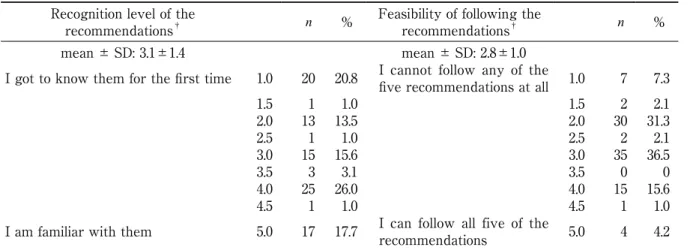
The mean score for the recognition level of the five recommendations was 3.1 ± 1.4 (mean ± SD; range: 1-5); the most frequent score was 4.0 points (n=25, 26.0%), which was followed in order by 1.0 point (n=20, 20.8%), 5.0 points (n=17, 17.7%), and 3.0 points (n=15, 15.6%). Answers ranging from 3 to 5 points accounted for 63.5% of the total number of answers. The mean score for feasibility of following the five recommendations was 2.8 ± 1.0 (mean ± SD; range: 1-5); the most frequent score was 3.0 points (n=35, 36.5%), which was followed in order by 2.0 points (n=30, 31.3%) and 4.0 points (n=15, 15.6%) (Table 3).
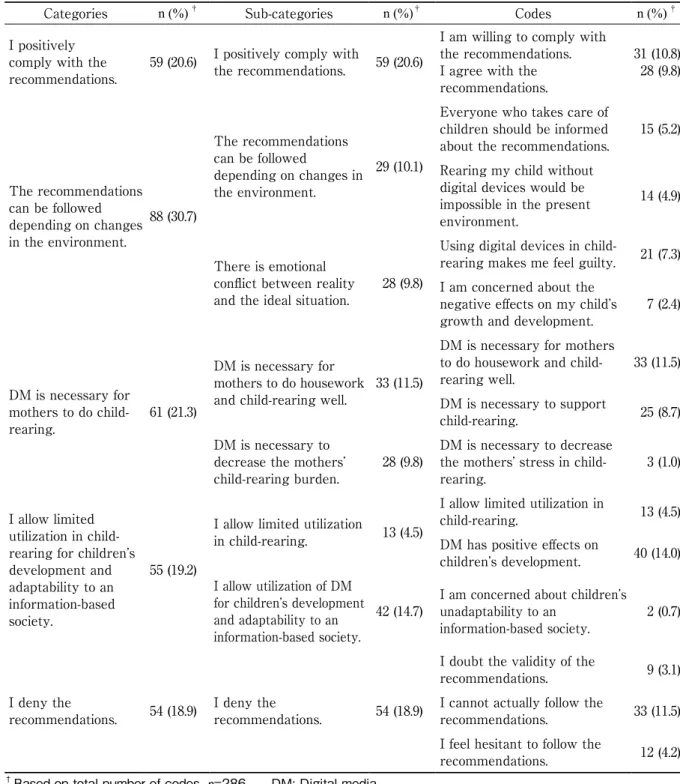
3.3 Perspectives on the five recommendations (Table 4)
Five categories constituting the mothers’ perspectives emerged from content analysis of the data. In the open-coding phase, 286 codes were obtained. These codes were subsequently integrated into 39 second-codes, and then sorted into 15 third-codes. Furthermore, eight subcategories, "I positively comply with the recommendations", "The recommendations can be followed depending on changes in the environment", "There is emotional conflict between reality and the ideal situation", "DM is necessary for mothers to do housework and child-rearing well", "DM is necessary to decrease the mothers’ child-rearing burden", "I allow limited utilization in child-rearing", "I allow utilization of DM for children’s development and adaptability
to an information-based society", and "I do not comply with the recommendations" were obtained. Finally, five categories, "Positively comply with the recommendations", "The recommendations can be followed depending on changes in the environment", "DM is necessary for mothers to do child-rearing", "I allow limited utilization in child-rearing for children’s development and adaptability to an information-based society", and "I do not comply with the recommendations" were obtained.
The categories were configured from, "I positively comply with the recommendations at the top" to "I do not follow the recommendations" at the bottom in a vertical line in accordance with the mothers’ level of compliance with the recommendations. While both, "I positively comply with the recommendations" and "I do not follow the recommendations" accounted for approximately 20%, respectively, of all responses to the question asking about the level of compliance with the recommendations, the remaining 60% were in the middle, implying ambivalence toward complying with the recommendations. Those ambivalent
Table 2 Characteristics of the subjects (n=96)
Characteristics n %
Age of child (months) Less than 17 18-23 24-29 30-35
Age of mother (years) 20-24 25-29 30-34 35-39 40-45 No response Occupation Housewife Clerical
Sales, Customer service
Professional/Skilled/Research work
Work involves taking care of preschool children, e.g., childcare worker, nurse, midwife
Self employment Technical work Unskilled work Other
Number of family members in the same household 3 4 5 Other Utilizing nurseries Yes No
Utilizing child-care services Yes No 19.0±6.1 (mean ± SD) 38 34 17 7 32.2±5.4 (mean ± SD) 6 26 32 21 10 1 40 16 11 9 4 2 2 1 11 86 6 7 2 41 55 49 47 (range: 12-35) 39.6 35.4 17.7 7.3 (range: 21-45) 6.3 27.1 33.3) 21.9 10.4 0.7 41.7 16.7 11.5 9.4 4.2 2.1 2.1 1.0 11.5 89.6 6.3 5.2 2.1 42.7 57.3 51.0 49.0
Table 3 Recognition level and feasibility of following the five recommendations (n=96)
Recognition level of the
recommendations† n % Feasibility of following the recommendations† n %
mean ± SD: 3.1±1.4 I got to know them for the first time
I am familiar with them
1.0 1.5 2.0 2.5 3.0 3.5 4.0 4.5 5.0 20 1 13 1 15 3 25 1 17 20.8 1.0 13.5 1.0 15.6 3.1 26.0 1.0 17.7 mean ± SD: 2.8±1.0 I cannot follow any of the five recommendations at all
I can follow all five of the recommendations 1.0 1.5 2.0 2.5 3.0 3.5 4.0 4.5 5.0 7 2 30 2 35 0 15 1 4 7.3 2.1 31.3 2.1 36.5 0 15.6 1.0 4.2
† Based on 1-to 5-point semantic differential method
n: numbers, SD: Standard Deviation
perspectives included, "The recommendations can be followed depending on changes in the environment", "DM is necessary to decrease the mothers’ stress in child-rearing", "I allow limited utilization in child-rearing for children’s development and adaptability to an information-based society", and "I do not comply with the recommendations".
4. Discussion
4.1 Characteristics of participants
Mothers in the present study gave birth around 30 years of age. This almost coincides with the mean age of primipara indicated by the National Institute of Population and Security Research8). The nursery
utilization rate of 42.7% in the present study was higher than the 37.4% for parents whose first child was under 3 years old, as reported by the National Institute of Population and Security Research9). A vast
majority of the housewives and one-third of the working mothers in the present study conducted child-rearing without using nurseries or child-care services. Therefore, some of the participating housewives likely reared their children by themselves throughout the day while attempting to do household chores, which could be stressful.
4.2 Recognition level, feasibility of following the five recommendations, and perspectives on the recommendations
In this study, the recognition level of the participants on the five recommendations was not high, even though the recommendations were issued in 2004. One possible reason is the information about the recommendations was not widely publicized outside of medical facilities. Another possible reason is that all of the participants were mothers with only one child less than 3 years of age, meaning, as new mothers, they may not have had an opportunity to obtain information on the recommendations. The mean score for the feasibility of following the recommendations was 0.3 points lower than the recognition level. Moreover, according to the results of the content analysis of the descriptive responses on the participants’ perspectives, only 20.6% of the respondents positively complied with the recommendations. We can assume that even if the mothers want to follow the recommendations, they are unable to because of their surrounding environment. This results in their having conflict between reality and the ideal situation. In terms of the amount of time spent on parenting, the Ministry of Internal Affairs and Communications’ Survey on Time Use and Leisure Activities 201610) shows that, on average, women spend 10.7 times as long
as men on parenting per week in dual income households, while women spend three and a half times as long as men do in fulltime homemaker households. Taking care of young children is demanding, thus, it is reasonable that many participants thought that DM was necessary to do housework and child-rearing well,
while they felt guilty for using digital devices for child-rearing. The guilty feeling stems from concern about the negative effects on their children’s growth and development. On the other hand, some perspectives focused on the positive effects of DM, such as stimulating children’s intellectual curiosity, mastering a social skill, and promoting motor function. Concern about children’s unadaptability to an information-based society was also presented. Therefore, despite concern about the negative effects on their children’s growth and development, many mothers still use DM in their everyday child-rearing. Furthermore, it is assumed that the mothers expect benefits from DM regarding their children’s development that they cannot provide by themselves.
Table 4 Perspectives on the five recommendations
Categories n (%)† Sub-categories n (%)† Codes n (%)†
I positively comply with the
recommendations. 59 (20.6) I positively comply with the recommendations. 59 (20.6)
I am willing to comply with the recommendations. I agree with the recommendations. 31 (10.8) 28 (9.8) The recommendations can be followed depending on changes in the environment. 88 (30.7) The recommendations can be followed depending on changes in the environment. 29 (10.1)
Everyone who takes care of children should be informed
about the recommendations. 15 (5.2) Rearing my child without
digital devices would be impossible in the present environment.
14 (4.9)
There is emotional conflict between reality
and the ideal situation. 28 (9.8)
Using digital devices in
child-rearing makes me feel guilty. 21 (7.3) I am concerned about the
negative effects on my child’s
growth and development. 7 (2.4)
DM is necessary for mothers to do
child-rearing. 61 (21.3)
DM is necessary for mothers to do housework
and child-rearing well. 33 (11.5)
DM is necessary for mothers to do housework and
child-rearing well. 33 (11.5)
DM is necessary to support
child-rearing. 25 (8.7)
DM is necessary to decrease the mothers’
child-rearing burden. 28 (9.8)
DM is necessary to decrease the mothers’ stress in
child-rearing. 3 (1.0)
I allow limited utilization in child-rearing for children’s development and adaptability to an information-based society.
55 (19.2)
I allow limited utilization
in child-rearing. 13 (4.5)
I allow limited utilization in
child-rearing. 13 (4.5)
DM has positive effects on
children’s development. 40 (14.0) I allow utilization of DM
for children’s development and adaptability to an information-based society.
42 (14.7) I am concerned about children’s unadaptability to an
information-based society. 2 (0.7)
I deny the
recommendations. 54 (18.9) I deny the recommendations. 54 (18.9)
I doubt the validity of the
recommendations. 9 (3.1)
I cannot actually follow the
recommendations. 33 (11.5) I feel hesitant to follow the
recommendations. 12 (4.2)
The Japan Pediatric Association developed the five recommendations as precautions against the negative effects of DM on children both mentally and physically2,3). As previously mentioned, a maternal and child
health handbook suggests that young children refrain from using DM for a long time, and mentions reading a picture book as an alternative means of using DM in rearing young children. Reading a picture book aloud is reportedly beneficial for stimulating children’s intellectual development; however, the positive effects on children’s development is limited without active parent involvement11). Also, it is pointed out that children
younger than 30 months cannot learn from 2-dimensional video agents, and they need social interaction with trusted caregivers for their successful development12,13). The maternal and child health professionals
should provide appropriate information on how to communicate with their children while reading the book and DM use. Another study indicated that mothers who feel more difficulty with child-rearing use DM more often14). Mothers who do not let their children use DM reportedly feel a burden when doing so and
easily become depressed15).
There is a tendency that mothers are expected to devote their time to taking care of their families. Okamoto exhorts that women should place importance on themselves. In addition, she insists that women need to spend a sufficient amount of time to confirm who they are by themselves in order to attain an identity as a care-taker and fulfill that role23). If mothers are severely restricted from using DM, it might
consequently increase their stress, which, in turn, could negatively affect their children’s development. Since DM is now a part of our daily lives, it may be impossible to do child-rearing without DM today. As indicated in the findings of the present study, some participants considered DM as a tool for stimulating children’s intellectual development and enhancing motor function. However, interpersonal communication between mothers and children without the use of DM is also crucial. It is essential that maternal child health professionals do not simply restrict parents’ use of DM in child-rearing, but provide concrete information on how to use DM effectively accompanied by an explanation of both the positive and negative effects of DM.
5. Limitations of the study
There is a limitation to the generalization of the results from the present study. The findings were limited to 96 participants attending three pediatric clinics, two maternity hospitals, and a municipal health center. To overcome this limitation, further studies should recruit more participants from multiple facilities. Acknowledgements
The authors are indebted to the mothers who participated in this survey. We are also grateful to the pediatric clinics, the maternity hospitals, and the municipal health center for their cooperation in this study. We wish to thank the Japan Pediatric Association for permission to transcribe "The Five Recommendations for Children’s Media Use" for the questionnaires. This paper was prepared by partially supplementing and revising a master’s thesis submitted to the Graduate School of Kawasaki University of Medical Welfare in 2019. An outline of this study was presented at the 35th Conference of the Okayama Maternal Health Society.
References
1. Ministry of Education, Culture, Sports, Science and Technology : 2018 (Heisei 30) school hygiene statistics
report of investigation.
https://www.mext.go.jp/component/b_menu/other/__icsFiles/afieldfile/2019/03/25/1411703_01.pdf, 2019. (February 15, 2020) (In Japanese, translated by the author of this article)
2. Barr R, Lauricella A, Zack E and Calvert SL : Infant and early childhood exposure to adult-directed and child-directed TV programming. Merrill-Palmer Quarterly, 56(1), 21-48, 2010.
3. Zimmerman FJ and Christakis DA : Children’s television viewing and cognitive outcomes: A longitudinal analysis of national data. Archives Pediatrics Adolescent Medicine, 159(7), 619-625, 2005.
4. Japan Pediatric Association : Children and media committee.
https://www.jpa- web.org/about/organization_chart/cm_committee.html, 2017. (February 15, 2020) (In Japanese, translated by the author of this article)
5. Japan Pediatric Association : The five recommendations regarding children’s media use
https://www.jpa-web.org/dcms_media/other/ktmedia_teigenzenbun.pdf, 2004. (February 15, 2020) (In Japanese, translated by the author of this article)
6. Ministry of Internal Affairs and Communications : The 2017 white paper on information and communications in
Japan.
https://www.soumu.go.jp/johotsusintokei/whitepaper/ja/h30/html/nd252120.html, 2018. (February 15, 2020) (In Japanese, translated by the author of this article)
7. Krippendorff K : Content analysis: An introduction to its methodology. 3rd ed, Sage, Thousand Orks, 2012. 8. National Institute of Population and Security Research : Population statistics report 2018.
http://www.ipss.go.jp/syoushika/tohkei/Popular/P_Detail2018.asp?fname=T04-17.htm&title1=%87W%81 D%8Fo%90%B6%81E%89%C6%91%B0%8Cv%89%E6&title2=%95%5C%82S%81%7C17+%82t%82m%82d% 82b%82d%89%C1%96%BF%8D%91%82%C9%82%A8%82%AF%82%E9%95%EA%82%CC%91%E6%82P%8 Eq%95%BD%8B%CF%8Fo%90%B6%94N%97%EE%81F1980%81%602015%94N, 2019. (February 15, 2020) (In Japanese, translated by the author of this article)
9. National Institute of Population and Social Security Research : Marriage process and fertility of married
couples: Attitudes toward marriage and family among Japanese singles: The fifteenth Japanese National Fertility Survey in 2015: Highlights of the survey results on married couples/singles (March 2017). National Institute of
Population and Social Security Research, http://www.ipss.go.jp/ps-doukou/e/doukou15/Nfs15R_points_ eng.pdf, 2017. (February 15, 2020)
10. Ministry of Internal Affairs and Communications : Survey on time use and leisure activities 2016.
https://www.e-stat.go.jp/stat- search/files?page=1&layout=datalist&toukei=00200533&tstat=000001095 335&cycle=0&tclass1=000001095377&tclass2=000001095393&tclass3=000001095394, 2017. (February 15, 2020) (In Japanese, translated by the author of this article)
11. Lauricella AR, Barr R and Calver SL : Parent-child interactions during traditional and computer storybook reading for children’s comprehension: Implications for electronic storybook design. International Journal of
Child-Computer Interaction, 2(1), 17-25, 2014.
12. Anderson DR and Pempek TA : Television and very young children. American Behavioral Scientist, 48(5), 505-522, 2005.
13. Brown A and Council on Communications and Media Executive Committee : Media use by children younger than 2 years. Pediatrics, 128(5), 1040-1045, 2011.
14. Okamura R : Mother’s use of IT devices for child rearing and their perceived fulfillment in life. Japanese
Journal of Family Sociology, 29(1), 7-18, 2017. (In Japanese with English abstract)
15. Fukuda Y, Ariyoshi N, Ueki S, Kihara Y, Katase T and Suetsugu Y : The child rearing actual condition by the smart phone use in little children, and the shape of a mother’s melancholia. Japanese Journal of