Japan Advanced Institute of Science and Technology
JAIST Repository
https://dspace.jaist.ac.jp/
Title
領域横断的オントロジーの協調的開発アプローチ:ラ イフサイクルアセスメントにおけるシナリオベース知 識構築システム
Author(s) Takhom, Akkharawoot Citation
Issue Date 2018‑09
Type Thesis or Dissertation Text version ETD
URL http://hdl.handle.net/10119/15518 Rights
Description Supervisor:池田 満, 知識科学研究科, 博士
Collaborative Development Approach for Multidisciplinary Ontology:
A Scenario-based Knowledge Construction System in Life Cycle Assessment
Akkharawoot TAKHOM
Japan Advanced Institute of Science and Technology
Doctoral Dissertation
Collaborative Development Approach for Multidisciplinary Ontology:
A Scenario-based Knowledge Construction System in Life Cycle Assessment
By
Akkharawoot TAKHOM
Supervisor: Professor Mitsuru IKEDA
School of Knowledge Science
Japan Advanced Institute of Science and Technology
September 2018
i
Abstract
Collaborative Development Approach for Multidisciplinary Ontology:
A Scenario-based Knowledge Construction System in Life Cycle Assessment By
Akkharawoot TAKHOM
BSc. (Management of Information Technology) Mae Fah Luang University, 2009 MEng. (Information and Communication Technology for Embedded Systems) Sirindhorn International Institute of Technology, Thammasat University 2013
Creating an ontology from multidisciplinary knowledge is a challenge because it needs a number of various domain experts to collaborate in knowledge construction and verify the semantic meanings of the cross-domain concepts. Confusions and misinterpretations of concepts during knowledge creation are usually caused by having different perspectives and different business goals from different domain experts. The dissertation proposes a community-driven ontology-based application management (CD-OAM) framework that provides a collaborative environment with supporting features to enable collaborative knowledge creation. It can also reduce confusions and misinterpretations among domain stakeholders during knowledge construction process. I selected one of the multidisciplinary domains, which is Life Cycle Assessment (LCA) for our scenario-based knowledge construction.
Constructing the LCA knowledge requires many concepts from various fields including environment protection, economic development, social development, etc.
The output of this collaborative knowledge construction is called MLCA (multidisciplinary LCA) ontology. Based on our scenario-based experiment, it shows that CD-OAM framework can support the collaborative activities for MLCA knowledge construction and also reduce confusions and misinterpretations of cross- domain concepts that usually presents in general approach.
Keyword: Multidisciplinary Knowledge, User-adaptive Ontology, Life Cycle Assessment, Ontology-based Knowledge Management, Collaborative Framework
ii
Acknowledgments
Carrying out the essential work and then writing this dissertation was the most rigorous task I have undertaken. The key to having completed the thesis is looking back at all supporters whose has helped this research in the success of the doctoral dissertation. First of all, I wish to express my sincere appreciation to Prof. Mitsuru IKEDA his supervision, encouragement, and understanding in this research approach.
I would like to express my gratitude for a grant program FY2016 to support my off-campus research that is an excellent opportunity to gain knowledge and experience. Without this support, this research would not have been possible. I would also like to acknowledge and thank Prof. Heinz Ulrich HOPPE and all members of Collaborative Learning in Intelligent Distributed Environment (COLLIDE) laboratory for their guidance and insight throughout this research approach and collaboration.
I am appreciative to co-advisors Assoc. Prof. Hideaki KANAI and Prof. Yukari NAGAI for their support, guidance, helpful suggestions and their meaningful consultancy. I am very grateful to Dr. Marut Buranarach and Dr. Prachya Boonkwan from Language and Semantic Technology (LST) Laboratory, NECTEC, Thailand, for fruitful technical discussions. And I would like to thank Wanwisa Thanungkano and all researchers from Life Cycle Assessment (LCA) Laboratory, National Metal and Materials Technology Center (MTEC), Thailand for their providing of worth LCA knowledge both of information and materials.
I would like to thank Prof. Takashi HASHIMOTO, Assoc. Prof. Takaya YUIZONO, Dr. Sasiporn USANAVASIN, and Dr. Thepchai SUPNITHI for the fruitful comments and discussions. I would also like to thank all members in Ikeda laboratory for their questions and useful comments on my research.
iii Nine classmates under the dual doctoral degree program batch fourth also deserve my sincerest thanks, their friendship and assistance have meant more to me than I could ever express. I could not complete my work without the invaluable friendly compensation of their participants.
Moreover, a special thanks to my family, particularly my parents and sister, for their love, support, and unwavering belief in me. Their unconditional love inspired me and was my driving force. I would like to dedicate this work to my father, Adul TAKHOM, who passed away. I hope that this work would make him proud.
Finally, I would like to thank Prof. Thanaruk THEERAMUNKONG and Assoc. Prof. Waree KONGPRAWECHNON for providing indispensable advice, information, and support for this doctoral degree program and their cooperation with research institutes. This research cannot be completed without partially supported by Japan Advanced Institute of Science and Technology (JAIST), Japan, the Center of Excellence in Intelligent Informatics, Speech and Language Technology and Service Innovation (CILS) and by NRU grant at Sirindhorn International Institute of Technology (SIIT), Thammasat University and National Electronics and Computer Technology Center (NECTEC), Thailand.
iv
Table of Contents
Abstract i
Acknowledgments ii
Table of Contents iv
List of Figures vii
List of Tables ix
Glossary and Terminology x
Chapter 1 Introduction 1
Background of Research 4
Research Motivations and Problem Statements 5
Research Objectives and Scopes 6
Contributions and Originalities 7
1.4.1. The unique points of the research 7
1.4.2. Extent of the Research 7
1.4.3. Expected impact of the research 8
Organization and Contents 9
Chapter 2 Background and Literature Review 11
Multidisciplinary Knowledge and Construction Approaches 11 2.1.1. A paradigm of Sustainable Development (SD) 14 Ontology Development and a Collaborative Approach 15
2.2.1. Semantic Web ontology language 15
2.2.2. A collaborative framework 16
Literature Review 17
2.3.1. Development of LCA domain ontologies 17
2.3.2. Related LCA ontologies in perspectives of multidisciplinary domain 19
2.3.3. An ontology development framework based on a collaborative
approach 21
2.3.4. Limitation of the existing works and motivation on a collaborative
framework 22
Concluding Remarks 24
Chapter 3 Research Methodology 25
v
Introduction 25
Research Design and Approach 27
3.2.1. Research design and setting 27
3.2.2. Research approach and methodology 28
A Pilot Study: Discovering multiple-domain problem in a network
perspective 31
3.3.1. A network perspective for contexts analysis 31
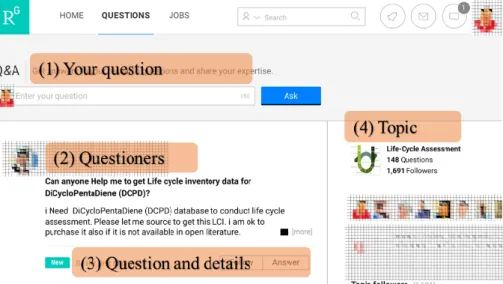
3.3.2. A discussion forum and participants 31
3.3.3. A network perspective for contexts analysis 33 3.3.4. Discovering multidisciplinarity using a cross-disciplinary
approach 34
3.3.5. Multidisciplinarity in Sustainable Development 36
3.3.6. Experimental result 39
Discussion and Summary 40
Chapter 4 A Collaborative Framework: Community-driven Ontology-based
Application Management 42
A Collaborative Framework 42
4.1.1. Community-driven ontology-based application management 42
4.1.2. System design and development 45
4.1.3. Conceptualization 46
Development of a User-adaptive Ontology 48
4.2.1. Processes of ontological engineering 49
Summary 53
Chapter 5 Collaborative Use Case Scenarios 55
Introduction 55
A Scenario of Data Qualification in Life Cycle Inventory 56 5.2.1. Stakeholder’s roles and collaborative activities 56 5.2.2. Criteria for assessment of the qualified LCA dataset 56 5.2.3. Semantic mapping between domain ontology and database 58 5.2.4. Semantic search and recommendation system 60 A Scenario in a Business Plan for Environmentally Friendly Products 62 5.3.1. Stakeholder’s roles and collaborative activities 63 5.3.2. Recognition for solving misinterpretation problems 65
vi 5.3.3. Exploitations of a collaborative framework 68
Summary 74
Chapter 6 Discussions, Conclusions, and Recommendations 76
Discussion 76
6.1.1. Testing result 76
6.1.2. Limitations and concerning criteria 81
Conclusions 83
Recommendations 85
Bibliography 86
Publications 93
International journal 93
International conferences 93
“This dissertation was prepared according to the curriculum for the Collaborative Education Program organized by Japan Advanced Institute of Science and Technology and Sirindhorn International Institute of Technology University”
vii
List of Figures
Figure 1 The United Nations Educational, Scientific and Cultural Organization (UNESCO) and adopted the Sustainable Development Goals (SDGs). 2
Figure 2 Dissertation Organization. 10
Figure 3 A multidisciplinary framework for theory building, Circuits of Theory
(Glazier & Grover, 2002). 16
Figure 4 Multi-tier architecture of the OAM framework (Buranarach et al., 2016).
21 Figure 5 System architecture of OAM Framework (Buranarach et al., 2016, 2013).
22 Figure 6A pilot study (in yellow rectangles) and three crucial phases (in green
rectangles) of the main research. 27
Figure 7 A flow of research methodology used in this dissertation. 29 Figure 8 An example of a discussion forum of ResearchGate (“Question
Answering (Q&A) under topic; Life-Cycle Assessment (LCA) from ResearchGate website, A social networking site for scientists and
researchers to share papers,” 2016). 32
Figure 9 Seven phases in the workflow of the network text analysis (NTA) (Daems et al., 2014; Diesner & Carley, 2004). 35 Figure 10 Co-occurrence network visualization generated by GePhi (Bastian et al.,
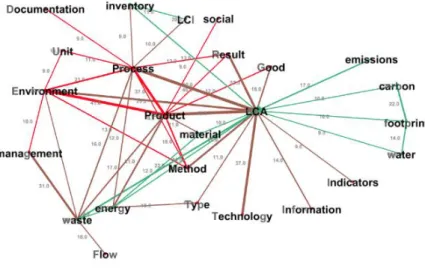
2009): green lines for only LCA domain, red lines for only economic, and brown lines for two relevant domains (LCA and economic). 39 Figure 11 An excerpt of a bipartite graph matching co-occurrence terms from an
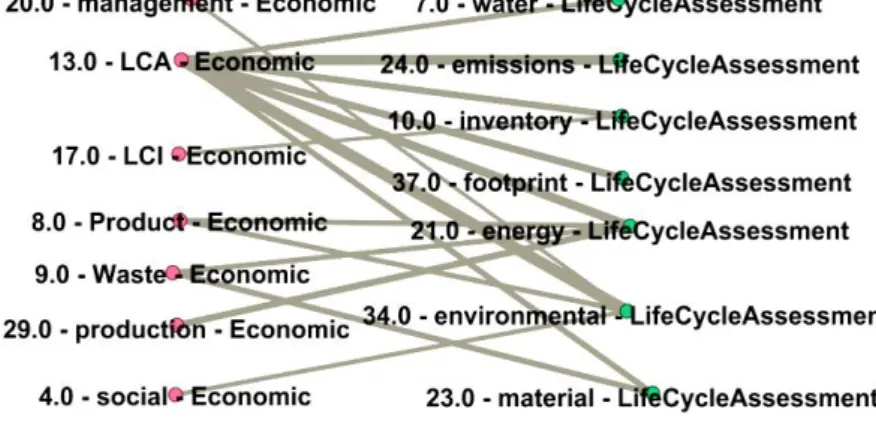
economic domain (pink edges) to LCA domain (green edges). 40 Figure 12 Collaborative interaction of domain stakeholders in the knowledge-
based framework for a recommendation system (Buranarach et al., 2016,
2013). 43
Figure 13 A system overview of a community-driven ontology-based application management framework (CD-OAM) (Takhom, Suntisrivaraporn, et al.,
2014). 45
Figure 14 System overview of a community-driven ontology-based application management (CD-OAM) framework (Takhom, Suntisrivaraporn, et al.,
2014) 54
Figure 15 A family of international standards guideline (ISO) on LCA domain
and four phases of LCA framework. 49
Figure 16 Three groups of upper concepts in our DQ-LCA ontology: 1) LCI concepts in a yellow group, 2) EIA concepts in blue group, and 3) DQI
concepts in red group (Takhom et al., 2015). 50
Figure 17 A group of Life Cycle Inventory (LCI) concepts in the DQ-LCA
ontology (Takhom et al., 2015). 51
viii Figure 18 A group of Data Quality Indicator (DQI) concepts in the DQ-LCA
ontology (Takhom et al., 2015). 53
Figure 19 Multidisciplinary ontology for Life Cycle Assessment (MLCA): a
group of Data Quality Indicator concepts. 59
Figure 20 Mapping between ontology and database: concept properties are
considered with corresponding data fields 60
Figure 21 Semantic search: a supporting feature of CD-OAM framework. 61 Figure 22 User-defined policy recommendation: a supporting feature of CD-OAM
framework. 62
Figure 23 A sequence diagram of a collaborative scenario. 64 Figure 24 An example of misinterpretation of two different domains: Life Cycle
Inventory (LCI) from ISO14048 (International Organization for Standardization, 2002) at the left, and Life Cycle Costing (LCC)
calculation at the right. 67
Figure 25 Multidisciplinary ontology for Life Cycle Assessment (MLCA): Life Cycle Assessment (LCA) concepts and concepts hierarchy. 69 Figure 26 Multidisciplinary ontology for Life Cycle Assessment (MLCA): Life
Cycle Costing (LCC) concepts and concepts hierarchy. 70 Figure 27 Excerpt of Multidisciplinary ontology for Life Cycle Assessment
(MLCA): two areas have highlighted an interrelation from an environmental protection aspect to an economic aspect: from LCA
concept properties to the LCC concept properties. 72 Figure 28 A knowledge construction system, called a community-driven
ontology-based application management (CD-OAM) framework,
supporting domain ontology incorporation. 73
Figure 29 Excerpt of Web Ontology Language (OWL) (Schreiber & Dean, 2004) representing relevant concepts in a different perspective and the whole
concept. 74
Figure 30 Formal problems in combining knowledge into ontologies (Klein,
2001). 78
Figure 31 A system workflow of the first collaborative scenario in collaborative
activities. 79
Figure 32 A system workflow of the second collaborative scenario in
collaborative activities. 80
ix
List of Tables
Table 1 The development of domain-specific ontologies, Life Cycle Assessment
(LCA). 17
Table 2 A comparison of LCA ontology development considering two criteria:
sources of knowledge and cross-disciplinary domains. 20 Table 3 A comparison of related works based on Network Text Analysis (NTA)
approach. 34
Table 4 An example of question answering (Q&A) contexts (“Question Answering (Q&A) under topic; Life-Cycle Assessment (LCA) from ResearchGate website, A social networking site for scientists and
researchers to share papers,” 2016): economic terms (red italic) and LCA
terms (green italic). 37
Table 5 Pairs of bigram in two relevant domains with term frequency. 38 Table 6 Determination of three aspects in this study contexts based on essential
‘C’ terms: ‘coordination,’ ‘cooperation’, and ‘collaboration’: structure,
responsibilities and communication contexts. 48
Table 7 An example of the first use case scenario: a recommender system for environmental data qualification consisting of the user scenarios and the
recommendation rules that applied. 58
Table 8 Process details of a collaborative scenario in each collaborative activity
with communicating messages. 64
Table 9 A comparison of terms between two different domains: Life Cycle
Costing (LCC) and Life Cycle Assessment (LCA) domains. 68
x
Glossary and Terminology
Glossary Terminology
ISO An acronym for International Organization for Standardization.
LCI An acronym for – Life Cycle Inventory.
LCA An acronym for Life Cycle Assessment.
LCIA An acronym for Life Cycle Impact Assessment.
LCC An acronym for Life Cycle Costing.
DQI An acronym for Data Qualification Indicator.
1
Chapter 1
Introduction
Multiple-domain collaboration is a challenging task in knowledge engineering. To achieve a particular goal through collaboration, participants contribute their domain expertise through a lengthy discussion. Misunderstanding in such communication context is quite common when some terms are shared in more than one domain, causing two significant problems: (1) lexical ambiguity and (2) misleading semantics. Some of these terms do have separate meanings, while the rest share their meanings across domains in some degree. Therefore, recognition of these terms during the discussion will significantly reduce the chance of misunderstanding in multidisciplinary knowledge collaboration.
To cope with the challenging task, this research has an aim to provide a collaborative framework for supporting multidisciplinary communication of different stakeholders. Two essential functions are designed and conducted for addressing the problems into two functional parts of the collaborative framework: (1) a communicative function for recognizing lexical ambiguity, and (2) a collaborative function for avoiding misleading semantic. The conceptualization of knowledge enhances interoperability between these two functions and its processing within the collaborative framework, called a multidisciplinary domain ontology, and roles of these two functions are designed as follows: the communicative function has a role in reducing ambiguity in communication of stakeholder, and the collaborative function has a role in facilitating stakeholder to identify misleading concepts and to propose a new understanding in collaborative communication to a domain-specific community. Therefore, in this research approach, these designed two functions of a collaboration framework have particularly response in the necessary roles to interoperate the multidisciplinary knowledge
2 These two essential parts of the collaboration framework have proceeded in order to overcome the challenging task. This dissertation has mainly focused on the collaborative function overcoming misleading semantics in the second part. Then the first part in overcoming lexical ambiguity has been conducted in another research, and in this dissertation, the communicative function is used to present clarification of multidisciplinarity in a domain- specific knowledge. Therefore, the collaborative framework in this dissertation presents the collaborative function supporting multidisciplinary knowledge collaboration to interoperate with stakeholders by employing the multidisciplinary domain ontology, and to points out an alternative solution for solving miscommunication, causing by sending a cross-domain unawareness concept and receiving a misinterpretation concept.
Figure 1 The United Nations Educational, Scientific and Cultural Organization (UNESCO)1 and adopted the Sustainable Development Goals (SDGs).
In the domain of sustainability science (Gruen et al., 2008), multiple disciplines have been proposed, as a current trend in improving the sustainability of natural systems for meeting demand, both of economy and society. A paradigm of Sustainable Development (SD) (European Union, 2010) has relevant disciplines based on three primary aspects: environmental protection, economic growth, and human development, as illustrated in Figure 1.
1 The United Nations Educational, Scientific and Cultural Organization (UNESCO), (https://en.unesco.org/sdgs)
3 Regarding the multidisciplinary knowledge, the SD paradigm is an emergence of environmental management and preservation in different aspects (e.g., nature and society) that require the understanding of the fundamental characteristics. For example, a study of Life Cycle Assessment (LCA) could be used to explain how to calculate and manage the environmental resources through knowledge of an economic aspect, called Life Cycle Costing (LCC) (Milicic, Perdikakis, Kadiri, & Kiritsis, 2013). However, only the LCA knowledge cannot clearly explain for addressing the blind spot among LCA and LCC stakeholder perspectives, such as a problem of misinterpretation.
In order to understand stakeholder’s perspectives and recognizing miscommunication problems, this research takes a term of multidisciplinary knowledge (Alvargonzález, 2011) into account in multiple perspectives of stakeholders, a blind spot (Holsapple & Joshi, 2002), because the knowledge sharing (T. Gruber, 1991) has a limitation within domain boundaries.
Then, employing the multiple disciplines could be difficult for verification of an understanding of different perspectives. In this situation where stakeholder can contribute their knowledge for achieving collaborative goals, they need to share their knowledge through their communication to make an understanding, and other participants also follow these collaborative activities.
Then a solution will be provided for a collaborative problem depending on their roles.
However, misunderstanding can occur in their communication contexts consisting of a common term that mislead and has ambiguous semantics. Although the participants can recognize misleading terms, clarification of meaning and relevant knowledge is a difficulty when they express their understanding by contexts with existing multiple-domain terms that they are possible to separate meaning or to be shared as multidisciplinary knowledge.
For performing different research or business purposes, ontology development in the LCA domain has been constructed (Cappellaro, Masoni, Moreno, & Scalbi, 2002; M. Braescher and F. Monteiro and A. Silva, 2007; Muñoz, Capón-García, Laínez, Espuña, & Puigjaner, 2013;
Takhom, 2013; Takhom, Ikeda, Suntisrivaraporn, & Supnithi, 2015) by interpreting ISO standard guidelines (International Organization for Standardization, 2002, 2006a). The research approach intends to establish domain ontology for serving business applications.
Notwithstanding the LCA ontologies, the difficulty of manipulating domain ontologies comes from the misinterpretations and confusions of semantic meanings of some terms (concepts) and their relationships from a different domain perspective. Selecting relevant ontologies and
4 understanding the ontological structures are major research challenge for domain stakeholders, especially for those who are inexperienced in working with domain ontology.
With the reason to overcome the research challenge, this research approach takes characteristics of a multidisciplinary approach (Alvargonzález, 2011; Bernard & Anita, 2006) into consideration in knowledge sharing and co-creation, and the understanding of the different domain perspectives. Therefore, breakthrough the blind spots of multiple perspectives, this research considers the multidisciplinary knowledge to manipulate in various domains in different viewpoints of stakeholders and intends to draw multiple-disciplinary thinking appropriately with problems outside normal boundaries and redefine cross-domain concepts.
Background of Research
Consuming more products not only have an effect in the environmental resource reductions but also cause many environmental impacts, such as the increase of carbon dioxide from industrialization can lead to having more greenhouse effect and global warming. To preserve and organize the resources, SD paradigm (European Union, 2010) is proposed as a current trend in improving the sustainability of natural systems for meeting demand, both of economy and society. As depicted in Figure 1, SD paradigm focuses on many aspects (domains), but three most essential aspects that SD has been discussed in many contexts are the aspects of economic development, social development, and environmental protection.
Life Cycle Assessment (LCA) (Ciroth, 2007) is one of the essential topics in SD paradigm, and it is used for identifying and quantifying levels of energy and materials used and released to the environment. LCA is also used for indicating carbon footprints through the product life cycle. Although LCA knowledge is considered as an environmental protection domain of the SD paradigm, the knowledge has been adopted and used for other purposes, such as promoting environmentally friendly products. For the LCA in marketing and business domains, essential knowledge, called Life Cycle Costing (LCC), is analyzing total cost of production’s investment and promoting environmentally friendly products in a marketing plan. LCA and LCC domains are considered for achieving a business goal that concerns costing and environmental protection. The business owner and relevant stakeholders have to understand appropriately in multiple domains collaboration, which is related to LCA knowledge. Many stakeholders (e.g., a researcher) attempt to construct LCA knowledge for sharing their understanding, but the
5 knowledge is represented from one perspective based on only environmental protection domain.
Research Motivations and Problem Statements
The research introduces a collaborative framework for stakeholder’s facilitation in knowledge construction of multiple domains. The framework provides a collaborative environment for supporting knowledge co-creation of different domain stakeholders (e.g., domain experts and knowledge engineers). An integrated approach of this study is introducing knowledge acquisition based on a combination of a collaborative scenario in knowledge management, which is learning from sources of knowledge, such as reference documents as ISO standard guideline, and shared ontologies (Horrocks, 2008).
Ontology development in the LCA domain has been constructed for performing different research or business purposes. Cappellaro et al. (Cappellaro et al., 2002) and Braescher et al.
(M. Braescher and F. Monteiro and A. Silva, 2007) designed LCA ontology to represent ISO standard guidelines(International Organization for Standardization, 2002, 2006a). B. Bertin et al. (Bertin et al., 2012) designed another LCA ontology to represent a mathematical technique for presenting an application of electricity production processes, and E. Muñoz et al. (Muñoz et al., 2013) designed LCA ontology for business management. B. Sayan (Sayan, 2011) attempted presented LCA domain in an open framework. For the LCA domain in our research approach, we published two LCA ontologies, namely Ontology-Enhanced Life Cycle Assessment (O-LCA) ontology (Takhom, 2013) and Data Qualification for LCA (DQ-LCA) ontology (Takhom et al., 2015). O-LCA was our first ontology designing based on Description Logic language (Baader, Horrocks, & Sattler, 2004) that has the purpose of recommending alternative resources for cleaner technology. DQ-LCA is the second ontology that we improve the LCA knowledge for qualifying environmental data.
In order to employ domain ontologies for serving business applications, we can create a new ontology or modify/extend/reuse the existing domain ontologies. Notwithstanding the LCA ontologies, the difficulty of creating ontology or modifying/extending/reusing the existing ontology comes from the misinterpretations and confusions of semantic meanings of some terms (concepts) and their relationships from a different domain perspective. Selecting relevant ontologies and understanding the ontological structures are significant challenges for domain stakeholders, especially for those who are inexperienced in working with domain
6 ontology. For this reason, our research aim is to resolve those issues by introducing a framework supporting collaborative environment and features for both highly experienced and inexperienced stakeholders to create/modify/extend/reuse ontology. Therefore, the research challenges are taken into account in designing the collaborative framework supporting activities of different stakeholders.
Research Objectives and Scopes
The goal of this research is enhancing interoperability of the multidisciplinary knowledge for relevant stakeholders in a domain-specific knowledge, especially in LCA domain, and supporting collaborative activities of the stakeholders by providing a collaborative environment. Therefore, objectives of this research are defined, as follows:
• To conceptualize a user-adaptive ontology for supporting multidisciplinary-domain knowledge existing an ontology curation system, which encourages activities of different domain stakeholders, in a collaborative situation.
• To provide a collaborative framework to enhance community-driven ontology-based application management (CD-OAM).
• To test the CD-OAM framework to work with MLCA ontology by qualitative evaluation in use case scenarios.
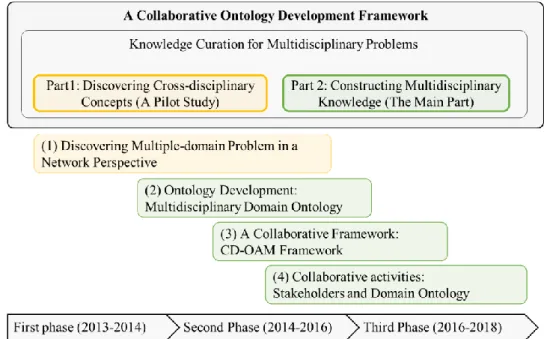
Concretely, for finding evidence of an existence of cross-domain in LCA domain, the research conducted a pilot study by taking into consideration in an approach of network text analysis (Diesner & Carley, 2004). Therefore, as a preliminary experiment, a pilot study has defined five subgoals, as follows:
1) To identify sources of knowledge: domain-specific data are surveyed sources of data and facilitating tool for data collections and handling. In a preliminary experiment, the sampling data are reviewed, such as from discussion contexts in forums of a community in environmental science.
2) To propose pre-processing scripts for manipulating sources of knowledge: we consider Python, a scripting language for natural language processing, such as extracting data, removing stop words, and mapping co-occurrence concepts.
7 3) To propose of a cross-disciplinary codebook: the research manipulates post-processing data based on a qualitative approach. The codebook is generated for supporting in classifying the co-occurrence concepts and analyze in multidisciplinarity of relevant domain knowledge.
4) To establish the semantic network: The collected data are used to generate a graph visualization for discovering and analyzing conceptual knowledge in a co-occurrence network.
5) To evaluate the finding result: cross-disciplinary concepts are assessed in a quantitative evaluation.
Contributions and Originalities
As mentioned the research questions, this dissertation proposes a collaborative framework based on community-driven ontology-based application management (CD-OAM) to overcome the research challenges. Therefore, the unique points of the research, extent of the research, and expected impact of the study are described as follows.
1.4.1. The unique points of the research
The unique points of the research aimed at the following novelties:
• A methodology in this dissertation is to analyze multiple-domain knowledge, and conceptualize multidisciplinary LCA domain ontology, underlying a paradigm of Sustainable Development.
• A multidisciplinary LCA ontology for interoperability cross-disciplinary concepts in a collaborative situation.
• Enhanced a collaborative capability for a collaborative framework based on community-driven ontology-based application management (CD-OAM).
1.4.2. Extent of the Research
Regarding these research objectives, the research intends to enhance a collaborative capability for the ontology-based application management (OAM) Framework (Buranarach, Thein, &
8 Supnithi, 2013), as a community-driven development platform of multidisciplinary Ontology.
The collaborative framework of this research offers the following extent:
• To conceptualize the multidisciplinary LCA domain knowledge,
• To analyze sources of LCA domain knowledge: international standard guideline and critical case studies,
• To collaborate with stakeholders that are knowledgeable participators in providing insightful information, suggesting and verifying the finding concepts and relations,
• To demonstrate exploitation of cross-disciplinary concepts. The benefits of employing multidisciplinary domain ontologies is to use a collaborative framework for ontology development and carry out collaborative scenarios, and
• To support stakeholders to consolidate LCA knowledge in term of domain ontology underlying SD paradigm.
1.4.3. Expected impact of the research
The research approach attempts to enhance stakeholders in working with computer side by side (Horrocks, 2008). Knowledge representation of this research follows an ontology-based approach (Horridge & Bechhofer, 2011) in domain ontology development for multidisciplinary knowledge. The knowledge is analyzed and conceptualized by considering relevant domain knowledge because transferring knowledge of the relevant stakeholder’s community is a laborious task requiring close collaborative activates among domain experts.
Although domain ontologies have been designed for adopting a variety of research activities, acquisition of comprehensive knowledge requires a steep learning curve from novices/practitioners. Therefore, expected impacts of the research have an intention to shorten the learning curve and to enhance a collaborative capability in knowledge construction.
Moreover, in human society, expected impacts of the research are contributions in a deeper understanding of the multidisciplinary knowledge, and inclusive participation engages and empowers a domain-specific community in sustainable knowledge, especially in environmental protection.
9
Organization and Contents
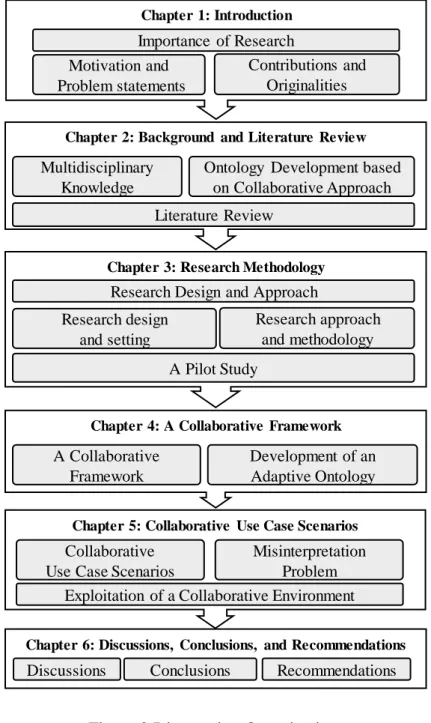
As depicted in Figure 2, this dissertation is organized structure and contents into six chapter, and details of each chapter are briefly explained as follows;
‘Chapter 2: Background and Literature Review’ introduces multidisciplinary knowledge including a paradigm of Sustainable Development (SD) and multidisciplinarity of Life Cycle Assessment (LCA) domain. Knowledge representation in the next section is explained regarding a semantic approach in order to develop domain ontologies and a collaborative approach for constructing the knowledge. The ontology is the language used to conceptualize knowledge from domain experts by explicit representation in a set of concepts and relations.
Then, a collaborative approach is considered in ontology development. Afterward, related works on LCA domain ontologies and multidisciplinary aspects are reviewed, and the existence of ontology development frameworks based on a collaborative approach are defined features and limitations. The last section summarizes this research approach.
‘Chapter 3: Research Methodology’ purposes to present a methodology of this study. First, research approach and a pilot study are explained by two methods: a collaborative approach and a network perspective for discovering multidisciplinary knowledge. Next, the research approach is design and set by considering study population, sampling, and data-collection instrument. After that, the collected data are analyzed and formulated the hypothesis. The last section summarizes the research methodology and the research approach.
‘Chapter 4: A Collaborative Framework’ presents a collaborative framework including community-driven ontology-based application management, system design, and development.
Based on the OAM framework in two tiers (data tier and application tier), this chapter next describes collaborative features in three tiers: collaboration tier, knowledge tier, and user tier.
Then, development of a user-adaptive ontology is described knowledge elicitation, visualization by using the ontology editor, and ontological engineering processes. The last section summarizes the collaborative framework with the development of the user-adaptive ontology.
‘Chapter 5: Collaborative Use Case Scenarios’ introduces collaborative use case studies for a paradigm regarding multidisciplinarity knowledge. Next, each stakeholder is defined roles and activates in a collaborative situation, and the following section explains problem recognition and a solution for reducing misinterpretation problem. After that, the collaborative framework
10 is exploited with the scenarios and demonstrated a scenario-based recommender system. The last section summarizes two use case scenarios, the problem of misinterpretation and exploitations of a collaborative framework.
‘Chapter 6: Discussions, Conclusions, and Recommendations’ explains an evaluation of the research findings including the questionnaire results and the collaborative use case scenarios based on user interaction in the collaborative framework. The following section discusses the experimental results from exploiting the collaborative framework. The last section summarizes research contributions and recommendations for future work.
Figure 2 Dissertation Organization.
Chapter 1: Introduction
Motivation and Problem statements
Contributions and Originalities
Chapter 2: Background and Literature Review Multidisciplinary
Knowledge
Ontology Development based on Collaborative Approach Literature Review
Chapter 4: A Collaborative Framework A Collaborative
Framework
Development of an Adaptive Ontology
Chapter 5: Collaborative Use Case Scenarios Collaborative
Use Case Scenarios
Exploitation of a Collaborative Environment Misinterpretation
Problem Importance of Research
Chapter 3: Research Methodology
A Pilot Study
Research Design and Approach Research design
and setting
Research approach and methodology
Chapter 6: Discussions, Conclusions, and Recommendations Conclusions Recommendations Discussions
11
Chapter 2
Background and Literature Review
This chapter first introduces multidisciplinary knowledge by considering a paradigm of Sustainable Development (SD). The paradigm has characteristics of the knowledge involving multiple disciplines, especially in an environmental domain, called Life Cycle Assessment (LCA). In representing domain knowledge, a semantic approach is exploited for representing in next section. The ontology is the language used to conceptualize knowledge from domain experts by explicit representation in a set of concepts and relations. Related works on LCA ontologies are then reviewed and considered existing multiple-disciplines. Afterward, a collaborative approach is considered in enhancing ontology development. Existing LCA ontologies are defined by their features and limitations in a collaborative capability. Finally, the chapter summary remarks the research challenges in features and limitations of LCA ontologies with the collaborative approach.
Multidisciplinary Knowledge and Construction Approaches
As the attempt to discuss the reasons for a relationship between science (Alvargonzález, 2011), four different terminologies are taken into account in the meaning of the word ‘discipline’ with its cognates.
This study intends to give reasons in support of an approach, typically with the aim of persuading to share knowledge and understanding in stakeholder perspectives. The word
‘discipline’ means a branch of knowledge, in the sense of using the word ‘multidisciplinary.’
Thus, the ‘discipline’ is a body of knowledge or skill that can be taught and learned.
12 As a social relationship, the word ‘discipline’ is a core process between teachers and learners in the process of knowledge sharing. The discipline can become from technique, arts, skills, rhetoric, theology, and philosophy in a suitable situation., three knowledge establishments (Bernard & Anita, 2006) are clarified to analyze characteristics of interchanging knowledge, as follows:
1. Multidisciplinary is to draw on knowledge from different disciplines but stay within their boundaries.
2. Interdisciplinary is to analyze, synthesize and harmonize links between disciplines into a coordinated and coherent whole.
3. Transdisciplinary is to integrate the natural, social, and health science in a humanities context and transcends their traditional boundaries.
In this study, two additional disciplines based on (Jensenius, 2012) are used to describe an interrelation of the different disciplinarities regarding the multiple-domain problems. Five different types of discipline are described, as follows:
1. Intradisciplinary: working within a single discipline.
2. Cross-disciplinary: viewing one discipline from the perspective of another.
3. Multidisciplinary: people from different disciplines working together, each drawing on their disciplinary knowledge.
4. Interdisciplinary: integrating knowledge and methods from different disciplines, using a real synthesis of approaches.
5. Transdisciplinary: creating a unity of intellectual frameworks beyond the disciplinary perspectives.
The extended representation based on Jensenius have been used to describe different disciplinarities and clarify characteristics of an interrelation both of multidisciplinary and cross-disciplinary with other disciplinaries. The interrelation of the different disciplinarities has been considered in the meaning of the various disciplinarities. Taylor et al. (Taylor, Schwaibold, & Watson, 2015) considered the various disciplinarities in processes of team selection and development of the curriculum and discussed dealing with the academic. Next,
13 Gardner (Gardner, 2017) addressed an issue of educational courses that students and educator can take advantage of a cross-disciplinary education that requires the collaboration of different academicals boundaries.
Two important terms are used to analyze characteristics of multiple-domain knowledge and interrelation between multidisciplinary and cross-disciplinary. Activities associated with different domain experts have determined the multiple-domain knowledge existing in their collaborative project. For this research study, therefore, the term ‘multidisciplinary’ is the first chosen discipline that is an appropriate word for clarifying characteristics of specific-domain knowledge. The multidisciplinary means the people from different disciplines and professions join and make up the knowledge in a multidisciplinary community. Second, to identify a relation within the major domain, the term ‘cross-disciplinary’ is to view one discipline from the perspective of another to understand the relation drawing to other knowledge boundaries.
The cross-disciplinary is to determine in clarifying a crossing relation of two different domains underlying a paradigm of multidisciplinary knowledge. This term is used to analyze different perspectives of stakeholders.
For example, in a situation that stakeholder who has different disciplines working together, the multidisciplinary knowledge refers to their collaboration based on their disciplines. Under the same goal, viewing of different perspectives means to compresence a concept for cross- disciplinary to achieve new insight and to share similar epistemological assumptions in a complex problem or issue.
In other words, only a single discipline could not cover explanations to address a gap among the different perspective. Therefore, using knowledge from different domain has independent bodies. The different stakeholder needs to share their understanding when the single discipline does not cover the other relevant knowledge.
Several studies have been applied the multidisciplinary knowledge for solving problems and supporting an understanding of a collaboration between different domains as follows. In education fields, the approach (Chaudhry & Higgins, 2003) were extensive to find knowledge associated with curriculum involving academic disciplines of business, computing, and information, and to construct education programs. Next, in other circumstances, Heinrich et al.
2005 identified polyphenol contents by considering multidisciplinarity in nutraceuticals
14 knowledge. Using antioxidants relies on the following cross-disciplinary knowledge:
pharmacology, nutritional science, and anthropology.
In this research approach, multidisciplinarity in environmental science is our domain of interest involving many aspects of circumstance. A case of preserving environmental resources for future generation, Sustainable Development (SD) (European Union, 2010), is a paradigm that is a kind of multidisciplinary knowledge focusing more on three crucial aspects: economic development, social development, and environmental protection. Using the term ‘SD’
sometimes cannot cover explanations to address a gap among different stakeholder perspectives. The paradigm can be considered in a characteristic of multidisciplinarity (Alvargonzález, 2011; Bernard & Anita, 2006) in order to understand other related aspects, for example, how to share knowledge from different domain perspectives.
This research approach involves drawing appropriately from multiple-disciplinary thinking to redefine problems outside normal boundaries and solve a complicated situation with solutions based on an understanding of different domain perspectives. Multiple perspectives are acquired for breakthrough their blind spots. This study determines the multidisciplinary approach to manipulate in multiple domains in different viewpoints of stakeholders. Therefore, the multidisciplinary knowledge is the crucial term in this research.
Many of the knowledge related to the research interest are intertwined in multiple-domain knowledge. Investigation of cross-disciplinary concepts existing in domain contexts is interested in knowledge construction.
2.1.1. A paradigm of Sustainable Development (SD)
As aforementioned in the previous section, an understanding of the fundamental characteristics of an interaction between nature and society is the importance of emerging environmental management and preservation concerning sustainability sciences (Gruen et al., 2008). The term Sustainable Development (SD) is to take current human needs of the Earth's limited resources into consideration in balancing technological advancement with the environmental survivability of future generations.
In an aspect of an environmental impact assessment (EIA), a domain knowledge in multidisciplinarity of the SD paradigm is Life Cycle Assessment (LCA). Knowledge of LCA is employed as the methodology of EIA that identifies, quantifies energy and materials used and
15 released to the environment, and evaluates and implements opportunities to influence environmental improvements. Following the SD paradigm in a multidisciplinary approach, LCA is then applied to assist other disciplines to understand environmental impacts in their field of interest, as cross-disciplinary coordination. The international standard guidelines including ISO14040 (International Organization for Standardization, 2006a), 14044 (International Organization for Standardization, 2006b), and 14048 (International Organization for Standardization, 2002)) of LCA are employed to calculate the environmental impacts by several agencies, companies, and research fields that have different approach depending on their interpretation. Interpreted guidelines are utilized in many approaches such as a Life Cycle Inventory (LCI) database in information technology, Life Cycle Costing (LCC) in determining the most cost-effective option in an economic field, and knowledge structuring in semantic technology.
Ontology Development and a Collaborative Approach
2.2.1. Semantic Web ontology language
Semantic Web is an extension of the World Wide Web (Schreiber & Dean, 2004) that brings a structure in which information is formally defined, enabling computers and people to work in cooperation (Horrocks, 2008). The structure can be semantically computed that collects information and sets of inference rules that they can use to conduct automated reasoning. The function brings structure to the meaningful content of Web pages. The Semantic Web provides a language that expresses both data and rules for reasoning and allows rules from any existing knowledge representation system to be exported onto the Web, called ontologies.
Web Ontology Language is the most well-known definition commonly cited in the Semantic Web and Knowledge Representation communities from Gruber (T R Gruber, 1995), i.e.: “An ontology is an explicit and formal specification of a conceptualization of a domain of interest.” In the philosophical aspect, ontology is a discipline that studies theory about the nature of existence. However, this study considers the computing and KR aspect. It is a kind of formal language for the rules as expressive as needed to allow the Web to reason as widely as desired. The most typical kind of ontology for the Web has taxonomy and a set of inference rules. The taxonomy defines classes of objects and relations among them. Ontology (Horrocks, 2008) is a way to formalize explicit and tacit knowledge and domain expertise by explicitly representing it with a set of concepts, i.e., conceptualization, and eliciting relations among
16 them. Therefore, the Semantic Web provides a language to express data fields, concepts, concept relations, and rules for an inference system allowing us to conduct automated reasoning.
2.2.2. A collaborative framework
Regarding Groza et al. (Groza, Tudorache, & Dumontier, 2013)'s commentary mentioned state of the art and open challenges for knowledge curation. Community-driven knowledge curation has two major types of the knowledge curation systems supporting a community-driven approach as follows:
1. knowledge curation platforms aim to enable researchers and experts in a particular field to define, detail and explore the knowledge within that field via a quality-driven collaborative curation process, and
2. ontology curation systems focus on providing an environment in which experts can externalize and formalize the knowledge captured within a domain.
Figure 3 A multidisciplinary framework for theory building, Circuits of Theory (Glazier & Grover, 2002).
Knowledge discovery in specific domains was next determined social knowledge. Glazier et al. (Glazier & Grover, 2002) proposed a framework for library and information studies that leads research that more accurately mirrors the role of disciplines, the influence of social factors on the construction of personal and social knowledge, and the research process. As illustrated in Figure 3, Glazier et al.’s framework, Circuits of Theory, presented three dialectically related
17 modules and the taxonomy of theory within the existing social environment comprising in a social system. Phenomena are isolated and analyzed within the context of the research environment. While these three modules including Self, Society, and Knowledge, both discovered and undiscovered, the difference is the modules represented in the contextual variables that surround and contribute to the utilization of the taxonomy.
Literature Review
This section first explains two comparisons of ontology development: 1) development of LCA domain ontologies and 2) LCA ontologies in a multidisciplinary perspective. Next, an ontology development framework is explained based on a collaborative approach. Afterward, limitation of the existing works and motivation on a collaborative framework are explained.
2.3.1. Development of LCA domain ontologies
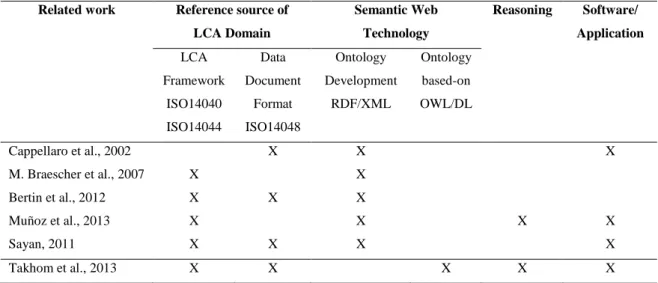
Since 2002, LCA knowledge and semantic web technology have interpreted the standard guideline (International Organization for Standardization, 2002, 2006a) and adapted to their specific objectives. Previous works on ontology development and implementation have been applied to LCA knowledge. Their characteristics are summarized and compared in Table 1.
Table 1 The development of domain-specific ontologies, Life Cycle Assessment (LCA).
Related work Reference source of LCA Domain
Semantic Web Technology
Reasoning Software/
Application LCA
Framework ISO14040 ISO14044
Data Document
Format ISO14048
Ontology Development
RDF/XML
Ontology based-on OWL/DL
Cappellaro et al., 2002 X X X
M. Braescher et al., 2007 X X
Bertin et al., 2012 X X X
Muñoz et al., 2013 X X X X
Sayan, 2011 X X X X
Takhom et al., 2013 X X X X X
18
• CASCADE ontology designed the first LCA ontology project under a project, named the Cooperation and Standards Assessment Data in Europe (CASCADE) (Cappellaro et al., 2002). The project interprets LCA information in the standard data format guideline in ISO14048 (International Organization for Standardization, 2002). The data format ontology aims to accommodate standard development in design and manufacturing with their requirements for LCA. The project achievements were delivered in LCA ontology OWL(Schreiber & Dean, 2004), a W3C recommended ontology language. The ontology was utilized in a standard conversion software, a website, and a procedural guideline. For the collaborative aspect, LCA knowledge is interpreted by a domain expert, and a knowledge engineer constructed the ontology.
• LCAO ontology (Bräscher, Monteiro, & Silva, 2007) was designed and developed by the Brazilian Institute for Information in Science and Technology (IBICT). Their work concern the Follow-up of Life Cycle Assessment (FLCA) according to ISO 14040 (International Organization for Standardization, 2006a) standard guideline. The project provides the LCA framework, aiming at organization and retrieval of information, and a contribution to consensual vision. Their work presents an effort to construct the LCA framework from the interpretation of the standard guideline by knowledge engineers.
• Bertin’s ontology(Bertin et al., 2012) was a case study of the U.S. energy impact data management. LCI data can also be semantically represented as manipulatable databases using relational algebra. This LCI ontology consists of economic activities considered as elementary processes linked together through interdependency relations. Their work presents a semantic approach to LCA knowledge that is applied to energy environmental impact data management. The data was analyzed and then interpreted.
LCI can also be semantically represented as manipulatable databases using relational algebra. The ontology modeling by a mathematical technique for collaborative discussions among domain experts and knowledge engineers demonstrates the benefits of logical structures extraction.
• Muñoz’s ontology (Muñoz et al., 2013) applied environmental ontology for enterprise resource management and the environmental assessment of enterprise system employed in a case study of a supply chain network design and planning in optimization problems of process scheduling. Regarding interdisciplinary approach, conceptualization
19 requires collaboration among stakeholders (e.g., discussion) to integrate existing environmental ontologies with knowledge of enterprise resource planning.
• O-LCA Ontology was formalized by taking LCA knowledge: life cycle inventory and life cycle impact assessment into account in ontology designing. The knowledge has converted the knowledge into a well-structured and exchangeable form which facilitates information sharing and discussion among domain experts. An LCA ontology is represented formally in terms of Description Logic (DL). For a collaborative aspect, the ontology was designed from the interpretation of resources of knowledge including LCA standard guidelines and existing ontologies, and discussion with domain experts. The ontology requires knowledge formalization in conceptual design based on DL by knowledge engineering. For instance, constraints of concepts could be expressed effectively and inference with available reasoning services.
Although LCA ontologies have been designed and employed, the LCA knowledge is needed to be interrelated to other knowledge in case of achieving a goal under the SD paradigm.
Therefore, different expertise from other domains is involved that a collaborative approach is considered to improve in using of LCA ontology.
2.3.2. Related LCA ontologies in perspectives of multidisciplinary domain
Many LCA ontologies based on Semantic approach (Da Silva et al., 2006) have been developed for explicating different domain perspectives. The related works are summarized by their characteristics considering two criteria: resources of knowledge, and cross-disciplinary domains. As illustrated in Table 2, LCA international standard guidelines (International Organization for Standardization, 2002, 2006a) are the primary sources of knowledge that standardize principle, framework, and data document format through a family of best-practice procedures. Next, LCA ontologies are considered to other domains in the aspect of a cross- disciplinary domain.
20 Table 2 A comparison of LCA ontology development considering two criteria:
sources of knowledge and cross-disciplinary domains.
LCA Ontology Development Resources of Knowledge
Cross-disciplinary Domain
Cappellaro et al., 2002 ISO14018 Industrial standards
M. Braescher et al., 2007 ISO14040, 14048 Follow-up of LCA
Bertin et al., 2012 ISO14040 Mathematics
Muñoz et al., 2013 ISO14040 Business management
Sayan, 2011 ISO14040 Software development
Takhom et al., 2013 ISO14040, 14048 Cleaning technology
Takhom et al., 2015 ISO14040, 14048 Data qualification
El Kadiri et al., 2015; Milicic et al., 2013 ISO14040, 14044 Life Cycle Costs
The CASCADE (Cappellaro et al., 2002) was the first LCA ontology designed by interpreting standard guidelines (International Organization for Standardization, 2002). The ontology focused on data format aiming at accommodating standard development in design and manufacturing. A cross-disciplinary domain is representing industrial standards in an application of data conversion. The second ontology is LCAO (M. Braescher and F. Monteiro and A. Silva, 2007) designed according to standard guideline [17] and considering the Follow- up of Life Cycle Assessment (FLCA) approach as a cross-disciplinary domain. Next, Bertin et al. (Bertin et al., 2012) ontology was semantically ontology based on a case study of data management and applied mathematical technique as a cross-disciplinary domain for data manipulation. Afterward, Muñoz et al. (Muñoz et al., 2013) designed the LCA ontology by considering enterprise resource management as a cross-disciplinary domain. The last one is an open source software (OSS) by B. Sayan (Sayan, 2011) that presented LCA in linked data.
This research study has further examined LCA ontologies development and published elsewhere. Ontology-Enhanced Life Cycle Assessment (O-LCA) (Takhom, 2013) was the first ontology based on Description Logic (DL) (Baader et al., 2004). The ontology was formalized by taking standard guidelines (International Organization for Standardization, 2002, 2006a, 2006b) into account in Life Cycle Inventory (LCI) and impact method (LCIA). As a cross- disciplinary domain, a recommender system was utilized an inferential ability for reducing environmental impact regarding a Cleaner Technology (de Callejon & Day, 2013) approach.
Lastly, I attempted to draw across the LCA domain to data qualification and Data Qualification for LCA (DQ-LCA) ontology (Takhom et al., 2015)represented in our second generation.
21 However, this research study intends to overcome the challenge of elaborating collaboration of multidisciplinary knowledge and encourage different domain stakeholders to work with existing LCA ontologies. In chapter 4, the development of a user-adaptive LCA ontology is described as supporting multidisciplinarity knowledge.
2.3.3. An ontology development framework based on a collaborative approach
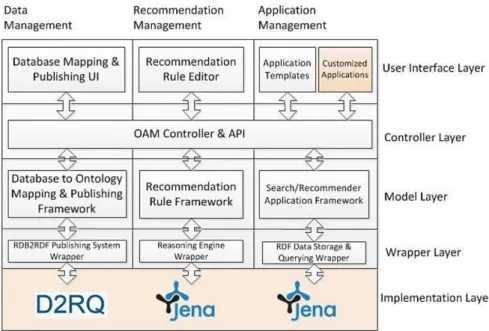
With the rationale of ontology stakeholder collaboration, an ontology-based application management system (OAM Framework2) (Buranarach et al., 2016), is selected to simplify stakeholder’s activities in collaborative development and implementation with a knowledge base as illustrated in Figure 4.
Figure 4 Multi-tier architecture of the OAM framework (Buranarach et al., 2016).
This research focuses on acquisition and accessing the knowledge base that is designed that consists of two main components:
1. Knowledge Base is a component built from resources of knowledge (e.g., existing ontologies, guideline document) analyzed and designed by domain experts. It consists of two subcomponents: 1) a domain ontology representing a knowledge structure to
2 An Ontology Application Management (OAM) Framework for simplifying ontology-based semantic web application development, (http://text.hlt.nectec.or.th/ontology).
22 users by a visualization tool, 2) defined rules are created for inference in a decision model that use in generating recommendation results.
2. Recommender Engine is to process the ontology data in the W3C Web Ontology Language (OWL) (Schreiber & Dean, 2004) format in the knowledge base. The framework maps the database to ontology using the RDF model for ease of data manipulation. Thus, the rule-based knowledge can be applied by retrieving data from the mapping of knowledge base and database. The Jena API is mainly used in manipulating the knowledge base data.
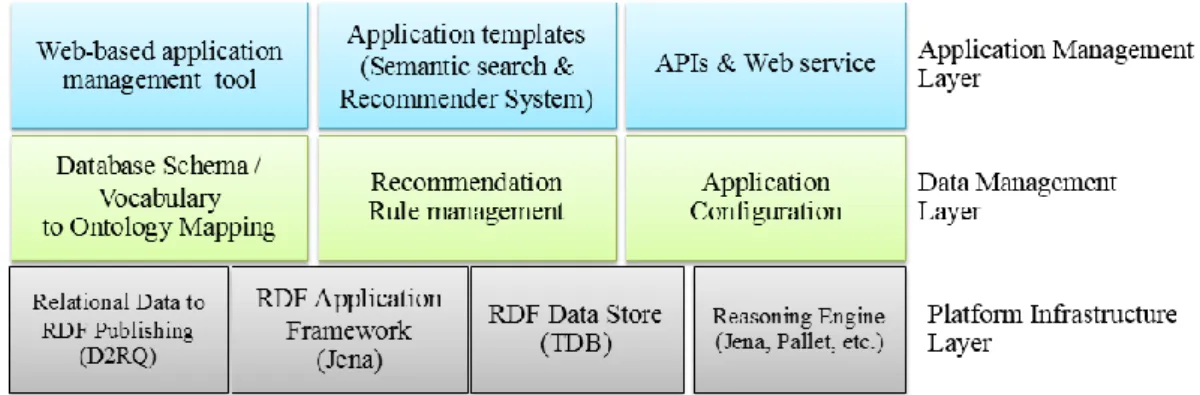
2.3.4. Limitation of the existing works and motivation on a collaborative framework For limitation of the existing works, the OAM Framework is a software platform that aims to simplify the development and maintenance of a semantic web and an ontology as well as to automate the implementation of a semantic search and a web service. The architecture of OAM is illustrated in Figure 5. Ontology development via OAM entails three fundamental steps and three user roles: domain experts, a knowledge engineer, and application developers.
Figure 5 System architecture of OAM Framework (Buranarach et al., 2016, 2013).
First, a domain expert designs his ontology according to the task of interest and export it in the OWL format. On OAM, the knowledge engineer maps the ontology developed by the experts to the database schema and the vocabulary and imports it into the system. At this step, the knowledge engineer also maintains the current ontology according to the experts’ requests via personal communication.
Second, the domain experts design recommendation rules for the current ontology in terms of Prolog-like first-order logic. The knowledge engineer then transcribes these rules into JENA Language via the Recommendation Rule Management Module. Finally, the knowledge users
23 implement their knowledge-enhanced applications with the Application Configuration Module. At this stage, they can deploy a semantic search engine and a web service using the ontology developed by the domain experts.
The essential struggle in this multidisciplinary paradigm is the ontology development entirely relies on personal communication. This method is prone to the loss of communication;
i.e., it is very hard to keep track of conversations and consensus as time goes by. The history of development evolution, or version control, plays a crucial role in community-based development, especially for a large-scale ontology, in which a group of domain experts, knowledge engineers and knowledge users are involved. These lacks necessitate the use of a tractable communication means where conversations and consensus are structurally organized for ease of bookkeeping, knowledge transcription, versioning, and deployment.
The research study is to propose an extension of the OAM Framework that incorporates the notion of thread-based webboard, version control, and status notification to solve the problems above. These features allow the community with the three user roles to co-create a large-scale ontology and maintain it using community endorsement. By doing so, the system and the knowledge grow along with the users’ expertise.
The community-driven approach is suitable for the development of LCA ontology because of the following reasons. First, the domain experts specialize in their particular subfields of LCA. Since these fields sometimes share common knowledge, cross-checking becomes necessary in a large-scale development project. Second, the development of the LCA ontology is operated by a group of experts in parallel. In practice, they usually branch (or fork) the current version of the ontology to work on their own. This is causes in updating when the finished ontologies are to be merged back to the main ontology; thus, the need for version control. Third and last, some parts of the ontology have to be cross-checked by specialists from other relevant fields; for example, some parts of the ontology regarding earth and water can also be validated by geophysicists, chemists, and environmentalists.
24
Concluding Remarks
To conclude the second chapter, multidisciplinary knowledge is first introduced in the meaning of knowledge, in the sense of using the word multidisciplinary. Next, one of multidisciplinary knowledge, Sustainable Development (SD), is described in term of an understanding of the fundamental characteristics of an interaction between nature and society is the importance of emerging environmental management and preservation concerning sustainability sciences.
Then, a semantic approach is explained in order to present domain knowledge and the language for expressing knowledge ontology used to conceptualize knowledge. Afterward, related works on LCA ontologies and a collaborative approach are reviewed and considered existing multiple-disciplines. Lastly, limitation of the existing works and motivation on a collaborative framework are determined. With this reason, the research approach focuses on multidisciplinary knowledge integration and crosschecking among domain experts and relevant stakeholders. An ontology-based application management framework regarding community-driven approach is reviewed. Therefore, the following chapter will introduce the methodology of this research study that intends to enhance a collaborative capability by providing communication, knowledge transfer and discuss the changes of the worked ontology with respect to immediate needs.