JAIST Repository
https://dspace.jaist.ac.jp/
Title 特異スペクトル分析と心理音響モデルに基づいた音響
情報ハイディングとその応用
Author(s) KARNJANA, JESSADA Citation
Issue Date 2016‑09
Type Thesis or Dissertation Text version ETD
URL http://hdl.handle.net/10119/13824 Rights
Description Supervisor:鵜木 祐史, 情報科学研究科, 博士
Audio Information Hiding Based on
Singular-Spectrum Analysis with Psychoacoustic Model and Its Applications
Jessada KARNJANA
Japan Advanced Institute of Science and Technology
Doctoral Dissertation
Audio Information Hiding Based on
Singular-Spectrum Analysis with Psychoacoustic Model and Its Applications
Jessada KARNJANA
Supervisor: Associate Professor Masashi UNOKI
School of Information Science
Japan Advanced Institute of Science and Technology
September 2016
Abstract
The growth of the Internet since the last century and the spread of digital-multimedia transfer are use- ful and convenient for us because it has enabled us to access gigantic shared data. As a consequence, demands for applications such as broadcast monitoring, owner identification, proof of ownership, transac- tion tracking, tampering detection, copy control, and information carrier for audio signal have increased considerably due to technologies misusage. To answer such demands, audio information hiding has been suggested. There are five requirements for audio information hiding. (1) Inaudibility: a property that hidden information does not affect a perceptual quality of host signals. (2) Robustness: an ability to extract hidden information correctly when attacks are performed. (3)Blindness: a property of extracting hidden information correctly without the original signal. (4) Confidentiality: a property of concealing the hidden data. (5) Capacity: quantity of hidden information. To meet the first requirement is a real challenge because the human auditory system is very sensitive. When the first and the second are re- quired together, the challenge is tougher because they conflict with each other. Compromising them has proved to be difficult. Actually, not just two, but all requirements conflict with each other.
The aim of this research is to explore audio information hiding that can satisfy all requirements, espe- cially the conflict between inaudibility and robustness. A literature review of various audio-information- hiding techniques has suggested that audio watermarking based on singular value decomposition (SVD) is one of the robust techniques, and the published results are promising. Fundamentally, its robustness is due to the fact that a singular value is invariant under common signal processing. The hidden informa- tion is embedded by slightly modifying singular values. However, there are two critical problems. First, the problem about the balance between inaudibility and robustness. All SVD-based schemes treat an audio signal as a meaningless time-series and rely only on a mathematical singular-value-manipulation.
They have never taken audio features or human perception into account. Second, when we see them from the acoustic-signal-processing point of view, the physical meaning of singular values has never been addressed. Thus, it seems impossible to formulate a modification rule associating with human perception.
The sole philosophy behind the published embedding rules seems to be that, notwithstanding the physical meaning of singular values is unknown, a human being cannot perceive the difference between original and watermarked sounds if the modification is done slightly.
Inspired by these facts, we propose a framework based on the singular-spectrum analysis (SSA), which is closely related to the SVD. We show that, by using SSA, singular values can have the physical meaning. Actually, they are scale factors of oscillatory components of the signal. Hence, by adopting SSA, we can exploit the advantages of SVD-based techniques, and, at the same time, SSA provides us the framework in which a modification rule can be informed. Quite contrary to the philosophy of conventional SVD-based schemes, the philosophy of this work is based on an idea that the embedding rules should be based on both the nature of the audio signal and the human audio-perceptual ability.
When combining human perception model, such as the psychoacoustic models, and the strength of the SVD-based technique together, it is expected that the problem of conflicting requirements can be solved.
Solving this problem is the ultimate goal.
In this work, we investigate the potentiality of SSA and formulate some basic principles that can be used to achieve the goal. Six audio-information-hiding models based on SSA are proposed. The test results show that the proposed framework achieve five subgoals. The scheme we implement can keep the advantages of the SVD-based technique and, at the same time, can reach a better performance with
the help of an artificial intelligence technique. We also found the connection between singular-spectrum index and peak frequency of oscillatory components and used the finding to improve performance further.
In addition, the self-synchronization for watermark detection is proposed. To demonstrate that the framework is practicable, we applied it to applications of ownership protection, information carrier, and fragile audio-watermarking.
Keywords: audio information hiding, singular-spectrum analysis, differential evolution, psychoacoustic model, self-synchronization
Acknowledgments
Doing research is like investigating a crime scene, once said my Sensei, my supervisor Prof. Masashi Unoki. We researchers are like detectives who collect and analyze data, and then use them to serve our purpose, he taught. Unlike fictional, brilliant and famous detectives (Doyle’s Holmes, Christie’s Poirot, Simenon’s Maigret, Aoyama’s Conan, and you name it), a real detective in science has hardly, if not never, solved a case alone.
Many people, too numerous to mention, have helped bring this dissertation to fruition.
My deepest gratitude goes first and foremost to my adviser, Unoki-sensei, for his tremendous guidance and support. I appreciate his broad and deep knowledge and pa- tience every time we discuss. Without his supervision, there seems to be no end in sight to my Ph.D. course. I would like to extend my heartfelt gratitude to my vice supervisor Prof. Masato Akagi whose a lot of insightful questions and comments on my laboratory- meeting reports and presentation rehearsals have helped me to improve my knowledge and skills. Tons of critical comments and suggestions have been from my two Thai pro- fessors and co-advisors, Prof. Pakinee Aimmanee and Dr. Chai Wutiwiwatchai, as well. I would like to take this opportunity to thank them for giving me their time and support.
I would also like to extend my sincere thanks to Dr. Kwan Sitathani, then the deputy director at NECTEC, who introduced and persuaded me to the SIIT-JAIST-NECTEC dual degree program. Without him (and his call), I might not sit here. Thanks also go to my friends and members of Akagi & Unoki laboratories. They are of great importance for me. I appreciate the supporting grants in SIIT-JAIST-NECTEC dual degree program, A3 Foresight program, and JAIST research grant.
Last but not least, I would like to give many thanks to my parents and two sisters who have stood by my side during almost forty years of my life.
Table of Contents
Abstract i
Acknowledgments iii
Table of Contents iv
List of Figures vii
List of Tables xiii
Notation xvii
Acronym and Abbreviation xviii
1 Introduction 1
1.1 Importance of research and its challenges . . . 1
1.2 Motivation and research goal . . . 3
1.3 Thesis outline . . . 5
1.4 Summary . . . 6
2 Background 8 2.1 Audio information hiding: state of the art . . . 8
2.1.1 Overview of AIH systems . . . 8
2.1.2 Applications of AIH systems . . . 10
2.1.3 AIH techniques . . . 12
2.1.4 SVD-based audio watermarking . . . 14
2.2 Singular-spectrum analysis . . . 20
2.2.1 The basic SSA . . . 21
2.2.2 Interpretation of singular value . . . 23
2.3 Differential evolution . . . 23
2.3.1 Initialization . . . 27
2.3.2 Mutation . . . 27
2.3.3 Crossover . . . 28
2.3.4 Selection . . . 28
2.4 Human auditory perception and psychoacoustic models . . . 29
2.4.1 Absolute threshold of hearing . . . 29
2.4.2 Simultaneous masking . . . 30
2.4.3 Spread of masking . . . 31
2.4.4 Psychoacoustic model . . . 31
2.5 Summary . . . 35
3 Schemes of AIH based on SSA 37 3.1 Philosophy of this work . . . 37
3.2 Core structure of the SSA-based AIH . . . 38
3.2.1 Embedding process . . . 39
3.2.2 Embedding areas . . . 40
3.2.3 Extraction process . . . 42
3.2.4 Embedding repetitions . . . 46
3.3 Differential evolution and the SSA-based AIH . . . 48
3.3.1 Differential evolution optimization . . . 50
3.3.2 Automatic parameter estimation . . . 51
3.4 Psychoacoustic model and the SSA-based AIH . . . 61
3.5 Automatic frame detection for the SSA-based AIH . . . 67
3.5.1 Embedding synchronization code . . . 67
3.5.2 Self-synchronization . . . 71
3.6 AIH based on SSA in transform domain . . . 76
3.6.1 Discrete wavelet transform . . . 77
3.6.2 Embedding process . . . 77
3.6.3 Extraction process . . . 80
3.7 Summary . . . 80
4 Implementations and evaluations of the proposed schemes 81 4.1 Database and evaluation methods . . . 81
4.1.1 Database and conditions . . . 81
4.1.2 Sound-quality tests . . . 82
4.1.3 Robustness tests . . . 83
4.2 Implementations and evaluations of the SSA-based AIH schemes . . . 84
4.2.1 Fixed-parameter model . . . 84
4.2.2 Partially-blind, adaptive-parameter model . . . 87
4.2.3 Completely-blind, adaptive-parameter model . . . 90
4.3 Experiments on AIH integrated with a psychoacoustic model . . . 92
4.3.1 Scheme without the automatic parameter estimation . . . 92
4.3.2 Scheme with the automatic parameter estimation . . . 93
4.3.3 Discussion . . . 96
4.4 Experiments on the automatic frame detection . . . 102
4.5 Experiments on AIH based on SSA in DWT domain . . . 106
4.6 Summary . . . 107
5 Applications of the SSA-based AIH 108 5.1 Ownership protection with SSA-based audio watermarking . . . 108
5.1.1 Implementation . . . 109
5.1.2 Evaluation and discussion . . . 110
5.2 Information carrier with SSA-based audio watermarking . . . 110
5.2.1 Implementation . . . 111
5.2.2 Evaluation . . . 112
5.2.3 Discussion . . . 112
5.3 Fragile audio-watermarking based on SSA . . . 113
5.3.1 Implementation . . . 115
5.3.2 Evaluation . . . 116
5.3.3 Discussion . . . 116
5.4 Summary . . . 116
6 Conclusion 119 6.1 Summary . . . 119 6.2 Contributions . . . 122 6.3 Future work . . . 122
Appendices 124
A Evaluation details of the proposed SSA-based AIH 125
B Optimized parameters 141
C Evaluation of the parameter estimation methods 146 D Comparative evaluations of inaudible and robust audio-watermarking
methods 148
Bibliography 148
Publications 168
This dissertation was prepared according to the curriculum for the Collaborative Edu- cation Program organized by Japan Advanced Institute of Science and Technology and Sirindhron International Institute of Science and Technology, Thammasat University.
List of Figures
1.1 Organization of this thesis. . . 7
2.1 Category of information hiding. . . 9
2.2 Audio-information-hiding system. . . 10
2.3 Audio information hiding viewed as a communication problem. . . 10
2.4 Examples of echo kernels. . . 15
2.5 Embedding and extraction processes of the SVD-based audio watermarking of the Framework 1. . . 16
2.6 Embedding and extraction processes of the SVD-based audio watermarking of the Framework 2. . . 18
2.7 Example of using SSA to decompose a signal (top panel) into additive oscillatory components (last five panels). . . 24
2.8 Example of the first 200 singular values. . . 25
2.9 Original and reconstructed signals (top). The difference between original and reconstructed signals (bottom). . . 25
2.10 Differential evolution processes. . . 27
2.11 Absolute threshold of hearing. . . 30
2.12 Spreading of masking into neighboring critical bands. . . 31
2.13 Psychoacoustic model 1. . . 32
2.14 Signal PSD, global masking level, and SMR. . . 36
3.1 Embedding and extraction processes of the core structure . . . 39
3.2 Illustration of the embedding rule of the core structure. . . 41
3.3 Example of embedding “0” and “1” into the 35th oscillatory component. . . 42
3.4 Relation between LSD and embedding area. . . 43
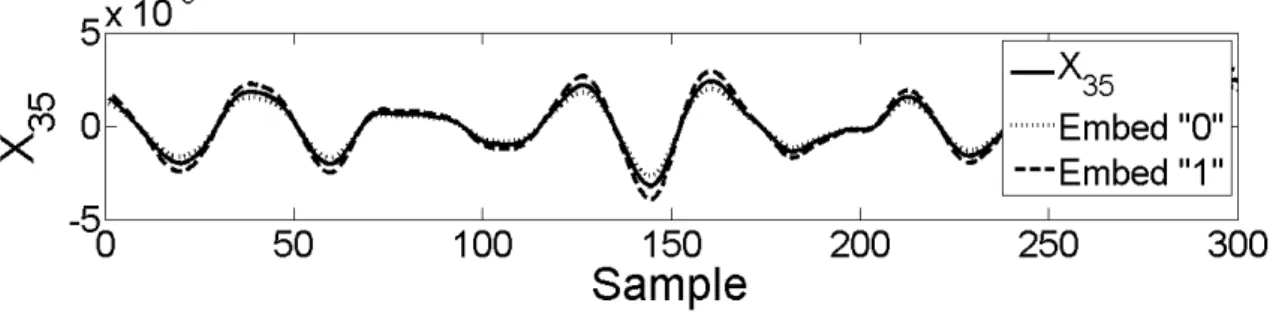
3.5 Relation between SDR and embedding area. . . 43
3.6 Relation between LSD and the window length (L). . . 44
3.7 Relation between SDR and the window length (L). . . 44
3.8 The ratio of total deformation of the singular value to the initial value. . . 45
3.9 Distortion of singular spectra when embedding hidden information . . . 46
3.10 Distortion patterns in modified singular spectra . . . 47
3.11 Example of decoding by the polynomial fitting . . . 47
3.12 Example of embedding repetitions . . . 49
3.13 Bit-detection rate of the embedding repetitions. . . 49
3.14 Differential evolution optimization. . . 51
3.15 Extraction process with automatic parameter estimation. . . 52
3.16 Example of a singular spectrum and its derivatives. . . 54
3.17 Example of a modified singular spectrum and its second order derivative. . 55
3.18 Singular spectrum of original signal and a line segment connecting √ λ16 and √ λ37. Singular values on [17,36] are under the line segment. . . 55
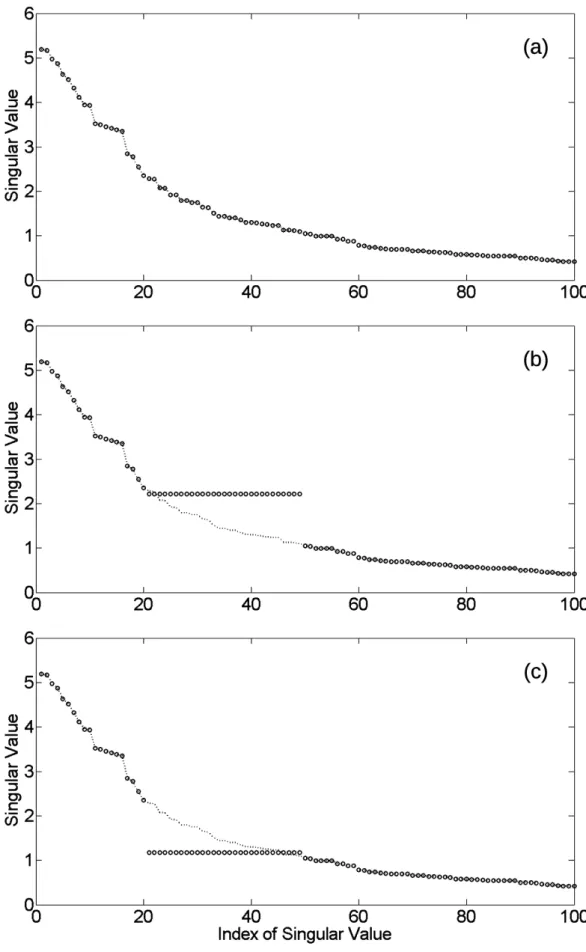
3.19 Singular spectrum of a watermarked signal and two line segments. Line segment #1 connects √ λ16 and √ λ37, and line segment #2 connects√ λ21 and √ λ49. Into this frame, a watermark bit 1 is embedded by forcing the singular values √ λ21 to √ λ49 toward the singular value √ λ20. The dotted curve represents the original singular spectrum. It can be seen clearly that almost all of the singular values are above the line segment #2. . . 58
3.20 A line segment connecting√ λ18and√ λ42is used to calculate the concavity density D18,42 by summing up all differences between singular values and their associated values on the line segment from index 19 to index 41. D18,42 in this example is −2.5353. The minus sign implies that the segment of the singular spectrum on [18,42] is convex. . . 58
3.21 Set of concavity density {D1,31, D2,32, ..., D110,140}. Notice that there is a strong relationship between regions of positive density and indices of modified singular values. . . 59
3.22 Singular spectrum and three different line-segments. . . 59
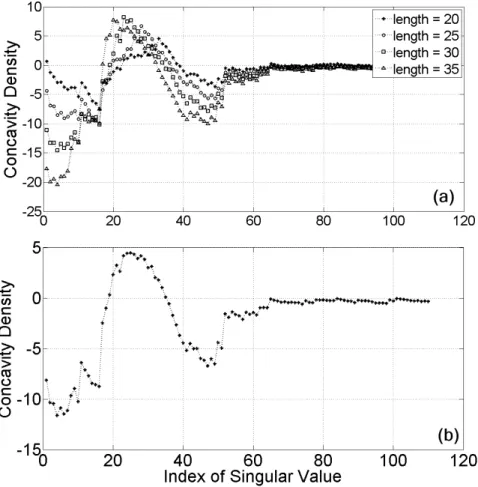
3.23 Concavity density curves when analyzing with four different lengths. . . 60
3.24 Automatic parameter estimation diagram. . . 60
3.25 Averaging algorithm for the automatic parameter estimation. . . 62
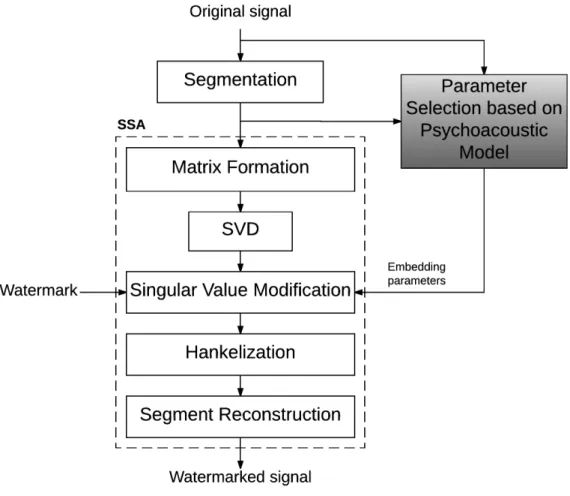
3.26 Embedding process of the AIH scheme based on SSA and a psychoacoustic model. . . 63
3.27 Example of the spectra of oscillatory components. . . 64
3.28 Example of the spectra of oscillatory components (continued). . . 65
3.29 Relation between frequencies and singular-value indices. . . 66
3.30 Parameter selection based on the psychoacoustic model 1. . . 68
3.31 Average SMR. . . 69
3.32 Example of the parameter selection: the frequency range [f1, f2] is mapped to the interval [u, l]. . . 69
3.33 Example of replacing the last L bits of the sample i with giL, where L= 3. (a) The last 3 bits of the sample are 1, 0, and 0, respectively, and g3i is 101. (b) The last 3 bits of the sample are 1, 0, and 1, respectively, after the replacement. . . 70
3.34 Example of the audio clip with 3 frames and three segments from which trajectory matrices are constructed. . . 72
3.35 Four bits of “0100” are embedded into 4 subsegment of a frame, which represents embedding “0” (left), and 4 bits of “0110” are embedded into 4 subsegment of a frame, which represents embedding “1” (right). . . 73
3.36 Example of performing the subframe-scan operation to a 3200-sample frame, i.e., M= 800, with δ= 10, u= 30, l= 80, and “1” are embedded into the second subframe of the frame. . . 74
3.37 Three-bit patterns of “010” and “000” are used to represent the watermark bit 1 and 0, respectively. . . 74
3.38 Example of performing the four windows to Scan[Yi]. . . 76
3.39 Three-level DWT filter bank. . . 78
3.40 Frequency domain representation of the three-level DWT of the signal with frequency range from 0 to fn. . . 78
3.41 Embedding and extraction processes of the AIH based on SSA in DWT domain. . . 79
4.1 Relation between frequencies and singular-value indices at different frame
size. . . 86
4.2 Psychoacoustic analysis of the host signal (track no. 57) and its SMR. . . . 99
4.3 Relationship between dominant frequency and singular-value index of the signal (track no. 57). . . 99
4.4 Relationships between the dominant frequency and the singular-value index from six different frames. . . 101
4.5 Reference relationship between the dominant frequency and the singular- value index. . . 102
4.6 Examples of the distribution ofζB over 100 frames of two audio signals. . . 103
4.7 ODGs of watermarked signals obtained from the scheme with the automatic frame detection. . . 104
4.8 LSDs of watermarked signals obtained from the scheme with the automatic frame detection. . . 104
4.9 SDRs of watermarked signals obtained from the scheme with the automatic frame detection. . . 104
5.1 Embedding and extraction processes of the AIH scheme for the ownership protection. . . 109
5.2 Relation between robustness and embedding capacity of the proposed frame- work for the information carrier. . . 113
5.3 Relation between PEAQ and embedding capacity. . . 114
5.4 Relation between LSD and embedding capacity. . . 114
5.5 Relation between SDR and embedding capacity. . . 114
5.6 Double embedding: information is embedded twice into two areas. . . 115
5.7 BERs (%) of double embedding when no attack. . . 117
5.8 BERs (%) of double embedding when MP3 was performed to watermarked signals. . . 117
A.1 PEAQ (N= 2450, Fixed-parameter model, No repetition.) . . . 126
A.2 LSD (N= 2450, Fixed-parameter model, No repetition.) . . . 126
A.3 SDR (N= 2450, Fixed-parameter model, No repetition.) . . . 126
A.4 PEAQ (N= 816, Fixed-parameter model, No repetition.) . . . 127
A.5 LSD (N= 816, Fixed-parameter model, No repetition.) . . . 127
A.6 SDR (N= 816, Fixed-parameter model, No repetition.) . . . 127
A.7 PEAQ (N= 816, Fixed-parameter model, Repetitions = 5.) . . . 128
A.8 LSD (N= 816, Fixed-parameter model, Repetitions = 5.) . . . 128
A.9 SDR (N= 816, Fixed-parameter model, Repetitions = 5.) . . . 128
A.10 BER (%) (MP3, Fixed-parameter model, N= 2450, No repetition.) . . . . 129
A.11 BER (%) (MP3 attack, Fixed-parameter model, N= 816, No repetition.) . 129 A.12 BER (%) (MP3 attack, Fixed-parameter model, N= 816, Repetitions = 5.) 129 A.13 BER (%) (MP4, Fixed-parameter model, N= 2450, No repetition.) . . . . 130
A.14 BER (%) (MP4 attack, Fixed-parameter model, N= 816, No repetition.) . 130 A.15 BER (%) (MP4 attack, Fixed-parameter model, N= 816, Repetitions = 5.) 130 A.16 BER (%) (AWGN, Fixed-parameter model, N= 2450, No repetition.) . . . 131
A.17 BER (%) (AWGN, Fixed-parameter model, N= 816, No repetition.) . . . . 131
A.18 BER (%) (AWGN, Fixed-parameter model, N= 816, Repetitions = 5.) . . . 131
A.19 BER (%) (BPF, Fixed-parameter model, N= 2450, No repetition.) . . . 132
A.20 BER (%) (BPF, Fixed-parameter model, N= 816, No repetition.) . . . 132
A.21 BER (%) (BPF, Fixed-parameter model, N= 816, Repetitions = 5.) . . . . 132
A.22 BER (%) (RES 16, Fixed-parameter model, N= 2450, No repetition.) . . . 133
A.23 BER (%) (RES 16, Fixed-parameter model, N= 816, No repetition.) . . . . 133
A.24 BER (%) (RES 16, Fixed-parameter model, N= 816, Repetitions = 5.) . . 133
A.25 BER (%) (RES 22.05, Fixed-parameter model, N= 2450, No repetition.) . 134 A.26 BER (%) (RES 22.05, Fixed-parameter model, N= 816, No repetition.) . . 134
A.27 BER (%) (RES 22.05, Fixed-parameter model, N= 816, Repetitions = 5.) . 134 A.28 BER (%) (No attack, Fixed-parameter model, N= 2450, No repetition.) . . 135
A.29 BER (%) (No attack, Fixed-parameter model, N= 816, No repetition.) . . 135
A.30 BER (%) (No attack, Fixed-parameter model, N= 816, Repetitions = 5.) . 135 A.31 BER (%) (No attack, Partially-blind model, N= 2450, No repetition.) . . . 136
A.32 BER (%) (MP3, Partially-blind model, N= 2450, No repetition.) . . . 136
A.33 BER (%) (BPF, Partially-blind model, N= 2450, No repetition.) . . . 136
A.34 BER (%) (RES 16, Partially-blind model, N= 2450, No repetition.) . . . . 137
A.35 BER (%) (RES 22.05, Partially-blind model, N= 2450, No repetition.) . . 137
A.36 BER (%) (AWGN, Partially-blind model, N= 2450, No repetition.) . . . . 137
A.37 PEAQ (N= 2450, Completely-blind model, No repetition.) . . . 138
A.38 LSD (N= 2450, Completely-blind model, No repetition.) . . . 138
A.39 SDR (N= 2450, Completely-blind model, No repetition.) . . . 138
A.40 BER (%) (No attack, Completely-blind model, N= 2450, No repetition.) . 139 A.41 BER (%) (MP3, Completely-blind model, N= 2450, No repetition.) . . . . 139
A.42 BER (%) (BPF, Completely-blind model, N= 2450, No repetition.) . . . . 139
A.43 BER (%) (RES 16, Completely-blind model, N= 2450, No repetition.) . . . 140
A.44 BER (%) (RES 22.05, Completely-blind model, N= 2450, No repetition.) . 140 A.45 BER (%) (AWGN, Completely-blind model, N= 2450, No repetition.) . . . 140
D.1 PEAQ Comparison. . . 149
D.2 LSD Comparison. . . 149
D.3 SDR Comparison. . . 149
D.4 BER Comparison (No attack). . . 149
D.5 BER Comparison (MP3 compression). . . 150
D.6 BER Comparison (MP4 compression). . . 150
D.7 BER Comparison (AWGN). . . 150
D.8 BER Comparison (8-bit re-quantization). . . 150
D.9 BER Comparison (22.05 kHz re-sampling). . . 151
D.10 BER Comparison (16 kHz re-sampling). . . 151
D.11 BER Comparison (Band-pass filtering). . . 151
List of Tables
3.1 Conditions for stopping frame-scan operation. . . 76 4.1 Parameters for the fixed-parameter model. . . 84 4.2 ODGs, LSDs, and SERs: comparison of the fixed-parameter model and the
conventional method. . . 84 4.3 BERs (%) comparison of the fix-parameter model and the conventional
SVD-based method when attacks (i.e., MP3 and MP4 compression, Gaus- sian noise addition (AWGN), re-sampling with 16 and 22.05 kHz (RES 16 and RES 22.05, respectively), and band-pass filtering (BPF)) were performed. 85 4.4 Average BERs (%): comparison of the fix-parameter model and the con-
ventional SVD-based method. . . 85 4.5 Parameters for the partially-blind model. . . 88 4.6 Average, maximum, and minimum correct identification of the ABX tasks
with 20 stimuli for the fixed-parameter and partially-blind models. . . 88 4.7 ODGs, LSDs, and SERs: comparison of the fixed-parameter model, partially-
blind model, and the conventional method. . . 89 4.8 BERs (%): comparison of the fix-parameter model, partially-blind model,
and the conventional SVD-based method when attacks (i.e., MP3 and MP4 compression, Gaussian noise addition (AWGN), re-sampling with 16 and 22.05 kHz (RES 16 and RES 22.05, respectively), and band-pass filtering (BPF)) were performed. . . 89 4.9 Parameters for the completely-blind model. . . 90 4.10 ODGs, LSDs, and SERs: comparison of the fixed-parameter model, partially-
blind model, completely-blind model, and the conventional method. . . 90
4.11 BERs (%): comparison of the fix-parameter model, partially-blind model, completely-blind model, and the conventional SVD-based method when at- tacks (i.e., MP3 and MP4 compression, Gaussian noise addition (AWGN), re-sampling with 16 and 22.05 kHz (RES 16 and RES 22.05, respectively), and band-pass filtering (BPF)) were performed. . . 91 4.12 Parameters for the psychoacoustic-model-based AIH schemes. . . 93 4.13 ODGs, LSDs, and SDRs: comparison of the psychoacoustic-model-based
AIH schemes, the fixed-parameter model, the partially-blind model, and the conventional SVD-based method. . . 94 4.14 BERs (%) comparison of the psychoacoustic-model-based AIH schemes,
the fixed-parameter model, the partially-blind model, and the conventional SVD-based method when attacks (i.e., MP3 and MP4 compression, Gaus- sian noise addition (AWGN), re-sampling with 16 and 22.05 kHz (RES 16 and RES 22.05, respectively), and band-pass filtering (BPF)) were performed. 94 4.15 Actual and estimated values of the parameters u and l used in the scheme
with the automatic parameter estimation. . . 95 4.16 BERs (%) comparison of the psychoacoustic-model-based AIH schemes
with and without the automatic parameter estimation (APE), the fixed- parameter model, the partially-blind model, and the conventional SVD- based method when attacks (i.e., MP3 and MP4 compression, Gaussian noise addition (AWGN), re-sampling with 16 and 22.05 kHz (RES 16 and RES 22.05, respectively), and band-pass filtering (BPF)) were performed. . 96 4.17 Comparison of the computational times for determining the parameters of a
host signal when the automatic parameterization is based on the differential evolution and when it is based on the psychoacoustic model. . . 97 4.18 ODGs, LSDs, and SDRs: comparision of the psychoacoustic-model-based
AIH scheme and the partially-blind model when the frame size is small. . . 98 4.19 ODGs, LSDs, and SDRs: comparison of the psychoacoustic-model-based
AIH scheme when the singular spectrum is modified and when it is not modified to embed the watermark bit 0. . . 98
4.20 Parameters for the SSA-based AIH scheme with the automatic frame de-
tection. . . 105
4.21 Parameters for the AIH scheme based on SSA in DWT domain. . . 106
B.1 Parameters I (Partially-blind model). . . 142
B.2 Parameters II (Partially-blind model). . . 143
B.3 Parameters I (Completely-blind model). . . 144
B.4 Parameters (Psychoacoustic model). . . 145
C.1 Actual and estimated parameters. . . 147
C.2 Indices at rising (σ) and falling (τ) edges of the average positve-density curve derived from the concavity density-based method. . . 147
D.1 Average BER (%): comparison of the fixed-parameter model and the typ- ical methods. . . 148
Notation
γ SMR level
δ scan step size
∆ frame-scan step size
embedding parameter
η overlap degree
Λi,√
λi singular value at indexi λi eigenvalue at indexi
Σ overlap margin
bi concave/convex index
Dm,n concavity density of the singular values from indicesm ton k number of subframes (number of repetitions)
l lower-bound index (embedding parameterl)
L window length
L(i) function defining the line connecting Λm and Λn N frame/subframe size
u upper-bound index (embedding parameter u)
PNM(¯k) noise masker at the geometric mean spectral line ¯k of the critical band
PTM(k) tonal masker at the spectral line k ST tonal component set
SF(i, j) spread of masking from the masker bin j to the maskee bini Tg(i) global masking threshold at the frequency bin i
TNM(i, j) masking contribution at the frequency binidue to the noise masker located at the bin j
TTM(i, j) masking contribution at the frequency binidue to the tonal masker located at the bin j
Tq(i) absolute threshold of hearing at the frequency bini zb(i) Bark frequency of the frequency bini
Acronym and Abbreviation
AIH audio information hiding BDR bit-detection rate
BER bit-error rate bps bit per second DE differential evolution DWT discrete wavelet transform FFT fast Fourier transform LSD log-spectral distance NMN noise-masking-noise NMT noise-masking-tone ODG objective difference grade
PEAQ perceptual evaluation of audio quality PSD power spectral density
RSA Rivest-Shamir-Adleman SDR signal-to-distortion ratio SMR signal-to-mask ratio SPL sound pressure level SSA singular-spectrum analysis SVD singular value decomposition TMN tone-masking-noise
TMT tone-masking-tone
Chapter 1 Introduction
1.1 Importance of research and its challenges
Like a coin, the Internet has two sides. The Internet is a good distribution system, thus for the music industry, it means a lot of benefits in terms of market expansion, but, at the same time, it brings the danger of piracy of intellectual property rights [1]. Digital goods have the distinctive characteristic, i.e., they are expensive to produce for the first copy but cheap to reproduce for subsequent [2]. When combining with the great benefits from the digital age, e.g., copying without loss of quality [3], the availability of efficient data compression [4], and the availability of high-speed network [5], the music industry and its artists have become victims [6]. Music sharing via the Internet has been estimated to result in annual sale losses of 3.1 billion US dollars by 2005 [7]. The music industry has been aware of this danger and has sought for a solution since 1990s [1].
The first technology that the industry or contents owners turn to is cryptography [8,9]. Although it can solve many problems concerning confidentiality, data integrity, and authentication [10], there are some problems that cannot be solved by cryptography. For example, once information is decrypted, it is no longer protected. How can cryptography protect the information which is decrypted legally but distributed illegally?
Another problem of cryptography is that it messes up information. It prevents infor- mation usage. Actually, downloading digital products for free also has a positive effect due to sampling, i.e., the match between product and customer’s tastes is increased [11].
Can cryptography protect information without messing it up? Another example is a
story told by Toby Sharp [12] about a computer engineer who went to work within a restricted country and the encrypted message is restricted. The bottom line is that, in the end, cryptography cannot conceal the fact that two parties communicate to each other secretly.
Alternatively, audio information hiding can be one of potential solutions [13,14]. It is a scheme of making information unnoticeable. In other words, a user is not even aware of the existence of hidden information. Therefore, it can serve the purpose of both information protection and secret communication. In addition, it can protect content after the content is decrypted.
Even though the use of audio information hiding for copyright control has been consid- ered to meet the original goal [15], there are many other types of applications (Examples and details will be given in Chapter 2.).
In general, there are five requirements for audio information hiding [13, 16, 17].
1. Inaudibility: a property that hidden information does not affect a perceptual quality of the host signal.
2. Robustness: an ability to extract hidden information correctly when attacks are performed.
3. Blindness: a property of extracting hidden information correctly without the orig- inal signal.
4. Confidentiality: a property of concealing hidden data.
5. Capacity: quantity of the information embedded into the host signal.
Naturally, these requirements conflict with each other. The high robustness, for exam- ple, normally comes with the cost of low audio quality or semi-transparency [18]. Some techniques are good at transparency or inaudibility, but not blind [19]. High capacity implies low robustness [20]. Therefore, in addition to proposing a new effective technique, many researchers in this field have focused on how to compromise these conflicts, and it has proved to be difficult. Therefore, there is a trade-off among these requirements, and to solve the problem of conflicting requirements is one of the challenges in the audio information hiding.
The other challenge comes from the fact that the human auditory system is very sensitive. We can hear a sound wave with extremely small pressure fluctuations [21], and,
by nature, a watermark is nothing but noise added to a host signal. How to fool our ears is a difficult task by itself.
Therefore, from the viewpoints of social concerns and of the scientific and engineering challenges, the research in audio information hiding is of interest.
As a final remark, like the Internet (and a coin), information hiding also has two sides.
The hidden information can be used for good or for bad. As reported by the Guardian on Tuesday 7 November 2006 [22], an Al Qaeda operative, Dhiren Barot, concealed his reconnaissance in New York within a copy of Bruce Willis movie Die Hard 3. From this view point, the important of information hiding is in analyzing cover signals in order to detect hidden message as well.
1.2 Motivation and research goal
A literature review of many audio-information-hiding techniques has suggested that audio watermarking based on singular value decomposition (SVD) is one of the robust techniques [19, 23]. Fundamentally, in SVD-based information hiding, a watermark bit is embedded by modifying singular values of a matrix representing a host signal, and its robustness is due to the invariance of singular values under common signal processing [24]. However, SVD-based methods have two critical problems.
1. A balance between inaudibility and robustness for certain pieces of music is not good enough, i.e., high inaudibility comes with the cost of sound quality. One of the reasons is that all SVD-based schemes treat an audio signal as a meaningless time-series. They are input-independent and rely only on a mathematical method of extracting singular values. All SVD-based methods have never taken any audio features nor human perception into account [18, 23, 25–43]. In other words, modifi- cation rules employed by those schemes are uninformed.
2. When we look from the acoustic-signal-processing point of view, a physical meaning of singular values has never been addressed [18, 23, 25–43]. Thus, it seems impos- sible to formulate a modification rule associating with human perception when the relation between singular value and physical feature is not established.
The motivation for this research has started from curiosity of what happen when a mathematical manipulation method combines with a human perception model. Is it possible to integrate into each other? Is it possible to bring the advantages of the SVD- based scheme and those of the human perception model together? If all the answers are yes, it is expected that the critical problems stated above can be overcome, and this combination might pave the way to a solution that solves the conflict in requirements.
This research aims to explore audio information hiding that can satisfy all requirements, especially the conflict between inaudibility and robustness.
We adopt the singular-spectrum analysis (SSA), which is an SVD-based analysis tech- nique, as a core structure. We choose SSA because, when a signal is analyzed, singular values can be interpreted and have the physical meaning. The physical meaning is needed in order to link SSA to the perceptual model. We use SSA to decompose a signal into a finite number of additive oscillatory components, and singular values are scale factors of their associated components. Then, a watermark bit is embedded by slightly changing scale factors of some oscillatory components. Hence, by adopting SSA, we can exploit the advantages of SVD-based technique, and, at the same time, SSA provides us the frame- work of which a modification rule which can be informed by human auditory-perception conditions. The central philosophy of this research is that SSA equipped with such per- ceptual conditions can give a good balance between inaudibility and robustness so that it can overcome the critical problems in SVD-based methods.
The ultimate goal of this work is to resolve the problem of conflicting requirements.
To reach that goal, a few of subgoals are set for this dissertation.
1. To verify that the scheme based on SSA can keep the advantages of the SVD-based technique.
2. After we verify that the SSA-based scheme also has the good properties as those of the SVD-based scheme, we have to show that the proposed SSA-based scheme has parameters which can be adjusted to obtain a better performance.
3. To find a relation between those parameters and their physical meanings, and to make a connection between them and conventional analyses. Because all psychoa- coustic models analyze signals by using the conventional analysis techniques such as the Fourier transform.
4. To verify that the proposed schemes can deploy information from the perceptual model to improve its performance.
5. To show that the proposed SSA-based scheme can be applied to various applications.
In addition, we also aim to solve a so-called frame synchronization problem, the prob- lem that the extraction process requires to know frame positions in advance. All SVD- based schemes are frame-based, and most of them ignore this problem, whereas a few of them adopt synchronization codes. In this work, we exploit the characteristics of the singular spectrum to detect watermarked frames automatically.
1.3 Thesis outline
The organization of this dissertation is shown in Fig. 1.1. The rest of this dissertation consists of five chapters and is organized as follows.
Chapter 2 introduces background knowledge about audio information hiding, its general applications, and some conventional and famous techniques. Since the proposed framework is closely related to methods based on SVD, the SVD-based frameworks are reviewed and analyzed carefully and thoughtfully in order to recognize their advantages and disadvantages. The basic tools and principles necessary to implement the proposed schemes and to investigate their properties, such as singular-spectrum analysis, differential evolution, and psychoacoustic principles, are also provided in this chapter.
Chapter 3 describes the proposed audio-information-hiding frameworks based on SSA. We start with the simplest one, i.e., the core structure, on which the other improved schemes are based. Thenceforth, the more complex schemes are introduced. We show in this chapter how to make a balance between inaudibility and robustness by adopting the differential evolution and how to achieve good performance in transparency by integrating a psychoacoustic model to the scheme. Issues about embedding locations, the effect of embedding the watermark into high- and low-order singular values, and the concept of embedding repetitions, are discussed. In addition, we also propose a novel automatic- frame-detection method without embedding additional synchronization code.
Chapter 4 reports results from implementations and evaluations three related, but different, models based on the frameworks described in the previous chapter. We start
with a database, conditions, and evaluation methods in the first section, after that the pa- rameters that are used to implement each model are given in detail. The automatic frame detection and the audio-information-hiding scheme based on SSA in discrete-wavelet- transform domain are also implemented and investigated their properties in some aspects.
Finally, we demonstrate the scheme in which a psychoacoustic model is incorporated.
Chapter 5 gives three examples of applications of the SSA-based audio informa- tion hiding: the ownership protection, the information carrier, and the fragile audio- watermarking. Each application has its own requirements, and some of their requirements are different. For example, the fragile audio-watermarking requires fragility, but the own- ership protection requires robustness. On the contrary, the robustness is not a concern for the information carrier. These applications are a good example that shows the flexibility of the proposed framework. Evaluations with respect to each application’s requirements are performed, and results are reported.
Chapter 6 summarizes this work and emphasizes its contributions to this research field as well as to other research fields. Since the ultimate goal of audio information hiding has yet to achieve, it discusses room for improvement.
1.4 Summary
The unique, innovative points can be summed up as follows: (1) this research exploits the strength of audio watermarking based on SVD but overcomes its drawbacks by propos- ing a framework based on SSA, (2) using SSA to interpret singular values and to hide information has never been proposed before, (3) the psychoacoustic principles are inte- grated to the SSA-based framework, (4) the links between SSA and standard analyses need to be established, and (5) the characteristics of the singular spectrum can be used to automatically detect watermarked frames.
In short, this chapter began with giving specific answers to the following questions:
what the problem that we want to solve is, why it is worth solving, and whether it is challenging. Then, the motivation and goal of this dissertation are clarified. Lastly, the structure of this thesis is outlined.
Figure 1.1: Organization of this thesis.
Chapter 2 Background
This chapter introduces background knowledge about audio information hiding, its general applications, and some conventional and famous techniques. Since the proposed frame- work is closely related to the methods based on SVD, the SVD-based frameworks are reviewed and analyzed carefully and thoughtfully in order to recognize their advantages and disadvantages. The basic tools and principles necessary to implement the proposed schemes and to investigate their properties, such as singular-spectrum analysis, differential evolution, and psychoacoustic principles, are also provided in this chapter.
2.1 Audio information hiding: state of the art
The state of the art of Audio Information Hiding (AIH) is provided in this section. We define AIH and answer the following questions: what it is for, what it has been done so far, and what the clues that we can use to tackle the problem are.
2.1.1 Overview of AIH systems
Strictly speaking, the words information hiding, watermarking, and steganography are different but closely related. Both watermarking and steganography are information hid- ing but with different aspects. Steganography is the art of hiding information, with a requirement that the existence of the hidden information must be secret [44]. Whereas, this requirement is not the main concern for watermarking. Instead, the relation between the host (the thing into which the hidden information is embedded) and the hidden in-
Figure 2.1: Category of information hiding.
formation is more concerned in the watermarking. That is, if the hidden information depends upon the host, then the art of hiding such information into the host is called watermarking [8]. Figure 2.1 depicts the information hiding class. It can be clearly seen that there are both overlapped and separated areas between the steganography and the watermarking.
In most published technical papers, the content and secrecy of the hidden information are not assumed, i.e., they could be any. Thus, the terminologies are used interchangeably.
In this work, those terms are interchangeable as well. Accordingly, we also use the words hidden information and watermark as synonym of each other.
Basically, an AIH system consists of two main processes: embedding and extraction, as shown in Fig. 2.2. The embedding process can be considered as a function that takes two inputs, which are a host signal and the hidden information, and returns a watermarked signal. Given the host signal A and the hidden information w, the watermarked signal A∗ can be expressed mathematically by the equation A∗=A+f(A, w) [45]. The function f is an embedding function. The extraction process extracts the hidden information ˆw from the watermarked signal A∗. The process can be expressed mathematically by the equation ˆw=g(A∗, c(A)), where the function g is an extracting function and c(A) is a function representing some information that depends on the host signal A. If there is no such information (c(A) = 0), the extraction process is called the blind detection; otherwise, the non-blind detection.
In addition to the standard view (Fig. 2.2), the system can also be seen as a com-
Figure 2.2: Audio-information-hiding system.
Figure 2.3: Audio information hiding viewed as a communication problem.
munication problem, as shown in Fig. 2.3 [1]. The hidden information is transmitted via the noisy channel. The host audio signal is considered as a noise of the communication channel. The objective is to send the information without distortion, with one additional condition, i.e., the information itself should not be perceived by the human auditory sys- tem. This view is useful in the development of digital audio watermarking methods based on the spread spectrum technique [1, 14, 46].
AIH systems can be characterized by a number of properties, such as inaudibility, data payload, blind or non-blind detection, false positive rate, robustness, security, cipher keys, and multiple watermarks [8]. This research focuses on three key properties: inaudibility, robustness, and blind detection. However, the data payload, security, and the multiple watermarks are investigated as secondary properties as well.
2.1.2 Applications of AIH systems
The use of AIH systems for the purpose of copyright control was the original goal of hidden information [16]. Soon after the first successful implementation of a spread-spectrum- based watermarking technique [47], a number of potential applications have been proposed [8, 13, 14, 48, 49]. In this section, we examine some proposed and actual applications.
1. Ownership protection orowner identification. In the case of dispute of ownership of signals, the owner who knows the watermark hidden inside the signals in question can show the existence of this watermark. Then, he/she can claim the signals are his/her. This application requires a very small false positive detection, the secrecy of the watermark, and the robustness.
2. Proof of ownership. This application is related to the previous one, but more de- manding. In this scenario, we assume that an attacker can detect and edit the host signal so that the attacker can embed his/her own watermark into the watermarked signal. Thus, the task is not just to identify but to prove the ownership.
3. Integrity verification or content authentication. The aim of this application is to check whether a signal has been edited since the hidden information was embedded into it. In this scenario, the watermark should be fragile to signal processing, so that the complete extracted watermark can be used to verify integrity [50, 51]. The required properties are the blind detection, the data capacity (normally, the capacity is higher than that required in the previous applications), and the fragility.
4. Broadcast monitoring. The monitoring system can be categorized into two groups:
passive and active. For the passive monitoring, all received signals are compared with a database, so it raises many problems, such as searching, storing, and manag- ing database [8]. To avoid these problems, the active monitoring system decodes the identification information, which is transmitted along with the broadcast content.
Instead of inserting the information in a separate area of the broadcast signal, such as in the vertical blanking interval (VBI) of a video signal, AIH techniques suggest to embed it into the broadcast signal [52–54]. This application requires the high data capacity, the blind detection, and the low rate of false positive.
5. Fingerprinting or transaction tracking. In the scenario that each distributed signal contains a unique watermark, the watermark can be used to trace the responsible person for misuses or illegal distribution of signals [55, 56]. The requirements for this application are the same as those for the proof-of-ownership application.
6. Copy control and access control. A number of methods for copy control, which is integrated in recording or playback systems, have been proposed [15, 57–59]. In
these methods, the embedded watermark serves a useful purpose as a copy control or access control policy. This application requires the blind detection and the low rate of false positive.
7. Information carrier or added value services. In this scenario, the watermark is not related to copyright information. It adds a value to the host signals, such as annotation and linking content to the Internet [60]. Therefore, malicious attacks are not an issue. The legacy enhancement [8] can be considered as one example of the information carrier. The requirements for this application are the blind detection and the high data capacity.
8. Applications of steganography. There are a lot of motivations for two parties who want to communicate secretly [61, 62]. Thus, there are proposed steganography applications, such as the steganography for dissidents or criminals [8]. The common properties for these applications are the high data capacity, the robustness, and the secrecy of the hidden information.
2.1.3 AIH techniques
There are many ways to classify AIH techniques since there are a number of properties that we can use to characterize the algorithm. In other words, classifications depend upon a set of criteria. For example, the audio watermarking techniques can be classified into four categories [63]. The first category embeds information in the time domain, such as the least-significant-bit (LSB) replacement-based schemes. The second category embeds the watermark by introducing an echo to the host signal. The third category embeds information in a certain transform domain, and, the last one, the watermark is embedded based on an audio content and the human auditory system. However, this classification is somehow arbitrary because there are a number of methods that fall into more than one category. For example, the method based on the low-frequency amplitude modification [64] embeds information in the time domain and is based on the human auditory system, so it falls into both the first and the last categories. There is a method based on the FFT amplitude interpolation and the human auditory system [20], thus it falls into the third and the fourth categories. To avoid such a confusion, in this section,
we try not to group the existing AIH techniques. If necessary, a dichotomy is preferred.
For example, one can classify the AIH techniques into two groups: the one that deploys properties of the human auditory system [17, 65, 66] and the one that does not [67, 68].
The following subsections briefly explain some conventional and famous AIH tech- niques.
Least significant bit coding
The least-significant-bit (LSB) coding is one of the earliest and the simplest techniques [69–71]. Basically, the watermark is embedded by the alternation of certain bits of audio samples. The replaced bits are usually the LSBs so as to guarantee inaudibility. Since the most of the information in a sample is contained in the most significant bits, those LSBs hardly affect the sound perception of humans [72]. The extraction process extracts the watermark by decoding the values of those bits.
The LSB-based technique has two major advantages. First, it has a very small com- putational complexity [13]. So, it is good for real-time applications. Second, it has a very large embedding capacity. The maximum possible capacity is the same as the sampling rate, where all samples are used to embed one bit. However, it has a very serious problem in terms of robustness because the random changes of LSBs, such as adding the white Gaussian noise, destroy the watermark.
Echo hiding
The echo hiding technique was firstly described by Bender et al. in 1996 [73]. The fundamental principle is that humans cannot perceive echoes with a sufficiently short time [74]. Thus, hidden information can be embedded into the host by adding echoes.
The watermark bit is encoded by using the difference in delay times and amplitudes of the echoes. The embedding process can be seen as a system that has two possible functions, calledkernels, as shown in Fig. 2.4(a). The watermark is extracted by detection of spacing between echoes by examining the magnitude at two locations of the autocorrelation of the cepstrum of watermarked signals [73].
From then on, there have been a lot of proposed improved kernels. For example, the dual echo kernel shown in Fig. 2.4(b) was proposed to enhance the detection rate, and
the successive echoes also make the sound quality of echoes signal improved considerably [75]. The backward and forward kernel shown in Fig. 2.4(c), in some sense, is non-causal because the forward echo is added to the host signal before the host signal exists [76].
However, its evaluation results show a lot of advantages, such as the reduction in the echo strength and the increase in detectability. The combined kernels shown in Fig. 2.4(d) combine the dual and backward-and-forward kernels to achieve the imperceptibility and robustness, especially against an echo addition attack [77]. Besides proposing a new kernel, there are other directions of development, such as the adaptive echo hiding proposed to determine the maximum decay rates of impulses in the echo kernels with respect to energy of segments [78].
The echo hiding is blind and robust, but the hidden information can be easily detected by attackers. Moreover, adding echoes has a number of constraints in inaudibility due to the sensitivity of the human auditory system.
So far in this section, we intentionally avoid mentioning a group of AIH techniques, which is based solely on mathematical manipulation of the algebraic features called the singular values. That is the techniques based on SVD. As stated in the first chapter, our proposed SSA-based AIH scheme is closely related to the SVD-based ones. In order to keep the advantages of SVD-based methods and to overcome their drawbacks, the SVD-based techniques are reviewed carefully and thoughtfully. The summarized results are given in detail in the following section.
2.1.4 SVD-based audio watermarking
The SVD-based audio watermarking was first reported in 2005 by ¨Ozer et al. [25] after the success of applying the same technique in the image watermarking a few years before [79–
81]. Since then, it has been a hot research topic in the state-of-the-art audio watermarking techniques [19]. All SVD-based watermarking techniques embed the hidden information into the host signals by means of singular-value modification. The singular value produced by the SVD has interesting properties due to its robust nature [24], such as the sound quality of the audio signal is not affected much by changing singular values to some extent, and the singular values are somewhat stable after various types of signal processing attacks
Figure 2.4: Examples of echo kernels.
Figure 2.5: Embedding and extraction processes of the SVD-based audio watermarking of the Framework 1.
[33–36]. Thus, the reported experimental results from the SVD-based audio watermarking were promising and impressive in terms of robustness [18, 23, 25–43].
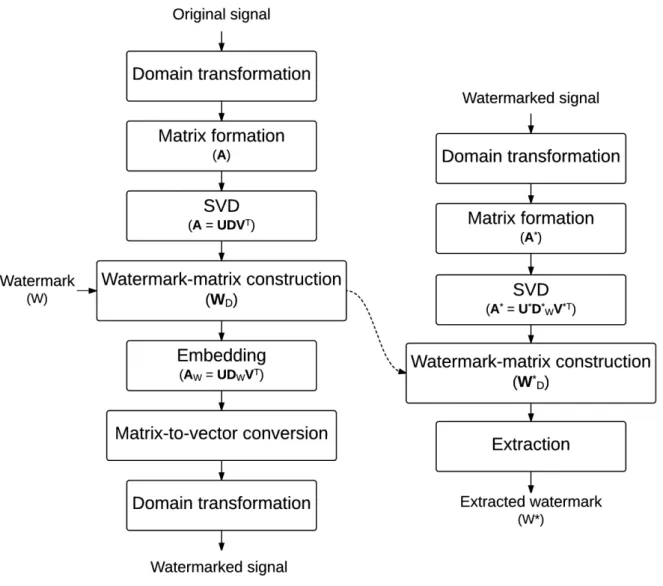
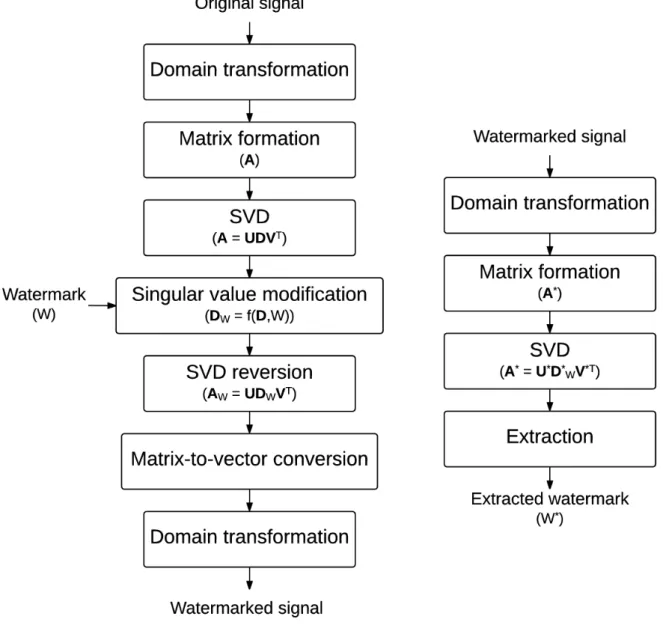
Based on our survey and analysis, the published SVD-based audio watermarking meth- ods can be categorized into two frameworks: framework 1 [24,25,28,29,37] andframework 2 [18, 19, 23, 26, 27, 30–36, 38–43]. The embedding and extraction processes of these two frameworks are shown in Figs. 2.5 and 2.6, respectively. The key difference between them is the use of the side information from the embedding process in the extraction process.
In order to extract the watermark, the extraction process of the framework 1 uses some information which is an output from the watermark-matrix construction of the embedding
process, whereas that of the framework 2 does not use such information. Therefore, the methods based on the framework 1 are certainly non-blind. However, some of the methods based on the framework 2 are blind [19,23,26,27,38,82], and some are non-blind [18,30–36].
Framework 1
The left flowchart of Fig. 2.5 illustrates the embedding process. The audio signal repre- sented in a certain domain, such as time or frequency domain, is mapped to the matrixA.
Then, the matrix Ais decomposed by SVD: A=UDVT, where D is a diagonal matrix, and its diagonal members √
λi, called the singular values, are sorted in descending order.
The matrix D and the watermark W are used to construct the watermark matrix WD, i.e., WD=f1(D, W). For example, WD=k×W+D, where W is a binary image which is encrypted by a chaotic algorithm andk is a scale factor [28]. To determine the scale factor k, a search algorithm, such as the adaptive tabu search (ATS), might be adopted [29].
Then, SVD is performed to the watermark matrix WD: WD=UWDWVTW. To embed the watermark, the matrix D is replaced by the matrix WD. Thus, the watermarked matrix AW is the product of the matrices U, WD, and the transpose of the matrix V. Finally, the watermarked matrix AW is mapped to a one-dimensional signal, and then it is transformed to the signal in the time domain.
The extraction process is illustrated in Fig. 2.5 (right). The watermarked signal is firstly represented in the certain domain and mapped to the matrix A∗. Then, SVD is performed to the matrix A∗: A∗=U∗D∗WV∗T. The diagonal matrix D∗W along with the matrices UW and VW obtained from the embedding process are used to construct the watermark matrix W∗D, where W∗D =UWD∗WVTW. Finally, the watermark matrix W∗D and the matrix D are used to determine the extracted watermark W∗. Although the host signal does not directly present as an input of the extraction process, the matrixD, which contains some information of the host signal, is required. Therefore, the methods based on this framework are considered as non-blind.
Based on this framework, many methods develop differently in the domain trans- formation, matrix formation, and the watermark-matrix construction. For example, the short-time Fourier transform [25], discrete wavelet transform [40], or discrete cosine trans- form [28] might be adopted as the domain transformation. The analysis of matrix for-
Figure 2.6: Embedding and extraction processes of the SVD-based audio watermarking of the Framework 2.
mation is discussed in [83]. The watermark-matrix construction (the function f1) in the embedding process directly affects the extraction. For example, if WD=k×W+D, then the extracted watermark W∗ is W
∗ D−D
k [28, 29].
It should be noted that, even though the experimental results from the methods based on this framework are excellent in terms of robustness, the high bit-detection rates are possibly due to the false positive detection [24, 84, 85]. The false-positive rate raises because the matrices UW and VW, which contain most information of the watermark, are used to construct the watermark matrix W∗D, and our preliminary simulations have confirmed this effect.
Framework 2
The embedding process is shown in Fig. 2.6 (left). In contrast with the framework 1, this framework performs SVD only once in the embedding process, i.e, the SVD is performed to the matrix A, which represents the original signal in a certain domain: A=UDVT. Then, the watermark W is embedded by modification of the diagonal matrix D, i.e., DW =f2(D, W), where DW is the modified D. The function f2 is called the singular- value modification rule. The watermarked matrixAW is constructed by the SVD reversion where the diagonal matrix D is replaced with the matrix DW, i.e., AW = UDWVT. Finally. the matrix AW is conversed and transformed to the time-domain watermarked signal.
The extraction process is shown in the right flowchart of Fig. 2.6 (right). The wa- termarked signal is transformed and mapped to the matrix A∗. Then, the matrix A∗ is decomposed by SVD, and the diagonal matrix D∗W is obtained. The extracted water- markW∗ is decoded from the matrixD∗W with respect to the singular-value modification rule f2. The extraction process may require some information of the host signal as an input [18, 30–36], or it may not [23, 26, 27, 38, 82]. Thus, the methods based on this frame- work can be either blind or non-blind. For example, let us consider the modification rule of the methods [18, 30, 31].
Given a watermark bit w ∈ {0,1}, the first singular value √
λ1 of the matrix A is replaced with modified singular value √
λ1W=√
λ1×(1+α·w), where α is a scale factor called the watermark intensity. According to this rule, the extracted watermark bit w∗
is 1 if
√√λ1W
λ1 = 1 +α, and the w∗ is 0 if
√√λ1W
λ1 = 1. It can be seen clearly that, in order to extract the watermark bit, these methods require the first singular value √
λ1 of the matrix A, which represents the host signal. Note that different methods may modify other singular values. For example, some methods [18, 30, 31, 33, 35, 36] modify only the largest singular value. Other methods [23, 26, 27, 32, 38] modify all singular values, and there is a method [82] that modifies only some small singular values.
The quantization index modulation (QIM) can be applied to the singular-value mod- ification to make the methods to be blind [23, 26, 27].
Remarks
1. To avoid the false-positive-detection problem as happened to the framework 1, any information of the watermark should not be used in the extraction process.
2. All SVD-based audio watermarking methods have shown that the singular values are stable to some extent because the watermark encoded in the singular values is extractable after several signal processing attacks, as evidenced by the published results. Thus, the singular value is proved to be a potential candidate for hiding information. However, to the best of our knowledge, all SVD-based audio water- marking methods have treated an audio signal as a meaningless time-series, and they have yet to provide the insight or explanation of its effectiveness. The question of interpretation of the singular value has never been discussed and answered. More- over, all modification rules are uninformed, i.e., the nature of signals or the nature of signal perception have never been taken into account. The sole philosophy of all SVD-based methods so far seems to be that, if something changes very slightly, we hardly notice.
2.2 Singular-spectrum analysis
Singular-spectrum analysis (SSA) is a time-series analysis technique, which is useful for identifying and extracting oscillatory components from a signal [86]. Compared to other techniques for investigating time-series data, such as performing a Fourier transform or the principle component analysis, the SSA is much younger. It was proposed by Broom- head and King in 1986 [87] and has been widely used in various applications, such as
extraction of periodicities and finding structures in time series [88]. As evidenced by be- coming a standard tool in the analysis of climate, meteorological, and geophysical data, it has proved to be one of the successful techniques [86]. It is also popular for analyzing biomedical signals [89–91].
The SSA is a model-free algorithm in the sense that, during analyzing, statistical assumptions concerning the signal are not made, so that it can be applied to arbitrary signals including non-stationary ones [86]. There are many types of SSAs. The following subsection describes the basic SSA, on which our proposed scheme is based.
2.2.1 The basic SSA
The basic SSA consists of four steps: embedding, singular value decomposition (SVD), grouping, and diagonal averaging. The first two steps form the decomposition (or analysis) stage. The last two steps form the reconstruction (or synthesis) stage.
Embedding step
A signal F = [f0 f1 f2 ... fN−1]T of length N, where N >2, is mapped to the trajectory matrix X of size L×K.
X =
f0 f1 f2 · · · fK−1 f1 f2 f3 · · · fK f2 f3 f4 · · · fK+1
... ... ... . .. ... fL−1 fL fL+1 · · · fN−1
, (2.1)
whereK=N−L+1, and whereLis the only parameter of the basic SSA, called awindow length of matrix formation, and has a maximum value ofN. Forj = 0,1, ...,K−1, letxj, called a lagged vector, denote thejthcolumn of the matrixX, i.e.,xj = [fj fj+1 ... fj+L−1]T. Thus,X = [x0 x1 x2 ...xK−1]. Since the trajectory matrixX has equal elements on the minor diagonals (ascending skew-diagonals from left to right), it is a Hankel matrix.