Japan Advanced Institute of Science and Technology
JAIST Repository
https://dspace.jaist.ac.jp/
Title
有機金属構造体を用いた複合膜の調製と水処理への応
用
Author(s)
Trinh, Dai Xuan
CitationIssue Date
2017‑09
Type
Thesis or Dissertation
Text versionETD
URL
http://hdl.handle.net/10119/14836
RightsDescription
Supervisor:谷池 俊明, マテリアルサイエンス研究科
, 博士
氏 名 TRINH XUAN DAI 学 位 の 種 類
学 位 記 番 号 学 位 授 与 年 月 日
博士(マテリアルサイエンス)
博材第436号 平成29年9月22日
論 文 題 目
Metal-organic framework-based composite membrane and its application to water filtration
(有機金属構造体を用いた複合膜の調製と水処理への応用)
論 文 審 査 委 員 主査 谷池 俊明 北陸先端科学技術大学院大学 准教授 松見 紀佳 同 教授 長尾 祐樹 同 准教授 松村 和明 同 准教授 森永 隆志 鶴岡工業高等専門学校 准教授
論文の内容の要旨
The shortage of fresh water is pointed out as one of the biggest global problems. In order to address this problem, membrane-based water treatment technology is recognized as a leading technology because of its advantages such as superior water quality, the un-necessity of chemicals, small footprint, and so on. In this technology, membranes are hearts, which dominantly determine the cost and efficiency of the whole process. However, after the invention of cross-linked polyamide thin film composite membranes, the development of membranes seems to be saturated because of their inherent limitations such as membrane fouling, and a tradeoff between permeability and selectivity. Recently, materials bearing well-defined nanochannels such as carbon nanotubes, stacked graphene oxides, and aquaporins have attracted significant attention as next-generation membrane materials. The nanochannels of molecular dimensions offer exceptionally high water flux, which is not accounted by the classical Hagen-Poiseuille equation. In this light, metal-organic frameworks (MOFs) possess nanochanneled and highly porous structures with a diverse of tunable pore sizes and environment, and thus sound appealing to overcome the tradeoff of conventional membranes. There have been several pioneering works that employed MOFs for filtration membranes. These researches reported that the excellent permeability and selectivity of MOF-based membranes were achieved by crystallization of an MOF layer on top of support membranes, while these membranes were either inflexible (because of the crystalline nature) or unstable in water.
In order to overcome both the limitations of conventional membranes and the challenges of recent MOF-based membranes, in this dissertation, I have designed a new type of MOF-based composite membranes, in which a discontinuous selective layer was created by the deposition of water-stable MOF nanoparticles (UiO-66) on a flexible support membrane. Ultrahigh permeability of selective nanochannels in the MOF against slow permeation through interparticle voids among nanoparticles was behind this
design. The membrane design in this dissertation has been implemented in three steps as depicted in Fig. 1.
In Chapter 2, UiO-66 nanoparticles were deposited on a support membrane to develop the first flexible and stable MOF-based composite membranes for ultra/nano filtration. In Chapter 3, the fouling resistance of a composite membrane was enhanced by grafting a hydrophilic polymer from UiO-66 nanoparticles. In Chapter 4, interparticle voids among UiO-66 nanoparticles were filled by cross-linked polyamide and the membrane was applied to reverse osmosis (RO) desalination.
Fig. 1. MOF-based composite membranes designed in the dissertation
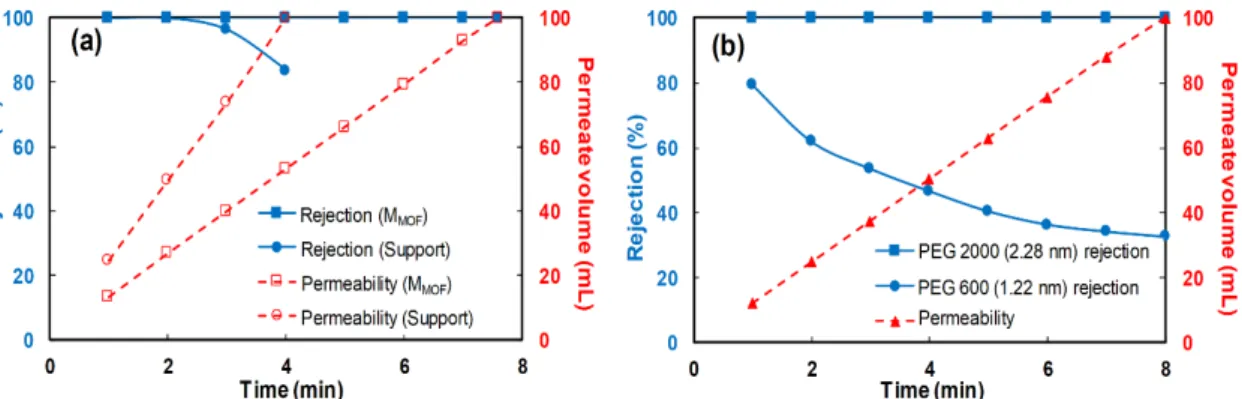
In Chapter 2, a novel composite membrane was fabricated by depositing UiO-66 nanoparticles into the porosity of a regenerated cellulose support membrane. The resulting membrane was applied to ultra/nano filtration for the rejection of methylene blue and polyethylene glycol from aqueous solutions. The membrane exhibited a perfect rejection while keeping an exceptionally high permeability (Fig. 2a), two to three orders of magnitudes higher than those of commercial ultra/nano filtration membranes. The origin of the permeability and rejection was attributed to the fluxes passing through intraparticle channels of UiO-66 with a size cut-off between 1.22 and 2.28 nm (Fig. 2b). The unique membrane structure and the stability of UiO-66 in water enabled consistent performance against bending and reuse.
Fig. 2. Filtration performance of a membrane filled by UiO-66 nanoparticles: (a) methylene blue filtration and (b) polyethylene glycol filtration
In Chapter 3, a strategy to enhance the fouling resistance of the membrane was proposed, in which
hydrophilic poly(ethylene glycol) methacrylate (PEGMA) was grafted from UiO-66 nanoparticles via atom transfer radical polymerization without destructing the structure of UiO-66. Then, the PEGMA-g-UiO-66 nanoparticles were deposited on a cellulose nitrate support membrane. The oil removal test from oil/water nanoemulsion revealed that the polymer modification improved the founling resistant of the MOF-based membranes. Moreover, the grafted PEGMA also benefitted in the improvement of the permeability and selectivity of the membranes.
In this way, Chapters 2 and 3 clarified the feasibility and promising performance of the new type of MOF-based membranes, which was based on the creation of a discontinuous selective layer by MOF nanoparticles. However, when the membranes are subjected to the removal of smaller solutes (i.e. salts), the applied pressurization causes the leakage from the interparticle voids among UiO-66 nanoparticles.
This challenge was finally addressed in Chapter 4, in which interfacial polymerization of cross-linked polyamide (PA) was utilized to fill the voids among the nanoparticles deposited on a polyethersulfone (PES) support membrane, thus forming a PA/UiO-66/PES membrane. The membranes were applied to salt rejection based on an RO process. The PA/UiO-66/PES membrane exhibited very good salt rejection, while the permeability was 200% higher than that of the PA/PES membrane with the same preparation condition (Fig. 3). This increment was explained by a contribution of ultrafast intraparticle channels of UiO-66 nanoparticles embedded in the PA layer.
Fig. 3. Filtration performance of PA/PES and PA/UiO-66/PES membranes
Chapter 5 describes the summary and general conclusions of the dissertation. The purpose of the thesis was accomplished by successful fabrication of new composite membranes based on the creation of a discontinuous selective layer by depositing water-stable MOF nanoparticles on a support membrane. I showed that such the membranes can exploit superior permeability and selectivity while keeping the flexibility and stability. Additional strategies were also proposed in order to improve the fouling resistance
of the membranes and to enable their application in the RO desalination. The former was based on the modification of MOF nanoparticles by hydrophilic polymer, and the latter based on filling the interparticle voids among MOF nanoparticles by cross-linked polyamide through interfacial polymerization. Thus, this dissertation has successfully uncovered the promising design and aspects of MOF-based next-generation membranes for a wide range of applications.
KEYWORDS: UiO-66; Metal-organic framework; nanofiltration; desalination; rejection mechanism
論文審査の結果の要旨
本論文は、有機金属構造体を用いた次世代濾過膜の開発に関する研究成果をまとめたものであ る。
人口増加や環境汚染、地球規模の気候変化に伴い、2025年には世界で18億人が水不足の問題 に直面すると予測される中、水処理技術の中核を成す濾過膜の開発は最重要である。現在工業的 に利用される濾過膜は、ロール・ツー・ロール方式で生産・運用可能な高分子膜であるが、運用 に伴う膜詰まり(ファウリング)や膜設計における透過性と除去率のトレードオフ(生産性の向 上が顕著な除去率の低下を伴う)が深刻な問題となっている。近年、カーボンナノチューブなど、
分子レベルのサイズを有し、かつ、ウェルディファインドな細孔中で水分子の流束が飛躍的に増 大するという理論的・実験的報告を受けて、これらの要請を満たすミクロ孔物質を用いた次世代 膜の開発に注目が集まっている。中でも有機金属構造体(MOF)は、精密濾過から逆浸透濾過 までを網羅可能な幅広い細孔径と種々の化学構造をライブラリとして揃えており有望視されて きた。しかし、温和な条件下での合成可能性と水に対しての安定性を兼ね備えたMOFが存在し ないことが問題となり、ロール・ツー・ロール方式に適用可能な柔軟性を備えた水浄化用MOF 膜はこれまで報告されていなかった。
本論文では、水に極めて安定なUiO-66ナノ粒子を担持体としての高分子膜の表面上ないしは 細孔中に充填し、非連続的な除去層を構築する新規法(従来法では高分子膜上にMOFの連続選 択層を合成)によって、柔軟性・安定性を兼ね備え、かつ、極めて優れた透過性(従来の高分子
膜の500-1000倍)と除去率を有するMOFコンポジット膜を開発することに成功した。さらに、
非多孔性の TiO2ナノ粒子を MOF の代替として用いた参照コンポジット膜や分子サイズの異な る溶質の濾過実験などを通して、合成した MOF コンポジット膜の優れた濾過性能が、MOF 細 孔中の水分子の選択的透過に起因する事実を突き止めた。続いて、原子移動ラジカル重合を用い て親水性のメタクリル酸誘導体高分子鎖をMOFナノ粒子表面上にグラフトさせ、これを用いた コンポジット膜がO/Wエマルジョンの濾過において透過性・除去率・ファウリング耐性を一様 に向上できる事実を見出した。さらには、加圧濾過時に問題となるナノ粒子間のボイドを架橋ポ リアミドで封止することによって、柔軟なMOFコンポジット膜が海水の逆浸透濾過にも応用可 能であることを示した。ポリアミド中に埋め込まれたMOFナノ粒子は、除去率はそのままに透
過性を最大で3倍に増大させた。
以上、本論文は、高い透過性・除去率・柔軟性・安定性を併せ持つMOFナノ粒子充コンポジ ット膜を初めて与え、有望な次世代膜としてのポテンシャルを幅広く開拓したという点で学術的 貢献は極めて大きい。よって博士(マテリアルサイエンス)の学位論文として十分価値あるもの と認めた。